I HAVE not the space here to show the antiquated methods and doctrines of geology, or how the whole system seems about to fall to pieces from very absurdity. The heading of this article calls for an account of some recent discoveries made in the south of France, and I must confine myself to this one point.
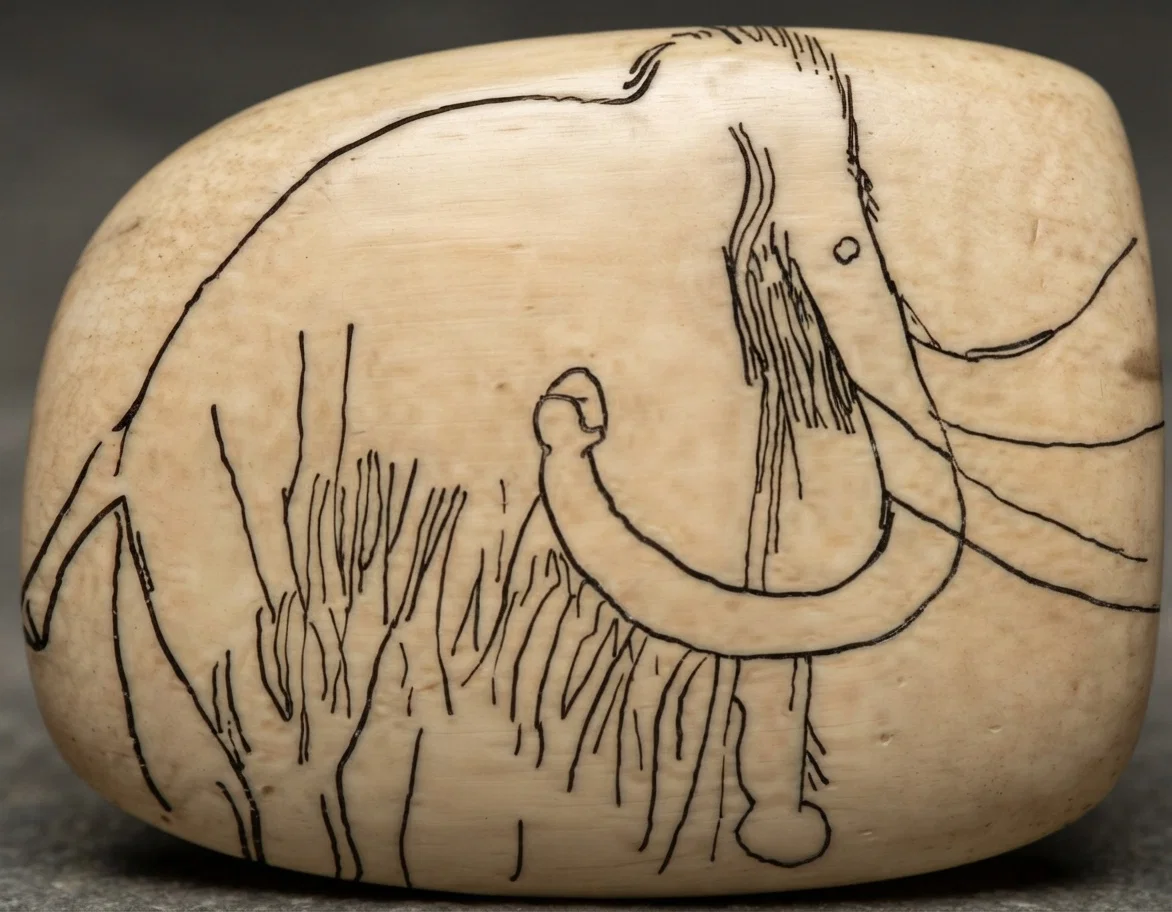
Dana, in his "Manual" (p. 1009), and also in some of his smaller works, gives an illustration showing the picture of a mammoth carved on a piece of ivory which was found in the La Madeline cave a great many years ago. Next they found pictures on the walls of some caves, and not only engraved, but painted. From the first it has been known that these ancient men were almost giants in stature, and even out-of-out evolutionists acknowledge that "their cranial capacity was above that of average Europeans of the present day."—Nature, March 7, 1901, p. 456. But the artistic character of these pictures has well astonished those who persisted in looking upon the men of the "mammoth age" as quite degraded savages.
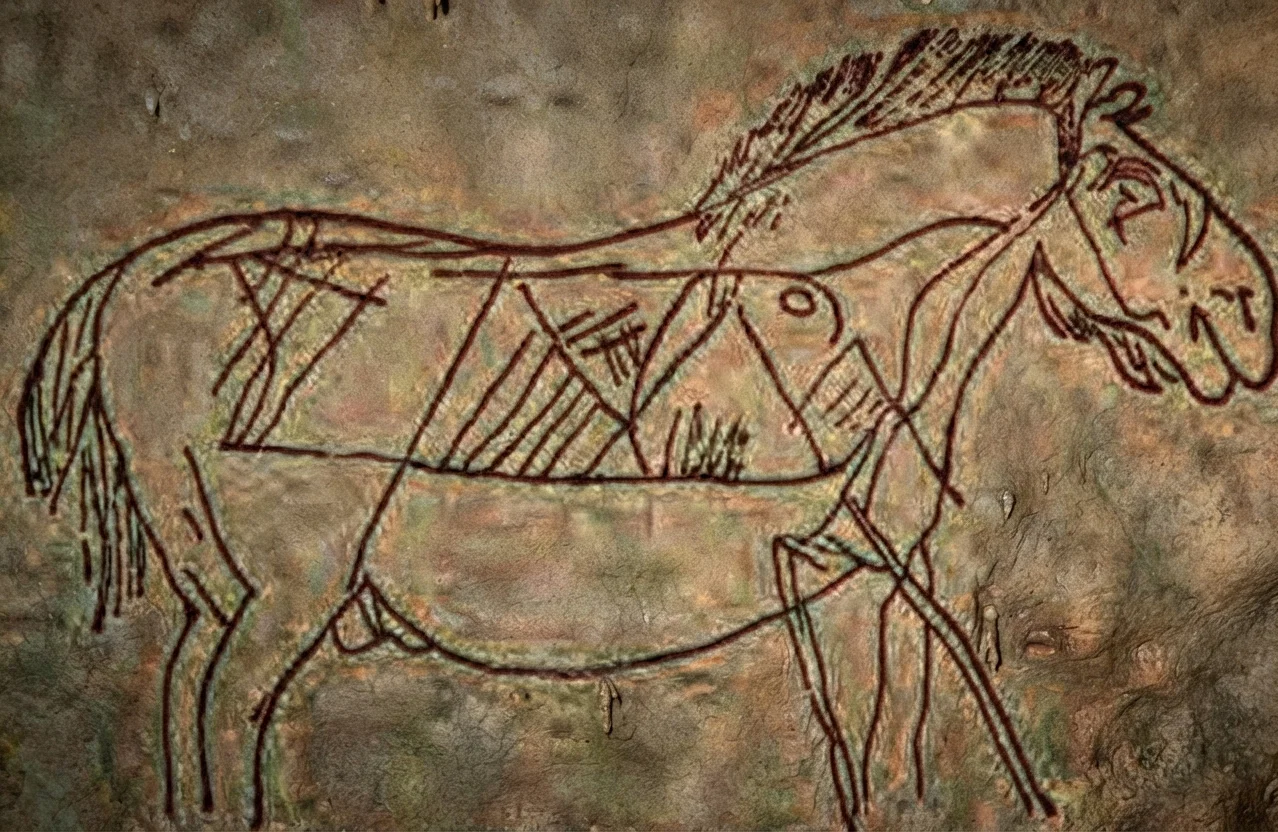
The latest of these discoveries was made about six months ago, and I shall quote from a description by the Marquis De Nadaillac, in Popular Science News, February, 1902, pp. 31, 32. The author describes the first cavern, that of Combarelles, near Tayac (Dordogne), as "a long trench measuring 230 metres in length, m. 1.50 in breadth, and from m. 0.30 to m. 3 in height. The first figures, easily identified, begin on both walls at m. 119 from the entrance of the cavern, and continue to its end. These figures vary considerably in size, while some measure one metre and more in height, others are no longer than m. 0.10. Often they crowd and overlap one another; some, especially at the end of the cavern, are shown of a bluish paint, and covered by a thick layer of stalactites.
A HORSE FROM THE CAVE OF COMBARELLES.
From a few lines about them in Nature, October 3, I learn that the figures in this cave that the lion and hyena, "altho of unusual size," and even the hippopotamus (H. major) lived in great numbers in England along with the mammoth, rhinoceros, and reindeer (See Dana's "Manual," p. 1,004). They have always insisted that the presence of this latter animal is proof that the climate was much colder than at present; but they have failed to show how these other animals could exist even in the present climate of England. The modern lion and hyena, which are admitted to be not only of the same type, but the very identical species that lived in Britain—"altho these modern kinds are dwarfs in comparison," as Dana says—are now found only in tropical or semitropical countries.
Elephas Primigenius-Mammoth.
Especially is this true of the hippopotamus, or "river-horse," which, as Professor Nicholson remarks, could not possibly live in a country where the streams froze over, even in the most severe winters. How, then, could these animals have lived in these northern countries—for England has about the same latitude as Labrador—when the larger part of the North Temperate Zone is said by the geologists to have been covered with glaciers all the year round? The thing is almost too absurd for discussion. No, we have abundant evidence, from the fossils as well as from the Bible, that in those antediluvian days a nearly uniform climate of spring-like loveliness spread over all the earth. It is quite reasonable to suppose that the reindeer has since become adapted by a wise Creator to the terrific frosts of the arctic regions. Or we may suppose that it was originally, like the modern chamois and ibex, adapted to the high mountains of that ancient world. Certainly, with semi-tropical animals and plants over the land, and tropical shell-fish in the seas, there is no room for their imaginary ice-sheets down to the sea-level in both Europe and America.
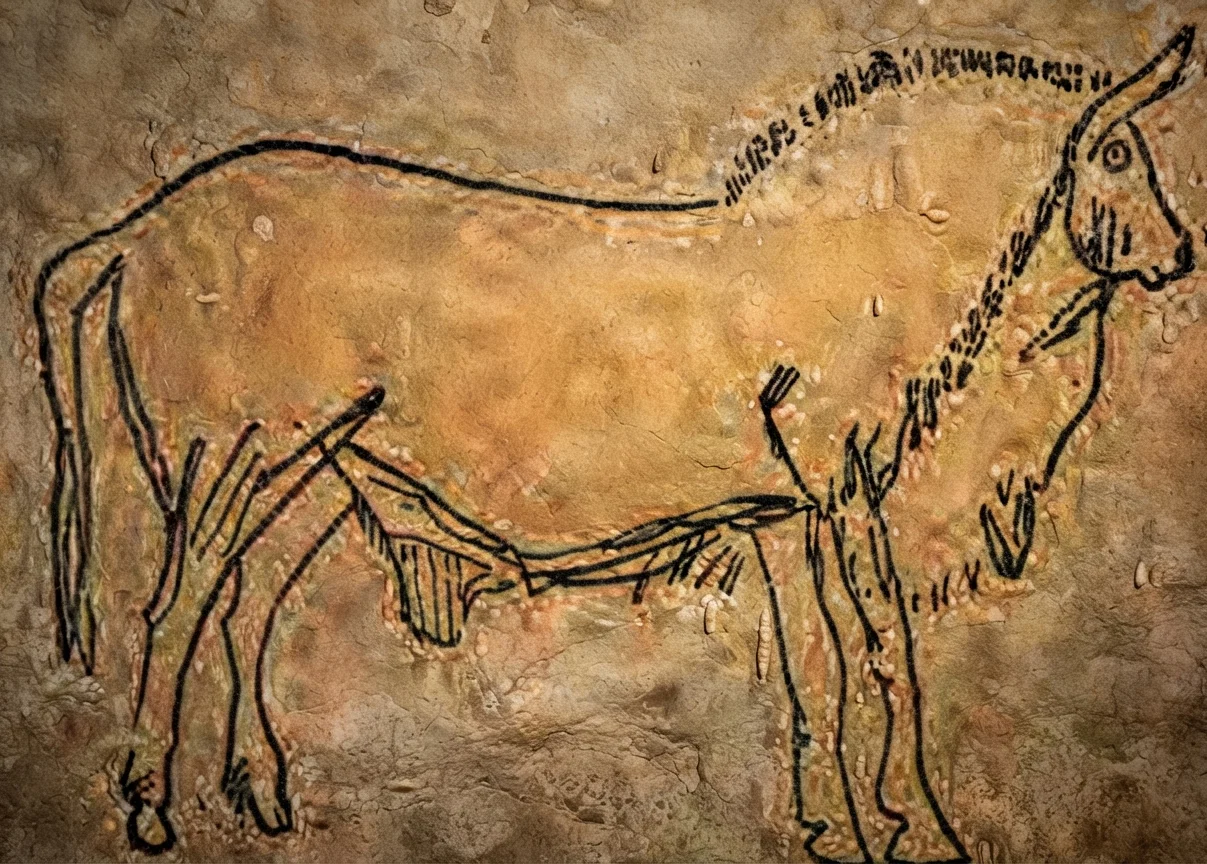
A Gnu,
The other cave described by this gentleman, is only about two miles from the former, and is much broader and higher—six to ten feet wide, and twenty to twenty-five feet high—tho not so long.
The first animal figurations begin at sixty-five metres from the opening; they are reached by a narrow passage between two walls of stalactite. Their character is different from all we have seen at Combarelles. The figures are represented by slight lines filled with black paint, and often the body and the legs of the animal are entirely covered with the same black paint.
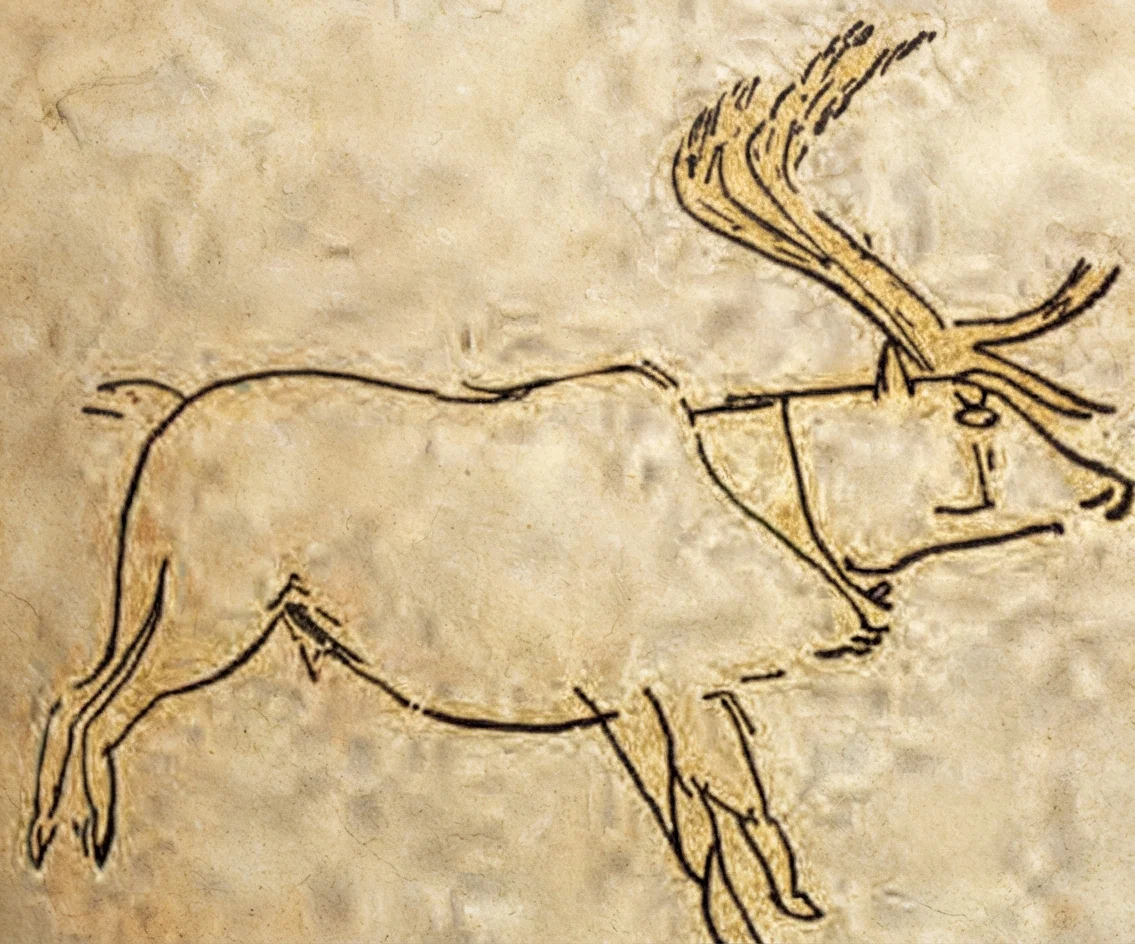
Some of these pictures are quite large. He mentions one of a reindeer "measuring m. 1.50," or nearly five feet, and says that the heads of some of them were "first painted in black, and then in red, obtaining a brownish color. On the others the hind parts were brown, and the heads black. Some are covered by stalactites measuring two inches in thickness."
There are seventy-seven figures in all on the walls of this cave, of which the majority are horned cattle and deer. There are four reindeer, but only three mammoths.
In conclusion he says of the pictures in these caves:5"In both cases we are justly astonished to find such artistic performances in times so distant from ours, and in which we did not suppose a like civilization."
I can only say a few words in conclusion. When the reindeer lived in the most southern part of "sunny France," the present home of the grape and the silkworm, and when at the same time lions, hyenas, elephants, rhinoceroses, and even the hippopotami, lived in England, and some of them even in northern Siberia, we know that the present extremes of climate were unknown. All talk about a "mammoth age" and a "reindeer age" succeeding one another, is absurd; for we not only find their bones together over great regions of country, but here on the walls of these caves their pictures are drawn true to life by the same artists, showing that man and these animals lived there together. But when in addition to all this we remember that geology and the Bible alike testify that these conditions were changed by some great aqueous catastrophe, and that at this same time similar events were taking place on all the other continents, we see that this out-of-date system of uniformitarian geology has been fooling us all these years by trying to cover up the evidence that "the world that then was, being overflowed with water, perished." 2 Peter 3:6.
GEO. E. McCREADY PRICE.
Tracadie, N. B.
A Reindeer. Copyrighted. Courtesy Popular Science News.
THE SANCTUARY.
By Alexander MacLaren
THE holy place, like the most holy, was screened off by a curtain, which we now pass into the outer courts. That was the place for the people, and contained two articles, both of which derived their significance from the one solemn fact that man is separated from God by sin. There was a laver "between the tent of meeting and the altar," and still farther outwards there was the altar of burnt-offering. With that altar all access to God began then in symbol, with what that altar shadowed all access to God in reality begins. It is not survival from an effete and rude ritual which proclaims that "without shedding of blood is no remission." The heart of the Gospel is that Christ's death makes access to the Holiest of all possible, and nothing else makes it possible. We must first betake ourselves to the altar of sacrifice, and then be cleansed in "the laver of regeneration," before we can lift the heavy curtain shutting us out from the place where a priestly people kindles its incense of praise, trims its lamp of holy living, and offers all its works to God. The removal of the guilt that puts a gulf between God and us, which none but He can bridge, and which can be removed only by the death that takes away the sin of the world, must be followed by the baptism in the Holy Ghost which cleanses from all filthiness of the flesh and spirit. Then the way into the holy place is open for us here and now, and in due time the worshipers there will pass into the holiest of all, and dwell forever in the light of the glory between the cherubim. The steps as from within outwards are three,—the ark of the testimony, the altar of incense, the altar of burnt-offering. God comes out and down to us by these. By the same must we go up and go in to Him.—Alexander MacLaren D.D., in S. S. Times.
THE SUNDAY.
By A. Smith
Is It a Growth of God's Planting? or Is It a Usurping Weed?
"Every plant, which My heavenly Father hath not planted, shall be rooted up." Matt. 15:13.
THE scribes and Pharisees had complained to Jesus that His disciples had transgressed the tradition of the elders by eating with unwashed hands, but Christ in turn charged them with transgressing the command of God by their traditions, and said concerning the people who followed such traditions, "In vain they do worship Me, teaching for doctrines the commandments of men." Verse 9. And immediately after, He said to His disciples, with reference to such traditions, "Every plant, which My heavenly Father hath not planted, shall be rooted up."
Judging from this reasoning, every tradition or commandment of men, which in its meaning or application renders of no effect any one or more of the commandments of God, is a plant not of the Father's setting, and it will most certainly be rooted up. Such a plant is the doctrine of the first-day sabbath. It is wholly based upon the traditions and commandments of men, thus making the commandment to sanctify the seventh day of no effect with a vast majority of the professed Christian people of the world.
In Matt. 15:9, 13, are recorded two of the "sayings" of Jesus, and in John 14:24 He says, "He that loveth Me not keepeth not My sayings; and the word which ye hear is not Mine, but the Father's which sent me."
Another saying of Jesus was, "Think not that I am come to destroy the law [of God], or the prophets; I am not come to destroy, but to fulfil [to keep, to obey]. For verily I say unto you, till heaven and earth pass, one jot or one tittle shall in no wise pass from the law, till all be fulfilled." Matt. 5:17, 18. Heaven and earth have not yet passed away, and therefore the Sabbath precept, as part of that law, has not been changed in a single point. The commandments and traditions of men can only mislead such as can be deceived by them; but those who love Jesus with a fervor deeper than a mere profession will show their love by respecting His sayings concerning God's law in a practical way, and will return to the observance of the Sabbath, which by the Father's will was planted in Eden for all mankind.
In the coming "harvest," or end of the world, the Sunday-sabbath weed will be rooted up and burned in the fire. If then our spiritual life be identified with the obnoxious growth, we shall share its destiny. How much better to ripen as the precious wheat, and be gathered into the heavenly garner. A. SMITH.
Grandville, Mich.
"EVERY WORD."
By Ellet Joseph Waggoner
"THE words of the Lord are pure words; as silver tried in a furnace of earth, purified seven times." Ps. 12:6. This is true not merely of a few words, but of all. "Every word of God is pure; He is a shield unto them that put their trust in Him." Prov. 30:6.
Moreover, there is enough in the words of God for every necessary purpose. They are sufficient to make a man "perfect, thoroughly furnished unto all good works." 2 Tim. 3:17. Not only is nothing more needed, but whatever is added to God's Word is a lie. "Add thou not unto His words, lest He reprove thee, and thou be found a liar." Prov. 30:7.
There is no trace of error or likeness to untruth in the words of the Lord. He is the truth; therefore His words are truth, for they are His life. "Thy Word is true from the beginning; and every one of thy righteous judgments endureth for ever." Ps. 119:160.
Unto us the Lord says: "Let your communication be Yea, yea; Nay, nay; for whatsoever is more than these cometh of evil." Matt. 5:37. Also, "If any man speak, let him speak as the oracles of God." 1 Peter 4:11. That is, the Lord wishes men to speak just as He does, but He will not have them equivocate. They must not say one thing and mean another. This is because there is nothing of that kind in the words of God. He is not double-minded nor double-tongued.
God is infinite; "there is no searching of His understanding." Isa. 40:28. Therefore His Word is of infinite depth. Eternity will not be long enough to enable the keenest intellect or the most diligent student to exhaust the meaning of any one of the words of the Lord. Thus it is that we can always return to the same Word, and find something fresh and new. It is a sun shining with never-fading light; a fountain whose waters never fail. Therefore the one who comes into close acquaintance with the Word of God never tires of it any more than he tires of the light of the sun, the fresh beauty of nature, or the sparkling flow of the mountain stream. E. J. WAGGONER.
THE BURNING OF THE BIBLE.
By T. De Witt Talmage
HERE is a perfect Bible. It seems that instead of destroying the Bible, the chapters have been driven in and clenched on the other side by the hammers of eternity. The fact is, that the Book, so far from being destroyed, is going on until the fires of the last day, and when the fires of the last day are kindled, they will not find the Bible a bundle of loose letters, but a compact Book; and when the fires begin to burn on one side, they will burn from Genesis toward Revelation; then the other fires will burn from Revelation toward Genesis, and they will in all their course not find one chapter or one verse out of place.
That will be the only time the world can afford to do without the Bible. What use, then, of Genesis, with its description of the making of the world, which is all destroyed? What use, then, of the prophecies? All are fulfilled. What use then, of the evangelistic and Pauline description of Jesus Christ when we see Him face to face? What use of the Book of Revelation, when we stand with our foot on the glassy sea, and our hand on the ringing harp, our forehead chapleted with eternal coronation amid the amethystine and twelve-gated glory of heaven, the emerald dashing its green against the beryl, the beryl dashing its blue against the sapphire, the sapphire throwing its light on the jacinth, the jacinth dashing its fire against the chrysoprasus, and we standing amid the chorus of ten thousand sunsets?—T. De Witt Talmage.
Christ in Both Testaments
"The Babe of Bethlehem is wrapt up as it were in the swathing bands of both Testaments. Christ is both the substance and object, the author and matter of the Scriptures."
HOW DO YOU LOOK UPON IT?
THERE are two ways of looking upon every difficulty which besets the child or the church of God. And the difficulties are legion, Satan will hedge us about with as many as he can. He will make what are not difficulties at all seem so, that he may discourage us.
God removes from our sight many difficulties that we know not of nor will we know till the leaves of the judgment books unroll. He permits others always for our good, difficulties often of our own making, often of others' making. But there is profit in every one of them for him or them called upon to meet them. It all depends upon the way we look at the matter.
If we with physical sight only look upon the obstacles in the way, the difficulties around us, we shall surely become discouraged. They will seem too much for human strength and wisdom, and we will yield the conflict.
So looked ten of the twelve spies Moses sent forth. Doubtless they were considered bright, clear-headed, able men. They were princes among the people. They had brought themselves near to the murmuring people, and possessed their confidence. (See Numbers 13: 14; Deut. 1: 22-25.) The spies passed through the land. They saw the goodly land, its fertility, its productiveness, just as God had promised; but looming above all these assurances, they saw the great and high-walled cities, and the gigantic men; and then they looked upon their own small stature, remembered the women and children and the way-worn host from Egypt, and were discouraged. And coming back, laden with fruit, to the murmuring, discouraged people, they presented their despairing, fatal report, which turned a multitude back into the wilderness, and buried a whole generation in desert graves.
There were two other men among the spies, strong, manly men, but perhaps no more so physically than their ten brethren. They saw what the ten saw,—the fruit, the beauty, the fertility, the great and walled cities, the mighty Nephilim, the giants of great stature. But they saw more. They saw in the fruit, in the goodly land, in the abounding vegetation and flowers, producing the "milk and honey," the word of God which had come to them in Egypt plain writ before their eyes. They saw, by the clear eyes of a luminous faith, angels of God accompanying them. They saw Israel's host of weary-journeyed men, women, and children marching into the land with songs of gladness, "thanksgiving and the voice of melody," surrounded by the shining host of God. Not with naked physical eye did they see this; but they saw it not the less clearly and definitely by the eye of faith. And so they reported: "Let us go up at once and possess it; for we are well able to overcome it." God was with them; and what were all obstacles and difficulties to Him? He would not fail, could not fail. If they would only go, He would lead them all the way.
There was in reality but one insurmountable obstacle, but one difficulty in the way: the unbelief of the people. And that is all that ever hindered a single soul. God will not compel men to believe in His infinite power. His fathomless wisdom, His undying love, and His exhaustless resources, all are pledged to the salvation and eternal triumph of humanity. But humanity must accept them. God invites us by His eternal goodness, but He will not coerce.
O hasten, put away the unbelief. Let faith see God leading all the way. Use the obstacle for a stepping-stone heavenward. Let the difficulty bring you nearer to God. In Him is victory.
"Weak as you are, you shall not faint,
Or, fainting, shall not die;
Jesus the strength of every saint,
Will aid you from on high.
Tho now unseen by earthly sense,
Faith sees Him always near;
A guide, a glory, a defense,
What, then, have we to fear?"
WHOSE LAW SHALL WE HONOR?
IN its issue of July 1, the Christian Life publishes as its leading editorial the old Pennsylvania law of April 22, 1794, against "Sabbath desecration;" that is, against performing on that day any act recognized as legal and permissible on other days. The editor states that his purpose in publishing this is to show men that by working or indulging in sports on Sunday they are breaking the laws of man as well as the law of God, and that by "keeping open on this day" they "are sinning against God and man."
Now there is no doubt that in working or playing on Sunday in the State of Pennsylvania a person is breaking the law of man; but that such person is, at the same time, breaking the law of God is not so evident. It certainly does not appear in the old law which that journal quotes from the civil code of Pennsylvania. However, there is a law against Sabbath desecration, in the breaking of which there is sin against God. It is not on the statute books of Pennsylvania or any other State. It goes back to a date considerably beyond 1794. Would it not have been better for the editor of the Christian Life to have quoted this law in reference to Sabbath desecration, especially in view of the fact that this law was given by Him who was the Author of the Sabbath, and especially also in view of the fact that Christ (who only can give Christian life) Himself has declared that this law shall never fail or be abrogated in the least particular as long as heaven and earth shall remain? We believe that it would have been more appropriate for a Christian journal to quote a Christian law, than to ignore such a law and publish to its Christian readers a law of the State against the desecration of a professedly Christian institution. The reader has a right to ask, Why is not God's law published in reference to Sabbath desecration? Christ has declared that that law is perpetual. Why is it not given?
The only possible answer is that the church of today finds itself keeping as the Sabbath a day to which God's law does not and never can apply, a day which God has never blessed or hallowed as a Sabbath, and a day concerning whose keeping there is no law but the law of man. The law of the State, or the human, is the only law that can be quoted in reference to the keeping of Sunday. But this can not be said of that day which has been and is ever more to be the Sabbath of Jehovah, the seventh day of the week. That needs no recognition or support from the State, for behind it is all the power and authority of the Creator of the heavens and the earth. His law declares: "The seventh day is the Sabbath of the Lord thy God. In it thou shalt not do any work." And far from its being a sin against God to labor on the first day of the week, Sunday, the one who does so, and rests and worships upon the day He rested, is in that "walking as He walked." We are not indebted to nor dependent upon the State or the church for a Sabbath law; neither are we sinning against God or man in working upon the day which God and Christ dedicated to labor by the very example which they set. We are, however, sinning against God in desecrating the Sabbath which He instituted, and which He commanded should be kept holy. See Ex. 20:8-11, Matt. 5:18, and Luke 17:16, 17. There can be no mistaking the Lord's intention in the matter. It is better to stand on the Lord's side alone, than to be found fighting against Him, tho all the world and all its laws are with us. S.
The Death Penalty for Sabbath-breaking
By G.
THE SABBATH. No. 11.
The Death Penalty for Sabbath-breaking.
THE enemies of the Lord's Sabbath think they have made a strong point against the observance of the seventh day when they cite the death penalty for its desecration. In Ex. 31:15 we read the Lord's command to Moses, "Whosoever doeth any work in the Sabbath day, he shall surely be put to death." To assume that Sabbath observance demands the summary execution of transgressors, by the judgment and at the hands of fallible men, is simply an effort to dodge the obligation to obey the Sabbath commandment. Sabbath-breaking is a transgression of the law of God, and therefore it is sin; "for sin is the transgression of the law." 1 John 3:4. And "the wages of sin is death." Rom. 6:23. Therefore, the penalty for Sabbath-breaking is death; but "because judgment against an evil work is not executed speedily, therefore the heart of the sons of men is fully set in them to do evil." Eccl. 8:11.
But who has the right to execute the death penalty for sin? The Father has "committed all judgment to the Son" (John 5:22, 27), and He will execute judgment at His second advent. Jude 14, 15. And the Son expressly enjoins us not to judge any one. "Judge not, that ye be not judged. For with what judgment ye judge, ye shall be judged; and with what measure ye mete, it shall be measured to you again." Matt. 7:1, 2.
Under the theocratic government of Israel God Himself was the ruler. He gave not only the moral law but the laws for temporal government. He had the right to order the summary punishment of sin, or to grant a stay of execution, according to the wisdom of His own good judgment. The only case on record in which the penalty of death for Sabbath-breaking was immediately executed may be taken as a sample. The incident is thus stated:—
"And while the children of Israel were in the wilderness, they found a man that gathered sticks upon the Sabbath day. And they that found him gathering sticks brought him unto Moses and Aaron, and unto all the congregation. And they put him in7ward, because it was not declared what should be done to him. And the Lord said unto Moses, The man shall be surely put to death; all the congregation shall stone him with stones without the camp. And all the congregation brought him without the camp, and stoned him with stones, and he died; as the Lord commanded Moses." Num. 15:32-36.
It is noticeable here that Moses did not take it upon himself to put the man to death; and when the Lord ordered the execution, He did not designate any one individual to do it, but required all the congregation to participate. The man's offense was evidently an aggravated, presumptuous act, of which the Lord thought best to make a notable example, and it was no doubt a salutary one. But men having rejected the theocracy, and chosen rather to be governed by men, the Lord permitted men to govern in secular affairs, and to punish infringement of the rights of men; but He did not delegate the right to punish infractions of the first table of the law—the first four commandments, which pertain only to offenses against God.
When the Son of God dwelt among men as a man, He kept the Sabbath day as it should be observed. There were many in His day who violated all of those four commandments, but there is no record of their being put to death. Roman law would not permit the execution of the death penalty for such offenses, and God did not interfere to have it done. In His own time He will attend to that. "He hath appointed a day, in the which He will judge the world in righteousness by that man whom He hath ordained." Acts 17:31. The Jews, in a fit of desperation, did take the law in their own hands and put to death, Stephen, on a false charge of blasphemy. But all such proceedings were simply the outbreak of lawlessness, as also was the arrest and condemnation of Jesus.
One case, however, illustrates the Saviour's idea of men's taking the death penalty for sin in their own hands. Under the Mosaic law (given by the Lord), adultery was to be punished with death. So the scribes and Pharisees, desiring to tempt Jesus, brought to Him a woman taken in adultery. The case was a flagrant one, and there was no doubt of her guilt. Her accusers therefore had a very good test case, as they supposed, with which to tempt Jesus, and they put the question straight: "Moses in the law commanded us, that such should be stoned; but what sayest Thou?" Jesus said nothing against the law, nor did He say that it had been repealed. In fact He indorsed it as being yet in full force, and gave permission for the execution. But He added a qualification that disqualified them as executors: "He that is without sin among you, let him first cast a stone at her." And they "being convicted by their own conscience," went away and left the woman with Jesus.
Nor did Jesus Himself condemn the woman. Shall we say, then, that He condoned the sin of adultery?—Not at all; for He had given adultery a much finer definition than men had before attached to it, besides declaring that He had not come to destroy the law. See Matt. 5:17, 18, 27, 28. The position of Jesus at that time is made clear by His declaration that "the Son of Man is not come to destroy men's lives, but to save them." Luke 9:56. "The Son of Man is come to seek and to save that which is lost." Ch. 19:10. He had come to save the adulterers and the Sabbath-breakers and the sinners of every class, and not to condemn them. He is long-suffering toward all classes, "not willing that any should perish, but that all should come to repentance." 2 Peter 3:9. And such is the mission and the spirit of all true disciples of Christ. Death is verily the penalty for sin, but the bearers of the Gospel of peace are not executioners. Even the Lord Himself will not execute vengeance on the ungodly until He leaves the mediatorial throne.
The reason that Sabbath-breakers and all other sinners are not put to death summarily is because the love and grace and mercy of God are still held out as an olive branch of peace. "God so loved the world, that He gave His only-begotten Son, that whosoever believeth in Him should not perish, but have everlasting life." John 3:16. "God was in Christ, reconciling the world unto Himself, not imputing their trespasses unto them; and had committed unto us the Word of reconciliation. Now then we are ambassadors for Christ, as the God did beseech you by us, we pray you in Christ's stead, be ye reconciled to God." 2 Cor. 5:19, 20.
"The great day of the Lord is near, it is near, and hasteth greatly; even the Voice of the day of the Lord; the mighty man shall cry there bitterly. That day is a day of wrath, a day of trouble and distress, a day of wasteness and desolation," etc. Zeph. 1:14, 15. In that day the Lord will execute the death penalty upon the Sabbath-breakers, and all other classes of law-breakers who have rejected His overtures of mercy. 2 Thess. 1:7-10; 2 Peter 3:9, 10; Jude 14, 15. G.
WHEN HE COMES.
God does not do anything arbitrarily. He but acts out the principles of the infinite goodness of His character. He will not force His presence into one heart closed against Him. He will stand at the door and knock, but He will not force admittance. The soul must welcome the Divine Guest.
He did not come to the Jewish nation at His first advent till they professed outwardly to be His people. When they claimed to be His own, surely He had a right to enter. But "He came to His own and they that were His own received Him not." They did not know Him, and therefore claimed that He was not Himself, even as they professed that they were what they were not. The result of the hypocrisy and deception was the utter ruin of the nation.
When Christ comes the second time the whole world will be in the same condition. The wickedly fallacious idea of "national Christianity," of "Christian nations," is taking possession of the world. It is pressed upon the public, and upon rulers, and law-makers everywhere. As vital, individual godliness has diminished, formalism has increased. As true possession has been wanting, false profession has become clamorous for recognition. Its voice is heard in municipal, in county, in State, in national, in international chambers. Insistently and persistently it demands not only hearing, but recognition in law. It uses religious superstition, ecclesiastical anathema, political taboo, and commercial boycott to carry its schemes. It points to great wealth, to progress in uncertain science, to military progress and prowess, as evidences of the superior value of Christianity, while the essentials of Christianity, humility and obedient faith, it knows not.
The result will be a world-wide profession of religion, a formal acceptance of Christianity, an outward acknowledgment that He alone is King, and that the earth in general and particular is His. Nothing more will be required. The men that warn against hypocrisy, which show the hopelessness of dead formalism, the wickedness of false assumption, will be accounted enemies to the "Christian State," and in Christ's name proscribed and punished.
Then Christ will come. In the strictest justice they could not say Him nay. They profess to be His own; they should be willing to receive Him. But O the fearful result! He comes in the resplendent and overpowering glory of His own righteous character. There is not one ray of dazzling, burning glory emanating from His presence which does not belong there. He has not fixed Himself up to destroy the wicked. He only comes as is fitting to the monarch about to receive His own. But before that awful Presence die all those who profess to be His, but know Him not. They will be destroyed by the spirit of His mouth, and consumed by the forthshining of His presence. He has taken them at their word, a word false in heart and utterance; and before the True it perishes.
O soul, let Christ reign in the heart now; then you will welcome Him when He comes.