We have shown that all intelligent creatures have been given the power of choice, and are granted a probationary period in which to develop character. And we have shown that any one or all of them had the power to sin, and that some have sinned. We wish now to inquire, What is the relation of these probationers to life? What life was given to them? Was it a temporary and conditional one, or was it an immortal and unconditional one?
Since God is seeking to bring about a state of perfect harmony, and since a sinner with an immortal life would be an element of discord to all eternity, and since in receiving the power of choice each creature is placed where it is possible for him to become a sinner, therefore it is evident that it would be wisdom on the part of God to give them only a conditional life, that is, to make the continuance of their existence dependent on the choices they make, or the characters they develop. Otherwise, a wrong choice on the part of any one of them would forever defeat God’s plan for harmony. In view of this fact, we must conclude that no probationer has immortality.
In keeping with this idea, we find that when Adam was placed on probation the conditions named were, “Thou shalt not eat of it; for in the day that thou eatest thereof thou shalt surely die;” i. e., obey and live; disobey and die. Thus his life was to run parallel with his obedience. (This is leaving out of the consideration the plan of salvation, which, as we shall presently see, grants to every sinner a protracted probation.)
The Scriptures abundantly teach that man does not possess immortality. In Rom. 1:23 man is classed with fourfooted beasts, and creeping things, and declared to be corruptible, or mortal, and is placed in contrast with God, who is said to be incorruptible, or immortal. In this mortal state we are to seek immortality, by patient continuance in well-doing. Rom. 2:7. And there have been those among every generation of the sons of Adam who have thus sought for immortality, and have found eternal life in Christ Jesus, and have fallen asleep in him, and are resting in the dust of the earth, awaiting the last day, to be called forth by the voice of the Son of God. “For the Lord himself shall descend from heaven with a shout, with the voice of the Archangel, and with the trump of God; and the dead in Christ shall rise first. Then we which are alive and remain shall be caught up together with them in the clouds, to meet the Lord in the air; and so shall we ever be with the Lord.” 1 Thess. 4:16, 17. But before being thus caught up, both the living and the dead receive immortality. “Behold, I show you a mystery: We shall not all sleep, but we shall all be changed, in a moment, in the twinkling of an eye, at the last trump; for the trumpet shall sound, and the dead shall be raised incorruptible, and we shall be changed. For this corruptible must put on incorruption, and this mortal must put on immortality. So when this corruptible shall have put on incorruption, and this mortal shall have put on immortality, then shall be brought to pass the saying that is written, Death is swallowed up in victory. O death, where is thy sting? O grave, where is thy victory?” Then the faithful of earth will receive the gift of immortality at the coming of Christ in the clouds of heaven.
In Rev. 22:11, 12 we read: “He that is unjust, let him be unjust still; and he which is filthy, let him be filthy still; and he that is righteous, let him be righteous still; and he that is holy, let him be holy still. And, behold, I come quickly; and My reward is with Me, to give every man according as his work shall be.” We learn from this text that just before Christ comes there goes forth a decree which forever fixes the character of every individual. Beyond that point of time no one can change his choice. Each one's destiny is sealed, each one's fate determined. This brings us to the time of rewards and punishments, and probationary time is forever passed away.
Thus we have found that both wicked men and fallen angels are reserved until after the close of probation to receive their punishment for sin, and that in the second death to both will be meted out the final result of their choice. We have also found that those of the human family who have developed right characters are reserved to receive the gift of immortality at the second coming of Christ. May we not then reasonably conclude that the loyal angels are also awaiting the same time to receive the same gift. Thus we have before us the idea of one common probationary period for the entire universe, and at its close one common period of rewards and punishments. To that time the eyes of all are turned. At that time the unfaithful everywhere who have developed wrong characters, and by so doing have become irreconcilable elements of discord, after receiving a just punishment for past acts of disobedience, will then be given the fullness of their choice (eternal death), and forever pass out of existence, while the righteous, receiving the gift of immortality, enter upon a life coequal with the life of God. “The world6passeth away, and the lust thereof; but he that doeth the will of God abideth forever.” 1 John 2:17.
With this idea we can accept without qualification the statement that God only hath immortality, and thus during the probationary period all created beings are possessed of only a conditional life, the continued existence of each one depending upon his developing a character in accord with the character of God.
This plan when carried out will insure harmony to all eternity, for when all have developed right characters, it will be as impossible for any one of them to sin as it is for God to lie. To sin would be to violate the law of their being, to do contrary to their natures. To insure this result, however, sin must be dealt with in every one with great exactitude and without partiality. For in no other way could we be assured that eternity would differ from time as regards sin, for should God pass by or excuse a single sin in one person in the line of that individual's especial weakness, he, being no respecter of persons, would be compelled to grant the same favor to every one, and thus every conceivable sin would slip through; and thus the future state would be a sinful one, like the present. No, we are glad that God can not look upon sin with the least degree of allowance, and that perfect accord with his righteous character is the one condition upon which admission to the immortal state can or will be granted. Yes, for every wrong thought retained, for every idle word spoken, for every evil deed performed, each one will be called to account by his Maker. Only the overcomer “shall eat of the tree of life,” “shall not be hurt of the second death,” “shall be a pillar in the temple of my God, and shall go no more out.”
“The Son of man shall send forth his angels, and they shall gather out of his kingdom all things that offend, and them which do iniquity; and shall cast them into a furnace of fire; there shall be wailing and gnashing of teeth. Then shall the righteous shine forth as the sun in the kingdom of their Father.” Matt. 13:41-43.
A SOLDIER is held responsible for the condition of his gun. It must be kept bright and ready for use. The engineer must see that his locomotive is polished and oiled and in such repair as to make the best possible speed. So the Lord has intrusted your body, your mind, your soul, to your keeping. He holds you responsible; he wants you to be ever ready for service and to make the best time and the best record possible. Every man must look after himself and make the most of himself.
The Lord Taketh Pleasure in Them That Fear Him
“The Lord taketh pleasure in them that fear him, in those that hope in his mercy.” Ps. 147:11.
The truth of my God is my shield and my buckler;
Under the wings of Jehovah I hide;
My city of refuge is Jesus, my Saviour;
Trusting in him I shall safely abide.
The Chief of ten thousand is Christ, my Redeemer;
His word breathes the love which his heart holds in store.
In trouble I trust him my soul to deliver;
His goodness I praise, and his name I adore.
His breath like the zephyrs of spring to my nature,
Both fills me with life and with raptures of love.
He was tempted by Satan as I have been tempted;
He conquered and dwells with his Father above.
'Tis best for the weakest to trust in the strongest,
To obey him and serve him, then all will be well.
Though trials may thicken on life's dreary pathway,
They soon will be ended; with Christ I shall dwell.
My earthly possessions may vanish like shadows;
The friends of my table their faces may hide,
But angels of God shall come to my dwelling,
And Christ is one Friend who will constant abide.
New Zealand.
“AFTER THAT THOU SHALT CUT IT DOWN.”
By Ellen G. White
BY MRS. E. G. WHITE.
Christ spoke a parable to convey to the people a truth which would ever be remembered. He said: “A certain man had a fig tree planted in his vineyard; and he came and sought fruit thereon, and found none. Then said he unto the dresser of his vineyard, Behold, these three years I come seeking fruit on this fig tree, and find none; cut it down; why cumbereth it the ground? And he answering said unto him, Lord, let it alone this year also, till I shall dig about it, and dung it; and if it bear fruit, well; and if not, then after that thou shalt cut it down.” For three years Christ had carefully sought for fruit among the Jewish people. Rich opportunities and privileges had been granted them. For three years and a half Christ had tabernacled among men. “The Word was made flesh, and dwelt [tabernacled] among us (and we beheld his glory, the glory as of the only begotten of the Father), full of grace and truth.” He was as the shadow of a great rock in a desert land, where no water is. He constantly refreshed humanity by opening to men the cool streams of the brook flowing from Lebanon. He was ever seeking to refresh his vineyard. He sought to leave his imprint upon the hearts and characters of his followers. He identified his interest with that of fallen humanity. Their weakness was his weakness. Their necessity was his necessity. As a humble suppliant who sought divine strength from the hand of his Father, he took the attitude of petitioner, that he himself might be invigorated and refreshed by converse with God.
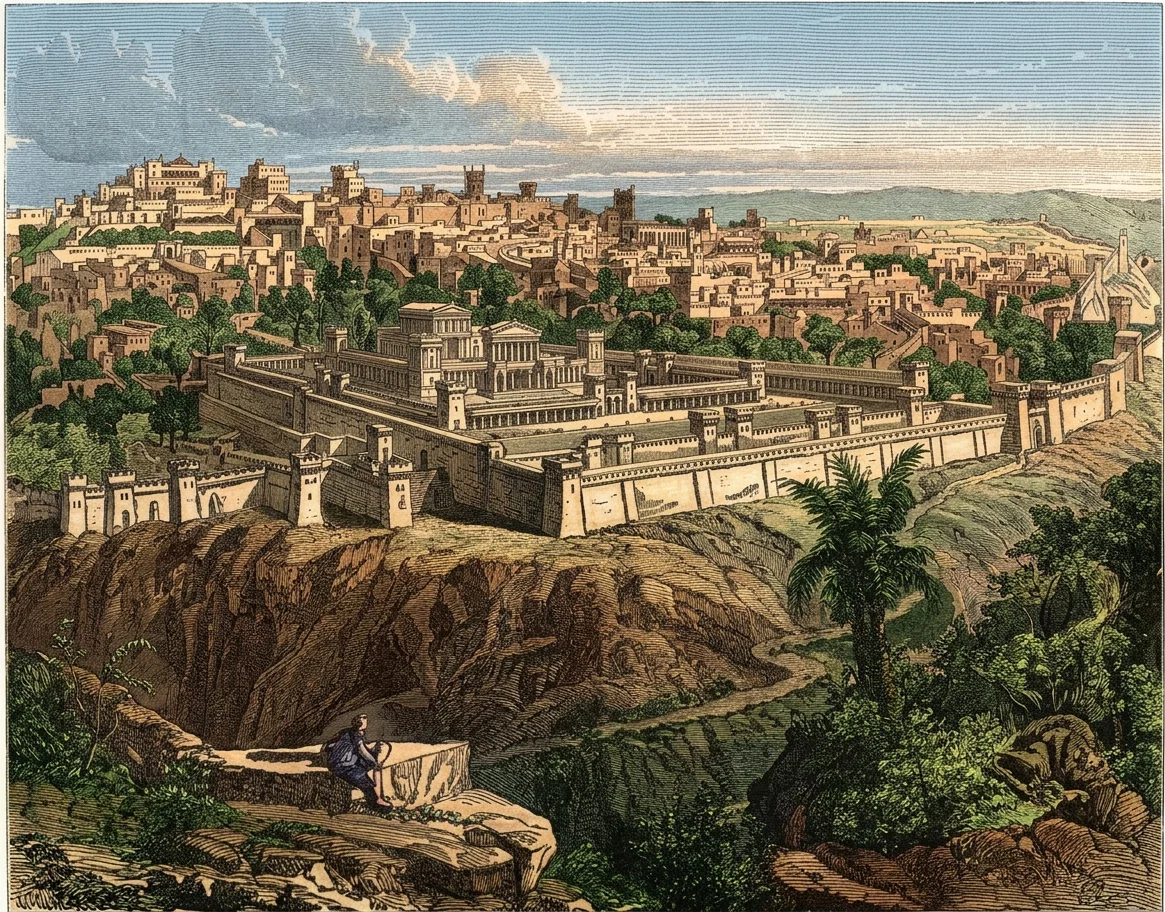
JERUSALEM.
Christ took upon himself human nature, but daily he linked it with the divine nature. He devoted whole nights to prayer, leaving an example for all humanity; for as he relied upon God, the Source of all strength, so are we to be invigorated and refreshed, to be strengthened for duty and braced for trial, through communion with God.
Christ labored for his vineyard. The Prince of heaven, he was yet the intercessor for man, and he had power with God, and prevailed for himself and for his people. Morning by morning he communicated with his Father in heaven, receiving from him daily a fresh baptism of the Holy Spirit. The Lord awakened him from his slumbers in the early hours of the new day, that his soul and his lips might be anointed with grace which he should impart to others. His words were given him fresh from the heavenly courts, words that he might speak in season to those that were weary and oppressed. Of Christ we read, “The Lord God hath given me the tongue of the learned, that I should know to speak a word in season to him that is weary; he wakeneth morning by morning, he wakeneth mine ear to hear as the learned.”
The Son of God, having humanity upon him, lived in our world as a human agent. He passed over the ground which man must travel. He supplicated for suffering humanity till his humanity was charged with a heavenly current that should connect humanity with divinity. He uttered supplications for a people over whom the prince of darkness was striving for mastery. He healed the sick, relieved the suffering and oppressed, consoled the bereaved, and restored the backslider, seeking and saving that which was lost. Christ worked for his vineyard, speaking words in season. But what an ominous sentence is this—“And if it bear fruit, well; and if not, then after that thou shalt cut it down”! Our Saviour was calling the Jewish nation to repentance. To them he said, “Except ye repent, ye shall all likewise727perish.” In the parable of the vineyard Christ represented to them the manner in which God had dealt with them. He showed them the blessings that God had given them; for the vineyard was a symbol of the Jewish nation.
Well might the Jewish nation inquire, “What mean these words, And after that thou shalt cut it down.” They might have been answered, “O inhabitants of Jerusalem, this is your day of opportunity and privilege, your day of merciful visitation.” It was still time for them to know the things which belonged unto their peace. Jesus was in the midst of them, the only one who had power to save them; but their unbelief, their resistance, was bringing to them its sure results of hardness of heart and impenitence, and was filling them with stubbornness and rebellion. Jesus was diffusing light, scattering his blessings upon every hand, showering mercies upon the unthankful and the evil. His mercies were unacknowledged, and Jesus, the Light, the Way, and the Truth, was rejected. Still a brief space was theirs before the irrevocable words should be spoken. Shall the season of trial close, and after that the mandate from heaven be pronounced, “Cut it down; why cumbereth it the ground?” They had fulfilled the word, “They would none of My counsel; they despised all My reproof.” They had none to blame but themselves if they perished in their sins. Jesus had said to them, “Ye will not come unto me, that ye might have life.”
The Lord had often punished the enemies of the Jewish nation, and had saved his people when their foes purposed to destroy them. As a mighty warrior he had raised his hand to press back the powers of darkness, working in behalf of his people in order that the Jews and that other nations might have an opportunity to see the character of God as represented in Christ Jesus. He gave them an opportunity to repent and to believe on the only-begotten Son of God. And “as many as received him, to them gave he power to become the sons of God, even to them that believe on his name.” He bore long with the Jewish nation, even when they were given up to idolatry. He saw them not as fruit-bearing trees, but as cumberers of the ground. These were not merely useless, but decided hindrances. Their religion was misleading, and wrought ruin instead of salvation.
But the great Teacher had undertaken the task of correcting the evil that existed in the world. He sought to break the spell which paralyzed every spiritual energy. With what authority he spoke, with what winning grace he gave his invitations, his assurances, and promises! His commands and denunciations were alike clothed in language that was elevating and uplifting. His utterances were the expression of paternal tenderness and love. In no instance did he lower the standard of the law of God. He came to show the world its value, its elevated character. He was the Desire of nations, the world’s only hope, and was obedient to all the commandments of God, thus showing forth the divine character. He came to test the Jewish nation, to try them after the plan of God. If they persisted in continuing in transgression, they would miserably perish. This will be the fate of all who turn a deaf ear to the words of invitation and warning sent of God. Those who refuse to listen in this their day of test and trial, will have to meet the results of their own perversity. They may grasp eagerly for the treasures of the earth, seek its honors and pleasures, but what a scene will the judgment present when the books are opened, and every man is rewarded according as his works have been!
The soul’s value is estimated by the cross of Calvary. The Lord appreciates the souls for whom he died, and wants them to be the subjects of his kingdom; but the god of this world blinds the perceptive powers of men so that they do not see their peril. To them Christ is saying, “If thou hadst known, even thou, at least in this thy day, the things which belong unto thy peace!” He is still pleading that they may understand the day of their visitation, saying, as did the gardener concerning the unfruitful tree, “Let it alone this year also, till I shall dig about it, and dung it; and if it bear fruit, well; and if not, then after that thou shalt cut it down.”
Do the Duty Nearest Thee
“Do THE duty nearest thee. Thy second duty will already have become clearer.”
DO YOU DISCERN THEIR SPECIAL SIGNIFICANCE?
By D. T. Bourdeau
BY D. T. BOURDEAU.
The special significance of what? you will ask. Why, of such occurrences of our times as droughts, terrific, destructive floods, conflagrations, tidal waves, earthquakes, and cyclones, the recent going down of the temperature fifteen to twenty degrees below zero in portions of the United States where it seldom freezes, causing the destruction of millions of dollars’ worth of oranges, orange groves, etc., and then the rising of the temperature in the northern states and in the southern part of British America, early in the month of May of this year, to nearly one hundred degrees in the shade, followed by a fearful snowstorm and cold, freezing weather, leading many to ask, almost involuntarily, Are we in May or in December? marring nature’s lovely dress and foliage, and blasting the hopes of millions with regard to an abundant harvest of all kinds of fruit, the prospects of which had been indeed most flattering.
What do all these things mean? What is the special significance of the ravages of the phylloxera in France, Switzerland, and other countries of Europe, etc., as seen in the ruin of vineyards valued at millions of dollars? So of the ravages of various kinds of insects on grains, vegetables, fruit trees, etc., in America. Do these strange manifestations spring from the dust? Should they be considered simply as the freaks of nature and as the result of natural causes? Are they so trivial as not to demand our serious study and closest attention, and not to draw out and bring into requisition our reasoning powers?
Why does not the earth produce as it used to in former years, even though brought under and subjected to the most studied and scientific methods of cultivation? What are we to conclude from the increase of swindling, robbery, crime, and deviltry, the recital of which occupies so large a space in most of the papers of the day? What signifies the general state of uncertainty, uneasiness, and fear, of fearful apprehensions of some failure, some great evil coming, among the poor, the wealthy, and business men, and among nations, leading to the formation of different unions either to brace up religious dogmas, or to hold selfish, unjust elements in check, and avert threatening dangers? Why this tremor, this almost universal fear among men and nations, as if society and the governments of earth in general were conscious that they were on a shaking, moving, sandy foundation, which was liable to fail them at any moment? What is the meaning of the present armament of the nations of Europe, etc., on a scale hitherto unknown to themselves and to the world? May we not find a clue to the special significance of all these manifestations in the Book of God, in the “sure word of prophecy,” that was to serve those who should “take heed” to it “as . . . a light that shineth in a dark place, until the day dawn, and the day-star arise”? 2 Peter 1:19. May not these manifestations, these striking signs of the times, be sure indications that the great Restorer, the Lord of heaven and of earth, is soon to make his glorious appearing in his own wonderful glory and majesty and in the glory of his Father, accompanied by all the shining hosts of heaven, to raise the righteous dead and change the righteous living, and put an end to hatred, injustice, crime, war, and all that is unpleasant and frightful in our world, cursed by sin and Satan, and bring in his peaceful reign of righteousness? See 2 Peter 1:19; Rev. 19:11–16; Mark 9:38; Isa. 11:1–4; Jer. 23:6.
But methinks I hear some say, Bosh! such things have always been. The Lord is not so near as you think he is. You are an alarmist. But hold; consider further before you pass such a judgment upon so many astounding signs of our times. The Lord himself has told us that when his second coming should be near, some, calling him Lord, would say, “My Lord delayeth his coming,” and would oppose those who should call the attention of the people to this glorious forthcoming event; and he has also told us that he would appoint the portion of such with hypocrites. Matt. 24:48–51. Surely you would not want to belong to that class. Nor would you want to be classed with those of whom the apostle Peter speaks when he says, “Knowing this first, that there shall come in the last days scoffers, walking after their own lusts [or desires], and saying, Where is the promise of his coming? for since the fathers fell asleep, all things continue as they were from the beginning of the creation.” 2 Peter 3:3, 4. What if we should prove to be “in the last days”? What if the coming of our Lord was really near? Let us be cautious and see that we are on the Lord’s side, and not with those here described.
What if it should be true that, to a certain extent, the wonderful manifestations we refer to had appeared in past ages? Would it not even then be proper to have them repeated, better to teach us the certainty of coming events by a comparison between now and times when fearful judgments were to be sent to peoples and nations because of their sins and their forgetfulness of God? But there are things we refer to that never happened on a scale on which they are now happening. Were there ever eleven millions of soldiers8prepared for war in Europe, as at the present time? Were ever such large armies kept up, at such a ruinous expense, and apparently held in check for God to do a special work, as now? What does this mean?—It means that general war is coming, when the slain will be scattered from one end of the earth to the other, without being lamented, gathered, or buried; and this will be after the sun has been supernaturally darkened and the moon has refused to give her light (the wonderful darkening of the sun and moon the 19th of May, 1780), and after an extraordinary fall of stars, or meteors (that of Nov. 13, 1833), and while God is preparing a people for what is coming on the earth and for the appearing of his Son. See Rev. 6:12–17; 7:1–3; Jer. 25:27–33, and works entitled “His Glorious Appearing,” “Is the End Near?” “What Do These Things Mean?” etc.
And our Saviour teaches that after these striking signs should appear “in the sun, and in the moon, and in the stars,” showing his coming to be very near, there was to be “upon the earth distress of nations, with perplexity; the sea and the waves roaring; men’s hearts failing them for fear, and for looking after those things which are coming on the earth.” Luke 21:25, 26; Matt. 24:28–33. This means financial troubles, war, and just such disturbances in nature as we have lately seen in tidal waves and in an increase of earthquakes. According to history, there have been more earthquakes during the present century, yes, during the fifty years just past, than in all the previous ages of our world put together. See “Facts for the Times,” pp. 64–81, etc., etc.
Surely we are living in a period when “fire, and hail; snow, and vapors” and “stormy winds” are “fulfilling his [God’s] word” (Ps. 148:8); when from time to time rain is withheld by the Lord for wise purposes; and when such passages as the following are especially applicable and shed light on points already introduced:—
“But it shall come to pass, if thou wilt not hearken unto the voice of the Lord thy God, to observe to do all his commandments, . . . the Lord shall make the rain of thy land powder and dust.” Deut. 28:15–24.
“And also I have withholden the rain from you, when there were yet three months to the harvest; and I caused it to rain upon one city, and caused it not to rain upon another city; one piece was rained upon, and the piece whereupon it rained not withered. . . . I have overthrown some of you, as God overthrew Sodom and Gomorrah, and ye were as a firebrand plucked out of the burning; yet have ye not returned unto me, saith the Lord.” Amos 4:7–11.
“Behold, the Lord maketh the earth empty, and maketh it waste. . . . The land shall be utterly emptied, and utterly spoiled; for the Lord hath spoken this word. The earth mourneth and fadeth away, the world languisheth and fadeth away, the haughty people of the earth do languish. The earth also is defiled under the inhabitants thereof; because they have transgressed the laws, changed the ordinance, broken the everlasting covenant. Therefore hath the curse devoured the earth. . . . The new wine mourneth, the vine languisheth, all the merry hearted do sigh.” Isa. 24:1–7.
“Lift up your eyes to the heavens, and look upon the earth beneath; for the heavens shall vanish away like smoke, and the earth shall wax old like a garment, and they that dwell therein shall die in like manner; but my salvation shall be forever, and my righteousness shall not be abolished.” Isa. 51:6.
“And judgment is turned away backward, and justice standeth afar off; for truth is fallen in the street, and equity can not enter. Yea, truth faileth; and he that departeth from evil maketh himself a prey; and the Lord saw it, and it displeased him that there was no judgment.” Isa. 59:14, 15.
“An end is come, the end is come. . . . Behold the day, behold, it is come; the morning is gone forth; the rod hath blossomed, pride hath budded. Violence is risen up into a rod of wickedness.” Eze. 7:6–11.
“Woe to him that increaseth that which is not his! how long? . . . Woe to him that coveteth an evil covetousness to his house, that he may set his nest on high, that he may be delivered from the power of evil?” Hab. 2:6–9. See also Hab. 2:1–3; Heb. 10:37.
“Go to now, ye rich men, weep and howl for your miseries that shall come upon you. Your riches are corrupted, and your garments are moth-eaten. Your gold and silver is cankered; and the rust of them shall be a witness against you, and shall eat your flesh as it were fire. Ye have heaped treasure together for the last days. Behold, the hire of the laborers who have reaped down your fields, which is of you kept back by fraud, crieth; and the cries of them which have reaped are entered into the ears of the Lord of sabaoth.” James 5:1–4.
“Associate yourselves, O ye people, and ye shall be broken in pieces; and give ear, all ye of far countries: gird yourselves, and ye shall be broken in pieces; gird yourselves, and ye shall be broken in pieces. Take counsel together, and it shall come to naught; speak the word, and it shall not stand; for God is with us. For the Lord spake thus to me with a strong hand, and instructed me that I should not walk in the way of this people, saying, Say ye not, A confederacy, to all them to whom this people shall say, A confederacy; neither fear ye their fear [the fear that great calamities will come if religious political combinations are not effected to brace up and enforce religion, or to favor religious institutions by law, or if business unions and national alliances are not formed to hold selfish, grasping, unruly elements in check], nor be afraid. Sanctify the Lord of hosts himself; and let him be your fear, and let him be your dread. . . . And I will wait upon the Lord, that hideth his face from the house of Jacob, and I WILL LOOK FOR HIM.” Isa. 8:9–17, etc.
“That which the palmerworm hath left hath the locust eaten; and that which the locust hath left hath the cankerworm eaten; and that which the cankerworm hath left hath the caterpillar eaten. Awake, ye drunkards, and weep; and howl, all ye drinkers of wine, because of the new wine; for it is cut off from your mouth. . . . The field is wasted, the land mourneth; for the corn is wasted; the new wine is dried up, the oil languisheth. Be ye ashamed, O ye husbandmen; howl, O ye vine-dressers, for the wheat and for the barley; because the harvest of the field is perished. The vine is dried up, and the fig tree languisheth; the pomegranate tree, the palm tree also, and the apple tree, even all the trees of the field, are withered; because joy is withered away from the sons of men. . . . Alas for the day! for the day of the Lord is at hand, and as a destruction from the Almighty shall it come. . . . How do the beasts groan! the herds of cattle are perplexed, because they have no pasture; yea, the flocks of sheep are made desolate. O Lord, to thee will I cry; for the fire hath devoured the pastures of the wilderness, and the flame hath burned all the trees of the field. The beasts of the field cry also unto thee; for the rivers of waters are dried up, and the fire hath devoured the pastures of the wilderness. Blow ye the trumpet in Zion, and sound an alarm in my holy mountain; let all the inhabitants of the land tremble; for the day of the Lord cometh, for it is nigh at hand.” Joel 1:4–20; 2:1.
“And because iniquity shall abound, the love of many shall wax cold. But he that shall endure unto the end, the same shall be saved.” Matt. 24:12, 13.
The end in question is that connected with Christ’s second coming. Verse 3.
“This know also, that in the last days perilous times shall come. For men shall be lovers of their own selves, covetous, boasters, proud, blasphemers, disobedient to parents, unthankful, unholy, without natural affection, truce-breakers, false accusers, incontinent, fierce, despisers of those that are good, traitors, heady, high-minded, lovers of pleasures more than lovers of God; having a form of godliness, but denying the power thereof; from such turn away.” 2 Tim. 3:1–5.
“Proclaim ye this among the gentiles [or nations, Hebrew, etc.]: Prepare war, wake up the mighty men, let all the men of war draw near; let them come up; beat your plowshares into swords, and your pruning hooks into spears; let the weak say, I am strong. Assemble yourselves, and come, all ye heathen [nations], and gather yourselves together round about; thither cause thy mighty ones to come down, O Lord. Let the heathen be wakened, and come up to the valley of Jehoshaphat; for there will I sit to judge all the heathen [nations] round about. Put ye in the sickle, for the harvest is ripe; come, get you down; for the press is full, the fats overflow; for their wickedness is great. Multitudes, multitudes in the valley of decision [or ‘threshing,’ margin]; for the day of the Lord is near in the valley of decision [threshing]. The sun and the moon shall be [or have been, as some translate] darkened, and the stars shall withdraw [or have withdrawn, Ib.] their shining.” Joel 3:9–15.
“For they are the spirits of devils, working miracles, which go forth unto the kings of the earth and of the whole world, to gather them to the battle of that great day of God Almighty. Behold, I come as a thief.” Rev. 16:14, 15.
To unbelievers in his day our Saviour, referring to events fulfilling numerous prophecies relating to himself and to his work at his first coming, said, “But can ye not discern the signs of the times?” Matt. 16:3. This question can be as pertinently asked respecting the wonderful events or signs of our times occurring in fulfillment of many more scriptural predictions than were fulfilled in the days of our Lord, and showing that Christ’s second coming is imminent. Matt. 24:33. Even Satan, his evil angels, and wicked men, though opposed to Christ and his coming, do, nevertheless, help furnish unmistakable evidences of the nearness of the Saviour’s second advent. Be it far from us to impute to God all the calamities that come to men through conflagrations, cyclones, war, etc., or to say that God is the direct cause or instigator of the recent fires and cyclones, and inspires men to hate and kill each other. Many fearful, disastrous conflagrations have been started through the criminal carelessness or evil desires of men influenced by the enemy of God and humanity; yet such calamities are often attributed to God, and are appealed to to build up error and unscriptural doctrines. And we may expect more of such imposition and such false applications of events as we draw near the end.
“The prince of this world” (John 12:31), “the prince of the power of the air,” the spirit that works through fallen angels, through “the children of disobedience,” and through the elements (Eph. 2:2; Rev. 12:7; 2 Peter 2:4; Matt. 25:41, etc.), “is come down,” “having great wrath, because he knoweth that he hath but a short time” (Rev. 12:12); and he is more active now in wielding the elements to the destruction of property and human beings than he has been in past ages. See Job 1:2, etc. As men harden their hearts by turning away from God’s truth and sinning presumptuously against their Maker, as they persist in their defiant, audacious, sinful course, and transcend the limits of divine mercy and divine forbearance, God withdraws his Spirit from them, and permits those who have chosen and faithfully served the arch rebel and grieved away the Holy Spirit, to reap from the master of their choice and from their own wicked course, wages in terrible judgments coming from his Satanic majesty.9
Now, as in former ages, the Lord at times permits these and other calamities to affect measurably his children, that his grace and their virtues, secured by grace divine, may shine forth in all their luster in affliction, for the good of those for whom there is still hope, and that God’s pilgrims on earth may be more thoroughly weaned from the transitory things of time and sense, and be ready for their transfer to “a better country, that is, a heavenly.” Heb. 11:16.
God in mercy has waited long, and is still waiting, for men humbly to fall on the Rock, Christ Jesus, and be broken, and restored to moral rectitude and divine favor. He would win men to repentance through his “goodness,” “long-suffering,” and amazing and matchless love. Rom. 2:4; 2 Peter 3:9, etc. He invites all wisely to improve upon the very brief period of probation now remaining, in repenting of their sins, embracing Christ as their Saviour, and shining as lights amid the dense moral darkness of this age of unsurpassed wickedness, and as trophies of Christ’s power to save, that they may enjoy the smiles and the rich blessings of his Spirit, escape his just and retributive judgments soon to be inflicted on the finally impenitent through the seven last plagues at the close of human probation. Rev. 16; 15:1; 14:9–14; 22:10–12, etc.
Sinner, repent, believe, honor God by walking in his ways, and live. Saints, press on in the narrow, self-denying path of progressive sanctification, whose measure is God’s truth, which is progressive in its manifestation to those who, with hearts fully resigned to the divine will expressed in Holy Writ, search for it in the Book of God as for hid treasures. Prov. 2:1–7; 1 Thess. 5:23; Heb. 6:1, 2; 2 Cor. 6:17; 7:1.