The Youth’s Instructor, Vol. LII, No. 51

FRED SANTEE

The Youth’s Instructor

December 20, 1904

Review and Herald Publishing Assn. · Washington, D. C. · December 20, 1904

FRED SANTEE

Pleasure

LET those who will, seek pleasure here— For seeking they’ll not find her; Perceiving one upon her track, She leaves him far behind her.
Illusive as the fair mirage, She seems at times o’ertaken, But when almost within the grasp, The seeker is forsaken, And left upon the burning sands In solitude to perish, With faith all gone, with conscience dead, No more a hope to cherish.
For unto those who others serve In fullest, freest measure— Yea, unto those who seek her not, Unbidden cometh Pleasure.

FRED SANTEE

A First Glimpse at the Fair
THE Louisiana Purchase Exposition commemorates an act fraught with infinitely greater possibilities for our country than was recognized by its most sanguine supporters,—that of the purchase of the “Louisiana territory” for fifteen million dollars from Napoleon Bonaparte. A fabulous sum to be expended for a wilderness, some thought; yet in a single year the manufactures of one of its cities, St. Louis, would pay the price more than fifteen times. Whatever men may have thought or feared, the Fair is acknowledged as existing to commemorate the most profitable real-estate transaction in the history of the world, the Louisiana Purchase.
The territory represented in this transaction embraces the great stretch of land west of the Mississippi, comprising the States of Louisiana, Arkansas, Kansas, Missouri, Iowa, Nebraska, Colorado, Wyoming, Dakota, Minnesota, Montana, and the Oklahoma and Indian Territories.
The decision to celebrate the centennial of the “Louisiana Purchase” by a world’s fair, determined the managers to make it excel in essential features all previous expositions, and to their endeavor is unanimously accredited the highest success.
The representation at the Fair includes fifty-one States and fifty-three foreign governments. Every country from the islands of the Pacific to the jungles of India, and from the pampas of South America to the tundras of Siberia, has been searched for things of rarest interest. Peoples of all nations are there, from the diminutive Eskimos of polar cold to the Filipinos of tropical clime. The exhibits are almost as varied as numerous. Those of one building alone are more in number than the words of an ordinary monthly magazine. A mere catalogue of the entire Exposition exhibits would make volumes of dictionary size. This condition exists after the constant insistence of the managers upon concentration of the best, and for processes instead of products. Sufficient applications were received from breakfast food manufacturers alone, said President Francis, to more than fill the largest building on the grounds, the Palace of Agriculture.
One thousand two hundred forty acres is the area covered by the St. Louis Fair,—an area but slightly less than the combined areas of the Chicago, Paris, and Pan-American expositions. One hundred twenty-eight acres of this vast area were used in the erection of the sixteen hundred distinct buildings demanded by the Exposition. The Pan-American had under cover but fifteen acres, and Chicago eighty-two. The Palaces of Transportation and Agriculture at St. Louis cover respectively sixteen and twenty acres. The enthusiastic visitor who early determines to compass the entire exposition has to solve a number of problems almost as fatiguing as the one presented by the Palace of Agriculture, a frontage upon its various aisles of nine miles of booths.
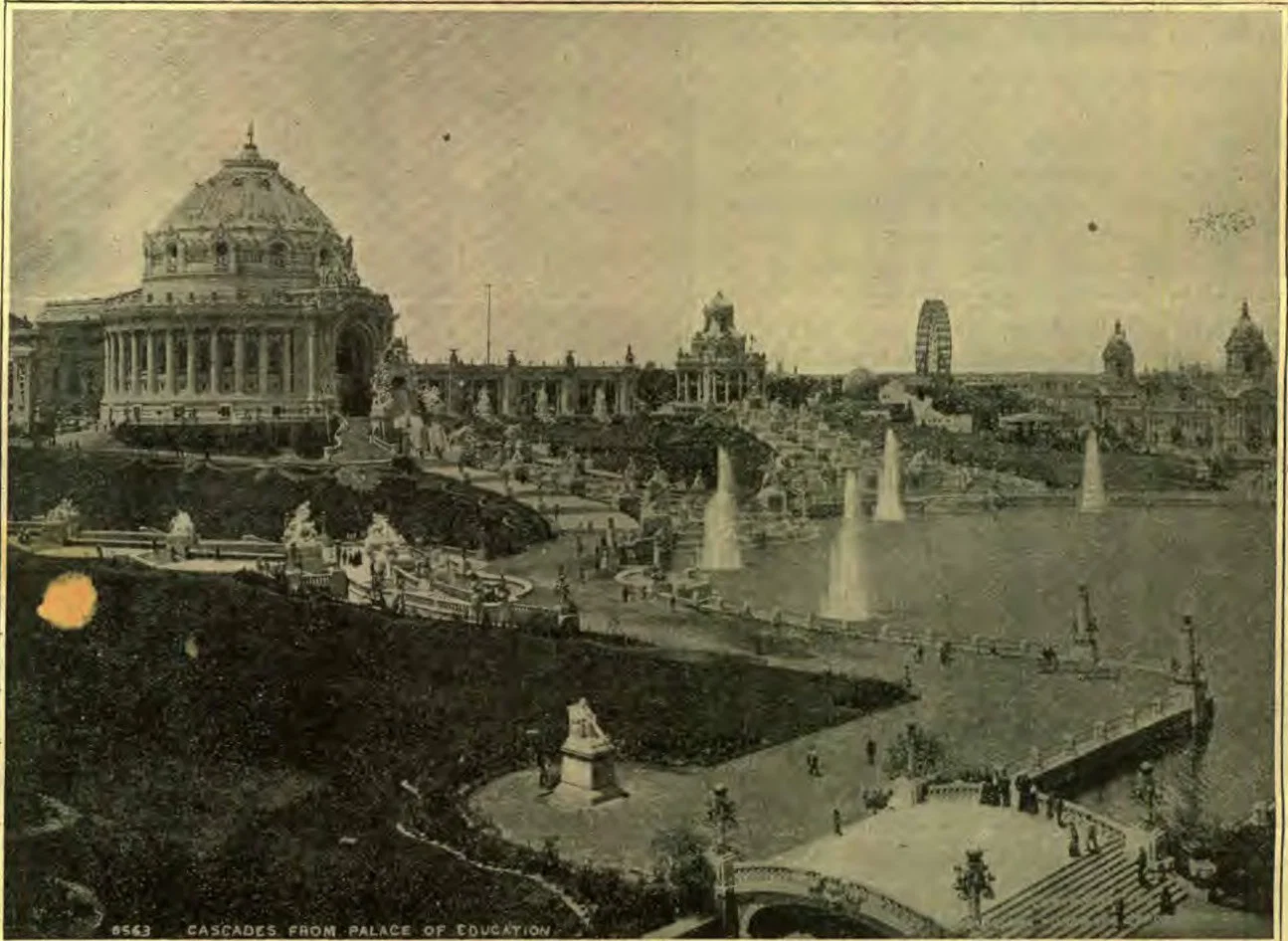
8563 CASCADES FROM PALACE OF EDUCATION
Three years ago the site of the Ivory City, extensive, beautiful, and filled with treasures, was a primeval forest. The work of construction, once begun, progressed by leaps. The rapidity of the changes along many lines is illustrated by the work of beautifying the grounds. Frequently a plot that on one day was unadorned mud and clay, on the next would be nicely grassed, and ornamented with blossoming plants and thrifty shrubs.
The plan of the Exposition’s arrangement is that of a fan, the Palace of Fine Arts on Art Hill and Festival Hall with the Terrace of States on either side, forming the fan’s point. Over the flight of steps leading from these to the lagoon at the foot of the hill flow the Cascades. Disposed upon a level stretch beyond the lagoon are the main exhibit palaces, arranged in two semicircular rows. Between these various buildings are lagoons, attractive flower gardens, and large level plazas ornamented with statuary and monuments. To the right of these main buildings is the plateau of States, an attractive place because of its broad roadways, wooded knolls and dells, and because of the architectural and historical interest of the State mansions. To the left are the buildings of the foreign nations, together with other State buildings. Opportunity is offered by all of these for rest, social hours, display of native products or other State attractions.
Figures, even though they represent millions of dollars, tell very little of the full cost of so gigantic a memorial as the Louisiana Purchase Exposition. Besides three years of incessant labor from thousands of employees, an incalculable amount of severe mental effort must have been demanded of the president and his associates before the desert could blossom as the rose, and a thousand buildings, artistic and of generous proportions, have been erected, furnished, and ornamented with the best produced by the world of mechanics, science, and art. The chief figure of the picture is Festival Hall.

Patagonian Monarch Visits the St. Louis Exposition

An odd-looking foreigner, who is monarch over a portion of Patagonia and one of the boldest warriors in his country, spent the summer at the St. Louis Exposition. A bodyguard of five men, his daughter, and a Patagonian dog accompanied him.

Queen Victoria's Jubilee Gifts at the Exhibition
A MAMMOTH room in one of the exhibit buildings was filled with hundreds of the rarest of Queen Victoria’s Jubilee presents. Every part of the British empire sent its offering. The Indian gifts are of great interest. Nothing seemed too costly to be used in expressing the good-will of the subjects toward their ruler. Ivory chairs, writing desks, caskets, ebony boxes, gold and silver caskets and boxes, costly ornaments, handsomely carved sandalwood boxes, pictures, busts, banners with printed addresses, handsome silver trays, carved scepter, and many other things of equal value were among those on display.
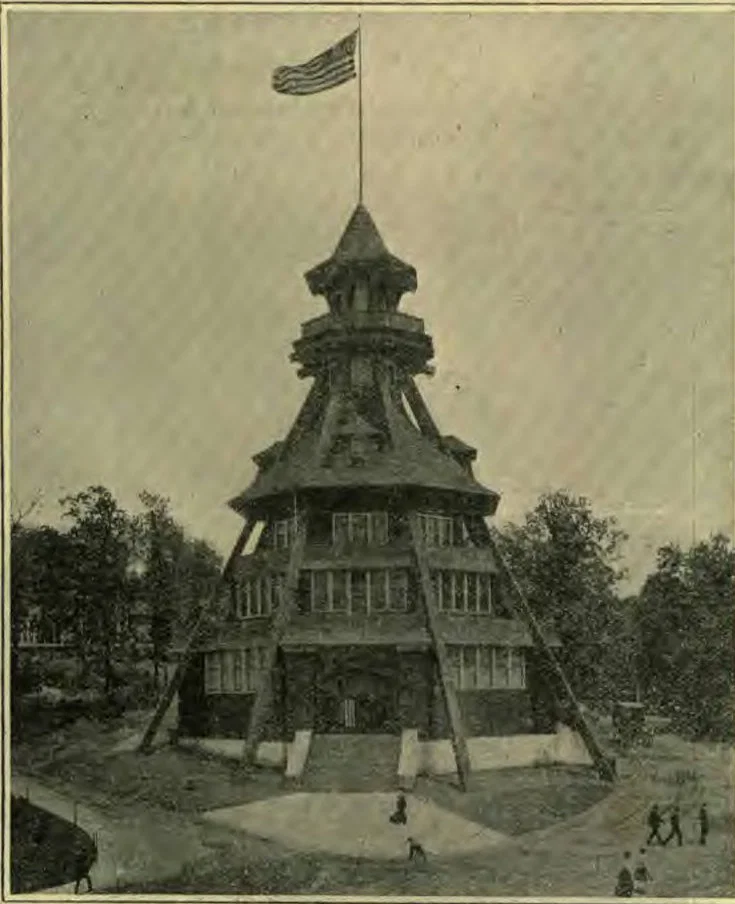
WASHINGTON STATE BUILDING
A brief description of one of the gifts will suffice to show that much attention has been given to the details. The carving of the Ivory Chair of State is a revelation of the possibilities of art. The feet are in the form of lions’ paws, and the arms end in lions’ heads. The back is in the form of a shell, supported by wild elephants. The seat is of alabaster, and the chair has a gold and silver tissue drapery around the under side of the frame, finished with tassels and richly chased ornaments. The cushions are of green velvet embroidered in gold and silver thread. Every outside part of the chair is covered with delicately carved figures of men and animals.

A Boy Sculptor

VICTOR SALVATOR made a model in clay for the St. Louis Exposition. He lives in the tenements, has had few advantages of education, and the race between his family and Want has been so close that he could not give much time to work of this kind.
Competent critics, however, say that the boy is a wonderful artist. He has worked under many disadvantages, such as cold and lack of time and models. In spite of that, or, as some of his friends say, because of it, he has gone ahead, and the result was a note which he received from the New York managers of the Exposition. This is as follows:—
“The New York section of the National Jury of Selection for the Division of Sculpture takes pleasure in informing you that your ‘Ava’ has been accepted for exhibition in the Department of Art at the International Exposition at St. Louis.”
The boy attracted the attention of Dr. Burkleman, of Charlton Street, a year ago, when the physician called to attend the boy’s mother. The room was poorly ventilated and dark. There was little heat in it. In the dim light near a window the physician saw a boy modeling in clay an elderly woman whom the patient called mother.
The physician became so much interested in the lad that he built him a studio in the rear of his Charlton Street home, and even posed at times for him. The result of the labor there was a fine piece of work which has received praise from such men as St. Gaudens and French. The St. Louis work is the “Ava,” which, it is said with confidence, will make the boy famous.—Selected.

Some Korean Customs

ALL things in Korea seem strange to foreigners. Thimbles are of cloth, beautifully embroidered. There are no buttons or pins, and garments are tied on with ribbons. Soap is sold in the form of a powder, and the only matches are shavings tipped with sulphur. These have to be put into the fire to light them.
The market scenes are interesting. You see pompous men in long gowns and high hats, poor women with green cloaks over their heads, and scores of boys carrying vegetables. The people are early risers, and the best time to market is between five and six in the morning. Two hours later the stands are all cleared away, and you have to rely on the retail stores or little shops.
Eggs in Korea are bought by the stick, and are stacked up like kindling wood. Ten eggs are laid end to end, and they are then wrapped about with straw so that they stand out straight and stiff, and look more like clubs than eggs. In the stores these sticks of eggs are piled up crosswise, and the price is about three cents a stick.—The King's Own.

The Little Word Please

“I wonder why it is the boys in this store never will do anything for me. Now if Mary,” indicating a sister saleswoman, “suggests anything, the clerks are all falling over one another to do it for her.”
“Now, she is rather prim and precise, and never makes of the boys, while I am popular with the men.”
This suggestion from Rose set me to thinking, while I was waiting for the car.
“Eddy, will you sharpen my pencil, please?” asks Mary. Eddy does not need to be asked again. One would think, to see him, that refusal would be impossible.
“Eddy, get that step-ladder for me, and be quick!” This command is from Rose. “Guess you own this store,” retorts Eddy, standing and looking at her, but not in admiration of her charms. An altercation follows, and finally the step-ladder is brought by Rose herself, with a remark about the “laziness of boys.”
Now Rose is a good, warm-hearted, lovable little body, more cordial and attractive than Mary, but she has never learned to say “please.” She never thinks of it, while her friend never forgets it. It is only a little word, but it smooths over many a rough place in the business world. In this day of hurry and bustle it is easy, but not wise, to forget the little courtesies, and, like Rose, instead of requesting demand favors.—Selected.

Louisiana Purchase Land Area Compared With Original Thirteen States

The land area of the Louisiana Purchase, 875,021 square miles, exceeds that of the original thirteen States. This area cost the government but fifteen million dollars. Now it is fifty million dollars for a strip of land ten miles wide across the Isthmus of Panama.

The Duplex Comptometer: A Calculating Machine

THE duplex comptometer, just put upon the market, is the simplest and most satisfactory of calculating machines exhibited. By its keys alone it adds columns, extends bills, figures discounts, percentages, and many other arithmetical problems. A few years ago the comptometer was merely an interesting curiosity; now a single commercial house uses ninety-four of these machines. They save time and mistakes. If it were not for their high price, they would soon become as popular with the schoolboy as the arithmetic.

The Great Bird Cage Exhibit

THE huge bird cage erected by our government was an interesting feature. It extended over the tops of large trees, and included streams of running water, and swimming pools, where aquatic birds divert themselves. Persons were allowed to enter the cage and wander about in the forest inhabited by a variety of bird life. There was a rare collection of tropical birds, also equally interesting ones from the temperate zones. Birds of all kinds were there, from the giant condor and albatross to a humming-bird, not much larger than a grasshopper.

The Philippine Exhibit at the Fair

THE Philippine exhibit, covering forty acres, was the largest on the grounds. It was meant to give a correct impression of the arts, industries, habits of life, recreation, and amusements of the people of the Philippines. One thousand Filipinos were brought over to take part in the operations and amusements of the reservation. Their simple musical concerts and native dances attracted daily crowds. Cameras very frequently snatched a likeness of some group or individual; but even the little tots soon learned not to submit to the trying ordeal without proper remuneration in the form of some substantial coin.

Floral Designs and Gardens at the Exposition

The grounds, as far as practicable, were allowed to retain their native simplicity and beauty. Nearly every foreign country, however, provided a typical garden. These, with the ones planted by the Exposition management, produced a masterpiece of landscape gardening. There are floral designs on a scale harmonizing with the other main features of the great exposition. A plant map of the United States, upon which classes of public school children worked daily, is a unique design, costing ten thousand dollars. Native plants and grasses were used to represent the State, and footpaths the boundary lines. A clock is another design, whose beauty, however, is marred by the huge metallic hands that traverse its handsome floral dial-plate.
The largest rose garden in the world, covering nearly ten acres, occupies a space near the Agricultural building, and at times temptingly presents to the visitor a million offerings of fragrance and beauty.

Human Destiny

“THE fault is not in our stars, but in ourselves, that we are underlings.”
The tissues of the life to be, We weave with colors all our own, And in the field of destiny We reap as we have sown.
— J. G. Whittier.
“Let’s find the sunny side of man, Or be believers in it; A light there is in every soul That takes the pains to win it.”
“There is dew in one flower, and not in another,” said Beecher, “because one opens its cup and takes it in, while the other closes itself, and the drop runs off.” Are you satisfied with to-day’s success? It is the harvest from your yesterday’s sowing. Do you dream of a golden to-morrow? You will reap as you have sown this day. We get out of our life just what we put into it. The great world has for us just as much as we have for it. It is a great mirror which reflects the faces we make. If we smile and are glad, it reflects a cheerful, sunny face. If we are sour, irritable, mean, and contemptible, it will still show us a true likeness. The world is like a whispering gallery which returns the echo of ourselves. What we say of others is said of us. Just as we cherish in memory’s hall golden traits of character seen in neighbor and friend, so will be remitted to us by friend and neighbor those same attributes.
It rests with the workman whether a rude piece of marble shall be carved into a horse block, or carved into an Apollo. It is yours, if you choose to develop a spiritual form more beautiful than any of these, instinct with immortal life, refulgent with all the glory of character.
About the middle of the eighteenth century a lighthouse called Dunston Pillar, was built on Lincoln Heath to guide travelers over a trackless, barren waste, a veritable desert, almost in the heart of England. But now it stands in the midst of a fertile region. No barren heath has been visible, even from its top, for more than a generation. Superphosphate of lime has effected this magic transformation. Many a barren, useless life has been made fruitful by the inspiration of a high ideal. Improvement hardly less radical is possible even in the best of our lives. Apply the superphosphate of lofty purposes, and the useless, barren life will blossom as the rose.
At the gateway of life each soul finds, as it were, a block of purest marble (time), a chisel, and a mallet (ability and opportunity) placed at his disposal by the hand of an unseen messenger. What shall he do with the marble? He may chisel out an angel or a demon; he may rear a palace or a hovel. One shapes his marble into a statue which enchants the world; another chisels his into disgusting forms which shall demoralize man to all time, and poison the mind of every beholder.
In the same family and under the same circumstances one rears a stately edifice, while his brother, vacillating and incompetent, lies forever amid ruins. From the same material we may fashion vessels of honor or dishonor. We find just what we are looking for. The geologist sees design and order in every paved stone. The botanist reads volumes in the flowers and grasses which the ordinary man treads thoughtlessly beneath his feet. The astronomer gazes with rapt soul into the starry depths, while his fellow companion seldom looks upward to see the works of an almighty Creator.
Nature takes on our moods: she laughs with those who laugh, and weeps with those who weep. If we rejoice and are glad, looking for the sunshine of life, even the very birds sing more sweetly, the woods and streams murmur our songs. But if we are sad and sorrowful, looking on the shadowy side of life, even a sudden gloom will fall on Nature’s face. The sun shines, but not in our hearts; the birds sing, but not to us. Even the music of spheres is pitched in the minor key.
Somehow we seem to have an innate conviction that, although we are free, yet there is a kind of fatality within us which curbs our wills, limits our thought, contracts our liberties, places bounds about our possibilities, and gives a grooved direction to our thought and action. But freedom is also a part of fate, and what seems like inexorable destiny is but nature’s law of limitation. Knowledge, energy, push, and constancy annul the old ideal doctrine of fate. The more we learn, the greater depth of mind and the more freedom we have. We are given all the liberty that we can use. Our fate or veritable destiny recedes as the store of knowledge advances. Only he who determines to rise superior to what is commonly called destination will accomplish any great thing, or achieve a successful career.
If I trust, I am trusted; if I suspect, I am suspected; if I love, I am loved; if I hate, I am despised. Every man is a magnet, and attracts to himself kindred spirits and principles until he is surrounded by a world all his own, good or bad, like himself; so all the bodily organs and functions are tied together in close sympathy. If one laughs, all rejoice; if one suffers, all others suffer in like manner. The future is just what we make it. Our purposes will give it its mold. One’s resolutions are his prophecies. There is no bright hope or glorious future to the boy or girl who has no great ambition or star to attain. A man is just what his resolutions are. Leave all your pessimism behind. Do not prophesy evil, but good. Have a will to bring sunshine, and the sunshine will come. Every day comes to us freighted with opportunities, possibilities, and privileges. It is ours to make of these sunshine or shadows. Every day comes to us that we may conquer and overcome.
Every young man is now a sower in the field of life. These bright days of youth are the seed-time. Every emotion of your heart, every word of your tongue, every thought of your intellect, every principle you adopt, and every act you perform is the good or evil seed, weal or woe in after-life. The emotions of the heart bear the thought. If we sow a thought, we shall reap an act. If we sow an act, we shall reap a character. Thus we see in all our lives the law of an all-wise Creator,—that as we sow, so shall we reap. Then is it not true that whatsoever a man soweth that shall he also reap? If we sow to the flesh, we shall of the flesh reap corruption; but if we sow to the spirit, we shall of the spirit reap lasting things that shall bud, blossom, and bear fruit in the kingdom of the blest. How true, then, it is that “the fault is not in our stars, but in ourselves, that we are underlings.” This life is just what we make it.
CHAS. W. MILLER.

“Remember Now Thy Creator”

In the days of youth, when the mind and heart are most susceptible to right influences, when life is bright with prospects, then is the time to remember God, the Creator.
Remember him by holding communion with him through prayer and through a study of his Word and works; also by observing all of his commandments.
In the days of youth, when life is joyous, and hopes are buoyant, then it is that the Lord by his Spirit invites all to come to him. If each one would accept this invitation, his feet would be led into paths of peace and safety.
The days of youth are days when the heart is full of ambition and a desire to get knowledge. If, then, the mind and heart are directed into right channels, this ambition will be of the right kind, and the knowledge gained will be from the right source; but if, on the other hand, they are let run in worldly channels, the ambition will, as a natural consequence, be of a worldly character, and the knowledge from the wrong source. The individual will be led to a desire to become great, as the world esteems greatness, and instead of obeying the injunction, “Seek ye the Lord while he may be found, call ye upon him while he is near,” he will drift away from God. The “evil days” will finally come, and he will exclaim, “I have no pleasure in them”—no pleasure in studying the Word of God, nor in holding communion with him.
An early surrender of the heart, therefore, to the Lord lessens the afflictions of old age, and heightens its joys. Well is it to heed the command, “Remember now thy Creator in the days of thy youth, while the evil days come not, nor the years draw nigh, when thou shalt say, “I have no pleasure in them.” ARTHUR LOGAN.

A Worker's Prayer

Oh! strengthen me, that while I stand Firm on the Rock and strong in thee, I may stretch out a loving hand To wrestlers on the troubled sea.
Oh! teach me, Lord, that I may teach The precious things thou dost impart; And wing my words, that they may reach The hidden depths of many a heart.
Oh! use me, Lord, use even me, Just as thou wilt, and when and where, Until thy blessed face I see, Thy rest, thy joy, thy glory share.
— Frances Ridley Havergal.

The Smallest American Possession

THE little island of Midway, so called on account of its position about in the middle of the Pacific Ocean, is the smallest piece of territorial real estate owned by the United States. It was first known as Brooks’ Island, says George Kennan, in the Outlook, because it was claimed in the name of this government by Capt. N. C. Brooks, the discoverer, in 1859.
At first it was uncertain what use, if any, could be made of it. The idea of making it a coaling station for the Pacific Mail Steamship Company was laid aside when it was found how difficult it was to approach the island. But when the trans-Pacific cable was projected, this bit of land, not two miles across, suddenly acquired importance and value. It was made a cable repeating station, and became, for the first time, an inhabited place. It has now a population of ten or twelve men—nearly all cable operators—and one woman.
As seen from a distance of three or four miles, Midway Island looks like a low, rolling drift of marble dust, with rounded, bush-covered hillocks here and there, and encircled by a barrier reef of jagged coral rock, ten or twelve miles around, over which the waves break in spray and mist. Between the reef and the island is a shallow lagoon half a mile across. The island is composed of powdered coral, and shows up dazzling white under the bright Pacific sky. Its highest part is only forty-three feet above the level of the ocean, and were it not for the coral reef, the waves would dash completely over it at times.
The life of the cable operators on this remote, verdureless sand-dune in mid-ocean is more lonely and dreary than that of any other telegraphers in the world. They are off the regular routes of steamers and sailing vessels, and are visited by government transports or supply ships only at long and uncertain intervals.—Week’s Progress.

Groping Mid Sin's Hopeless Ways

“THEY’RE groping ’mid sin’s hopeless ways, A thousand millions blind; On them have dawned no gospel rays, No path of peace they find.”

THE WEEKLY STUDY

Paul and Silas at Berea

SCRIPTURE FOR STUDY: Acts 17: 1-15.
SCRIPTURE FOR WORKERS:—
The field: Matt. 13:38.
The message: Rev. 14:9-12.
The messenger: Rev. 22:17.
REFERENCE STUDY: “Sketches from the Life of Paul,” pages 87, 88.
OUTLINE OF TOPICS:—
Apostles leave Thessalonica by night.
Arrive at Berea.
Preach in synagogue.
Receive the word.
Many believe.
Jews come from Thessalonica.
Paul leaves for Athens.

Notes

Berea is another city of Macedonia, and was about fifty or sixty miles southwest of Thessalonica. It was not very far from Pella, the birthplace of Alexander the Great. It was the home of Sopater, who later accompanied Paul into Asia. Acts 20: 4.
The people of Berea seem to have been a more educated and refined class than in Thessalonica. They were “more noble.” They were not filled with the narrow prejudice encountered there, but were willing to investigate. They made God’s holy Book their “daily” companion, searching to see if the doctrines presented by the apostles were the truth. The result was that many, both men and women, Jews and Gentiles, believed.
“In the presentation of the truth, those who honestly desire to be right will be awakened to a diligent searching of the Scriptures. This will produce results similar to those that attended the labors of the apostles in Berea. But those who preach the truth in these days meet many who are the opposite of the Bereans. . . . They think their old faith and customs are good enough for them. But the Lord, who sends out his ambassadors with a message to the world, will hold the people responsible for the manner in which they treat the words of his servants.”
“The minds of the Bereans were not narrowed by prejudice, and they were willing to investigate and receive the truths preached by the apostles.”
“The unbelieving Jews of Thessalonica, filled with jealousy and hatred of the apostles, and not content with having driven them from among the Thessalonians, followed them to Berea, and again stirred up the excitable passions of the lower class to do them violence.”
“God, in his providence, permitted Satan to hinder Paul from returning to the Thessalonians. Yet the faithful apostle steadily pressed on through opposition, conflict, and persecution, to carry out the purpose of God as revealed to him in the vision at Jerusalem: ‘I will send thee far hence unto the Gentiles.’”
“From Berea Paul went to Athens. He was accompanied on his journey by some of the Bereans who had been newly brought into the faith, and who were desirous of learning more from him of the way of life. When the apostle arrived at Athens, he sent these men back with a message to Silas and Timothy to join him immediately in that city. Timothy had come to Berea previous to Paul’s departure, and with Silas had remained to carry on the work so well begun there, and to instruct the new converts in the principles of their holy faith.” G. R. T.

A Little Talk to the Youth and Children

DEAR young people and children, if it were possible, I would like to have all the young people and children among Seventh-day Adventists together in one company, for about an hour, so that I could have a talk with you.
There are many things that I would like to say, but just now there is one particular subject that rests upon my mind.
Since coming to Washington, I have had a chance to see how some of our leading brethren are burdened night and day, because of a lack of money to carry forward God’s work in the world; and now I want to have a little talk with you on this subject of money.
We know that Jesus is soon coming. We know that this world is soon to be destroyed; but many, very many, of the people in the world know nothing about these things.
Quite a number of our people have gone to other lands, to tell them about the coming of Jesus, and how to be ready to meet him; and many more ought to go.
These brethren and sisters need something to eat, and something to wear, and some place to stay. They also need money to print books and papers, that the people may read the truth for this time.
The workers who have gone to these fields can not work to earn the money for these expenses, and at the same time do the work that must be done. Somebody must furnish the money.
Of course, God could make the money and give it to them, but that is not his way of doing. He wants us to have a part in his work, not only by doing what we can where we are, but by giving of the money that he gives to us. Every penny that comes into our hands in any way belongs to God, and, sometime soon, he will inquire what we did with it. Perhaps many of you have thought that most of the giving ought to be done by the older people, but I am sure that Jesus is watching to see what the young people and children are doing for him.
Now, there are two things especially that every one of you can do:—
First, you can pray earnestly to the Lord, that he will put it into the hearts of those who have money to give it for the Lord’s work. Some of our fathers and mothers are keeping back money that ought to be used now in hastening the coming of Jesus. Will all our young people and children unite during this week of prayer, to pray that the Lord’s work shall no longer be hindered by a lack of money?
Then, second, if our prayers mean anything, we must do all we can to help answer them.
Perhaps you think that the little you could give would not help very much, but Jesus has said, “He that is faithful in that which is least is faithful also in much.”
Do you remember how Jesus once fed thousands of people with a few loaves and fishes, and it was a lad who furnished the food that, with Jesus’ blessing, fed the multitude.
Wouldn’t you have been glad to have been in his place that day?
Just now, many, many thousands are dying for the “Bread of life.” Will you let Jesus have your few pennies, or dimes, or dollars to bless, and then use to feed a hungry world?
We are very near the Christmas time, and this year, why not make all our gifts to Jesus, instead of spending money for useless presents to one another?
Tell your parents and friends to let you have the money they think of using for presents for you, that you may make a present to Jesus, who has given so much for you.
Not only might our Christmas gifts be turned this way, but all through the year, how much money is wasted in little things that we do not need. Candy, gum, photographs, jewelry, and many other things of this sort take most of the money that many young people and children might give to the precious work of God.
O, my dear ones, will Jesus say “Well done,” to us, if we keep on using his money uselessly, while those for whom he gave his life are lost for lack of the help we might have given?
Now, if I could see you face to face, I would like to say much more to you about these things, but will you think and pray over this matter, and then do all you can to help others to be interested in it?
May God greatly bless you all during this special week of prayer, that you may give not only your money, but yourselves to be used in God’s precious work, so that Jesus can quickly come and take us home.
LUTHER WARREN.
Washington, D. C.

Report From South Lancaster, Massachusetts

“The Advent message to all the world in this generation,” is the thought that has roused us to throw off the lethargy which had crept into our work, and we have wakened to the realization of the responsibility that rests upon us.
There is a better working spirit in the Society than in any year since I entered the school. There seems to have come a realization of the times in which we are living, and it has brought an earnest, active spirit into the work.
The faculty and older members of the church have been ready to help in any way that they could, by advice, counsel, plans, and means. They have not only advised, but have worked with us.
As directed by the spirit of prophecy, our Society has been divided into bands, containing from five to nine members each, under the direction of a leader. There are ten bands. Each band has its work. Four hundred sets of the special Signs have been ordered, and some are working with these. Some are holding Bible readings, others have been sewing, and still others distributing literature. An opening for work in the hospital has been gladly accepted, and a company goes weekly with the purpose of bringing the truth to some one. We regard this as an especial providence; for Sunday is not a visiting day, but has been given us in which to do our work. Meetings are being held in several places. In one town a hall has been freely offered us for services.
Our weekly meetings continue. Many profitable talks have been given, and we have gained strength and courage by them. It is our determination never to lay down the cross until He comes whose right it is to rule, and to press on with his help to give the gospel to all the world in this generation. MAY G. COLE.

When Love Is Done

THE night has a thousand eyes, And the day but one. Yet the light of the bright world dies With the dying sun.
The mind has a thousand eyes, And the heart but one, Yet the light of a whole world dies When love is done.
—Bourdillon.
Continue reading: John Hubbell, Station Agent