The sitting-room looked very cozy in spite of the scanty furniture, and there was a happy smile on Mrs. Hubbell’s face as she sat by the sunny window. She was thinking how well John had done at the graduating exercises last evening.
Suddenly the door burst open, and John rushed in, and tossed his cap gently upon his mother’s pretty hair.
“Hurrah, motherly!” he shouted, “I’ve got a job! No, don’t take it off; it’s very becoming.”
Mrs. Hubbell smiled up at her big boy. “I’m glad you’ve got work, John,” she said, “but I wasn’t in any hurry. I think you ought to have a little vacation.”
“Listen to the lady!” said John, solemnly. “Well, now, I am in a hurry. If it hadn’t been for my good bringing up I should have rebelled long before I finished my course at the academy, while you were eating codfish four times a week, and turning, returning, and overturning your old dresses whenever you needed a new one.”
“But, John,” began Mrs. Hubbell, “it was no hardship to me—”
“Oh, no,” said John, “it was just your fun, that’s all. But now my turn has come to have some fun. Michael Donovan, baggage-master and freight manipulator at the station has resigned, and Mr. Morse wants me to take his place. It isn’t quite the same as being president of the road, but there is a trifle of twelve dollars to bring home every Saturday night, if I can get safely past the peanut stand.”
Mrs. Hubbell laughed, and then the tears stood in her eyes. “You make me think of your father, John,” she said. But John could not remember his father.
“And, mother,” continued John, more seriously, “there is something else. Mr. Morse, the station agent, says that he begins to feel that he is getting old, and he will soon need some help about the office. And he says that he knows that now I have completed the regular course at the academy, it will be easy for me to learn all that is necessary for me to know in order to do the office work well, and he will teach me telegraphy, too.”
Riverdale is on the Killington branch of the great B. & D. system, about seven miles from the Summit, where it crosses the Green Mountains. The railroad runs along the mountainside a hundred feet above the village, and John went to his work through the little garden, and up the embankment to the terrace where the station stood.
In a few days John began to telegraph to his mother when he sat down to his meals, putting his knife between the tines of a fork, and ticking away most vigorously.
“I like the telegraphing best of all,” he said. “Hear this: ‘...’ That’s ‘v, v, v, v.’ It is the call for Riverdale. Here you go, ‘...,’ ‘p’ that’s the call for Proctorvale; ‘...,’ ‘Cr,’ for Chestertown, and so on. I know every call between Burlington and Bellows Falls.”
“You must be learning fast,” said Mrs. Hubbell.
“Nothing like it on record since the great freshet of 1843,” said John, promptly. “But here is a message especially for you, fair Ellen of the Isle.” And John ticked out:— ‘...’ “Can you read it?” he said. “Why, John,” laughed Mrs. Hubbell, “it sounds just like the ticking of the clock to me.”
John by a deep sigh feigned great disappointment. “Well, then,” he said, “I must tell you, though I hoped to keep it a secret a little longer. Those little ticks mean, ‘I love you,’ but do not let it worry you. Now it is almost time for the up mail, and nothing can be done till I get there.”
John grew more and more enthusiastic over his telegraphy. “Sent my first message to-day,” he told his mother, one evening. “Look for an account of the wonderful achievement in to-morrow’s paper.” And again, some time later, he said, “Reported the trains to-day. The president was much pleased.”
But, after several months, there came a time when John ate his meals very soberly, and dropped all the cheerful fun which his mother enjoyed so much. He seemed absent-minded, as if he was listening for something all the time, and he hurried back to the station when his hour was not over, and no train was due. At last Mrs. Hubbell could bear the suspense no longer, and one day she said:—
“John, I know that something is troubling you. You have not acted like yourself for weeks. Can’t you tell me what it is?”
John sat back from the table and thought seriously for a minute. “Well, mother,” he said, “I think I will tell you, for I am surely very much troubled. But it isn’t about myself. It is about Mr. Morse?”
“About Mr. Morse?”
“Yes. He is growing deaf. That is the whole story. There are a great many calls for Riverdale on the wire that he doesn’t hear at all unless I call his attention to them. And then he doesn’t seem to understand what the matter is. He will say, when I speak to him, ‘Calling me, are they? Well, it’s queer I didn’t hear it.’ Then he will go and take the message all right; but when he is a few feet from the instrument again, he doesn’t hear the next call. I’m sure I don’t know what to do. I hate to say anything to Mr. Morse about it, or to any one else, but I’m afraid all the time that some accident will happen.”
When John went back to his work, Mr. Morse met him at the door of the station.
“John,” he said, “I’ve got orders to send that car of railroad iron to the Summit by the local. They can take it on the tail end of the train, and leave it on the turnout at the Summit for the section men. Rutland gave me a big blowing up; said they had been calling me half an hour before I answered; but I told them I knew better, for I was right here in the office all the time.”
In a short time the local freight pulled in. And indeed it was a pull on the sharp grade, and the big mogul shook like a toy engine as she came around the curve.
“Danny,” said John to the conductor, “you have to take that car of rails and leave it on the turnout at the Summit for the section men.”
“Not much!” said Danny Maguire. “She has all she can pull, hasn’t she, Jim?”
The engineer looked confidently at his great machine.
“I guess she’ll handle it,” he said.
“Make me do all the putterin’ jobs,” growled Danny. But when the long train had been slowly backed down on the turnout to the car of rails, he was furious.
“Ain’t a couplin’-pin on the car!” he cried, “and we used our last spare pin at Proctorvale. If you hain’t got an extra pin somewhere, Johnny, we’ll have to leave it. Hurry, now! We’re late, anyway.”
John hastily searched every corner of the freight house, and at last he discovered a rusty coupling-pin which he carried to Danny. “It looks to me as if there was a flaw in it,” he said, doubtfully.
Danny struck the pin against a rail. “I guess it will hold till we get to the Summit,” he said. Then he threw it to a brakeman, and shouted: “Couple her on, there, quick,” and then gave the signal to be off.
The big mogul climbed the mountain slowly but surely, fighting with the giant of gravitation for every inch of the way. John went to his work in the freight-house, where he was busy until it was nearly time for the afternoon flyer from Boston. Then he went to the passenger station, and, as he entered the door, he heard Summit calling furiously, and there sat Mr. Morse calmly making out freight bills. John opened his lips to speak, when the call changed, and in a moment Proctorvale answered, and then this message flashed over the wire:—
“Car of iron loose—”
John waited to hear no more. He rushed out of the station and flew along the track toward the upper switch. As he went, his gaze eagerly scanned the track up the mountain to the dark hole that marked the entrance to the stone-cut, three miles away. Just as he reached the switch, the car shot out of the cut like a cannon ball, and, far down the valley below him, he heard the faint echoes of a locomotive whistle. The flyer had left Proctorvale before the message came, and was whistling for the lower crossing.
John threw the switch with a single wrench of his strong arms. Then he turned and sped down the track, his heart throbbing like a fire-engine. He knew that the car would leave the track at the lower switch, but that it would spread itself all over the main track in front of the flyer. He was dimly aware that Mr. Morse stood on the platform, waving his hands as he passed the station. His brain worked like lightning, but he could think of nothing but the vain hope of warning the flyer. A minute was gone already, and two more would bring the crash.
Suddenly, at the end of the freight-house, he caught sight of some tools that belonged to the section men. He grasped the spike puller, and sprang to the outside rail of the turnout, where old-fashioned “chairs” still held the ends of the rails together.
The car of iron had reached the high bridge, and up through the valley came the clearer whistle of the flyer from the first crossing.
With tremendous energy John bent over the bar and drew out the spikes till he could spring the end of the rail two or three inches toward the edge of the embankment.
Clang! The runaway car struck the upper end of the turnout. It did not leave the track, but one of the rails jolted from the car and6made a bull’s-eye shot through the red target of the switch.
John leaped back and stood for three terrible seconds in fear lest his effort should fail.
Flash! The loosened rail did its work. The car left the track, leaped over the embankment like a bounding deer, and fell upon the rocks below with a terrific crash whose echoes mingled with the clean-cut, steady puffing of the flyer as it rounded the curve below the lower switch and came hissing to the station.
After the flyer had gone, Mr. Morse, pale and trembling, turned to John, clasped his hand, and said: “God bless you, my brave boy! You have saved many lives to-day, and mine, too, I think. But tell me the truth, John. Did they call me over the wire?”
“Yes, Mr. Morse,” said John, reluctantly. The old man said no more, but turned and went into his office. But that night, long after John had gone home, he worked among his books, and then he sat down to his telegraph instrument, and sent a long message to Rutland. And when it was finished, there were tears in his eyes; for he had been station agent at Riverdale for more than forty years, ever since the road was built.
The next day all the boys in the village rushed up to the station to see the “Annewagun,” the private locomotive of the president of the B. & D., with its wonderful upholstered cabin above the boiler. There it stood, clean and shining, and through the windows of the office, Sleepy Day declared he saw the president shaking hands with John Hubbell, and old Mr. Morse crying in a corner.
At any rate, when John went home to supper, he seized his mother in his arms, and walked around the table, singing:—
“And three times round went she,” before he began a story which Mrs. Hubbell listened to with great interest.
“And of course, mother, I wouldn’t take it,” continued John. “But Mr. Morse said he wouldn’t keep it another day, and he told the president that I was perfectly capable of doing the work; and so you must wake and call me early, call me early, mother dear, for to-morrow I’m to be station agent at Riverdale.”
—J. Mervin Hull, in Young People’s Weekly.
A Small Dictionary for Basket Makers
BASE, Bottom of basket, either woven or of wood.
SPOKES, Ribs or framework of base.
STAKES, Framework or upright reeds of sides of basket.
BY-STAKES, Extra stakes inserted beside the true stakes.
UPSET, First few rows of weaving above base.
SIDING, The weaving which forms the sides about upset.
WALING, The last few rows of weaving at top.
BORDER, Any sort of finish around top of basket.
WEAVERS, Reeds or other material used for filling in spokes or stakes.
STROKE, One move with a weaver.
SINGLE WEAVING, Using one weaver, and placing before one stake and back of the next.
DOUBLE WEAVING, Using two weavers, and placing them together before and behind single stakes.
PAIRING, Using two weavers, and placing one before and one behind same stake, and crossing weavers between stakes.
TRIPLE TWIST, Three weavers, one in each of three consecutive spaces; left weaver passed over the other two weavers in front of two stakes, back of one stake, and out in first vacant space at right.
ROPE TWIST, Four weavers, one in each of four consecutive spaces; left weaver passed over the other three weavers, in front of three stakes, back of one stake, and out in first vacant space at right.
WALING TWIST, Four weavers, one in each of four consecutive spaces: left weaver passed over two weavers in front of two stakes, back of two stakes, and out in first vacant space at right.
FIG. 2.
FITCHING, Various kinds of open work known as straight fitch, V fitch, diamond fitch, etc.
A Simple Work Basket
By Mrs. E. M. Long
Model No. 2—Base of Basket
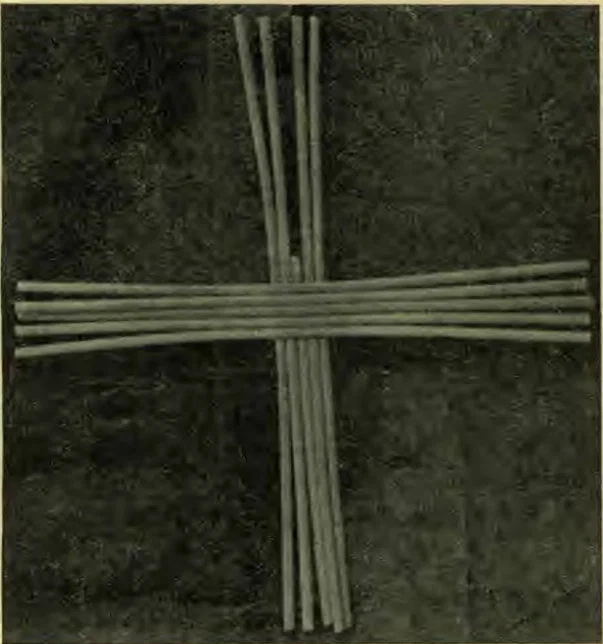
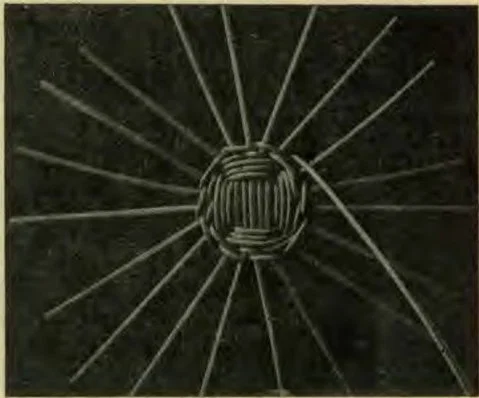
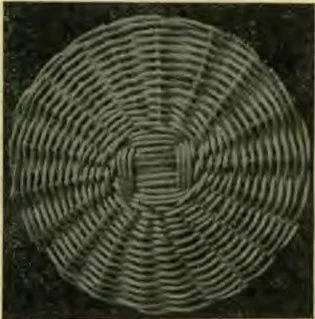
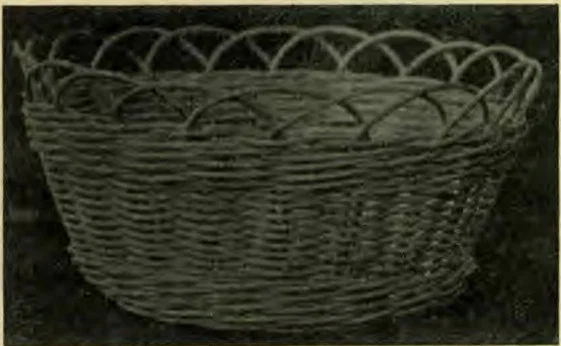
REEDS Nos. 3, 4, and 5 are used in the construction of this basket. The base is similar to the mat previously described. For spokes cut nine pieces of No. 5 reed seven inches long and one piece four inches long. When well softened, split five long ones in the center, and insert the others, placing the short piece in the center, with one end projecting one-fourth inch through the opening. Fig. 1. At a point five feet from one end of one of the longest pieces of well-soaked No. 3 reed separate the fibers by a sharp blow with the awl handle; bend and place the loop as directed for the mat; read carefully the directions there given. Encircle the quarters three times with the pairing weave (same as on the mat), then with the same weave continue twice around, using the spokes in pairs. Notice that the second row divides the first row of pairs. Fig. 2. Pay special attention to filling the corners by bending the spokes well outward, and drawing the weaver toward the center at each stroke, thus forcing it down between the spokes. Still using the same weave, cover the spokes singly until the short weaver is used up. Keep the work round, the spokes evenly spaced, and the weaving close. Do not forget that all changes should be made and the binding off completed at the spoke where the weaving began. With the remaining weaver pass over one spoke and under the next (single weaving), drawing sufficiently tight to make the base slightly convex. The convex side should be toward the worker. Continue until the base is six inches in diameter, splicing and binding off exactly as directed for the mat. Cut surplus spokes as close as possible. Fig. 3.
FIG. 3.
MRS. E. M. LONG.
(To be concluded)
The Art of Making Crockery
By L. E. Hutchinson
THE Chinese were the first to discover the art of making china, and their principal branch of this industry was the making of teacups, this being the article most used by the tea-drinking Chinamen.
There is a town in China where a great many potters lived and made their beautiful dishes. There was a river close by this town, and when the cups and pots were finished, they were packed, and sent away in the boats. The potters’ furnaces were always burning to bake the dishes, so that at night the town looked as if it were on fire.
The potters would not let a stranger stay all night in the place, for fear he would find out the secret of china-making. He was obliged to either sleep in one of the boats or go away until the next morning. But it happened that two strangers had been on the watch for a long time, and at last they thought they had learned the secret. They saw potters buying large bricks at the markets, and they felt sure that this was the material they used. They were right so far, but they soon found out that something else was needed to mix with it, and what it was they could not tell.
FINISHED BASKET
It afforded the potters much amusement when they heard that persons were trying to make china without “kaolin,” as the necessary substance was called. But now it is not necessary to use the Chinaman’s bricks, as there is a kind of clay dug out of the ground that does quite as well. It is called porcelain clay. This clay is carried to a porcelain manufactory, where all kinds of cups and saucers and jugs and basins are constantly being made. It is put into a machine, where it runs upon a number of sharp knives that work round and round and chop it in pieces. When it has been chopped long enough, it is turned into a kind of churn and churned as though it were going to be made into butter. When the churning is over, it is called “clay cream.” Other things, such as flint and bone, are then mixed with it; but they must be ground into powder, and made into a “clay cream” also. Then the two creams are mixed together and stirred until they are quite smooth. This cream is boiled over a fire until the moisture is dried out, making it much like dough. A man then begins to slap and beat it and cut it in pieces and to fling the pieces one on another with all his might. When he has worked it long enough, he says it is “ready for the potter.”
The potter’s wheel that is used in making7dishes is of great antiquity. When china was first made, one man did the entire work of making a dish; but now potters are classed according to their avocation — throwers, handlers, or turners. A good thrower requires much practise, as he is expected to throw several hundred pieces a day. In consequence of the new plan of pressing all large pieces in plaster molds, the thrower has but small or moderate-sized pieces to work, and these he finishes only on the inside, leaving the outside to be done by the turner when the pieces are in a more advanced state of dryness.
The thrower prepares the pieces of a thicker bulk than is required, and it is the turner’s business to bring them to a proper thickness by removing the excess of material and giving to the outside a smooth and highly finished surface.
The Chinaman makes his cups without handles; and these were the kind first used in this country, but now a cup is seldom seen without a handle. If the handles are to be ornamented, they are pressed in plaster molds; if plain, they are squeezed from a brass cylinder, filled with clay, with a small opening at the bottom, from which it escapes in long ribbons. These are placed side by side on a board, cut across at the required length, and bent in the form of handles when sufficiently hard. The parts where the handle is to join are wet with a certain mixture of clay and water, to make them stick.
In manufactories which have adopted the latest improvements the ovens in which the pieces are dried are heated by steam pipes. After the ware is dried, it is placed in “saggers” and fired. The firing must be conducted very slowly at first, to prevent too sudden an evaporation of the damp, which could crack the dishes. By the first fire to which it is exposed, it is converted into what is called biscuit china. From this oven the dishes are sent to be glazed, and after glazing, they are fired a second time, to give a finished look.
Our best China is painted by hand. In China one man paints nothing but red, another blue, and so on; but here one person paints fruit, another flowers, another leaves, and another figures. After being painted, the dishes are fired for the last time.
It was a long time before the way to paint pictures on china was discovered, or to give to the ware its beautiful gloss. The surface was not hard enough to hold the colors, and wanted a coating upon it, called enamel. A potter named Bernard Palissy tried again and again to make the enamel, and spent all his time in trying one thing and then another. At last he became so poor that he had no wood left to heat his furnace — just at the time, too, when more cups were ready to go into it — and he became so frantic that he ran into the room where his wife was sitting and snatched up the chairs and tables as if he were crazy, and ran with them to his furnace. We are very glad to know that he succeeded at last, and was richly rewarded, but since his time many improvements have been made.—L. E. Hutchinson, in The Children’s Visitor.
XIV—God’s Ownership
(December 31)
MEMORY VERSE: “The earth is the Lord’s, and the fulness thereof; the world, and they that dwell therein.” Ps. 24:1.
Questions
1. By whom was the earth and all that is upon it created? Isa. 45:12.
2. Then to whom do all these rightfully belong? Ps. 24:1.
3. What relation does man sustain to all these things? Matt. 25:14-21; note .
4. According to the law of Moses, what part of the goods entrusted to man did the Lord reserve as holy unto himself? Lev. 27:30-32.
5. For what purpose was this to be used? 1 Cor. 9:13.
6. Is the same law binding in the gospel dispensation? 1 Cor. 9:14.
7. Repeat the words of the Saviour showing that we ought to pay tithe. Matt. 23:23.
8. Of what is one guilty who withholds the tithe? Mal. 3:8.
9. What is the sure consequence of such a course? Mal. 3:9.
10. What gracious promise is made to those who return to the Lord his own? Mal. 3:10.
11. How extensive will be the blessing? Verses 11, 12.
12. From which part of the income should the Lord’s portion be taken? Prov. 3:9, 10.
13. What besides the tithe does the Lord require? Mal. 3:8.
1. WHAT was found in the temple when King Josiah began to repair it? What was written in this book? What message was sent to the king when he inquired of the Lord concerning the things written in the book? What promise was made to Josiah? When the king had gathered all the people together at the temple, what did he read to them? What covenant did he make with the Lord? What is said of the Passover that was kept in Jerusalem during the reign of this king? 2 Chronicles 34 and 35.
2. How many times did Nebuchadnezzar besiege Jerusalem? What did he carry away the first time? See 2 Chron. 36:7 and Dan. 1:1-4. Whom did he take away as captives the second time? 2 Kings 24:15, 16. Describe the third siege of Nebuchadnezzar. How completely did he destroy the city and the temple? 2 Kings 24 and 25.
3. What provision did King Nebuchadnezzar make for the food of the captives he took away from Jerusalem the first time he besieged it? What request did Daniel make for himself and his three companions? What was the result of the test that was made? Tell how the Lord plainly showed his approval of the course taken by these young men. Daniel 1.
4. What strange request did King Nebuchadnezzar make of the wise men of his realm? When they could not grant it, what decree did he send forth? Who heard of it? For what did he ask the king? Who sought the Lord with Daniel that the secret might be revealed? How was their prayer answered? Dan. 2:1-24.
5. What direct question did King Nebuchadnezzar ask Daniel when he was brought before him? To whom did Daniel give glory as the revealer of secrets? In your own words relate the dream of the king, and tell what it meant. What did the king exclaim when he had heard it? How did he honor Daniel and his companions? Dan. 2:25, 49.
6. Describe the image that Nebuchadnezzar set up in the plain of Dura. Who were present at its dedication? What complaint was made against Shadrach, Meshach, and Abednego? Tell how they were cast into the fiery furnace, and how they were delivered from it. What effect did this miracle have on King Nebuchadnezzar? Daniel 3.
7. What does King Nebuchadnezzar relate in the fourth chapter of Daniel? Tell the dream as the king told it to Daniel. Dan. 4:1-18.
8. How did Daniel feel when he had heard the dream? Give its meaning, as Daniel told it to the king. What lesson was the Lord trying to teach Nebuchadnezzar? How and when was the dream fulfilled? At the end of seven years, what happened? How much of Nebuchadnezzar's kingdom was given back to him? What was added? What lesson had the king learned? Whom did he praise? With what words does he close the story of these events? Verses 19-37.
9. Who was Belshazzar? When the city was besieged, what did he make for a thousand of his lords? Tell how they desecrated the holy vessels brought from the temple in Jerusalem. In the midst of the feast, what was seen? How did it affect the king? Who read the writing, and told its meaning? Give the words and their meaning. What happened to Belshazzar that same night? Who took the kingdom?
10. What position did King Darius give to Daniel? Why? How did Daniel's enemies feel about this? What plan did they make to have him put out of the way? Tell how this plan was carried out, and how Daniel was delivered. To whom did Daniel and King Darius give the praise for his deliverance? Daniel 6.
11. What was given to Daniel in the first year of the reign of Belshazzar? Describe the four beasts that he saw, and tell what was represented by each. Of what were the ten horns on the head of the fourth beast a symbol? What was represented by the little horn that came up among the ten horns? What else was shown to Daniel in this vision? Daniel 7.
12. When did Daniel have his second vision? What two beasts did he see in this vision? What king was represented by the notable horn of the he-goat? What became of this horn? What came up in its place? What did these four horns represent? By what strange symbol were the nation and church of Rome represented in this vision? Daniel 8.
13. To what great event are we brought by each of the three visions we have studied this quarter? How may we tell where we are in the world's history.
The Letter Box
Keene, Tex., Nov. 10, 1904.
Dear Editor: Some time ago I sent two subscriptions to the YOUTH’S INSTRUCTOR, with which they credited me toward one of your premium Bibles. To-day I send one more, and in a few days I hope to send two others, in order to get me a Bible. You will find money-order for seventy-five cents, for which please send the INSTRUCTOR to Charles Corwin, Keene, Tex.
Belva Cochran.
Perhaps this letter was not intended for publication; but since Miss Belva is doing what I wish scores and hundreds of others would do, it is given a place in the Letter Box corner, with the hope that before the new year begins, many will follow her example. The Bible will be especially prized because of the effort required to secure it, and, besides, a number of persons will have the INSTRUCTOR.
Baxter, Iowa, Oct. 23, 1904.
Dear Editor: I thought I would write another letter to be published in the YOUTH’S INSTRUCTOR. I enjoy the Children’s Page in the INSTRUCTOR, and also other interesting articles. I can not get along without it. I would like to have some one send me more papers for our reading rack. Copies of the Signs, Review, Life Boat, INSTRUCTOR, or any of our papers or tracts, will be acceptable. I have sold Life Boats enough to get me a pair of new shoes, and to pay my way to the Colfax camp-meeting and back again. I have been selling books also this summer. We had “Heralds of the Morning,” “Best Stories,” “Gospel Primer,” and “Easy Steps in the Bible Story,” and I have sold some Good Healths. I am going to the public school here in Baxter, and am in the seventh grade. My teacher’s name is Miss Lamb. Her parents live in Colfax, Iowa. We all like her very much. There are thirty-one children in our room, but only ten in my class, three boys and seven girls. We have an accordian, which mama plays; and nearly every Sabbath when she is playing, the children will come in to listen to the music. Our rack is nearly empty now.
Eva May Bowker.
Glendale, Cal., Nov. 15, 1904.
Dear Editor: I am twelve years old. I attend the district school. I went to a church-school last year, but I now live six miles out of town.
My mama died a year ago in Spokane, Wash., and since then I live with mama Hyatt. She has been in the truth ten years, and loves it dearly, and I do too, but I am not a member of the church. I hope to be some day. I have a pet calf and five missionary chickens. This is my first letter to the YOUTH’S INSTRUCTOR, and I hope it will be printed. I enclose an order for seventy-five cents, for which please send me the INSTRUCTOR for one year. Lolita Hyatt.
This is an interesting letter. Five missionary chickens may do a world of good. Let us hear, Lolita, whether they prove valuable helpers in the needy missionary cause; yet it is not possible to measure their worth to the cause of Christ just by the dollars and cents they bring. I hope, with you, that your name may be early recorded both in the book of life and in the church book.
The Full Tumbler
Mr. Moody, at Northfield, was speaking of the persistent way in which sin occupies a human heart. Taking in his hand a tumbler, he explained that it was full of air, and that it was almost impossible to remove that air. He could not pour it out. If he lifted it out with a spoon, it was immediately replaced. In the same way, the human heart is full of sin, and our efforts to remove it are unsuccessful. Then he went on to say that there is one sure and easy way to remove the air from the tumbler. Seizing a pitcher of water from the table, he filled the tumbler so full of the liquid that it overflowed to the platform. There was no longer any air left in the tumbler. His moral was that when a human heart is filled to overflowing with God’s Spirit, there is no room left for sin in that heart.
Through the Waters
Some years ago, when coming one morning from Canton, Massachusetts, to Boston, after a great freshet, the train went apparently into a large pond, the track and the wide meadow being all concealed beneath the water from an overflowing river. It seemed singular indeed to hear the water splashing against the wheels, as if they were those of a steamer, and to see a man in a boat rowing across the rear of the train as it moved slowly along. But the cars went confidently down into those waters; for underneath were the iron rails and the solid track.
“When thou passest through the waters, I will be with thee; and through the rivers, they shall not overflow thee.” When life’s path meets the deep waters, the Christian may confidently enter therein, for “underneath are the everlasting arms.”
And it is only a little while he is there; for he soon passes through them, as that train of cars went quickly through those waters to the region beyond.
Fresh Flowers
A Christian woman was employed as nurse in a home where a loved mother lay ill. Her daughter, a girl of fifteen or sixteen years, had never given her heart to Christ, fearing that by so doing she might lose some of her youthful pleasures, and saying that when she grew older, then she would give herself to him.
One day she came into the house, bringing a bouquet of beautiful, fresh carnations for her mother. The nurse commented upon their loveliness, and then said, “We will not take them up to mother now—they are too fresh and beautiful; we will wait a few days until they have begun to fade and wither.” The young girl was surprised, almost indignant, and sought an explanation for such a seemingly unnatural course.
Said the nurse: “Is not this what you are doing to your loving Heavenly Father? Are you not by your conduct reserving for yourself the beauty and freshness of your young life, and waiting to offer him the faded blossoms from which all the lovely beauty and freshness have departed?”
The girl felt the force of the illustration, and yielded her fair young life to the Master.
The Cross of Christ
An illustration which often recurs to my mind, and which has been most effective in enforcing its truth, was given by Dr. A. J. Gordon. To use the exact words, he said: “What a solemn expression is this, ‘Making the cross of Christ of none effect’! No power or might of man can sweep the stars from the sky, or blot the sun from the heavens, or efface the splendid landscape; but one wound in the eye can destroy the sight, and make all those things as though they were not. So the atonement of Christ can never pass into eclipse, or cease to be a fact; but there is such a thing as the eclipse of faith, unbelief filming the soul so that the cross and atonement of Christ shall become a great blank, vacant, lifeless, meaningless.
“O eyes that are becoming dim, but not with age; blinded, but not with tears; hard of seeing, but not with use, hear the Lord speaking from heaven, ‘Anoint thine eyes with eye-salve, that thou mayest see.’ It is not that God should do greater things for us, but that we should open our eyes and see what he has done.”
The writer firmly believes that use of these words of Dr. Gordon has been the means of winning souls for the kingdom.—Christian Endeavor World.