Your ShelfYour Projects

Signs of the Times, Vol. 30, No. 46.

SIGNS OF THE TIMES

Signs of the Times

Nov 23, 1904

Pacific Press Publishing Company · Mountain View, California · Nov 23, 1904

SIGNS OF THE TIMES
The SIGNS OF THE TIMES

for 1905

SIGNS OF THE TIMES

Mountain View . . . . . . . California

The Signs of the Times

The SIGNS OF THE TIMES will aim to be in the year to come the most up-to-date religious paper in the United States in all things which pertain to vital truth, Christian character, and God's message to this generation. It has a definite message to give; and it will give this message in the fear of God without prejudice or malice toward any, and with charity for all.

Topics for the Coming Year

Some of the more definite presentations of truth will be considered under the following, or kindred heads:—
  • The Stirring Prophecies of Daniel and the Revelation
  • Practical, Helpful Articles on the Life, Teachings, Parables, and Miracles of Christ
  • True Sabbath-Keeping in Christ Jesus
  • Evolution and Geology in Their Bearings on Vital Religions
  • The Spirit of God; Its Gifts and Manifestations, and the Necessity of Its Reception
  • What Is the Prospect of the World's Conversion?
  • Life and Immortality; From Whom Received, and When Restored
  • The Law of God; Its Purpose and Exceeding Breadth; Its Bearing on Individual, Social, and Political Life
  • Church and State; Their Proper Relation
  • Spiritism and Other Forms of Occultism in the Light of the Bible
  • The Gospel of Jesus Christ in Type, Symbol and Reality
  • The Signs of the Times
  • The Coming of the Lord
  • The World's Outlook, Including Monthly Letters from Intelligent Observers in London and Europe
  • The Great Field of Missions
  • Practical Articles on the Home Life; on Health and Temperance, with a Department for the Children
In short, every phase of Bible truth will be set before our readers in the year to come, oftentimes with appropriate and striking illustrations.

Subscription Information

The SIGNS of the TIMES is published fifty-two times a year. Subscription price, $1.50 a year. Address

"THEY SHALL BE MINE, SAITH THE LORD OF HOSTS."

By MRS. E. G. WHITE.
THE world is preparing for the last great conflict, nation rising against nation. The vast majority of human beings are taking their stand against God. But in every age the Lord Jesus has had His witnesses,—a remnant who trusted in the Word of God. And to-day, in every place, there are those who hold communion with God. A vital undercurrent of influence is leading them to the light, and when the question comes to them, "Who is on the Lord's side?" they will take their position for Him. Their characters have been moulded after the divine similitude, because they have read and practised the teachings of His Word.
Many in retired homes are God's hidden ones, serving Him according to the light they have received. These hidden ones greatly delight in the Word of God. His precepts are appreciated and treasured by them, and many are the works of love that they do for Christ's sake.
When Elijah complained that he stood alone in his service for God, the answer that came from heaven was, "I have reserved to Myself seven thousand men, who have not bowed the knee to Baal." Men are at best poor judges of the advancement made by the Gospel, of the influence that it has on souls who, perhaps, have never heard the preaching of an ordained minister. All through the world the Lord has His chosen ones. We can see plainly the prevailing degeneracy. Profligacy and infidelity are increasing to alarming proportions. Yet in the most wicked communities there are homes from which sincere, earnest prayers ascend to Christ.
In the judgment many secret things will be revealed. Then we shall see what a belief in God's Word has done for men and women. It will be seen how small companies, sometimes not more than three or four, have gathered together in secret places to seek the Lord, and how they received light and grace, and rich gems of thought. The Holy Spirit was their teacher, and their lives revealed the blessings that come from a possession of the oracles of God.
When Christ shall separate the tares from the wheat, it will be seen that God recognizes and honors these lowly followers. In the world they may not have been thought worthy of recognition, but in the heavenly courts they are registered as true and faithful. Through trial and opposition they kept their faith untainted. They gathered strength from the Word of God, which told them of the hope of immortal life in the kingdom of God. Of "them that feared the Lord, and that thought upon His name," it is written, "They shall be Mine, saith the Lord of hosts, in that day when I make up My jewels; and I will spare them as a man spareth his own son that serveth him."

GOD IS CALLING.

TO-DAY mercy pleads with the sinner. "As I live, saith the Lord God, I have no pleasure in the death of the wicked; but that the wicked turn from his way and live; turn ye, turn ye from your evil ways, or why will ye die?" The voice that speaks to the impenitent to-day is the voice of Him who in heart-anguish exclaimed as He beheld the city of His love, "O Jerusalem, Jerusalem, which killeth the prophets, and stoneth them that are sent unto her! how often would I have gathered thy children together, even as a hen gathereth her own brood under her wings, and ye would not! Behold, your house is left unto you desolate!" In Jerusalem, Jesus beheld a symbol of the world that had rejected and despised His grace. He was weeping, O stubborn heart, for you. Even when Jesus' tears were shed upon the mount, Jerusalem might yet have repented, and escaped her doom. For a little space the Gift of heaven still waited her acceptance. So, O heart, to you, Christ is still speaking in accents of love, "Behold, I stand at the door, and knock; if any man hear My voice, and open the door, I will come in to him, and will sup with him, and he with Me." "Now is the accepted time; behold, now is the day of salvation." You who are resting your hope on self, are building on the sand. But it is not yet too late to escape the impending ruin. Before the tempest breaks, flee to the sure foundation. "Look unto Me, and be ye saved, all the ends of the earth."—"Mount of Blessing."

WAS THE DEATH OF CHRIST NECESSARY?

BY R. C. PORTER
THE account of the creation of man, contained in the first two chapters of Genesis, is a remarkable revelation of God's love in the provision made for the comfort and happiness of His children.
The family relation, and the Sabbath,—these two institutions were both intended as means to that end.
But after man had fallen under sin, it was written of him: "There is none righteous, no, not one; there is none that understandeth, there is none that seeketh after God. They are all gone out of the way, they are together become unprofitable; there is none that doeth good; no, not one."
This was the condition into which man was plunged by sin. The whole race, without an exception, was placed where none could do righteousness. Christ said to the young man, "If thou wilt enter into life, keep the commandments." He also said, "Without Me, ye can do nothing." From the days of old we have the same pleading of God: "O that thou hadst harkened to My commandments! then had thy peace been as a river, and thy righteousness as the waves of the sea." But man sinned, and "the wages of sin is death."
In placing His law before man, God showed His love by giving, in that law, only the principles of happiness. These principles were the principles of righteousness, and only in righteousness is happiness and life. So the psalmist says, "All Thy commandments are righteousness." And the wise man declares: "In the way of righteousness is life; and in the pathway thereof there is no death." Prov. 12:28. His laws were ordained to life. Rom. 7:10.
Since the fall, can man restore himself without a Saviour?
It has ever been the tendency of the human heart, since sin entered, to seek perfection apart from Christ. The history of Israel under the old covenant is but the story of impossibility that lies at the threshold of every attempt to attain righteousness and life without a Saviour. "But Israel, which followed after the law of righteousness, hath not attained to the law of righteousness. Wherefore?—Because they sought it not by faith, but as it were by the works of the law."

What Is Required

in order to meet the demands of the law of righteousness?—Every individual is required to live in perfect obedience to every precept of the law from birth to death. This, according to the scriptures above quoted, no man hath done, or can do. Suppose a man were able to commence now, and live the balance of his days in perfect obedience to the law, could he pass, at life's close, before that law as perfect in character during his entire life?—No; because of his past failures, his life would be imperfect. It is also evident to every man that has tried to live a perfect life without Christ, that such a thing is impossible. His own heart's condemnation is but the open declaration that without a Saviour man is lost. Life would have been eternal if righteousness had not been lost. Death came by sin. If man can save himself from sin, he can in like manner save himself from death. As Death steals upon us, and his icy hand is felt clutching at the foundation of natural life, what man can save himself from the grim monster? Since sin entered, the universal verdict is, "By one man sin entered into the world, and death by sin; and so death passed upon all men, for that all have sinned." Outside of a Saviour, there is no discharge from this fiat. It is as futile for a man to try to save himself from sin without a Saviour, as to seek to save himself from death, which came as the result of sin, without a Saviour. The logic of this conclusion is self-evident.
This brings us to the scriptures which declare that Jesus Christ is

The Only Possible Hope

of the world, for release from both sin and death. "I am the door; by Me if any man enter in, he shall be saved, and shall go in and out, and find pasture." "He that entereth not by the door into the sheepfold, but climbeth up some other way, the same is a thief and a robber." To him the porter does not open. "The thief cometh not, but for to steal, and to kill, and to destroy; I am come that they might have life."
Satan, as a thief, started the claim of the possibility of perfect life outside of Christ. He robbed man of confidence in Christ, and stole from Christ, so far as possible to do, the honor of giving righteousness and life. He came to deprive us of these things, to destroy us.
Christ found us under sentence of death, and how can He justly free us from that sentence, since the penalty is just? He could only do so by taking man's place, and living under man's temptations a righteous life for man from birth to death, and dying under man's death sentence as his voluntary substitute. This He did.
His life was perfect from birth to death under the very temptations that meet us in life's pathway. This is what is required of each of us, but we have lost it. In and of ourselves it would be impossible to supply perfect obedience; for our lives testify to our imperfections. The perfect One is "Jesus Christ the righteous."
To give us full confidence that in Him our salvation is assured, we must know that the death penalty overhanging us is accepted by Him, altho He is innocent and free from the sin which brought death.
We find this plain truth declared in Isa. 53:6: "All we like sheep have gone astray; we have turned every one to his own way; and the Lord hath laid on Him the iniquity of us all." And again, in the same chapter: "Yet it pleased the Lord to bruise Him; He hath put Him to grief; when Thou shalt make His soul an offering for sin. . . . By His knowledge shall My righteous Servant justify many; for He shall bear their iniquities. . . . He hath poured out His soul unto death; and He was numbered with the transgressors; and He bore the sin of many, and made intercession for the transgressors."
According to these scriptures, Jesus Christ can "be just, and the Justifier of him which believeth in Jesus." He lived for man a perfect life from birth to death. He has therefore a perfect life to offer to the one who believes in Him as a Saviour. Innocent tho He was, He paid the penalty of man's transgression. Having met the death penalty in His own person, for us, he can ask our release from death without lowering the dignity of God's government.
So Paul declares, "That God was in Christ, reconciling the world unto Himself, not imputing their trespasses unto them." To whom, then, were they imputed?—"For He hath made Him to be sin for us, who knew no sin; that we might be made the righteousness of God in Him."
From this glorious fact the apostle draws the conclusion in Rom. 5:19: "For as by one man's disobedience many were made sinners, so by the obedience of One shall many be made righteous." Obedience, perfect and unceasing, is required for every moment of our lives. He has it to offer for us. He is "merciful, abundant in goodness and truth, keeping mercy for thousands, forgiving iniquity and transgression and sin; but He can by no means clear the guilty." To be cleared, man must confess his guilt, accept the righteous life He lived for him, and thus be free from the death penalty.
Surely, "There is none other name under heaven given among men, whereby we must be saved."

THE VISION.

BY CLYDE SCOTT CHASE.
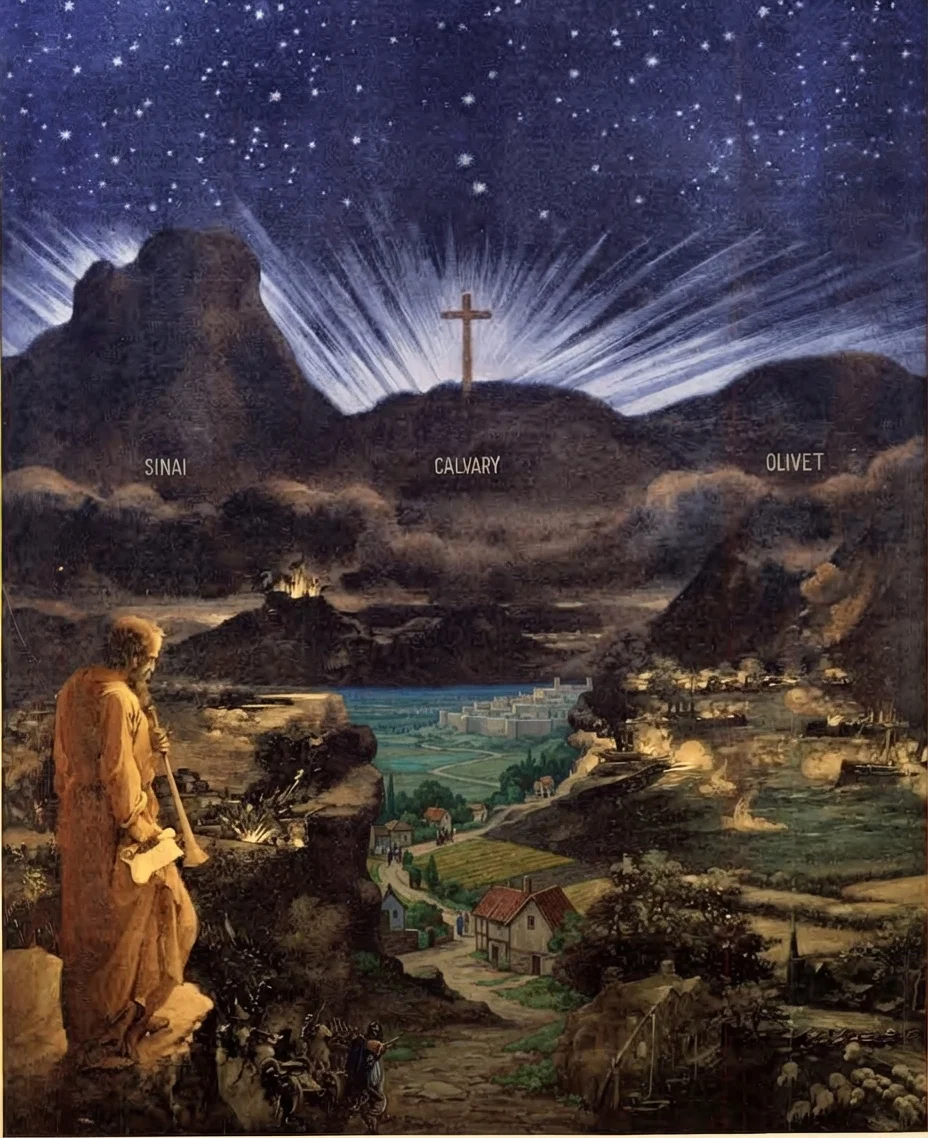
By a grim, rugged mountain, in grandeur upreared, A man lies asleep at the closing of day, And before him in vision the nations of earth Strive one with another for prestige and sway. At their feet all unheeded, eternity's shore Yawns, silently waiting their on-coming flight; But the dark, pathless ocean, with fierce, warning roar Throws high the white breakers far into the night.
And, lo! in the east a fair angel appears, The light of his glory bright gilding the wave, As swift on his mission our planet he nears, With the last Gospel message, the nations to save. To all kindreds and peoples his trumpet of gold Proclaims the great message in warning aloud, While above him, dispelling the darkness untold, The hand of the Master is seen in the cloud.

The Bible, True Eloquence and Wisdom

I REST in the Bible as the only book in which is to be found true eloquence and wisdom.—Picus Mirandula.

Be Ready for the Lord’s Coming

MANY that are looking at me may never die; we are near the end of this dispensation. The coming of the Lord in the clouds to take His church to be with Himself is the Christian's hope. O, to be ready! In the Master's name I tell you, Be ready! I charge you to prepare for His coming.—Henry Varley (1875).

The ROYAL LAW

By H. A. ST. JOHN

TRANSGRESSION OF THE LAW.

UNRIGHTEOUSNESS, ungodliness, iniquity, disobedience, rebellion, transgression, lawlessness, uncleanness, and all other words of like import, as used in the Word of God, are comprehended in that little word, of frequent occurrence, and only three letters, namely, SIN. And sin is defined by Inspiration as, “the transgression of the law.” “Whosoever committeth sin transgresseth also the law: for sin is the transgression of the law.” 1 John 3:4. “By one man sin entered into the world, and death by sin; and so death passed upon all men.” Rom. 5:12. Sin, when it is finished, always brings forth death. James 1:15.
Thus we see that the transgression of the law of God, sin, is the cause of all sickness, all trouble, and all death, in the world. It is the one thing above all others against which the Word of God warns.
Christ was manifested to take away sin, and in Him was no sin. Jesus died for sinners, and by His sinless life, and vicarious death, a remedy for sin has been provided and made available to all men. Christ is the great Physician of the sin-sick soul, and His glorious Gospel is the only remedy for sin. No other remedy is needed, as this is absolutely infallible, and always accessible to all. A fountain has been opened for sin and uncleanness, and whosoever will may come to the fountain, wash, and be made clean.
God, Christ, the Holy Spirit, and the holy angels, all antagonize sin, and this antagonism will never cease till sin is destroyed, and God has a clean universe. With the destruction of sin will come also the destruction and utter perdition of all who will persist in the neglect of the great salvation provided. Refusing to be separated from the unclean thing, sin, God can do nothing better in the eradication of rebellion from His government, than to destroy the incorrigible sinner with his sins.
The perfect law of God will never be vindicated until the curse of sin and death are no more. “If we confess our sins, He is faithful and just to forgive us our sins.” 1 John 1:9. “By the law is the knowledge of sin.” Rom. 3:20. By the Gospel is the all-sufficient remedy. “The wages of sin is death; but the gift of God is eternal life through Jesus Christ our Lord.” Rom. 6:23.
Thus we see that the law was ordained to life, and if it had always been obeyed, death could never have entered our world. No pen can describe, no mortal mind can conceive, the fearful results of transgression that have spread over our world for nearly six thousand years, and the devastating flood of sin, iniquity, and transgression, of the perfect and holy law of God, still continue, with ever-increasing volume and violence, and will continue until the earth is devoured by the curse. Then, when the transgression of God’s law has done its worst; when ruin, and desolation, and darkness, shall reign everywhere; when a most terrifying object-lesson of the consequences of transgression has been given the universe, the possession purchased by the precious blood of Jesus will be redeemed to the praise of God’s glory.
By the element of fire the Lord will burn up all the works of sin and Satan. All the marks and scars of sin will be forever erased. It will be the day of the utter perdition of all rebels and rebellion. The slimy path of the old serpent will be wiped out forever. Ungodliness, unrighteousness, iniquity, will forever cease. Sin, sickness, suffering, and death, will be no more. The first dominion, with all its pristine glory, will return, to be eternally inhabited by the Redeemer and redeemed. Then, and not till then, will the Lord’s Prayer, so oft and long repeated, be fully answered; the will of God will be done on earth as it is done in heaven.
O sinner, break off your transgressions by turning to the Lord, and put on His beautiful robe of righteousness, and thus be enrolled among the subjects of His coming kingdom of glory and immortality, of light, love, and loyalty.

CHURCH and STATE

By W. A. COLCORD

CREED POWER AND STATE AID.

IT is natural for men not only to believe, but to desire that others shall believe as they believe. While, to defend truth, it may be necessary at times for men to stand alone, it is unnatural for any man to desire to do so. Belief and desire for uniformity of belief naturally go together. What a man believes he naturally desires to communicate to others; and what he tells to others he naturally wishes them to accept as true.
But what a man believes, and by what means he seeks to induce others to accept it, are important considerations just here.
The word creed comes from the Latin word credo, which means, “I believe.” But what do I believe? What should I believe? And what is the true basis of what I should believe?
Truth is what I should believe, to be sure. But what is truth? Christ has answered this question. “Sanctify them through Thy truth,” He prays; and then He adds, “Thy Word is truth.” John 17:17. “Faith cometh by hearing, and hearing by the Word of God.” Rom. 10:17.
But instead of taking the Word of God as their creed, men have generally formulated creeds for themselves. Instead of saying, “I believe what the Bible says,” they have been prone to frame something else, and often something very different from the Bible, as the basis and expression of their belief.
And the more error it has contained, the more tenaciously, it seems, men have clung to their creed. As with the habit of taking intoxicating drink, belief in error generally gets a very strong hold on men. Once accepted, it is very difficult to dislodge. As with the inebriate and his wine, the more of error one has in his creed the more unreasonable, irascible, and dangerous generally, he becomes.
The proper means of extending belief in any doctrine is indicated in the Gospel commission: “Go ye into all the world, and preach the Gospel to every creature;” “teaching them to observe all things whatsoever I have commanded you.” The ambassador of truth preaches and teaches the Word and commandments of the Lord. He invites, persuades, and entreats men to believe, but depends upon the Holy Spirit to bring conviction and obedience. He gives his message, and leaves results with God. Those who desire the truth, he believes will accept the truth when they hear it. With Christ he says: “If any man hear My words, and believe not, I judge him not; for I come not to judge the world, but to save the world. He that rejecteth Me, and receiveth not My words, hath One that judgeth him; the Word that I have spoken, the same shall judge him in the last day.” John 12:47, 48.
But belief in error leads men to pursue a very different course. The advocates of error are not content merely to present their views, and leave their hearers to accept them or not, as they see fit. If milder means fail of making them believe what they think ought to be believed, they will resort to compulsion. As far as lies in their power, they will force men to comply with their ideas of what is right. This is what the Jews did in the days of Christ, and what the church has done ever since, whenever she has lost the grace of Christ. Finding herself destitute of the power of love, she has reached out for the strong arm of the state to enforce her dogmas and execute her decrees. Here is the secret of all human religious laws that have ever been enacted, and the secret of all persecution from the days of Abel to our own time.
Christ does not drive, but draws, men unto Him. The only compulsion which He employs is the constraint of love. When the church begins to seek for the support of the secular power, it is evident that she is devoid of the power of Christ—the constraint of divine love. This is the meaning of the statement in 2 Tim. 3:1-5, that in the last days men would have a “form” of godliness, but would deny the “power” thereof. While professing to be Christians, by appealing to the state to enforce their religious views, men deny the power of God in Christ to convert and reform men.
And a fact worthy of note is, that men generally work the hardest to have enforced by law the greatest error in their creed. Nebuchadnezzar never made a more positive or insistent decree than the one by which he commanded all to bow down and worship the golden image which he had set up. The most oppressive laws of Europe have been those requiring men to pay homage to the Papacy. And the laws which the Protestant churches to-day are laboring the hardest to have made and enforced are laws for the observance of the first day of the week as the Sabbath, while the commandment of God, as plainly as words can state it, says, “The seventh day is the Sabbath.” But thus it is, and thus it ever has been, the farther men in their belief get from the truth, the more state aid they require. But when they know the truth, and when they hold the truth as it is in Jesus, they know that there is nothing so powerful as the truth itself, and that genuine conviction and true conversion are wrought “not by might, nor by power, but by My Spirit, saith the Lord.”
By W. A. COLCORD
By W. A. COLCORD

The Parable of the Fig Tree

CONCERNING the signs of His coming, Jesus gave this parable: “Now learn a parable of the fig tree: When her branch is yet tender, and putteth forth leaves, ye know that summer is near; so ye in like manner, when ye shall see these things come to pass, know that it is nigh, even at the doors.” Mark 13:28, 29.

GLEANINGS ON PROPHECY.

THE Bible interpreted by sanctified common sense, with all wise helps from nature, from history, from all knowledge, and especially from the revealing Spirit, is the only and sufficient and authoritative guide in all matters of Christian practise, as it is in all matters of Christian faith; so that whatsoever the Bible teaches, by precept, example, or legitimate inference, is imperative upon all men at all times, while nothing which it does not so teach can be imperative upon any man at any time.—Dexter’s “Congregationalism,” page 2.
Continue reading: AN OBJECT LESSON IN REDEMPTION