Your ShelfYour Projects

Signs of the Times, Vol. 30, No. 46.

SIGNS OF THE TIMES
Earlier text: SIGNS OF THE TIMES

AN OBJECT LESSON IN REDEMPTION

BY M. H. BROWN
AN OBJECT LESSON IN REDEMPTION BY M. H. BROWN

Man a Sinner.

MAN was created in the image of God, and, like all of His works, was pronounced by the Creator "very good." Gen. 1:31. The wise man testified that, "God hath made man upright." Eccl. 7:29. Man was in harmony with his Creator, and delighted to do His will. It is inconceivable that God would create a being not in harmony with Himself. Therefore, we must conclude that, if man is now alienated from God, this separation must have been caused by his departure from God's way. In other words, man became disobedient, and rebelled against God's authority. The history of this first step in disobedience and rebellion is given in Genesis 3. The penalty for disobedience is death. Gen. 2:16, 17; 3:17-19; Rom. 5:12.
God's love prompted Him to create man and other intelligences, that they might share with Him the joy and felicity of life untainted by sin, and free from the sorrows and sufferings that follow in its train. The same divine wisdom and love that led God to create a sinless and happy pair to share the joys and pleasures of life, would lead Him to devise a plan by which they might be restored to the happy estate from which they fell, and be saved from eternal ruin. "God so loved the world, that He gave His only-begotten Son, that whosoever believeth in Him should not perish, but have everlasting life." John 3:16.
One of the saddest results of sin has been to deceive man, and blind his eyes to spiritual things. This makes it difficult to teach him spiritual truths, and enable him to understand the way of life. To overcome this difficulty, and aid in making plain the plan of redemption, the Lord has made use of

The Earthly Sanctuary and Its Services,

as an object-lesson. A profound and devout Bible scholar once said of this subject, "The sanctuary is like a golden thread that winds its way all through the Scriptures." It is a key which unlocks many doors in the great temple of Bible truth. It solves many difficult theological problems. It throws a flood of light on the plan of salvation. Therefore, we may profitably study this great object-lesson which God has given us.
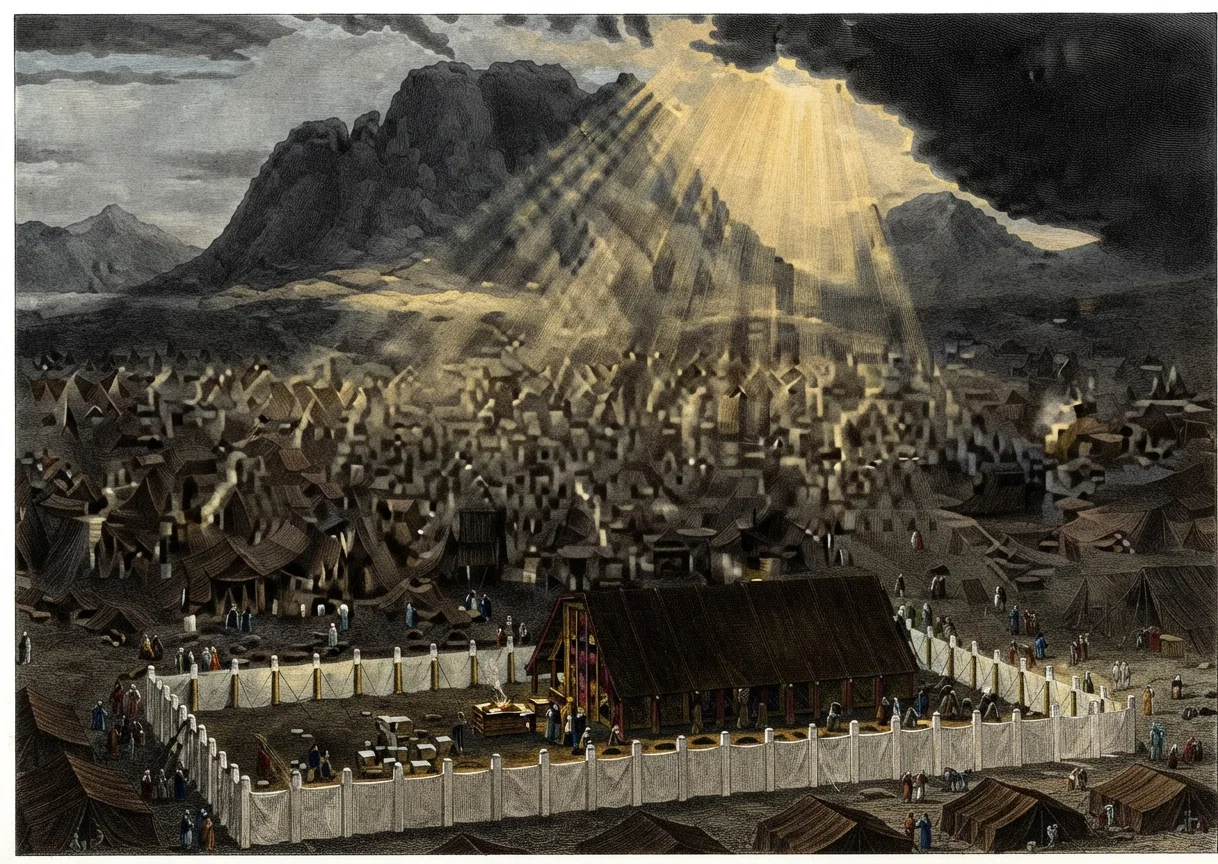
The tabernacle, or temporary structure, built by Moses, and the temple erected by Solomon, were built according to divine instruction, a pattern or model being furnished by the Lord to guide in their construction. Heb. 8:5; 1 Chron. 28:11, 12, 18, 19. In Exodus, chapters 25 to 40 inclusive, we have the instruction which the Lord gave in regard to the construction of the sanctuary, the selection and consecration of the priests, and the record of the erection of the tabernacle and its anointing, for the priestly service to be carried forward in it. In the book of Leviticus the priestly service is described with great care. Why is this subject so clearly and explicitly set forth in the Scriptures? And why should the Lord be so particular to require them to follow a pattern in making the sanctuary, and describe so minutely and specifically the service of the priests? The Lord answers these questions in His own Word. He tells us that the sanctuary built by Moses was a pattern of a sanctuary or temple in

The Pattern.

The pattern shown to Moses in the mount was a pattern of the sanctuary in heaven, so that when Moses followed the pattern in making the tabernacle, it became to the people a pattern "of things in the heavens,"—the heavenly sanctuary,—and its holy places made with hands were "figures of the
heaven, which the Lord pitched, and not man, and that the service of the priests in the worldly sanctuary was a shadow or type of Christ's service as our High Priest in the heavenly sanctuary. See Heb. 8:1-5; 9:9, 23, 24.
true" holy places, as shown by the scriptures last cited. Thus, the Lord designed that the earthly sanctuary and its services should be an object-lesson to teach the people in regard to the priesthood of Christ in the heavenly temple.
In order to learn the lessons we should from the earthly sanctuary and its services, we must study them. We are to remember, however, that the Levitical law which regulated those services was only a "shadow of good things to come, and not the very image of the things." Heb. 10:1. Therefore, it is not necessary, in this study, to do more than call attention to the great leading features of the subject, that stand out clearly and plainly as essential parts of this great object-lesson.
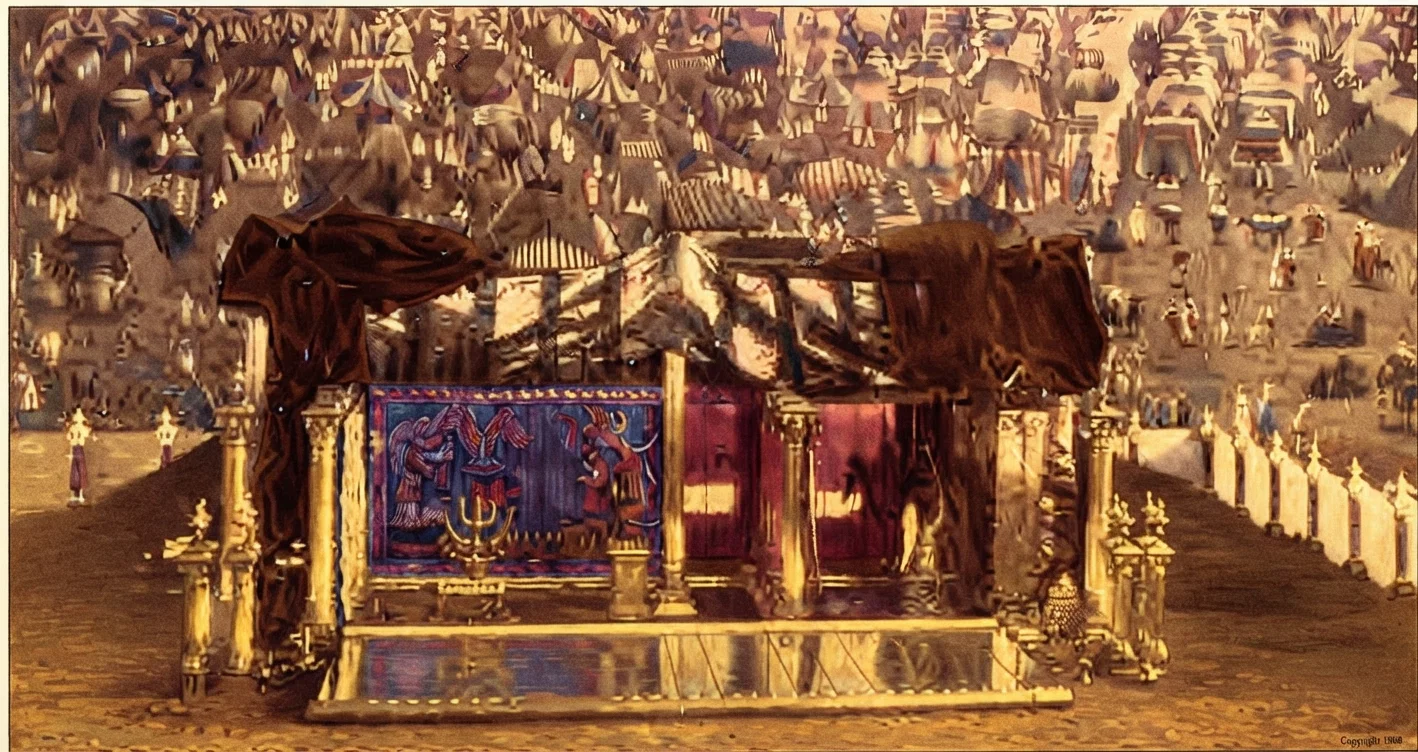
1. The sanctuary had two apartments and a service in each. 2. The first apartment, called the holy place, had three articles of furniture, the table of showbread, the golden candlestick, and the altar of incense.
3. The second apartment, called the most holy place, had in it the ark of the testament in which was the law of God, or Ten Commandments, written by the finger of God on tables of stone. Over the ark, as a cover, was the mercy-seat, and above it were the two cherubim, between whom God's presence, the holy Shekinah, was manifested. The Lord instructed the people to build Him a sanctuary that He might dwell among them. Ex. 25:8. Yet David understood that the sanctuary which Moses built for God to dwell in was only a figure or pattern of the true sanctuary in heaven, where God really dwells between the cherubim. See Ps. 102:19; 99:1.
4. A veil constituted a door by which to enter the holy place, and another veil, known as the second veil, separated the holy place from the most holy place. Heb. 9:1-5.

The Priestly Service.

This service is declared to be an example and shadow of heavenly things. Heb. 8:5. In studying the type, we find: 1. That there was a priestly ministration in each apartment of the sanctuary. 2. That the ministration was completed with one round of service which covered the period of one year, and closed with a special service on the tenth day of the seventh month. The special service was called the cleansing of the sanctuary, and that day was called the Day of Atonement. Lev. 16:2-34; 23:26-30; Heb. 9:1-7; 10:1-3. In order that each high priest might complete the entire round of service, and thus shadow forth the priestly service of Christ, it covered only a period of one year. Christ's priesthood is an unchangeable priesthood, as regards continuance. That is, He is a priest after the order of Melchizedek—an independent line, having no predecessor and no successor. In the Levitical priesthood, the priests were all chosen from the tribe of Levi, but Christ came from the tribe of Judah. Hence, while the form of service under the Levitical priesthood was a type of Christ's service as high priest, its unchangeable character, in not passing from one to another, is represented by the Melchizedek priesthood; and in order that each high priest under the Levitical law might prefigure as fully as possible the complete ministration of Christ without interruption by the death of the priest, the short period of one year was chosen in which a complete round of service was performed. See Heb. 6:20; 7:1-28, especially verses 21-25.
In Leviticus, full instructions are given concerning the sin-offerings. Through these offerings the sins of the people were removed, and borne by the priest to the sanctuary, either through the blood or the flesh of the offering. This service continued throughout the year, and resulted in the transfer of the sins of the people, first to the offering, then to the sanctuary through the ministration of the priest. Thus the sins of Israel were lodged in the sanctuary, and some service was necessary for their removal. This service occurred on the tenth day of the seventh month, as described in Leviticus 16 and 23, reference to which has already been made.

The Cleansing of the Sanctuary.

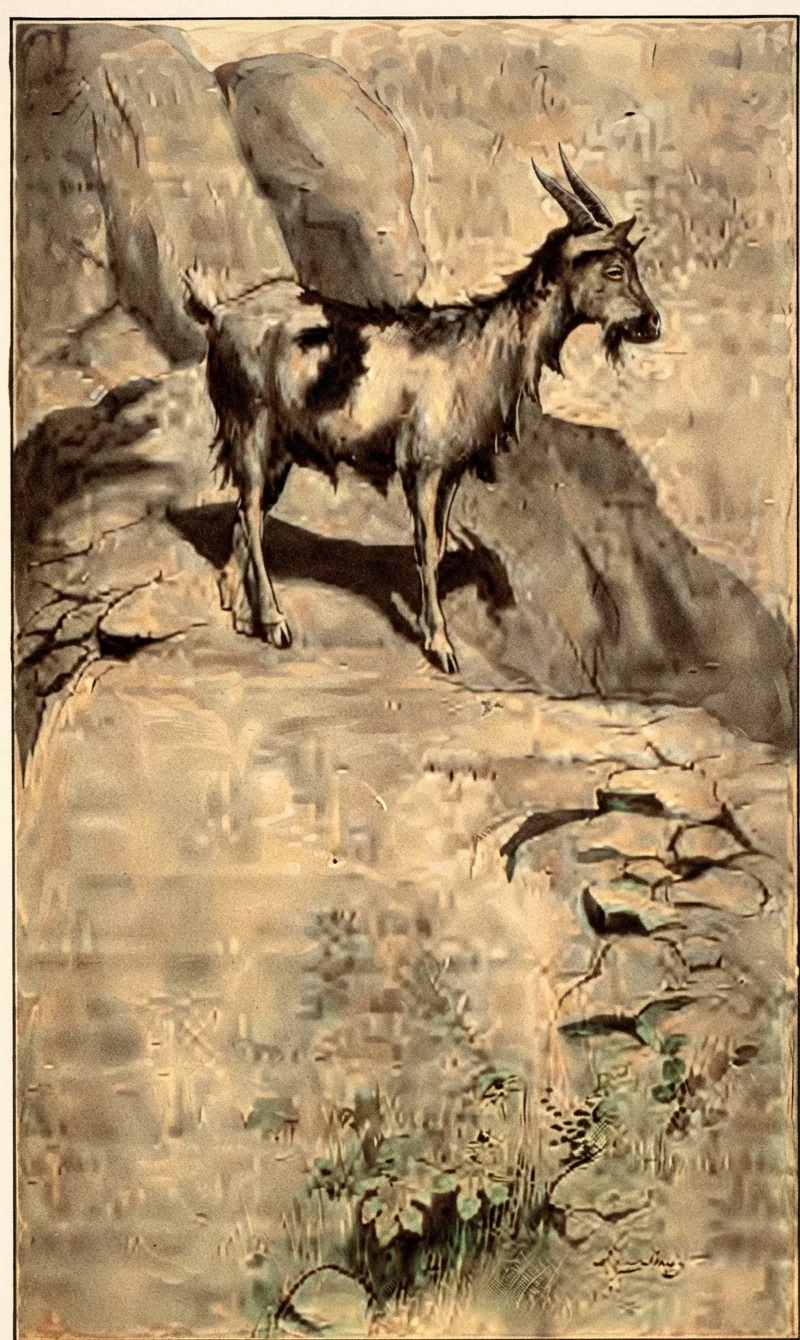
This was the culmination of the year's service, and was a memorable day for God's people. Two goats were chosen, and lots were cast upon them, one for the Lord, and one for the scapegoat. The one upon which the Lord's lot fell was killed, and its blood was sprinkled by the high priest before and upon the mercy-seat in the most holy place, or inner apartment of the sanctuary. By divine appointment, this service released the sins lodged in the sanctuary by the ministration during the year, and they were borne from the sanctuary by the high priest, and transferred to the scapegoat by a simple ceremony. This consisted in the high priest placing both his hands upon the head of the scapegoat, and confessing over him the sins of the people. Then the scapegoat, laden with these sins, was sent away by the hand of a fit man into the wilderness, and there left to perish. Lev. 16:20-22.
This service did not actually remove or take away sin, but it was typical of a real work that does remove and blot out sin. See Heb. 9:1-14; 10:1-14. Let us now compare type and antitype in the sanctuary service. 1. The high priest represented Christ our High Priest. Heb. 8:1, 2; 9:11, 12. 2. The sin-offerings slain day by day throughout the yearly service typified Christ, the Lamb slain from the foundation of the world (Rev. 13:8). He died for our sins according to the Scriptures. 1 Cor. 15:3. He bore our sins in His own body on the tree. 1 Peter 2:24. The nature of the death which is the penalty for sin is clearly shown by the death of Christ and the death of the offerings which represented Him. It is a literal, physical death. 3. The goat upon which the Lord's lot fell was killed as a sin-offering for the people (Lev. 16:8, 9, 15), and therefore must have symbolized Christ, who died as an offering for our sins. 4. The scapegoat (margin, Azazel) represents Satan, the great originator of sin, who, at the close of Christ's priestly work, will have the sins of God's people placed upon him, and he will bear them to the bottomless pit—the earth depopulated and desolate, a veritable chaotic wilderness, as its condition will be during the one thousand years of Rev. 20:1, 2, 7. See Isa. 24:1-3; Jer. 4:19-27.

Once for All.

In Christ's work as our sacrifice, or sin-offering, and as high priest in the heavenly temple, it is done once for all. That is, the one offering on Calvary was ample and complete. Heb. 9:24-28; 10:11-14. And He ministers but once in each apartment of the sanctuary. That is, He continues His service in the first apartment till the time comes for the final work of His ministry, namely, the cleansing of the sanctuary. In harmony with the type our High Priest would begin His work as priest after He ascended, in the first apartment, and He would close His work as priest in the second apartment by His act of placing the sins of God's people upon the head of the anti-typical scapegoat, Satan. As each part of Christ's work is once for all, and the cleansing of the sanctuary in the type was very brief, when compared with the service in the holy place, we know that Christ's ministry in the most holy place will also be brief, and, when it is reached, it will also be a solemn and momentous work, because it will close His work as priest and advocate for guilty man. He will then come to render to every man according as his work shall be.

The Time.

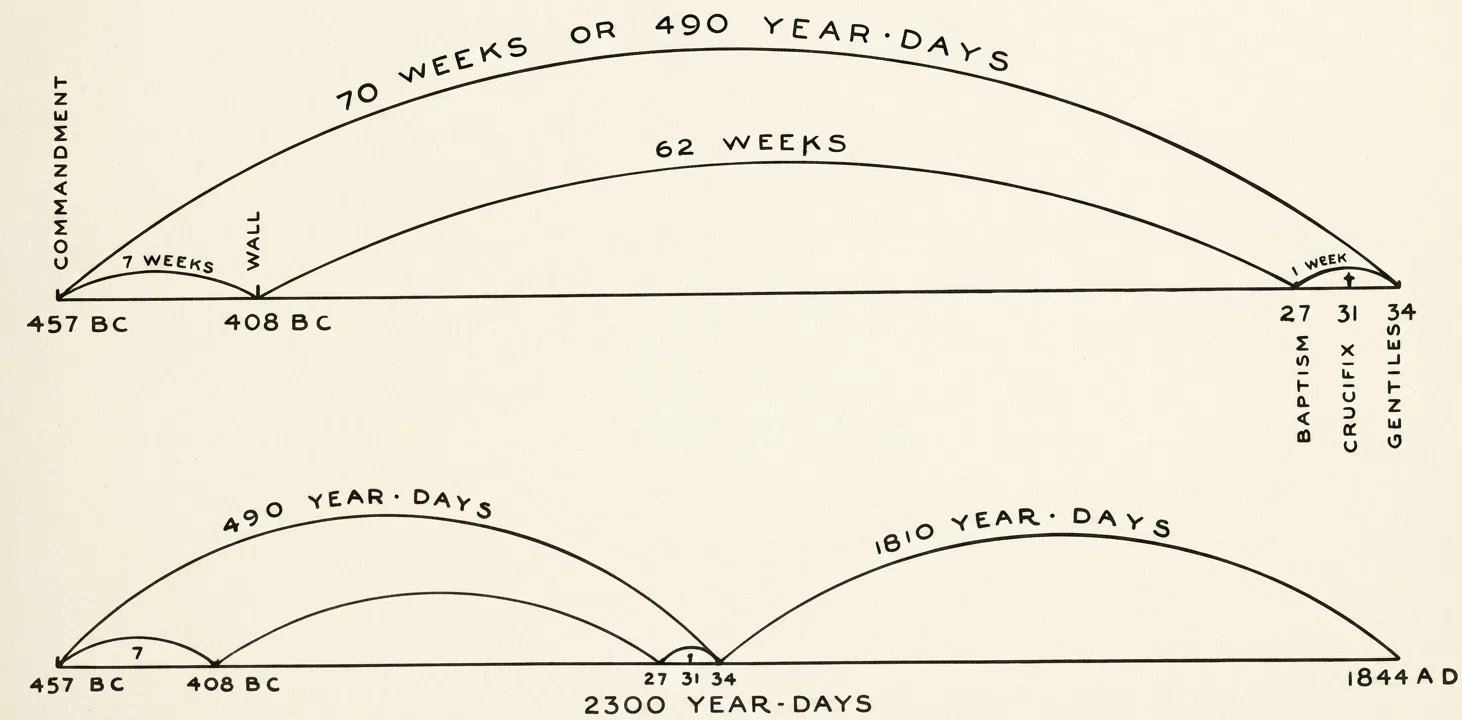
The Scriptures do not reveal when the Lord will come to execute judgment, but they do reveal the time when Christ begins His ministry in the second apartment of the sanctuary, or when the work of cleansing the sanctuary commences. In Dan. 8:14 we read, "Unto two thousand and three hundred days; then shall the sanctuary be cleansed." The year-day principle in prophecy has been thoroughly established as true, and it is generally accepted by Bible expositors; that is, that a day in symbolic prophecy represents a year, and this rule is plainly stated in the Scriptures. See Num. 14:34; Eze. 4:4-6. Hence, at the end of 2,300 years the sanctuary would be cleansed. In order to know when this period will end, we must know the date of its commencement. This is fully explained in Dan. 9:20-27. There a period of seventy weeks is cut off from the 2,300 days for a certain work to be accomplished. This is indicated in the diagram appended to this article. Verse 25 states that the period began with the commandment to restore and build Jerusalem. By reference to the date in the margin of Ezra 7, where the decree is recorded, we learn that it was B.C. 457. And, as all the intermediate dates coincide exactly with the dates recorded in history, we know that we have the correct date for the commencement of the period, namely, B.C. 457. The termination of the period would therefore be in A.D. 1844. Hence, since that date our great High Priest has been engaged in the last solemn work in the heavenly temple—the work of cleansing the sanctuary. This work can not relate to the earthly sanctuary, because that was destroyed, and its service wholly discontinued in A.D. 70, when Jerusalem was destroyed, as predicted in Dan. 9:26.
This cleansing of the sanctuary, as we learn from the type, is not from physical impurities, but from the sins of the people, borne into it by the ministration of the priest. The necessity of this is plainly stated in Heb. 9:21-24. John, on the Isle of Patmos, had a view of the heavenly temple and some of its furniture. See Rev. 8:3-5; 11:1, 19; 15:5, 8. He declares that the ark of the testament was seen when a certain time was reached. When Christ entered into the most holy place, He opened to the view of those who studied His priestly work, a system of wonderful truths in connection with the plan of redemption as revealed and taught in the great object-lesson we have been studying. We will close by giving a brief summary of some of the great truths which are revealed by the study of the sanctuary: 1. That there is a sanctuary in heaven of which the earthly sanctuary was a pattern or figure. 2. That the ministration in the earthly sanctuary was an example or shadow of the ministration of Christ in the heavenly temple. 3. That the cleansing of the sanctuary at the end of the 2,300 days, or years, in 1844, was not the coming of Christ and the destruction of the earth by fire, but it was a cleansing from sin by the blood of Christ, as prefigured in the type. 4. That Christ's ministration in the most holy place, beginning in 1844, opens to view the ark of the testament, as described in Rev. 11:19, and leads to a study of the law of God contained in that ark. This study reveals the great truth that God's law is as unchangeable as its Author, and reads the same as it did when it was spoken by the voice of God from Mount Sinai, and written by the finger of God on the tables of stone. Therefore it still reads, "The seventh day is the Sabbath of the Lord thy God." This light from the sanctuary led candid, conscientious searchers after truth to decide to obey God in the observance of the Sabbath, and this reform developed the people now known as Seventh-day Adventists. Truly, "the path of the just is as a shining light, that shineth more and more unto the perfect day." Prov. 4:18. 5. That the second coming of Christ is near, even at the doors, but the day and the hour of His coming has not been revealed. May this great theme which God has given as an object-lesson to teach us more effectually and more forcibly the story of redemption, be greatly blessed to the good of every reader, is the fervent prayer of the writer.

THE RESURRECTION OF THE DEAD—A NECESSITY.

By A. O. TAIT.
What does the Bible teach as regards the resurrection of the dead?
"But this I confess unto thee, that after the way which they call heresy, so worship I the God of my fathers, believing all things which are written in the law and in the prophets; and have hope toward God, which they themselves also allow, that there shall be a resurrection of the dead, both of the just and unjust." Acts 24:14, 15. The resurrection is clearly a Bible doctrine, for this text shows that Paul found it taught in both "the law and in the prophets."
2. If the dead go either to heaven or to a place of torment as soon as they die, what is the need of this resurrection?
This is a question for you to ponder and answer for yourself.
3. When will the resurrection take place?
"I will raise him up at the last day." John 6:44. It is at the "last day" that Jesus will raise the dead.
4. What power will awaken the dead?
"Marvel not at this; for the hour is coming, in the which all that are in the graves shall hear His voice, and shall come forth; they that have done good, unto the resurrection of life; and they that have done evil, unto the resurrection of damnation." John 5:28, 29. The dead are in the graves, and the voice of the Son of God brings them forth. Thus is it made plain that, were it not for the power of God to raise from the dead, the grave must forever hold all its occupants.
5. What redemption is promised?
"I will ransom them from the power of the grave; I will redeem them from death; O death, I will be thy plagues; O grave, I will be thy destruction; repentance shall be hid from mine eyes." Hosea 13:14. The grave and death have power, but our Father has promised to ransom all His own from their power, and not only so, but death and the grave shall both be destroyed.
6. In what condition will the righteous dead be raised?
"Behold, I show you a mystery: We shall not all sleep, but we shall all be changed, in a moment, in the twinkling of an eye, at the last trump; for the trumpet shall sound, and the dead shall be raised incorruptible, and we shall be changed. For this corruptible must put on incorruption, and this mortal must put on immortality. So when this corruptible shall have put on incorruption, and this mortal shall have put on immortality, then shall be brought to pass the saying that is written, Death is swallowed up in victory. O death, where is thy sting? O grave, where is thy victory?" 1 Cor. 15:51-55. They go into the grave mortal, they are raised immortal; they go into the grave corruptible, subject to decay; they are raised incorruptible, beyond the reach of decay.
7. What would be our condition were there no resurrection from the dead?
"Now if Christ be preached that He rose from the dead, how say some among you that there is no resurrection of the dead? But if there be no resurrection of the dead, then is Christ not risen; and if Christ be not risen, then is our preaching vain, and your faith is also vain. Yea, and we are found false witnesses of God; because we have testified of God that He raised up Christ; whom He raised not up, if so be that the dead rise not. For if the dead rise not, then is not Christ raised; and if Christ be not raised, your faith is vain; ye are yet in your sins. Then they also which are fallen asleep in Christ are perished." 1 Cor. 15:12-18. Thus the Bible plainly makes the resurrection the doorway to immortality.
8. Why is the resurrection not preached as much as it was in Bible times?
Plainly because the unscriptural doctrine that the dead go to heaven immediately upon dying has been made to take the place of the hope of the resurrection. God points us to the time when the grave must give up its dead as the time of victory, and not when the cruel monster is victorious over us by locking us in his relentless embrace.

A Judgment Work

By G. B. Thompson
HOW SOLEMN to the hosts of Israel encamped around the sanctuary must have been the typical Day of Atonement! It was a time in which a man was to afflict his soul, not in doing penance, but in contrition of heart for sin, that he might not be cut off.
The sanctuary was the dwelling-place of Jehovah. Here the Shekinah of His glory was seen. Daily throughout the entire year the sinner brought his offering to the door of the sanctuary, and, having confessed over the victim his sin, it was slain with his own hand, and the blood was carried by the high priest into the first apartment of the tabernacle. Thus, in type, the sins of Israel were transferred from the sinner to the sanctuary.
But once in the end of the year—the tenth day of the seventh month—a marked change took place in the service. "But into the second went the high priest alone once every year, not without blood, which he offered for himself, and for the errors of the people." Heb. 9:7. The "patterns of things in the heavens" must needs be cleansed, not from physical, but moral, uncleanness. The sins which, in figure, had been carried into the sanctuary must in some way be removed.
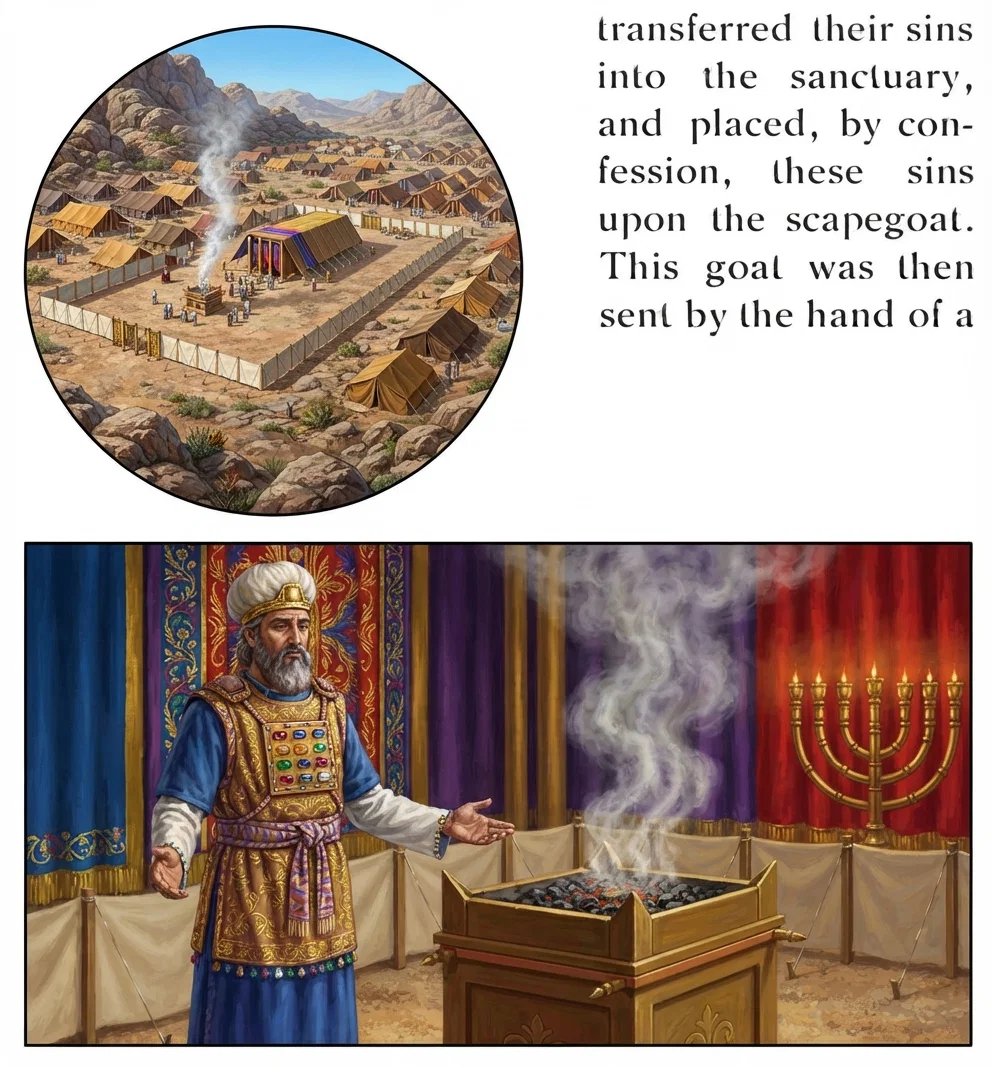
A full description of the work upon the Day of Atonement is given in Leviticus 16. Turn and read carefully the account of this soul-inspiring service. The Bible contains nothing more interesting or important. Two goats were taken—one for the Lord, the other for the scapegoat. The Lord's goat having been determined by lot, it was slain. Then the high priest, clad in his robes of spotless purity, having first made an offering for himself, took this blood, and went into the most holy place, into the immediate presence of God, and over the mercy-seat on the ark containing the ten-commandment law which the sinner had transgressed, he sprinkled the blood, and made an atonement for sin. This done, he came out to the door of the sanctuary laden with the sins of those who, by confession, had transferred their sins into the sanctuary, and placed, by confession, these sins upon the scapegoat. This goat was then sent by the hand of a fit man into the wilderness to perish. The round of service was then complete, and the sanctuary was cleansed from sin.

Putting Away Sin.

Note carefully that this work consisted in putting away sin. It was a decisive work. Some were cut off. "For whatsoever soul it be that shall not be afflicted in that same day, he shall be cut off from among his people." Lev. 23:29. A work which removes sin, and determines who are numbered among the Israel of God is a judgment work. Here a line was drawn between those who served God and those who served Him not.
This was the judgment in type, the "example and shadow of heavenly things." Heb. 8:5. It was the eternal judgment of the great day, portrayed in figure. There is in heaven the true tabernacle. Heb. 8:1, 2. This, too, must be cleansed, not with the blood of animals, but with the precious blood of Christ. "It was necessary therefore that the copies of the things in the heavens should be cleansed with these; but the heavenly things themselves with better sacrifices than these." Heb. 9:23.
When Christ ascended He entered within the veil, into the first apartment, the holy place (Heb. 6:19, 20). He is the victim; He is also the high priest. Through His merits the sins of all those who have confessed their transgressions are carried into the heavenly sanctuary. By confession we send our sins "before unto judgment." 1 Tim. 5:24. The sins of all the true Israel of God are thus transferred unto the sanctuary.
The heavenly sanctuary, like the type, must be cleansed, not from material impurity, but from sin. Just as the high priest, once in the end of the year, went into the most holy place, so Christ, "once in the end of the world" (Heb. 9:26), at the close of His ministry for sin in the heavenly sanctuary, must enter the most holy place, and make an atonement for sin. And just as surely as the typical service foreshadowed a work of judgment, just so surely will the terrible judgment of the great God then begin. The lives of men will be compared with the law of God—a copy of which was in the earthly sanctuary—and all who have not forsaken evil will be cut off.
The seer in Babylon in holy vision beheld the opening of this terrible tribunal. "I beheld till the thrones were placed, and One that was ancient of days did sit; His raiment was white as snow, and the hair of His head like pure wool; His throne was fiery flames, and the wheels thereof burning fire. A fiery stream issued and came forth from before Him; thousands of thousands ministered unto Him, and ten thousand times ten thousand stood before Him; the judgment was set, and the books were opened." Dan. 7:9, 10. What a sublime description of the opening of the heavenly tribunal—the Supreme Court of the universe. Its decrees know no change. Those pronounced holy will remain holy still, and those pronounced filthy will be filthy forever. Rev. 22:11. As Paul directed the mind of Felix to this time, the governor shook with fear. Well may those without God tremble. But in Christ we are safe.
Reader, pause in the mad rush for the baubles of earth, and listen: Elsewhere in this paper it is shown from prophecy, whose accuracy and truthfulness none can question, that the heavenly Court—the cleansing of the true sanctuary—commenced A.D. 1844. Oct. 22, 1904, marked the sixtieth anniversary of the beginning of this solemn work. How far have its investigations proceeded? How much longer will it sit ere the eternal Judge shall arise from His burning throne, and proclaim the mystery of God finished? When will the cases of the living pass in review? The exact time is beyond the ken of mortals, but it must be soon. The type calls for a work comparatively short. Are you ready for the record of your life to be placed beneath the scrutiny of the Ancient of days? Have you made Christ your friend? Is the blood of the Lamb upon the lintels of your soul, that, when the avenging angel shall pass over, he will "see the blood"? If not, delay no longer. Flee from the place where you are. Confess and forsake your iniquity, ere the door of the ark of mercy shall be shut forever, and you be "cut off," and numbered among the transgressors.

MY JUDGE.

BY MRS. L. D. AVERY-STUTTLE.
O Christ, I know that Thou dost see The hidden motive of my soul; Each word, each thought, is known to Thee, And Thou, O Christ, my Judge must be, Thou wilt appoint my lot to me, When like a mighty, parting scroll The quaking heavens asunder roll.
I know Thy judgment will be just; But O! Thy gentleness is great. Thou knowest that Thy child is dust, Thou knowest the fleshly heart of lust, I will not fear, O Christ, but trust In Thy dear, wounded hands, my fate— Thou canst not leave me desolate.
If man should judge my trembling soul, How drear, how sad, would be my lot; Then might I fear when tempests roll, Then might I miss the glorious goal, For ah! the struggles of my soul Perchance my brother hath forgot, Perchance my heart he knoweth not.
But O! what joy that He who made My shrinking soul, her judge shall be; I need not fear nor be afraid When in the balance I am laid, And in the scales of justice weighed, By Him who faced Gethsemane— The sinless Man of Calvary.
For O! one crimson drop will pay The overwhelming debt of sin, One drop of blood in that great day From Calvary's mountain shall repay, And all my guilt shall wash away; And through the gates all free from sin, That pierced Hand shall lead me in.

Prophecy Is Miraculous

PROPHECY is equivalent to any miracle, and is of itself evidently miraculous. . . . The voice of Omnipotence alone could tell all that lay hid in dark futurity, which to man is as impenetrable as the mansions of the dead—and both are alike the voice of God.—Dr. A. Keith.

The Purpose of Prophecy

God gave us His Word of prophecy, not to puzzle, mislead, or deceive, but to be a light to teach us His own purpose, and our duty and chief end.—James Scott.
Continue reading: Judgment "Is Come."