Your ShelfYour Projects

Signs of the Times, Vol. 30, No. 46.

SIGNS OF THE TIMES
Earlier text: GOD’S MESSAGE FOR THIS TIME

HEBER, THE FIRST-BORN

A Story of Israel's Deliverance

By HART HALL

CHAPTER V.

FOR many days the plague continued, then ceased as suddenly as it had begun. The king soon reappeared and assembled the court in its usual routine. The annoying Hebrews had not been seen, and, with a suavity fostered by hope that he was rid of them at last, the monarch presided over the affairs of the state.
The next day but one was appointed for devotions at the river, and with great pomp and ceremony the royal company repaired to their usual place of devotions. But, like a wraith or apparition of evil to the royal retinue, Moses and Aaron appeared for the second time at this place.
The king no longer ridiculed them or affected haughtiness, but dreaded and shrank from the judgments which he knew their appearance foretold. Fearlessly the prophet spoke: "Thus saith the Lord, Let My people go, that they may serve Me. Else, if thou wilt not let My people go, behold, I will send swarms of flies upon thee, and upon thy servants, and upon thy people, and into thy houses; and the houses of the Egyptians shall be full of swarms of flies, and also the ground whereon they are. And I will sever in that day the land of Goshen, in which My people dwell, that no swarms of flies shall be there; to the end thou mayest know that I am the Lord in the midst of the earth. . . . To-morrow shall this sign be."
The king called his wise men and philosophers in council, and unanimously they upheld him in resisting the divine mandate. After their idolatrous ceremonies had been performed, the return to the palace was made with great eclat.
On the morrow the Egyptians witnessed the fulfilment of the warning. Flies, or what is supposed was the great Egyptian beetle, scarabacus sacer, which is constantly represented in their sculpture, filled the land. The pest was a venomous creature with a painful bite, and besides being annoying and destructive was an object of worship. Thus were they scourged by their own superstitions.
The plagues that had been sent upon them hitherto had been a severe trial in their annoyance, but this visitation was a punishment that seemed intolerable, and like its predecessors afflicted high and low alike. Only in the land of Goshen the plague was not found.
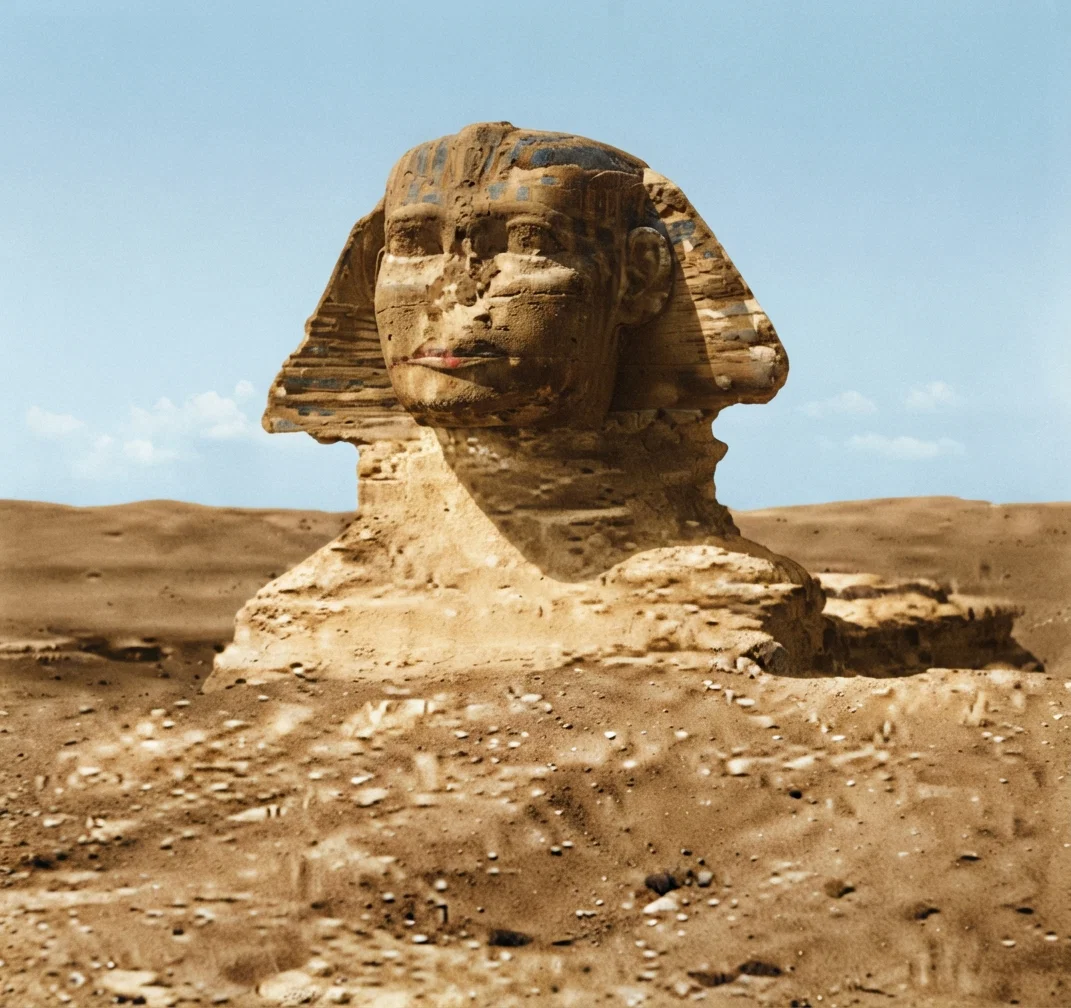
The Sphinx Which the Hebrews May Have Helped to Build.
In haste the monarch despatched Heber for Moses and Aaron, and when they arrived at the palace, he sternly commanded them, "Go ye, sacrifice to your God in the land." "It is not meet so to do," replied Moses, "for we shall sacrifice the abomination of the Egyptians . . . before their eyes, and will they not stone us?"
They would be required to sacrifice animals that the Egyptians held sacred, and such an insult to the gods would be an abomination, and would not be tolerated. To slay a sacred animal even accidentally was punishable with death.
Pharaoh replied, "I will let you go, that ye may sacrifice to the Lord your God in the wilderness; only ye shall not go very far away; entreat for me."
"Behold, I go out from thee," said Moses, "and I will entreat the Lord that the swarms of flies may depart from Pharaoh, from his servants, and from his people, to-morrow; but let not Pharaoh deal deceitfully any more in not letting the people go to sacrifice to the Lord."
The next day the flies departed as suddenly as they had appeared; there remained not one. But as soon as the air was free from the pest, Pharaoh's heart hardened. Stubbornly resisting all evidence, all promptings of the Spirit, all the testimony of the magicians, he continued in his determined course, supported by the priests and counselors.

CHAPTER VI.

The loss of a nation of bondmen was not to be considered, was not to be tolerated.
Again the prophets appeared with a warning message. A dreadful plague of murrain was threatened upon the Egyptian cattle, horses and camels, sacred animals, and beasts of burden. They were to be slain from one end of the land to the other, only the animals of the Israelites were to be exempt.
Time was given for consideration, but steadfastly the king persisted in his rebellion. So, swiftly, at the time specified, the plague appeared, and the beasts of the Egyptians, which were not only their property, but their deities as well, fell a prey to the wrath of God against their masters. Caravans of camels and asses fell under their burdens on the highways. The steeds of Pharaoh's hosts stiffened and died in their stalls, oxen at the cart and the furrow fell under the yoke, and from all over the land a great wail of despair went up.
Hosts of impoverished Copts waited on Pharaoh beseeching him to release the Hebrews, that the curse might be stayed. But the philosophers and the great men urged in reply that the disease was from natural causes. "Why," said they, "shall we give up the ones who are enriching the kingdom?"
To satisfy himself Pharaoh sent the messenger, Heber, with a letter of inquiry to the chief officer in Goshen, to ascertain whether or no the Israelites suffered with the rest.
With a glad heart the Hebrew had sped away for the land where he had spent his childhood, for was not his home hard-by on the way to the house of the chief magistrate? and, if not delayed, he might steal a moment to greet his parents. Many, many days had passed since his loving mother had sobingly clung to him in her despair at parting, kissing his fair cheeks and bidding him be true to his father's God at the king's palace, whatever happened to him. The tears welled up at the remembrance, blinding his eyes; but, brushing them away, he sped the faster, on and on.
Fortune favored him, for the officer promptly inscribed his report on a roll of papyrus, sealed it carefully, and bade him hasten. In a moment he was away like a flash, on his return; and, as he darted along, planned his movements carefully. Turning onto a side street he passed rows of houses, all squarely built of sun-dried brick laid in bitumen. They all looked the same with their flat roofs and large doorways, but he knew the one, and with a glad exclamation burst in upon his parents.
In Egypt's Land on the Nile.
Surprised beyond measure, they greeted him with a cry of joy, embracing him affectionately. His brothers and sisters crowded around in wondering bashfulness. After kissing them each in turn, he exclaimed, "I must hasten with the king's message. There are fearful things done in the land, have ye not heard?" "Yea," said the father, "the masters no longer beat the men as of yore. And the prophets are among us daily saying, Soon shall the deliverance come."
"Has aught of thy cattle died?" "None," was the reply. "I must hasten," again exclaimed Heber, "or the king will have my head," and with a farewell he was out and away.
Pharaoh received with stoical indifference the information of Goshen's immunity from the plague. Hardening his heart to the pleadings of his own people, he defied the judgments of the Almighty.
As he walked in the gardens early in the cool of the succeeding morning, he was again brought face to face with the prophets.
Not a word was spoken; but Moses, taking handfuls of ashes from his gathered tunic, scattered them high in air again and again many times. The king, with lowering brows, black with hate, watched the action, but understood none of its meaning. But it was deeply significant.

CHAPTER VII.

Four hundred years before, God had revealed to faithful Abraham, under the symbol of a burning lamp and a smoking furnace, the affliction and bondage of His people in Egypt. It was not His will that they should serve in bondage, but it was the result of their own apostasy from Him, occurring so many times in their later history. Sin, in all its phases, tends to deepest distress and bondage.
But now the years were fulfilled. He remembered His covenant with Abraham, Isaac, and Jacob, and would stretch forth His arm to save His heritage from the furnace of affliction. And as Moses scattered the ashes of the furnace the fine particles were carried by the winds over all Egypt, breaking forth in boils on man and beast. Only in Goshen the plague did not rest.
Pharaoh in his desperation called for the magicians again to see if they could imitate the plague; but they could not appear before him because the scourge rested on them also. Their vaunted powers only making them contemptible, no longer were they able to encourage the king in his stubbornness against the God of Israel.
Ordinarily the king of Egypt was a slave to the customs and duties of office. Every part of daily life was guarded by form; each moment something on the royal program awaited him. In the morning he must read communications and reports from different parts of his empire; then the kingly robes were donned; then an offering to gods by the priests in the name of the sovereign; after which they read to him out of the sacred books exhorting him to emulate their wisdom and virtue. He could go out, but must be accompanied, and must return at the prescribed moment; and so it went, year in and year out.
But with priests and courtiers tortured with the blains, unable to appear, Pharaoh was at absolute liberty. At any other time he would have enjoyed his vacation; but now he wandered aimlessly about the palace or in the beautiful gardens, plucking the rare blossoms, and meditating deeply over the turn affairs had taken.
It was here that Moses and Aaron found him again, and another fearful warning fell upon his ears: "Thus saith the Lord God of the Hebrews, Let My people go, that they may serve Me. For I will at this time send all My plagues upon thine heart, and upon thy servants, and upon thy people; that thou mayest know that there is none like Me in all the earth. For now I will stretch out My hand, that I may smite thee and thy people with pestilence; and thou shalt be cut off from the earth. And in very deed for this cause have I raised thee up, for to show in thee My power; and that My name may be declared throughout all the earth. As yet exaltest thou thyself against My people, that thou wilt not let them go? Behold, to-morrow about this time I will cause it to rain a very grievous hail, such as hath not been in Egypt since the foundation thereof even until now. Send therefore now, and gather thy cattle, and all that thou hast in the field; for upon every man and beast which shall be found in the field, and shall not be brought home, the hail shall come down upon them, and they shall die."
The report quickly spread throughout the land; but rain was a very unusual occurrence in Egypt, and the people were slow to believe. However, they had great reverence for Moses as the one who had power to remove the plagues, and many finally gathered the few beasts that remained to them from the plague of murrain, into their houses, as barns or stables were unknown among the common people in that warm climate. But those who believed not the word of the Lord left their animals in the fields and pastures.
The morning dawned with the eastern sky black and threatening. Heavy, low-ranging clouds rapidly filled the heavens, driven by a fierce wind that soon grew to a hurricane. Muttering thunder echoed in the distance, and streaks of vivid lightning shot across the sky.
Alarmed, the Egyptians hastened to the fields for their beasts, but ere they could return rain began falling in torrents, and with it great hail that struck down man and beast; it pounded the beautiful fields of barley and flax into the earth, stripped trees and vines of limbs and foliage, laying desolate the labor of years.
The thunder's crash grew fiercer and heavier as the lightning struck closer. Buildings were stripped of their parapets and roofs, burying the inhabitants beneath an avalanche of brick and stone. And above all, carried with the wind, came the cries of the people and the bellowing of beasts.
At the palace, terror reigned supreme. Caste and position were forgotten as prince and menial labored together to shield valuables from destruction, and to barricade windows and doors.
Pharaoh, fearing the result of the storm, haunted the halls, quaking as once and again a fearful detonating crash told the story of the lightning's havoc. Suddenly, he felt some one touch his arm, and turning, saw the slave messenger, Heber, standing before him.
"Wilt thou I go for the prophets?" he inquired. "Canst thou face the fury?" asked the king. The lad nodded. "Thou canst never reach Goshen," Pharaoh ejaculated in astonishment. "The prophets are abiding not far from the walls of the city, at the house of one of Pharaoh's officers." "Go, then; thy God save thee," commanded the king.
In a moment the lad was gone, and as he left the palace and met the force of the tempest he was carried off his feet, but the king at the window saw him rise again unharmed, seemingly unmindful of the falling, or rather, hurling, hail about him, and bending to meet the gale he struggled on, and was lost to view.
Pomona, Cal.
(To be continued.)

HUSBANDS AND WIVES.

By MRS. L. D. AVERY-STUTTLE.
I FEAR it is quite common for married people to think that the marriage ceremony renders null and void all the little courtesies of life; that, because they are married, the bars may be let down and the gate opened to all manner of discourtesy and petty meanness. Is it any reason that because a man has become your husband you are at liberty to treat him with less respect than if he were a mountebank or a charlatan?
My brother, does it logically follow that because you have promised to love and protect one woman above all others, and because she has become your wife, you may annoy and persecute and harass her,—that you may give her less attention both in private and in public than you do any other woman of your acquaintance? or that you are to treat her in a way that you would never have dreamed of doing before you took the solemn oath to love and protect her? O how many ardent and attentive lovers become cold and heartless husbands!
But it need not be so. Let the public press unite in educating the people upon this point. Let society frown upon the nagging and discourteous husband or wife; but, above all, let parents instil into the minds of their sons and daughters, both by precept and example, respect for the sanctity of the marriage relation.
O, I wish most earnestly that I could whisper into the ear of every newly-wedded couple a few simple and plain truths and maxims for every-day conduct, which, if lived up to conscientiously, would bring into the home such peace and love and joy as is characteristic only of the true home.
In the first place I should say, Look out for jealousy. This is the green-eyed monster which has wrecked more homes, and cursed and blighted more lives, than can be estimated. "But," you say, "how can I endure to see my husband show such familiarity toward that hateful Miss Blank." "Or," says some one else, "I can not stand quietly by and see my wife smilingly accept the attentions of that profligate man, and say nothing about it. I admit I am jealous,—and, positively, I will not endure it."
Now, I want you to listen to reason; you are both of you reasonable people, I am sure. In the first place, let me assure you that neither a wife nor a husband would be apt to do anything in the very presence of his or her own lawful companion which, either considered wrong. It is the deed done in secret, hidden from the accusing and criticizing eye of husband or wife or gossiping public,—it is the deed done, or the word spoken with the self-accusing blush of shame upon the cheek, that, in the eye of God, condemns one. So, should you notice any little departure from what you deem strict integrity, I beg of you, don't brood over it in secret, don't hide it in your heart as Achan hid the golden wedge in his tent, or it will prove to your soul also a snare and an "accursed thing." At the very first opportunity talk it over,—husband and wife together. It will need but a few tactful, tender, earnest words to effect a perfect reconciliation. O, don't brood,—talk it over; not accusingly and suspiciously, but frankly and trustingly. Believe me, there are few husbands and few wives but will respect your feelings, and love you the better. Next,—and let me whisper this in your ear especially, my sister—look out how you are tempted to speak disparagingly of your husband even to your most trusted friend. It will in the end prove to you as gall and wormwood and bitterness. If you have heartache, whisper it to no human ear. Tell it to the pitying One who alone can understand and help you.
"O, but I must tell my mother, sometimes. John was so cruel to me last evening. He even refused to kiss me when he went down-town. I cried all night, and I told my mother in the morning."
Well, but did the dear mother help you any? "O, I don't know as she did,—she couldn't, you see, but she sighed, and said she was afraid John didn't half appreciate me."
Well, now candidly, don't you think it would have been better to have talked it over with John? And then, besides, I am afraid poor John had what he considered a good reason for omitting his usual kiss. But you admit that even your mother can't really help you any in such matters, so why worry her with it at all. She loves you, yes, but her wisdom may be at fault; and even tho in her best judgment and her mother-love she be perfect, she must have more than human strength to be able to give you aid in times of such testing. Go to the Mighty One. His love and tenderness are greater than a mother's, and His ear is always open.
I know a dear little woman who has seen such sorrow as would have called for loud reproaches from less faithful lips,—whose husband has caused her many a bitter heartache, many a sleepless night, and many a tear-stained pillow. But her lips are closed, even to her most intimate friends. O, I say, God bless that noble, faithful woman! True as steel, good as gold, faithful unto death.
Again let me whisper, Try to be first to ask forgiveness of the other in any little misunderstanding. It is a noble thing to acknowledge one's self in the wrong. But I have seen people who would not do it, no matter how hard conscience pricked with her self-accusing needles,—and it is because they were not taught to do it when they were children.
O, how sad that poor, feeble, imperfect mortals will not humble themselves enough to acknowledge a fault committed even against their best loved!
We must learn to bear and forbear. Oftentimes the revelation comes to us shortly after marriage that we have not chosen the perfect man or woman that we supposed we had. Then we must remember that we also are dust. It ill becomes us to look for perfection in others. Then, tho the halo of glory with which we had invested the head of our best beloved gives place at times to a "pillar of cloud," let us remember that we, too, have caused the chill of disappointment in the loving heart of one who loves us fondly, despite our mistakes,—and remembering this, let us be forgiving and tender, and forget not that the marriage vow is sacred, and that it requires a constancy which reaches to the grave, and lasts until death folds the loving hands, and covers the gentle eye with his filmy veil.
O wife, be thou kind and gentle, And husband, be true and brave, For no kind word can e'er be heard 'Neath the clods of the silent grave.

THE WORD OF GOD.

Where is God's Word current and established? "Forever, O Jehovah, Thy Word is settled in heaven." Ps. 119:89.
2. What is the nature of this Word? "The words of Jehovah are pure words; as silver tried in a furnace on the earth, purified seven times." Ps. 12:6.
3. How was this Word given to men? "Men spake from God, being moved by the Holy Spirit." 2 Peter 1:21. "The Spirit of Jehovah spake by me, and His Word was upon my tongue." 2 Sam. 23:2.
4. How does God regard His Word? "Thou hast magnified Thy Word above all Thy name." Ps. 138:2.
5. What is that Word to the believer? "The words that I have spoken unto you are spirit, and are life." John 6:63.
6. What change is wrought in us by this Word? "Having been begotten again, not of corruptible seed, but of incorruptible, through the Word of God, which liveth and abideth." 1 Peter 1:23.
7. How is this life to be maintained? "Man shall not live by bread alone, but by every word that proceedeth out of the mouth of God." Matt. 4:4.
8. What will feeding on that Word accomplish? "Long for the spiritual milk [of the Word] . . . that ye may grow thereby unto salvation." 1 Peter 2:2.
9. What will the Word thus used be to us? "For the commandment is a lamp; and the law is light." Prov. 6:23.

Lamp Chimney Index

Our "Index" describes all lamps and their proper chimneys. With it you can always order the right size and shape of chimney for any lamp. FREE. Macbeth, Pittsburg, Pa.

MICHIGAN SANITARIUM TRAINING-SCHOOL FOR NURSES.

Next class will begin Jan. 4, 1905. Write at once for particulars. Address, T. H. Midgley, Michigan Sanitarium, Kalamazoo, Mich.

LLEWELLYN MORRISON'S POEMS.

HEART BELLS: A volume of poems, hymns, songs, lyrics, and descriptive verse, covering a wide range of subjects. 300 pages (10,000 lines) finely printed on toned paper with photo-engraving, bound in best English cloth, stitched binding. Specially suitable for a holiday gift book. Part of an edition, to clean out stock at cost. Fifty cents each by mail, prepaid, so long as the supply holds out. Address, Llewellyn A. Morrison, 106 Shuter Street, Toronto, Can.

OLIVES

Nice, large, pickled, ripe or green olives. Guaranteed.
A. E. CRIST Marysville, California

Discounted Pianos and Organs

Brother L. I. Sage, who is in the music business at Ventura, California, has agreed to sell pianos, organs, and small instruments on easy payments at one-third discount to all readers of the SIGNS OF THE TIMES. Direct all correspondence to L. I. Sage, Ventura, California.

Physician Wanted

Physician Wanted.—Finest equipped treatment rooms in Southern California, with growing city practise. Splendid opening for enterprising man. Climate unexcelled. Reasons for selling, appointment elsewhere. For particulars, address, Dr. J. R. Leadsworth, Riverside, Cal.

Individual Communion

Cups

Why permit a custom at the communion table which you would not tolerate in your own home? Individual Communion Cups are sanitary. Let us send you a list of nearly 3,000 churches where they are in use. Send for Free Book.
We offer a Trial Outfit free to any church. Sanitary Communion Outfit Co., 29th St. Rochester, N. Y.

WANTED

A Second Hand Set of Clark's Commentary. Address, SIGNS OF THE TIMES, Mountain View, Cal., stating style of binding, condition, and price; but do not send books until requested to do so.
INTERNATIONAL SERIES THE SUNDAY SCHOOL

LESSON 10.—DECEMBER 4.—HEZEKIAH REOPENS THE TEMPLE.

Lesson Scripture, 2 Chron. 29:18-31, A. R. V.

(18) "Then they went in to Hezekiah the king within the palace, and said, We have cleansed all the house of Jehovah, and the altar of burnt-offering, with all the vessels thereof, and the table of showbread, with all the vessels thereof. (19) Moreover all the vessels, which King Ahaz in his reign did cast away when he trespassed, have we prepared and sanctified; and, behold, they are before the altar of Jehovah.
(20) "Then Hezekiah the king arose early, and gathered the princes of the city, and went up to the house of Jehovah. (21) And they brought seven bullocks, and seven rams, and seven lambs, and seven he-goats, for a sin-offering for the kingdom and for the sanctuary and for Judah. And he commanded the priests the sons of Aaron to offer them on the altar of Jehovah. (22) So they killed the bullocks, and the priests received the blood, and sprinkled it on the altar; and they killed the rams, and sprinkled the blood upon the altar; they killed also the lambs, and sprinkled the blood upon the altar. (23) And they brought near the he-goats for the sin-offering before the king and the assembly; and they laid their hands upon them: (24) and the priests killed them, and they made a sin-offering with their blood upon the altar, to make atonement for all Israel; for the king commanded that the burnt-offering and the sin-offering should be made for all Israel.
(25) "And he set the Levites in the house of Jehovah with cymbals, with psalteries, and with harps, according to the commandment of David, and of Gad the king's seer, and Nathan the prophet; for the commandment was of Jehovah by His prophets. (26) And the Levites stood with the instruments of David, and the priests with the trumpets. (27) And Hezekiah commanded to offer the burnt-offering upon the altar. And when the burnt-offering began, the song of Jehovah began also, and the trumpets, together with the instruments of David king of Israel. (28) And all the assembly worshiped, and the singers sang, and the trumpeters sounded; all this continued until the burnt-offering was finished.
(29) "And when they had made an end of offering, the king and all that were present with him bowed themselves and worshiped. (30) Moreover Hezekiah the king and the princes commanded the Levites to sing praises unto Jehovah with the words of David, and of Asaph the seer. And they sang praises with gladness, and they bowed their heads and worshiped.
(31) "Then Hezekiah answered and said, Now ye have consecrated yourselves unto Jehovah; come near and bring sacrifices and thank-offerings into the house of Jehovah. And the assembly brought in sacrifices and thank-offerings; and as many as were of a willing heart brought burnt-offerings."
Golden Text.—"Them that honor Me I will honor." 1 Sam. 2:30.

SUGGESTIVE QUESTIONS.

(1) When the priests had finished the work which King Hezekiah had given them, what report did they make? Verse 18. Note 1. (2) What had they done with the vessels that King Ahaz had thrown aside? Verse 19. Note 2. (3) After hearing this report, what did the king do? Verse 20. (4) What animals were brought for sacrifice as a sin-offering? Who were commanded to offer them? Verse 21. Note 3. (5) As these animals were slain, what was done with the blood? Verse 22. (6) As the animals were brought forth to be slain, what did the priests first do? Verse 23. Note 4. (7) What was done with the blood of the slain animals? For how many was atonement made? Verse 24. Note 5. (8) What disposition did the king make of the Levites in this service? According to whose former commandment was this done? Verse 25; 1 Chron. 16:4-6; 2 Chron. 23:1-6. (9) What positions did the Levites and priests then take? Verse 26. (10) What command did the king then give? What ceremony accompanied the burning of the offering? Verse 27. (11) How extended was the worship on this occasion? Verse 28. (12) And when the offering was ended, what further service was observed? Verse 29. (13) With whose words did they sing praises? With what spirit did they sing and worship? Verse 30. (14) What further orders did the king give? How did the people respond? Verse 31. Note 6.

NOTES.

1. Hezekiah came to the throne of Judah at the age of twenty-five years. He was the son of a bad father (Ahaz), and his grandfather Jotham was also a bad man. So the fact that he could begin a good reign at that age, after having been reared amid such corrupt surroundings, is evidence that one need not be bad because his environment is bad. But his mother seems to have been a pious woman. Her name was Abijah, shortened to Abi in 2 Kings 18:2. Her piety is indicated by the name she gave to her son—Hezekiah, strength of God. In the first year of his reign he restored the priests to their proper positions, and ordered that repairs be made in the house of the Lord. With the finishing of this work our lesson begins.
2. The record of the trespass of King Ahaz is in 2 Chronicles 28:19-25, and in 2 Kings 16:1-4.
3. The sin-offering.—The ritual of the sin-offering is found in Leviticus 4. It was a symbol designed to teach the deadly nature of sin. "The wages of sin is death." Rom. 6:23. It also taught the need of confession and renunciation of sin. "He that covereth his sins shall not prosper; but whoso confesseth and forsaketh them shall have mercy." Prov. 28:13. Our real sin-offering is Christ. 1 John 1:5-9; 2:1-5.
4. The laying of the priests' hands on the heads of the victims was in token of the confession of the sins of the whole people, as the blood was a symbol of the forfeited life of the sinner, as demanded by the law. The fact that Christ shed His blood in behalf of all the world, indicates the continual force of the law, and its penalty.
5. Hezekiah did not forget that the people of Israel, as also of his own kingdom of Judah, were the recognized people of God; he also knew that they very much needed the same atonement that was made for Judah. The truly consecrated person will not confine his good offices—his prayers and sacrifices—to the benefit of himself and those immediately connected with him. The Lord of glory gave Himself for the sins of the whole world. The atonement was made for all, but, like the antitypical atonement of Christ, it only availed for those who complied with the conditions—humility before God and the confession of sin.
6. The king set the example in giving a portion of his substance for the support of the priests and the temple service, and then appealed to the people to do the same. So they were encouraged by the example of their ruler, and brought an abundance of their first-fruits. It is pertinent to this lesson to note the conclusion of the matter, as a logical outcome of the effort to restore the worship of Jehovah. The record of a great Passover is given in the next chapter, in which all Israel, from Dan to Beersheba, were invited to partake.

Sabbath-School Lesson Quarterly

The Sabbath-school lessons have been discontinued. The Lesson Quarterly may be obtained, containing three months' lessons and notes, for five cents. Address, Pacific Press, Mountain View, Cal. The Sunday-school lessons will continue.

Illustrated Bibles

Here are two Children's Bibles with colored engravings:—
No. 1. Red cloth binding, pearl type, chapter numbers in figures. Price, 60 cents.
No. 2. Same as No. 1, but with larger and clearer type. Price, $1.00.

Small Reference Bibles

Size, 5¾ x 3¾ inches
No. 3. Leather cover, over-lapping edges, linen lined, pearl type. Price, $1.00.

Cheap Concordance Bibles

Size, 5⅝ x 4 inches
These two Bibles have concordance, subject index, and maps.
No. 4. Leather cover, over-lapping edges, ruby type. Price, $1.10.
No. 5. Same as No. 4, but with leather-lined cover. Price, $1.40.

Large Type Bibles

Size, 6 x 9 inches
No. 6. Cloth covers, red edges, maps, small pica type. No references. Price, $1.50.
No. 7. Leather covers, gilt edges, small pica type. No references. Price, $2.00.

Teachers' Bibles

No. 8. Thin leather covers, leather lined, over-lapping edges, red under gold edges, full teachers' helps, minion type. Price, $1.50.
No. 9. The above book with index, $1.85.
No. 10. Leather covered, leather lined, silk sewed, with concordance, references, and long primer type, $2.60.
No. 11. Levant morocco, calf lined, over-lapping edges, silk sewed, round, corners, red under gold edges, thin India paper, minion type, Facsimile Series. Price, $6.50.
Correspondence concerning Bibles gladly received and promptly answered. Catalog sent on request.

Higher Criticism and the Bible

Higher Criticism and the Bible.—For years we have been told that the Bible was not inspired, because its history was not authentic, and the story of creation in Genesis 1 and the story of Abraham and the patriarchs were set down as myths. Of course some Christians were simple enough to believe it on the testimony of the Bible itself, and to rest content, notwithstanding the carpings of the critics. But, to make foolish by demonstration the wisdom of men, God in His providence caused to be preserved in the clay tablets and cylinders of the East the history of those times. Those Assyrian and Eastern records show that the Creation and Sabbath were facts to those outside of and antedating the Hebrew nation; that the patriarchs were no myths; that the battle of the four kings against five, recorded in Genesis 14, actually took place; that Tidal, king of nations, Chedorlaomer, king of Elam, etc., were real characters, as well as Melchizedek, king of Salem. Now the critics admit its authenticity in these respects, confirmed as they are by history, but they say that this does not prove its inspiration. Well, they will find fault anyhow, but the Word of God stands, independent of contemporary historical testimony. It is ingrafted and established in the hearts of God's people, and it establishes them in Him.
Continue reading: Thanks for a Good Law