WiTH the necessity of seeing "this gospel of the kingdom" reaching all nations with its witness within the few remaining years of this generation, the declaration of the apostle becomes ever a greater comfort and assurance as the years fly by:—
"For he will finish the work, and cut it short in righteousness: because a short work will the Lord make upon the earth." Rom. 9: 28.
So it is, the apostle declares, that the remnant of God's Israel is to be gathered. The Lord himself must do it; and though he uses his people in the bearing of the message through the nations, yet his Spirit and his angels are to work away beyond the human agencies in cutting short the witness to be borne.
"I will pour out my Spirit upon all flesh," the Lord promises through Joel, speaking of the last days. And after recounting the signs of the coming of the great and terrible day of the Lord, he says, "And it shall come to pass, that whosoever shall call on the name of the Lord shall be delivered: for in Mount Zion and in Jerusalem shall be deliverance, as the Lord hath said, and in the remnant whom the Lord shall call." Joel 2: 32.
As the Spirit of God is poured out awakening souls to the necessity of preparation for the coming of the great day, the Lord guides the earnest seekers after truth to his remnant people, to whom has been committed the ministry of the closing message. And to the church he sends the word in this time when his Spirit is pleading with all flesh:—
"O Zion, that bringeth good tidings, get thee up into the high mountain; O Jerusalem, that bringeth good tidings, lift up thy voice with strength; lift it up, be not afraid; say unto the cities of Judah, Behold your God!" Isa. 40: 9.
It is a stirring picture presented in the prophecy of the closing work. The Lord pours out his Spirit upon all flesh, his angels are all abroad among men, and his remnant church awakens, and lifts up with strength the cry of the prophetic message of the Lord's soon coming.
We see these prophecies fulfilling. Converting power is attending the preaching of the message in every land. And beyond the reach of the human effort, the providential tokens of the direct working of the Lord by his Spirit and his angels continue to multiply.
Preceding the last week of prayer, the Mission Board sent out a few extracts from the latest news from mission fields, for use by ministers and church elders. For the benefit of those who may not have heard these extracts read, we give several that illustrate this feature of the direct working of the Lord upon hearts in lands where opportunity to hear the gospel from the human agent is not so common as in our own land:—
Southeast China
From B. L. Anderson: "I have just returned from a ten days' itinerating trip, visiting companies and interested persons. At Hui-An a four days' meeting was held. An evangelist has been working at this place for some time, and a good interest is manifested. At the close of the meeting ten persons were buried with their Lord in baptism, four of whom were direct from heathenism. We expect that by the first of the year nearly as many others will be prepared for this sacred ordinance. The evangelist at Hui-An had a singular experience this season. His little boy, about five years old, was taken with the bubonic plague, and from all appearances it seemed that he would soon be silent in death. The only hope of his recovery was in God. The child earnestly urged prayer. 'Pray,' he said; 'there is wonderful power in prayer.' One evening the believers, also a number of others, gathered at the chapel and united in prayer for the child. There was a heathen man in the congregation who felt the presence of the Spirit of God, and that night while sleeping upon his bed he had a view of Jesus standing by the child, and he was very definitely impressed that the boy would recover. The boy did get well, and the heathen accepted Christ as his Saviour."
The Lord Restrained
A colporteur in Europe had sold a young Catholic woman "Steps to Christ." Just then the mother appeared, raging with anger. The colporteur says:—
"Once she darted into a corner, seized a hammer, and came at me crying, 'You false man with the false books, your head must be broken.' But the Lord held her back. She sank down upon a seat and could not carry out her intention. I, on my part, kept quiet, thanking God for his wonderful help."
Japan
Elder Kuniya, of Japan, reports:—
"Recently a woman about sixty years of age became interested in the message, and attended our meetings regularly. However, her husband and son opposed her, and she finally quit coming. A few days ago she called one of our young workers, and related her experience. 'For some time,' she said, 'I was troubled greatly because my family opposed my attending your meetings. I thought it not good to disturb the peace of the home with my new religion, so decided to study and pray alone; but one night I was shown that I should attend the meetings. I heard a voice say, 'If you stop going to church, your soul will die.' Still I had not the courage to go. Very soon I was taken sick, and suffered for several days. I prayed the Lord to heal me, but the answer was, 'No.' I was perplexed and disappointed; but last night I saw the sin of neglecting to heed the warning of the messenger, and repented, and prayed to the Lord to heal me. Now the fever has left me, and I have promised to attend the meetings, and also to tell my friends and relatives of this truth.'"
It is not that these are any greater evidences of the Lord's power than we see in the thousands of conversions every year as the message is preached. But they do show how the angels of the Lord are in the field with the workers. And we realize anew by these tokens that beyond the reach of the human agent, the Lord's unseen agencies are at work everywhere among the nations. He has more angels than there are people on earth, let us ever remember; and all of them are sent56forth to minister to those who shall be heirs of salvation. And by his Spirit the Lord can speak to every soul. This is why it is not a hard thing to understand that the Lord will make a short work in the earth.
But a quick, short work on God's part, must mean ready and whole-souled devotion on the part of his people who are to be with him in the finishing of the work.
W. A. S.
Editorial
By Editor
A Profitable New Year
WE made many failures in Christian living during 1913. We have resolved that 1914 shall be a year of victory and progress. It is well that we form good resolutions, but we must remember that of ourselves we are no stronger to carry out our good resolutions than we were at the beginning of 1913. We shall succeed this year better than last only as we are more consecrated, and rely more fully upon divine help. We may make the failures of the past stepping-stones to success in the future if we will but learn from the failures the lessons which God desires to teach us. The great lesson is the lesson of our own weakness and insufficiency.
It is for us, as expressed by the poet,—
"To forget the thing that binds us fast
To the vain regrets of the year that's
past;
To have the strength to let go our hold
Of the not worth while of the days
grown old."
Then, having done this, it is our priv-
ilege,—
"To dare go forth with a purpose true
To the unknown task of the year that's
new;
To help our brother along the road
To do his work and lift his load;
To add our gift to the world's good
cheer,
Is to have and give a happy year."
Our motto, as expressed by the apostle
Paul, should be: "Forgetting those
things which are behind, and reaching
forth unto those things which are before,
I press toward the mark for the prize of
the high calling of God in Christ Jesus."
Phil. 3: 13, 14.
As Rome Sees Things
By C. M. S.
THE Jesuit journal America, in its issue of January 3, takes up all the countries of the world and discusses the prevailing conditions in each as they relate to the program of the Roman hierarchy. Its résumé of the year's developments is interesting, both as to its admissions and as to its point of view. Under the head of "Rome" we find this interesting comment:—
The apathy of the Italian, and especially the Roman people, with regard to the sovereign pontiff and his rights and dignity, which are continually assailed and infringed, have been several times adverted to by the Holy Father, and their unconcern about foreign missionary work has been severely censured. A syndicate of five Catholic papers had to be warned because of their dangerous utterances, and in March a discourse of Bishop Bonomelli, of Cremona, was a cause of anxiety.
It seems a kind of enigmatical paradox that if the Roman Church is the true church of Jesus Christ, the reverence of the people for its visible head should be in inverse ratio to their nearness to that head; that their reverence should grow less as their nearness increases. It was not so with Jesus himself. They who were nearest to him had greatest reverence and affection for him. They were at his grave in the gray dawn, and they gazed with sad eyes and sorrowing hearts into the heavens as the cloud received him out of their sight. But America says it is the "Roman people"—the members of the Pope's congregation, we judge—who especially manifest this "apathy," this lack of regard for his "rights and dignity," this "unconcern" over the extension of the hierarchy's program in other lands. Perhaps they are close enough to see things as they are instead of judging them to be what they are not. This declaration carries the mind back to the report made by the Philippine commission, headed by Hon. William H. Taft, in which it was declared that the morals of the people grew worse the nearer one came to the cathedrals.
Adverting to the Italian government and its attitude toward the Roman Church, America says:—
The government was evidently sure of its position from the very beginning of 1913, for it made no secret of the anti-Catholic nature of the legislation it proposed to enact, even to the extent of insisting upon civil marriage and of introducing a law of divorce. In April, Giolitti frankly declared that in the ecclesiastical policy of the government the state was to be supreme. Later on, in October, when the elections had been won, the king gave utterance to the same sentiment. Nor did the occurrences of the year weaken this sense of security.
The legislators who are passing these laws obnoxious to the Roman Church, and the king and premier who are maintaining the same attitude, are all nominal Catholics, have all been educated under ecclesiastical influences, and know the Roman system and the fruit of its activities far better than Americans know them; and the action they are taking and the attitude they are maintaining are the direct fruit of that knowledge. Ought not this fact to be an object lesson of the most tangible character to Americans, and especially to American legislators and public officials?
Concerning Spain, America says:—
On January 14 [1913] the king signed the royal decree appointing an ambassador to the Holy See, and on February 5 Senor Calbeton y Planchon, named in that document, presented his credentials to the Pope. The post had been vacant since 1910, when Canalejas withdrew his government representative. . . . This concession to Catholic sentiment was not followed up by the further conciliatory policy a Catholic people had the right to expect.
The government has refused to repeal what the church designates as the "obnoxious padlock law," which restricts the establishment of religious houses, such as nunneries, monasteries, and what are known in America as Houses of the Good Shepherd. "The minister of instruction gave no satisfactory indication of his policy regarding the teaching of religion in the state schools," and it is even proposed that ecclesiastics be summoned "to serve in the army." And this is Catholic Spain, the paradise of the Inquisition! Spain has its National Reformers also, who are striving to turn the nation backward and are opposing every move toward civil and religious freedom. But the government, in the face of tremendous odds, is striving to extricate itself from the tentacles of a remorseless hierarchy.
Quoting a Catholic correspondent of a London paper concerning Portugal, America says:—
Portugal remains very much where it was when the revolution took place. Indeed, the country has gone backward. . . . It was announced that there would be "scrupulous insistence" on the enforcement of the antireligious laws passed since the revolution of three years ago. Following this, pastors who had remained loyal to the church were cited to the courts, and scarcely a day passed without robbery or profanation of some church. In schools and colleges a strict watch was put on professors, and severe punishment followed the introduction of religious teaching. The premier, in his furious opposition to the church, prohibited the circulation of certain papal documents. . . . Where his demands were not complied with [in reference to forming associations of worship], he ordered the closing of the churches.
And Portugal is a Roman Catholic country, and has been dominated by that church for many centuries! Portugal knows what Romanism means and stands for, and what the fruits of its workings are. The people have risen against the system, and are determined to have freedom from ecclesiastical dominance in civil affairs. They are therefore handling the Roman Church in the only way they know how to handle it—by force; but that is the way the church has handled the people of Portugal for centuries, and would handle all the world if it could have all the world where it has had Portugal so long. America believes Portugal, because it has thrown off the Roman yoke, to be "the reproach among the nations." The correspondent from whom it quotes declares that "the chaotic and hopeless condition of affairs in this country could not be paralleled even in Stamboul." We have seen frequent declarations in the public press to the effect that Portugal is on the brink of ruin, and may be expected to collapse completely at any moment. It is very apparent that these reports are of Catholic origin, and that the wish to have it so is the real heart of the prognostication, and must be interpreted as a desire instead of a piece of news.
In reference to France, America says:—
The birth rate is declining alarmingly; and the treasury deficit is $40,000,000. In brief, Poincaré's first year has not been one of glory.
One naturally inquires, What has Monsieur Poincaré's administration to do with the birth rate of the country? Does it mean that a restriction of the church's program restricts the birth rate? If so, one would be justified in making inquiry into the character of the birth rate where Roman activities are unrestrained. Continuing, America says:—
Meantime the government does not relent in its persecutions of the Catholic citizens of the republic.
And France, a Roman Catholic country, whose legislators were educated under the spiritual tutelage of the Roman Church, a country that has long been known as the "eldest daughter of the Church," turns from and turns against the system that has held her in its grip so long.
America continues:—
The closing of Catholic schools [in France] continues, adding to the 400,00057or 500,000 suppressed by preceding administrations, which easily explains the twenty-two per cent illiteracy of the army recruits, and in spite of common sense the ministry obstinately refuses to treat with the Vatican.
The World Almanac for 1914 gives the illiteracy of the French army recruits as three and three-tenths per cent; of the general population over ten years, fourteen and one-tenth per cent; and of those contracting marriages, four and one-tenth per cent. America seems to have added all these percentages together and credited the army recruits with the sum total. But if the secularizing of the schools of France causes an illiteracy of three and three-tenths per cent, what is the cause of the fifty-eight per cent of illiteracy in Spain, where Roman influence is still dominant? or the seventy-three per cent in Portugal who cannot read? or the eighty-two per cent in Bolivia? or the eighty-five per cent in Brazil? All these are under the dominance or influence of Rome. True, Portugal cast off the yoke a few years ago; but the figures given show her illiteracy before she did it, and it is probably too soon to look for much change.
The article throughout shows that the unqualified dominance of Rome in all the countries of earth is the unchanging aim of the Papacy; and in America's criticism of conditions in other nations the fundamental principles of Americanism and human liberty are criticized and condemned. The article further shows that when this country is brought into the condition which Rome designs, it will be a place of less tolerance than Italy, Spain, Portugal, or Austria. Americans ought to keep this ever in mind.
Let Us Take Time
By F. M. W.
In this age of busy activity we seem to lack time for many little things which, after all, make up the sum total of Christian experience. In missing them we miss the sweetness of life here, and shall fail of the life of eternity beyond. Let us take time during the year 1914 for some of these smaller ministries.
Let us take time for Bible study. It is an excellent thing to read the Bible through by course beginning with each year. Three chapters every day and five chapters on the Sabbath will accomplish this in the course of twelve months. In addition, opportunity may be found for topical study, book study, and word study.
Let us take time for the reading of other books. With how much profit might every Seventh-day Adventist read anew "Early Writings," "Great Controversy," "Patriarchs and Prophets," "Desire of Ages," and many other excellent books to be found on every hand. Let us take time for a little systematic reading of history, science, etc., to broaden and freshen our general education.
Let us take time for family prayer. In some Seventh-day Adventist homes the family altar has been forsaken. Let us gather our family circle every day, and if possible, both morning and evening, hold a little Bible study, affording all opportunity to take part in the family devotions.
Let us take time for secret prayer. We may attend the family worship, but this is not enough. We should seek a private audience daily with our blessed Saviour. Here we may open to him our whole heart. We may tell him our every need. We may reveal to him our secret sins. In this communion we may find overcoming grace, new power for Christian living, and strength and courage and confidence for all life's experiences.
Let us take time to become acquainted with our families. Let us take time to live with our children, with our parents, with our brothers and sisters, with our life companion,—living and becoming acquainted with them in that blessed communion and Christian fellowship which should exist in every Christian home. There are many families in the world today, living under the same roof, associating together daily, whose members are strangers to one another. We may know each member by name, we may know the program of each life, but this is not enough. We need to bear one another's burdens. We need to come into helpful Christian touch and association with one another.
Let us take time to call on our friends. We need to cultivate the bond of sympathy and love between ourselves and our brethren and sisters. We need association with them, and they in turn need the personal touch which we can give.
Let us take time to become acquainted with our neighbors. We must not become self-centered. There is a great world outside our family circle, outside the loving fellowship with friends which we enjoy. On every side are those in need, hungry hearts longing for sympathy. Let us reach out and seek to bring to them the blessing which God has given to us.
Let us take time to speak kind words and manifest the little courtesies of life. These things require but little time. They do not tax our energies, and the consciousness that we have brought cheer to others' lives will bring to us joy and peace, which will prove an inspiration for difficult tasks. Dispensing good cheer and sunshine is the highest kind of missionary work for the Master. No joy is so great as that which comes from the knowledge that we have helped some poor soul in life's struggles, that we have brought comfort and encouragement to those who were depressed or discouraged.
Let us take time to give the good-by kiss to our loved ones. Manifestations of affection are sadly lacking in many homes today. Love may be there, but it is oftentimes covered up by a cold exterior, which even affection's eyes cannot pierce. The kiss and a kind word of appreciation for the aged mother or father, for the faithful, tired wife, for the perplexed husband as he goes out to the day's toil, for the careless, indifferent boy or girl, cost little, but they reveal much. In this uncertain life we know not what parting may prove final. Let us never leave home with unkind words or with any shadow of misunderstanding between us and others.
Above all, let us take time to become acquainted with our Saviour. He is our best and truest friend. He is ever near, inviting our thoughts, our love, our devotion. At work, on the street, while surrounded by a multitude, in the stillness of the night watches, on every occasion and under all conditions, we may talk to him and hear his messages to our souls. The closer our acquaintance with him, and the more we possess his blessed Spirit, the more fully shall we be able to exemplify his character in every one of life's relationships.
If we make our lives fruitful in these simple ministries, the year will mark development in us and blessing to those around us. It is in the homely duties of life, in the wear and tear of everyday experience, in the perplexities and trials and little difficulties which arise in the home, where the real test of personal Christianity comes. Let us take time to be Christians in fact as well as in theory during the year 1914.
F. M. W.
A Good Beginning
By W. T. Knox
"WELL begun is half done," is an old saying, the truthfulness of which has been frequently demonstrated by many of the readers of the REVIEW. Too frequently its antithesis is demonstrated, and that, too, in connection with most excellent plans and resolutions, sometimes causing an entire failure. It behooves us, therefore, to see that every laudable enterprise for 1914, in which we are concerned, has a good beginning.58
A commendable object is worthy of a good and workable plan; a good plan merits a good beginning. To the Seventh-day Adventist people there should be no more commendable object, no greater undertaking, than that of preparing the way for the coming of the Lord,—the proclamation of the truths of the everlasting gospel to the nations of the world. The Lord's instruction to them is:—
"O Zion, that bringest good tidings, get thee up into the high mountain; O Jerusalem, that bringest good tidings, lift up thy voice with strength; lift it up, be not afraid; say unto the cities of Judah, Behold your God! Behold, the Lord God will come with strong hand, and his arm shall rule for him: behold, his reward is with him, and his work before him." Isa. 40:9, 10.
John the revelator, in describing this movement in Rev. 14:6, 7, says: "And I saw another angel fly in the midst of heaven, having the everlasting gospel to preach unto them that dwell on the earth, and to every nation, and kindred, and tongue, and people, saying with a loud voice, Fear God, and give glory to him; for the hour of his judgment is come: and worship him that made heaven, and earth, and the sea, and the fountains of waters." The distinguishing characteristic of this people is their possession of the everlasting gospel, and their one overshadowing work, the proclamation of this gospel, with its especially distinguishing last-day truths, to them that dwell upon the earth, and to every nation, and kindred, and tongue, and people. In other words, they are, above everything else, to be a missionary people, commissioned by Heaven to preach to all nations the judgment message and the coming of the Lord.
With the blessing of God, this work is making progress. One nation after another is being entered by its messengers, until now this message is being taught orally in over ninety languages and dialects. Converts from heathenism are being obtained in increasing numbers. As an instance of this, in a recent letter from Elder R. C. Porter, superintendent of the Asiatic Division, it is stated that during a trip through the Central China Mission, sixty were baptized by him, making two hundred and twenty-three baptized converts in that one mission territory during the year.
For the year 1914, the General Conference will require in mission offerings for the work already established, a full $500,000. The laborers are already in the field, bending all their energies to complete the work in this generation. The responsibility of sustaining them is ours. In encouraging them to leave their homes for these distant lands, we have assumed this responsibility. In addition to this, we desire during the year to raise by our weekly offerings $175,000 for the relief of our training schools and sanitariums. To accomplish these objects, the offerings of our people must average twenty cents a week per member. Our ability to accomplish this has been demonstrated in many conferences. Where failure has occurred, it was invariably due to failure to begin right at the first of the year.
The general showing of the American conferences for the first six months of 1913 in raising their mission funds revealed a shortage of $80,000, resulting in great embarrassment to the Treasury Department of the General Conference. During the last three or four months of the year, much of the energy of conference officers has been expended in trying to make up this shortage. Some will succeed in these efforts, but doubtless quite a number will fail, principally because the beginning of the work was too long delayed, and the task will prove to have been too great to accomplish in the remnant days of the year.
The degree of success the denomination has attained in financing its evangelical work, is to be attributed to its working along the Lord's plans. They are all systematic in character, and not spasmodic in their nature, and if fully followed out by all the denomination all the time, during the first as well as the last months of the year, would supply to our treasury ample funds to meet all the ever-increasing demands of the cause.
Why should we not, therefore, in 1914, take up in a systematic manner this important feature of our service to God, in the month of January, and carry it steadily forward to the close of the year, instead of either delaying the beginning of the work until the latter half of the year or pursuing it in a spasmodic manner? Surely, if any enterprise is worthy of a good beginning, it is ours—the proclamation of the third angel's message. Do not forget that "Well begun is half done." W. T. Knox.
Note and Comment
The Roman Question in Africa
THE rising tide of opposition to Roman encroachments is being felt even in East Africa; and as a result of the defensive union of anti-Roman denominations there, trouble is brewing within the Anglican Church. The trouble has become so acute that two bishops of the Anglican Church are likely to have to stand trial for heresy. A report from London states that there is danger of a schism which will rend the Church of England in two. The trouble originated in a conference held in the town of Kikuyu, East Africa, in which it was sought to unite the various Protestant denominations against the increasing power of the Roman Catholic propaganda in East Africa. These two Anglican bishops took the lead in the conference, celebrated the communion in a Presbyterian church, and administered the sacrament to the missionaries of the various sects composing the conference. The bishop of Zanzibar is endeavoring to have these two prelates impeached for heresy, and the heat of the discussion is creating two parties within the church. It would be a curious incident if, in endeavoring to unite Protestantism against Rome, the English Church should split itself in twain. That portion of the English Church which leans most strongly toward Rome will make the most of this division in order to show the danger to the church itself in attempting to antagonize Romanism.
Living Too Fast
WE hear scientists speaking of the glacial age, the stone age, the iron age, etc.; but the age in which we live is the age of fast living. A Los Angeles pastor, in a sermon based upon a fearful local tragedy, speaks as follows:—
From the individual culpability and depravity of the murderer, whoever he is, we may not subtract one iota. There is guilt enough to go around. But there are other facts that we as parents and those responsible for the birth and raising and training of children must not fail to face. And it is at a time like this when we in Los Angeles and California cannot escape, and to which we as responsible agents of God must give attention.
Young people of today live too fast. There is hardly an experience possible to a life that the boys and girls have not had before they have reached sixteen. You cannot surprise them. They know more at sixteen than their parents at twenty-five. The silly dances of the present time, the perfect tidal wave of almost constant amusement, the highly specialized social life of boys and girls of today, are appalling dangers which thoughtful souls see and seem powerless to stop. We are sowing what we reap. Los Angeles should have a curfew perfectly enforced. Young people should be subject to some form of parental control that will be firm but kind.
This pastor has not overdrawn the picture of the conditions which this generation faces. The ingenuity of the evil one is taxing itself in this age to invent ways of ensnaring the young. His activities are not restricted to any city or to the cities. His agencies are everywhere in the cities, the villages, and the country. The responsibility resting upon the parents for the children is a weighty one, and at no time in this world's history were greater efforts necessary on the part of parents to keep the young in the love of the truth and uncontaminated with the immoralities of the world.
An Electric Clock Running Since 1870
An electric clock, made by Daniel Drawbaugh, a pioneer electrical inventor, which is now running at Carlisle, Pa., has continued to operate since 1870 without winding. The pendulum, weighing forty-five pounds, is operated by an ordinary electromagnet and a permanent magnet armature, the current in the electromagnet being reversed as it passes the armature. It is expected to run one hundred years before needing renewal of any parts.
In Transylvania
By Guy Dail
GUY DAIL
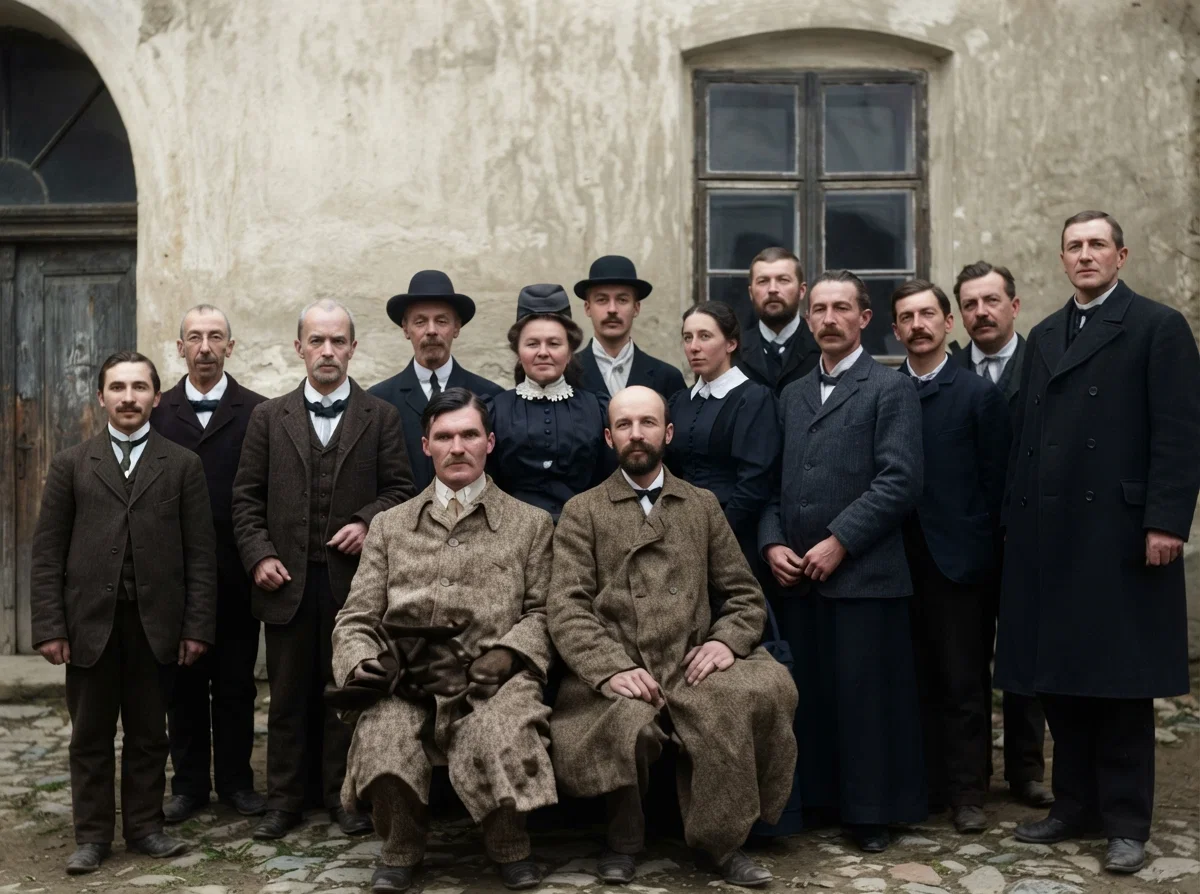
WE have just closed the fourth session of the Transylvanian Conference, convened here in the pleasant city of Nagy-Szeben (Hermannstadt), November 6-9. The thirty-one churches of the field (membership, seven hundred and three) were represented by about one hundred and fifty members, one third of whom were delegates.
A two days' institute for workers, colporteurs, and church officers preceded the conference proper. The time was profitably spent in studying the principles of church organization and government, and the best methods of soul winning in this part of the Danube Union. Aside from the assistance of the local workers, valuable and much appreciated help was rendered by Brethren J. T. Boettcher, vice president of the European Division Conference; H. F. Huenergardt, president of the Danube Union Conference; R. Cunitz, director of the West Hungarian Mission; and H. Boex, general canvassing agent of the Hamburg Publishing House.
In spite of the great damage done in some parts of the country by the floods that destroyed the harvest, the finances of the conference show a steady growth, and the ingathering of souls is encouraging, for one hundred and forty-six were received during the conference year, and three new churches were accepted into the conference at this meeting. The net gain was only ninety-four, several being lost by apostasy, a number by emigration, and some by death (one of whom, Max Loewinger, was a Bible worker).
There was a good missionary spirit manifest, and all took a deep interest in the work carried on in the regions beyond. The pledges amounted to 192 crowns, and 252 crowns [$51.15] cash were given on the Ten-cent-a-week Fund. The Sabbath school donations were nearly 54 crowns.
One of the most interesting features of the meeting was the baptism of twelve persons who accepted the truth and actually stepped out into the full light at this time. They were baptized on Sabbath, after the refreshing showers of God's Spirit had been felt during the forenoon service conducted by Brother Boettcher.
The strangers attending the public illustrated lectures, which were conducted in Hungarian, German, and Roumanian,—as indeed was necessary in all our meetings and conference proceedings,—manifested an earnest desire to hear the message, and we expect a still further harvest as the result of following up the interest created here, by a winter's course of lectures in the hall recently rented for that purpose.
WORKERS AT TRANSYLVANIA MEETING
We wish for the nine workers, under the leadership of Brother H. Meyer, the Lord's richest blessings for the coming year, as they labor for the four and one-half million Germans, Hungarians, and Roumanians in this land where so many persecuted Christians found refuge during the times of the Reformation.
Festival of Bala Sahib
By LEON G. WOOD
LEON G. WOOD
THE Hindus have no special day of the week for worship, as the Sabbath among Christians and Friday among Mohammedans. There are, however, numerous festivals held during the year. At these times but little work is done. Some attend them as a religious duty, others for amusement, while many combine both objects.
A great festival is held annually at Deolgaon Raja, in Chikli Taluq, in honor of Bala Sahib, the Hindu's principal golden god. This image is of solid gold, and is about eight inches high. It is said this god was in the house of a Brahman who worshiped it daily. One night thieves entered his house and stole the god. When they were about half a mile from the house, they became blind, so they could not run with the stolen property. The thieves were caught and punished by both god and man.
Some time after that Jadhar was the king of Deolgaon Raja and Suidhkhed. He resided at Suidhkhed, a village in the Mikkar Taluq. Tradition says that when this king was in a sound sleep, he dreamed that he heard Balazi speaking to him and saying that as he was the ruler of Deolgaon Raja he should build a temple at the place Balazi pointed out. The king accordingly obeyed the god and built a great temple at Deolgaon Raja. When the temple was finished, the king removed the god from the house of the old Brahman to Deolgaon Raja with great joy.
The story concerning Balazi's making his enemies blind gradually spread all over the world. Day by day Hindus began to trust more and more in their god of gold, and resolved to have a great fair once a year at his temple.
The first day of the fair Balazi is removed from the inner room to the front room of the temple by the attendant, where the people can see and worship him with offerings during the festival. In front of Balazi an arbor is erected. He is kept for fifteen days in the front room, and after this he is again put in his appointed place. The first and last days of the fair are considered most holy days. At midnight of the first day Balazi goes to the river in a palanquin to take a bath, and helps his worshipers to gain victory over Ronan, the demon king of Eylon. The people who touch the palanquin or carry it on their shoulders at the time of Balazi's going to the river are said to have all the sins removed that they have committed in ten births. Thousands of people try to touch this palanquin in order to be saved. Many are thrown down, and many are wounded. When Balazi reaches the river, the bank of the river is illuminated. People stay at the river until the daybreak, struggling to touch the palanquin for salvation.
The last day of the festival is spent in great joy by the pilgrims. Early in the morning thousands of them gather under the arbor before Balazi to worship and to receive a sacrament. While they are receiving the sacrament, the ropes of the arbor are cut and the large beams fall to the ground. Those who are not careful are badly wounded. After this ceremony all shops in the market of the fair are opened for a month.
The annual income of Balazi is nearly 80,000 rupees ($2,666), which is given by his worshipers. Balazi is made of gold by man. "They lavish gold out of the bag, and weigh silver in the balance, and hire a goldsmith; and he maketh it a god: they fall down, yea, they worship. They bear him upon the shoulder, they carry him, and set him in his place, and he standeth; from his place shall he not remove: yea, one shall cry60unto him, yet can he not answer, nor save him out of his trouble." Isa. 46: 6, 7. "Their idols are silver and gold, the work of men's hands. They have mouths, but they speak not: eyes have they, but they see not: they have ears, but they hear not: noses have they, but they smell not: . . . feet have they, but they walk not: neither speak they through their throat. They that make them are like unto them; so is every one that trusteth in them." Ps. 115: 4-8.