WHILE the pupils of the station school were away for their long vacation, the teachers here and from the outschools assembled for their annual training during the months of August and September.
We all came to the conclusion that thoroughness is one of our greatest needs, and so all set to work to that end. In the afternoons we concentrated considerable effort on school management and criticism lessons to enable our teachers to use to good advantage the excellent books in the vernacular prepared by the Educational Council of Nyasaland.
These lessons were greatly needed, the methods adopted by the village teacher being somewhat crude at times. However, after a short time they began to see where their methods were severely criticized, and toward the end of the session they were doing very well. The native here is an apt imitator. Daily drills were also given in Scripture, reading, writing, arithmetic, translation, and singing; all showed an eagerness that was very encouraging. We feel confident that marked improvement will be shown in the villages at the close of the school year.
After a short service in the church, September 21, a goodly company gathered at the waterside to witness the baptism of six teachers and four teachers' wives. These were away teaching when Elder Porter was with us last year. Brother Robinson officiated. In the evening a church meeting convened to extend the right hand of fellowship to the new brethren. Several names were dropped for apostasy, leaving 125 members in good and regular standing. This does not include Mantandane Mission, which has a separate organization.
Last year a new marriage law for natives, known as the Native Christian Marriage Ordinance, was enacted by the government of this protectorate. This law provides that any missionary, whether ordained or not, may be licensed as marriage officer. Both the contracting parties must be Christians. A number of our teachers wished to take advantage of this ordinance, there being nothing in the native custom to prevent the mother-in-law from calling her daughter home, leaving the man to take another wife or live single. These teachers having satisfied the resident as to their character, the necessary civil permission was received; and the ten couples who desired to enjoy the benefits of the new act were joined in holy matrimony by Brother Robinson, September 29.
Blantyre, Nyasaland.
Mission Notes
THE bishop of Chester, in speaking of the British and Foreign Bible Society, said: "There is one thing that always appeals to me very much in connection with the Bible Society. There is a saying that God is great in his great works, but that he is greatest of all in his least works. In accordance with that idea we ought, I believe, specially to honor the Bible Society for its care of small peoples and tribes and those who are, I will not say small, but at all events comparatively few and helpless. All honor to the Bible Society for the tender, considerate sympathy shown for a tribe like the Cree Indians. The Cree Indians are, I believe, very few, and perhaps they are a dwindling folk. Some would say: Is not the Bible Society wasting time and money, and the translators wasting power, in providing a version for these few folk? It seems to me that it is one of the noblest points in the policy of the Bible Society that it should do its best for the few Cree Indians."
The conversion of three officials in an English gold mine in Central Brazil led to the establishment of the Brazil section of the Evangelical Union of South America. These men—electrician, stenographer, and assayer—were finally forced out of their positions because of their Christian testimony. They put together their savings,—$5,000,—dedicated it to the Lord, hired a hall in Ouro Preto, the capital of Minas Geraes, for evangelical services, and undertook long cross-country colportage service. Their center was later transferred to Sao Paulo. Here in three years a church of one hundred and fifty converts—all ex-Romanists—has been gathered. In connection with it are nine established stations with workers in charge, and nearly six hundred baptized converts. One of the native pastors, the late Samuel Mello of Paranagua, was perhaps the most remarkable evangelist that Brazil has produced.
Those who have been following in detail the prosecution of the Korean Christians will remember that the first trial of Baron Yun Chi Ho and his five companions was declared void by the supreme court, and that when the case was remanded they were tried and sentenced again. The report of this second trial makes it more than ever difficult to understand how the condemnation of the prisoners can be justified, or even sustained, by legal technicalities. The supreme court, on review of the original proceedings, held that the evidence did not support the verdict against the prisoners. At the new trial no new evidence whatever was introduced, and the prosecution rested wholly on the same alleged proofs that it presented before. On these discredited grounds the court reaffirmed its former verdict, so that Baron Yun Chi Ho and his companions must serve their sentence. He is, however, using his term in prison to preach the gospel to his fellow prisoners, whom no missionary can visit.
A Year on the Canal Zone
By D. E. Blake, M. D.
D. E. BLAKE, M. D.
A YEAR ago I landed in Colon, having separated from the Sanitarium work in Nashville, Tenn., to engage in self-supporting medical missionary work in this field. We were welcomed by the brethren here, this being a very needy field with but few workers.
The town of Empire, an important section about twelve miles from Panama City, was chosen for beginning our medical work, and as there was a small, struggling company at this place, we felt that our assistance would be needed in strengthening the believers, also in making additions to the church.
The Lord has blessed us in our medical work far beyond our highest expectation, and our efforts in evangelical work have also been very gratifying.
The need of a small sanitarium was one of our early observations, but as the government of the Canal Zone forbids the acquisition of land and the putting up of buildings, we were perplexed to know how to meet this pressing need. We were thus compelled to work with what facilities we had at hand, and await developments of certain plans we had in view.
Two weeks ago we were favored with the lease of twelve rooms in a large building in Cristobal, the American settlement adjoining Colon, at a very reasonable price, the owner giving twenty-five dollars for the special electrical installation in our section of the building.
The Isthmian Canal Commission maintained a hospital in Colon, but owing to the early completion of the canal, it was decided to discontinue it. This action removed the only hospital from Colon, thus leaving the field clear for our work.
We were also privileged to secure the equipment we needed from Commission's Colon Hospital, in the way of surgical instruments, beds, bedding, etc., some of these new, and at an exceedingly low price. Thus within a few weeks our institution will be ready for business.
We feel very thankful for these evidences of divine leading. They encourage and strengthen us. We are also thankful for the hearty support of the conference brethren.
Our only purpose is to assist in the furtherance of the third angel's message. Our success is not measured by the money made, but by reaching souls with this glorious message. To the above end we solicit your prayers for the success of our work in this needy field.
Empire, Canal Zone.
A Mother's Love
By George R. Scott
GEORGE R. SCOTT
A naughty boy stood in William Street, New York, defying his mother's commands.
The mother of the boy was poorly clad, and gave abundant evidence in her speech that she had never been graduated from a college.
The boy was of the common order of street Arabs. The mother was a woman who had no doubt seen hard times from the day she was born.
But that fond mother said to that wild boy, "If you will do what I want you to do, I will love you more than ever."
The words that caught my ears brought me to the realization that I was standing in the presence of a loving mother pleading with her disobedient boy.
She was only a poor, hard-working woman. The clothes on her back were hardly worth the trouble to put on. Her speech was not the language of refinement. But there were tears in her eyes that were worth more than costly diamonds. She possessed a mother's heart that was filled with love for her wayward offspring.
Perhaps she did not know enough to bring up her boy properly, but there are thousands of rich women who have boys even worse than her boy.
She said her boy was bad, but within the space of ten minutes that boy felt the effect of his mother's tears; for he walked up to her and said a few words, and then they both wended their way home.
As they walked toward the East River, I had a good opportunity to look that mother in the face. The marks of the tears were still on her cheeks, but a strange smile could be seen on her face; it was the smile that only a victorious mother can exhibit.
The boy looked sheepish; but his mother had evidently conquered him, for in a meek tone of voice he addressed her more than once by the endearing name of mother.
As they passed out of my sight, perhaps never again to be seen by me, a wish stole over me to follow them and take a look at the home where they reside. But in this world we all have about as much as we can do at times to attend to our own business, and that was my condition as the mother and her boy disappeared on their way home.
Several times in my life have I seen strange exhibitions of mother love.
Years ago I stood by the side of a swiftly running stream in the western portion of this State. It ran alongside of a railroad track. There had been a heavy spring freshet the day before, and on account of a washout a freight engine and two of the cars had jumped the track and fallen into the stream. The water was so clear that the engine could be seen at the bottom. Under that engine was supposed to be the body of the fireman.
On the bank of that river stood the mother of that young fireman. She stood there and declared her intention to remain standing there until the body of her boy was rescued from the bottom of the stream.
The look of that mother haunts me still. Her eyes were unlike the eyes of those around her, for they had a stare that made me shudder. Her voice was so low that what she said could hardly be comprehended. The only words that I could make out were, "My darling boy is dead; I want him!"
For some hours it was my painful experience to see that mother's emotions. Her chest heaved as if under it were troubles that created waves of distress. She did not utter a groan nor shed a tear. The people all around her were excited, but that mother gave no such evidence of the effects of the sad accident. She looked so awful that it occurred to me that her heart must have been broken by the stroke of death that had robbed her of her boy.
There I stood, also, looking at the cold waters that were rapidly running over the unseen body of her boy and at the face of a mother who loved her boy better than she did herself.
It was a picture I do not want again to behold. The combination of warm mother love and cold death do not make a desirable picture.
I got into a car and left the scene, but the scene would not leave me. In the chamber of memory the picture hangs still, and that mother's face is now as "familiar as household words."
Here is another picture, more pleasant to behold. It is a mother seated among a crowd of notable personages, watching for the moment when her boy would take the oath of office as President of the United States. It was not my good fortune to see that sight; but those who did will never forget it. On that old lady's face was a smile that meant more than she could say. Her boy was to her the greatest man that this country had ever produced. Thousands of voters had said that he was not their choice for the presidency; but the lips of that good old mother would have been only too willing to declare that he was the best boy and the best man that had yet been born.
She, too, looked upon her boy with a steady gaze that no one in that crowd could keep up. Mother love peered out of her eyes and feasted on the scene.
How many grand, loving mothers who read this article, will say in their hearts, "I love my children with a love that cannot be quenched."
One day I was riding in a car on my way to speak in a penitentiary. In the same car was a woman who was going there to see her boy. She talked to me about him as if he were an angel rather than a housebreaker. Mother love poured from her heart in streams. Her boy had his good points in the estimation of his mother. When I was inside of that penitentiary, her boy told me he was bad, but his mother did not say so. In her great love she had wiped out the sins of her boy from her thoughts. She seemed to know her boy only as he was before sin had painted him the color of the devil.
The young housebreaker and the mother kissed each other as best they could under the circumstances. The boy showed the effects of the life he had been leading; but the mother looked as if she had "been with Jesus" and learned of him how to win back her boy to her home and heart.
That mother could not feel proud of her boy, but she could not help showing to others how she loved him. Did I blame her?—No; for she was a loving mother, and could not have acted differently.
The heart of a loving mother is like some portions of the ocean—unfathomable. You may think you have reached the bottom of a mother's love; but when you get there, you have only begun to penetrate the grandest part of true womanhood.
Did you ever see a mother bending over the body of a sick child? The soft words of cheer are slightly moistened by her tears. There is love in every sentence. Where did that mother, perhaps uneducated, get such soothing sentences? Shall I tell you? Yes; out of the well of love.
If, peradventure, the child looks up and faintly smiles, you can see that joy immediately takes possession of the heart of that watching mother angel. Again she dips her lips in the waters fresh from the same old well, and new words of cheer drop into the ears of her sick child.
The doctor's medicine may have done its part toward the restoration of the child; but mother's love will give the finishing touch that will enable that loved one to get up and walk about once more.
What clinging properties there are in mother love. To her bad boy or girl a mother says, "I will not let thee go!" The more her children strive to break away from her, the harder she clings to them.
If I never saw the wrestling match between Jacob and the angel, I have seen62wrestling matches between good mothers and bad children that ended in a victory for mother love that ought to have made a deep impression on the children.
A mother's love is the strongest cord that binds a boy or girl to the old home. And it is a cord that is hard to break. It may sometimes be badly stretched; but it holds.
When your children leave you, be sure to tell them that the latchstring is hanging on the outside of the door night and day; that they need not even knock, but only pull the latch and walk in.
If your children left the house under a cloud when darkness encompassed them, the best thing for you to do is to put lights in the windows that will keep bright every pathway that leads into the house.—New York Weekly Witness.
Eugenics or the Word?
By O. B. Kuhn
O. B. Kuhn
The theories and facts of eugenics, the science of improving offspring by bequeathing them better hereditary tendencies and placing them in a favorable environment, present practical suggestions to Christians; but as advanced by worldly philosophers, this science is deceiving some professed Christians and many moralists.
These philosophers teach that the laws of heredity and the influence of environment are absolute in the making of good or bad characters. The life and teachings of the great Instructor and divine Saviour show that the deductions of these scientists are incorrect.
For four thousand years the race had been decreasing in physical strength, mental power, and moral worth when Christ took upon himself the infirmities of degenerate humanity. He took humanity, with all its liabilities. He took the nature of man, with the possibility of yielding to temptation. Some of his ancestors were murderers, drunkards, adulterers, and liars. They were guilty of every crime. He was reared in a city so evil that its inhabitants were proverbial for their wickedness. "Can there any good thing come out of Nazareth?"
"Sacrifice and offering thou wouldest not, but a body hast thou prepared me." He "was in all points tempted like as we are, yet without sin." While he was in the world, he was not of the world. He was a mighty conqueror over the flesh, the world, and the devil. He resisted the temptation to indulge appetite, to love display and the world.
Go back ten centuries and every one of us has two thousand ancestors living contemporaneously in one generation. These, converging through their posterity down through the ages, shape up in us. For six thousand years the race has been degenerating physically, mentally, and morally. Inherited and cultivated evil tendencies and immoral surroundings are intensified.
Left alone, we are indeed helpless in the grasp of hereditary laws, hopeless in the strength of evil tendencies, and resistless to the influence of environment. "Who shall deliver me from the body of this death? I thank God through Jesus Christ."
When one experiences the new birth, he becomes the temple of the Holy Spirit. Christ dwells within, an all-sufficient helper, the hope of glory, able to deliver. He is not bound by his own laws. By his word he caused the sun to stand still, and to turn back, and congealed the waters of the Red Sea. He healed the sick and opened the eyes of the blind. He raised the dead. By his word he loosens the grasp of hereditary laws and inherited evil tendencies and strengthens the will to resist the influences of evil surroundings.
Through the power of the Word dwelling in the life, the appetites and passions are held in subjection to the will of God. Evil imaginations are cast down, and every thought is brought into captivity to Christ. "Thy word have I hid in mine heart, that I might not sin against thee." "By the word of thy lips I have kept me from the paths of the destroyer." "Let the word of Christ dwell in you richly in all wisdom."
In this last generation bodies prepared by centuries of ancestral wickedness, subject to hereditary laws, and molded by environment, become the temple of the Spirit of God; Christ imputes and imparts his righteousness; his word overcomes sin and weakness; a godlike character is developed, fitted for translation. The redeemed will be prepared for heaven, not by eugenics, but by the power of the Word.
Friends Who Refresh Us
It would be hard to tell why we have chosen some of our friends. There are many traits we admire and should like to have in our friends. But by no means the least desirable is the power to refresh us.
All of us have our seasons when we need refreshing. Natures that are intense and passionate have their times of depression of which more temperate natures know little. Every man who works with enthusiasm and zeal is sure to feel the reaction. He may be misunderstood. He may be opposed by those he is trying to help. Such an attitude on the part of others is like a poison gas which chokes, and we need some one to dispel it.
There are also apparent failures, or perhaps real failures, in our work, which depress us. To put our best efforts into anything and to accomplish little, or to have some promising success spoiled by the carelessness or malice of others, is a heavy trial to our natures. There are times when things go wrong, when discouragements pile up, and then the friend we need is the friend who can refresh us!
There are some whom God seems to have specially endowed for this ministry. They may not be persons of strong character. They may not be famed for their learning or eloquence. But their coming is like the sunshine which dispels the gloom, like the pure air that revives us after we have been in some stifling atmosphere. They may remind us of some cheering promise that we have forgotten in our despair. They may tell us of some success which has come through our efforts but has not come under our notice. Perhaps we cannot at all explain how they do it. About them there is an atmosphere which acts on us like oxygen on the dying flame. The home is unfortunate that does not have at least one such person in it.
We have friends whose learning never ceases to amaze us. When there are things we do not understand, we go to them for information. We value their friendship. We have friends who are rich and influential. We know that they will help us when we get into trouble. We value their friendship. But the friend who can put the heart back into us, can make us forget our troubles and discouragements and look on the bright side of things, whose presence inspires us to be our best, that is the best friend of all.
If we appreciate what it is to have such friends, it hardly needs to be suggested that we should be such friends to one another. We all have discouragements, but it does not help us any to thrust them upon others; it only makes them gloomy. Our friends will value our friendship more highly if we try constantly to be like the sunshine, like the pure air, so that they cannot be in our company without having their spirits revived.
It is this trait that gives value to the friendship of Christ. Above all others, he is the friend that refreshes us, and we can be more and more refreshing to others as we become more and more like him.—United Presbyterian.
A Health Hint for All Who Wear Collars
A Vienna doctor has discovered that one of the most frequent causes of headaches is the tight and high collar. He has been experimenting with various patients, and he finds that those who suffer from frequent headaches are always those who are in the habit of wearing high collars.
His attention was drawn one day to the high neckband of a woman patient who was subject to violent pains in the head and to dizziness. He persuaded her to lay aside this form of neckwear, with the result that the compression of the neck ceased, and she was cured.
Struck by this result, the doctor has paid particular attention to the collars worn by his headache patients, and in almost all cases the change to lower and easier neckbands has been beneficial. The doctor declares that nobody with any tendency to headache should wear a high collar.
Joseph Cook, while speaking at Chautauqua, had an attack that almost resembled apoplexy. It was caused entirely by a tight neckband. The writer learned that lesson early, and indorsed this Vienna doctor.—Selected.
A Great Awakening in South Lancaster Academy
By R. D. Quinn
DURING the week of prayer the Lord came very near to the teachers and students in the South Lancaster Academy. The chapel periods were given each day to the readings, and were followed by prayer bands meeting in several places to seek the Lord.
As a fitting climax for the week, Professor Machlan planned for an important meeting in the students' assembly room Friday evening. A large number were present besides the regular students of the home. After a short talk by the writer on the nearness of the end and the special personal preparation necessary for the finishing of the work, a call was made for all to come forward, and prayer would be offered for power for obedience and service. About two hundred of the young people responded. Quite a number, however, moved back to the rear seats. The spirit of personal labor for others took possession of many, who left their seats and gathered around those who had not yielded; and, one by one, these were led to take their stand and come forward.
When nearly all in the assembly room had yielded to the entreaties of their fellow students, a burden came upon quite a number of the students and teachers to search out those who had remained in their rooms, and they left the assembly room and went through the rooms of the dormitory, working and praying for those who had not come to the meeting. With the exception of one or two, every student in the home finally came to the meeting and made an unconditional surrender to God.
The revival continued until eleven o'clock, and when it closed, all present, as far as could be learned, had given themselves to the Lord and his work. Many heartfelt confessions were made, and many desired prayers for themselves and their loved ones at home. A number asked to be remembered as they returned to their homes during the vacation, that they might be true to God and win their friends to the truth. All testified who had opportunity to do so. Effectual prayer was offered at the close of the service for the outpouring of the Holy Spirit.
The meeting was one of the most encouraging the academy has ever experienced. We are sure that our people will be rejoiced to know of the strong spiritual influence that has prevailed at the school throughout the entire year.
The meetings in Boston and Melrose have been seasons of great spiritual refreshing, and were of an entirely unusual character. It is clearly evident that we are now entering the time of the latter rain, and it is falling everywhere on hearts that are prepared to receive it. The reports that are daily coming to our office from all parts of the union indicate that a wave of spiritual power and blessing is spreading over the East, and that great victories are being won, and special blessings are awaiting the people of God.
R. D. Quinn.
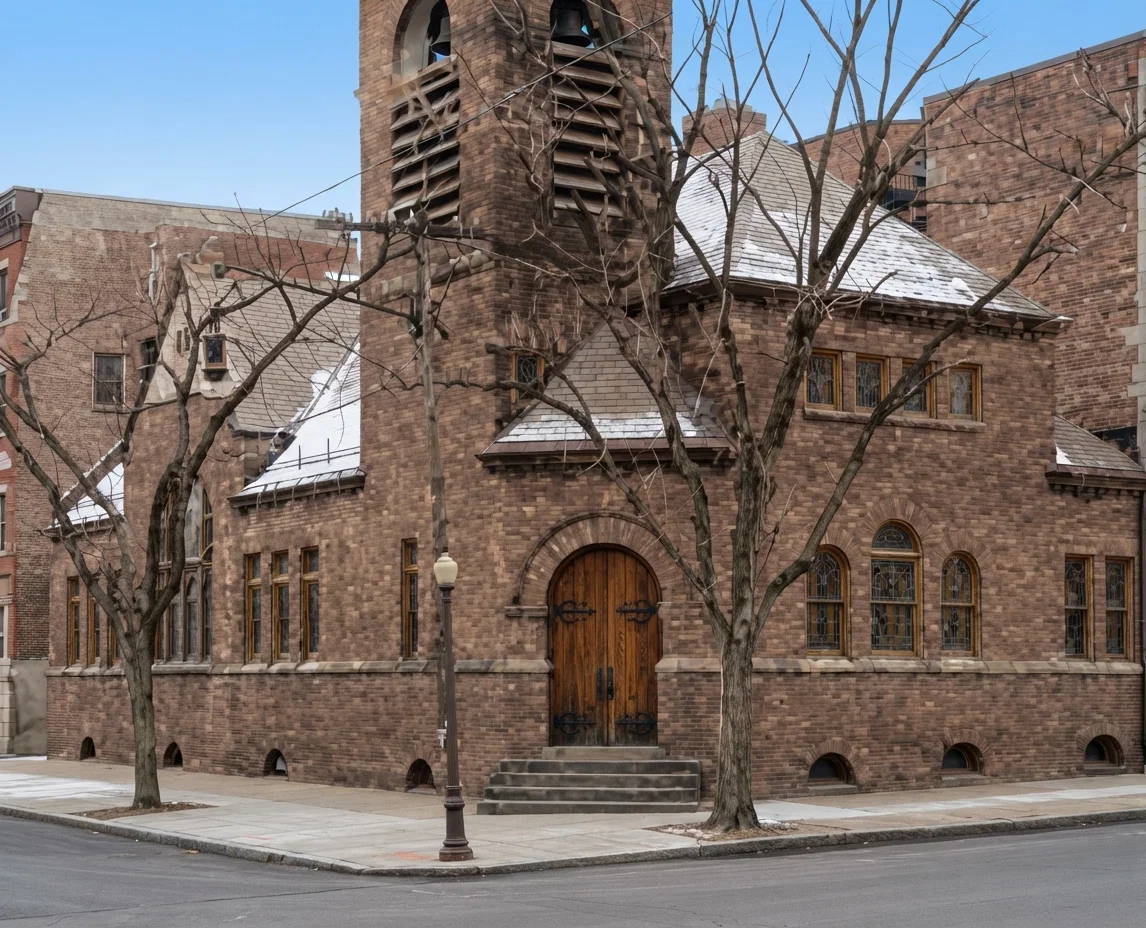
The Dedication of the Albany (N. Y.) Church
By A. G. Daniells
SUNDAY afternoon, December 14, our brethren and sisters in Albany, N. Y., dedicated to the worship and service of the Lord the church building they have recently bought. They had arranged for special meetings to begin Friday night and continue until Sunday night. Brethren and sisters came from Troy and Schenectady. Elder Holden, president of the New York Conference, and Sister Holden; also Brother Johnson, conference secretary and treasurer, and his wife, came from Rome. The weather was all that could be desired, and many of the interested citizens and friends in Albany attended all the meetings.
SEVENTH-DAY ADVENTIST CHURCH BUILDING AT ALBANY, N. Y.
It was an encouraging occasion to our people in Albany. For many years a few members in that city have been struggling along the best they could, trying to hold up the light of truth. As they had no church building, and were not able to pay for a suitable hall, they met in private houses for worship. But during the last year or two, under the labors of Elder E. L. Cardey, a number of substantial persons have taken their stand for the truth. This has brought new life and activity into the church, and one of the results is the neat and commodious church building just dedicated.
This building is well constructed of brick, and stands on the corner of a good street in a central part of the city. It was unfurnished, and the interior was out of repair, when purchased; but the brethren have shown great zeal, self-sacrifice, and good taste in making it a creditable, attractive place of worship.
The dedicatory exercises were very pleasant and impressive. The history of the enterprise was given by Elder Cardey. The sermon was preached by the writer, and the prayer was offered by Elder Holden. The house was well filled, and everybody seemed to rejoice. The evening service which followed was a most excellent one. Although there were many present who are not identified with us, nearly every person in the meeting publicly expressed a desire for prayer for divine help to obey the Lord. During the two days' meetings, several took their stand for the truth.
The Lord is working in Albany. There is no doubt about that. Brother Cardey and the church have set their hearts on still greater victories. They enter upon this new year with hands and hearts joined in a consecrated effort to double the membership of the church this year. It certainly looks as if this might be done.
This meeting was one of special encouragement to me. My own soul was blessed, and my vision of what the Lord is beginning to do in the East was enlarged. God is working and is doing all that our personal fitness will enable him to do through us. This calls for a fuller surrender to him and a greater consecration to his work. May it be made without delay.
A. G. DANIELLS.
Canary Islands
By Bert B. Aldrich
The work is making some advancement in these islands. We are sowing the seed of truth, and believe we shall reap if we faint not. Our health at present is ordinarily good. The best health16interests of all concerned in this mission demand a convenient, attractive, cheerful, and sanitary health home. While we have the best we can find here, we have not these conditions. To have them we must build.
Our greatest perplexity here is to get the truth before the five hundred thousand souls on seven large islands, each of which is from forty to seventy-five miles from any other. Another is how to unite the small interests we have into a Sabbath school. After presenting the testing truth, we hope to be able to do this. Pray that many may have the courage and the love for the truth to obey.
We continue to get a few orders for the health book, and to sell tracts, besides holding three or four Bible studies each week. Remember us at the throne of grace.
BERT B. ALDRICH.
Using the Newspapers in the Southeastern Union Conference
By Walter L. Burgan
WORKERS in the Southeastern Union Conference have had success in their efforts to have different phases of the message published in their home newspapers since the General Conference. It was encouraging to talk with a number of these at the biennial session of the union, which was held at Graysville, Tenn., December 22 to January 1, and to listen to their experiences in connection with this important work.
One brother, laboring in Georgia, told how the newspaper in the town where he conducted a tent effort helped very materially in bringing an audience to his meetings. For two nights in succession, he said no one attended the meetings; he then placed some advertisements and reading notices in the paper. These notices brought an audience, and upon seeing immediate results he continued to use the paper for advertising meetings, and contributed extracts of his sermons, which the editor gladly published. Some of these articles were a column long. The reports of his sermons brought some to his meetings from adjacent places. Among those who began the observance of the Sabbath were a man and his wife who were attracted to the meetings by the reports in the paper.
Elder Stewart Kime, president of the North Carolina Conference, is an ardent advocate of using the newspapers for the spreading of the precious truth, which is soon to lighten the whole world with its glory. In speaking of what has been done in his State during the last two years toward giving the message through this agency, he said:—
“During the last two years we have seen the effect of the newspaper work in North Carolina. We are convinced that the daily press can be made a power for the promulgation of the truth, or it can be made a hindrance. During our last camp meeting we enjoyed favor with the press all over the State. We were given a generous amount of space in the papers of Greensboro, where the meeting was held. Papers all over the State copied the reports, and favorable impressions were made. On both Sundays of the meeting there was a delegation of men who came more than one hundred miles to attend the meeting, of which they had learned through the papers. They are now calling for meetings. Where our tent meeting was held last summer the editor has insisted on having an article every week on the present truth. These articles are regularly furnished.”
Another brother in North Carolina told of the desire of an editor of a magazine published in the Middle West to have articles furnished his publication touching on some of our doctrines. This brother stated that the magazine in question has a circulation of several hundred thousand. It certainly was good to hear this, as this is an most excellent opportunity to further advance the truth through the powerful medium of the press. No doubt other brethren will be invited to furnish to magazines articles dealing with one phase or another of our message, and it is to be hoped that they will avail themselves of such opportunities without delay, and thus help increase the progress of the work. No estimate can ever be made of the area covered by such agencies.
This last session of the Southeastern Union Conference was itself extensively advertised. Daily accounts were furnished the Chattanooga papers, while items of particular interest to various States in the union were also sent out to the leading papers in these States. It was learned that the Chattanooga papers circulate one hundred and fifty miles west of Chattanooga, taking in a part of the Cumberland Mountains. One sister who came thirty miles from a mountain home to attend the meetings said that her neighbors had been reading the reports, and that they were much interested.
We never can tell how many souls will be saved in the kingdom as the result of the efforts our workers are putting forth to give the message through this medium.
WALTER L. BURGAN.
Church Dedications in Maryland
By S. B. Horton
It was my privilege to have part in two church dedications in Maryland recently. One took place in Fords Store during the Harvest Ingathering campaign, the other at Whiteleysburg on Sunday, December 28. About twenty years ago the Atlantic Conference, then comprising New York City, Long Island, New Jersey, Delaware, Maryland, and the District of Columbia, sent workers to what is called the Eastern Shore of Maryland. Tents were pitched at Rock Hall, Fords Store, Church Hill, Millington, Chestertown, Crumpton, and one or two other places, resulting in raising up churches at the first four places named. Buildings were erected at Rock Hall (recently repaired and very tastefully embellished), at Fords Store, and at Church Hill. The Fords Store building had not weathered the years so well, which prompted the brethren to plan for a new building, the one recently dedicated. It is a credit to our work in that section of the State, and has brought revival and inspiration to the loyal members composing the Fords Store congregation.
Previous to the Eastern Shore efforts, work had been conducted with success at Hollandville, Del., near the Maryland line, at Greensboro and other points in Caroline County, Maryland. The brethren at these places decided to erect a building at some geographical center which would serve as a lighthouse in that section, as well as a meeting place for the scattered flock. Accordingly a neat and attractive pebble-dash structure was erected, and the neighbors and friends were invited to its dedication. On this occasion the building was filled to its capacity. There were present at the services R. T. Baer, president of the Chesapeake Conference, R. H. Martin, L. E. Froom, F. E. Hankins, and the writer. The neighbors and friends have been liberal in helping to complete the edifice. Elder and Mrs. Baer remained after the dedication to conduct a seven days' effort under encouraging conditions.
It was a pleasure to meet with many whom I had not seen for years. Their loyalty to the work gives inspiration and courage.
S. B. Horton.