Our heart, our thoughts, our words, and our actions are all so closely connected, and so intimately associated that they cannot be separated. If we cherish sin or iniquity in our hearts, it will betray itself in our words and actions; and if our heart is pure, our thoughts, words, and actions will be the same; for the heart is the great fountain head from whence flow right thoughts, sincere desires, pure motives, kindly acts, and deeds of charity; in fact, all that is honest, true, noble, and generous in our characters. “Out of the heart proceed evil thoughts, murders, adulteries, fornications, thefts, false witness, blasphemies,” and everything that defileth. Matt. 15:19.
Well did the prophet exclaim, “The heart is deceitful above all things, and desperately wicked: who can know it?” Jer. 17:9. It may be truly said that the heart is the foundation of character; for if we have a pure heart, we shall have, as a result, a pure character. But if we permit sin and iniquity to dwell and reign there, an evil, vicious character will be the inevitable result.
The apostle uttered this truth in James 3:11, 12: “Doth a fountain send forth at the same place sweet water and bitter? Can the fig-tree, my brethren, bear olive berries? either a vine, figs? so can no fountain both yield salt water and fresh.” Neither can we, being evil, speak good things; for as we think in our hearts, so are we. “A good man out of the good treasure of his heart bringeth forth that which is good; and an evil man out of the evil treasure of his heart bringeth forth that which is evil: for of the abundance of the heart his mouth speaketh.” Luke 6:45. “Those things which proceed out of the mouth come forth from the heart; and they defile the man.” Matt. 15:18.
There are seven things that are an abomination to the Lord, among which we find this: “a heart that deviseth wicked imaginations.” Prov. 6:18. “The thoughts of the wicked are an abomination to the Lord” (Prov. 15:26), and “their thoughts are thoughts of iniquity.” Isa. 59:7. It is wicked to cherish idle, frivolous thoughts; for “the thought of foolishness is sin.” Prov. 24:9. They separate between us and God; for his Spirit cannot dwell where sin is cherished; and if we regard iniquity in our hearts, he will not hear us when we pray. Ps. 66:18.
Yet God extends mercy and offers forgiveness; for he says: “Let the wicked forsake his way, and the unrighteous man his thoughts: and let him return unto the Lord, and he will have mercy upon him; and to our God, for he will abundantly pardon.” Isa. 55:7. He exhorts us by the apostle Paul to cast down imaginations and every high thing that exalteth itself against the knowledge of God, and to bring every thought into captivity to the obedience of Christ. 2 Cor. 10:5. God knows our heart, and every thought, and most secret desire; we can withhold or conceal nothing from him. He says: “I the Lord search the heart.” Jer. 17:10. No thought can be withheld from God. See Job 42:2. “The Lord knoweth the thoughts of man, that they are vanity.” Ps. 94:11. Paul says, “The word of God is quick, and powerful, and sharper than any two-edged sword, . . . and is a discerner of the thoughts and intents of the heart.” Heb. 4:12.
Of the thoughts of the righteous, the wise man says they are right (Prov. 12:5), and that “the thoughts of the diligent tend only to plenteousness.” Prov. 21:5. “A man shall eat good by the fruit of his mouth” (Prov. 13:2), and “whoso keepeth his mouth and his tongue, keepeth his soul from troubles.” Prov. 21:23. Above all, he says: “Commit thy works unto the Lord, and thy thoughts shall be established.” Prov. 16:3. James says very truly that we offend all in many things; but “if any offend not in word, the same is a perfect man, and able also to bridle the whole body.” James 3:2. Eternal life or death, our future happiness or woe, depends more than we often think, upon our thoughts and words. David asks this question, and answers it briefly, in Ps. 24:3-5: “Who shall ascend into the hill of the Lord? or who shall stand in his holy place? He that hath clean hands and a pure heart: who hath not lifted up his soul unto vanity, nor sworn deceitfully. He shall receive the blessing from the Lord, and righteousness from the God of his salvation.” Here a rich blessing and robes of righteousness are promised to those who are pure-hearted and chaste in their conversation.
Jesus says: “Blessed are the pure in heart: for they shall see God.” Matt. 5:8. Solomon says: “He that keepeth his mouth keepeth his life: but he that openeth wide his lips shall have destruction.” Prov. 13:3. Again, he says: “Keep thy heart with all diligence [margin, above all keeping]; for out of it are the issues of life.” Chap. 4:23. The time is coming, and is not far distant, when the thoughts of every heart shall be revealed; when all shall have to answer for their inmost thoughts and words, and shall receive according as they have been. We shall then learn for a certainty (if we do not learn it now) the sad truth that “death and life are in the power of the tongue, and they that love it shall eat the fruit thereof.” Prov. 18:21.
Jesus says that for “every idle word that men shall speak, they shall give account thereof in the day of Judgment. For by thy words thou shalt be justified, and by thy words thou shalt be condemned.” Matt. 12:36, 37. “I the Lord search the heart, I try the reins, even to give every man according to his ways, and according to the fruit of his doings.” Jer. 17:10; see also Ps. 62:12; Rom. 2:6; Rev. 2:23. How much importance the Scriptures attach to our thoughts and words, and of how little consequence we consider these; how careless we are of them, sowing them broadcast, here and there, idle, thoughtless, frivolous, and unkind words, giving them hardly a thought, never thinking that angels are constantly by our side recording all, never stopping to consider that all our words are Judgment bound, nor that momentous and weighty results hang upon our daily conversation. We often hear the expression, “Talk is cheap”; but when we meet all our words in the Judgment, and know that our future joy or woe is hanging upon our past conversation, we will then realize that talk is not so cheap after all.
If we would order our conversation aright, we must first cleanse our soul temple, the heart, from every thing impure and that defiles. David realized these solemn facts, and we can almost hear the fervent prayers he uttered coming down the ages to us; and may they find a constant echo in our every heart. “Search me, O God, and know my heart: try me, and know my thoughts: and see if there be any wicked way in me, and lead me in the way everlasting.” “Incline not my heart to any evil thing, to practice wicked works with men that work iniquity.” “Create in me a clean heart, O God; and renew a right spirit within me.” “Let the words of my mouth, and the meditation of my heart, be acceptable in thy sight, O Lord, my strength, and my redeemer.” Ps. 139:23, 24; 141:4; 51:10; 19:14.
Pleasant Grove, Minn.
Learning Through Asking Questions Without Shame
—A Persian philosopher being asked by what method he had acquired so much knowledge, answered, “By not being prevented by shame from asking questions when I was ignorant.”
The Weaver.
By M. J. Bahler
BY MRS. M. J. BAHLER.
I saw a weaver at her loom,
And as swift the shuttles flew,
Just once she pressed the treadles wrong;
But that once she must undo.
So backward were the treadles pressed,
The shuttles backward thrown,
And all the wrong was soon made right
With this weaver at her loom.
And we are weavers; every day
In the loom of life we tread;
Sometimes we press the treadles wrong,
And weave a faulty thread;
But we cannot press the treadles back;
Onward the shuttles fly,
Leaving our work with patterns marred
To meet the all-seeing eye.
And were it not He “knows our frame,”
And counts the tears we shed
Over our faulty, unfinished work,
While he notes the efforts made,
We might give up in sad despair;
But no; we’ll trust his love;
He can work a change, a wondrous change,
In the faulty web we have wove.
And he will work this wondrous change
If we but do our best;
Our best is always marred and rough,
And ne’er could bear the test
Of Heaven’s searching, piercing light
Without the power divine,
Transforming it; but through his love
Our web of life may shine.
CULTIVATED HAPPINESS.
By Aurelia Botsford
How may one cultivate happiness? For one thing, instead of looking to the future, conclude to be happy in the present. No one knows enough of next year to depend on being happy then; nor is it well to wait till the new house is built, or the children are old enough to take care of themselves, or a fortune has been amassed. It is the case of the rich fool in the Scriptures.
There is much pleasure to be obtained from little things that are often neglected as too trivial for notice; a flower in the window when a greenhouse is beyond one's reach; a book from the public library if one cannot purchase books of one's own, or paper covered volumes when fine bindings are too expensive; the music of the voice when an instrument is wanting. There is almost always a substitute attainable for the pleasure that is desired, and the child who fishes with a bent pin and a string gets all the happiness of a fisherman from it.
There were never before so many enjoyable things accessible to the common people. With parks, art galleries, libraries, museums, the dwellers in cities have pleasure and information almost forced upon them; and for those who live in the country, Nature's picture-book is continually open. The trouble is, people do not appreciate what may be so easily obtained. Men like Thoreau and John Burroughs will note with a naturalist's delight the common sights of nature, and we enjoy reading their books; but the things themselves are all around us, and we take no pleasure in them. We need to learn to enjoy the simple daily joys of life, and to open our eyes to the wonderful world about us.
Some people lose the pleasure of life through sheer egotism. If for a few hours they could forget themselves, they might be happy. It is an old saying that it is more blessed to give than to receive; and it is true in every sense. To give of time and thought and interest to others is infinitely better than to absorb all in regard for the welfare of that insignificant but big-feeling "I." "Look out and not in," and "Lend a hand," are good mottoes for him who seeks true happiness. Busy he must be; for there is no pleasure in idleness; and the more help and comfort he can bring to his fellow-men by his labor, the happier he will be himself.
It is well to quit thinking of disagreeable things. No doubt they are plenty, but why pay any attention to them except to strive to overcome them. Don't roll trouble over and over till it has grown like a snow-ball. If you have a skeleton in your closet, just keep it there; don't let it out to terrify the rest of the family, and don't keep slipping away to take a private look at it. If you keep it shut up closely enough, it may possibly crumble into harmless dust—bones do that way sometimes.
It is a great aid to cheerfulness “to count up your mercies,” as the contented old lady put it. And remember that according to Mark Tapley there isn't any credit in being jolly under agreeable circumstances. He had finally to give up the task of finding a situation so wretched that there was any credit in being jolly in it. A good many persons are more easily satisfied, and take credit, not for being jolly, but for simply not grumbling at slightly annoying events.
These brief suggestions are only with regard to outside expedients; the true secret, simple and disregarded as it commonly is, lies in seeking true happiness, which is found only in God himself. All other happiness is temporary; this alone is permanent. It is, as has been beautifully said, when our will is parallel to God's that there is no cross; the cross is found when our will is at right angles with his. Human nature clings desperately to its own way, and finds it hard to believe that happiness is found in the renunciation of self-will. But it is only when God's children can say with Paul, “For me to live is Christ, and to die is gain,” that they know the meaning of “rejoice evermore.” Then can they be calm in danger, and joy in tribulation, and all things are well with them. This has made prisoners sing in their dungeons, and martyrs happy at the stake, and the happiness is the privilege and the duty of every Christian to-day. We not only may, we ought to, be happy. How happy we might be, no matter how circumstanced, if we would seek happiness in the will of God. God only knows how blessed he would make us if we would but let him.
—Aurelia Botsford, in Illustrated Christian Weekly.
THE POWER OF SAYING NOTHING.
By Amelia E. Barr
A foolish wit once entered a Friends' meeting-house, and, taking a raspberry tart from his pocket, cried out, “This is for the one who speaks first.” “Young man,” began a venerable Quaker—“Ah! the tart is yours, sir,” was the instant reply. This is a good example of the value of saying nothing; for if no one had answered the impertinence, the congregation would not have been made to look foolish, and the tables would have been completely turned upon the intruding buffoon.
The capacity for saying nothing is a great power. Solomon estimates the man who “uttereth all his mind” as a fool; and there is no doubt that the man who cannot keep his own counsel, will let everything else slip through his fingers. It is this power which gives the Scotch their national reputation for being “cannie” and cautious. “They willna tell a lee;” but they will render it next to impossible to discover anything they wish to conceal; and thus they make of their ability to keep quiet a positive shield to their every-day life.
In the household this power is better than the gift of tongues in all those little domestic disputes in which not even the soft answer is so good as no answer at all. Again, how gracious is that silence which understands times and seasons, which knows that early in the morning, when all the load of the day lies on the husband's shoulders, even a kind and cheerful man is apt to be preoccupied and quiet. Then even words of endearment do not always “fit the mood;” and a wise wife will know how to refrain from her own little anxieties and worries, will let the bread-winner gather himself together in peace and quietness for the day's struggle, quite sure that as the burden of the day lifts, he will remember her forbearance and her peculiar wants in the kindliest manner.
Often, too, there will be days when the burden does not lift; when he will come home at night weary and heavy-laden with business cares and anxieties. Then to compel him to “talk over” silly trifles, or even household plans, the carrying out of which appear to him almost impossible, while grave interests are hanging on the slenderest hopes, is a kind of slow torture which no wife not thoroughly selfish and unreasonable, will inflict.
One of the hardest and bitterest trials of domestic silence is keeping quiet and saying nothing under injustice and misapprehension because the good of others demands it. Nevertheless, we may remember that God rights those who keep silence, and brings out their righteousness as the light and their judgment as the noonday.
There is such a thing in domestic life as holding the tongue out of pure spite; preserving day after day a dogged, sullen silence, impervious to all offers of reconciliation or regret or kindness. Such a condition is of the gravest spiritual danger; for the soul is subject to malignant diseases as well as the body, and this is one of them. The man or woman who is capable of such endurance in evil, is possessed by some dumb devil, which can only be driven out by the grace of God.
The power of saying nothing in our business life is one whose value it is hard to estimate. We have all heard what Lord Thurlow's awful nod did for his advancement. How many medical reputations have been built up on the ability to look wise and say nothing! The same is true in all professions; for people are sure to give the silent ones credit for far more intelligence than they really possess.
On the contrary, many a life is ruined by an open mouth. Pope Pius IX. is an example; according to himself, “he never ceased to speak”—lamenting, reproving, complaining, he could neither keep his peace nor his pontificate. In this he was the more remarkable because his predecessors won so much from their ability to say nothing and to bide their time. They understood what he failed to understand—that silence may even go with infallibility. A man can hold anything who can hold his tongue, as a general rule. And there will occur to most memories the example of a living great man who has held divers high offices by a wise exertion of this same power—justly so; for its very existence in any public man implies a quiet confidence in his own strength.
Even the Bible teaches us, by example as well as precept, the value of this reserve. It has its silences, and they are evidently the result of a divine foresight which foreknows the end from the beginning. Why are we not informed of the exact dates in the great events of Christ's life and of the rise of Christianity? Not because the apostles were either ignorant or indifferent, but because God knew the tendency in the heart of man to “observe times,” and the new dispensation was to be a spiritual, not a ritualistic one. Why are the first thirty years of Christ's life sealed up in the divine heart? Go into Catholic churches and houses, and see the idolatrous reverence given to the mother and the babe, and we shall understand why the cradle was hid behind the cross. The Gospels abound in such thoughtful, touching silences, evidences for our faith that commend themselves with great power to some hearts.
Then, by precept and example, by our own experience and observation, we are continually taught the power of saying nothing, the power of controlling our impatient lips, and remembering that in all the strife of life “he that refraineth his lips is wise.”
“The age is full of talkers. Thou
Be silent for a season,
Till slowly ripening facts shall grow
Into a stable reason.”
—Amelia E. Barr, in Christian Union.
FAULT-FINDING
THERE are parents who truly love their children, and mean to make them happy, yet who form a habit of reproving them for every slight misdemeanor or awkwardness, and with reckless disregard of their self-respect or sensitiveness, snub and rebuke with stern voice and hard manner, in the presence of other members of the family and even of strangers. Such treatment hardens into stubbornness, or irritates and discourages children; and we have known persons who said that when children they had a constant sense of being under censure, and a source of annoyance to their parents. A lady once said, “I always felt in my father's presence ill at ease, and as though I was a trial to him, as on account of my awkwardness of manner or inadvertency of speech, I was the subject of constant reproofs. ‘Don't let your shoulders drop forward in that slovenly manner,’ ‘sit up,’ ‘step livelier,’ ‘don't drawl your sentences,’ ‘don't speak so loud,’ and so on, till I felt that no effort of mine would ever make my presence agreeable to my father.” Some one says truly, “Reproof that pushes the reproved down from the reprover does ordinarily more harm than good.” A constant tone118of “I am disgusted with you” never helped anybody.
There are teachers who oppress their pupils with the sense of being only tolerated. The sharp sarcasm, the sneer, and the generally disgusted tone in which some teachers reprimand pupils who in their estimation are stupid or negligent, cause us to wonder that so many children survive such discipline, and are preserved from hardness of heart or broken-spiritedness; for such would be the natural effect of such treatment. There is no possible excuse for thus bruising the tender hearts of children, offending their self-respect. It is a direct disregard of the Golden Rule—“Whatsoever ye would that men should do to you, do ye even so to them.”—Baptist Weekly.
THE PACIFIC ISLANDS AS A MISSION FIELD.
By J. O. Corliss
THE RECEPTION AND VISIT ON PITCAIRN ISLAND.
It was decided that all on board should be permitted to visit the island for a few hours. But as the day was wearing away, the captain and some of his officers proposed to return with the islanders, and enjoy their hospitality for the night. Upon his making application, Bro. Tay was granted permission to accompany them. Ascending the steep, narrow path which leads to the table-land, where the village is located, the company was met by nearly all the remaining islanders with a cordial greeting. The first inquiry made was, “What ship is that?” Bro. Tay being in advance, answered, “The ‘Pelican,’ Captain Hope,” and added, “If you remember the ‘blessed hope,’ you cannot forget his name.”
This answer seemed to command admiration, and one proffered the hand with the eager inquiry, “Are you a Christian?” Upon being answered in the affirmative, he was conducted to the house of Simon Young (Rosa’s father), where he partook of refreshments, and spent the night. He told them why he had come to the island, and said he would be glad to remain with them till another vessel passed by the island, to take him away. But none that night would give consent for him to stay. The next morning, however, at six o’clock, the church bell was rung to call together the principal men of the island. Upon assembling, they thoroughly canvassed the question as to whether or not Bro. Tay should remain among them, and when the vote was called, not a dissenting voice was heard.
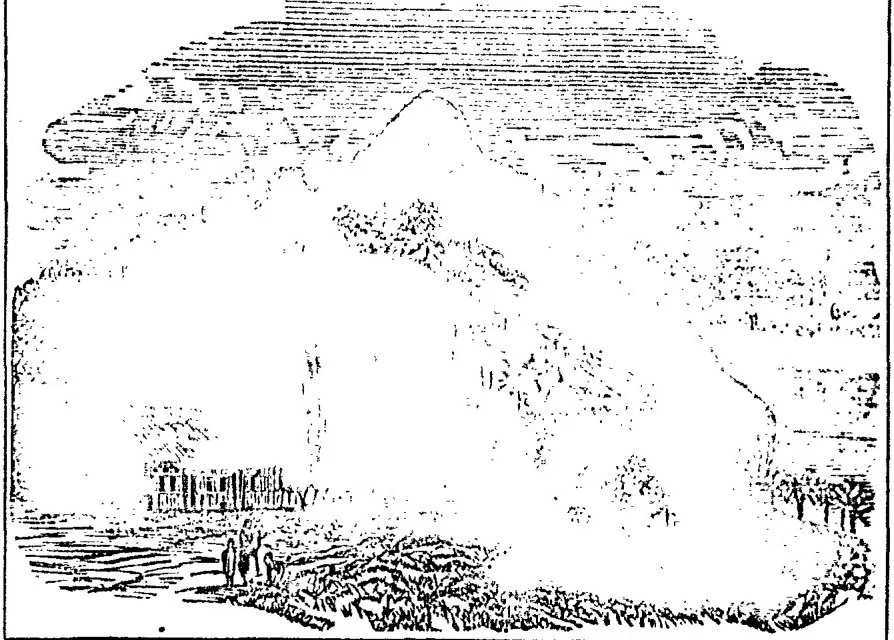
Immediately he began visiting and talking with the people, and soon five of them (four women and one man) were gathered around the table in Mr. Young’s house, engaged in reading the Bible on the Sanctuary question. The next day twenty-two came together to learn of the wonderful subject. The following Sunday, the Sabbath question was spoken of, and all seemed deeply interested. Soon the meetings were transferred to the school-house (also used as a church), a picture of which is here presented. Another reading on the Sabbath and law was given, and several pledged themselves to keep the Sabbath.
When the Sabbath came, the church bell was rung for morning service, and the whole community was present at the meeting, including the magistrate and pastor. From that time forward Sunday was relegated to its proper place in the cycle of the week; namely, among the working-days, and the Sabbath was observed as God had commanded it to be,—a day of holy convocation.
On every subject presented, the Bible and that alone was the standard acknowledged. When the subject of baptism came up, nearly all saw and acknowledged their duty on that point. After spending five weeks with this interesting people, one day just before the Sabbath a small yacht of fourteen tons burden, the “General Evans,” unexpectedly came to the island, to purchase the cotton, coffee, arrowroot, etc., raised by the islanders, and to take it to the San Francisco market. On being told that they could do nothing about it till after the Sabbath, the captain came on shore and attended meeting during that day.
When the little vessel had received her cargo, there seemed no other way for Bro. Tay to do, but to embark on her for home. His work was but just well begun; however, if this opportunity passed, another might not present itself for a whole year. So he decided to leave a good stock of books for them to read, and promising them that just as soon as practicable a minister should be sent, to baptize and further instruct them, he commended them to the care of our Heavenly Father, and bade them adieu. The “General Evans” reached Tahiti Dec. 10, and Bro. Tay remained there until Jan. 14, when he took passage on the brig “Tahiti” for San Francisco, where he arrived Feb. 12, 1887, having been absent from home seven and one half months.
Although the people of Pitcairn are largely deprived of intercourse with the great outside world, they are by no means devoid of intelligence. They improve their limited privileges for education far more than many who have them in greater abundance. As a sample of the earnestness in expressing their thoughts, we give the following letter from one of them, written as Bro. Tay was on the point of leaving the island:—
Pitcairn Island, Nov. 22, 1886.
DEAR MRS. TAY: Your good husband has just proposed that I write you a letter. It must be short, as he is on the eve of leaving for Tahiti. I trust that, under God, he has been the means of awakening in us a great deal of interest in the Bible, especially on the prophetical books. We have had daily Bible readings since he came here, and I trust this has been profitable to us all. We would like to have him stay a longer time with us, but he thinks the Lord wills it otherwise. May he prosper him in his work, and guide him safely to you when his work is ended. We have had the pleasure of his staying with us, and will miss him, I know.
Mother and I send you a hat and basket which we made. We hope you will like them. The hat is trimmed with the bark of the bread-fruit tree, young, beaten out. It is dotted with colored wool. Two other friends have remembered you also. With best love,
Yours truly,
ROSA YOUNG.
A letter from the island written March 1, 1887, shows the anxiety then felt on the part of the people there for more instruction on the different points of truth:—
Pitcairn Island, March 1, 1887.
DEAR BROTHER: Three months have elapsed since you left. I would have written sooner, but no chance came to send the letter. I wrote two letters in November and December, but destroyed them on that account. But a vessel was seen last night on the west side of the island. She waited till to-day, and it proved to be a vessel bound direct for California. I am sorry I did not know of it till the boat returned with the captain. As I write in haste, a full account of the work cannot be given in this note, but another opportunity may soon offer itself, as we expect the “General Evans” this month.
I am happy to inform you of the progress of the work here. Most of the people seem so eager to know the truth. There is not a book left unread by the people, and there are hardly enough for all who wish them now. The old ones that were here before, I had taken from the public library, to send on board ships, and so help spread the present truth; but I shall distribute them among our own people instead. Their interests are all awakened. The “Testimonies” and “Great Controversy” seem to be of special interest. “Testimony No. 32,” I kept for my own use, but one of the girls of my class wished very much to have one, and that was given away. Then I read mostly the doctrines, especially “The Sanctuary and the Twenty-three Hundred Days,” and “Thoughts on Daniel and the Revelation.” This book I have found to be of priceless value, and I cannot thank our God enough for sending you here, and for the large presents of books you made. You have not spoken enough in their praise. Truly we have the light. Sr. White’s books I have little chance of reading; for I would not keep one from the people who ask for them.
Then referring to the destitute condition in which they find themselves, for want of some one further to teach them the truth, the writer quotes from the “Testimonies” to strengthen their appeal for help:—
It would not be amiss for me to quote here from Sister White: “They must not be neglected; they must not be left to die for want of proper personal effort and training. The work should not be left prematurely.” There are some who while they read the books and admire the style of writing, so candid and open, yet are slow to take in some of the doctrines, especially the doctrine of “immortality.” May the Lord soon bring them to see the light. The daily Bible readings are still carried on. The Sabbath services are the same as when you left, though the work makes rapid progress here. But there are divisions, and I am sorry to say that they are at present carried to a mournful degree. Oh, how I long to see your people back again! I like to serve the Lord with one heart and one mind with his people. The divisions I shall give in full in my next. I trust that by this time, through the mercy and goodness of our Heavenly Father, you have reached home in safety.
With kindest regards and Christian love for your dear wife, yourself, and all who are in the Lord, I am—
Most respectfully,
MARY ANN McCOY.
It seems as though such an appeal ought to stir every heart, especially those who have confidence in the “Testimony” quoted. It would be more than strange if the enemy of all truth did not seek by every possible means, the overthrow of those pure and single-hearted islanders. Here are more than one hundred souls that are just as precious in the sight of God as the same number in any other part of the world, left to be buffeted by the enemy at will, and by the most plausible devices, as we shall find upon examination of letters from there of a later date.
Nearly a month later another letter was written, giving somewhat in detail the divisions spoken of above, and also the happy change that followed:—
In my last I spoke of divisions among this people, and promised to give them in full in my next. The same time that you left, some of our people determined to break away from the Church of England, and the feast days instituted by the Church, and attend only the Bible readings. It was warmly spoken against. Those who had withdrawn held morning services in a private house (just below Mr. Young’s), and joined the Bible reading in the afternoon; but I am sorry to say that the divine Spirit of our Master is much needed. From a lack of meekness, the cause of truth is somewhat injured. Things went on in this way until Feb. 8, when it so happened that the subject for our daily Bible reading was Daniel’s vision of chapters 8 and 9. I had been asked twice before to take the book on the great image of Daniel 2, and the vision of Daniel 7, but refused to do so. The book was at this time put into my hands (Feb. 8). It caused a stir. Those who had withdrawn from the church, and a few others, would not attend the meetings as long as the “woman continued,” considering that if they attended the meeting while a woman taught, the word of God would be broken; for a woman must not “usurp authority over a man.” So the greater part of the men absented themselves, and the women who attended, did not come with a right spirit. The word was read with such irreverence that it raised a feeling, I trust, of holy jealousy in the hearts of God’s humble followers. Some spent a sleepless night on that account.
Two days after the reading of Daniel 8 and 9, which continued for three days, my brother took the book. The reading was for “workers.” There arose some dispute in the meeting in respect to women’s teaching. The party that had withdrawn were bitter against it. Mr. Young, my brother, and others, are for it. It was remarked that a woman’s teaching or usurping authority over a man, is paving the way for the antichristian power, and is therefore the spirit of antichrist. “Does Mrs. White teach?” we asked.—“Yes,” and no one dares to condemn her work and labor of love. Things went on badly for a time, but thank God, only for a time. I regret to write anything against our people, as it affords me no pleasure whatever. I shall be happy to know what your people will say on the subject. If God has seen fit to bestow gifts on a woman, to make use of her in his service for his honor and glory, and the good of our fellow-men, must she bury her talents simply because she is a woman, and allow a man, however destitute of ability and, above all, the Spirit of God, to take the119lead in teaching a whole assembly simply because he is a man!
In my last note I quoted from Sr. White that the work should not be “left prematurely,” and also spoke of some who were still clinging to the old and false doctrines, especially the immortality of the soul. But a happy change has taken place. For the last few weeks, nearly if not all have embraced the present truth, and have come out entirely from the Church of England. Peace and unity reign among this people. Since Feb. 10, Mr. Young has read “Thoughts on Daniel and the Revelation,” instead of sermon books. On the Sabbath of March 26, the form of the Church of England was entirely put away. (Our Sabbath services now are, Sabbath-school at eight o’clock A. M.; morning service at half past ten.) The morning services commenced with singing, then prayer was offered, after which followed the reading of a chapter in the Bible, and a portion from “Thoughts on Daniel and the Revelation.” The meeting thus closed with prayer and singing. In the afternoon reading we were divided into classes. The teachers were the same as in the morning, with the exception of two added, my brother and Stanley (Ben). We all worship together again.
The work of reformation has been going on. There is only one man still addicted to the use of tobacco,—that little American. The rest of our men have strictly given up the use of tobacco. The habit of tea-drinking several have given up, especially among the children. In some cases whole families have given up pork-eating. I trust the result will be that no one here will use swine’s flesh much longer. The interest of the people in the present truth seems to increase daily. Their earnestness to obtain knowledge and to walk in the light of truth is great. Of the books, I have none with me at present. As fast as they are returned, others are ready to take them. Besides reading “Thoughts on Daniel and the Revelation” on Sabbath, my brother sometimes reads from “The Marvel of Nations” in the meeting, for our benefit. We followed the Saviour’s example of humility in washing one another’s feet at the Lord’s supper Dec. 5, 1886.
I have given away tracts to three ships. The first was Sabbath, Dec. 19. A vessel was seen coming in when we were in the morning-school. The day being fine and calm, it was not until late that she was near enough for the boat. I sent three tracts on board, “The Sabbath of the New Testament.” One was given to a young Christian sailor. When our men left the ship, he with another was searching the tracts and the Bible, with a promise to keep the Sabbath. The captain and his wife came on shore. She thinks it makes no difference what day we keep. I gave another tract to her. She thankfully received it, and promised to read it. In February another vessel came on Sabbath. The captain came on shore, and I gave him a tract which he promised to read. Two weeks ago on preparation day, the men went off to another vessel. I sent by my brother the “Constitutional Amendment: or the Sunday, the Sabbath,” to the captain, who gladly received the tract. He is one who used to read your papers, and believed present truth, but has been for a long time where he could not get them. There are two other cases for baptism.—The “Synopsis of Present Truth” is of inexpressible value. This, together with the chart, has been a great help to me in the Sabbath-school, and of intense interest to the scholars.
May the blessing of our Heavenly Father rest upon you, your wife, and your people, and may we be found as we are borne on by time nearer to our eternal home, a ready people for the city of the New Jerusalem.
Most respectfully yours,
MARY ANN McCOY.
J. O. CORLISS.
What Makes a Man Remarkable
—A real man is a rare man. Most men are as much like other men, and as little like themselves, as they can be. Only now and then does a man appear to be himself, or wish to be himself; and such a man is always a man of mark, is always a man worthy of remark,—is always, in fact, a remarkable man; for a remarkable man is simply as the term implies, a man worthy of a second note,—a man worthy of being marked and remarked. Indeed, a man who is worthy of respect, or who is of respectable ability, is simply, according to the etymology of the words “respect,” “respectable,” a man who will bear looking at more than once,—a man whose character calls for more than a passing glance; hence it may be said that a man of even respectable ability is a remarkable man.
It is well worth any man’s while to be himself at his own best, even though he must differ from all his fellows in his standard of character and of conduct in order to be at his own best; for that individuality in itself will make him a man who commands respect by his remarkable personality. Yet it is not an easy thing for any man to be himself at his best. It is a very simple thing, but it is not an easy thing, to have one’s own standard in little matters and in larger, and to adhere to that standard at the risk of being all by one’s self, in one’s social circle, in one’s community, or, if need be, in all the world. But he who will not do this, can hardly be a remarkable person, even though he deems himself respectable.—S. S. Times.
Afflictions of the Righteous and Divine Deliverance
—Some one has said that “the saints are sometimes allowed to fall into an affliction, to preserve them from falling in with a temptation.” And we read in the Scriptures that “many are the afflictions of the righteous: but the Lord delivereth him out of them all.”