How should we reckon the tithe in order that every church member may have due credit for doing his duty, and not be judged as guilty of robbing God? Perhaps one reason there is not a better showing as to the number of church members paying tithe is due to the fact that many of the members, being minors and having no personal income, are left out of the count, even when their fathers have paid tithe. May this not, too often, be the case with the man's wife also? She may sometimes have some eggs or butter to sell, or may take in some cash for sewing or washing, and pay her tithe out of that, and thus be counted as paying tithe. Some of the boys or girls in the family may pay their tenth out of occasional earnings, and be reported as tithe payers. Or it may be that the younger members, and perhaps their mother also, have had no earnings they could really call their own, and the husband and father paid the tithe, and he only is recorded as doing so. But should not his wife and children, if they are in harmony with the system of tithe paying, be regarded also as tithe payers; for did not they help in the general work about the house and garden, and in caring for the stock, and raising the crops, etc.?
Again: some sister, in full harmony with this duty, may have a husband who is out of the truth, and bitterly opposed to her using for this purpose any of the money he furnishes her. She may seldom have an opportunity to earn any means, and can pay tithe only on this small pittance. Should not she be recognized as a tithe payer?
Now as to what constitutes a true tithe. This puzzles many. The Bible clearly states that the tithe should be one tenth of the increase. Lev. 27:30. So if a person puts in a crop of wheat himself and markets it himself, the only expense he ought to count out is the cost of seed, and the reaping and threshing if he had to hire them done. The gain, or increase, would be the remainder. Or if a family plants two bushels of potatoes, and raises twenty bushels, they would have eighteen bushels to pay tithe on, even if they kept them all for their own use; for if the Lord gives us our food and raiment, we should pay him one tenth. This is surely his plan (see Gen. 28:20, 22), and it would be well for us to be faithful in carrying it out in the spirit and to the letter (Matt. 23:23; Mal. 3:8-11); and let every member of the family, especially those who are church members, have an interest and be counted in it.
The Secret of Witnessing
THE great secret of witnessing is to become acquainted with the Lord, and to know his sin-cleansing and his keeping power. He who knows this for himself, because he has the Spirit's own testimony, so that he has no need of any human assurance of the fact, can speak with an authority that is impossible to the greatest scholar in the world, who has not that witness. The whole secret of the power of the apostles was that “they had been with Jesus.”
Not only will one who has been with Jesus, and who walks with him, be able to witness for him, but he will not be able to keep from testifying. The rulers threatened the apostles with the severest punishment if they persisted in witnessing for Christ, but they said, “We can not but speak the things which we have seen and heard.” Acts 4:20. Jeremiah had a similar experience. He was derided and reproached and threatened, and he says: “Then I said, I will not make mention of him, nor speak any more in his name. But his word was in mine heart as a burning fire shut up in my bones, and I was weary with forbearing, and I could not stay.” Jer. 20:9. Remember that these men were ordinary men, such as we are. The apostles were fishermen whom the Lord called; and Jeremiah was a timid child until God put his words in his mouth. Jer. 1:4-9.—Selected.
Sin’s Fascination
WHEN once a man has done a wrong thing, it has an awful power of attracting him and making him hunger to do it again. Every evil that I do may, indeed, for a moment create in me a revulsion of conscience, but, stronger than that revulsion of conscience, it exercises a fascination over me, which it is hard to resist. It is a great deal easier to find a man who has never done a certain wrong thing than to find a man who has done it only once.
If the wall of the dyke is sound, it will keep the water out, but if there is the tiniest hole in it, it will all come in. So the evil that you do asserts its power over you; it has a fierce, longing desire after you, and it gets you in its clutches. Beware of the first evils; for as surely as you are living, the first step taken will make the second seem to become necessary. The first drop will be followed by a bigger second, and the second, at a shorter interval, by a more copious third, until the drops become a shower, and the shower becomes a deluge.
The course of evil is ever wider and deeper, and more tumultuous. The little sins get in at the window, and open the front door for the big house-breakers. One smooths the path for the other. All sin has an awful power of perpetuating and increasing itself. As the prophet says in his awful vision of the doleful creatures that make their sport in the desolate city, “None shall want her mate.” “The wild beasts of the desert shall also meet with the wild beasts of the island.”
Every sin tells upon the character, and makes the repetition of itself more and more easy. “None is barren among them.” And all sin is linked together in a slimy tangle, like a field of seaweed, so that the man once caught in its oozy fingers is almost sure to drown.—Dr. Alexander Maclaren.
Beware of the “little” sins.
Will Come
By G. B. Thompson
G. B. THOMPSON
“But the day of the Lord will come.” Thank the Lord for this blessed promise. Though long delayed, and scoffed at by thousands, it “will come.” The promise is sure. Though thousands of years may have sped by since the Lord gave this promise, it is sure to all the seed.
This blessed promise has cheered the hearts of thousands in their journey through this valley and shadow of death. When worn, tempted, and tried, perchance almost beyond endurance, they have looked ahead to the day when deliverance will come.
To encourage the hearts of the watching pilgrims in Zion the King of the eternal city has placed along their pathway signs as omens of the coming day. In the heavens—in sun, moon, and stars, every place in which a sign could be placed—the Lord has placed a herald of the approaching end. On the earth, in land and sea, and in the air, he has foretold certain conditions which will exist, which, when seen, will unmistakably indicate how far we have traveled on the highway of time, and how near we are to the final consummation. And, further, among earth’s warlike nations mustering for slaughter, in society, in a cold, pleasure-loving church, and in the hearts of men, beholding with dread akin to terror, the gathering storm, the Father has placed precursors of the end, which he has before declared “will come,” and prophetically indicated how near is the great and glorious consummation. As surely as the railway traveler can locate himself, and know how near he is to the end of his journey by consulting the “time table,” so the student of God’s Word can accurately determine where we are in the history of the world, and when the last station will be reached in the long, weary journey from paradise lost to paradise restored.
And, bless the Lord, the end is almost here. The waymarks are nearly all in the past. The day of the Lord is almost here. Though the hearts of some may be growing cold, and they begin to say that the end is delayed, it hasteth greatly. Not much longer will the toils and sorrows of earth continue. God’s people are almost home. The ship, tossed for six thousand years on the foaming breakers of sin’s wild ocean, will soon enter port. The watchman can discern in the distance the land of rest. Though unbelief may thicken about us, let courage and hope spring up anew in the hearts of the watching remnant. The message of the coming King in this generation is no cunningly devised fable. “The day of the Lord will come.” The closing act in the terrible drama being enacted on earth will soon close, and the curtain will drop forever. There has been no more solemn or sublime time than this since man was created.
Joshua the Spy and Conqueror
“Joshua the spy, was a prophecy of Joshua the conqueror. Faithfulness to God is the finger-board pointing to the front.”
A Wholesome Medicine
A wholesome medicine is Cheer,
And Hope a tonic strong;
He conquers all who conquers Fear,
And shall his days prolong.
A happy heart, a cheerful lip,
Contagious health bestow;
As honey-bees their sweetness sip
From fragrant flowers that blow.
Who lives in Love's enchanted hall,
Where Fear nor Sorrow stalk,
The melodies of Peace o'er all
Shall hear, though men may mock.
A thousand years are as a day
To him who trusts the Truth;
Who shuns the path of Error's way,
Attains perennial youth.
Sing on, sing on, forever sing
And hope, despite thy lot;
From heaven thy fervent heart shall
wring
The fate thy prayer hath sought.
Let cheerful thoughts prevail among
The sons of men alway,
And sighs shall change to Love's sweet
song,
And night to golden day.
— Selected.
Early Training
By Mrs. J. C. Brower
MRS. J. C. BROWER
“Making a mistake in the outset of life is like beginning to unwind a skein of silk at the wrong end. It gives infinite trouble, and perhaps it is in a tangle half through, but it often gets smooth and straight before the close. Thus many a man has so conquered himself for duty’s sake, that the work he originally hated, and therefore did ill, he gets in time to do well, and consequently to like.”—Dinah Mulock Craik.
This has been true of men in secular business. Much more in one whose soul has been enlightened by the divine illumination. And what a satisfaction and joy it is to know that the Lord can make of us “a new creation,” and that in him we can turn failure to success, and reproach to praise and benediction.
Yet even though this may occasionally be true, it does not always come about so. For sometimes when the skein of life is more than half unwound, we find ourselves perplexed and hindered by snarls and knotty places that result from beginning things “at the wrong end.”
Beginning right! How much it implies! Youth who are taught lessons of self-control and burden bearing naturally acquire strength of character as a result of such training and exercise.
The Lord expresses the thought in the simple declaration, “It is good for a man that he bear the yoke in his youth.” Lam. 3:27. And the blessed crop of good begins to ripen before the skein is half unwound, blessing not only the one who bore the yoke in his youth, but every one who comes within his influence.
Beware of the Little Foxes
By F. W. Johnson
F. W. JOHNSON
My heart goes out to all the young in our ranks, who, because of their youth and inexperience, are special targets for the temptations of the evil one. So often, through yielding to appetite, or some other selfish indulgence,—perhaps before they are aware of the seriousness of their mistake,—they are bound by Satan with the cords of a habit which results in the undermining of health of body and mind. And thus early the temple of God is impaired. That temple, which he intended to be pure and sacred, and in all things to glorify its Maker, is broken down, and it will take true repentance and years of right “seed sowing” to undo the effects of these “little sins,” as they are often considered. “For whatsoever a man soweth, that shall he also reap.” And God’s record only will show the power and opportunities for good that were wasted in those lost years. But sadder still is it when the shattered temple early decays, and the grave swallows the promising young life which might have been filled with good influences as far-reaching as eternity.
I have in mind a talented young man, a student in one of our schools. He was a sincere Christian, and had been educated for the ministry. But too late the knowledge came that early habits of impurity, though repented of and denounced, had laid the foundation for disease; and the God-given abilities for good were cut short. Our young friend fell a victim to consumption. He died a triumphant death, falling peacefully asleep in Jesus. But he suffered greatly, and lost his life; his friends deeply mourned, and the world lost one of God’s messengers.
I have before me the picture of another,—a bright, kind-hearted youth, one generally loved. He was also a student of our schools. His sin was no uncommon one—indulgence of appetite. Too late he saw his mistake, regretted his disregard of counsel, and strove to correct his errors. Already the relentless hand of disease was upon him; and with unavailing attention and aching hearts, we watched him rapidly fail, and laid his still form in the grave; but not—I rejoice to say—until he had made his peace with God. “For in bright hope he died.” But the possibilities that were before him, the good he might have accomplished, the stars his crown might have borne, God only knows.
One more picture, yet sadder, but too true. A talented, conscientious boy,—but impure thoughts entered, and were harbored in that once spiritual mind, and the good Spirit was driven out. Evil practices deadened his conscience. He renounced God, and took to drink. Later, these evils all cast their blight over his fair young wife. His stony heart was now without natural affection, and he soon deserted her whom he had vowed to cherish, and indulged more deeply in vice and lust. And the end?—I know not. With his mind unbalanced, his constitution shattered, the termination must be speedy and terrible.
O! will our dear youth banish the first impure thought, and shun the beginning of evil as they would the leprosy? “Whether therefore ye eat, or drink, or whatsoever ye do, do all to the glory of God,” remembering that “he that soweth to his flesh shall of the flesh reap corruption.” But “blessed are the pure in heart [or thought]: for they shall see God.”
Country Life
By Frederick Griggs
FREDERICK GRIGGS
“The groves were God’s first temples.” God speaks to the heart and mind of a child who lives in the country, in a far more positive way than he can to one who lives in the city.
The purpose of God is to bring to himself every child born into this world. In this work he should have the co-operation of parents and teachers. But when we have the children so far removed from the environment in which he particularly manifests himself, obviously the work is much harder. While it is true that many parents are so situated that it is quite impossible for them to have their children in the country, yet it should be the endeavor of every parent, each year, to spend some time with his children away from the bustle and noise, the excitement and over-stimulation, of the city.
The country is the native home of every child, though it is true that many of them do not live in the land of their nativity. The fresh air, beautiful sunshine, and fragrant flowers have a life-giving influence upon the developing child. Aside from this physical effect, there is the additional leading to worship and reverence, given by this same sunshine, fresh air, and flowers.
If the child is taught that the heavens declare the glory of God, and that the sunshine, fresh air, flowers, birds, and rocks are but means that God is employing to speak to them of himself, he can but come to have a reverence for the Creator and Preserver of these wonderful things which bring so much happiness to him.
Power of Unconscious Influences
That which affects us most is that which we receive unconsciously. We receive more from the unconscious influence13and association of our friends than by the direct effort which we may make to imitate them. So it is with the child in the country. As various flowers take from the soil, sunshine, air, and water, just those elements which are needed to produce the particular form of life that they manifest, rejecting all others, so will the child drink in from nature in all its various forms just those ingredients of character which are necessary for his individual needs. This should be qualified, however, by saying that the benefit which he derives or does not derive, will depend largely upon the attitude which his parents and instructors themselves take toward the works of God.
Every one in the world is seeking after pleasure, but few know what true pleasure is. This is due largely to errors in education. True pleasures, those which make up the life of mind, are, after all, the simplest and most unassuming. The man of wealth and leisure may traverse land and sea after happiness, and find it not, unless he takes it with him in his heart day by day. On the other hand, examples are abundant of men who have never been more than a day’s journey from home, and yet whose lives are filled with contentment and happiness.
God in Nature
Christianity is the only source of the real happiness and enjoyment of this life, the only place whence one may receive a philosophy that will meet the perplexities and annoyances incident to life, as they should be met. And when one knows that this religion embraces the love of nature, the soul is brought into closer contact with our Creator, and the ability to meet with and overcome the perplexities of life is greatly increased.
These perplexities of life are caused largely by one’s thinking of himself. Every one should have some wholesome lines of thought, which will take his attention away from himself, and center it in something else. What better can be suggested as a field of thought than the works of God? They are full of beauty and power, sweetness and grandeur.
But how few people there are in the world who see the works of nature at all, much less see the presence and love of God in these works! It requires education and training to observe the things about us, and to take from these objects the lessons which they are designed to teach us. This education comes to the child who lives in the country, if he has wise teachers, and this education leads him in the path of contentment, because it presents to him lines of thought and action which lead him outside of himself.
It can not be said there is more in the country to attract the attention of the child than in the city; probably there is less. But that to which he does give his attention in the country is wholesome, while in the city, or even in villages, this is not always or generally true. In the country everything lives for the child; in the city everything seems to live for itself. In this the country makes, teaches—
A Lesson in Unselfishness
For the child the birds sing, the flowers bloom, the bees work. Everything works for the good of something besides itself, and he can but unconsciously learn the lesson of unselfishness.
Further than that, there is also something for him to do with his own hands, in a sense which there is not in the city. Work is one of the greatest blessings which can come to childhood. Those children who learn this lesson early will correspondingly early develop strong characters in which there is much of sunshine and helpfulness; for they have drunk it unconsciously in childhood. Give the child the country, where, unfettered by the trammels of modern civilization, he may be natural.
Do That Which Is Honest
In these days when business schemes, so unjust, so unholy, are being practiced, when lying and cheating are so common, it means something to “do that which is honest” in all our relations with the world. Again, we are told to “provide things honest in the sight of all men.” This means that we are to pay for the things we get. “Owe no man anything,” is preceded with, “Render therefore to all their dues,” and followed with the statement, “But to love one another.”
Getting into debt sometimes seems unavoidable, but usually it is the result of failing to live within our income. Our supposed wants lead us to go beyond the point where we can reasonably expect to pay. By exercising self-denial we might be comfortable, and save ourselves and others much trouble by not getting involved in debt.
We can not do as others do. Let us not forget that we are closely watched by the world. Keep your word. Better not promise, than promise and fail. Can we imagine that Jesus Christ ever promised to make a house, a dining-table, an ox yoke, or anything of the kind in a carpenter’s line of work, and slighted the job? or failed in doing precisely as he agreed to do in every particular?
Much care should be exercised in making bargains. A close spirit should be avoided on the one hand, and an extravagant one on the other. “There is that scattereth, and yet increaseth; and there is that withholdeth more than is meet, but it tendeth to poverty.”
It is possible for us to “do that which is honest” in the sight of God and all men, and let us not flatter ourselves that we are following Christ if our dealings with others savor in any way of dishonest practices. It is by beholding the pure, unselfish, and upright “works” of the children “of light” that unbelievers are led to glorify the Father which is in heaven. Are these works in sight? Let us get just as many as possible before the people. They are as beacon lights to the wrecks floating by.—The Indicator.
Fevers
FEVERS are among the most common forms of disease. In general they are not dangerous, considering the great variety of causes by which the body becomes frequently loaded with morbid matter. A fever may be a desirable and useful remedial effort. It is a fire that burns out the impurities of the system, and ought to, as it generally does, leave it in a better state of health than before. Many persons long afflicted with chronic ailments become quite well after having an attack of some form of fever.
The causes of fever are classed as remote and direct. The remote causes are all forms of impurities which accumulate in the body from bad habits; generally from eating improper food, drinking impure water, or breathing air loaded with malaria or other poisons. The direct causes are severe colds or some form of nervous shock.
In a fever, the effort to depurate morbid matter out of the system is mainly through the skin, hence the determination of blood to reach the surface, and a rise of temperature. When the excessive heat of the surface is checked by frequent bathing in tepid water, the extremities kept warm, the head, lungs, and bowels kept at a natural temperature by the application of tepid or cool wet compresses, the sick chamber supplied with fresh air both day and night, and the bed linen frequently changed, death from fever is exceedingly rare, even if there is no other treatment.
We have found the unfermented juice of various fruits an excellent article of food in fever cases, when the food must necessarily be of a light character easily disposed of.—Selected.
Avoid Stimulants
THE Popular Science News gives the following sensible advice in regard to the use of stimulants:—
“All of the so-called strengthening preparations, which enable a man to accomplish more work when he is under their influence, do this, not by adding units of force to his body, but by utilizing those units of force which have already been obtained and stored away as reserve force by the digestion of his food. Kola, cocoa, chocolate, coffee, tea, and similar substances, which, while they temporarily cause nervous work to seem lighter, do so only by adding to the units of force which a man ought to spend in his daily life, those units which he should most sacredly preserve as his reserve fund. The condition of the individual who uses these articles when tired and exhausted, with the object of accomplishing more work than his fatigued system could otherwise endure, is similar to that of a banker, who, under the pressure of financial difficulties, draws upon his capital and reserve funds to supplement the use of those moneys which he can properly employ in carrying on his business. The result in both instances is the same. In a greater or less time the banker or the patient, as the case may be, finds that he is a pecuniary or nervous bankrupt.”
A Glimpse of “Holy Week” in Rome
By Chas. T. Everson
CHAS. T. EVERSON
The week which begins with Palm Sunday and ends with Easter, is, by far, the most important time in the year for the Roman Catholic Church. The multitudinous ceremonies of this week we shall not attempt to describe; we will notice but a few of the more prominent features of this time.
The service of Palm Sunday at St. Peter’s church was carried on much the same as this service is celebrated in Catholic churches everywhere, with the exception that a cardinal officiates here. The cardinal, with the aid of a large number of prelates and bishops, blessed the palms and scattered them out to the people, who grasped them with eager hands.
On Wednesday afternoon the doleful service of the Tenebrae, which word means darkness, was begun, and this service was repeated each day, for the three days of Wednesday, Thursday, and Friday. In this service a candlestick containing fifteen candles was given a prominent place at the altar, and at the end of each psalm one candle was extinguished, until at the end of two hours of tedious and unintelligible service the candles were all finally extinguished, except one, which, while still burning, was removed from the candlestick.
After this service of the Tenebrae on Thursday at St. Peter’s church, the traditional washing of the papal altar took place, which is performed in this church only. Five canons, passing around the altar, from which the altar-cloths had previously been removed, each in turn poured wine and oil from flasks over the stone slab. Then with the aspergillum, a kind of brush which each carried, they performed the washing of the altar. After the five canons had completed their office, all the members of the officiating company, beginning with the cardinal, walked around the altar, passing over it the aspergillum which each carried in his hand. This part of the ceremony completed, the five canons concluded the service by wiping up the oil and the wine with sponges.
At the close of this ceremony the relics of the church were displayed from the gallery of St. Veronica. They were purported to be the veil of St. Veronica, the spear with which Christ was pierced, and a large piece of the “true” cross. When the people saw the piece of “the true cross,” they fell on their knees, and a marked silence prevailed. They did not know how many pieces of this so-called true cross there are in the world. A leading professor in history has said that if all the wood purported by the Catholic Church to be the true cross could be collected, it would fill a large ship. Paul wished to banish from our minds any such ideas as adoring relics when he said, “Yea, though we have known Christ after the flesh, yet now henceforth know we him no more.”
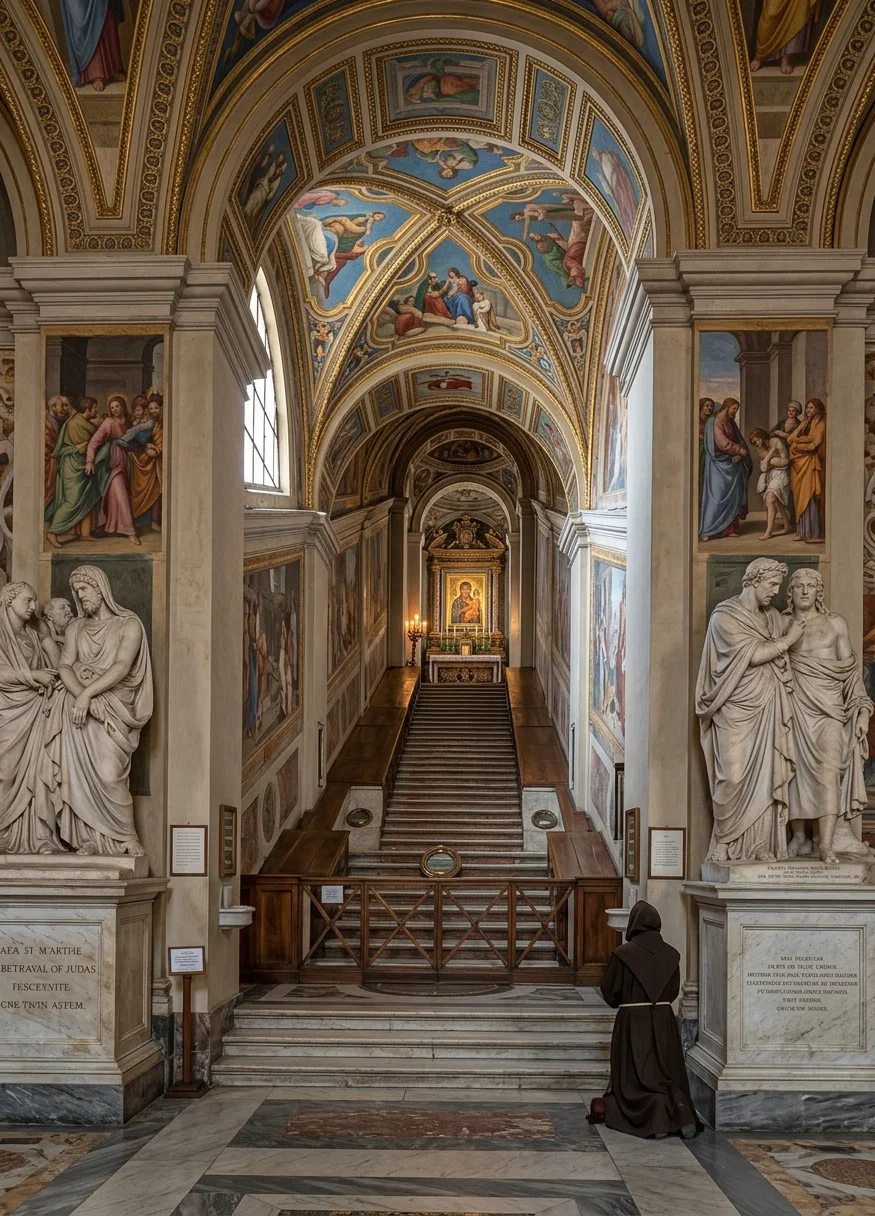
SCALA SANTA
Adoring pieces of the cross, or even worshiping a dead Saviour, will not bring salvation. But we are to look to a Jesus who says, “I am he that liveth, and was dead; and, behold, I am alive for evermore.” A morbid religion has been the result of dwelling on such pictures as Ecce Homo, on crucifixes and pieces of the cross. What we need to behold is the One who has all power in heaven and in earth.
On Thursday we witnessed the service of humility as it is performed by the Catholic Church, this being the day that the Romish church has ordained as the one on which the original ordinance was instituted. We saw a cardinal wash the feet of thirteen young students of the priesthood. He had two assistants, one of whom held the basin, while the other held the pitcher containing the water. All the utensils were of silver. The cardinal washed only one foot of each individual. He was girded with a towel. The one assistant poured the water over the foot, while the other held the basin under it to receive the water. The cardinal then wiped the foot and kissed it. This service he performed for each of the thirteen students. The ceremony was extremely formal, and there was no washing of “each other’s feet,” as only these students’ feet were washed. That completed the service. There was none of that deep moving of the Spirit that I have witnessed at the celebration of this solemn service when it was performed from the heart. With much difficulty the students suppressed their smiles, and the cardinal seemed somewhat ashamed of his work.
On Good Friday we visited the Scala Santa. This is a flight of twenty-eight stairs, said to be the flight of stairs that Christ ascended to Pilate’s judgment hall, and they were transferred hither centuries ago. It was while ascending these stairs that Martin Luther heard the voice, saying, “The just shall live by faith,” and immediately arose from his knees and went forth a determined apostle of the Reformation. No one is allowed to ascend the stairs except on his knees. Good Friday is the time when most people ascend these stairs; for on this particular day there is an image representing the dead Christ at the head of the stairs. The stairs were so crowded by those who were ascending, that a large number climbed up the sides, which are used ordinarily for the descent. As each one reached the top, he, still on his knees, came to the image of Christ, and kissed it over and over again. On each stair the one ascending is supposed to say a prayer. As we saw them climbing up the stairs and kissing the image, it would not have taken much of a stretch of the imagination to believe that we were in the temple of some idol in the midst of heathendom. We thought that instead of bowing at the image of a dead Christ, how much this people needed to know the power of a living Redeemer.
Nowhere in the history of the early church do we find the Christians making pictures of the cross or using crucifixes, or employing any of these outward forms to aid them in devotion. They dwelt not so much under the shadow of the cross, but in the presence of a Christ that “ever liveth to make intercession for them.” Truly they valued his death, and rejoiced that he had won a complete victory. But they gloried most in the fact that their Jesus had all power in heaven and in earth, and that this Jesus was with them alway, even to the end of the world. Our Saviour is not in Joseph’s new tomb, but on the right hand of his Father in glory.
Rome, Italy.
Revival of Personal Devotion
“THE needs of the home churches and the needs of the heathen abroad can only be met by a revival of personal devotion to God.”
Medical Missions at Home and Abroad
Medical Missions at Home and Abroad for January gives the names and locations of three hundred and twenty-eight physicians in the foreign field who hold British degrees or diplomas. The number was but one hundred and sixty-five in 1893, so that it has doubled in a decade.
Mission Notes
A SEMIWEEKLY railway service between Paris and Peking, carrying the China mails and connecting the steamship lines to Shanghai, was opened May 1, 1902. From London to Shanghai the time covered will be three and one-half weeks.
IN the province of Hu-peh, China, there are sixty-nine cities, in forty-five of which there is not a single resident missionary. Including lady missionaries and wives of missionaries, there is only one missionary to every two hundred and ninety thousand souls.
LAST October an appeal was made, through the Missionary Review of the World, for missionaries to work among the Arabs. A band of Danish missionaries have responded, and the author of the appeal, Dr. Zwemer, says that this is an answer to definite prayer on the day that the article was sent to the Review.
CHINA has attempted a census, with the result that she now estimates her population as four hundred and twenty-six million. The World's Work says that a considerable area of China is so densely populated that if all the people in the United States proper lived in Texas, forty million more would have to go there before the population would be as dense as it is in the more thickly settled portions of China.
BISHOP FOWLER, of the Methodist Church, thus describes some Japanese Christians in California: “These men go about their daily life in a most prayerful manner. One man asked that he might serve half time in the family where he was employed, that he might give the other half to the study of the Bible and prayer. Having earned enough to do so, he went into the mountains to devote all his time to Bible study and prayer, and so fit himself for Christian work. That spirit has spread throughout the company of Japanese workers. They go to the incoming steamers to meet their fellow countrymen, take them to boarding-houses, and there win them to Christ. They even sent one of their companions to Honolulu, a graduate of the university, an educated Japanese.”
SOME little girls recently received into the orphanage at Aintab, to take the place of boys who had left to earn their own living, did not seem even to know how to play. They would sit all huddled together during the play time, and had to be shown what it was to play. What a poor cramped life theirs was which never suggested to them the thought of playing.
IN China a man is required to mourn three years for the death of his father, one hundred days for the death of his mother, and not at all for the death of his wife. Indeed, a Chinaman would feel disgraced if he showed any sorrow on account of the death of his wife. This tells its own story of life in a heathen country with a civilization thousands of years old.—Reformed Church Record.
A CARD received from Miss A. Helen Wilcox, dated at Bombay, India, March 6, noted her arrival in that city. She was expecting to begin work immediately, with health literature. She felt quite sure that the Lord had led even in the time of her sailing from England, as she had the privilege of meeting with some whom she believed the Lord had designed she should meet. We shall probably have reports from her later.
A MASSACHUSETTS physician who has recently been around the world making a study of hospitals and surgical methods, says of medical missions: “The missionary physicians have been the pioneers in disseminating modern medicine throughout the distant East, and in establishing outposts for scientific research. In many of the small laboratories of the missionary hospitals, original work is being done which would be creditable to larger and better-equipped institutions.”
A SOUTH AFRICAN paper reports facts to the effect that no less than one hundred and seventy-five Boer prisoners, almost all young men, while confined in St. Helena, Ceylon, India, and the Bermudas, were converted, and have since devoted themselves to life service as missionaries to the heathen. Returning home, they are received by the Dutch Reformed Church, and great preparations have already been begun to assist them to an education that they may be fitted for their work. One congregation has subscribed ten thousand dollars for land and buildings, another has undertaken to support twenty-one students at an annual cost of two thousand five hundred dollars, another to support ten, and so on.