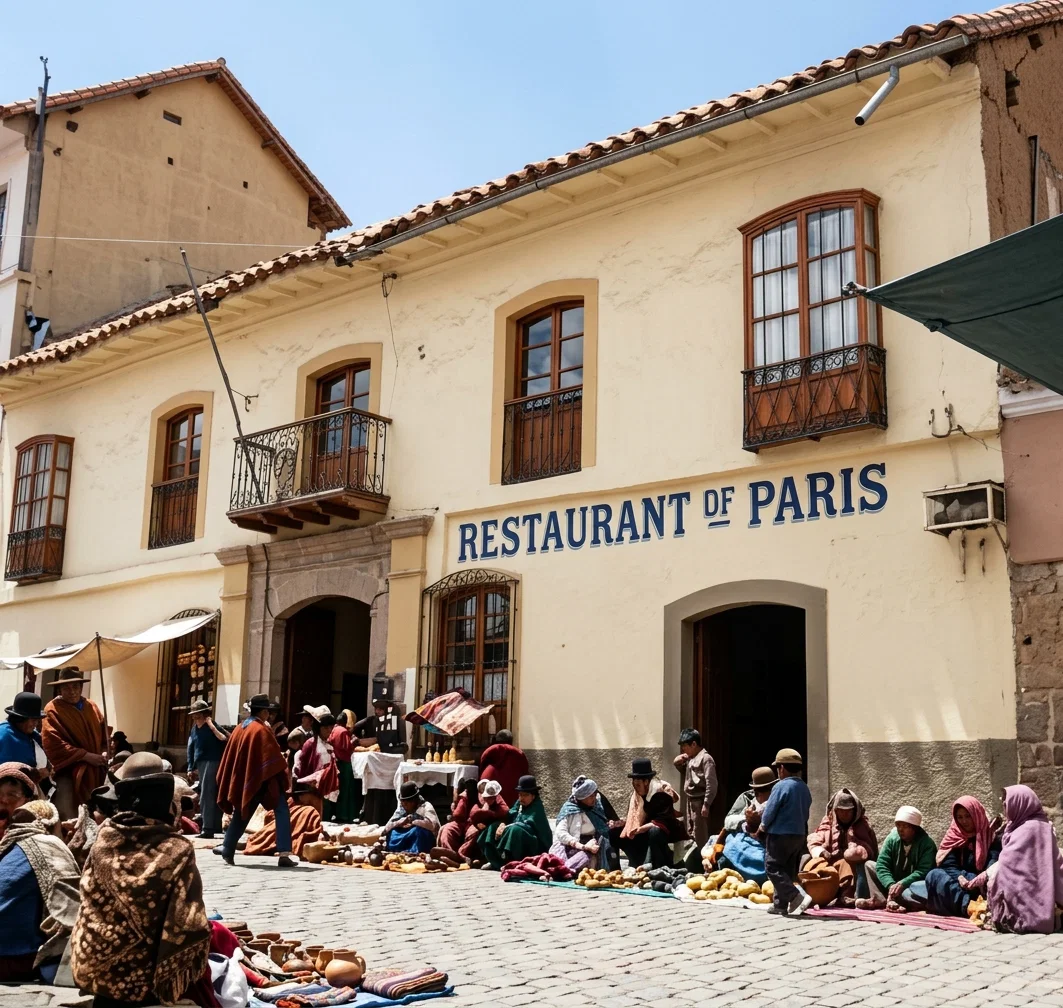
BOLIVIA is a republican state in the western part of South America. It extends from Lat. 10° to 23° S., and Long. 57° 30′ to 70° 10′ West., touching Chile on the southwest, Peru on the northwest, Brazil on the north and east, Paraguay on the southeast, and Argentina on the south. Its area is about eight hundred thousand square miles. The population is about two million five hundred thousand. Since the war between Chile, Peru, and Bolivia, it has no sea coast or ports.
A FAIR ON LA PAZ, BOLIVIA
With regard to temperature, Bolivia, almost entirely a tropical region, may claim to embrace all the zones in the world. Each locality has its own peculiar vegetation. Even the arid brows of the Andes yield a coarse grass which forms the favorite food of the llama, alpaca, and vicuna—animals almost as independent of water as the camel. The table-land of Titicaca, which has a minimum height of 12,441 feet, produces maize, rye, barley, and wheat.
There are in Bolivia several valleys which produce many kinds of fruit and vegetables. In some places fruits are abundant and cheap. In parts of Bolivia there are immense forests, and other districts where there is pasturage for cattle, but the regions most thickly populated produce very little food for man or beast. Llamas and sheep find food nearly everywhere.
Hitherto, however, Bolivia has been remarkable mainly for its mineral productions. The silver mines of Potosi, after having, on a well-founded estimate, completed the full tale of two billion dollars, are believed to be inexhaustible; while gold, lead, tin, salt, sulphur, nitre, and copper are abundant.
The foreign trade labors under heavy disadvantages. The imports, confined to articles of the highest necessity, are principally iron, hardware, and silks; and the exports, besides the precious metals, are copper, cocoa, barks, skins, tobacco, and articles of native manufacture. The total imports amount to about $5,500,000 annually, and the exports to $4,500,000.
Being surrounded by other nations, Bolivia has, since the days of Spanish rule, remained in nearly the same condition. The authorities, mostly conservative, have done very little to provide the country with roads and other means of communication. It has no railway, except one extending from Antofagasta, its former seaport town, to Oruro, and another in construction between Lake Titicaca and La Paz. Freight is nearly all carried on llama or mule back.
In the larger cities there are persons of good education, but most of the inhabitants know very little of the sciences and arts. Perhaps 100,000 of the population can read. About 1,200,000 are Indians, and of these 300,000 are said to be savages. The mixed people number about 1,000,000, and those of pure foreign blood 300,000. Nearly one third of all the inhabitants understand the Spanish language. The remaining two thirds speak their aboriginal tongues.
Colombia
By S. P. Smith
ST. ANDREWS ISLAND.— School was opened January 19, after a four weeks' vacation. We have enrolled thirty-eight regular students, and two or three who are taking special work.
There has been considerable stir here over Catholicism, caused by a priest who recently came here, and is stirring up the Baptist nest. He is now in Old Providence. We have tried to show the Baptists what these things mean, and that the only hope of a successful warfare against Romanism is in a return to the principles of true Protestantism. I feel sure that many see the point on the Sunday question; but their minds are too full of the pleasures of this world to heed what their conscience tells them. I hope that some will be converted before this crisis is past. S. P. SMITH.
W. O. JAMES
By W. O. James
India
BOMBAY.—We landed March 30, and obtained a small room at the Y. M. C. A. home for a few days. As a result of our stay at the Y. M. C. A., I took an order for the Oriental Watchman from the acting superintendent. He is a fine man, and wishes to know the truth. He is willing and anxious to read. When the first meal was served, we told him that we were vegetarians. He did his best to prepare suitable food for us, and even discontinued the use of meat himself. He told me to-day that he feels much better on a vegetable diet. He was not feeling well when we came.
The hot season is just beginning, and we intend to be quite careful, as it is dangerous for newcomers to be exposed much. It has been quite cool up to the present time, for which we are grateful.
India is indeed a great harvest field, and I am thankful to have a part in this blessed work, although I often wonder how the message will reach the millions of downtrodden natives who are treated more like dogs than souls for whom Christ died. May God give us the Saviour’s love for these. That is the only thing that will win, and I am seeking it, for without it there can be no ministry.
A person has to be able to speak some Hindustani before he can get around among the natives, so we are trying to introduce it into the home as we learn it.
There is so much to be done that one hardly knows where to begin. May the Lord hasten his people into the vineyard, that the earth may be reaped, for O, how many pitiful and unsightly scenes are of every-day occurrence here—poverty on every hand, and such filthy places for human beings to live. Truly, “the earth also is defiled under the inhabitants.”
There seems to be just two ways in which the natives can be reached. One requires a special study of the language; the other is to bring into the truth those who have already mastered the language. It seems an impossible thing, and it is, from a human standpoint; but how thankful we are to know that we have a God with whom all things are possible! India needs many workers—workers who realize that in the commission, “Go ye into all the world,” the Lord is speaking to them. It means much, and I am glad to be learning the lessons which it brings. May God bless the young people who know this truth, and put such a burning desire into their hearts to reach lost souls that only one thing will satisfy, and that the carrying of the gospel. I expect to remain in Bombay until I canvass for the paper.
W. O. JAMES
An Educational Conference
By M. Bessie DeGraw
A MEETING of the educational superintendents of Lake Union Conference was held at Berrien Springs, Mich., May 7, 8. Among those in attendance were S. M. Butler, of the West Michigan Conference; E. K. Slade, of the East Michigan Conference; Miss Lottie Farrell, of Wisconsin; Mrs. I. J. Hankins, of Indiana; and Miss Mary Cook, of northern Illinois. These workers represent territory in which an active interest is taken in the subject of Christian education. They came from the field thoroughly alive to the importance of this work, and anxious to formulate plans which would tend to place the work on a more substantial basis.
The following are some of the subjects discussed: Plans for the Summer School at Berrien Springs; How to Reach the Young People and Give Them the Necessary Training to Place Them in the Field as Missionaries; The Circulation of Educational Literature, such as “Education,” by Mrs. E. G. White, Vol. VII of the Testimonies, “Living Fountains,” The Advocate, and “The Bible in Education,” by A. T. Jones; The Bible Plan for the Support of Christian Teachers; Conventions for Young People; How to Provide Christian Schools for Isolated Families; Scope of Work for Elementary Schools, Intermediate Schools, and Training Schools, and the Relation of Each of These Schools to the Others; Uniform Examinations for Elementary and Intermediate Schools; Proper Text-books as a Factor in Christian Education; Industrial Work for Elementary Christian Schools; The Duties of Educational Superintendents.
Definite arrangements were made for the summer school, which opens June 24 at Berrien Springs, Mich. As the educational superintendents bear a heavy responsibility, and are to a great degree responsible for the success of elementary school teachers, it was decided that the examinations and the classification of students for the summer school should be in their hands. The superintendents also decided to make arrangements to spend as much of their time as possible in the summer school, giving practical instruction to the students concerning the work in the field and the problems which must be met.
Arrangements have been made for conducting a five days’ institute at the beginning of the summer school. This will call together educational superintendents, elementary Christian teachers, representatives from intermediate industrial schools, ministers, and general workers. It was felt that the importance of the educational work demands a study of principles by both teachers and ministers. The program for the institute presents subjects for discussion which are of most vital importance at the present time.
The question of the circulation of educational literature was discussed, the educational superintendents pledging themselves to unite with the Advocate Publishing Company in placing three thousand copies of the book, “Education,” before the public during the next few months. They offered also to see that the pamphlet, “The Place of the Bible in Education,” written by Elder A. T. Jones, is widely distributed among teachers in secular schools. The mission of the Advocate also received attention, and arrangements were made to issue a pamphlet dealing with the subject, “Why Seventh-day Adventists Maintain Separate Schools.” This is to be given wide circulation.
A general movement was started looking forward to a more definite work for the young people. Plans were laid for holding young people’s conferences, in which a study of the work which young people should do will be made prominent, young people themselves bearing the burden of these meetings.
The superintendents recognized the importance of encouraging definite study on the part of young people,—this to be carried on by correspondence,—and they pledged themselves to exert their influence to start classes among all the churches, the work to be connected with the Correspondence-Study Department of Emmanuel Missionary College.17
Appropriations have been made for the erection of cottages in the grove on Emmanuel Missionary College farm. These will be placed at the disposal of summer school students. Christian teachers are recognized as a self-sacrificing class of people, and it is gratifying to know that many of the conferences are planning to meet the traveling expenses of those teachers who attend the Summer Assembly.
Plans were suggested whereby the support of Christian schools will be more uniform. Elder Butler advocated, temporarily at least, the plan now in operation in the West Michigan Conference. According to this plan, each church-member assists in the support of Christian schools. The fund thus raised is held by the conference, and teachers’ accounts are audited the same as other conference laborers. By this means Christian education is placed within the reach of all the children within the church, as well as all others; the schools become centers for missionary work, and the burden of support is equalized.
No problem at the present time weighs more heavily upon educational workers than that of the support of schools, and its solution will be the signal for rapid advancement in the cause of Christian education.
We have been told plainly that the first work of the church is the education of its children, and instruction has also been given that every Christian should share in the financial support of these schools. How can we expect the work to prosper until these direct commands are heeded?
Such questions as Conferences for Young People, Text-books, Liberal Support for Teachers, How to Obtain Better Qualified Teachers, etc., will be considered at the institute, held the first five days of the summer school, June 24-29.
A general invitation is extended to all who are interested in the work for children. The educational superintendents of Lake Union Conference will gladly welcome parents, teachers, and workers whose hearts respond to the invitation.
M. BESSIE DEGRAW.
Tahiti, Society Islands
By B. J. Cady
PAPEETE.—Since I last wrote you, I have visited three of the other islands. Our work on Raiatea is progressing. The home on our plantation at Avera is doing a good work for those who are connected with it. Some of the youth are making rapid progress. We hope to see faithful workers go out from this place by and by to fight the battles of the Lord.
We think that good work might be done on the island of Tahaa. There are a few Sabbath-keepers there. We have but one on Huaheine at present.
In Papeete, Tahiti, our health food store and book depository are doing fairly well. If we had a larger oven so we could do more baking, it would be much better. Many of the leading people of Papeete deal with us.
There are several here and at Raiatea who expect to be baptized soon.
In the great disaster in the Tuamotu, where several hundred were killed in a dreadful storm, none of our people were drowned. A number of them had left there a while before. We did not feel the effects of it much here in Tahiti. At Raiatea some damage was done.
I expect to go around the island to Paea next Sunday, and assist the brethren for a few weeks while the church is being built. We expected to begin it some time ago, but the epidemic of measles hindered us. That disease had not been in these islands for twenty-eight years, so when it did come, many took it. Our courage is good in the Lord. B. J. CADY.
Interesting Facts About the Oakwood School
By George I. Butler
At the late meeting of the Southern Union Conference Committee in Nashville much consideration was given to the Oakwood Industrial School for Colored Workers, located about five miles from Huntsville, the county seat of Madison County, Ala. As the impression seems to prevail with some that the needs of the school are nearly supplied, the committee thought it duty to state the present condition of the property and work at Oakwood.
Huntsville has a population of about eighteen thousand. There are two railroads and several large cotton mills. Our school is pleasantly situated on a farm of three hundred and sixty acres. On the school grounds are many beautiful oaks, cedars, and other trees. Besides the school grounds, there are about sixty-five acres of timber, which will furnish fuel for many years. The rest of the land is in pasture or under cultivation, except a few acres that are not fenced. The pasture land is too poor for profitable cultivation, and furnishes comparatively little grazing.
The farm is one of the best in the section where it is located. Nearly all the tillable land is level and free from ditches. But a good farm in this section will not compare favorably with a good farm in some parts of the country. In the opinion of Brother S. M. Jacobs, there are about fifty acres of land on the farm that would be called good land in the section where he previously farmed. This good land is not in a body. This causes inconvenience in cultivation; for a crop requiring good land must be planted in patches, leaving, sometimes, both ends of a field to be planted with something that will grow on the poorer soil.
Brother Jacobs reports that under a proper rotation of crops, the land has improved, and it is believed that a still further improvement can be effected. But our brethren must understand that this farm can not be made to produce as much as an equal area of the rich land of the great plains of the West or of the alluvial soil of the Mississippi Valley.
Up to the present, the farm has produced enough to board the school family, with the aid of donations, but no tuition has ever been earned by work on this farm, so that all teachers, as well as the farm superintendent, have been paid by the General Conference or the Southern Union Conference.
Our students are poor, and very few are able to pay any money. The tuition in our school is therefore necessarily free. A charge of only seven dollars a month is made for board and other expenses, and when it is known that scarcely any of the students can pay even this small sum in money, but must be allowed to pay in work, it will be evident that the Oakwood school can not be self-supporting.
A sum of about twenty-five hundred dollars a year is required to pay the workers in this school. It does not seem right to reduce the force, but on the contrary it is imperative that more help be provided to do the work acceptably. The managers are doing the best they can to reduce expense by planting fruit trees, and introducing industries that will render some aid; but for some time to come, the situation must remain practically unchanged.
The Southern Union Conference has the same work to do for the whites that is done in the North, and in addition must maintain separate schools, sanitariums, and churches for the colored people. The tithe in this field is not nearly sufficient for aggressive work among the whites. When this is considered in the light of the statement from the Lord that the burden of the colored work rests equally upon our people everywhere, we can see that it was but just that the Oakwood school was recognized at the General Conference as worthy to receive help from all our people.
Oakwood is the only school we have in which to educate workers, not only for the millions of colored people in the South, but also in the Gulf and Caribbean Islands, in Central and South America, and in far-off Africa. Surely, when these perishing millions are considered, no one will ask us to slacken our efforts in making this one school as efficient as possible.
Not only is money required to pay the teachers of this school, but the buildings are in great need of some improvements
We have no suitable dormitory for the young women. They are compelled to live principally in two large low rooms under the roof, there being sometimes as many as sixteen girls crowded into one room. This state of affairs should not be allowed to continue.
We need a cottage for the principal's family. A furnace must be provided for the schoolroom. Some money should be used in making the water supply sure for the entire year. Bath rooms should be built. Farming implements must be purchased, and the farm put in proper condition. The school has no apparatus, and only an inferior library. These are not all our real wants, but enough has been mentioned to show that we are in pressing need of immediate and liberal help.
The teachers’ wages can be paid by purchasing scholarships. Fifty dollars a year will maintain a scholarship. Fifty persons could in this way pay the teachers. Donations of any sum will be received to make improvements. Money should not be sent to any individual, but all sums should be made payable to the business manager of Oakwood Industrial School, to whom all letters should be addressed at Huntsville, Ala., Box 414.
SOUTHERN UNION CONF. COMMITTEE,
BY GEO. I. BUTLER, President.
Church Dedication at Cooper, Oklahoma Territory
By Frank H. Westphal
Sabbath, May 9, the church at Cooper, O. T., was dedicated. The building was once the public school house of the village. It was bought by our brethren at a low price. They remodeled the building, painted it, and seated it for a place of worship. It is truly a neat, clean, and respectable house to worship God in. We could offer it to the Lord with thankfulness. There is no incumbrance upon it. It is located in the vicinity of other German Seventh-day Adventist churches. One of these could be seen from the church we dedicated.
Elder N. P. Nelson, president of the Southwestern Union Conference, Elder H. Haffner, president of the Oklahoma Conference, and the writer conducted the services. The writer spoke first in German, which was followed by a talk in English by Elder Nelson, after which Elder Haffner offered the dedicatory prayer. Three hundred persons were in attendance, and gave good attention to what was said. In the remarks the thought was presented that the church building as a memorial can be an honor to God only when the members are faithful to the Lord in their services. If they are hypocrites, then the house itself becomes a reproach. The Lord could not permit the Jewish temple to stand when the people had turned to idols. It became a reproach to him, so he permitted it to be burned.
The duty of paying a faithful tithe was also presented. Some of the brethren took homesteads in Dakota, which cost them but fourteen dollars. They sold these farms for five or ten thousand dollars. Of the increase above fourteen dollars they never paid tithe. If the brethren within a radius of twenty miles of this place would give an honest tithe, there would be an inflow of ten thousand dollars into the treasury. This tithe ought to be brought in. How much is kept back that really belongs to God!18
We called attention to the foreign mission fields and the work of the Lord in these fields. There were many hearty amens. We could see that many are willing to give of their means to help sustain the missionaries in these fields. When I saw the large fields of wheat that promise an abundant harvest, I prayed that our brethren might devote a good share of it to foreign missions. We have but a little while longer to work; soon our work will be done.
We felt especially interested in the young people, of whom there are a large number. We hope that many of them will prepare to work for the Master. There ought to be many to attend our schools. There is room for a large number in the wide harvest field. May the Lord lay the burden of the work upon many of these dear young souls. We felt greatly blessed in our visit to that field. We can truly say that the Lord blessed the word spoken.
F. H. WESTPHAL.
More Teachers and Better Teachers
By E. A. Sutherland
“The school will be found to be the means which God has chosen for the regeneration of the world,” said Horace Mann, when in the midst of his educational reform in the State of Massachusetts. It stands as a truth to-day. The church is beginning to awake to the fact that it must do its first work, that is, train its children.
We have been preaching the gospel to those who sit in darkness. This is a work of liberation. It is the emancipation proclamation to the world. It corresponds to the work done in the early sixties for the negroes of the South. When those slaves had been liberated, the people thought their duty was accomplished. To-day the South, and the North as well, realizes that the real work of reconstruction was left undone, because the negroes, although free, did not have the advantages of education.
Men are now beginning to spend money and much thought on the subject of the education of the Southern children. The same thing is true in the work of the church ministry. The church has liberated souls from the bondage of sin, and then it has left those liberated souls to themselves. The second generation has grown up worse than the parents, and they are returning to the state from which the parents came. This has been the weakness of the entire system.
The establishment of schools is the only remedy. When the subject of education is approached, the church pleads poverty. The South made the same plea when reproached because the negroes were uneducated. But what has been the result? The South might be far ahead of its present situation had it done forty years ago what it is beginning to do at the present time. The same is true of the church.
“Too poor to maintain schools?” asks Walter Page. “The man who says it, is the perpetuator of poverty. It is the doctrine that has kept us poor. It smells of the almshouse and the hovel. The ability to maintain schools is in proportion rather to the appreciation of education than to the amount of wealth. We pay for schools, not so much out of our purses, as out of our state of mind.”
Let us get our minds in the right condition. In the South there has been a great awakening. The Southern Education Board, composed of many prominent men, is hard at work. It is placing literature in the hands of people all over this country. It receives donations. It agitates an increase of the school tax. It is training teachers. It is making its strongest appeals to vigorous young people to work for the education of the children.
The Seventh-day Adventist Church has also begun to sense the need of the hour. It is organizing for the education of its children. Already a few schools have been started, but there are still within the church thirty thousand children who are unprovided for. Two thousand teachers are needed for these children. Add to this number the hundreds who should be prepared to open mission schools in our cities and in foreign countries. Is it not time to agitate this question?
It is time to issue literature on the subject and spread it broadcast.
It is time to decide on the proper means of support for Christian schools; to raise the taxes, as it were, or to persuade Christians to pay their just proportion.
It is time to train teachers; time for parents to lead their children and youth to decide upon a life work.
What are the churches doing to help young people to prepare for this work? What we should do is plainly indicated in the following paragraphs:—
“As people who claim to have advanced light, we are to devise ways and means by which to bring forth a corps of educated workmen for the various departments of the work of God. We need a well-disciplined, cultivated class of young men and women. . . . As a church, as individuals, if we would stand clear in the judgment, we must make more liberal efforts for the training of our young people, that they may be better fitted for the various branches of the great work committed to our hands.
“There is a great necessity of making plans, that there may be a large number of competent workers, and many should fit themselves as teachers, that others may be trained and disciplined for the great work of the future. The church should take in the situation, and by its influence and means seek to bring about this much desired end. Let a fund be created by generous contributions for the establishment of schools for the advancement of educational work.”
There is no question but that hundreds of young people should be preparing to teach the children. The summer offers the best opportunity of the whole year for the training of teachers. Summer schools are held for this special purpose. The Teachers’ Assembly to be held at Berrien Springs, Mich., June 24 to August 30, will afford an opportunity for thorough work in the principles of Christian education and methods of teaching in primary, intermediate, and training schools.
Need the thought be further emphasized that now is the time to enter this work, and that delay is fatal?—fatal to the children who should have a teacher, but do not have one because somebody fails to do his duty,—fatal to the one who should teach, but does not; for the opportune time of action comes but once in a lifetime.
“We must have more teachers and better teachers.” Why not join the ranks now? E. A. SUTHERLAND.