A THICK-SET, ugly-looking fellow was seated on a bench in the public park, and seemed to be reading some writing on a sheet of paper which he held in his hand.
“You seem to be much interested in your writing,” I said.
“Yes! I've been figuring my account with Old Alcohol, to see how we stand.”
“And he comes out ahead, I suppose?”
“Every time; and he has lied like sixty.”
“How did you come to have dealings with him in the first place?”
“That's what I've been writing. You see he promised to make a man of me, but he has made me a beast. Then he said he would brace me up, but he has made me go staggering around and then threw me into the ditch. He said I must drink to be social. Then he made me quarrel with my best friends, and to be the laughing stock of my enemies. He said he would steady my nerves, but instead he gave me delirium tremens. He said he would give me great strength, and he made me helpless. He promised me courage.”
“Then what followed?”
“Then he made me a coward, for I beat my sick wife and kicked my little child. He said he would brighten my wits, but instead he made me act like a fool, and talk like an idiot. He promised to make a gentleman of me, but he made me a Tramp.”—Our Paper.
DESTROYING THE CHILDREN.
“Do AMERICAN men and women realize that in five cities of our country alone there were during the last school term over 16,000 school children between the ages of eight and fourteen taken out of the public schools because their nervous systems were wrecked, and their minds were incapable of going on any further in the infernal cramming system which exists to-day in our schools?” inquires Edward Bok in the Ladies’ Home Journal. “And these 16,000 helpless little wrecks,” he continues, “are simply the children we know about. Conservative medical men who have given their lives to the study of children place the number whose health is shattered by over-study at more than 50,000 each year. It is putting the truth mildly to state that, of all American institutions, that which deals with the public education of our children is at once the most faulty, the most unintelligent, and the most cruel.”
WHEN WE FACE THE PAST.
A rich landlord cruelly oppressed a poor widow. Her son, then a little boy of eight years, witnessed it. He afterward became a painter, and painted a life-likeness of the dark scene.
Years afterward he placed it where the man saw it. The man turned pale, trembled in every joint, and offered a large sum to purchase it, that he might put it out of sight.
Thus there is an invisible painter drawing on the canvas of the soul a life-likeness, reflecting correctly all the passions and actions of our spiritual history on earth. Eternity will reveal them to every man. We must meet our earth-life again, whether it has been good or evil.—Episcopal Recorder.
The Hat and the Whistle
In the following incident there is a lesson for the thoughtless parent who practises deception upon his child:— “George, George, mind, your hat will be blown off if you lean so far out of the window!” exclaimed the fond father to his little son, who was traveling with him in a railway carriage. Quickly snatching the hat from the head of the refractory youngster, papa hid it behind his back. “There now, the hat is gone!” he cried, pretending to be angry. George immediately set up a howl. After a time the father remarked, “Come, be quiet; if I whistle your hat will come back again.” Then he whistled and replaced the hat on the boy’s head. “There, it’s back again, you see.” Afterward, while papa was talking to mama, a small shrill voice was heard saying, “Papa, I’ve thrown my hat out of the window! Whistle again, will you?”
IN JAPAN.
By S. Hasegawa
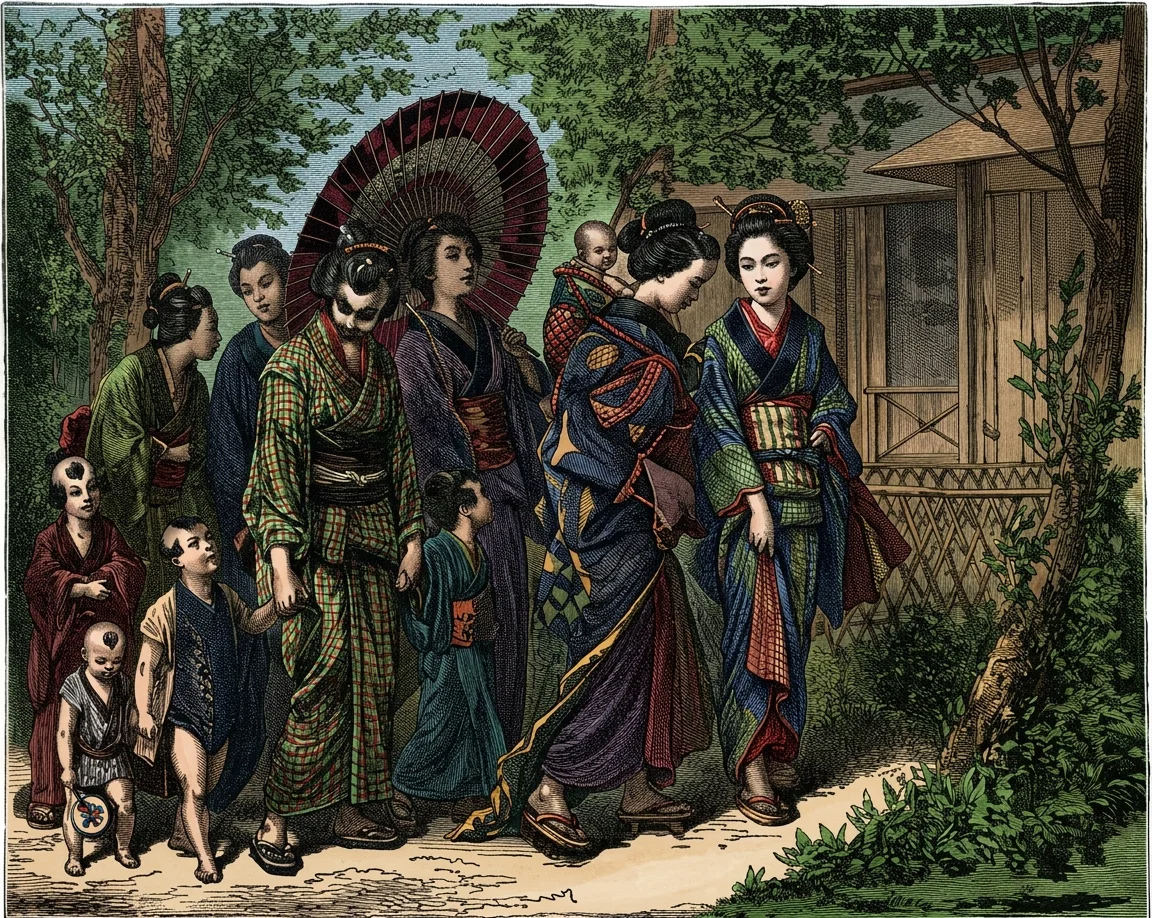
WHILE I was in the United States, Japan made great progress in all directions; but what has most astonished me is the lack of advancement in the cause of Christianity. Indeed, many churches which were once prosperous are now desolate and powerless. Not long since, an elderly Christian friend complainingly remarked to me that six or seven years ago the interest to hear the Gospel was so great that her church was filled to overflowing, and even twenty-five or thirty would be found in the house-to-house prayer-meetings, where old and young would testify of the love of God or offer up fervent prayers in the name of His Son. The entire church was in a blessed spiritual condition. But now the church attendance is very, very small, and only a few come to the ladies’ prayer-meeting. This is a sad downfall, and there must be some cause for it.
Japanese Women Visiting.
In view of the large sums of money spent in the propagation of the Christian faith, and considering the number of missionaries devoted to the work, it seems that the Japanese field is somewhat discouraging, since there is so little visible fruit. Some might think my people quite indifferent in religious matters, but this is not the case. It is true that the upper and educated classes are inclined to regard religion as the toy of the unlearned, but the masses are very pious. Those who should be leaders and educators in the nation entertain such shallow views that their writings are not noble. They breathe the spirit of hypocrisy and vainglory. They hold forth no high spiritual ideal. And the stronger their influence over the common people, the worse off will be their spirituality.
In this land may be witnessed examples of devotion that would put to shame many professed Christians. For instance, in the East Hongan temple are fifty ropes made of the hair of Japanese women, to assist in lifting the timbers used in the construction of that building. These cables of human hair vary in size, ranging from fifteen to thirty-five feet in length, and from four to fifteen inches in circumference. The making of the ropes required a sacrifice, for Japanese women take special pride in their hair. The other day I read of a poor old man who walked from his home to Kyoto, because he wished to save car-fare; but he offered hundreds of yen to the temple, altho it had probably cost him long years of hard labor to save the amount. These things are not rare here. This spirit of self-sacrifice will make good Christians of those who will but turn to the Lord. Catholicism, under a leader none other than the famous Xavier, accomplished great things three centuries ago. When bitter persecution broke out against the converts to the new faith, they died glorious martyrs, and the pope honorably recorded their deeds in the history of Catholic missions.
The Japanese in general are too religious. They are superstitious, overcredulous. “Even the head of a sardine, by faith,” is one of their proverbs; that is, even the head of a sardine, if worshiped by faith, will give us some power.
If such devotion is manifested in these respects, why will they not accept the Gospel?—Because they do not test the truthfulness of it; they know it only as a thing hideous and detestable. After the persecution above referred to, the Tokugawa government did everything possible to root up its seeds, and Christianity came to be regarded as magic and sorcery. Had it not been for that unfortunate occurrence, it is quite probable that Christianity would have entered this country along with the customs and inventions adopted from civilized nations, just as Buddhism and Chinese literature were introduced at a very ancient time. Altho the government was not in favor of the reception of the Gospel, yet it was obliged to tolerate it, or incur the ill-will of civilized powers. But with European culture came the bad as well as the good.
At one time Christianity seemed on the verge of success. It began to attain popularity. This was the very time when the followers of Christ should have been on guard: “Let him that thinketh he standeth take heed, lest he fall.” But they thought everything would be all right. The discouraging policy of the government, conservatism, the war with China and the vainglory after conquest, mammon worship, and Epicureanism have tended to block the advance of the Gospel and promote the downfall of Christianity. Young men and women in whom the churches hoped to find earnest pastors and evangelists, have been carried down in the whirlpool of social degeneration; many eminent Japanese preachers have become men of the world; and the majority of the people remain unbettered and unenlightened by the Light of men. Their present condition is very deplorable.
However, it would be unjust to the Japanese to heap upon their heads all the blame for this state of affairs, since many of their vices have been brought in with Western learning and advancement. Japan is, perhaps, taking the worst part; for she grasps at the husks of civilization, and rejects its life, its Christianity. But that our country puts no great premium on Christianity is not without reason. Behold the Western nations in their dealings with the Filipinos, the Boers, and the Chinese. And yet they boast of their Christianity. What influence will they exert over Japan, who is misinterpreting Christianity by their actions?
Withal the present condition of Japan is not at all disheartening to the faithful Christian worker. Now is the harvest time; but if we labor faithfully and patiently, a large field will open to us. To-day, by the terms of the new treaty, any missionary can go anywhere throughout Japan, and will have access to the common people, who are much more promising subjects for the Gospel worker than the higher ranks of society. We must go to the poor and the needy, to the unlettered and uneducated. If we are faithful and manifest practical Christianity, we shall surely win the people for Christ. Japan leads the Orient, and missionary success in this country will give prestige to the propagation of Christianity in Korea and China. I quote from a Japanese lady:—
“Japan, as a nation, has been given the noble privilege of being the first to receive and interpret the civilization of the West. Standing at Asia’s gateway, the task assigned her seems to be to open her mind to Western ideas, to assimilate them, and then give them to her sister nations in a more or less modified form. Christianity, like many other gifts from the Occident, must first be studied and reduced13to its fundamental elements by minds other than European, before it can be comprehended by the Asiatic mind. It often comes in forms too highly colored with Western modes of thought for our ready appreciation. It stands to reason, therefore, that we can approach our Korean and Chinese sisters, as well as our own in Formosa, with better facility, perhaps, than our Western sisters. We shall have to seek them in their own homes, as we have been sought in ours, and give them our truest and best—in short, give them, in our turn, what has so freely been given to us. We must remember that we have many things in common—our literature, our social customs, etc., which ought certainly to be a bond between us to prepare the way for mutual understanding.”
These words were written with reference to the work among the women, yet the principles adduced are of universal application.
We hope that, thru the blessing of God, the time will come when our work will grow, and many laborers will be raised up here to spread the truth in Japan and in China and Korea. But this can not be unless we are faithful, and our American brethren and sisters co-operate with interest and earnestness.
S. HASEGAWA
TRUSTING
What tho the way seem dreary,
Look above;
What tho you grow aweary,
Look above;
God's Spirit will watch o'er you,
His angels go before you,
To guide and to restore you,
God is love.
Sad heart, cease your repining,
Look above;
Beyond, the sun is shining,
Look above;
Tho cares may now surround you,
And storms of life confound you,
Yet sure His mercy bounds you;
God is love.
Thy prayers shall all be answered,
Never fear;
Tho now thy hope seems withered,
Brown and sere;
He chastens but to try thee,
But keep His precepts by thee;
No good will He deny thee;
He will hear.
Then rest thee in His mercy,
Heart of mine;
Let my desires and wishes
Merge with Thine.
Then whatsoe'er befall thee,
Tho tempests wild appall thee,
Yet He thy pathway clearly
Will assign.
—Selected.
SMITH'S BIBLE DICTIONARY
Size 9¼ x7½ in.
Size 9¾ x 7 x 2½ in.
A standard book of reference
A necessity to every Bible student
An invaluable help to every Sabbath-school teacher and scholar
1017 pages
Illustrated
Cloth bound
PUBLISHER'S PRICE $4.50
SENT POST-PAID WITH $2.75 SIGNS ONE YEAR ** $2.75
Sent free for four new yearly subscriptions at $1.50 each
JAPANESE CUSTOMS.
By Sophia B. Brunson
A RETURNED Japanese missionary tells this incident, illustrative of Japanese customs: “One day our cook came to us with a long face, and informed us that his mother had died, and he would therefore go away for a few days. We had been told by the missionary who engaged him that his mother was already dead; and on referring the matter to our friend, he said: ‘O, that is only a polite way the Japanese have of leaving your service. You will probably never see him again.’ We learned afterward that he had entered on a private business enterprise of his own in the city, with the intention of returning to us if it failed. We found that it is a custom of the Japanese for a servant never to tell his master that he is going to secure other employment, or leave him for any reason. He usually comes in with a story about the death or illness of some relative. Those accustomed to the ways of the servant class readily understand that that means that the servant intends to leave them.”
MOST of the Japanese are Buddhists or Shintoists. Shinto means, literally, “the way of the gods.” It is the name given to the vague, mythical, and ancestral nature-worship which preceded the introduction of Buddhism into Japan. Buddhism has been grafted on to Shintoism. The Japanese themselves seem to know very little about it. It is studied in the convents by the monks, who spend their lives trying to dehumanize themselves as far as possible. There are many beautiful temples erected to Buddhism in Japan, the most modern one being that at Kyoto. The description of one temple will give a general idea of all. The way leading to the temple is a babel of noise and confusion. There are venders hawking their wares; there are flower-sellers, and sellers of ointment, and all are yelling at the top of their voices, each one praising his own article, and endeavoring to get the passer-by to purchase. It is the noisiest spot in the city—a regular fair. The entrance to the temple is guarded by two gigantic and hideous demons, which seem more like the mythical gate-keepers of the infernal regions than the guards to a sacred place.
Within the temple there is a promiscuous throng. There are ladies dressed in elegant silks; soldiers in the latest uniforms, resplendent in gold braid and brass buttons; children with babies fastened on their backs; beggars, aristocrats, and servants—all making their offerings and saying their prayers. The main altar, behind which the god sits, is protected by a wire screen. The worshiper must put a copper into the coffer before worshiping his gods. The Japanese write their prayers on slips of paper, chew the paper into soft wads, and spit them out at the god. If the wad hits him, the omen is favorable. Such is the religious worship of Japan, and such it will remain until the people accept the glad tidings that rang out on the air that night in far-off Judea, when a Saviour was born unto men.—Sophia B. Brunson.
PERIODICALS WANTED.
LATE copies of the SIGNS for missionary work in Ardmore, Indian Territory. Address, post-paid, Sydney Deats, Box 701.
OUR WORK AND WORKERS.
THE annual camp-meeting and business session of California Conference is appointed for June 4-16, at Oakland.
BROTHER C. W. Flaiz has been chosen president of the Northwestern Union Conference, formerly General Conference District No. 4.
AT Shive, Texas, Brother O. Glass reports ten converts; and three have accepted the truth at Palestine, same State, thru the labors of Brother J. F. Bahler and wife.
NINE tracts on present truth have been published in the native languages of India. Seven of these are published in but one language each; the other two are published in two languages.
A NEW house of worship at Okeene, O. T., was dedicated on the 5th inst. Brother C. McReynolds, president of Southwestern Union Conference, and Brother H. Schultz were present and officiated.
THE Eastern Union Conference (formerly District No. 1 of the General Conference) has been organized by electing Brother H. W. Cottrell president, and D. B. Parmelee secretary, with headquarters at South Lancaster, Mass.
A NEW house of worship was recently dedicated at Stevensville, Mont. Brother C. N. Martin, of Cal., stopped over on his way home from General Conference to preach the dedicatory sermon. Brother L. A. Gibson also took part in the services.
AT the recent General Conference, missionaries to foreign fields were appointed as follows: Australasia, twelve; South America, ten; West Indies, twelve; Central America and Mexico, four; South Africa, one; Scandinavia, two; Germany, five; Switzerland, one; Mediterranean field, one; Polynesia (Pacific islands), seven; Canada, four; India, two; Finland, one; England, six.
AT the conference recently held at Butte, Mont., a Children’s Day was appointed for November 23, at which time appropriate exercises will be held in the churches. The Bivouac says: “One of the most important features of this work is to educate our children to love benevolence. If the children will earn their offerings for themselves, this lesson will be of more value than if they get the money of their parents. We hope the parents will take special pains to help their children to earn something for this offering.”
“CHRIST’S OBJECT LESSONS” bids fair to become one of the popular books of the time, not merely popular with our own people, but with people of all classes who are interested in the Word of God. It is the only book dealing exclusively with the parables of Christ, and with all of them. Men of other denominations are buying and selling the book. It is a book that every Bible student and every Christian worker needs. There are books claiming to be undenominational, but this is one of that class pre-eminently. It will instruct and edify any one who loves Christ, or is willing to learn of Him.
Kind Words and Deeds
By John Fullerton
OVER the field when the day is fair,
The sower scatters the seed abroad,
Stays not to the mark where it falls, his care
But to leave it with his God,
Who sendeth the rain and the sun’s bright rays,
And a hundred-fold in the harvest days.
So a kindly word and a kindly deed,
If done and spoken in time of need
By a true, pure heart to a brother astray,
Lonely and fainting on life’s highway,
At last in the harvest of years are found,
Where only kind deeds and kind words abound. —John Fullerton.
PLEASE NOTICE.
In consequence of a business transfer, we are prepared, temporarily, to furnish “Cof-farin” to SIGNS OF THE TIMES readers at one-half of retail price, which has been 25 cts. per 1½ lb. package. We will fill orders received at once at $3.00 per case, each case containing 24 packages; or we will supply half cases for $1.75, or quarter cases for $1.20. “Cof-farin” is so well known as a pure, delicious, healthful, and nutritious beverage that many will undoubtedly avail themselves of this liberal offer. Therefore order early. Special prices for larger quantities. Helping Hand Mission, 641 Commercial St., San Francisco, Cal.
Self-Pronouncing New Testament
Vest-Pocket Edition
Bound in French Morocco, flexible covers, round corners, red under gold edges
Large, sharp, clear type
All proper names are diacritically marked, which renders their proper pronunciation very easy
Just what is needed by busy people and travelers who wish to make a daily study of the Scriptures
A Minister’s wife says:—
“I am just delighted with it, and so are my friends who have seen it”
Given for one new yearly subscription to the SIGNS OF THE TIMES at $1.50.
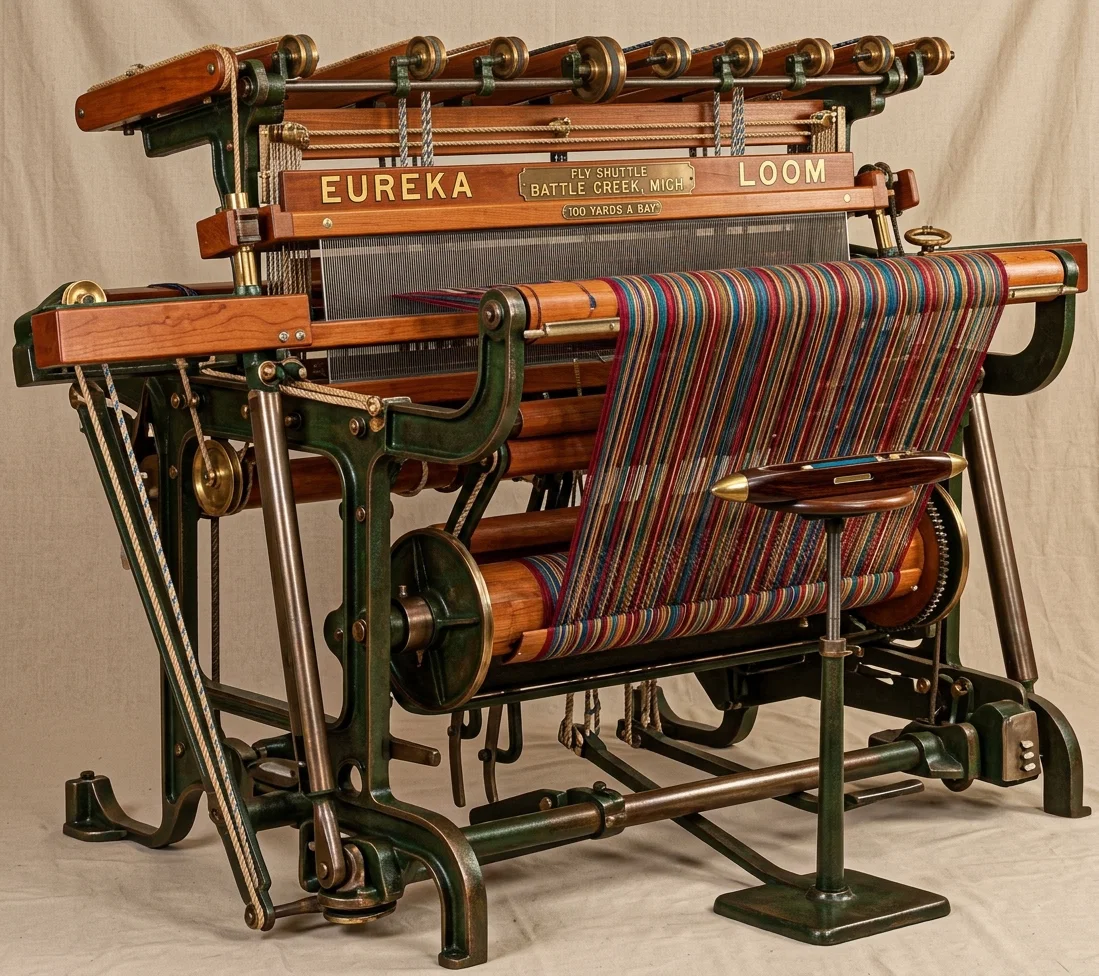
FLY SHUTTLE CARPET LOOM
The best, handiest, easiest running, cheapest, and most durable
FLY SHUTTLE CARPET LOOM
In the world,—100 yards a day. Catalogue free.
EUREKA LOOM CO.
5018 Main St., Battle Creek, Mich.
When you write, please mention the SIGNS OF THE TIMES.
Wanted
WANTED—Salesmen or Ladies—Do you want to make more money? You can do it by working for the largest manufacturing company in our line, in the country. Salary guaranteed; expenses advanced weekly. Write Monarch Co., 608-46 Jackson St., Chicago, Ill.
LESSON 10.—JUNE 1.—THE OFFERINGS.
The Sin-offering.
[Note to the Student.—These lessons are not designed to be exhaustive, but suggestive. In references to the “Desire of Ages,” in the lessons, the subscription edition is referred to. Those who have only the trade edition will find the matter in chapters 1, 4, 11, 27, 71, 77, 78; also read “Patriarchs and Prophets,” chapters 5 and 30. “Christ Our Advocate,” Bible Students’ Library No. 20 (price, 10 cents), and “Looking unto Jesus” (price, $1.00) will be found a great help. The SIGNS OF THE TIMES will have an article on the subject of each lesson this quarter by J. O. Corliss. Read these articles in connection with the study of the lesson. We have not space to print all the scriptures. Let the student study them carefully from the Bible. Those printed are from the Revised Version.]
SUGGESTIVE QUESTIONS.
1. What offerings were made for the sin of ignorance, by the high priest? What offerings were made by the whole congregation? Describe the way in which these offerings were made. Lev. 4: 2-21.
2. What offering was made by a ruler, or by any one of the common people, for the same sin? In what way was it dealt with differently from the offering made by the priest and the whole congregation? Lev. 4: 22-35; 6: 25-30.
3. For what purpose were some of the sin-offerings eaten? “And Moses diligently sought the goat of the sin-offering, and, behold, it was burnt; and he was angry with Eleazar and with Ithamar, the sons of Aaron that were left, saying, Wherefore have ye not eaten the sin-offering in the place of the sanctuary, seeing it is most holy, and He hath given it you to bear the iniquity of the congregation, to make atonement for them before the Lord?” Lev. 10: 16, 17. (Notice that where the priest was concerned in the sin, he was not permitted to eat of the offering.)
4. In what way are we privileged above those priests? “We have an altar, whereof they have no right to eat which serve the tabernacle. For the bodies of those beasts, whose blood is brought into the holy place by the high priest as an offering for sin, are burned without the camp. Wherefore Jesus also, that He might sanctify the people through His own blood, suffered without the gate. Let us therefore go forth unto Him without the camp, bearing His reproach.” Heb. 13: 10-13. (Note 1.)
5. What offering has been provided for us? “And walk in love, even as Christ also loved you, and gave Himself up for us, an offering and a sacrifice to God for an odor of a sweet smell.” Eph. 5: 2.
6. What must we do with the offering? What will be the result? “Yet it pleased the Lord to bruise Him; He hath put Him to grief: when Thou shalt make His soul an offering for sin, He shall see His seed, He shall prolong His days, and the pleasure of the Lord shall prosper in His hand.” Isa. 53: 10.
The Trespass-Offering.
7. How many kinds of sins are mentioned in Lev. 5: 6:1-7; 7: 1-7? How were the offerings made? (Note 2.)
8. What offering has been provided for us? Eph. 5: 2, above.
9. What must we do with the offering? What will be the result? “Yet it pleased the Lord to bruise Him; He hath put Him to grief: when Thou shalt make His soul an offering for sin, He shall see His seed, He shall prolong His days, and the pleasure of the Lord shall prosper in His hand. He shall see of the travail of His soul, and shall be satisfied: by His knowledge shall My righteous servant justify many; and He shall bear their iniquities.” Isa. 53: 10, 11. (Note 3.)
10. To whom did the fat of all these offerings belong? (See Lev. 3: 14-17.)
12. For whom was the altar made? What was it called? “An altar of earth thou shalt make unto Me, and shalt sacrifice thereon thy burnt-offerings, and thy peace-offerings, thy sheep, and thine oxen: in every place where I record My name I will come unto thee, and I will bless thee. And if thou make Me an altar of stone, thou shalt not build it of hewn stones: for if thou lift up thy tool upon it, thou hast polluted it.” Ex. 20: 24, 25; (Mal. 1: 7, 12.)
13. What did the fat represent? “Thou hast bought Me no sweet cane with money, neither hast thou filled Me with the fat of thy sacrifices: but thou hast made Me to serve with thy sins, thou hast wearied Me with thine iniquities.” Isa. 43: 24. “But the wicked shall perish, And the enemies of the Lord shall be as the excellency of the pastures: They shall consume; into smoke shall they consume away.” Ps. 37: 20.
14. To whom do our sins belong? Why, then, is the fat the Lord’s? “Who gave Himself for our sins, that He might deliver us out of this present evil world, according to the will of our God and Father.” Gal. 1: 4.
NOTES.
1. There were two ways in which the priest bore the sins into the sanctuary, by the blood and by eating the flesh. See “Patriarchs and Prophets,” p. 354. Those priests were not permitted to eat their own sin-offering, as the eating of the offering was for the purpose of conveying the sins to the priest, to teach us that Christ actually bore “our sins in His own body”—became “sinful flesh.” We, however, can eat our sin-offering, and by so doing become righteous.
2. The distinction between sin and trespass does not seem very clear, hence will bear much study. One writer has said: “In the sin-offering we see Christ offering Himself for us, for what we are in ourselves,—sinful creatures. In the trespass-offering we see Jesus offering Himself for our sins, our trespasses, the fruits and effects of our sinful natures,—what we do.”
3. There are two classes of offerings, the sweet savor and the non-sweet savor. The sin and trespass offerings belong to the non-sweet savor, as sin was upon them by imputation. Therefore they could not be burnt upon the brazen altar, which was God’s table. Mal. 1: 12. However, in order to teach us the preciousness of our giving up our sins, the fat, representing them, is consumed on God’s altar, and is called the bread of the Lord, a savor of His rest, as we can not enter into His rest except by ceasing from our own works of sin. Heb. 4: 10. All the fat is the Lord’s so all our sins belong to Him, and we should fill Him with the fat of our sacrifices, and not cause Him to serve with our sins. Otherwise our bodies must be burned without the camp in the great burning day. See Ps. 37: 20.
1 “And when the day of Pentecost was now come, they were 2 all together in one place. And suddenly there came from heaven a sound as of the rushing of a mighty wind, and it 3 filled all the house where they were sitting. And there appeared unto them tongues parting asunder, like as of fire; 4 and it sat upon each one of them. And they were all filled with the Holy Spirit, and began to speak with other tongues, as the Spirit gave them utterance. 5 “Now there were dwelling at Jerusalem Jews, devout men, 6 from every nation under heaven. And when this sound was heard, the multitude came together, and were confounded, because that every man heard them speaking in his own language. 7 And they were all amazed and marveled, saying, Be- 8 hold, are not all these which speak Galileans? And how hear we, every man in our own language, wherein we were 9 born? Parthians and Medes and Elamites, and the dwellers in Mesopotamia, in Judea and Cappadocia, in Pontus and 10 Asia, in Phrygia and Pamphylia, in Egypt and the parts of Libya about Cyrene, and sojourners from Rome, both Jews 11 and proselytes, Cretans and Arabians, we do hear them speaking in our tongues the mighty works of God.”
Golden Text: “When He, the Spirit of truth, is come, He will guide you into all the truth.” John 16:13.
SUGGESTIVE QUESTIONS.
(1) When was the day of Pentecost? What was its purpose? Where were the disciples on this day? Verse 1; Lev. 23:15-21. Note 1. (2) What suddenly filled the house where they were sitting? Verse 2. (3) Then what appeared to them? Verse 3. Note 2. (4) What was the effect of this sudden visitation? Verse 4. Note 3. (5) Who were then dwelling at Jerusalem? Verse 5. Note 4. (6) When they heard of the wonderful occurrence, how were they affected? Why? Verse 6. (7) What did they ask about the men who had become so wonderfully endowed? Verses 7, 8. Note 5. (8) What remote parts of the world are mentioned? Verses 9-11, first part. (9) What was it that they heard spoken in so many different languages? Verse 11, last part.
NOTES.
1. The Pentecost was a feast of the Jews celebrated fifty days after the Passover. “Upon these occasions the Jews were required to repair to the temple and to present the first-fruits of all the harvest, thus acknowledging their dependence on the great Giver of all good, and their obligation to render back to God, in gifts and offerings to sustain His cause, that which He had entrusted to them. On this day of divine appointment, the Lord graciously poured out His Spirit on the little company of believers, who were the first-fruits of the Christian Church.”—Great Controversy, Vol. 3.
2. “The Holy Ghost, assuming the form of tongues of fire divided at the tips, and resting upon those assembled, was an emblem of the gift which was bestowed upon them of speaking with fluency several different languages, with which they had formerly been unacquainted. And the appearance of fire signified the fervid zeal with which they would labor, and the power which would attend their words.”—Ibid.
3. “Filled with the Holy Spirit.”—This being the case, the disciples could not do otherwise than speak as the Spirit gave utterance. Whatever spirit fills one will surely control his words as well as his actions. The life of Christ was a Spirit-filled life. He was led by the Spirit in all that He said and did, and it could not be expected that men could carry on the work of Christ in the earth with any less power than He had. He has commanded us to follow Him, and how can we do so successfully unless endued with the same Spirit that led Him?
4. “Every nation under heaven” was represented by Jews in Jerusalem on this festal occasion “When assembled, they were of every known tongue. This diversity of languages was a great obstacle to the labors of God’s servants in publishing the doctrine of Christ to the uttermost parts of the earth. That God should supply the deficiency of the apostles in a miraculous manner was to the people the most perfect confirmation of the testimony of these witnesses for Christ. The Holy Spirit had done for them that which they could not have accomplished for themselves in a lifetime; they could now spread the truth of the Gospel abroad, speaking with accuracy the language of those for whom they were laboring. This miraculous gift was the highest evidence they could present to the world that their commission bore the signet of heaven.”—Great Controversy, Vol. 3.
5. “Are not all these Galileans?”—It was no small feature of this marvelous occurrence, in the minds of Jews, that the men so signally endowed were of Galilee. The Judeans deemed the Galileans much inferior to them in learning and in nobility of birth; and that these should have been selected for such wonderful endowment was indeed amazing to people of Judea. But there was reason for their marveling, from a natural standpoint. The language of the Galileans was imperfect, and unlearned adults among them would hardly have been thought capable of becoming expert linguists. However, this fact tended to make the miracle all the more conspicuous. “God hath chosen the foolish things of the world to confound the wise.” 1 Cor. 1:27. Judas, the only proud Judean among the twelve companions of Christ, had proved a failure. The Lord will dwell with him that is of a contrite and humble spirit (Isa. 57:15), without reference to his nationality or acquired learning.
(See also editorial article, “The Lesson of Pentecost,” on page 7 of this paper.)
Good Health
By Editor
Everybody wants it who hasn't it, but it is not always easy to get it
GOOD HEALTH is the leading health journal of the world, and no household should be without it. It is the purpose of this magazine to give scientific instruction to those who are well whereby they can keep well; to the sick whereby they may be able to get well. Subscribers are at liberty to ask questions, which are answered in the correspondence department by the editor.
A special offer is made to subscribers for the next sixty days. Send us a year's subscription to Good Health, $1.00, and the names of five persons who ought to be interested in the question of diet, and we will send you Good Health for one year, postage prepaid, and our
FAMILY BOX FREE
Just think of it! $1.50 worth of Battle Creek Sanitarium Food Co.'s and Sanitas Nut Food Co.'s cereal and nut foods, and other household necessities, and a year's subscription to Good Health, a 64-page magazine, 800 pages a year, all for $1.00. We could not do this only that the manufacturers have made us a present of these articles to use for this purpose, well knowing that the merits of the foods will secure for them sufficient trade to pay their expense. Cut out this clipping and send to us with $1.00 and we will do the rest.
N. B.—We do not pay freight or express charges. Have the goods go by freight. One Family Box weighs 14 pounds. Get six persons to join with you, which will make 100 pounds. Have all shipped to one address, and the expense will be but a few cents each.
GOOD HEALTH PUBLISHING COMPANY
Battle Creek, Michigan
VIRGINIA HOMES.
You learn all about Virginia lands, soil, water, climate, resources, products, fruits, berries, mode of cultivation, prices, etc., by reading the Virginia Farmer. Send 10 cents, for three months' subscription, to Farmer Co., Emporia, Va.
BIBLE QUESTIONS AND ANSWERS CONCERNING MAN.
By Alonzo T. Jones
By Alonzo T. Jones. Bible Students’ Library, No. 76. Pacific Press Pub. Co., Oakland, Cal. 16 pp.; 2 cents.