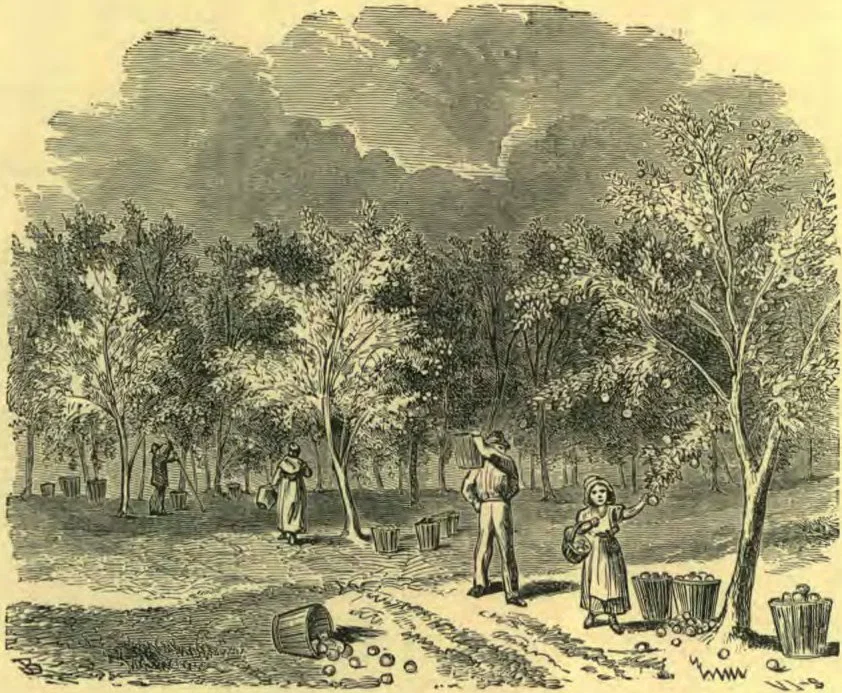
At last the autumn has come. The pretty green leaves have turned to red and gold, and then to russet brown, and most of them have dropped from the trees. But the old oak leaves cling to the boughs in the hardest wind, as if they would not give up the hope of summer yet.
Jack Frost has sent some sharp snaps to open the closely-wrapped nuts, and send them rattling to the ground. And the busy little squirrels and chipmunks are frisking up and down the trees, laying in their winter stores.
The robins and the other summer birds are going to sunnier lands. We find them one morning picking up crumbs and seeds, and chirping a plaintive song, very different from the joyous one which burst upon our ears in the early spring days. The next morn we wake to find the little songsters flown. We shall see them no more until another springtime. But not every bird has left us. There is many and many a dusky brown little fellow who defiantly braves the winter storms and cheers us with his merry twitter.
Does it really seem as if the spring was such a long, long way off? It isn't so. Spring doesn't begin when the warm, sunny days of April come. Spring gets ready beforehand. Come on out into the garden, little friends, and let us see if this is not so.
Here is an old lilac bush. Not all its summer leaves have fallen, and in the axil of each leaf, that is, at the place where the leaf joins the stem, we find a little bud. Let us open one of the larger ones. Taking off some thick scales, we come to little green leaves so fine and delicate, yet so perfect that you can see the veinings of each leaf. Twenty or more leaves in all,—a whole branch, in fact,—and all wrapped up in one little bud!
The apple trees have buds, too, and the cherry, and pear, and peach trees; and now that we are looking for them, we find that every tree has buds. Here is a stout horse-chestnut, with larger buds than most of the other trees have. We can examine these more easily. How they shine, as if Dame Nature had put a coat of varnish on the whole to shut out the wet and cold. Inside these scales is more varnish and wool, and inside them the tiny green leaves, securely sheltered from the winter cold and rain. What wonderful care Mother Nature takes of all these tender things!
Then, when the sun again shines warm on the Northland, and the wind blows softly from the south, Nature has only to unloose her children's winter wrappings, and presto! what a shooting forth of green leaves and beautiful blossoms to gladden us! What a weary time of waiting it would be, if all the little leaves had to be gotten ready when the spring months really came! Now it is done so quietly that many never suspect any such work is going on at all. Just look about closely, and see how many things besides the buds are all ready and waiting for the spring.
Ready beforehand! That is the way Dame Nature works. Wouldn't that be a good motto for our boys and girls to take for their own? W. E. L.
Letter Budget.
“How does the letter-box stand now?” asked a little writer to the Budget not long ago. It is very, very full, and some of the letters were written months ago. So many letters are received, it will not be possible to publish only the most interesting. Those who wrote the longest while ago must have something new which they would rather have printed than their old letters; so we invite them to try again. Below are the names of some of them, and we will give names of others another time: Anna and Minerva Opple, Minnie Fischer, Edna Osgood, Anna Valentine, Liza Pyle, Myrtle Crapsey, Clinton C. Burg, Fannie G. Cain, Arthur Detamore, Daisy Yates, Mary O. Willie, F. and Lena E. Carl, Valley A. and Lottie M. Copenhaver, Ezra Noyes, Lulu Wright, Perry and Nettie Ketchum, Willie S. Winchell, Orra D. Kittle, Arnold M. Jensen, Samuel D. Smith, Nettie and Stella Colicott, Ella A. Lobdell, Julia E. Glospie, Florence Johns, Susie Carson, Susanna E. Flora, Annie E. Krumm, Sola Bernard, Cora Miles, Eunice G. Rand, George Durvie, Ellen Pool, Winnie Thompson, Frank Syphers, Samuel T. Shadel, and Myrtle Draper.
Next we have a letter from LEE NEFF, who writes: “I once lived at Honey Creek, Ind., but I now live in Hernando Co., Florida. My pa and I left Indiana for this place the forepart of last October. My ma and little Jennie did not arrive here until the first of January following. We like this part of Florida, so far. My pa’s health is not very good, but he thinks Florida is improving it. We have a nice lot, and a nice home here. The lot has a number of orange trees on it, about four years old. This part of Florida has nice roads; that is, they are not so sandy as in other parts of the State. The surface of the ground is quite rolling, and the scenery is most beautiful. There are no Sabbath-keepers here, but we read the INSTRUCTOR, which is forwarded to us from Indiana. I like to read the paper. Ma and I learn the lessons in it, and also those in Books No. 1 and 2.”
Lee has written another letter since the first, in which he says: “Mamma, Jennie, and I have kept the Sabbath about two and a half years. We have no Sabbath-school here, but I study in Book No. 2. I love to read the INSTRUCTOR, especially the Budget. I have seen several letters in it from Florida. I would like very much to correspond with some of these little writers. It is pleasanter living here than in the North, where it is so cold in winter time. I had two pet rabbits, but they died. I am trying my best to be a good boy, and have my conduct pleasing in the eyes of God. I hope to meet you all when Jesus comes.”
GEORGE C. MADDOCK, of Renville Co., Minn., writes: “I am a little boy eight years old. My older sisters are all writing, and it made me want to write, too, something for the INSTRUCTOR. I never went to Sabbath-school but once. I liked it very much. I saw many beautiful things there. We have Sabbath-school at home, but I like the church Sabbath-school best. I have a white rat. It has pink eyes, and uses his front feet for hands. When I give him fresh water, he dips his fore paws in and washes his face and fur perfectly clean. The weather has been hot. There are very few apples or plums. We had plenty of them last year. We have some pretty flowers. We have a hammock in our grove. To-day, we children were all in it while a friend read the INSTRUCTOR for us.”
FREDDIE NIELS sends a letter from Sway, England. He writes: “I am nearly eleven years old. I have been living here about two months. Before this, I lived at Shirley, Southampton, England, where Mr. Loughborough came to preach. I liked him very much, and should like him to come back again. I have a brother and three sisters, and we all keep the Sabbath with our parents. We have Sabbath-school here, but the children who attend are poor, and don’t have lesson books or hymn books. I like to read the Letter Budget. I am trying to be a good boy, and hope to meet you all in the earth made new.”
We have letters from MAGGIE and MINA C. ROSS, twin sisters, who live in Franklin Co., Neb. They are twelve years old. At the time they wrote, they had a brother living in Blue Earth, Minn. He did not keep the Sabbath, but was a Christian. These little girls are quite anxious their brother George should be invited to Sabbath-school, where he may learn the truth. He is seventeen years of age. They were going to raise some missionary chickens, and Mina was going to knit some curtains, for which her mamma was to pay her. They are trying to be good girls.
CHARLIE TUCKER sends a donation to the African Mission from Hill Co., Texas, and says: “Tell them I am a little boy eleven years old, and go to both day and Sabbath-school. There are about fifty members in our Sabbath-school. We have a neat little church just a mile from home. We have not had any preaching in it yet, though we wish to.”
LAURA M. RICHARDSON and her two sisters live with their grandparents. They go six miles to Sabbath-school, which is held in the new Health Home building at Mt. Vernon, Ohio.
HATTIE M. PORNHAM, of Tamora, Neb., says she sends her INSTRUCTORS to her cousins in Kansas when she is through with them.
PHEBE J. WRIGHT of Sanilac Co., Mich., is trying to do all the missionary work she can, and to be a true Christian.
ANIMALS THAT LIKE MUSIC.
A GREAT many stories have been told about animals that like music.
All animals do not like music, however, for I have known dogs that would howl dismally whenever they heard it. Perhaps, however, they were only trying to see what they could do themselves in that line.
The composer, Haydn, when a little boy of eight, was a good musician; and when he was still a lad, he took a short trip through Italy with a boy of his own age. They went on foot, carrying their knapsacks on their backs and camping out.
Of course they could not do without music of some sort, and they had with them a flute, which they played by the wayside when they sat down to eat or to rest.
They crossed the Apennines, and upon the green slopes of the hills were many flocks of sheep feeding.
One day, as Haydn was playing near a flock of these sheep, he noticed that they began to listen, one after another drawing nearer and nearer, until by and by the whole flock were gathered about the two boys.
And what was still more strange, these sheep seemed to know the difference between gay and sad music. For when Haydn played the former, they would come up close and rub against his legs to show their joy. But when he played the sad music, they would droop their heads as though they felt bad.
I have heard a story, too, of another player on a flute, who played to a flock of sheep and goats in these same mountains. And when it came time for the flock to go home, they refused to go so long as he played.
The shepherd would get them started on the way, but the moment the music began again, they would turn back, and he could do nothing with them. And he had to beg the traveler to stop playing until his sheep and goats were out of hearing.—Our Little Men and Women.
GATHERING APPLES.
DOWN! down! down!
Down under the tree,
See the apples falling,
Ripe as they can be.
Beautiful golden apples,
Yellow, brown, and red;
Down, down they fall in showers,
And over the green grass spread.
Come, little boys and girls,
Leave your books and play;
Help to gather the apples—
No more school to-day.
Some we'll keep till winter,
Till the merry Christmas days,
When friends are met together,
Around the bright wood blaze.
So help to gather the apples,
Working while you play;
Put away the lessons—
No more school to-day.