The Youth’s Instructor, Vol. 29, No. 2.

PROTECTIVE COLORS OF ANIMALS

The Youth’s Instructor

Jan 12, 1881

S. D. A. Publishing Association · Battle Creek, Mich. · Jan 12, 1881

PROTECTIVE COLORS OF ANIMALS.

PART FIRST.

What abundant food for thought is contained in the above phrase. Immediately the mind grasps the idea that color was bestowed upon animals by the All-wise Creator, not merely, as it were, by fancy or caprice, but in direct benevolence, giving them a better chance of lengthening their lives. Proofs of this theory are very numerous.
Perhaps the most striking illustration of this fact may be found in the insect world. Here, grays, and browns, and olives harmonize with lichens, and wood, and stone, affording the creatures so colored a good means of concealment. And yet some insects are exceedingly conspicuous, as witness the brilliant tints of many species of butterflies. But this, so far from disproving the theory, tends, as we shall see, to confirm it.
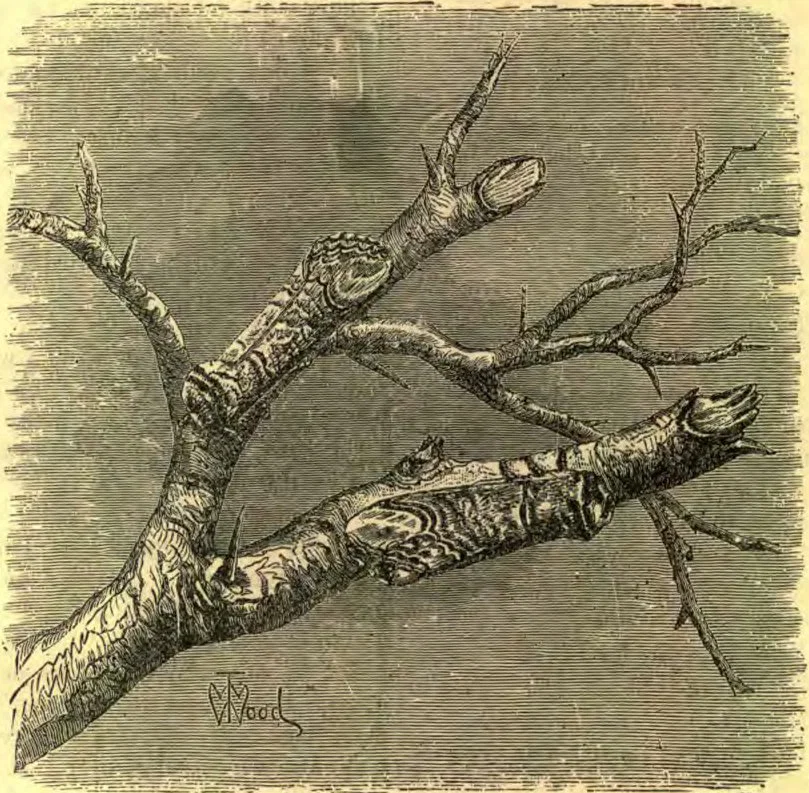
As may be seen from the illustration, the Buff-tip moth so contracts its wings as to look exactly like a large piece of broken stick, the yellow patch at the extremity of the wings giving the appearance of the freshly broken end.
The Lappet-moth, when at rest, so disposes its rich brown wings as to seem, both in shape and color, like a dead leaf.
In the case of other moths, we have those which settle among lichens and in the trunks of trees, being almost entirely concealed by the colors by which they are surrounded. Some, which strongly resemble bits of mortar, make stone walls their favorite resting-place. It has been noticed, also, that moths which are on the wing in autumn and winter, partake of the prevailing hues of these seasons,—autumnal moths are generally yellow and brown, like much of the foliage then visible, and many winter moths are of gray and silvery tints.
Gorgeous colors, however, as we have said, are no evidence of non-protection. These best harmonize with the bright and vivid hues of the leaves, the flowers, and the sky. The most wonderful, perhaps, of all imitative insects is the leaf-butterfly of India. This is a rather large and handsome butterfly, of a deep bluish color, with a broad orange band across the wings. It is thus very conspicuous; but it flies rapidly, and in a zigzag manner, so as to be caught with great difficulty.
It is when at rest, therefore, that it requires protection, and this it obtains by its color and markings on the under surface, and by its peculiar habits. The upper wings have an acute lengthened apex, which is exactly the shape of the tip of the leaf of many tropical trees and shrubs; while the hind wings are produced into a short, narrow tail, which well represents the stalk of a leaf. It always settles on an upright twig or branch, holding on by its fore-legs, while its body, concealed between the lower margin of the wings, rests against the stem which the extremity of the tail, representing the stalk, just touches.
The tropics abound with examples of insects equally well-protected. The best-known are the leaf-insects of the genus phyllium, whose wings and wing-covers are broad and flat, shaped and veined exactly like leaves, while their legs, head, and thorax have all flat dilatations, like the stipules of many plants; and the whole being of the exact green tint of the foliage of the plant they live on, it is actually impossible to detect them when they are not in motion.
The walking-stick insects, or spectres, are equally curious. These are long, cylindrical insects, often nearly a foot in length, and of the exact color of pieces of greenish or brown sticks. If they have wings, these fold up closely, and are concealed under wing-covers of the same stick-like appearance; while the head and legs are so shaped and jointed as either to fit closely on to the stick-like body, or to appear like branched twigs. These creatures hang about shrubs in the forest, and can seldom be distinguished from small twigs and branches which have fallen from the trees overhead. They remain quite motionless during the day, and feed at night. They hang across the foliage, holding on by two or three of their legs only, while the others are closely fitted to the body, and they thus give themselves that unsymmetrical appearance which belongs to accidentally broken twigs.
Wonderful indeed are the works of the Maker of all!—Arthur's Home Magazine.
THE BUFF-TIP MOTH.
THE BUFF-TIP MOTH.

JACK FROST'S SONG.

I RIDE on the wings of the north-west wind From my home in the frozen seas, Where I lie and rest with a quiet mind When bloweth the summer breeze.
I filch the rainbow from out the skies, And place it on maple leaves; I whisper the swallow, away he flies From his nest beneath the eaves.
I work in the dark of the blackest night, And paint pictures upon the pane; What though the sun in his noonday might Dims them, I limn them again.
I draw, as I please, the tender spray Of fern, with its feathery grace; And if that dies out in the sun’s warm ray, I put a pine in its place.
But this is only my pleasant play While sunbeams lie and dream; For I clasp in my chilling clutch by day The throat of the gurgling stream.
I still its music. I strip the trees Of their leaves, and kill the flowers; I hush the hum of the busy bees, Who work during summer hours.
I tumble the fences, and lift the grain From where it lies in the soil; I pinch the poor on their way to gain Their bread by their daily toil.
But when spring days come I change my mind, For I am a fickle soul; So I mount on the wings of the south-west winds, And ride to the Arctic Pole.—Sel.

TOBACCO HARMFUL.

Some religious sects are making the use of tobacco a bar to an entrance into the ministry. No candidate can receive ordination from them who is a slave to the weed. The French military schools are adopting a similar rule of admission, and some of the universities as well. It has been found by careful observation, that those students who use tobacco freely, seldom stand in the front rank of scholars.
A distinguished teacher in a professional school near Boston, says that after two weeks’ acquaintance with his students in the lecture-room, he can mark those who indulge in smoking or chewing. They show a decided inferiority in insight and mental force.
Physicians are beginning to be alarmed at the mischief done to the physical system by excessive smoking. It occasions paralysis which ends fatally.
When a habit so useless and expensive is also dangerous to health, young men ought not to form it. It stunts the growth, weakens the appetite, disturbs the nerves, and unfits for a long intellectual strain. It is great folly for boys thus to inflict permanent injury on themselves. The use of tobacco is not a sign of manliness.—Youth’s Companion.

THE OLDEST BOOK.

In some of our great libraries there are old books stored away which were written ages before printing was discovered. But there is an older book than the oldest on earth, and that is God’s Book of Remembrance, in Heaven. It is not only the oldest, but the most interesting, for in it are written the life-stories of all mankind from the beginning of the world. There are the stories of Abraham and Noah; of Job’s patience and Saul’s disobedience; there are the stories of strong men and little children; your story and mine are there.
Let us think of some of the things that are noted in God’s book. Our tears of sorrow and penitence are there. They were shed in secret, but God saw them. When the memory of some sin has made you weep bitterly, those tears were very precious in God’s sight, since there is joy in the presence of the angels of God over one sinner that repenteth.
What other things are noted in God’s Book of Remembrance? Our neglected opportunities,—our wasted chances. Ah! my children, what a long sad catalogue! The opportunities of your childhood, the lessons of your teachers, the gentle schooling of your parents, the precious seed-time of youth, what a sad list this must make in God’s book if they have been neglected!
Do you remember the man who dropped his ax into the water, and then came to the prophet Elisha, saying, “Alas! master! for it was borrowed”? Well, your opportunities, your chances of learning what is right and of doing what is good, are all borrowed; every hour we live is lent to us by God, and we must give an account for it. If we waste the time which God gives us, we shall one day be forced to cry in our sorrow, “Alas! Master! for it was borrowed!”
What next is noted in God’s book? Our unrepented sins, which are therefore unforgiven sins. Every cruel, foolish, angry speech of which we have not repented is written there.
The passionate word said to a companion; that cruel tale told of a playmate, and not atoned for; that secret sin of pride or envy nourished in the heart,—these are all noted in God’s book.
There are other things, too, written there. Every little act of self-denial, every struggle with a fault, every gentle act and word are in God’s Book of Remembrance.
The names of the great and the small are there, all who have tried to do good for the love of Jesus Christ. The name of the little Hebrew maid, which is not written in the Bible, is written in Heaven. The widow’s mite and Mary’s alabaster box, and the clothes which Dorcas made for the poor are not forgotten there. So, every time you have ministered to the sick and suffering, if you have only carried a few flowers to a poor person’s sick-room, or stayed to read a little to a lonely sufferer, or given up your play to sit by the bedside of a school-fellow, these things are noted in God’s book.
That Book of Remembrance will be opened on the great day of Judgment, and from it we shall be judged. Before that great and terrible day comes, let us repent truly of our past sins and mistakes, our negligence and ignorance, so that God may, for Christ’s sake, blot out our transgressions; and for the future let us ask our dear Lord to help us to make our life-story better and purer, while we let this question act as a check upon our thoughts and words and works: “Are not these things noted in thy book?”—Presbyterian Banner.

THE UNITED STATES SENATE.

THIRTY-EIGHT States and seventy-six senators,—that makes just two senators for each State. And it makes no difference whether the State is as large as Texas and California or as small as Rhode Island and New Hampshire, each State is entitled to two senators, no more, no less.
Now see if you can remember the following facts about the United States Senate:—
1. Every senator must be at least thirty years old.
2. Every senator must have been a citizen of the United States for nine years previous to his election.
3. Every senator must be an inhabitant of the State for which he is chosen.
4. While the members of the House of Representatives are elected directly by the people, the senators are elected by the legislatures of the several States.
5. While the representatives are elected for two years, the senators are elected for six years.
6. The vice-president of the United States is the president of the Senate.
There are other facts about the Senate, but these six things are enough to remember for one time.

AN IRISH BOY'S GOOD INFLUENCE.

To do good in the world it is not necessary for one to be an orator, a scholar, or a genius, as the following incident beautifully shows:—
It is many, many years since Mr. and Mrs. S. C. Hall visited Ireland, previous to writing their well-known work descriptive of its scenery and customs. On the occasion of their visit to Glendalough, the far-famed district of the Seven Churches, they observed a young lad seated on one of the tombstones, who, immediately on their approach, doffed his cap, and offered his services as guide over the district.
A bargain was soon struck, and the party drove off. The lad, full of the quaint old legends of the place, did the work well, and to the entire satisfaction of his employers. Returning home after a day's thorough enjoyment, Mr. Hall took a flask from his pocket, and after partaking of the contents, offered some to the lad. To his utter astonishment, the offer was firmly but politely declined.
To Mr. Hall such a thing was inexplicable. An Irish boy who would not even taste whisky was, indeed, a stranger sight than any he had seen during the day. He could not understand it. Resolved to test the lad's principles, he offered him a shilling, then half a crown, then five shillings, if he would drink the poisonous drug; but the lad was firm. Under the ragged jacket, there throbbed a true heart. Mr. Hall determined, however, to conquer, if possible, and finally offered him half a sovereign, a coin not often seen by lads of his class in those parts. It was a wicked act, and proved too much for the politeness even of an Irish boy.
Drawing himself up in something well-nigh akin to indignation, and pulling a temperance medal from the folds of his ragged jacket, he firmly told Mr. Hall “that for all the money His Honor might be worth he would not break his pledge.”
The history of the medal was soon told. It had belonged to the lad's father, who had spent the prime of his days in the service of the cruelest of task-masters,—Drink. Until the advent of the genuine apostle of temperance, happiness had been unknown in yon home on the hill-side. But with his advent, peace and joy prevailed. The medal was now round the lad's neck,—a father's dying legacy to his son. Hence his noble and firm resolve. Nor was his heroism in vain. It was too much for Mr. Hall, who there and then screwed the top on to the flask, and threw it into the lake by the side of which they stood. Since that day, and entirely through the influence of that lad, Mr. and Mrs. Hall have been staunch teetotalers, aiding the movement by tongue and pen.—Sel.

GREEN GRASS UNDER THE SNOW.

The work of the sun is slow, But as sure as Heaven we know; So we'll not forget, When the skies are wet, There's green grass under the snow.
When the winds of winter blow, Wailing like voices of woe, There are April showers And buds and flowers, And green grass under the snow.
We'll find that it's ever so In this life's uneven flow, We've only to wait In the face of fate, For the green grass under the snow.
—Sol.

THE WHOLE CLASS.

“It is such a rainy day that I don’t believe I’ll go to school to-day,” said Charles Bedford to his mother.
“Why, my son, you are not afraid of rain, I hope?”
“Oh, no.”
“I thought you loved to go to school.”
“So I do, when the other boys are there; but you know that Willie and Frank are out of town, Joseph is sick, and it is so very rainy that others cannot come so far.”
“Then I should think there would be all the more need of your going, to encourage your teacher.”
“Yes, I know it; but it’s rather hard on a boy to be the whole class in school.”
“Don’t you have your lessons learned?”
“Yes; but to tell the truth, it gives the teacher such a chance to ask me close questions when she has me all to herself.”
“Well,” said Mrs. Bedford to Charley, after he had returned home from school, “were you the whole class to-day?”
“I was the only scholar.”
“Was it as hard as you thought it would be?”
“Why, no, it wasn’t. The teacher said, ‘Charley, it is hardly fair for you to answer all the questions, so you may ask me every other one.’ So I did, and it was very nice; and before I knew it, I was talking just as easy as could be. I never had such good recitations as these all by myself.”
In after years, Charley looked back on that rainy day in school, when he represented the whole class, as the turning point in his life, for from it he learned to overcome difficulties.—Sel.

NOT USELESS.

There died lately in a Western State a blind brush-maker, whose story is worth telling for the truth it illustrates and the practical lesson it conveys.
At the age of sixteen, John B—— was a bright, ambitious, hopeful student in an Ohio college. His parents being poor, he worked on the farm in summer to pay for his winter’s schooling. He was an earnest follower of Christ, and it was his intention to become a missionary, and he hoped to go into the field in Africa, his attention having been drawn to that field of Christian labor.
A violent attack of fever destroyed his health and left him with a disease of the eyes, which in a year’s time rendered him stone-blind.
Whatever the boy suffered in this destruction of all his earthly hopes, he kept to himself. He was outwardly the same cheerful, light-hearted fellow.
As soon as he had strength, he began to learn brush-making, and supported himself by that trade. A year after he was established at it, he began to gather into his little shop on Sundays the boys whom he found on the river wharves, to teach and talk to them.
This work he continued for thirty years, until the time of his death.
He had a peculiar aptitude for interesting lads, and the experience of his own life gave a force and pungency to his appeals which they would have lacked coming from other men.
But he was in the habit of regarding his life’s work as utterly destroyed by his misfortune.
When he died, a letter came from one of the most influential and wisest statesmen of our country; a man whose strength has urged many a reform which has helped to elevate and civilize the nation.
“Whatever I am,” he said, “and whatever I have done, I owe, under God, to John B——. It was he who took me out of the slough, and made a man of me.”
Let no boy who reads this be discouraged by any circumstance, however hard. If God forbids you to plant an oak, plant an herb. It is he who will give the increase, and only the future can tell how great the harvest will be.
“Do thou thy work; it shall succeed In thine or in another’s day; And if denied the victor’s meed, Thou shalt not miss the toiler’s pay.”
— Youth’s Companion.

LESSONS FOR CHILDREN.

LESSON 107.—RECAPITULATION.

Besides the miracles already noticed, Elisha wrought many others no less remarkable. During a famine, a young prophet went out to gather herbs for potage; and, without knowing their nature, gathered and put into the pot some wild gourds, that were poisonous. When the prophets had begun to eat, one cried out, saying, “There is death in the pot.” Then Elisha cast in meal, and the potage was made harmless, so that none were made sick by eating it.
At another time, he told Naaman, the proud Syrian, that if he would go and dip himself in the Jordan seven times, he should be healed of his leprosy. At first, Naaman refused to do this, but finally yielded, and his flesh was made perfectly sound like that of a little child. Elisha refused all Naaman’s rich presents; but Gehazi, the servant of Elisha, followed on, and by falsehood obtained costly garments and much money. When called to account for his absence, he told another falsehood, but it was all in vain; for the Lord had made Gehazi’s actions known to the prophet; and when Elisha reproved Gehazi, Naaman’s leprosy came upon the wicked servant.
Again, when one of the young prophets lost a borrowed ax in the Jordan, Elisha caused it to float upon the surface of the stream, so that it could be recovered.
Now when there was war with Syria, Elisha told the king of Israel all the plans of the king of Syria. So the Syrians came with an army to take Elisha; but when they drew near, the prophet smote them with blindness, and after leading them into the midst of the city of Samaria, opened their eyes, had them bountifully fed, and sent them home. This brought the war to an end.
Some years afterward, during a severe famine, the Syrians came up again and besieged Samaria. The people of the city were finally so distressed for food that women ate their own children. Right in this time of greatest suffering, Elisha prophesied that on the very next day, food should be remarkably cheap; and so it turned out; for in the night the Syrians heard a strange noise, like the sound of chariots going to war, and thinking that the king of Israel had hired the kings of other nations to come against them, they fled in great confusion, leaving all their treasures, tents and provisions behind them, where they had encamped.
The kingdom of Israel continued two hundred and fifty-four years, and was ruled by twenty kings all of them idolaters and bad men. The twentieth was Hoshea; and in his day, Shalmaneser, the king of Assyria, conquered the Israelites, and took them to distant countries, putting people of other nations in their place.
The kingdom of Judah continued one hundred and thirty-three years after the kingdom of Israel came to an end. Some of its kings were excellent men, while others were bad. Among the good kings were Asa, Jehoshaphat, Jotham, Hezekiah, and Josiah.
Asa did all he could to root out the worship of idols, and was quite successful. When Zerah, the Ethiopian, came up against him with an immense army, Asa prayed to God for help, and the mighty host was completely routed. But afterward, when the king of Israel threatened war, Asa was cowardly, and displeased the Lord by taking the treasures of the temple to hire the Syrians to make war against the king of Israel.
Jehoshaphat not only took pains to do away with idolatry by destroying idols, and the altars where false gods were worshiped, but he sent good men all through the land to teach the people about the true God, and how they might have his favor.
Jotham was a good king, and improved his country by building many useful buildings.
Hezekiah tried to set all things right in the worship at the temple, held a remarkable passover, and was very kind to the people. It was in his days that one hundred and eighty thousand of Sennacherib’s host were slain in one night by the angel of the Lord.
Josiah began to reign when he was very young. He did much to put down idolatry throughout the land, and did an important work in repairing the temple. He was finally killed at Megiddo, in a battle with Pharaoh Necho.
Although some of the kings, as we have seen, were good men and wise rulers, most of them were idolaters and very wicked. When God sent his prophets to warn them, they would not take heed, and finally Jerusalem and the temple were destroyed, and the people that remained alive were taken away to Babylon by Nebuchadnezzar.

QUESTIONS.

  1. Describe Elisha’s miracle in healing the poisoned potage.
  2. Describe the miracle of healing Naaman the Syrian.
  3. How did this proud man have to be humbled before he could be healed?
  4. Why did Elisha refuse Naaman’s rich presents?—Because he would not have it appear that the favor of God could be bought.
  5. Upon whom did Naaman’s leprosy fall?
  6. How did this servant deserve such a punishment?
  7. Describe the miracle of making the ax swim.
  8. When war broke out with Syria, why did the Syrian king send an army to take Elisha?
  9. What was the result of the expedition?
  10. What double affliction did the people of Samaria have to suffer some years after this?
  11. How severe did the famine become?
  12. What did Elisha prophesy right in this time of greatest suffering?
  13. How long did the kingdom of Israel continue?
  14. By how many kings was it ruled?
  15. What kind of men were they?
  16. Who was the twentieth?
  17. What happened in his day?
  18. How long did the kingdom of Judah continue?
  19. What may be said of its kings?
  20. Name some of the good kings?
  21. What good work did Asa do?
  22. Describe his encounter with Zerah, king of Ethiopia.
  23. Of what cowardly conduct was he afterward guilty?
  24. For what good works was Jehoshaphat noted?
  25. How did Jotham improve his country?
  26. What did Hezekiah do?
  27. What remarkable event took place during his reign?
  28. Give a brief history of Josiah.
  29. What was the character of most of the kings of Judah?
  30. How did they behave when God sent his prophets to warn them?
  31. What terrible fate did they bring upon their city and their nation?

LESSONS ON NEW-TESTAMENT HISTORY.

LESSON 12.—REVIEW OF LESSONS 9–11.

1. Who was Nicodemus?
2. How was he distinguished above the common people?
3. How did he regard the miracles and teachings of Jesus?
4. When did he seek an interview?
5. How did he show that other leading men besides himself regarded Christ as a divine teacher?
6. By what startling statement did Christ at once show that it is a change of heart and life that God requires in order to salvation?
7. How did Nicodemus evade the application of these words?
8. In what words did the Saviour then present the thought?
9. Explain the import of these words.
10. Describe the effect which the Holy Spirit has upon the heart and life.
11. How did Christ illustrate the mysterious operations of the Spirit?
12. When Nicodemus could not, or would not, understand this illustration, what did Christ say about telling him of heavenly things?
13. How did our Lord then proceed to illustrate the plan of salvation?
14. What condemnation rests upon those who will not receive Christ as their Saviour?
15. Why do some hate the light of revelation, while others love it?
16. What did Jesus do immediately after the passover?
17. Who else was baptizing at the same time?
18. How did John’s disciples manifest a spirit of jealousy?
19. By what words did John, in a single sentence, strike at the root of this evil?
20. How did he regard his own work?
21. How had he, from the first, exalted Christ above himself?
22. Was he disappointed when the people preferred Christ before him?
23. What did John most delight to do?
24. How did he set forth the exalted character of Christ?
25. What reward awaits the true believer in Christ?
26. What sentence rests upon him who rejects the Saviour?
27. Over what part of Palestine did each of Herod’s sons hold dominion?
28. What social evil prevailed among princes at this time?
29. Whom did John reprove for this unlawful practice?
30. Who was enraged by the reproof?
31. How did she seek revenge?
32. How was she prevented from immediately carrying out her cruel designs?
33. How did Herod silence the bold reprover?
34. What did Christ do when he heard of the imprisonment of John?
35. Where did he stop on his journey to Samaria?
36. Describe the location of Sychar.
37. What solemn ceremony had once been performed here? Josh. 8.
38. Relate the circumstances which led to the conversation between our Saviour and the woman of Samaria.
39. What seems to have been his object in conversing with her?
40. How did he awaken her curiosity in regard to himself?
41. How did she manifest her surprise at such a statement?
42. How did he show that his words had reference to spiritual things?
43. What request did she then make? John 4:15.
44. How did he convince her that he knew all her life?
45. What acknowledgment did she then make?
46. How did he answer her cavil in regard to the place where men ought to worship?
47. How did he enlighten her in regard to the true worship of God?
48. How did she show her faith in the coming Messiah?
49. What announcement did he then make?
Continue reading: LAST DAY ON SHIPBOARD