The Youth’s Instructor, Vol. 29, No. 2.

PROTECTIVE COLORS OF ANIMALS
Earlier text: PROTECTIVE COLORS OF ANIMALS

LAST DAY ON SHIPBOARD.

As we awake on the morning of the twelfth and last day of our voyage, we are in sight of “Old England.” On our right is the island of Holyhead. The coast around this island, in time of storms and gales, is very dangerous. The government has provided, at an expense of seven and one-half million dollars, a “harbor of refuge” two hundred and sixty-seven acres in extent, with four hundred acres more of roadstead. In this no less than four thousand ships seek refuge every year.
As we near the shores of the land of our forefathers, the land from whence, to a large extent, the manners and customs of the United States have been derived, our thoughts and feelings are vastly different from those of the Romans, two thousand years ago, when they were traversing these very waters. It is said that they doubted the capacity of the Britons to receive improvement. A letter written at that time by a senator at Rome to a friend in the country, contained this lamentable picture: “By the way, the last news from Briton appears to be unfavorable, and it begins to be doubted whether the island was ever worth the trouble and cost of its conquest; for besides being enveloped in fogs throughout the year, which makes all approach to it dangerous, and having its navigable channels impeded by innumerable shoals, the natives are so incorrigibly stupid, as well as barbarous, that it is thought they cannot be made serviceable even as slaves.”
If that same senator could now pass these channels, and witness the improvements of people and lands, and its advanced civilization, he would say the change is indeed amazing, and might conclude that it was the spirit of manhood and true independence that unfitted them for slaves, and not what he called stupidity.
But while thus musing our ship has made its passage through the Irish Sea, past the mouth of the River Dee, and into the estuary of the River Mersey, which forms the Liverpool Harbor. On our right is Birkenhead, a borough of some fifty thousand inhabitants, and on our left is Liverpool one of the greatest points of commerce of Great Britain with the western world. It is a city of about five hundred and forty thousand inhabitants.
But our ship has come to a halt before the great custom-house through which we must pass with our baggage for inspection. It is a little past two o’clock. We have made two hundred and ninety-nine miles since yesterday, and are three thousand and forty-six miles from New York City. Our sea voyage is ended, and we praise God, the author of all good, that we find ourselves safely over the great deep.
J. N. LOUGHBOROUGH.

Rules for Asking Questions in Class

Do not ask questions in rotation.
Do not point to the pupil whom you wish to answer, while asking a question.
Do not even look fixedly at the pupil whom you wish to answer, while giving the question.
State questions to the class as a whole; ask one member for the answer.
Do not wait an instant for the answer when reviewing most subjects.
Do not look steadily at the pupil who is answering.
Do not repeat a question to oblige those who were inattentive.
Be sure to ask questions to those who are in the slightest degree inattentive.

KNIVES AND FORKS.

Perhaps most boys and girls, if they have ever thought at all about knives and forks, suppose that they have been made and used always, or at least as long as people have been civilized and lived in houses, but the fact is that they have only been used about three hundred years; before that time our ancestors had never seen a fork, and each man, so history tells us, had his own knife, which he carried in his pocket and used at the table. Meat and bread were passed from one to another without being carved or cut up, and each man cut off a piece to suit himself with his own knife. As we read nothing about the women and children having knives of their own, we must suppose that they did not own such treasures, but were obliged to borrow their husband's and father's after they had finished their meal. After the food was cut up into small pieces it was put into the mouth by the fingers of the left hand. We would think eating without forks very rude now; yet no farther away than Mexico, the Spanish Mexicans eat very gracefully and neatly without forks, using a tortilla (pronounced tor-teel-ya), a thin cake made of corn-meal and baked on an iron or stone griddle, with which to carry their food to their mouths, and then eat the cake also. And in many parts of Spain, forks and spoons are almost unknown to this day.
The Chinese eat with chopsticks, or small sticks of wood or ivory, and they handle them very dexterously, too, having used them so long, while we would be very awkward should we try to take our food with them.
Elizabeth was the first queen of England who is known to have had a fork; several were presented to her, but she probably used them only on rare occasions when she entertained the nobility at a great feast, preferring usually to use her fingers as every one else did in those days. In royal households at that time there was a servant whose special duty it was to attend the tables with basins of water and towels, that the lords and princes might wash their hands whenever they chose, and it was considered a great honor to wash after the king or queen.
Steel forks were first manufactured for general use at Sheffield, England, and the general introduction of silver forks in Great Britain was as late as 1814.—Young Folk's Favorite.

“FINISHED AND FOLDED UP.”

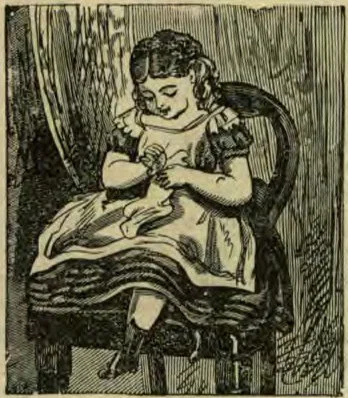
“There, that is finished and folded up, and I am heartily glad!” said Bertha, as she took off her little thimble, and laid on the table a pretty blue muslin dress, on which she had been busy for several days.
“Is it well done, too?” asked practical Aunt Mabel.
“Pretty well done for me, auntie; mother says I improve in dress-making.”
“That is encouraging. Now, Bertha, do you know that something else of yours is finished and folded up this evening?”
“What else can it be, Aunt Mabel? This is the only piece of work I have had to do this week, unless it is that tidy. I do not expect to see the end of that these six weeks.”
“Still you have finished and folded up something far more important than your tidy, or your dress, even; something that will not be unfolded again for years, perhaps; and yet you will see it again with every line and fold. Your day’s history is done, and gone from your keeping. You may remodel your dress if it does not please you, but you cannot change one jot or tittle of a day’s record.”
Aunt Mabel had the fashion of dropping these seed-thoughts, which often grew into strong, vigorous plants in young hearts.
“What has the record been?” asked Bertha of her own heart, as she thoughtfully laid away the blue muslin. As, little by little, she tried to go over the hours, there was much she would have changed if she could.
“I wish I had spoken pleasantly to Ned, when he wished me to help him with his flag. It would only have taken me a minute or two; and he was first sad, then vexed, at my crossness. It is too bad! Then, too, I left mother to do all her baking alone.” A sight of a little Bible, whose clasp had been closed all day, suggested still more reproachful thoughts. “No wonder I had such a poor day’s record, when I began it in too much haste for prayer, or reading a verse even.”
The day’s work did not look satisfactory from this standpoint, and she sighed as she felt that it was folded up.
—Words of Life.

THE JINGLING BELLS.

How many boys and girls know how the jingling sleigh-bells are made? How do you think the little iron ball gets inside the bell? It is too big to be put in through the holes in the bell, yet it is inside. How did it get there?
This little iron ball is called the “jingle.” When you shake the bell it jingles. When the horse trots, the bells jingle, jingle. In making the bell, this jingle is put inside a little ball of mud just the shape of the inside of the bell. Then a mold is made just the shape of the outside of the bell. This mud ball, with the jingle inside, is placed in the mold of the outside, and the melted metal is poured in, which fills up the space between the mud ball and the mold. When the mold is taken off, you see a sleigh-bell; but it will not ring, as it is full of dirt. The hot metal, however, dries the dirt of which the ball is made so that it can all be shaken out. After the dirt is all shaken out of the holes in the bell, the little iron jingle will still be in the bell, and it will ring all right.—Sel.

FRENCH BEES.

BEES are now being expelled from Paris by the prefect of police. A complaint lodged against these proverbial patterns of industry brought the fact to light that some skillful speculator had established, somewhere in the outskirts of the gay capital, no fewer than a thousand bee-hives, with a busy community of about forty million of subjects, who rob and torment their neighbors to an alarming degree. These winged brigands, as it seems, sallied forth to prey upon the sugar-boiling works with which the neighborhood is studded, and which proved to be most profitable substitute for honey-giving flowers.
The owner of one of these sugar factories, who stands first in the list of complainers, calculates that bees steal from him, at the least, twenty-five thousand francs a year. The workmen of these establishments look with even more unfriendly eyes on the winged freebooters, as they suffer in person for their greediness. When the workman leaves the factory, he is often covered with a sticky layer of sugar, and the watchful bees immediately pounce upon him and turn him into a field or pasture. In short, so many misdeeds are charged upon these busy insects, that it is not improbable the head of police will issue an order for their banishment from Parisian soil.—Continental Gazette.

EFFECTS OF POLITENESS.

A brave, active, intelligent terrier, belonging to a lady friend, one day discovered a monkey owned by an itinerant organ-grinder, seated upon a bank within the grounds, and at once made a dash for him. The monkey, who was attired in jacket and hat, awaited the onset with such undisturbed tranquillity that the dog halted within a few feet of him to reconnoitre.
Both animals took a long, steady stare at each other, but the dog evidently was recovering from his surprise and about to make a spring for the intruder. At this critical juncture the monkey, who had remained perfectly quiet hitherto, raised his paw and gracefully saluted by lifting his hat. The effect was magical; the dog's head and tail dropped and he sneaked off and entered the house, refusing to leave it till he was satisfied that his polite but mysterious guest had departed. His whole demeanor showed plainly that he felt the monkey was something “uncanny” and not to be meddled with.

LITTLE ERMIN'S “BLESSING.”

Little Ermine, three years old, is very particular about being at the table when the blessing is asked, and will run to climb into his high-chair to be on time.
One day lately his papa and mamma were away, and we had silent blessing. But this did not satisfy him at all, and he said, “I can't hear it.”
So at the next meal-time he bent his head down as usual, and said softly,—
“Now I lay me down to sleep, I pray the Lord my soul to keep.”

LETTER BUDGET.

Minnie McCurdy, of Sumner, Michigan, writes us that she has been keeping the Sabbath with her parents since last spring. She attends Sabbath-school, where she gets the INSTRUCTOR. She was twelve years old last August.
Wilmer W. McNeal, of Wheelersburg, Ohio, writes: “I have been taking the INSTRUCTOR nearly a year, and I like it so well. I read all the letters from the INSTRUCTOR family, but I guess none of them ever read one from me, so I thought I would write one. I go to Sabbath-school every week with pa and ma, and my two sisters. Our Sabbath-school was organized by Eld. Gates nearly a year ago. Our school is not very large, only seventeen of us; but we all go every Sabbath. Sometimes it rains, and sometimes it snows, but there are always seventeen there when school opens. I know all of God’s commandments; pray for me that I may keep them, and meet you all on the new earth.”
The spirit that prompts to go to Sabbath-school whether it “rains or snows” is the spirit which, getting into a school, makes it prosper. There you will find genuine interest and the blessing of God. Oh, that this spirit might spread, till it reaches every school and every scholar throughout our ranks!

THE LIFE-BOOK.

“Mamma, if I were a woman, If I knew as much as you, I would write a book,” said Lillie, “And I'd write it good and true.
“I would make it just like talking, As you talked to me last night, So that every one who read it Would love Jesus and do right.”
“Every one, my love,” said mamma, “Must at least one book compose; Each must write his own life-story From its dawning to the close.
“On a new, unwritten volume, Pure and spotless to the sight, Loving ones confer a title,— Baby hands begin to write.
“All through babyhood and childhood, Youth, mid-life, and trembling age, Still those hands are writing, writing, Never lifting from the page.
Every word and every action, Rude or gentle, wrong or right, In its ugliness or beauty, Live upon those pages white.
Every deed of love and mercy Shines upon those leaflets fair, And if one has loved the Saviour, All his love is written there.
“Just below the last word written, Angel hands will trace, ‘The End;’ Angel hands will clasp the volume, And will bear it up to God.”
— Children's Friend.

You have reached the end of this edition.

The Youth’s Instructor · Jan 12, 1881