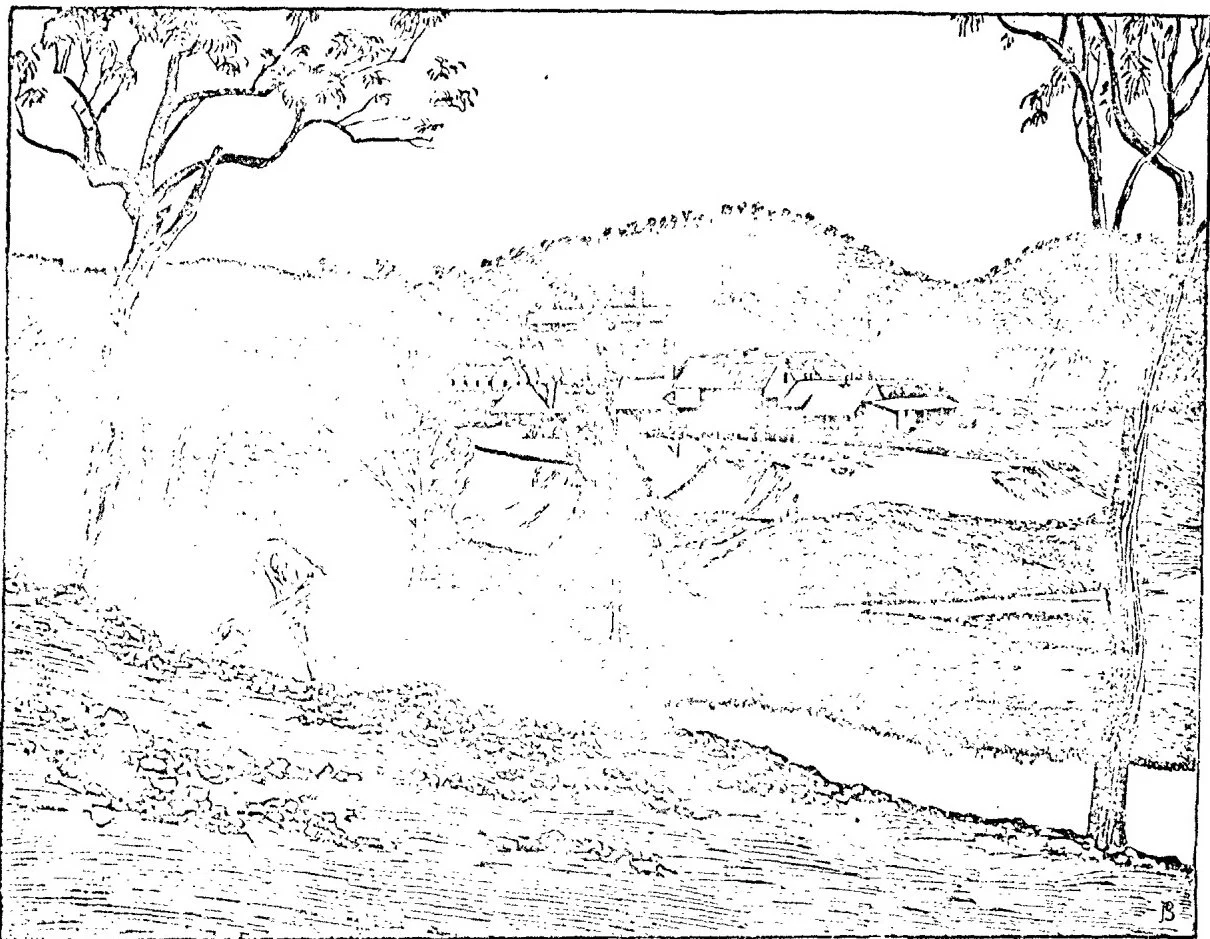
About twelve miles from Brisbane, on the shores of Moreton Bay, is the village of Wymunn, a quiet watering-place, with few attractions outside of its bathing facilities, fresh sea air, and the opportunity it affords for picking up oysters, and catching fish. These, however, are quite sufficient to draw from the cities each hot season crowds of pleasure-seekers, whose love of excitement leads them at times to the most daring feats.
Sea turtles are quite plentiful in the bay, ranging in weight from fifty to three hundred pounds, or even more. These are much sought after by hotel proprietors, whose bills of fare frequently include such toothsome viands as turtle soup, or turtle eggs; therefore many engage in “turtle fishing” to supply the exceedingly large demand for this questionable article of diet. These shell monsters are usually taken by the white people in nets, but the aboriginals have a different way of securing them, which I will try to describe.
They generally go in a company of four or five in a small boat; and when a turtle is seen in the distance, the boat is rapidly steered toward him. When the boat comes near its prey, the scene becomes exciting. The turtle finding itself pursued, rushes through the water in a zigzag course, sometimes diving, to elude its pursuers. The natives then begin to yell in concert, increasing the volume of noise in proportion as the chase becomes exciting. Coming to within a few yards of the turtle, one of the blacks, with a fiendish yell, plunges overboard, with a rope in hand, and struggles to fasten the running noose of the line to the monster. Perhaps he misses the mark in his first effort; he then seizes the creature by the edge of the shell, and holds on for life, while being carried up and down, this way and that way, through the water. All this time the turtle struggles violently, striking with its flipper, or vainly trying to bite its sable foe. It is, however, a useless effort; soon the noose is slipped over the flipper, and the captive is finally, with some trouble, hauled into the boat.
In order to enjoy these exciting occasions, white men sometimes buy the privilege of accompanying the natives on a turtle expedition. I am informed that one rarely witnesses the scene without himself becoming much impassioned, when he, too, yells as lustily as any one of his black companions. Sometimes, indeed, it is said that in his frenzy the white man will plunge into the water, and seize on the turtle with the same zeal as the native black, proving that an example only needs to be accompanied with zeal and enthusiasm, to be followed by those even of higher intelligence than the one setting it.
Could men only enter into the work of God with the same degree of enthusiasm, no limit could be named to the amount of good it would be possible for them to accomplish. But the real reason why men do not accomplish more for the truth, is because they do not get intensely interested in it. They have had enough interest to adopt it in theory; but to have undying anxiety to see it move along rapidly, has not even been scented in the distance, by many. Could they have as much as this, they would be like the soldier in battle, who, though wounded, refuses to leave the field, and when victory turns on his side, shouts as loud and enthusiastically as those who have escaped without a scratch.
On the Fitzroy River, about forty miles from its mouth, and something over 400 miles northwest of Brisbane, is situated the city of Rockhampton. It is spread out over a level plain, with the mountains in the background; and at a distance looks very inviting. The city itself is nicely laid out, and is one of busy activity. It was founded in 1860, since which it has become one of the first cities of Queensland. For an almost unlimited distance around it, the soil is unsurpassed in richness, and this has contributed largely to the growth and commercial prosperity of the place. Latterly, however, a gold mine, one of the finest in the world, located at Mount Morgan, in the immediate vicinity, has given the town an upward spring far surpassing anything in its earlier history.
MOUNT MORGAN, NEAR ROCKHAMPTON, QUEENSLAND, AUSTRALIA.
The site of this mine was originally owned by a young Scotchman named Gordon, who used it for a cattle run. While he owned it, two brothers by the name of Morgan discovered the value of the mountain, and on the occasion of a bad season, when Mr. Gordon was discouraged, bought him out for one pound ($4.84) per acre, or about $3,000 for the entire section of land. Soon a company was formed, and purchased it of the brothers for $300,000. Upon developing the mine, it has proved so valuable that its 1,000,000 shares are now held at $70 each, or $70,000,000 for a small piece of property which was sold by its original proprietor for about $3,000.
It seems singular that the first owner of this little mountain did not learn its value, for it is nearly covered with gold-bearing stone, somewhat resembling “slag” from an iron furnace. The stone is of a dark red color, and has been known to yield as high as 445 ounces of gold to the ton. Last year, with only four crushers at work, the mine paid out dividends of nearly $1,000,000. This year thirty-five such machines are constantly at work, which must give enormous returns to those who are interested.
The sketch on this page shows the crushing and separating works. Those in the foreground are the old works, and those higher up against the golden hill are the new works, which were erected at a cost of more than $100,000. These works provide labor for many people in and around Rockhampton, and at the same time enrich, and elevate into public favor, those who are fortunate enough to own stock in the golden mountain.
The city of Rockhampton, which contains in the neighborhood of 20,000 inhabitants, was canvassed this year for “Thoughts on Daniel and the Revelation,” by Bro. Wainman. He writes that his canvass of the city was quite successful, he having secured nearly 300 subscriptions for the book. But although this place and Brisbane have had placed in them several hundred books on present truth, not a sermon on our faith has been delivered in all that great colony, by the living preacher. It cannot be otherwise, however, than that many who have read the books, are now ready to listen to further instruction on the various points of truth.
Such a rich country cannot fail to prove a fruitful field for the truth; and if devoted men could be spared from other fields, there is no other country that would yield larger returns for the efforts put forth, than the colonies of Australia. True, there are now nearly half a score of workers in that corner of the earth; but the field is so large that what these are able to do for the whole field, is like a speck in the great blue heavens over our heads.
And yet the work in that land is gathering force, and will ere long spread out to cover the entire country. If there is no other way, the Lord will raise up men in the very places that need to be entered, and put the words of the message in their mouths, and the burden of it on their hearts, until, like the prophet of old, they will have no rest day or night, until they have consented to give their lives to the propagation of the truth. Happy is the person whom the Lord can use in some branch of his work in these last days. J. O. Corliss.
EXPECT CONVERSIONS.
He who preaches the gospel as God has given it, and where God has sent him and bidden him to preach it, expecting and working for the conversion of men, is not likely to be disappointed ; and he who works in his own way, and seeks his own pleasure, and does not expect conversions, is not often disappointed in his expectations. If men lose sight of the great object of Christian labor; if they cease to hold direct communion with God, and hold their commission from men and not from him; if they devote themselves to literary discussions, doctrinal disputes, and human notions, and theories, and measures, what wonder if they in the harvest day come empty-handed, even from fertile fields.
Souls are perishing, and a thousand million of the children of Adam have never heard that Christ died for them. Time is short. Let Christians awake to their duty; let them put forth their efforts for lost men; let their souls feel the burden of the dying multitudes around them, and let them go forth bearing precious seed, with tears; and a prayer-bearing God will bless the seed sown, and give the increase; and the faithful stewards of the Lord will be co-workers, and help forward the work to its consummation.—The Christian.
One Cannot Always Be a Hero
—One cannot always be a hero, but one can always be a man.—Goethe.
Rest in Christ Found Through Duty
—The rest of Christ is not that of torpor, but harmony; it is not refusing the struggle, but conquering in it; not resting from duty, but finding rest in duty.
The Christian's Joy in Believing
—Men may rejoice in the increase of their worldly substance; but far greater is the Christian's joy, when God puts gladness in his heart, and fills him with comfort and peace in believing.
REPORT OF THE FIRST-DAY OFFERINGS FOR THE QUARTER ENDING JUNE 30, 1888.
By G. I. R.
Knowing the great interest that all the true friends of the cause will have in the success of the plan devised by the last General Conference, for sustaining our missionary work by means of weekly donations, we present the following itemized table for the quarter ending June 30, 1888. It will be seen that it takes nearly three months to get in a full report of all the donations paid in the first-day offerings, so that the report is nearly three months behind. Let the reader carefully scan the following table:—
WHOLE AMOUNT OF FIRST-DAY DONATIONS PAID IN FOR THE QUARTER ENDING JUNE 30, 1888.
NAME.
WHOLE AMOUNT.
NO. MEM.
AMT. PER MEM. PER QUARTER.
AMT. PER MEM. PER WEEK.
California,
$223 86
1800
.124
.01
Colorado,
84 72
229
.37
.03 ½
Dakota,
136 19
632
.215
.01 ½
Dist. of Col.,
17 00
Georgia & Florida,
15 62
80
.195
.01 ½
Iowa,
288 96
1756
.164
.013
Indiana,
38 52
1121
.034
.00 ½
Kansas,
208 94
2000
.104
.00 ½
Kentucky,
13 13
125
.107
.00 ½
Louisiana,
5 95
Michigan,
740 20
4355
.169
.01 ½
Minnesota,
172 20
1689
.109
.00 ½
Maine,
97 10
436
.223
.01 ½
Missouri,
20 05
862
.023
.00
New England,
204 20
729
.28
.02 ½
Nebraska,
23 77
700
.034
.00 ½
New York,
55 94
810
.069
.005
North Pacific,
64 57
370
.174
.01 ½
Ohio,
93 39
1153
.051
.00 ½
Tennessee,
10 56
167
.065
.005
Texas,
17 45
390
.044
.00 ½
Upper Columbia,
44 97
290
.152
.01 ½
Vermont,
86 46
452
.191
.016
Virginia,
8 11
118
.069
.005
Wisconsin,
286 32
1665
.172
.01 ½
West Virginia,
6 00
Grand total,
$2,962 38
Amount paid last quarter,
1,231 46
It will be seen that there are some encouraging features, as the amount contributed is larger than it was in the last report; but we cannot suppose that, even yet, the plan is fully inaugurated, and in successful operation. Twenty-two thousand five hundred boxes have been sent out by the General Conference Association, each having a written pledge on it, which the individual taking it is expected to sign, that he will pay something each week for the support of our foreign mission work. While the number of boxes given out has been nearly equal to the entire number of our church membership, yet we do not suppose that nearly all, or even a large proportion, have thus far actually contributed each week. Many give nothing; and when we consider the amount given by the average membership of each Conference per week, we cannot say that we are very forcibly impressed as to the extreme liberality of our people toward the foreign missionary work. When we think that, averaging it, one Seventh-day Adventist gives from one half of a mill to three cents per week for the support of our foreign missionary work, we can hardly think that they are straining their generosity in behalf of this estimable work. We confess that it is to us some disappointment to see how little interest has thus far been shown for this most excellent plan of raising means, which might be followed without pecuniary loss to any, if they would carry it out according to the design.
We know of people who have given one dollar every week since this plan has been put in operation. There are doubtless those who give twenty-five and fifty cents each week, others ten, and five; and if this be so, where are the majority of our people on this question, and how are they trying to help forward the missionary work in foreign lands? Of course, if there are some who are giving a dollar, and others one half a dollar per week, etc., and the average for the whole membership is only one half mill to three cents, there must be many who are doing nothing at all. If this plan could be carried out with any degree of efficiency, we know that our foreign mission work would be bountifully supplied with means to carry on its operations. Let our people consider this matter carefully, and try to help all they consistently can. May God help us to see our duty, and do it. G. I. R.
Such is the designation used in this text to specify a certain class who in the final judgment scene are numbered with those upon whom falls the wrath of God. There is nothing in the term which especially implies guilt, yet they stand in the company of those who have been perpetrators of the most heinous sins. In their earthly career they were not conspicuous as evil doers, and their progress in the downward road was not especially noticeable to those around them, perhaps not even to themselves; yet it was no less real, as shown by their arrival in due time at the common terminus,—perdition.
The meaning of the term, and the class designated thereby, it is not difficult to comprehend. They are not the heathen, or worldlings who have lived with no thought of God and his requirements, but those who, though knowing his claims upon them, have not had the courage to fully walk in the path he has marked out before them.
There is a boldness which springs from a lack of Christian reverence, and there is a timidity which is born of doubt; they are equally out of place in the worship and service of God. The Salvation Army and self-styled “holiness” bands furnish examples of the former, while in the faint-hearted service of many Christian professors, is seen the working of the latter. Which of the two states is the worse, it would perhaps be a difficult matter to determine.
The “fearful” person never gets very far along in the journey toward Zion. He pauses after taking the first few steps, and seems quite loth to venture further. He has gone perhaps as far as the majority of those in the church, and is afraid lest, by going further, he should make himself conspicuous. He has full confidence, apparently, in the promises of God’s word; he admits that it is safe for the Christian to venture out upon them; he knows that God requires and is pleased with such a course; still he never quite has the courage to make the trial. A person of this class never assumes any active part in church work. His timidity prevents it. When a new enterprise is started, he looks upon it with distrust, though he can give no well-defined reason for so doing. He does not like that anything should occur to stir him out of the rut in which he has been accustomed to move. If he engages in any new work, it is not because he expects to derive any benefit from it himself, but because he fears it might result to his disadvantage to do otherwise. His policy is not to discover how much he can do to advance the interests of the cause of God, but to do as little as he can and still satisfy his conscience. He is never on the lookout to discern when an opportunity has arrived of which the church might take advantage; or an emergency arisen which calls for special effort to prevent disaster; and did the result depend upon him, the curse of Meroz would be sure to rest upon the church because of their inactivity.
And yet such persons usually have little difficulty in passing for good church-members; for the reason, perhaps, that they constitute such a considerable proportion of the church. Their theory as to what the service of God requires is all right; but it is one which they never put into practice. They talk freely of the high standard of moral excellence set before the Christian in God’s word, but in their hearts they do not expect ever to reach that standard. Such men as Paul, and John, and other Bible characters, might have attained such excellence, but it is not for them. They assent to the truth that Elias was a man of like passions with themselves, but they do not make it of any practical value. The attainments of these worthies,—so far beyond the narrow limits to which they have dared to venture,—seem to lie wholly beyond the range of present possibilities. And this impression having finally assumed the form of actual conviction, their efforts in the Christian race are accordingly of a wavering and half-hearted kind.
Fearfulness is always associated with a lack of faith. It is indicative of unbelief in one of its subtlest forms; and the person who does not stop to scrutinize and test the spirit which prompts his actions, may be for a long time unaware of its presence. It is a sad fact, but one made certain by the words of the text with which we started, that it will deceive many souls, to their final ruin. It does not render its victim conspicuous in the eyes of those around him, or cause him to feel especially guilty himself, as would the commission of out-breaking sin; but the fact that such a one is finally classed with sinners of the blackest type, and shares with them his fate in the lake of fire, shows us that it is not leniently regarded in the sight of Heaven. The discovery that we are in such a condition may well fill us with genuine alarm.
There is a boldness in Christian work which is offensive in the sight of Heaven, and there is a boldness which is proper and well-pleasing. So also there is a fear which is born of reverence, and a timidity which comes from cowardice. We need power to discriminate closely between them, lest we should fail to exercise that courage and activity which are born of faith, and be led to continue in a course633which will finally bring us to share the dreadful fate of those who “have their part in the lake which burneth with fire and brimstone.” I. A. S.
THE MICHIGAN CAMP-MEETING.
This meeting was held at the appointed time, on the same ground that was occupied last year, in Grand Rapids, Mich. The season, Sept. 25 to Oct. 2, was that part of the year which, covering the transition to later autumn, is subject to increasing chilliness and fitful storms; and this year proved no exception to the rule. The closing days were pleasant.
The meeting was not as large as the general meetings in this State for some years past. But as three camp-meetings in different parts of the State had preceded this, the larger proportion of brethren and sisters in Michigan have doubtless enjoyed the privilege of a camp-meeting the present season.
These are all the unfavorable features we have to mention. There was a good spirit in the meeting. We believe that the great majority of the hundreds who were present, were those whose hearts are confident in God and true to his work. And as we looked into the faces of the large audience of the friends of the precious cause of truth, courage and good cheer seemed to be depicted upon almost every countenance; and we believe their hearts are knit together by strong cords of union and brotherly love.
The preaching was spirited and free, and listened to with interest. Including the preaching done during the workers' meeting, which commenced the 18th, many discourses on profitable subjects were delivered. As we were present only a brief season, we cannot name them all, but understand the speaking devolved principally upon Brn. Corliss, Rupert, and Van Horn. Bro. Farnsworth after his arrival, the 27th, took an active part in the work.
Sabbath, the 29th, was a marked day in the camp. Bro. Corliss spoke in the forenoon, and Bro. Farnsworth in the afternoon. Following this discourse, some one hundred and eighty signified their desire to start in the service of God, or to renew their covenant of consecration to him, by presenting themselves for prayers. Many feeling testimonies were borne, and in fervent prayer these cases were presented before the Lord. In the evening, Prof. Prescott presented the subject of our educational interest, in words calculated to awaken zeal in all hearts in behalf of this important branch of our work.
On Sunday the attendance from without was good. The great pavilion was well filled. The subjects of Life through Christ, How the Gentiles become connected with, or become a part of, the people of God, and Christian Temperance, were presented.
The usual business of the different organizations was attended to. The earnest efforts of Bro. Butler in behalf of the Conference during his year, in the midst of other manifold labors, received suitable acknowledgment by resolution, as will be seen in the business proceedings. His duties are so arduous in other directions that it is not consistent for him to be longer burdened with this office. Eld. Van Horn was therefore chosen as president of the Conference, with Brn. J. Fargo, H. W. Miller, G. G. Rupert, and Harmon Lindsay, as associates on the committee.
The general verdict, as far as we have learned, concerning the meeting, is that it was an excellent one, the influence of which cannot fail to be good. Additional reports concerning many interesting features of the meeting we trust will be reported by others whose stay at this feast of tabernacles was more extended.
SLIGHTLY INCONSISTENT.
By J. O. C.
In the Christian Statesman of Sept. 18, is a short catechetical article which sets forth the writer's view of National Reform. In answer to the question as to how it is possible to make Christ the ruler of this country's national life, when the land is a chaos of beliefs, prejudices, and ignorance, it is there stated that the nation must be converted, “just as the truth concerning personal religion must be preached to man, in order to his conversion.”
Had the writer said that the subject of the National Reform movement contemplated personal labor with people in the nation until the last sinner should be converted, the efforts of its promoters could be considered only laudable; but when the writer goes on to say that “preaching the truths of personal religion alone will not save the nation, any more than preaching the truths of national religion will save individual souls,” he states the matter in a light that shows the inconsistency of the whole movement.
We do not say that the statement is not true; for we fully believe that it is. We further believe that the exact truth of the matter could not be more tersely stated than it is in that sentence. But let us weigh the matter carefully. Preaching national religion will not save individual souls. And yet the entire life, and all the energies of the being, of scores of talented men, and thousands upon thousands of dollars, are being expended—for what?—According to their own confession, for a work which has no power to convert an individual soul. More than this; they propose to move heaven and earth to secure the object of their desire—a converted nation. And yet after having done all this, no individual soul will have been converted through the Herculean task.
No one can say that this conclusion is not legitimately drawn. Then why waste time and means to bring about a religious reform in the nation, which will not be a religious benefit to individual souls? It may be said that when the nation becomes Christian by vote, then individuals in the nation will have the benefit of the nation's condition. But if the conversion of the nation does not convert its individual members, where does the benefit come in? Will they not still be unconverted, and need personal labor? Why, then, not do the personal labor in the start, and let the other part alone until the first and most important part of the work is accomplished?
But the accomplishment of such a work is evidently not what the National Reformers are after. The very fact that they disclaim any power in their work, to effect the salvation of individual souls, shows that theirs is another work than that of the salvation of their fellow-men in the good old-fashioned way. What they want is power to control the sentiment of the nation, so as to oblige all to outwardly conform to certain religious tenets, regardless of the condition of the heart.
We had always supposed that the nation was composed of its citizens, and that so far as these citizens were reformed, just so far the nation would be reformed. But it seems that these nineteenth century reformers do not view the matter in that light. They say that personal religion is one thing, and national religion another; that even though the majority of the nation's citizens are Christians, and might, if they chose, control the sentiment of the nation, there is an element lacking, in their estimation, which can be supplied only by the nation's conversion.
This seems strange to an unsophisticated person. How the nation is to be converted, without teaching personal religion, would indeed be a poser, were it not that these Reformers (?) have laid the matter open before all. They say that while “there is a decisive majority of Christians, even numerically considered, . . . they allow themselves to be divided up on issues which are irrelevant to the kingdom of Christ, and do not control the nation.” That is to say, Christians are now allowed to think for themselves, and to vote on moral questions as they consider for the best good of themselves and the country at large; and by so doing, scatter their votes to some extent. Therefore, our National Reformers want a conversion in the nation which will make all cast their votes solid for whatever dogma the leaders of religious thought may formulate.
And this is the effort of the National Reform movement, according to their own statements, when they are fully analyzed. But woe to any country that shall be brought under such domination. It would be but the repetition of the history of the Dark Ages, when men's minds were dwarfed because some combination did the thinking, and the subjects quietly sustained them in their manipulations. Is it possible that with the history of the papal supremacy before the people of this generation, they can be led into such a snare?—It is more than probable from the present outlook that this will be the case; but when it comes, look for persecution and moral darkness, from the midst of which the Lord has promised to redeem his faithful people.
J. O. C.
THE COUNCIL OF LAODICEA.
By James White
The first authoritative action of the Catholic Church in substituting the Sunday for the Sabbath of the Lord, was that of the Council of Laodicea, in the year 364. An effort has been made to evade the force of this fact, and to disconnect this work from the papacy, by offering the following objection; namely, the Council of Laodicea was held in the Eastern church, and not in Rome; therefore the change was not made by the papal church.
If anything were needed to prove that they who try to uphold the Sunday are reduced to great straits, their offering such an objection as this would surely serve the purpose. It clearly proves that they take only superficial views of the evidences on the subject, and have never considered the real relation of events and localities. On this subject, notice a few points:—
1. The council which declared the primacy of the bishop of Rome, was also held in Asia Minor.
2. The bishop of Rome was constituted the head of all the churches, and the effectual corrector of heretics, by the emperor of the East.
3. No general council was held west of Constantinople until the twelfth century. Does this fact have any effect on the supremacy of the popes of Rome in the centuries preceding?
4. The decrees of councils received no authority from the places where they were held, but from the consent and action of the emperors, popes, and churches.
5. No council was ever held that better served the purposes of the pope of Rome, than the second Council of Nice, Asia Minor, A. D. 787, called by Irene, empress of the East. Irene, crafty and unscrupulous, caused Tarasius, a layman, to be made bishop of Constantinople. Pope Hadrian I., “offended at the uncanonical election and ordination of a layman, had declared that he approved of his election only upon condition that he got the holy images restored.” So says Bower. But why did the pope look to such a source for the accomplishment of such an object? It was because he knew that Charlemagne, then ruling in the West, was opposed to the worship of images, and so were most all the bishops of the West; and he knew that Irene was in favor of the images. There appeared to be no hope of their restoration, under the circumstances, except by means of a council called by the empress and the patriarch of Constantinople. This council was attended by 375 bishops, all from the East, the West being represented by the pope’s legates only. There was great unanimity in their decision; but great also was the indignation manifested throughout the West. Charlemagne convened a council at Frankfort to counteract the decision of that of Nice, the decree of which was there condemned. The emperor made every effort to induce the pope to condemn the Council of Nice, and to reverse its decision, but in vain. The pope declared that “apostolic tradition” was in favor of the adoration of images; and through his influence the decision of the second Council of Nice became the established faith of the church. Had the pope united with Charlemagne and the bishops of the West, that canon of Nice would have become a dead letter. Does the fact that this council was held in Asia Minor, and was called by the empress of the East, destroy the claim that image-worship is a Romish, or papal, dogma?
6. The Council of Laodicea was not ecumenical, but, as says the Cyclopedia of McClintock & Strong, its canons “were received by the other churches.” The decisions of some of the most important councils, as that of Chalcedon, and the second of Nice, were subjects of much contention. Probably the canons of no council met with greater favor than those of Laodicea, and amongst them the 29th was almost universally accepted, because the decree of Constantine had already popularized the day of the sun, and because the observance of the seventh day was stigmatized as a badge of Judaism. But it was most favorably received in the West, the papal church making the Sabbath a fast day, which action was opposed at Constantinople. All history attests that Sunday received its strongest support from Rome, and that opposition to the Sabbath was much stronger at Rome than in the East. The observance of the Sabbath continued longer in the East than in the West. As in the case of the second of Nice, so in that of Laodicea, Rome was the life and strength of its canons.
7. The words of the best historians may be quoted to prove that it was not by any one act, nor in a brief period of time, that the Sabbath was entirely supplanted by the day of the sun. That Rome, with all her influence, found it extremely difficult to exalt Sunday to the place it attained, is proved by the many decrees of emperors and canons of councils which were found to be necessary to accomplish the object. Dr. Heylyn says the sixth council of Constantinople, A. D. 690, “did admonish those of Rome to forbear fasting upon that day upon pain of censures.” Rome had compelled fasting upon the Sabbath about three centuries before that, and she persisted, and prevailed. The Sunday church-festival, gradually turned into a Sunday Sabbath, is as truly a creature of the papacy, as is the custom of image-worship.
8. All that part of the Protestant Church at large which is represented in faith by the Baptists, has been forward to lay innovations to the papacy. It has persistently declared that infant baptism is an institution of the papal church. That infant baptism, even as the Sunday, owes its strength and perpetuity, its general acceptance, to Rome cannot be denied. And yet, who does not know that infant baptism originated in Africa, and not in Rome? So impossible is it for the advocates of Sunday to be consistent.
The sum of the matter is this: The primacy of Rome was declared in the East; the supremacy of Rome over all the churches was established in the East; all the general councils, before the 12th century, were held in the East; all the churches, east and west, were united into one hierarchy by Constantine; and the actual division into the eastern and western churches was not until the tenth century. Therefore, the councils held in the East were the councils of the Catholic Church as established by Constantine, over which the bishop of Rome was given the primacy by the first general council held in Asia Minor, A. D. 325.
But this objection is only an evasion; a subterfuge by which, if possible, to keep out of sight the fact that the Sabbath was changed for the Sunday by the church in the fourth century. Were the objection valid,—were it a fact that the church represented by Rome had nothing to do with establishing this canon of Laodicea,—it would not aid the cause of Sunday at all. It would still remain a fact that the Sunday institution, as a day of church observance, received its authority (1) from the 29th canon of the Council of Laodicea; and (2) from those who enforced and gave effect to this canon. It can be traced to no other source. But, unfortunately for the cause of the objectors, they cannot possibly separate this action from the Catholic Church, of which the bishop of Rome was at that time the primate, and from whom this canon received its best support.
They who are even partially acquainted with the history of the church in the early centuries, will not need this explanation. But it is very apparent that the advocates of Sunday are quite ignorant of the facts of history, or are fully determined to suppress those facts. Flimsy as is the objection here noticed, it has been urged with most amazing confidence. The confident manner of the objector might deceive, where the objection itself has no weight.
J. H. W.
The Proper Use of Knowledge
—The real use of all knowledge is this, that we should dedicate the reason given to us by God to the use and advantage of man.—Bacon.
Go Directly to Christ
By Rev. Peter S. Menzies
—Keep clear of mere machineries, stride over church worshipings, and earthly priesthoods, and all the theologic lore of the ages; and go directly to Christ, and ask thyself whether thou canst love him supremely and undividedly.—Rev. Peter S. Menzies.
THE EUROPEAN COUNCIL OF SEVENTH-DAY ADVENTISTS.
The sixth annual session of this body was held in connection with the camp-meeting at Tramelan, Switzerland, Aug. 26. The meeting was called by Eld. O. A. Olsen, the only officer of the Council present.
Upon motion of Eld. Waggoner, Eld. Olsen was elected chairman. E. W. Whitney was chosen secretary pro tem. Prayer was offered by Eld. J. H. Waggoner. A statement was then made by the Chairman concerning the appointment of the Council, explaining in part the reasons why other officers and members were not present, and that, owing to the circumstances, there was very little that could be done. Some references to the minutes of the last session were made, but the reading of them was waived.
The following resolutions, introduced by Eld. J. H. Waggoner, after consideration, were adopted.
Resolved, That inasmuch as the school-laws of the different countries in Europe are so very different that no suggestions can be made which will apply in general, we leave the subject with the several Conferences, to do as their circumstances require.
Whereas, In view of the manifest benefit of the camp-meeting at Moss, Norway, and Tramelan, Switzerland, which is full proof that such meetings may be as profitable in Europe as in America; and in view of the fact that already our general meetings are too large to be convened in meeting-houses or halls; therefore,—
Resolved, That we recommend the several Conferences in Europe to adopt this method of holding their general meetings, as fast and as far as their circumstances require or will permit.
Whereas, The Conferences in Europe are now established, each with its peculiar circumstances, and publishing in different tongues; therefore,—
Resolved, That we ask the General Conference to consider the matter of the European Council, and to instruct us as to the advisability of continuing it.