Your ShelfYour Projects

Review and Herald, Vol. 81, No. 28.

— A. A. PROCTER
Earlier text: Washington, D. C., the Headquarters of the Seventh-day Adventists

I Will Trust, Nor Be Afraid

C. H. KESLAKE
THROUGH Death’s valley dark I’m passing, On my path its shadows fall, Mid the darkness evil voices My poor, trembling heart appal; But I hear my Saviour speaking, “Fear thou not, be not dismayed,” And my spirit gladly answers, “I will trust, nor be afraid.”
Dark the way, still thou dost guide me— Light of life, bright Morning Star! Thou hast promised ne’er to leave me Till I’ve passed the gates ajar; Strengthen me, O Christ my Saviour! Shepherd King, I need thy aid, With thy rod and staff to comfort; “I will trust, nor be afraid.”
Though I stand before Death’s portals, Still thy promises I prove; Gently clasp me to thy bosom, Hold me firmly in thy love; O my Father, I will praise thee, See, my hand in thine is laid, Thou hast turned from me thine anger: “I will trust, nor be afraid.”
When at last, the journey over, I shall see him face to face, And again, with tongue immortal, Sing the story “Saved by grace,” Then throughout eternal ages, Clothed in garb that shall not fade, With my Saviour, peaceful, dwelling, “I will trust, nor be afraid.”

Open the Door of Your Heart

Open the door of your heart, my lad, To the angels of love and truth, When the world is full of unnumbered joys In the beautiful dawn of youth. Casting aside all the things that mar, Saying to wrong, Depart! To the voices of hope that are calling you Open the door of your heart.
Open the door of your heart, my lass; To the things that shall abide, To the holy thoughts that lift your soul Like the stars at eventide. All the fadeless flowers that bloom In the realms of song and art Are yours if you’ll only give them room. Open the door of your heart.
Open the door of your heart, my friend, Heedless of class or creed, When you hear the cry of a brother’s voice, The sob of a child in need. To the shining heaven that o’er you bends You need no map nor chart, But only the love the Master gave. Open the door of your heart.
— Boston Transcript.

Laughter and Health

It is natural, that is, in accordance with nature, to laugh. This is not to say that it is natural to be foolish, or silly; but circumstances often occur under which a laugh is irrepressible. One reason why this is so—why it is thus ordained in nature—may appear in the fact that laughter is a great conservator of health. It is an exercise everybody needs. In this world, where evil and sorrow and disease abound on every hand, the capacity and the opportunity to laugh may well be recognized as among nature’s beneficent provisions for this state of being, however unnecessary they might be under an ideal state of existence.
On this subject a writer in Success says the following:—
“People ask me daily, when they look at my face that is without a wrinkle,” says Adelina Patti, “what I do to keep so young. I tell them that whenever I have felt a wrinkle coming, I have laughed it away. They can scarcely believe me. Women ask me if I do not use certain creams; if I do not advocate face-steaming, massage, or some other artificial beautifying process; or if I do not bathe in milk, or mineral water, or champagne. But I answer that I do none of these things. I never use anything but plain water, and I laugh my wrinkles away.”
“If we realized the power of good cheer and the habit of laughter to retard the progress of age and to stay the hand which writes the wrinkles of care and anxiety on the face, we should have discovered the famed fountain of youth—the elixir of life.”
“The power of laughter, the rejuvenating force of cheerfulness, ought to be taught in our schools, especially our medical schools.”

Laughter as a Tonic

“There is nothing better established among physicians than that cheerfulness prolongs life, and also enriches and enlarges it. Whole-souled, joyous laughter is a powerful health tonic. ‘There is not one remotest corner or little inlet of the minute blood-vessels of the human body,’ says an eminent physician, ‘that does not feel some wavelet from the convulsions occasioned by a good, hearty laugh.’ Laughter stimulates the digestive process, accelerates the respiration, and gives a warm glow to the whole system. It brightens the eye, expands the chest, forces the poison out from the least-used lung cells, fills them with life-giving oxygen, and tends to restore that exquisite poise or balance which we call health.
“Some time ago a patient in an insane asylum was suffering from extreme melancholia. He did not laugh or smile. Day after day he sat or walked with an expression of settled melancholy on his face. Months passed, without bringing any change in his condition. Finally his physician resolved to try a new form of treatment—the laugh cure. He employed a large, jovial, hearty man to come to the patient’s door every day and laugh. What peals the visitor sent ringing through the whole establishment, of deep, melodious, side-shaking laughter, so joyous, hearty, and infectious that every one who heard was compelled to join in it! But the melancholy sufferer looked at the laughing man with the same deep, immovable gloom upon his face. One day, while the laughter was convulsing every one in his vicinity, the patient suddenly stopped pacing his room, and burst into a hearty laugh. The effect was magical. The light of reason shone once more in his face. He looked around in a dazed way, and asked, ‘Where am I? What is this place?’ The black clouds of gloom had been dispersed. The melancholia had departed. The man was in his right mind again. Laughter had done for him what the physicians, the drugs, and all the treatment at the asylum had failed to do.
“If people only knew what the habit of practising real side-shaking laughter every day would do for them, thousands of physicians would be looking for a change of employment. If you want to be well and happy, practise laughing. Don’t be afraid to let yourself out. Shake yourself with deep, hearty laughter several times a day. It will do more for you than horseback-riding, a gymnasium, or solemn, sober walks. It is the best kind of recreation. It is nature’s great safety-valve. It gives the body more resisting power. It doubles one’s force, and increases capacity for endurance.
“Give me the man who laughs at poverty and misfortune! Give me the joy which is independent of circumstances, and lifts above environment!
“No matter how hard your lot, or how dark the day; if you work a little good cheer into it, it will lift your life above a joyless existence. Cheer will take the drudgery out of your work, and make it more interesting. It will make you more interesting, too; for dry, over-serious people are, as a rule, monotonous and unattractive. The man who never laughs is dull and uncompanionable. His capacity for enjoying life, or making it pleasant for others, dries up and atrophies.
“A great many people never learn to laugh heartily. A sort of half smile or a disagreeable chuckle is as far as they ever get. They look upon whole-souled merriment as a misdemeanor, a breach of good manners. They can not imagine such an unbecoming performance in a well-regulated home. If the children get a little boisterous, they must be hushed. They are told to sit down and be quiet. Their little lives are suppressed until they almost lose the power of spontaneous, hearty laughter. It is positively sinful to suppress the fun-loving tendencies in the young. They were intended to bubble over, to be joyous and happy; and to exult in mere existence. A sober, gloomy face on a child should be impossible. Let the children laugh and romp and play. What have care and trouble to do with young life? Anxiety and worry in the face of a child show that somebody has been criminal.
“There is nothing else the world needs so much as sunshine, and the greatest benefactor of mankind is the man or woman who has the wealth of a cheerful, helpful disposition. There is a great opening in the ‘cheering-up business.’ There is plenty of room in it for everybody, and it does not interfere with any other vocation. Make it a hobby, if you want to be happy and successful.”
“A merry heart doeth good like a medicine.”

Physical Culture in the Daily Occupations

Positions While Working

As we are studying the foundation principles of physical culture, we will look at the first pair to find our positions. We read in the Word, “God hath made man upright.” While the word “upright” is used in the Scripture with reference to character, yet it is also true that this is only a secondary meaning derived from the original, which is defined in Webster’s unabridged and Century dictionaries as “straight up and down.”
We know it is true that God did make man physically upright in the primary sense of the word; for we read in Gen. 1:27 that he was made in the image of God. He also made him morally upright; but in this article we are taking a view of man’s physical being; hence we will look at these scriptures as stating the truth that God, in the beginning, made man physically upright. Let us study this truth to the glorifying of God in our bodies, as well as our spirits, which are his.
In harmony with this, we view the same word made visible in man’s creation; for we find that he gave them (man and woman) just the necessary muscles to keep them upright. He fastened them to the right bones in just the proper way to accomplish this result. All the internal organs are so arranged that an upright position of the body keeps them in their places, ready to work for man’s physical salvation. The Creator so arranged nerves and nerve centers that warning might be given when this upright position was not being maintained. So we see that the same power that created men and women, upholds them, and will continue its work until interrupted by the creature.
Going up and down stairs is often a part of our daily work. It is a very healthful exercise. Lungs, heart, liver, bowels, as well as leg muscles, are greatly benefited by it. It will be found on examination that the injury is due to a wrong position in walking, by which muscles not calculated to do the work, bear the burden. An upright position of the trunk, with the head up, lays the task of lifting the body, one step at a time, upon the legs. They are well able to do this, and if the breath is drawn slowly through the nostrils, there will be no panting when the top step is reached. Plant each foot, in its turn, squarely on the step, and the advanced leg will lift the weight of the body as easily as the hand will lift an apple. Neither men nor women need be injured by this exercise when properly performed.
Many whose work requires them to stand a greater part of the time, fall into careless habits of slouching, leaning, or stooping. Women over the dishpan, or table, men over the counter or desk, are tempted to think they can not help it. Let them but straighten up, and they will find that they can stay straight. Repeated acts become habits, and habits form character. Then why not repeat again and again the act of standing straight until it becomes a habit? This habit keeps the muscles that hold the body upright, at their best continually, and thus an upright physical character is formed. If you have not the will and determination to go at it and stick to it, you may need a teacher to prompt and correct you.
Others, whose work requires them to sit during a large part of their time, may easily ruin their health by sitting in bad positions; but they might, with little trouble, form the habit of sitting correctly, and thus regain and keep their health. A stooping posture, a forward drooping of the shoulders, or sitting so that the weight of the body rests on the spine, will surely cause trouble. A straight, low chair for sewing is to be preferred to a rocker, as the latter encourages improper postures. The bones and muscles which were created to hold the weight of the body when sitting in an upright position, are well able to sustain it without injury to themselves or to the delicate organs in its interior. No others are. To put these burdens on other parts is to give them a task they can never accomplish, and to inflict painful diseases on vital organs. These workers should make it a point to rise, stand erect, breathe deeply, and walk a few steps as often as possible. A dressmaker of my acquaintance keeps her sewing-machine in an adjoining room, that she may have the exercise of walking to it from her cutting and sewing table. By this means she saves time and prevents disease; for she retains her health in spite of her unhealthful employment. She takes her physical culture in her work.
Sweeping is another employment often condemned; but much, yes, all of the harm resulting from it may be entirely avoided by using the proper muscles. Sisters, sweep with your arms. Using the arm muscles and not those of the back, will make sweeping a pastime. Broom-makers, unfortunately, have failed to discover that women differ in height, and consequent length of limbs, so they hand out brooms all of one pattern. The tall woman and the short woman both suffer by their ignorance. But we are looking for a better day.
To every worker, no matter in what occupation, there come changes of position. They may be slight, perhaps only reaching for a spool or passing a book, but by making the most of these, one may get quite a variety in a day. Let every part of the body move at the time of the change, and by breathing in harmony with the motion, the whole body will be helped.
Another part of the true physical culture is rest. There come waiting times, often very short, but long enough to relax and breathe. Take them as resting-places, not as seasons for impatience.
“There’s many a rest in the road of life, If we’d only stop to take it.”
Well, take it then, and let the strained, wearied body and mind find the refreshment these little jogs in the machinery were meant to give. Our Father is watching over us all for good, and let us note these resting-places, and thankfully, trustingly enjoy them. It may be waiting for some one to copy an address, or to sharpen a pencil, or bring a missing article, or even waiting for a car. The car that we almost caught, but missed, was not for us. We needed a rest, time to collect our scattered thoughts, and so the dear Father called us to his side for a few short moments, while he brings our car speeding down the track to us. Resting is one of God’s beautiful ways of recreating our wasting bodies. Even the heart rests between beats, and that brings, in its turn, its quota of rest to the entire circulation. So these little resting-places come; they surely come to us in our work. Let us watch for them, and use them as the dear Sender designed, and so be blessed.—Augusta C. Bainbridge, in Southern Watchman.

A King Deposed

He sat in the darkness weeping, By the gates of his empire, closed, A ruler stripped of his purple, A king from his realm deposed.
They passed him, going to worship; And, wistful, behind he crept; And coldly they bade him be silent Because that the new king slept.
They lifted him up to the cradle, Their fingers laid on their lips, And he touched one baby dimple With his own little finger-tips.
Then they set him down in the nursery, A wan little lovelorn heap; And he lay with his child's heart breaking, Sob-sobbing himself to sleep.
— Will H. Ogilvie.

Harvest Months of the World

EXCEPTING the months of November and December, harvest is always going on somewhere on the globe. In January reapers are busy in most of Chile, Argentina, Australia, and New Zealand. Harvest is in full swing throughout the East Indies in February and March. April sees the fields of Mexico, Egypt, Persia, and Syria being cut. The merry month of May is thus used in Morocco and Texas. California, Spain, Portugal, Italy, Sicily, Greece, and part of southern France reap in June. The greater part of the United States and France, Austria, and southern Russia are stripped in July. August is the harvest month in England, Germany, Holland, Belgium, Denmark, the Northeastern States of America, and part of Russia and Canada. Scotland, Sweden, Norway, the northern midlands of Russia, and the greater portion of Canada are glad to shear in September. And October beholds the reapers in the most northerly districts of Russia, Norway, and Sweden gathering with endless trouble their scanty crops.—Selected.

The Lily and the Rose

“The lily’s lips are pure and white without a touch of fire; The rose’s heart is warm and red and sweetened with desire. In earth’s broad fields of deathless bloom the gladdest lives are those Whose thoughts are as the lily, and whose love is like the rose.”

The Cloud’s Bright Lining

“THE inner half of every cloud Is bright and shining; I therefore turn my clouds about, And always wear them inside out, To show the lining.”

The Need in the Dark Continent

W. S. HYATT
I HAVE long felt that the needs of the African field are not realized by our brethren, and I do not wonder at this; for they have known but little about the great work there is to be done here before the message closes. At present we have five small missions started in Africa, and some of these are scarcely in running order, hence able to accomplish but very little. The facts are that we have scarcely made a beginning, even in South Africa, and the millions of Africa are still beyond, and nothing is being done to give them the last warning message .
Thank God, he has sent godly men into these fields who are giving the Bible to the people, and preparing the way before us.
We are constantly saying, “There shall be delay no longer.” I firmly believe that the time has come for the last message to go to the world with power; but one question constantly arises in my mind, and that is, Are we going forward with the message? I wonder why it is that more people do not have a burden to work for souls and to enter these benighted fields. O how very few seem to think that God wants them to take up this work! Even here in Africa, where men speak the language and know the native and his needs, very few can be found who will labor for the souls of the people who are in such great blindness. May the Lord awaken his people.
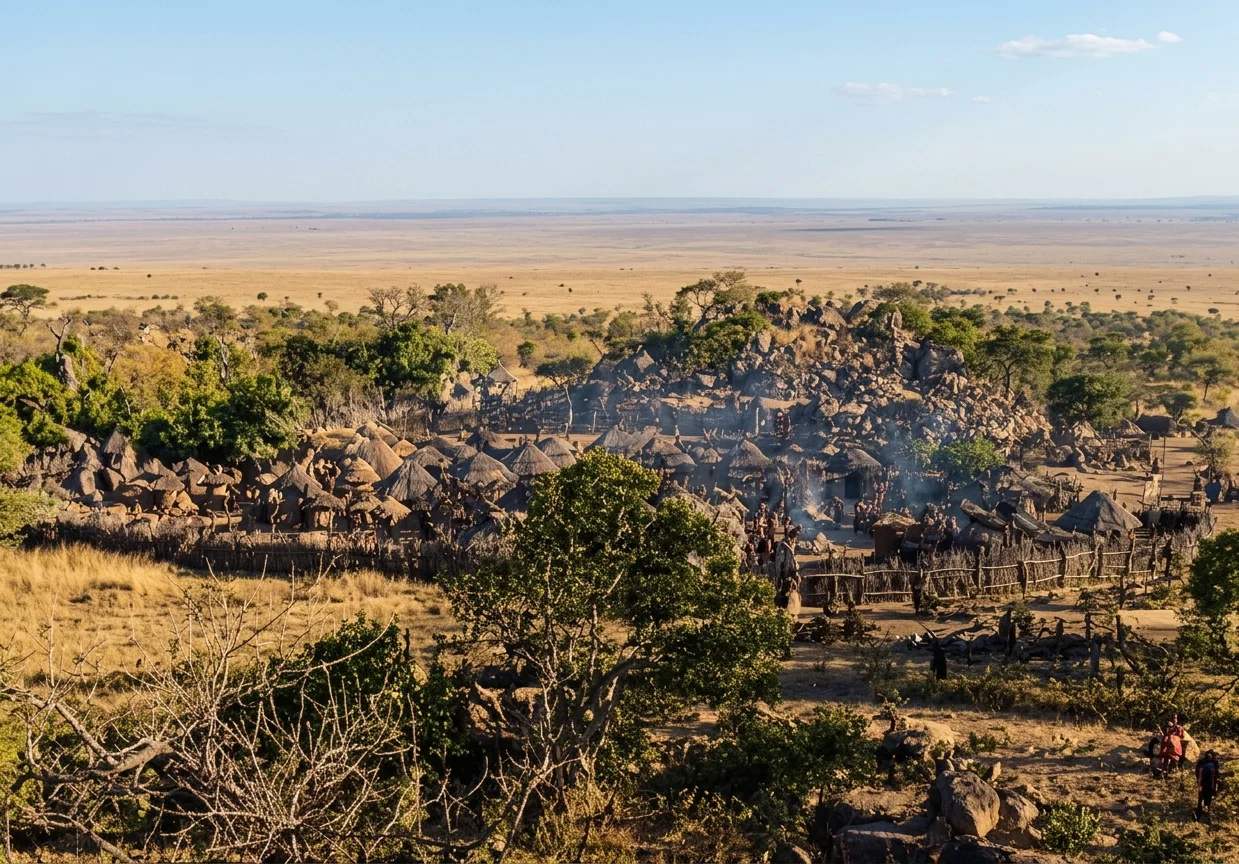
A NATIVE KRAAL IN MATABELELAND
Let us consider the needs that are staring us in the face to-day. It is nearly fourteen hundred miles to the mission farm from Cape Town. There is absolutely nothing being done for the natives between here and there. Bechuanaland has stood with open doors, inviting us to enter, ever since we began work in Matabeleland, but it remains untouched. It was in this country that Dr. Livingstone began his work for Africa. Khama’s country is a portion of this section, and we have talked of entering it, but it remains untouched. The Transvaal and Orange River Colonies have their thousands of natives, for whom we have never lifted our finger. Natal and Zululand teem with natives who are partly civilized and Christianized, for whom we have done nothing.
But let us come a little nearer home. The Kaffir tribe, or more properly the Amaxosa people, are found in this colony, especially in the eastern portion. Perhaps there are no natives in South Africa who are better educated and have had more done for them, but we have not yet begun work among them. The country in which they live is healthful, and is largely settled by white people, hence almost every convenience may be had. The land is generally good. Fruit and vegetables of all kinds may be grown. Other denominations have opened missions among this people, and have educated natives whom they have sent into the interior to labor for their own people, the white missionary visiting them only in the winter season, when there is but little danger of the fever. In this way they have saved the lives of their men of experience, and the work has advanced equally as fast.
But I want to bring you to Cape Town, and see what a field we have at the very doors of our work. Go where you will, it is hard to find a more healthful spot, and one that offers more advantages and comforts than Cape Town. There is a location in one of the suburbs of this city where there are thousands of natives living. These men are those who perform the work in the city and at the docks. Labor has brought these people right to our doors, where we can work for them and have every comfort, but nothing has been done. How long are we to pass by on the other side, and leave these people in darkness?
We have some things for which to thank the Lord. One of our brethren here gave us two lots of land in Johannesburg, which are to be sold, and the proceeds devoted to the native work. These are worth about four hundred pounds. We should enter Kaffraria and open a mission, and this will require at least five hundred pounds. Brother Moko, an educated native, is now working for his people, and would be good help to a man who might take up this work. These are healthy fields, where work can be done, and at the same time the benefits of civilization may be enjoyed. I ask, Is it not time that we begin work in this field?
The hearts of all are sad at the news of the death of Pastor Watson, our missionary to Nyassaland. Once more the banner has dropped from the hands of a brave Christian man, and now who is the one to pick it up and bear it onward? The message must go, and God has the men to bear it. Because a warrior drops in the field, the work of God will not stop. The burden rests upon some heart that will take up the work and go forward till the Father sees that his work is finished. He may as well drop in Africa as in any other part of the world.
Shall we as a people rally around our standard, “The commandments of God and the faith of Jesus,” and bear it onward to every land? Shall we by word and deed say, “There shall be delay no longer”? Shall we give our lives and our all to the promulgation of this message? I know it will triumph gloriously, and there will be a people who will go through to victory with it. From the shores of Africa, God will have a people whom he will gather into the kingdom, to join in the song of redeeming love. There will be a people to whom he will say, Well done, good and faithful servants, because they have been faithful to him. May the Lord awaken his people and arouse them to act while the day lasts; for soon the time will come when no man can work.

Northwestern Training Centers

W. A. SPICER
The new Northwest is a hearty, vigorous country, and it produces a strong, rugged class of young people, full of physical and mental vigor. The Northwestern spirit charges these youth with an electric ambition to be doing something. I am glad we have several training centers in this region to help our own young people to secure an equipment for service in the cause of the message.
I spent several very pleasant and profitable days at the Walla Walla College, which held its closing exercises early in May. By all the signs I could read there has been a strong uplifting influence in the school to turn the hearts of students toward God and his glorious work for our time. Among the older students I found an encouraging desire to get ready for active service in the cause. This is the test in our school work, surely. Only as the faculties are composed of those whose hearts are burning with zeal for the advancement and finishing of this work can we expect to find the same spirit pervading the school. I believe that any students at Walla Walla who passed through the year without receiving an inspiration in this direction must have resisted the general spirit in the school; for I found an earnest faculty, and was cheered by association with a good company of earnest-minded students.
The graduates numbered thirteen—five gentlemen and eight ladies. The courses of study represented by the class of 1904 are the ministerial, commercial, scientific, nurses’, stenographic, and normal.
Two students of Walla Walla, I believe, Brother William Steele and his wife, are now on their way to South America, and others who have been attending this year will erelong no doubt be serving in mission fields. Prof. J. L. Kay, now president of the college, was in attendance at the Western Washington and Oregon camp-meetings in the interests of the school, and I was glad to observe that his strong presentation of the cause of education and of the interests of the college met with hearty response from the people. There are many in the Northwest, of more mature years and experience than may usually be represented in the school, who I hope will take advantage of the courses of study planned for the next year.
In Portland, Ore., I enjoyed very much meeting with the sanitarium family, numbering about thirty workers. Here is another training center which has already given earnest missionaries to the far East. I am sure we shall find many others going out from Portland as missionaries to the fields abroad. These little sanitariums are essentially missionary training-schools, and as they multiply in the cities of our own land, they must produce a veritable army of evangelistic nurses. That is what the fields are calling for, and I found many a heart responsive to the call. Tacoma and Seattle, Wash., each have a small medical center, and I caught just a glimpse of the good work being done in them. The Northwest is in line with the call from the world-wide field. May the Lord bless this vigorous region, and make it a blessing.

A New Conference in Europe

L. R. CONRADI
WE are thankful to God that the work in Europe is onward. Our membership is constantly increasing, and this increase in membership, laborers, and means, enables us to further subdivide our large and populous field, so that each division may receive better attention, and become more fully developed. It is now five years since the German empire, which to-day has a population of sixty million, was organized into one immense conference. In 1901 the East German Conference was organized, and southern Germany was formed into a mission; in 1902 the South German mission was changed into the South German Conference; in the beginning of 1903 the Rhenish Prussian Conference was cut out of the territory of the West German Conference, and now, near the close of the year, the Prussian Conference, composed of East and West Prussia, with a population of three and a half millions, has been organized into the Prussian Conference. The territory of this newly organized conference includes about one sixth of the German empire in Europe. It is situated in the northeastern part, pretty well surrounded by Russia on the one side, and the Baltic Sea on the other. Thus it was quite unhandy for the brethren to attend the annual meetings of the East German Conference, and the field was not so carefully looked after as it should have been.
The first annual meeting of this local field was held at Koenigsberg, its largest city, with two hundred thousand inhabitants, December 16-20. About one hundred and twenty of our brethren and sisters were present, giving us a good representation in the twenty churches and companies in the conference. We had a nice hall in the center of the place; it held about three hundred persons, and was crowded from night to night. The evening collections, averaging five dollars, nearly covered the hall rent.
All the brethren present took a deep interest in learning everything they could as to the duties which would fall upon them as a newly organized conference. While the tithe thus far paid by the four hundred and fifty members in this field is the lowest we receive in Germany, averaging not more than four dollars per capita, yet they were willing to promise the same assistance to the union treasury as is rendered by our four northern German conferences—to pay two tithes. God has testified his approval of this system, as the eastern conference was able to turn over to the newly organized field five hundred dollars of its capital, which will assist in making up the probable deficit that will need to be covered the first few months of its existence. The only ordained minister in this field is Elder G. Ohlander, unanimously chosen the president. He is assisted by one licentiate and four Bible workers.
As these divisions are made from time to time, we see plainer than ever that one of our great needs is ordained men who can bear responsibilities. What might not be done, had we more help!
In the Prussian Conference there are fifteen canvassers and one general agent, who are doing a good work. We are operating in the German, Polish, and Livonian languages. We are giving special attention to strengthening our publishing work.
A deep interest was manifested in the East African Mission, which has just been started, and the collection for that purpose amounted to eleven dollars; the Sabbath-school offerings were the same. As the week of prayer was so near, we did not feel that it would be best to make any special call for means. Two new companies were received into the conference at this time, and thirteen persons were baptized.
En route to the conference, I stopped a day in Berlin, where we have under consideration the lease of a lot near the middle of the city, on which we may erect a chapel. On my return to Hamburg, I again spent a little time in the capital city, counseling and assisting Brother Teschner, a nurse from Friedensau, who was en route to Jerusalem, Palestine, to connect with our institution there. He will assist in filling a place recently made vacant through sickness. The German union has enough territory of its own to keep busy all the workers it can educate, and yet we are glad to lend a helping hand to other fields, wherever we can.
Hamburg, Germany.

The Moravian Rest House at Kailang

The Moravian station at Kailang in Lahoul has a “Rest House,” which is a refuge for Tibetan, Mohammedan, and other travelers in the Himalayas. The work is as benevolent and as disinterested as that of the old hospices in the Alps. Some true converts have been won through this gospel of deeds of love.

Native African Ministers in Liberia

The ministerial force of the Protestant Episcopal Mission in Liberia is being steadily recruited from the native Africans. Two young men of the Gredebo tribe have lately been ordained deacons, after faithful service as lay-readers. One sometimes forgets the profound meaning, as regards the progress of the kingdom, latent in such transfers of men from the forces against, to the forces working for, Christianity.

Egypt

CAIRO.—I am working among the Moslems almost exclusively; they know me as a doctor, and not as a missionary. Every day I have conversations with the native Moslems about salvation from sin, our doctrines, health principles, etc., and always have my Bible on my desk, and while talking, I open it for reference. All who know me know my principles and belief. To the fanatical I do not talk about Christ, but to the educated only. Some of them say I am a better Moslem than they, for I practise what Mohammed tells them to do. Many of these dear people love me. Although our principles are so different from theirs that they think me strange because of my habits of living, yet they respect me for my daily life and teaching.
Among the patients who daily come to me, some are able to pay, but there are many who can not pay. The latter I do not encourage, because I do not have the money to pay for supplies. A servant here receives only from two and one-half to five cents a day.
Some one has said, “Egypt has fifty creeds, and no religion.” This is true, and each sect makes its prime object that of gaining believers. I want to make my first work the saving of these poor, ignorant, superstitious people from real, every-day sin, and educate them in a simple religion, to help the sick, the discouraged, the publican, the children, and all who need help. And who is my teacher, my guide, my master in this?—Christ Jesus the Lord, my Elder Brother, praise God!
I am especially interested in the young men—students, officers, government employees, lawyers, doctors, clerks. Thousands of them are in Cairo, and there are tens of thousands of young men here during the winter. I pray the Lord that he may help me to start a work here for them, that they may see that Christ loves them.
I am here to do God's will in Cairo, and when he sees fit to send me to Syria or to Sudan, I am ready to go. Pray for me. J. M. KEICHLIN[E], M. D.

Brazil

TAQUARY.—We came to this place from Sao Leopolds by the advice of our brethren at the last state conference, and so far experience has demonstrated it a wise move. Here we have not the bitter Catholic element to meet that was there.
Taquary is a small city,—the population is fifteen hundred,—but the municipio is large. In Brazil it is impossible to get away from municipal authority. All the country is apportioned to the cities.
Mrs. Gregory had been attending school for the last seven months, studying Portuguese and German, but has now stopped. She teaches English one hour each day. We have no trouble in making ourselves understood in Portuguese.
I have quite a practise, about equally divided between medical and dental work. Some days people crowd the office so that I have not time to eat dinner till nearly eight o'clock. Many nights I am too tired to study, so go to bed soon after eight o'clock.
There is only one English person—a lady—in this city, besides our own brethren,—Brother Graf and family and Brother John Hettrick. There are quite a number of Germans.
Our school is doing quite well, though the attendance is small.
We enjoy the good old REVIEW very much. Sometimes the tears come as we peruse its pages; for we see it tells of the victory soon to be attained. We indorse the move to Washington, D. C., and pray for the prosperity of the work there. Abel L. Gregory, M. D.

China

HONGKONG.—Our company in Hongkong is small, but we are of good courage. We esteem it a blessed privilege to be here, and our daily prayer is that we may be the means in the hands of God of leading others to a knowledge of the truth. This is a great shipping center, and people are constantly coming and going. For this reason, when persons accept the truth here, they do not long remain in Hongkong. But we are not discouraged at this; for though we miss their association and help here, we know that as they go to other parts of the world, they will carry the truth with them.
About two weeks ago an engineer from Belfast, Ireland, attended our Friday evening prayer-meeting. He said he had accepted the Sabbath through reading “Thoughts on Daniel and the Revelation,” “Great Controversy,” and tracts which he had previously purchased of us. He has also given up tobacco. He believes the coming of the Lord is very near, and said he should plan to go home and give his entire time to the Lord’s work as soon as he completes his contract on the merchant vessel where he is now engaged. In February a young man in the British navy returned to England, taking with him over one dozen of our standard denominational books. He has accepted the Sabbath and other truths held by us as a people. After he arrived at Ceylon, he sent us a letter full of courage and love of the truth, and expressing his desire to have a part in the Lord’s work. A short time ago I sold two copies of “Great Controversy” to an officer in the American navy, and he will doubtless have returned to his home in Washington, D. C., by the time this letter reaches the Review Office. Thus God makes the little that we do go a long way.
During recent months, we have at different times felt compelled to open our home to destitute Europeans. In every case they had come to want through drink, yet we could not see them starve to death, so we took them in, fed them, and gave them a place to sleep, one man at a time. Several of these afterward secured good positions, and have written grateful letters. One man wrote from Shanghai, saying we had saved him from suicide.
Mrs. Wilbur and I are keeping up our Chinese study, and hope some one will soon come to Hongkong to take up the English work, so that we can go to Canton and give our entire attention to Chinese. EDWIN H. WILBUR.

O. GLASS

Texas

ROANOKE.—I began meetings here some time ago, and as the result five precious souls decided to keep the commandments of God. Some had used tobacco until their health was almost ruined, and now it seems truly wonderful to hear them tell how God has delivered them from this habit. They are rejoicing in the truth. We praise God for his goodness and love to us.

O. GLASS

GEO. M. BROWN

Mexico

CHIHUAHUA.—I am now in the northern part of Mexico. Brother Leland has decided that it is better for him to enter a new field, so he is with me, and we are prospecting for a suitable location. We expect to remain here until Sunday, and then will go down to Torreon, Zacatecas, and Aguas Calientes, all towns farther south.
While looking around here and getting a knowledge of the situation, we have been taking a few subscriptions for the paper and selling a few books. I think we have interested one intelligent Protestant in our work, so that we can entrust an agency for the El Mensajero to him. By getting Mexican agents in various towns, we shall increase the circulation of our literature, with very little expense, as these local agents will be paid by commission.
I think that within a month Brother Leland will move from Guadalajara, and locate in some town that has never been touched. Work will then be carried on in four places, instead of two, as when I came here. Brother Bodwell is at San Luis, and has some interested people with whom he is working.

GEO. M. BROWN

Continue reading: Porto Rico