THE conflict between the French Government and the Papacy has reached a state of acuteness, out of which almost anything may be expected. This is, briefly told, the situation.
The famous law which asks the Jewish, the Protestant, and the Catholic Churches to pay their own expenses from henceforth, was voted last December. Five long months the French Catholics waited for a word from the pope to know how to prepare for the emergency. Then came the encyclical Vehementer nos, calling the French law an impious, iniquitous law, and denouncing the principle of the separation between the church and the state as altogether unchristian and God-defying. The pope's letter did not, however, give any advice as to what to do, but promised that such advice would be forthcoming.
In the meantime the pope advised the gathering of a full meeting of the French bishops and archbishops, who were to return to the pontiff the benefit of their candid opinion on the matter. The bishops convened, over seventy in number, deliberated, and forwarded to Rome, with an obsequious letter of submission, the verdict of the majority of the council. As was later found out, that majority verdict was decidedly in favor of giving the law, such as it is, a fair trial, and of organizing immediately such "associations for worship" as the law called for.
On the 10th of August last, a second encyclical was forthcoming, in which Pius X, "confirming the almost unanimous decision" of the French bishops, flatly refuses and forbids the acceptation of the law such as it is, and asks the bishops to meet again in order to find another way out.
As you may imagine, there was great astonishment when it was discovered that the alleged "unanimous decision" was a fraud, and that the conviction and advice of the French bishops was overruled in Rome at a meeting of foreign cardinals in which one single Frenchman took part.
The bishops met again, and sent in their unconditional submission to the wisdom of the "sovereign pontiff." So did twenty-three leading men, mostly academicians, devout Catholics, who had signed an open letter to the bishops, advising them to accept the law.
And now comes a new open letter, signed by hundreds of men, whose names are still unknown, and directed to the pope himself. The signers call themselves good Catholics, which makes the "remonstrance" all the more interesting. They address the pope in tones with which he has not been accustomed on the part of good church members. They say in part:
"In all the enlightened circles—that is to say, among all those professors, physicians, lawyers, engineers, and business men, . . . who generally carry along the opinion of the nation—the surprise (at your letter) was immense, and the disappointment profound and lamentable. . . . But, most holy father, if your letter saddened all the good citizens, we must tell you that it caused all the lovers of violence, hatred, and disorder to rejoice. . . . Only such men cheered it who are the known upholders of royalism, imperialism, and antisemitism, . . . to whom religion is only a mask, thrown off when the play is over."
The writers of the letter agree with the pope in condemning in principle the separation of church and state. But they remind him that the law makes a free grant to the Catholic Church of two hundred million francs' worth of church edifices and presbyteries and valuables, not speaking of the pensions to which the priests are entitled, and which for the present make their bread a certainty. Then they go on saying (I boil down the document, as it is rather lengthy):
"Now, most holy father, if your encyclical means what we discover in it, all these advantages will be lost. See what a terrible situation the dawn of the year 1907 will witness. Over 50,000 cathedrals, churches, and chapels will return to the state, which in time will dispose of them as it may please; the bishops and priests, thrown out of their residences, will be forced to find a refuge for themselves and their families. The people will be obliged to find the forty millions that are necessary to make a living for our priests and the twenty other millions required in order to carry on church services. The seminaries will be closed, public worship will be reduced to privacy, and held under suspicion. After a few years of this regime it will be a wonder if Catholicism has not lost most of its devotees, and if Protestantism has not stepped in to take our place."
"All this and more would be nothing if the question at issue were such a vital one as the church can not yield without ceasing to be the church of Jesus Christ. But we dare to ask you publicly if indeed our doctrine is imperilled by the law of separation. Catholics we are, and Catholics we shall remain, come what will. Only, most holy father, do not blame us if we live in the country of clear ideas. Our language and habits of thought, unknown to you, require frankness, and are averse to vague situations and ambiguous formulas. Pardon us for desiring to know the true and grounded reasons for this unexpected non possumus."
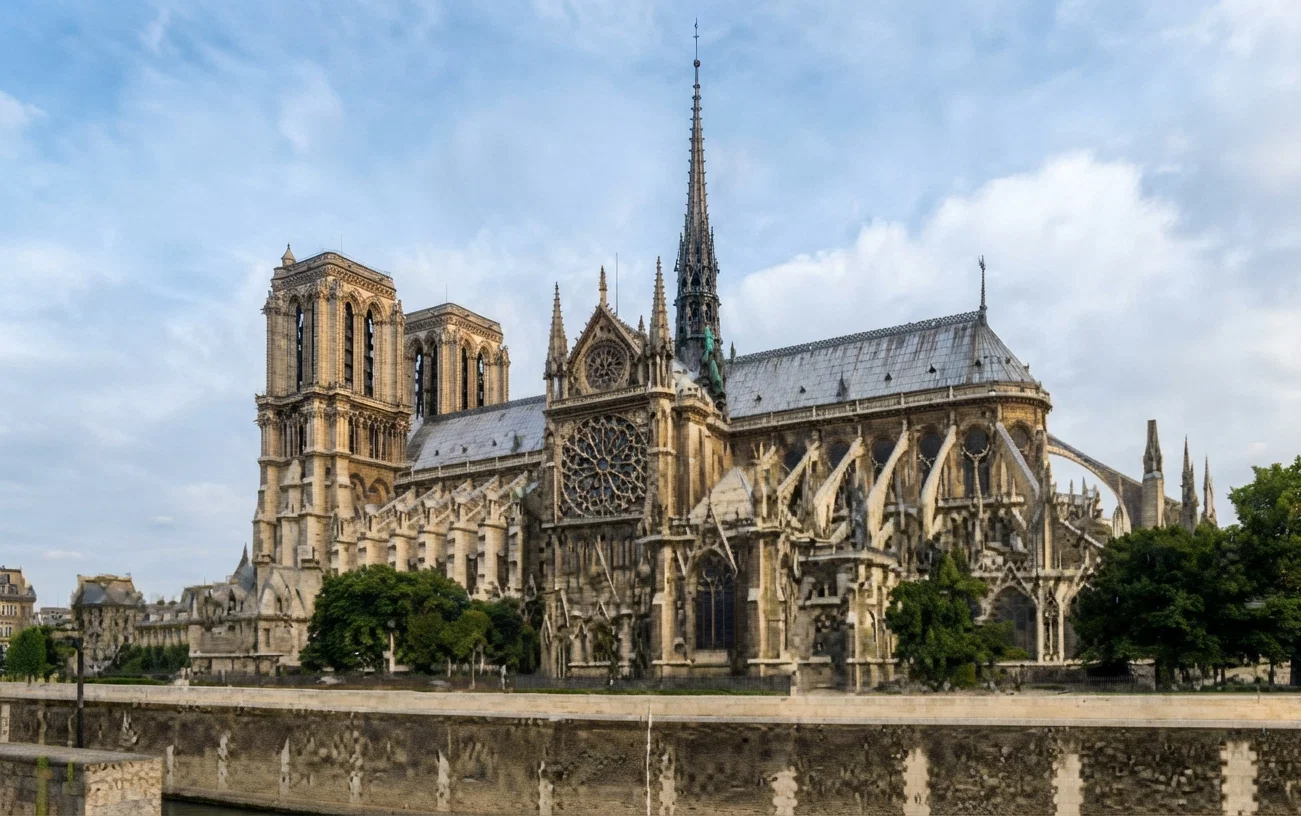
The Cathedral of Notre Dame, Paris.
"You have feared that the democratic regime might invade the church. But let not your holiness be afraid of this! Was this not one of the reforms most ardently desired, in his spiritual will, by the pious and quiet Cardinal Manning? Must we, then, regret those glorious days when the people played a much more important part in the affairs of the church than they ever will under the provisions of this law?"
The signers go even so far as to tell the pope that the bishops were in favor of the law, a fact concealed by him, and that the French people will "never deny the principles of the French Revolution, but rather trace its faith clear back to the Gospel and to the very heart of Christ!"
This is surely a new language for a pope to hear on the part of his own constituency. It breathes a healthy tone, which gives us who are laboring to spread the Gospel in this land great hopes of seeing many honest souls embrace it with joy. I met just such a case at our recent camp-meeting at Nimes—a young, intelligent couple, who hardly knew how to express their admiration and gratitude for the truth. May God greatly bless the laborers in France, and multiply their numbers!
JEAN VUILLEUMIER
A "PAN-ISLAM" REVIVAL IN THE ORIENT.
ARCHIBALD R. COLQUHOUN has written an interesting article in which he expresses a fear that there will be a "Pan-Islam" revival in the East. There was a time when it seemed to be possible that the Crescent and not the Cross might be the dominant power in Europe, and to-day the religion of the Prophet is spreading in both Asia and in Africa in a manner which is not without political significance. The question which Mr. Colquhoun considers is the possibility of a Pan-Islamic revival, there being some circumstances which seem to point toward a renewing of Moslem activity, or toward centralization. Associations calling themselves Pan-Islamite are found to-day in London, Paris, Geneva, and even in the United States; and nearly a dozen publications, six of which appear in Cairo, are devoted to their propaganda. The objects aimed at are so to revive the religion of the Prophet as to restore prestige of the East, and to form new Islamic groups for the preservation of the faith. And the means for accomplishing these ends are to be the coalition of existing Islamic states or the organization of religious forces to work through the
Moslem world. Mr. Colquhoun sets forth the difficulties with which the movement will have to contend. He says:15
"The brotherhood of the Senoussi is becoming known even in journalistic circles in Europe. Its name is continually cropping up in connection with affairs in Algeria and even in Nigeria and Central Africa. It is the most important organization of its kind. Originally theological schools, these brotherhoods occupied themselves until the last century with controversial questions of interpretation, legal and mystical abstractions and cognate matters; but under pressure of the French invasion and of European encroachment generally, they gradually assumed a politico-religious character. The founder of the Senoussi claimed descent from Hosein, the murderer son of Ali and Fatima, and had the right to wear the green turban, thereby fulfilling one of the conditions of Mahdiism. The key-note of the Senoussi propaganda is uncompromising resistance to European influence and a return to the early militant spirit of Islam.
"The growth of the Senoussi has been one of the most striking developments of modern Islam. They have adopted an active missionary policy and have spread southward through heathen Africa, while their organization has been framed with the idea of including and co-ordinating all existing brotherhoods. The Senoussi have established in all countries where the Moslem is governed by an alien race a system of occult government side by side and coinciding in its boundaries with the state administration. This occult government exists in Algeria, Egypt, and India, and its emissaries are at work in Nigeria."-Oklahoma State Capital.
Labor-Unionism, the Saloon, Politics, and Religion.
Labor-unionism would append three prominent auxiliaries in its aspiration for the throne. These elements are the saloon, politics, and religion. The connection of labor-unionism with the saloons and with politics has been strikingly manifest in San Francisco and elsewhere for some time, and always to the sacrifice of principle and manhood.
Its religious relationships have also been more or less in evidence in connection with its political aspirations. An incidental straw in this connection comes in a despatch from Chicago, under date of September 22, which reads as follows: "Religion and trades-unionism were blended last night at a ceremony unique in the annals of organized labor.
The life of a child was solemnly consecrated to the cause of uplifting humanity. Herr Lee Glesener Creel, the nineteen-months-old son of H. G. Creel, is the 'labor baby' whose life was dedicated to the cause of organized labor at a ceremony performed in St. James' Church, under the auspices of the Allied Trades Council. The church was well filled with trades-unionists and sympathizers, who wanted to witness the first dedication of a child ever offered by his parents for such a purpose."
BOYS AND TOO MUCH MONEY.
THE State of New York has been paying salaries as high as seven hundred and fifty dollars a year to office boys as pages at Albany. Where the New York office boy begins at two or three dollars a week, the state started its pay roll at six dollars a week, and increases were so rapid that twelve-dollar and fifteen-dollar-a-week salaries were not uncommon. Now by order of the State Civil Service Commission these salaries are to be reduced. Nine dollars a week is hereafter to be a boy's maximum pay. The reason given by the Commission is the occasion of our introducing the subject here: 'It is bad for the boys themselves to have so much money to spend.' To start in life with pay several times as large as that which other boys receive has a tendency to develop harmful qualities.
One of the dailies observes, 'There are many vices which can not be acquired without money,' and 'a boy's temptations are of a different degree from man's temptations. Every boy desires to be thought manly, and many boys are prone to imitate men's vices because a man's vices are more conspicuous than his virtues.' According to the chief examiner of the Civil Service Commission, several of the Albany 'office boys' have been ruined by having too much money, and to pay these boys more than boys in private employment demoralizes them. Parents would do well to remember this in allowing boys too much pocket money, not only while at home, but when they are sent away to school or college.—The Christian Advocate.
Earthquakes as Signs of Christ’s Advent
"Earthquakes in divers places" is one of the signs the Lord has given of His second advent to earth, and the sign is being fulfilled in a striking degree. Since the recent great quake on the South American west coast, there have been shocks on the island of Sicily, then on Porto Rico, and following this is another on the island of St. Thomas, Danish West Indies. At the latter scene of disturbance (September 27) it is said that "the frequency of earthquake shocks is causing alarm." Notwithstanding the claim that the "world is growing better" through the spread of church influence and "civic righteousness," we find that the great majority of people in all countries become greatly alarmed at the occurrence of an earthquake; and the more frequent the occurrence the greater the alarm. This is not an evidence of faith in God's Word, and especially is it not an evidence of love for the appearing of the King in His glory. The crowns of righteousness are for those who "love His appearing" (2 Tim. 4:7,8), and such will not be alarmed at the accredited sign of the near approach of that joyous event; for the promise is that when He comes He will bring His reward with Him.
THE ORDER OF JESUITS.
THE Jesuit conclave, mentioned in a recent issue, culminated in the election of Francis Xavier Wernz as general. The new "black pope" is a German, and as the New York World says, significance will attach to the choice of a head from the nation which has only begun to reopen the door closed against the Jesuits by Bismarck in 1872. The following brief sketch of this very influential order is also taken from the World:
"The Jesuits date from 1534, the year in which Ignatius Loyola and six associates vowed in a Montmartre chapel in Paris to make a pilgrimage to the Holy Land for the conversion of infidels. The order received formal sanction by Pope Paul III. in 1540. In 1902 it numbered in all 15,145 members, of whom 6,647 were professed fathers, vowed after eighteen years of preparation to poverty, chastity, and obedience, and under a further vow to go as missionaries wherever sent by the pope. In the United States the order comprises 2,100 members, of whom 658 are in the New York-Maryland province, of which the Very Rev. Thomas J. Gannon is provincial.
"The Jesuits have been the object of a more persistent political warfare than has been directed against any other religious order. The society has come in conflict with the secular authority of nearly every European state. France has seven times expelled it, England five times, and Spain thrice. From 1773, when it had attained its greatest power and had a membership of 22,600, until 1814, it was under the papal ban.
"The personnel of the Jesuits has always been of a high class. On the rolls of the order are some of the most aristocratic names of Europe. On the Continent, as here, it has control of the highest forms of Catholic education, its colleges embracing a student population of 60,000. In the New York-Maryland province alone it has thirteen residences and nine colleges."
Suicide
Suicide.—A medical writer in the New York Medical Record, referring to the increase of suicide as "civilization" increases, tells us that all statistics are unreliable as "there are many cases of suicide reported as being due to other causes." On account of uncertainty and the feelings of the relatives, the physician certifies the cause as "heart failure," "apoplexy," etc. Men cling to life, (1) from fear of death; (2) a belief in happiness from living; (3) the belief that suicide is a moral wrong; (4) a fear that death may not be a total annihilation. The two first reasons are readily overcome; but not the last two. When all are overcome in the mind of the person, suicide is easy. It is rare, he tells us, that an invalid ever commits suicide. The trouble lies with the mind and soul.
Women Teachers’ Moral Responsibility
The question as to whether the rising generation is improving morally, as compared with past generations, is one which might be considered with interest and perhaps with profit by school-teachers. Not so very long in the past male teachers were largely in the majority over female teachers. This is not the case at present, and the ratio is reversing rapidly. Take California, for instance: In seven years the number of teachers as a whole has increased 1,933, while the number of male teachers has decreased 250. At this rate it will not be many years until there will be no male teachers below the high-school grade. Are the women teachers fully considering their increased responsibility?
News from Valparaiso, Chile
By Editor
The sweetness of the Christian life comes in a conscious experience of sins forgiven, of victories gained in Christ Jesus.
News from Valparaiso, Chile.—Immediately on the occurrence of the earthquake in Chile we cabled friends there to send us full reports with photographs, but a week later the news came back, "Parties unknown." This led us to fear that the awful calamity might have destroyed their lives. But a letter has just come to hand stating that all are safe, and but little property destroyed. Over 2,000 were killed in Valparaiso alone. We will give more of the particulars by Brother Thomann in our next.
The year has been fearful in calamity. One gentleman writes another, "I shall be glad when I can tear off the calendar December's sheet;" but 1907 may be a far worse year. The earth is waxed old. The curse of sin rests heavily. Sometime God will say, "It is enough." Mercy's ultimate plea is made and rejected, and sin reaps its own fruitage—destruction. Those who laugh at these warnings now, will weep and wail in anguish when they come. It is God's desire that we shall be both forewarned and forearmed. "The prudent man foreseeth the evil, and hideth himself; but the simple pass on and are punished."
An Interdenominational Missionary Conference for Young People is to be held in Oakland, Cal., October 15 to 18, in the First Presbyterian Church. Every evangelical denomination is invited to participate, besides fifteen or more of the various associations auxiliary to or connected with the various churches. A very interesting provisional program of the four days has been placed in our hands by Rev. Dwight E. Potter, chairman of the program committee, which fairly covers the great field of evangelical effort. It ought to be an uplift to those who attend, and many ought to attend. Robert E. Speer, of New York, William Shaw, of Boston, and Alexander Henry, of Philadelphia, all earnest workers, will be present. The chairman of the general committee of the convention is F. Hullinger, and the secretary, Percy A. Bliss. The official address is First Presbyterian Church, 1214 Franklin Street, Oakland, Cal.
At the present rate of waste and trust grabbing, a "new earth" will be absolutely needed before long, if the masses of the people are to enjoy the ordinary comforts of life, or to have any claim upon the natural resources designed by a munificent Creator for the use of all. Timber is being so wasted and "cornered" that in a few years more prices are likely to become prohibitive excepting to the rich. The San Francisco Chronicle of recent date states the situation in this way: "A despatch from the North indicates that there is another jar in store for the consumers of lumber. The men who have gobbled all the timber in the Northwest have concluded that the increasing necessities of this section warrant putting up the price of logs, and an edict has gone forth to that effect. These predatory gentlemen may yet overreach themselves. The cost of a frame house is approaching that of a well-constructed brick or concrete dwelling, and very soon the margin will be wiped out. In that event we may get the substantial habit, and instead of housing ourselves in painted shacks, we may conclude to live in well-built structures such as are found in eastern cities, where a good brick building can be put up for forty per cent. less than it costs to erect a ramshackle frame in San Francisco."
San Francisco is making an unenviable record for daylight murders. August 20, Johannes Pfitzner, a shoe merchant, was killed in his store in the afternoon, while many people were passing. September 14, William Friede, a clothing merchant, was killed in his store about 3:30 o'clock in the afternoon. October 2, the manager of a Japanese bank was killed, and the teller beaten to unconsciousness during the noon hour when the clerks were out. Over three thousand dollars were stolen, altho many people were passing outside at the time. These men were all beaten with dull implements, and no shots were fired. The Japanese bank teller revived sufficiently to state that two white men had made the assault, and it is thought, from indications, that the same parties committed all three crimes.
The Christian doesn't need to wear any garment but plain, common-sense clothing. He needs no white or blue ribbon, no metallic cross or other medallion, to indicate that he is a Christian. He needs no conspicuous uniform to show that he is a soldier of Jesus Christ. How then is he to be known? The Lord tells us to follow Him, and He wore no broad phylacteries, or other outward badge of recognition. Yet He was known so well that He could not be hid. From His own words we learn how to be known as Christians: "Let your light so shine before men that they may see your good works, and glorify your Father which is in heaven." The light of good works and a clean, honest, self-sacrificing life is all the badge any Christian needs to be known almost anywhere. "A city that is set on a hill can not be hid."
And now it is Paris, the headquarters of fashion, that comes in for criticism on account of her filthy slaughter-houses. A press despatch of the 2d inst. says: "After visiting the slaughter-houses of Paris, Louis Lepine, the prefect of police, declared to-day that they are 'not a bit better than those in Chicago.' He asserts that the windows have not been washed for five years and that there is only half enough light to show the pavement, which dates from the time of Louis XIV, while it is impossible for the workmen to keep clean on account of the terrible insufficiency of water." The prefect has ordered a thorough cleaning up; and to be sure that it will be immediately and thoroughly done, it will be done by the city. But after all that has been said on this subject recently, who could reasonably expect anything but filth in a wholesale slaughter-house at best?
Later news from the Atlanta race-war clearly shows that the best and most respectable of the Southern people do not justify it. Sam D. Jones, leader of the Citizens' Committee in Atlanta, says: "On every hand citizens by the thousands are condemning in unmeasured terms the murdering of innocent negroes." The Rev. Dr. John W. E. Bowen, colored, acting President of the Cannon Theological Seminary, said: "The negro race is afflicted with a small brood of lustful, besotted, worthless, and dangerous black harpies who fear neither God nor man, and are the worst enemies to society. I speak from an experience of twenty-five years. They do attack white women, and, in addition, they pluck continuously and mercilessly at the vitals of their own race." He lays the seat of the trouble to "lack of home training and freedom from work," conditions destructive to the people of any race. Clark Howell, editor of the Atlanta Constitution, says: "I do not believe that mob law is ever justifiable. . . . All this talk about justification of mob law in the name of our womanhood is an appeal to prejudice and passion, which in the end endangers our womanhood, paralyzes commerce, stagnates industry, and stifles the cry of justice for the protection of the innocent, and the punishment of the guilty." The Grand Jury condemns mob law, and sensational newspapers for stirring up the mob. Mr. S. M. Williams, correspondent to the New York World, declares that "a dozen times a day one hears that no member of an old-time Southern family was in the mob." The mob was composed generally of younger men, and the lower class. In many cases respectable whites protected the colored people from the mad mob. Of these tokens we are glad, yet notwithstanding this sentiment among the better class, it does not check the mob spirit, prevalent throughout the country.
One of the objections to the taking over of Cuba by the United States is that it will increase the suspicions of the Central and South American republics that our expansion policy will continue to reach southward. This suspicion was greatly strengthened by the Panama secession and the acquiring of the Canal Zone by this government. For several years there has been strong talk about South American federation to resist the aggression of the great northern republic. Such a sentiment will be likely to gain impetus through the heavy accession of European emigration to the southern continent. And European competitors of the United States will not be slow to encourage this spirit of jealousy and suspicion.
Do not for one moment do evil that good may come. It is never justifiable. It may save temporal life to-day, and bring eternal death in the judgment day. The principle is utterly wrong, and is pervasive of every good principle in the soul. Despite all that we can do, it perverts our moral standard, and we can never see things with perfect rectitude till we utterly abhor it. A good conscience can only be kept by right action.
Mr. and Mrs. T. S. Brandegee, the well-known botanists of San Diego, have donated their entire botanical collections and library to the University of California. As a result of this munificent gift the facilities for research work at the State University are practically doubled, and it now possesses the most complete representation extant of our Pacific Coast flora.
It is ever a profitable prayer to God, "Keep my conscience clean." But that prayer implies that the soul will not violate conscience. Better never know that we have a conscience than to pray to God to keep it clean while we continually violate it. A clean conscience demands dependence upon God, a regulation of conscience by a faithful study of His Word, watchfulness against sin, and doing duty promptly.
Humboldt County, California, has the second time in its history driven out the Chinese. A local cannery braved public opinion and imported twenty-seven Chinese; but the whole county was aroused, and the cannery company agreed to send them away. The sentiment is, No Mongolian must be allowed in Humboldt County.
Begin the day with prayer. Commit your ways unto God. Endeavor to appreciate your weakness, your folly, your insufficiency by remembering past follies, but be assured that God will not hold them against you, and He has for you strength and wisdom for the day.
To know God is better than to know ourselves. To know ourselves is to have charity toward all; for a knowledge of ourselves shows us to be so exceeding sinful that we will not feel to criticize others' imperfections.
America's Highest Mountain.—Dr. F. A. Cook, of Brooklyn, is the first to ascend Mt. McKinley in Alaska. The height is 20,484 feet.
"Be ye also ready; for in such an hour as ye think not, the Son of Man cometh."