Your ShelfYour Projects

Review and Herald, Vol. 76, No. 31.

THE GOOD SHEPHERD

Review and Herald

Aug 1, 1899

Seventh-day Adventist Publishing Association · Battle Creek, Mich. · Aug 1, 1899

THE GOOD SHEPHERD.

MRS. L. D. AVERY-STUTTLE.
ONE day my heart was filled with pain, And bitter tear-drops fell like rain. In deep despair I hung my head; “The Master careth not,” I said; “My devious way I can not see; Why dealeth thus the Lord with me? The way once open for my feet He hedgeth up in gloom complete; His words I once could understand, Once could I see his guiding hand: But when he taketh, one by one, The things I’ve loved beneath the sun, How can I say, ‘Thy will be done’? Where once his bow of promise shone Is darkness, and I dwell alone. I lean no longer on his breast; Master, why stirreth thou my nest?”
’Twas thus I spoke, when, quick it seemed, I closed my eyes, and, sleeping, dreamed. The sun hung blazing in the sky Till many a purling brook was dry. The verdant grass grew crisp and dead, And rustled ’neath the traveler’s tread. The thirsty flowerets each held up With withering stem its parched cup, Until a burning desert seemed To stretch before me as I dreamed; While by the stream which once flowed deep, I saw a shepherd lead his sheep.
I saw the poor sheep, one by one, Fall fainting ’neath the burning sun; But though death lurked in that dread spot, The blinded lambkins knew it not, In death-like sleep content to lie Upon the arid field, and die.
But ah! the gentle shepherd knew Where green fields lay, all wet with dew; And where, beneath the cooling shade, The murmuring brooks sweet music made. And then he said, “I’ll lead my sheep Over the hillside, rough and steep, Though wild and thorny be the way; ’Tis death, ’tis only death to stay.” Then o’er the desert, wild and grim, He called his sheep to follow him. The foolish lambkins answered, “Nay; We are content; pray let us stay.” And thus they murmured all the way, From hour to hour, from day to day. “Why dost thou lead us thus?” they said; “We see no verdant fields ahead; We only see the desert bare, With rock and thorn and blinding glare. Dost thou not see our bleeding feet? Thou knowest that our rest was sweet.”
Then in his arms the lambs he pressed, And gently held them in his breast; And on his shoulders, broad and strong, He bore the fainting sheep along, And led his flock o’er hill and plain, Nor chid them for their murmurings vain, Until, their every danger passed, In pastures green they rest at last.
I woke, and dried my blinding tears, And said, “Begone, ye faithless fears! E’en as the shepherd leads his sheep O’er hill and dale and chasm deep, So he, my tender Shepherd, leads Me gently on, toward flowery meads. Though rough the journey to the goal, Fresh pastures wait my weary soul.”

THE PEARL OF GREAT PRICE.

MRS. E. G. WHITE.
“AGAIN the kingdom of heaven is like unto a merchant man, seeking goodly pearls: who, when he hath found one pearl of great price, went and sold all that he had, and bought it.”
Truth is represented as a pearl of great price. It is to be enthroned in the heart; for it alone can convince of, and reclaim from, sin. By comparing the kingdom of heaven to a pearl, Christ desired to lead every soul to appreciate that pearl, above all else. The possession of the pearl, which means the possession of a personal Saviour, is the symbol of true riches. It is a treasure above every earthly treasure.
Christ is ready to receive all who come to him in sincerity. He is our only hope, our Alpha and Omega. He is our sun and shield, our wisdom, our sanctification, our righteousness. Only by his power can our hearts be kept in the love of God. He longs to give us his peace and rest. But he will not tolerate one particle of pretense or hypocrisy. There are those who say and do not, who profess to know the truth, but whose lives are a denial of it. The Lord knows these.
On one occasion Christ warned his disciples to beware how they cast their pearls before those who had not discernment to appreciate their value. They were to be careful how they applied their time and taxed their strength. “Give not that which is holy unto the dogs,” he said, “neither cast ye your pearls before swine, lest they trample them under their feet, and turn again and rend you.”
There are those who will be rescued from the very depths of pollution. Isaiah speaks of this class: “Wash you, make you clean,” he says; “put away the evil of your doings from before mine eyes; cease to do evil; learn to do well; seek judgment, relieve the oppressed, judge the fatherless, plead for the widow. Come now, and let us reason together, saith the Lord: though your sins be as scarlet, they shall be as white as snow; though they be red like crimson, they shall be as wool.”
The evils are to be cut away from the life. Sins are to be repented of. Though they are as scarlet, they may be made as white as snow. Just as great a transformation as possible is to take place in the character. But if, after test and trial, after being brought into connection with those who work faithfully in their behalf, men and women do not give evidence that they have been purified from wrong habits and practises, they show that they do not appreciate the pearl of great price. If they are dishonest in any transaction, temporal or spiritual, if they are not straightforward, they show that they regard the rich mercies of God as a common thing. They can not see the value of the pearl of great price. “If ye be willing and obedient, ye shall eat the good of the land,” God declares; “but if ye refuse and rebel, ye shall be devoured with the sword: for the mouth of the Lord hath spoken it. How is the faithful city become an harlot.” How have those who have had every opportunity to know the truth become defiled with the corruptions of the ungodly. “It was full of judgment; righteousness lodged in it; but now murderers. Thy silver has become dross, thy wine mixed with water.”
Those represented in these words have mingled the sacred with the common. They profess to believe the truth, but they can not carry dishonest practises in the narrow road and through the strait gate. By their actions they show that they have chosen the road in which the world travels. “Enter ye in at the strait gate: for wide is the gate, and broad is the way, that leadeth to destruction, and many there be which go in thereat: because strait is the gate, and narrow is the way, which leadeth unto life, and few there be that find it.” “Strive to enter in at the strait gate: for many, I say unto you, will seek to enter in, and shall not be able. When once the Master of the house is risen up, and hath shut to the door, and ye begin to stand without, and to knock at the door, saying, Lord, Lord, open unto us; and he shall answer and say unto you, I know you not whence ye are: then shall ye begin to say, We have eaten and drunk in thy presence, and thou hast taught in our streets. But he shall say, I tell you, I know you not whence ye are; depart from me, all ye workers of iniquity. There shall be weeping and gnashing of teeth, when ye shall see Abraham, and Isaac, and Jacob, and all the prophets, in the kingdom of God, and you yourselves thrust out. And they shall come from the east, and from the west, and from the north, and from the south, and shall sit down in the kingdom of God. And, behold, there are last which shall be first, and there are first which shall be last.”
We shall meet those who have so perverted the conscience that they are unable to discern the precious truth of God’s word. Then let all be careful with whom they connect. When men show themselves unimpressionable, unable to appreciate the pearl of great price; when they deal dishonestly with God and with their fellow men; when they show that the fruit they bear is the fruit of the forbidden tree, beware lest, by connecting with them, you lose your connection with God. They give evidence that God is not working with them, and the knowledge gained by a connection with them is misleading. You can not be a savor of life unto them; for they will not appreciate the word of God. “Give not that which is holy unto the dogs, neither cast ye your pearls before swine.”
We shall see in the future, as we have seen in the past, all kinds of characters develop. We shall witness the apostasy of men in whom we have had confidence, in whom we trusted, who we supposed were as true as steel to principle. Something comes to test them, and they are overthrown. If such men fall, some say, Whom can we trust? This is a temptation Satan brings to destroy the faith of those who are striving to walk in the narrow road. Those who fall have evidently corrupted their way before the Lord. They are beacons of warning, teaching those who profess to believe the truth that the word of God alone can reclaim men from guilt, and keep them steadfast in the way of holiness.
The word of God is the pearl of great price. It is unchangeable, eternal. Truth as it is in Jesus sets men right, and keeps them so. The truth is an anchor to the soul, both sure and steadfast. But the truth is no truth to him who does not obey it. When men drift away from the principles of truth, they always betray sacred trust. Let every soul, whatever may be his sphere of action, make sure that the truth is implanted in the heart by the power of the Spirit of God. Unless this is made certain, those who preach the Word will betray holy trusts. Physicians will make shipwreck of the faith. Lawyers, judges, senators, will become corrupted, and yielding to bribery, will allow themselves to be bought and sold. Those who do not walk in the light as Christ is in the light, are blind leaders of the blind. “Clouds they are without water, carried about of winds; trees whose fruit withereth, without fruit, twice dead, plucked up by the roots.”

HEAVENLY VISIONS.

J. N. LOUGHBOROUGH.
“THE spirits of the prophets are subject to the prophets.” 1 Cor. 14:32. The same spirit that actuates one true prophet of God controls and actuates another. So in the true manifestation of the Holy Spirit there must be a similarity in the visions now given with those described in the Bible. It may be well, however, briefly to notice some Scriptural accounts of true visions from God, comparing them with the “open visions”—visions given before the people—of Mrs. E. G. White.
It has been the privilege of the writer to witness this manifestation through Mrs. White nearly fifty times during the last forty-six years, and to learn, in the year 1858, from the lips of those conversant with the beginning of this manifestation through her, the history of the same.
It may be well, however, before making the comparisons, to describe the manifestation itself as seen in Mrs. White. In the particulars which I now endeavor to give there was never a variation in all the numerous visions that the writer has witnessed. As the blessing of the Holy Spirit would fall upon her in power, she would give three shouts, speaking the word “glory!” The first shout, as nearly as can be described, sounded as if coming from the upper part of the room, and was accompanied by thrills of the power of the Lord, affecting all present whose hearts were susceptible to the Spirit of God. The second shout sounded still farther off, and the impress of the Spirit on those present was deeper. The third shout resembled that of a voice in the distance, like one just going out of hearing. With this the presence of the Spirit would be felt in a still greater degree, reminding one of the day of Pentecost, when the Spirit “filled all the house where they were sitting.” Acts 2:2.
After the third shout, for half a minute or more, there was a complete loss of strength. If the power of the Spirit came upon her when standing, she appeared gradually to settle down to the floor, as if being gently let down by unseen hands. When fairly in the vision, the action of the heart and pulse was natural, but the closest tests by medical men failed to discover a particle of breath in her body. The color of the countenance was natural, and the eyes were open, always looking upward, not with a vacant stare, neither in a stationary position, but turning from side to side in different directions, the only difference from the natural look being like that of one looking intently at some object in the distance. After a moment of weakness, a superhuman power came upon her. While she would sometimes rise to her feet, and walk about the room, gracefully moving her arms to the right or the left, yet in whatever position the arm might be placed, it was impossible for strong men to move it an inch.
When we look at the Scripture record of visions given to God’s servants, we find many particulars relative to the physical condition of the entranced person. In the case of Paul, as recorded in his letter to the Corinthians, he says: “I will come to visions and revelations of the Lord.” 2 Cor. 12:1. That he speaks of himself and his own visions is evident from the seventh verse, where he says, “And lest I should be exalted above measure through the abundance of the revelations, there was given to me a thorn in the flesh, the messenger of Satan to buffet me, lest I should be exalted above measure.” Verse 7.
Of his visions Paul says: “I knew a man in Christ above fourteen years ago (whether in the body, I can not tell; or whether out of the body, I can not tell: God knoweth), such an one caught up to the third heaven. And I knew such a man (whether in the body, or out of the body, I can not tell: God knoweth), how that he was caught up into paradise, and heard unspeakable words, which it is not lawful [“not possible,” margin] for a man to utter.” Verses 2-4.

JESUS

The King's Messenger.
Some of my friends persist in saying, in thinking, that Jesus was a tramp, a laboring man, a carpenter, a poor, thriftless, thoughtless personage who wandered aimlessly through the country, preaching without a license, not recognized by those in authority, and considered of no account save by the vacillating rabble, who one day shouted “Hosanna!” and the next, “Away with him! Crucify him!” This caricature of him seems to be a poor mendicant who shunned soap, and knew nothing of clean linen; and this contemptible idea gathers its lazy followers, who preach and teach as mendicants, and say employers and employees can have no place in the kingdom of God.
Jesus was the son of a carpenter, and he himself labored in the carpenter’s shed in Nazareth; but he was a child of promise, and was given the best training his industrious parents could give him. At twelve years of age he was in the temple teaching the teachers, and astonishing them with his knowledge and wisdom. Jesus was a gentleman. He mingled with society, and was a welcome guest at their bridal and social and funeral gatherings. He dressed well,—as a rabbi. He was not a crank, nor a snob, nor a fanatic. Jesus was lovely in appearance, in dress, in manner, so the children loved him, and were in no fear of him; and a woman broke her alabaster box of precious ointment, and anointed his head; and his feet were washed with the tears of a woman, and dried with the hairs of her head.
Jesus was a gentleman, and moved among the higher grades of society, while he chose his disciples from among the laboring class. He was a real gentleman, and so is every one that really follows him; for with a real gentleman there is no distinction of persons. The Holy Spirit is a gentle—, and as such is ever kind, considerate, and polite; never a brawler, nor a denouncer, nor a calumniator. A comforter is the Holy Ghost, an Another Comforter sent by Jesus, who knew the needs of his fellow men, and sent one to comfort us in all our affliction, that we might comfort others with the comfort wherewith we ourselves are comforted of God.

STRENGTH IN WEAKNESS.

“He giveth power to the faint; and to them that have no might he increaseth strength.”
It is no dream, Great Comforter, But very truth to me, That all earth’s strengthless, fainting ones May be made strong in thee.
The years have taught me many things, But none so sure as this, That shelter, solace, joy, and strength Are always where God is.
God is my refuge and my strength— I will not be afraid; And though the night be wild and dark, I meet it undismayed.
The strength to bear, or work, or wait, Is thine, O God, to give; And who shall weak and strengthless be That learns in thee to live? — Marianne Farningham.

UNLAWFUL USE OF GOOD THINGS.

S. J. HERSUM.
(Moncton, New Brunswick.)
In 1 Tim. 1:8 the apostle says: “We know that the law is good, if a man use it lawfully.” To use a thing lawfully is to use it right, to use it as it ought to be used. The wise man tells us that honey is good (Prov. 24:13), and to eat of it because it is good, and because it is sweet to the taste; but even honey, if eaten to excess, is injurious, because it is using a good thing unlawfully. Compare Prov. 25:27 with verse 16.
The same is true with “good works.” Good works are necessary. Every child of God should “abound” and be “fruitful in every good work,” and must “be careful to maintain good works” (2 Cor. 9:8; Col. 1:10; Titus 3:8); but for a person to hope for salvation because of his good works is putting them to an unlawful use.
The Signs of the Times is a good paper, and was brought into existence to fill an important position, and to do a special work; but it seems that some of the members of our churches are making even this good thing fill an unlawful place. Many of our churches take clubs of the Signs, the members deciding how many copies they are able to pay for and circulate. Some will take ten, eight, five, or two copies, more or less, as the case may be, and then let the Signs take the place, in their homes, of the REVIEW AND HERALD, thus robbing themselves and the family of the benefit they might receive from the REVIEW. This we believe is an unlawful use of a good thing. Not all our brethren, I am thankful to say, do this; but some do. I feel that whoever does this is sustaining a great loss. The Signs is indeed a good paper, but it ought not to be thought to take the place of the REVIEW with any of our people. The REVIEW is the paper for our own people, and it will do outsiders good to read it also. For our people to neglect to take the REVIEW because they can get the Signs in clubs so cheap is surely an unlawful thing.

Every Church a Praying Circle

EVERY church ought to be a praying circle; but this will not be, while we are waiting for the whole body to move together. The mass of professed Christians have too little hold on God to enter into such holy agreement.—Pierson.

CHRISTIAN PERFECTION.

A. T. JONES.
(Concluded.)
Let us look again at the statement that the gifts are for the perfecting of the saints, “till we all come in the unity of the faith, and of the knowledge of the Son of God, unto a perfect man, unto the measure of the stature of the fulness of Christ.” There is the pattern. The way that Christ went in this world of sin, and in sinful flesh,—your flesh and mine, burdened with the sins of the world,—the way he went in perfection and to perfection, is the way set before us.
He was born of the Holy Ghost. In other words, Jesus Christ was born again. He came from heaven, God’s first-born, to the earth, and was born again. But all in Christ’s work goes by opposites for us: he, the sinless one, was made to be sin, in order that we might be made the righteousness of God in him. He, the living one, the prince and author of life, died that we might live. He whose goings forth have been from the days of eternity, the first-born of God, was born again, in order that we might be born again.
If Jesus Christ had never been born again, could you and I have ever been born again?—No. But he was born again, from the world of righteousness into the world of sin; that we might be born again, from the world of sin into the world of righteousness. He was born again, and was made partaker of the human nature, that we might be born again, and so made partakers of the divine nature. He was born again, unto earth, unto sin, and unto man, that we might be born again unto heaven, unto righteousness, and unto God.
Brother Covert says that makes us as brethren. It does certainly make us as brethren. And he is not ashamed to call us his brethren, either.
Then he was born again, by the Holy Ghost; for it is written, and was spoken to Mary, “The Holy Ghost shall come upon thee, and the power of the Highest shall overshadow thee: therefore also that holy thing which shall be born of thee shall be called the Son of God.”
Jesus, born of the Holy Ghost, born again, grew “in wisdom and stature,” unto the fulness of life and character in the world, to where he could say to God, “I have glorified thee on the earth: I have finished the work thou gavest me to do.” God’s plan and mind in him had attained to perfection.
Jesus, born again, born of the Holy Ghost, born of flesh and blood, as we were, the Captain of our salvation, was made “perfect through sufferings.” For “though he were a Son; yet learned he obedience by the things which he suffered; and being made perfect, he became the author of eternal salvation unto all them that obey him.” Heb. 2:10; 5:8, 9. Jesus thus went to perfection in human flesh, through suffering; because it is in a world of suffering that we in human flesh must attain perfection.
And while growing all the time, he was perfect all the time. Do you see that? There is where many people misconceive the whole thought of Christian perfection—they think the ultimate is the only measure. It is in God’s plan; but the ultimate is not reached at the beginning. Look again at the fourth of Ephesians. This is a suggestion, thrown out to you and me, how we may attain to this perfection,—“the measure of the stature of the fulness of Christ.” I read the thirteenth verse; now couple with that verses 14–16: “Till we all come in the unity of the faith, and of the knowledge of the Son of God, unto a perfect man, unto the measure of the stature of the fulness of Christ: that we henceforth be no more children, tossed to and fro, and carried about with every wind of doctrine, by the sleight of men, and cunning craftiness, whereby they lie in wait to deceive; but speaking the truth in love, may grow up into him in all things, which is the head, even Christ.”
This is to be accomplished in you and me by growth; but there can be no growth where there is no life. This is growth in the knowledge of God, growth in the wisdom of God, growth in the character of God, growth in God; therefore it can be only by the life of God. But that life is planted in the man at the new birth. He is born again, born of the Holy Ghost; and the life of God is planted there, that he “may grow up into him”—in how much?—“In all things.”
You remember that “the kingdom of heaven is likened unto a man which sowed good seed in his field.” And “the seed is the word of God.” The seed is planted. He realizes that night and day it grows, he knows not how. But that seed is what?—It is perfect; for God made it. It sprouts presently. What of the sprout?
[Congregation: “Perfect, too.”]
Is it?
[Voices: “Yes.”]
But it is not a head of grain; it is not a stalk standing full and strong; it is a mere sprout peeping through the ground. But what of it? Is it not perfect?
[Congregation: “Yes.”]
According to the rate of its progress, it is as perfect at that point as it will be when its course is finished, at the point of maturity. Do you not see? Let not that misconception abide any more. Away with it!
When that sprout peeps through the ground, you stoop to look at it. It is a thing to be admired. It is charming, because it is perfect. That is as perfect a blade as ever appeared on earth, but it is a mere spindling thing, barely peeping through the ground. That is all there is of it; but it is perfect. It is perfect, because it is as God made it. God is the only one that had anything to do with it. Do you not see? It is all right. So you and I, born again of that good seed of the word of God,—born by the word of God and the Holy Ghost, born of the perfect seed,—when that seed sprouts and grows, and begins to appear among men, people see the characteristics of Christ. And what is he?—Perfect. Then what is the Christian right there?
[Congregation: “Perfect.”]
If we be born again through the power of Jesus Christ, and God himself directs the work, what will that be which appears?—It will be perfect. And that is Christian perfection at that point. Jesus Christ presents you holy, unblamable, and unreprovable, before the throne at that point.
That sprout grows and stands above the ground; presently another blade shoots off; there are two of them, and each is just as handsome as the other. The third one appears; it is now a stalk, and still grows. It now presents another picture altogether from that which it presented at first. Another picture indeed, but no more perfect than before. It is nearer to ultimate perfection, nearer to God’s accomplished purpose; but, though nearer to ultimate perfection, it is no more perfect, as it stands now, than it was the moment that it peeped through the ground.
In time it grows to its full height. The head is full-formed. The bloom appears upon it. It is more beautiful on account of it. And at last appears the full head of grain, perfect; and the grains of wheat, each one perfect. The work, God’s work, is finished upon it. It is perfected. It has attained unto perfection according to God’s mind when he started it.
That is Christian perfection. It comes by growth. But the growth can be only by the life of God. And the life of God being the spring, it can grow only according to God’s order. Only he can shape the growth. Only he knows, in perfection, the pattern. Christ is the pattern. God knows perfectly the pattern; and he can cause us to grow in perfection according to that pattern; because the same power, the same life, is in this growth that was in the growth of the original pattern, Jesus Christ.
And as Jesus began, at his birth, as a little child in human flesh, and grew up and finished the work that God had given him to do; so you and I, born again, growing up in him in all things, come presently to the day when we, as did he, shall say, and say in righteousness, “I have glorified thee on the earth: I have finished the work thou gavest me to do.” For it is written, “In the days of the voice of the seventh angel, when he shall begin to sound, the mystery of God should be finished.” We are in that day. We have that mystery given to us to give to the world. It is to be finished for the world; and it is to be finished in those who have it.
But what is the mystery of God?—“Christ in you, the hope of glory.” “God . . . manifest in the flesh.” Then in these days that mystery is to be finished in one hundred and forty-four thousand people. God’s work in human flesh, God being manifested in human flesh, in you and me, is to be finished. His work upon you and me is to be finished. We are to be perfected in Jesus Christ. By the Spirit we are to come unto a perfect man, unto the measure of the stature of the fulness of Christ.
Is not that worth having? Is not the Lord’s way a good way unto perfection? Oh, then, “leaving the principles of the doctrine of Christ, LET US GO ON UNTO PERFECTION; not laying again the foundation of repentance from dead works, and of faith toward God, of the doctrine of baptisms, and of laying on of hands, and of resurrection of the dead, and of eternal judgment.” He has freed us from the unstable foundation that we had when in sin. Let the only foundation be that of the service of righteousness unto holiness, and the end, everlasting life.
And to every soul who will face the Judgment, and hold himself in the presence of the Judgment, surrendering himself to crucifixion and destruction, that thing will be accomplished in God’s own way, and in the short time in which he has promised to bring us unto righteousness. Then it is only God, God’s estimate, his standard, and Christ the pattern, and his the work, always, in all things, everywhere and forever! Then be of good cheer. Let it be Christ first, last, and all the time. The way is told beautifully in verse:—
“When times of temptation bring sadness and gloom, I will tell it to Jesus my Lord; The last of earth’s treasures borne out to the tomb, I will tell it to Jesus my Lord. This earth hath no sorrow, for to-day or to-morrow, But Jesus hath known it and felt, long ago; And when it comes o’er me, and I’m tempted so sorely, I will tell it to Jesus my Lord.”
“When out on the hilltops, away from all sin, I will tell it to Jesus my Lord; When joyous and happy, the sunshine within, I will tell it to Jesus my Lord. To know I’m forgiven is a foretaste of heaven, And Jesus is dearer to me than before; Such peacefulness fills me, such an ecstasy thrills me, I will tell it to Jesus my Lord.”
“When weary with toiling, and ready to faint, I will tell it to Jesus my Lord; He never refuses to hear my complaint, I will tell it to Jesus my Lord. I’ll cheerfully bear it, when I’ve Jesus to share it; His yoke, it is easy; his burden is light. When life becomes dreary, and I’m footsore and weary, I will tell it to Jesus my Lord.”
“When darkness is dimming my path to the sky, I will tell it to Jesus my Lord; When helpers shall fail me, and comforts shall fly, I will tell it to Jesus my Lord. Though blurred my life’s pages, by my sin and its wages, He’s, yesterday; now, and forever, the same; I’ll not be forsaken, though my life should be taken; I will tell it to Jesus my Lord.”

OUR REFUGE.

L. D. HOUSE.
(Hokah, Minn.)
“Come, my people, enter thou into thy chambers, and shut thy doors about thee: hide thyself as it were for a little moment, until the indignation be overpast. For, behold, the Lord cometh out of his place to punish the inhabitants of the earth.” Isa. 26:20, 21. The time is not far distant when this scripture will be fulfilled.
It is evident that that part of the text relating to the hiding of one’s self in a chamber when the wrath of God is poured out upon the world, is figurative; for it is impossible that any place should be secure when every mountain and island is moved out of its place, and the wicked are calling for the mountains and rocks to fall on them. Revelation 6.
By examining a few texts we may find what this refuge is, which the Lord has prepared for his people. We read, in Deut. 33:27: “The eternal God is thy refuge, and underneath are the everlasting arms.” In 2 Sam. 22:3 David says of the Lord: “He is my shield, and the horn of my salvation, my high tower, and my refuge, my Saviour.” Again, “The Lord also will be a refuge for the oppressed, a refuge in times of trouble.” Ps. 9:9. In Prov. 18:10 we have the key to the subject: “The name of the Lord is a strong tower: the righteous runneth into it; and is safe.”
The Lord told Moses that he would proclaim his name before him: “And he said, I beseech thee, show me thy glory. And he said, I will make all my goodness pass before thee, and I will proclaim the name of the Lord before thee.” Ex. 33:18, 19. In Ex. 34:5–7 the Lord tells what his name is: “And the Lord descended in the cloud, and stood with him there, and proclaimed the name of the Lord. And the Lord passed by before him, and proclaimed, The Lord, The Lord God, merciful and gracious, long-suffering, and abundant in goodness and truth, keeping mercy for thousands, forgiving iniquity and transgression and sin.”
The name of the Lord is merciful, gracious, long-suffering, and abundant in goodness and truth, or, as John sums it up in one word, love. 1 John 4:8. To everything else in this world, “our God is a consuming fire.” Heb. 12:29. “But who may abide the day of his coming? and who shall stand when he appeareth? for he is like a refiner’s fire, and like fullers’ soap.” Mal. 3:2. “Who among us shall dwell with the devouring fire? who among us shall dwell with everlasting burnings? He that walketh righteously, and speaketh uprightly; he that despiseth the gain of oppressions, that shaketh his hands from holding of bribes, that stoppeth his ears from hearing of blood, and shutteth his eyes from seeing evil; he shall dwell on high: his place of defense shall be the munitions of rocks: bread shall be given him; his waters shall be sure.” Isa. 33:14–16.
All who pass through the perils of the last days unscathed, and are caught up together to meet the Lord in the air, must be clothed with the spotless robe of righteousness, having the name of the Lord (Rev. 22:4), or his character (Ex. 34:5, 6), which is one and the same thing, indelibly stamped on his person; in fact, this must be his very life. When such characters have been perfected, by claiming the victory over every besetting sin, through faith in Christ (“this is the victory that overcometh the world, even our faith”), then, “Only with thine eyes shalt thou behold and see the reward of the wicked. Because thou hast made the Lord, which is my refuge, even the Most High, thy habitation.” Ps. 91:8, 9.
Let us be “glad and rejoice in his salvation;” for the victory is ours.

PREACHERS

EUGENE LELAND.
(Barre, Vt.)
THEY are not all preachers who preach; neither because some do not preach should they not be considered preachers. This is not to say that all who preach may not be preachers; for from the Scriptures it can be clearly shown that every true Christian in the world ought to be a preacher—not that every Christian should be able to stand in a public desk, and deliver an address to a congregation. He should simply be a preacher. Read Eph. 3:8, and make the “me” personal. “I,” the reader, not Paul, the writer, “am less than the least of all saints.” But “unto me, who am less than the least of all saints, is this grace given.”
Now if the grace of God is given to “me, who am less than the least of all saints,” it certainly is given to “the least of all saints;” for he is greater than I am. And if the grace of God is given to the least of all saints, it certainly is given to all saints; for they are each one greater than the least of all saints.
But “unto me, who am less than the least of all saints, is this grace given” for a purpose; and that purpose is that I (“who am less than the least of all saints”) “should preach among the Gentiles the unsearchable riches of Christ.”
What! I “preach”! I can’t preach! I “am less than the least of all saints.”
Ah, but “unto me . . . is this grace given.” I am not so little in the eyes of God but that the grace of God is given to me.
Yes; but his grace is given to me to save me from sin, and to keep me from sinning.
That is all true; but it is not what the text says: “Unto me, who am less than the least of all saints, is this grace given, that I should preach.”
But I am not eloquent, and my education and training have not been such that I could teach the people, or appear before them in a graceful manner.
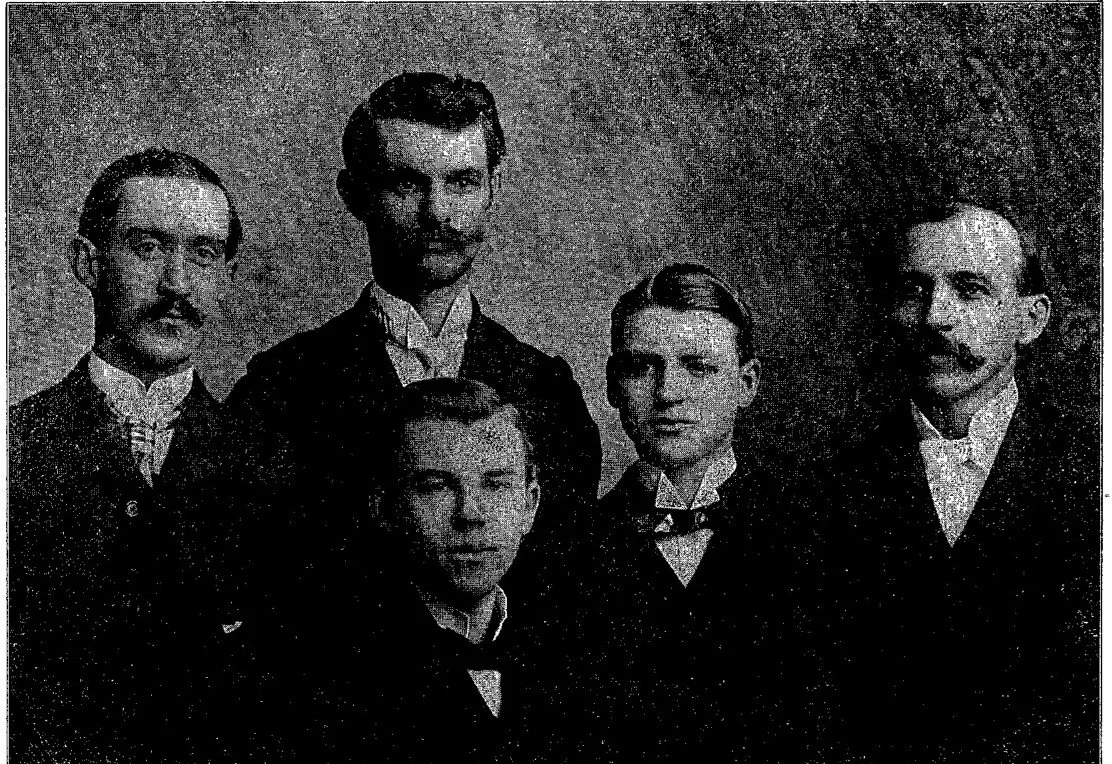
R. E. ELDRED. H. E. ROGERS. C. C. CRISLER. R. V. ASHLEY. W. E. CORNELL.
Listen: “For the grace of God that bringeth salvation to all men, hath appeared, teaching us.” Titus 2:11, 12, margin. And “unto me, who am less than the least of all saints, is this grace given.” And being given to me, and teaching me, I ought to be able to teach it to others, even though I am less than the least of all saints. And being filled with the grace of God, I ought to, and will, appear graceful, though I may be both awkward and uneducated.
Oh, if we would only let the grace of God appear in us, as it has already appeared to us, then we would be preachers indeed, whether by the wayside, in the workshop or the field, or wherever we may be. And when every Seventh-day Adventist becomes a preacher indeed, how quickly the warning message of the third angel will go to all the world!
Continue reading: A CONSTELLATION OF PRINCIPLES FROM PERSONAL LETTERS BY MRS. E. G. WHITE