Your ShelfYour Projects

Review and Herald, Vol. 93, No. 11.

The Word of God
Earlier text: The Word of God

My Vigilant Shepherd

O. P. WILSON
THE Lord is my vigilant shepherd, He giveth me water and rest, And leadeth me down to the pastures Where I am continually blest, Restoreth my feet in the morning For paths to be trod the long day; I know he’s the kindliest leader, He guideth me back when I stray.
Through valleys and mountains I follow, Where Evil, with feet newly shod, Doth cause me to fear and to tremble, But there is the staff and the rod; Then back to his table of bounties, Which, down from bright heaven above, Are given to me as a token Of what I can do in his love.
The Lord is my guide and my leader; He calleth me day after day; His goodness and mercy will follow, And keep me from life’s evil way. Whenever I hunger, he leadeth In pastures where waters flow free; Forever I’ll dwell with my Saviour, He’s the kindest of shepherds to me.
Berrien Springs, Mich.

“Hath Blinded the Minds of the Unbelieving”

B. G. WILKINSON
No one considers it a blessing to be blind. Yet, while the processes by which the physical eye is blinded are usually painful, Satan has made pleasing the way to spiritual blindness. With spiritual blindness our vision becomes straitened. Higher joys, higher fields of endeavor, and higher impulses are hid from the unseeing. And all this is the result of unbelief.
It was Paul who said, “The god of this world hath blinded the minds of the unbelieving.” 2 Cor. 4:4. In translation. There is always a cause when one is growing blind. Satan is the one who can turn out the light we have to guide us through this life. But he can never do it without the consent of man. God endeavors to keep up the supply of illuminating current, and save souls from the dangers of darkness. Unbelief alone can break the connection between us and God. It is the unbelieving who have no vision of greater forces in the universe, and become subject to the lower emotions. When trial comes, there is not a power within great enough to break the oppression without. The mind is no longer full of the inspiring uplift, and blindness ensues. It is a terrible thing to have an unbelieving mind.
Almost in the same breath the apostle declares, “But if our gospel is veiled, it is veiled in them that are perishing.” The gospel preached can mean different things to two different persons. The Jews in reading the Old Scriptures see only what their ancestors saw more than two thousand years ago. Christ is the center of those same writings to the Christian. It is the unbelieving who are perishing. The inner eye is growing dark. By continually dwelling in the caverns of doubt, they are perishing for the life-giving sunlight of faith. When the truth is preached, some believe with all readiness of mind; some exact multiplied proof, and then will doubt still. Without faith the mental qualities are not alert. Faith is the telescope which brings unseen greatness within the range of our vision. How great is faith!
There is within us a faculty to which truth commends itself. That faculty is the conscience. As the apostle says, “By the manifestation of the truth commending ourselves to every man’s conscience in the sight of God.” Conscience is not the possession only of Western nations. It dwells in all men. The Chinese have it; the savage possesses it. It responds to the presentation of truth as the steel responds to the magnet. The inner eye beholds the beauties for which it was created, and which are not revealed to the physical eye. Faith rejoices at the coming of its long-awaited Lord. Truth wakes the slumbering force, the whole being quivers with new life, and hastens to press forward. Around the great white throne of God will stand not those whom men have thought sure of enjoying the glories of heaven, but those whose consciences, polished by faith, laid hold on truth. But if the gospel be hid, it is hid to them that are perishing; for the god of this world has blinded the minds of the unbelieving. Unbelieving, perishing, the two terms mean the same.
None but those who believe have a message. “I believed,” said Paul, “and therefore did I speak.” Zacharias, the father of John the Baptist, was struck dumb because of unbelief at the announcement of the angel. Faith loosens the tongue and speaks the word by which nations are raised from degradation. Unbelief is dumb. It has no vision to endow it with inspiring utterance. Faith bids the Holy Ghost draw near, and where the Spirit of God is, there is liberty. Then the soul realizes how poor it is in heavenly riches. It is one thing to be in poverty, but a far worse thing is it to be blind to one’s poverty. It may seem severe to be compelled to walk the straight and narrow path; but faith would choose no other, for it is the only path in which we can have fellowship with God. One whose eyes are not blinded by unbelief, would prefer rather to unload more and yet more of earthly treasures than to quit the narrow path.

Science—True and False

D. H. KRESS, M. D.
In the garden of Eden the controversy between true science and science falsely so called, began. God said to Adam and Eve, “Of the tree of the knowledge of good and evil, thou shalt not eat of it: for in the day that thou eatest thereof thou shalt surely die.” Satan said, “Ye shall not surely die.” He promised to them a larger and a better life, by partaking of that which God had forbidden. Eve concluded to arrive at truth by experimentation, and accordingly she put forth her hand and did eat. She felt an exhilaration she had not experienced before. Convinced that God was wrong and Satan was right, she gave unto her husband, and “he did eat.” Although there was no visible evidence of it, man became a dying creature at the moment he ate of the forbidden fruit.
The Word of God is man's guide. With it he is safe in his investigations and researches. Without it he is in danger of arriving at wrong conclusions. Science, falsely so called, and the voice of Jehovah have for ages stood opposed in regard to alcohol. The claim made by science has been, “Alcohol is a food in health, and a medicine in disease,” while the Bible has been saying, “Look not thou upon the wine when it is red.” “Whosoever is deceived thereby is not wise.” The immediate feeling of strength and well-being experienced after taking a dose of whisky, brandy, wine, or beer, would lead any one unacquainted with the deceptive nature of alcohol to believe that these liquors actually impart new vigor to body and mind.
In the same way many a one, after reading the wonderful claims made in behalf of some patent medicine, has been persuaded to try it, and after experiencing the apparent feeling of well-being, has satisfied himself of its supposed virtue, and recommended it to friends and relatives. So we find every patent medicine has its advocates.
Alcohol is forbidden in the Word of God. It is as true today as it was at the beginning, that he who partakes of this poison, even though feeling better, is sustaining an injury. Alcohol brings about premature old age and shortens life. This has been fully demonstrated.
Narcotics are enemies of the gospel. Man needs a clear mind to discern his faults and defects of character and to feel his need of a change of heart. Satan is aware of this, hence he blinds the minds of men by the use of narcotic poisons. The mental paralysis they produce makes it impossible for man to discern between the sacred and the common, and between right and wrong. They destroy the judgment, and cause men to err in vision. By making man unconscious of his real need, saving faith in God is made impossible.
Some assert that it does not matter in what a person exercises faith, that the virtue lies in faith itself. Time fully demonstrated that it did matter whether Eve believed God or believed Satan's suggestions. No permanent good can ever come from believing a lie. Faith in a lie may act as an artificial mental stimulus for a time, as did the eating of the forbidden fruit in the garden of Eden. It may appear to benefit for a time. Virtue comes through a belief of the truth; the virtue lies in truth. “Ye shall know the truth, and the truth shall make you free.”
Many diseases have their origin in the mind, and are wholly due to a wrong mental state; while others which are brought on by wrong habits of eating, drinking, etc., may be aggravated by a wrong mental state. Christ's mission to this world is to “bind up the broken-hearted,” to “proclaim liberty to the captives,” and “to comfort all that mourn,” “to give the oil of joy for mourning, the garment of praise for the spirit of heaviness.” The truths of God's Word remove worry and fear, and impart an abiding confidence and trust in the Creator. That Word brings men to a knowledge of God, and gives them confidence in his providences. Such a mental state conveys impulses of health to every organ and cell of the body. To the mentally distressed, the words are still spoken, “Be of good cheer; thy sins be forgiven thee.”
There are many pleasing theories and practices which are inspired by the prince of darkness. Satan never appears to man as a cloven-footed, hideous monster. He comes as an angel of light, and his ministers also appear as ministers of righteousness. Those unacquainted with the Bible will be in danger of calling darkness light, and light darkness. Should Satan appear on our streets tomorrow and heal the sick and perform other miracles, the great mass of humanity would flock to him and bow down and worship him.
To those who turn away their ears from the truth as revealed in God's Word, and will not receive the love of it, that they might be saved, strong delusions will come, and they will eventually believe a lie. Satan's delusions can be detected only by those who believe in and are familiar with the Word of God. “Because thou hast kept the word of my patience,” is the promise given by the true Witness, “I also will keep thee from the hour of temptation, which shall come upon all the world, to try them.”
The belief of a lie can bring artificial stimulation to mind and body, which may be interpreted as a new lease of life. Disappointment will follow, even though sentence is not executed speedily. The whole aim of the gospel is to bring man into harmony with God by writing in his heart God's laws. A faith that claims health or life, but ignores the laws of health, must be spurious. “To the law and to the testimony: if they speak not according to this word, it is because there is no light in them.” True faith claims God's promises in his appointed way. It heeds the conditions upon which the promises are based.
The blessings of life and health come only to the doer of God's law. No promise of life is held out in the Word of God to the transgressor, no matter how sincere or honest he may be in his deception.
The words addressed anciently to God's people apply to his people for all time. After making known the statutes of life, and conditions which would assure life, Moses said, “I set before you this day a blessing and a curse; a blessing, if ye obey the commandments of the Lord your God, . . . and a curse, if ye will not obey the commandments of the Lord your God, . . . and a curse, if ye and spiritual, are ‘life unto those that find them, and health to all their flesh.’”
The fulness of these blessings can be realized only in the life to come. “Blessed are they that do his commandments, that they may have right to the tree of life.” Then it is that there shall be no more pain, no more sickness or death. Man will again have access to the tree of life, whose leaves are for the healing of the nations, and the fruit of which will perpetuate life.

The First Commandment

The Law of God — No. 6

The First Commandment

MILTON C. WILCOX
“I am the Lord thy God, which have brought thee out of the land of Egypt, out of the house of bondage. Thou shalt have no other gods before me.”
The first part of the above-quoted scripture should be regarded as a preface or preamble to the whole law. It is not in itself a commandment nor a prohibition, a statute nor a precept. It is the statement of a great fact, and in it is implied a mighty appeal to the gratitude due for favors bestowed. This statement revealed to Israel the Giver of the law.
The Hebrews had been slaves in sore bondage in Egypt for more than two centuries. God in his great goodness, by a mighty hand and an outstretched arm, had humbled the pride of Egypt in the dust, had demonstrated that their multitude of gods, representative of power and cruelty, of pride and lust, were vanity. The plagues of frogs and lice and flies and murrain visited upon Egypt were symbolical of the degrading filthiness and debasement of her worship. The plague of the darkness which might be felt was symbolical of the moral darkness in which the Daughter of the Nile groped spiritually.
Yet wanting as Egypt was in all that was uplifting and enlightening, Pharaoh, surrounded with Oriental royal splendor, could say in his stubborn pride, to the demand of the great God of the universe through his prophet Moses, “Who is Jehovah, that I should hearken unto his voice to let Israel go? I know not Jehovah, and moreover I will not let Israel go.” Ex. 5:2.
Little did Pharaoh know of the power he was defying. Jehovah is not an Egyptian god, he reasoned, therefore why should I obey him? But wherein the gods of Egypt or their devotees dealt proudly, Jehovah “was above them.” Ex. 18:11.
There was creative power in God’s redemption from Egypt. “For ask now of the days that are past, which were before thee, since the day that God created man upon the earth, and from the one end of heaven unto the other, whether there hath been any such thing as this great thing is, or hath been heard like it. Did ever people hear the voice of God speaking out of the midst of the fire, as thou hast heard, and live? Or hath God assayed to go and take him a nation from the midst of another nation, by trials, by signs, and by wonders, and by war, and by a mighty hand, and by an outstretched arm, and by great terrors, according to all that Jehovah your God did for you in Egypt before your eyes? Unto thee it was showed, that thou mightest know that Jehovah he is God; there is none else besides him.” Deut. 4:32-35.
God’s redemptive work in bringing the Israelites out of Egypt was a mighty manifestation of infinite and creative power. This God is the only God. This God, Jehovah, the covenant God, remembers his promise and delivers his people. This God is the Giver of the law.
It is equally applicable to every soul on earth; for Egypt is a symbol, a type of the darkness of this world from which the Lord Jesus Christ bought them by his infinite sacrifice. That love ought to appeal to sinners in the darkness of Egypt. That love ought to appeal to every Christian redeemed from the bondage of great Egypt’s sin.
The law by every argument and evidence is for all. “He that hath ears to hear, let him hear.” “Thou shalt have no other gods before me.”
The words are addressed to the individual soul, and to the nation and to the mass, only as the aggregate is composed of the units. Every moral command of God addresses the individual heart. He may not hide behind the mass. He cannot average his righteousness with his church or nation.
Man’s primal responsibility is to God. Before God’s judgment seat he must stand; for “each one of us shall give account of himself to God.” Rom. 14:12. He may not hide behind some worse transgressor. He will not be excused because some one else ignorantly or knowingly committed the same sin. Naked and open will be their stand, alone with God.
Is it not well, therefore, to stand alone with God now? Is it not well to pray him to shut out all other voices that we may listen to his alone, and not say as did sin-loving Israel to Moses, “Speak thou with us, and we will hear; but let not God speak with us”? Ex. 20:19. Better the response of the sincere, youthful Samuel, “Speak; for thy servant heareth.”
“Thou shalt have no other gods before me.” This word does not deal with image making and image worship. That is covered by another precept. The word “gods” does not necessarily refer to false gods. The term is applied to the judges. See Ex. 22:8, 28; 21:6, margin of the A. R. V. See also Ps. 82:6: “I said, Ye are gods, and all of you sons of the Most High.” Jesus recognized this when he said, “He called them gods, unto whom the word of God came.” John 10:35.
The first precept of the ten recognizes that there may be other authorities to whom recognition and obedience are due. Many of the kings of earth, like Alexander, counted themselves divine. Antiochus Epiphanes set himself forth as the “god manifest in the flesh.” Obedience in various and many things was due to these rulers. It is an inspired injunction. “Honor the king.” 1 Peter 2:17.
But God is first. This the commandment makes emphatic. Duty to him transcends all other duty. Above all obligations to emperors or kings or the state; above all church canons, creeds, councils, conferences; above all the demands of our fellow man, general, individual, political, religious, social, stands preeminently our duty to God. We may render to Cæsar—other gods—that which belongs to Cæsar, but we cannot render to Cæsar the things of God.
The loyal young Hebrews were but obeying the first commandment when they nobly answered Nebuchadnezzar, “We have no need to answer thee in this matter. Be it known unto thee, O king, that we will not serve thy gods.” Dan. 3:16-18.
It was in obedience to the first commandment that the apostles answered the highest religious body of their nation, “We must obey God rather than men.” Acts 5:29. And for loyalty to the Creator and Redeemer many noble souls have witnessed with their life-blood.
God’s children in these last days will be sorely tested by the same great principle. Sometimes it will come in the form of persecution. Sometimes to mammon and Mars, to pleasure and lust, the best energies of soul and body will be rendered in disobedience to God. The great thought of the Christian must ever be that though “there are gods many, and lords many; yet to us there is one God, the Father, of whom are all things, and we unto him; and one Lord, Jesus Christ, through whom are all things, and we through him.” 1 Cor. 8:6. And through him the prohibition of Sinai becomes an enabling act, Thou shalt have no other gods before Jehovah. He shall be first in everything.
Mountain View, Cal.

Preparedness

E. K. SLADE
In a recent speech on preparedness, President Wilson said: “I know that we are daily treading midst the most intricate dangers—not of our own making nor under our own control; and no man in the United States knows what a single week or a single day or a single hour may bring forth.” There are conditions and impending events confronting us infinitely more important than the precipitation of war between our government and a hostile power, as serious as that might be. The time is at hand when that part of Nebuchadnezzar’s dream which the prophet Daniel describes in the following words, is about to come to pass: “Thou sawest till that a stone was cut out without hands, which smote the image upon his feet that were of iron and clay, and break them to pieces. Then was the iron, the clay, the brass, the silver, and the gold, broken to pieces together, and became like the chaff of the summer threshing floors; and the wind carried them away, that no place was found for them: and the stone that smote the image became a great mountain, and filled the whole earth.” Dan. 2:34, 35.
This event calls for a special preparedness on the part of men and nations. The conflicts about us may divert our minds from the great issue. We cannot afford to ignore the counsel, “Prepare to meet thy God, O Israel.” More than national existence or prestige is involved, for mankind is to be prepared for eternal existence in God’s presence. He is to be made meet to be a partaker of the inheritance of the saints in light. To meet and be with him who dwelleth in “the light which no man can approach unto” calls for a preparation that concerns us more than any combination of earthly events. Heaven’s glory is to fill the earth, and only heavenly nature will be able to endure it. The preparation required is purity of heart and holiness. “Blessed are the pure in heart: for they shall see God.” To cherish one sin or to come short of victory over one wrong practice is a state of unpreparedness that will place us in the class of those who ask for rocks and mountains to cover and shelter them from his glory.
A few years ago a submarine boat sank, and its crew of eighteen men perished. The boat was well built and well equipped, and seemed to be perfect throughout. When it was raised and brought into dry dock, it was discovered that a very small gravelstone had lodged in a valve, preventing its perfect seating. It would seem strange that anything so small could work such harm. By this tiny defect, this almost unnoticeable obstacle, this massive and mighty iron monster of the deep became a useless, helpless, and defunct mass of metal and machinery at the bottom of the sea. Thus it will be with the unprepared. A very small defect will defeat the divine plan. To be prepared for that day is to have every defect removed. Little sins are big in their results. They make ineffective and inoperative all that pertains to God’s glory in us and in our eternal welfare. This is the day of salvation, the day of preparation.
Mount Vernon, Ohio.

The Work of Fra Bernardo

THERE is a beautiful legend of Fra Bernardo. The monastery had vowed to set a carved altar to the Christ at Christmastide. Every monk was to do his own part. All the other monks had finished their work. On Christmas Eve Fra Bernardo knelt and told his Lord of his failure. He had tried with his poor skill to carve something for the altar, for Christ’s dear sake, but somehow he could not make anything worthy. So he prayed that his fingers might have skill, and that he might be able that very night to carve the dream of beauty that was in his heart. In the morning the monks sought Bernardo’s cell and found him there—
“Dead, smiling still, and prostrate as in prayer; While at his side a wondrous carving lay, A face of Christ sublimely tender, sweet: The work of Fra Bernardo was complete.”
So it will be with those who seem to fail but who continue striving faithfully, doing their lowly work as well as they can. When the end comes, it will be seen that what to them seemed failure was beautiful with the beauty of Christ. God finishes the work that his lowly ones try to do for him.—“A Heart Garden.”

Winning Souls to Jesus Christ

It is the privilege of every child of God to experience the joy of winning a soul to Jesus Christ. Whenever the challenge has been presented to individual Christians to do this work, when the name and address of the person to be won is given to them with the request that they make definite effort and prayer for the salvation of that one, the response is in nearly every case favorable. If pastors and sessions would prepare a list of names of those in the community who should be won into the kingdom of God, and assign these names to those who are willing to undertake the work of personal appeal to them, great results would follow. In some churches the members have been asked to set apart as a minimum one hour a week to be definitely used for personal work to win others to Christ.—Christian Observer.

Guard the Door of Your Heart

“GUARD well the door of your heart, lest sin should come disguised and seek to enter. Let virtue keep the key, and Christianity be the sentinel.”

Experiences at the Lake Titicaca Mission
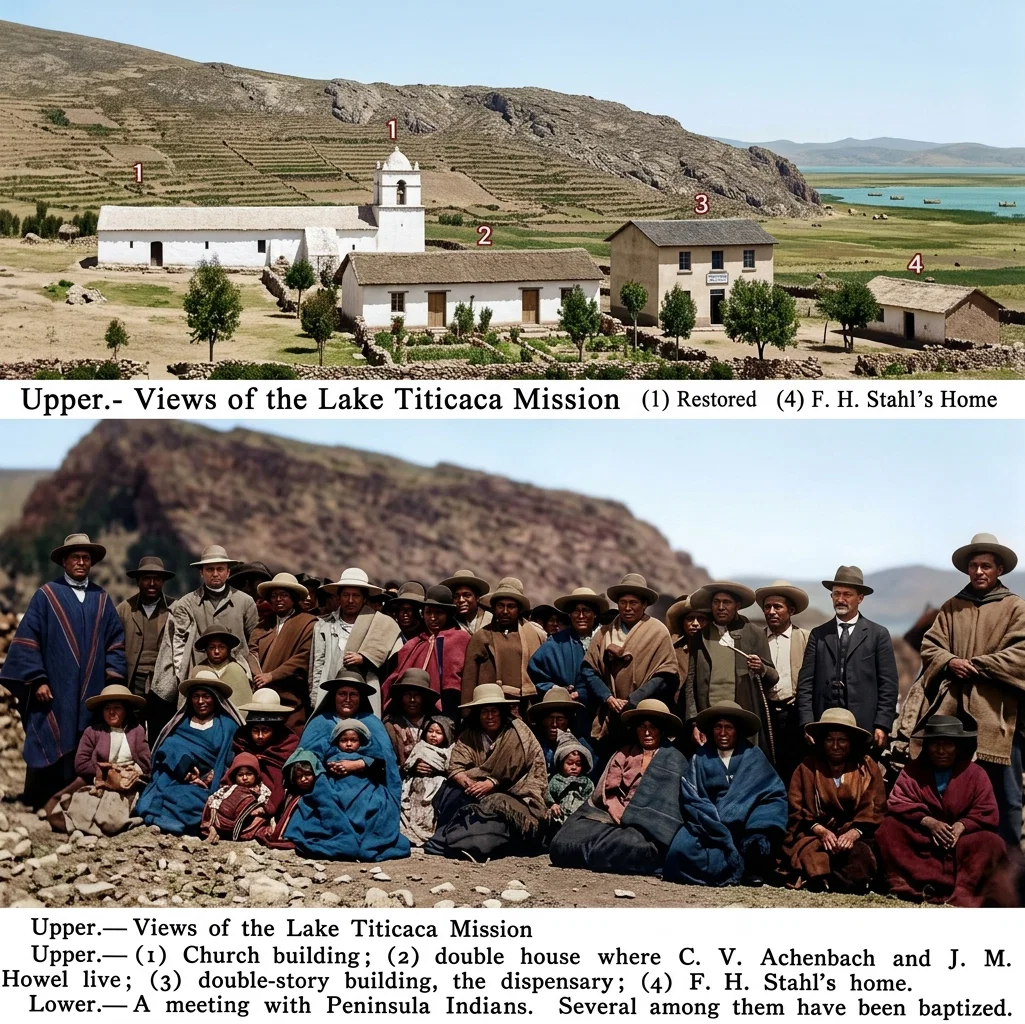
C. V. ACHENBACH
THE mission is situated at the foot of a mountain overlooking a large plain which is studded with small grass-covered Indian huts. The plain is about fifty miles long and six miles wide. We can see the shores of Lake Titicaca from the mission. Puno is about twenty-one miles distant, and is the station where we get off the cars for the mission. This journey must be made on horseback, as there are no vehicles of any kind in this part of the country. However, the trip is delightful. To our left we are continually in sight of Lake Titicaca, the highest navigable body of water in the world. We see the small Indian boats, which are made of grass which grows in the lake. The owners are either fishing or crossing the lake. To our right we see high mountains and ragged rocks with their strange, fantastic shapes. Along the side of the mountains are a great many Indian huts.
The children run toward us and ask for bread. Brother and Sister Stahl have made it a practice when they pass that way to give the children something, and it has helped greatly to make friends among the Indians. For those who are not used to riding on horseback, it is rather a tiresome trip, as it takes about four or five hours to make the journey.
The country looks rather barren, as there are no trees to be seen except a few small ones that are set out around the houses. The sides of the mountains are very rocky, and contain a network of stone fences. Every available space of ground is cultivated. Barley and potatoes are the chief products. The Indians also raise many sheep, llamas, chickens, and a few cows.
The leading highway between Puno and La Paz passes in front of the mission. Scores of Indians and Spaniards go along this road daily. The influence of the mission has extended far and wide.
We find the Indians of a very kind disposition. Although oppressed for centuries, they take delight in manifesting the spirit of kindness to others. They are very appreciative of any act of kindness shown to them. They speak the Aymaran and Quichuan languages. There are four hundred thousand who speak these languages, and every effort that is put forth to get the language into writing or in print is opposed by the priests, who realize that the missionary speaking these languages will gain the confidence of the Indians, and they themselves will lose their hold upon the people.
The work the mission is doing is known far and wide, and people are coming many miles for spiritual and medical help. The other day a man came hobbling to the mission. He was very tired. He told us that he had come thirty miles. He desired an electric treatment. I gave him the treatment and some medicines, and a few sandwiches. It is sometimes rather amusing to have them come into our dispensary, requesting us to remove their lungs for them, as they are hurting them very much.
Photo by F. H. Stahl

Upper.— (1) Church building; (2) double house where C. V. Achenbach and J. M. Howell live; (3) double-story building, the dispensary; (4) F. H. Stahl's home.
Lower.—A meeting with Peninsula Indians. Several among them have been baptized.
Photo by F. H. Stahl Upper.— (1) Church building; (2) double house where C. V. Achenbach and J. M. Howell live; (3) double-story building, the dispensary; (4) F. H. Stahl's home. Lower.—A meeting with Peninsula Indians. Several among them have been baptized.
A few days ago two Indians of the Quichuan tribe came to the mission and asked us to send them a teacher, that they might learn to read God's Word. Such requests come quite often, and it reveals the fact that the harvest is ripe. As a people we have done nothing among this tribe of Indians, which numbers three million.
We have a church here of over three hundred members. Our attendance ranges from six hundred to seven hundred persons every Sabbath. The building is far too small to accommodate the people decently. The Indians use no chairs, preferring to sit on the floor; so for this reason we have only a few benches. Our Sabbath school is very crowded, and we also lack sufficient teachers. Some of the classes have seventy-five students, and one can imagine how difficult it is for the teachers to teach a class of that size. In fact, we have only ten teachers, eight of whom are Indians, for the seven hundred persons. We hope that we shall soon have more Indians trained to help in our Sabbath school. However crowded we are, the people take a deep interest in learning the truths of the Bible. We pray that many of them may be fitted to take some active part in proclaiming the truth to their fellow men.
We are surely glad that Brother and Sister Howell have come. They will take charge of the school. We expect that at least two hundred students will attend this year. Brother Howell will have two native assistants. All the children speak Aymara, but as there is no literature in that language, we teach the Spanish language.
We have four Indian workers connected with the mission, who act as teachers and interpreters. Some also are sent out to preach the gospel to their fellow men. These workers are very earnest, and do a good work for God.
Just a few weeks ago the lawmaking body of Peru passed a bill granting religious liberty to all Protestant denominations, assuring protection to all Protestant sects. The president was showered with petitions asking him to veto the bill, but he failed to do so. We are glad for this omen of God's providence. Surely, under such favorable circumstances, we must carry the banner of the cross to all Peru. The governor of one of the small towns near the mission has posted notices warning the people against abusing us in any way, stating that if they did they would be fined and imprisoned. This shows a far different sentiment than that which has been manifested in the past. Two years ago, in the same town, Brother Stahl was stoned; but now as we go through the place the people are glad to see us. They say that the work of our mission has made it possible for the bill for liberty to be put through congress.
Photo by F. G. Hinkley
One of the many moving sand piles in Peru. The crescent is always in the same direction. These great piles of sand are constantly moving.
Photo by F. G. Hinkley One of the many moving sand piles in Peru. The crescent is always in the same direction. These great piles of sand are constantly moving.
Our Indians are far different from those of other places. The gospel has made a wonderful change in them, and the people cannot help noticing the difference. Thus they are beginning to look upon our work in an altogether different light than they did some time ago.
The medical work has been a great entering wedge to reach the hearts of the people. The Indians never had the privilege of receiving any medical attention whatever. The Spanish doctors do not treat Indians, and so the medical work of the mission has opened up the way to come in touch with hundreds of them, and to give them the gospel. The Indians know practically nothing of the principles of health. They live in filth, and there is a great deal of sickness among them. Our medical work is increasing continually. A few days ago a call came to the mission for some one to go to see a sick man about seven miles away. Brother Stahl was busy, so Brother Howell and I, with Wallace Stahl to act as interpreter, went to attend to the man. When we had finished our visit with him, and were ready to leave, we found a number of persons waiting outside the hut, all wanting medical help. Before we left we had treated nineteen patients. We arrived home late that night, yet glad for the privilege of helping these dear people. We generally pray with the people and invite them to the mission. Our prices are very reasonable, as the Indian cannot afford to pay much, a day's wage being only from fifteen to twenty-five cents. But we gain their confidence and love, and are thus able to get them to accept the gospel.
We also perform some very serious operations, although under conditions most people would think very unfavorable. A few weeks ago we operated on a young man's knee. The hut inside was dark, so we performed the operation in the yard. Even the priests come here for medical assistance. The Lord is blessing our efforts for the restoration of the physical ills of the people, as well as our efforts for their spiritual restoration.
A few days ago, while Brother Stahl and I were returning from a trip, we noticed to our left, about a mile away, a display of different colors. It looked to me like a blanket show. Brother Stahl recognized it at once as an Indian wedding. So he suggested that we go to see it. As we came near, many of the people recognized us, and came running to us. The women and some of the men were dancing to music made by tin flutes. Quite a number of the Indians who were present belong to our church, but they did not engage in the dancing and drinking as did the rest.
We dismounted, and every one wanted to shake hands. There were about three hundred present. After we got through hand-shaking, we went to see the bride. She and a number of women were sitting on the ground in a circle, in the midst of which was a blanket spread, having on it some boiled potatoes and some wedding cakes. We each presented her fifty centavos, or about twenty-five cents gold. In return, she gave us each a wedding cake. The women were dressed in their best. The Indian likes bright colors, and all the colors were represented at the wedding. They make their skirts as full as they can gather them at the band. They are made of heavy woolen goods which they make themselves. On festive occasions they wear as many as twelve skirts at a time. Women sometimes wear skirts weighing as much as fifty pounds. Each skirt worn is of a different color, and as the wearer wants each one to show a little, each comes a little below the one over it. The men wear shawls, or penchos, many of which are very pretty.
Before we left the wedding, we offered prayer. The groom then gave each of us a glass of fruit juice; and after wishing them both a happy future, we left for home.
By the time the next missionaries come, we hope they can travel from Puno by boat, as Brother Stahl has ordered a small boat from Michigan for the use of the mission. Our work for the Indians will center around Lake Titicaca, and many mission stations will undoubtedly be started near the lake, so the boat is a real necessity.
You can see by this that our needs are great, and that we need many more young men and women to help in this great work. We have barely made a beginning in the work. The many thousands who are waiting for help should be supplied with teachers and medical evangelists. Men and women who know God are needed here. We are praying that the Lord of the harvest will send more consecrated men and women into this part of his great vineyard.

Mission Notes

IN a letter to the Mission Board, W. R. Smith states that in eastern Korea, principally as the result of missionary work done by the brethren and sisters, four companies of Sabbath keepers have been raised up during the past year.
A young Indian who came to the mission to be cured of the "drink habit." He is a Christian now.
THERE is power in the gospel of Christ to save those who have sunken to the lowest depths. This is illustrated in an article by Elder B. L. Anderson, published in the Asiatic Division Mission News. He says this of two persons who have been attending his meetings: “Among those who have passed in their names and have attended the Bible classes were two persons whose characters might be called in question when we consider the business in which they were engaged. The one is a man whose business it is to collect the governmental revenue from the brothels, and the other is a woman who has been buying young girls and renting them out for immoral purposes. The revenue collector has faithfully attended the meetings for Bible studies, and become intensely interested in the gospel, and gives evidence of becoming a Christian. As the woman has listened to the preaching of the word and continued the study of the Bible, a new life has sprung up in her soul, and she sees the wonderful truth of God and recognizes the error of her ways, and has declared that the business in which she has been engaged must cease, and that henceforth she will live a different life.”
Continue reading: Conducted by Mrs. T. H. Evans, Takoma Park, Washington D. C