Signs of the Times, Vol. 33, No. 20.

With Our Inquirers
Earlier text: America's Great Peace Parliament

Studies in the Christ-Life at Brother Eldred's

Third Evening's Study.

"The sun is just sinking behind the hills," said Brother Eldred, the next Friday evening, as he smilingly regarded his little flock, "and I am glad to see you all in your places, ready to welcome the heavenly guest."
"Why, papa," said little Margaret, as she ran to the window and looked eagerly down the street, "are we going to have company this evening? Please, mama, what does 'heavenly guest' mean?" and Margaret turned her eyes questioningly toward her mother.
"We know, we know! don't we, Jack?" declared Florence eagerly, before her mother could reply.
"Why, yes," assented Jack, "I guess so; I think father means—"
"Angels, angels, of course—heavenly angels!" announced Florence triumphantly; "doesn't father mean that the angels are here, mother?"
Sister Eldred only smiled and said: "Perhaps father would better explain just what he does mean."
"What do you think about it, Alice?" smiled her father, continuing as he turned to Florence: "Alice is a little older than you are, dear, and she may be able to guess my meaning."
Florence, who always liked to talk about the angels, and greatly desired to see one, looked a little bit disappointed as Alice replied:
"I do not think father meant an angel, because I suppose the good angels are with us all the time, day and night,—at least, I hope they are;—but he spoke as if this guest wasn't with us all the time, so I am not quite sure—"
"Why father means the Sabbath! don't you, father?" exclaimed Jack; "and you called it a guest, because it only comes once a week; and it's heavenly, because God gave it to us; that's plain enough I'm sure!" continued Jack rather pompously.
"You are quite right, my son; but can you tell me the first time God ever sent the Sabbath to visit this earth, as a heaven-born guest?"
"O papa!" interrupted little Margaret, "let me answer that question, please; I believe I can. It was when Moses went up on top of the mountain, and the Lord gave him the commandments."
"H—m! I wonder what the people did for a day of rest, before that, if that's true!" said Jack. "I think that God gave the very first Sabbath to Adam and Eve, didn't He, father?"
"You are right, again, Jack; but we must get to our subject at once," said Brother Eldred, turning to his Bible which lay open on the table.
"Tillie, will you tell us where the first promise of a Saviour to come was recorded?"
"In the first book of the Bible," responded Tillie promptly.
"Please read Gen. 3:15."
" 'And I will put enmity between thee and the woman, and between thy seed and her seed; it shall bruise thy head, and thou shalt bruise his heel.' "
"Yes, this is the first recorded promise of a coming Saviour. Perhaps we should have mentioned this important fact before; but we must not forget that as soon as Adam and Eve sinned, God in mercy and kindness promised that some day a Child—the seed of the woman—should be born, who should bruise the head of the serpent. That wonderful Child was our blessed Saviour. Tom, you may tell us who first came to visit the holy Babe at Bethlehem; was it the shepherds, or the wise men?"
"Well, father, since Matthew gives the first account of Christ's birth in the New Testament, and mentions only the wise men, or magi, it is easy to think of them as coming first."
"Yes," said his father; "but really the wise men did not see the Babe until He was more than a month old. But Matthew seems to have addressed his writings to a class of people who, in his opinion, would naturally be more interested in a detailed account of the magi, than they would be in hearing a simple account of the humble shepherds. So he omits the story of the shepherds entirely, tho of course he knew that they came before the wise men. He relates the story most needed. Can you tell me, Tom," continued Brother Eldred, "what Mark says on this subject?"
"It will not take me very long, father," replied Tom, smiling, as he glanced hastily over the first chapter of Mark, "because the fact is, Mark says not a word about either the shepherds or the magi. I wonder why, father?"
"I think it is quite likely that each writer spoke particularly of those events—under the direction of the Holy Spirit—which would be most likely to be convincing and profitable to those people to whom he particularly addressed his gospel, as I before said."
"Luke tells more particulars than any of the others," said Sister Eldred, "about the birth of the wonderful Child. He mentions the only events which are recorded of the life of the Christ as a child. I wonder if Alice can mention the principal event?"
"Why," replied Alice, "His mother and father lost Him, and at last He was found in the temple at the feet of the rabbis, asking and answering many wonderful questions."
"How old was He at this time?" asked Brother Eldred, turning to little Margaret.
"Tillie told me that Jesus was just six years older than I am, when His parents lost Him; so that would be twelve years old," replied Margaret, glad to show mathematical precision in her reply.
"Just as old as I shall be in one year longer," observed Jack; "that is, if I live."
"Yes," said his mother; "and I would like you, my children, to realize that the dear Lord Jesus has passed over every year of childhood and youth, and that He knows just how to sympathize with you in all your little trials and difficulties."
"But, mother," objected Alice, "He did not know how it seemed to sin and then be sorry for it, did He? for you know He never did wrong. So how could He know how badly a little girl feels when she is tempted to disobey her mother, and gives up to the wicked tempter?"
"My dear child," said her mother, "tho Jesus never sinned Himself, yet He bore the sins of the whole world—the sins of every man and woman and child who ever lived or ever will live—He bore and suffered for all these sins."
"Let us hear what the Bible says upon this subject," interrupted Brother Eldred.
"Alice, my child, will you please read Heb. 4:15?"
" 'For we have not an high priest who can not be touched with the feeling of our infirmities; but was in all points tempted like as we are, yet without sin.' "
(To be continued.)

A Girl's Dressing-room.

"A GIRL'S dressing-room is a sure index to her character and habits. A clever woman asserted lately that she could gain a better knowledge of one of her own sex by an inspection of her dressing-room than after a casual acquaintance of years," says the New York Press. "In fact," she continued, "when one of my sons announces his engagement, I leave no stone unturned to have the girl under my eye for her morning and evening toilet. She is judged accordingly, and from what I see I can pretty well guess the sort of wife she will make. How so?—Because we women think a thousand times more of such details than you men, and every thrifty or slovenly trait is sure to crop out then. Why, I could make a black and white list for my marrying men friends, after this method, that would prove a safe guide to future happiness in wedlock. For instance, the girl's own room is always an infallible indication of her tastes and necessi-ties. I do not mean silver-mounted toilet articles, a lace-draped dressing-table, or full-length mirrors. They are well enough if she can afford them, but the first thing to note are her books and pictures, her sewing-basket, her toilet articles. It is worth while catching a glimpse of her closets and drawers, as they speak volumes for or against their owner's tidiness. When gloves are rolled in a hard knot, veils jammed under salve-pots, ribbons tumbled in with powder and hairpins, beware. That kind of thing is eloquent of curl papers at the breakfast table, muddy coffee, and cold biscuit to come."—Christian at Work.

Out in the Fields.

THE little cares that fretted me, I lost them yesterday Among the fields above the sea, Among the winds that play, Among the lowing of the herds, The rustling of the trees, Among the singing of the birds, The humming of the bees.
The foolish fear of what might pass— I cast them all away Among the clover-scented grass, Among the new-mown hay, Among the hushing of the corn, Where drowsy poppies nod, Where ill thoughts die, and good are born— Out in the fields with God!
—Selected.

Subscription Rates

Per Year, post-paid . . . . . . . . . . . . . . . . . . . . . . . . . . . . . . . . . . . . . . . . . . . . . . . . . . . . . . . . . . . . . . . . . . . . . . . . . . . . . . . . . . . . . . . . . . . . . . . . . . . $1.50
Six Months, 75 cts. Three Months, 40 cts.
To Foreign Countries, per year, $1.75

SPECIAL RATES.

1. One new yearly subscription and one renewal, or two new yearly subscriptions, sent at one time, $2.50.
2. Two new yearly subscriptions and one renewal, or three new yearly subscriptions, sent at one time, $3.25.
3. Three new yearly subscriptions and one renewal, or four new yearly subscriptions, sent at one time, $4.00.
Sample copies sent on application.

DATE OF EXPIRATION.

The Signs wrapper bears date of last issue due on your subscription. Unless renewed in advance, paper stops with expiration date.
If herewith is an order blank, you will know you have overlooked sending renewal. You will not wish to miss a single issue. Back numbers often can not be furnished.

FROM A SUBSCRIBER.

"Yes, you may consider me a subscriber for your paper while I live. I consider it the best paper in the United States. I fully endorse its teachings. It throws more light on the prophecies than any other work I have seen. A Mr. Williams introduced the SIGNS OF THE TIMES in this section about twelve months ago, and where it is read it has a wonderful awakening effect upon the people."

ORDERS FOR SPECIAL SERIES.

8,626 additional subscriptions have been added for the SIGNS OF THE TIMES during the past ten days. This is an indication of the interest being taken in the series of special numbers which began with last week's issue.
A number extra of the first issue in the series have been printed, so that for a limited time subscriptions may begin with very first number.
Prices are as follows: Five or more to one address for one year, each ............................. $1.00 Five or more to one address for six months, each ........................... .50 Four or more to single names and addresses, if sent by one person, one year, each ........................................................................ 1.00 One or more to single names and addresses for six months, each ...... .75
Has your order been placed? Subscription Department.

SALE OF THE 'SIGNS.'

From a city agent:
'I have just heard that the publishers of the SIGNS OF THE TIMES have gotten up a badge for those who sell the paper. I wish you would send me four, as there are four paper workers here selling the SIGNS. We expect to go to other cities soon in the same work. We have good success in the paper work, and love the work.'
If there are others who are selling the SIGNS, and wish a beautiful badge to wear in this work, address the publishers.

SALE OF THE "SIGNS."

From a city agent:
"I have just heard that the publishers of the SIGNS OF THE TIMES have gotten up a badge for those who sell the paper. I wish you would send me four, as there are four paper workers here selling the SIGNS. We expect to go to other cities soon in the same work. We have good success in the paper work, and love the work."
If there are others who are selling the SIGNS, and wish a beautiful badge to wear in this work, address the publishers.
SIGNS OF THE TIMES Mountain View, Cal.

Literary Notices.

"Due Process of Law Under the Federal Constitution." By Lucius Polk McGehee, Professor of law in the University of North Carolina, lately associate editor of the "American and English Encyclopædia of Law," second edition, 8vo, 452 pages, cloth, carriage paid, $3.00. Edward Thompson Company, Law Publishers, North Port, Long Island, New York.
This volume is one of a series of "Studies on Constitutional Law." The plan is to consider the various subjects treated in a separate way, tracing the relationship of each to various phases of constitutional law thru the history of the Republic. In this volume "Due Process of Law" is isolated and made a separate study. Its origin is given, its earlier uses, its relationship to other constitutional guarantees, and the part that it has performed in the upbuilding of a system of individual rights. In this way the meaning of "due process of law" is made to stand out more clearly than it could in a general treatise on constitutional law. It covers a rich field, one of great interest to the student and practitioner, and in a practical way to the layman. The author does not seem ever to discuss the right or wrong of court decisions. "Due process of law" as interpreted by the courts is the topic treated, and well and clear the author has set it forth.
"The Blue Book of Missions for 1907." Compiled by Henry Otis Dwight, D.D., LL.D., of the Bureau of Missions. Price, $1.00. Funk & Wagnalls Company, New York.
This book obtains the latest statistics obtainable, with facts and figures regarding mission work thru-out the field. It is undenominational in character, and is doubtless the most handy and reliable little work extant. Secretaries of the various mission boards, missionaries in various lands could doubtless help materially in future editions. Many times Dr. Dwight has been compelled to say, "No report."
"Sankey's Story of the Gospel Hymns." By Ira D. Sankey (third edition), with an introduction by Theodore L. Cuyler. Beautifully bound in red cloth, 272 pages, price, 75 cents; postage, ten cents.
The Sunday-School Times Company, 1031 Walnut Street, Philadelphia.
This little book brings you into closer, sweeter companionship with the hymns and songs you partly knew before, as it tells you their origin and incidents in their history. Every page of it is helpfully, intensely readable.
"A New Appraisal of Christian Science." By Joseph Dunn Burrell. 76 pages, cloth, 50 cents, net. Funk & Wagnalls Company, New York.
This little work is worth its price. In a candid, fair way it appraises "Christian Science" at its true worth as ordinary mortals would view it. Of course, Christian Scientists could not be expected to agree with it, they can not even agree with themselves, as the author clearly shows.
The Methodist Year Book, 1907. Stephen V. R. Ford, editor. 25 cents post-paid; 20 cents, net. Eaton & Mains, New York.
All who want to know the statistics of this great denomination should obtain this year book. Not only the church and its auxiliary societies are represented, but much information is given concerning other religious organizations.

A GOOD PROPOSITION

to men and women. Send four ten-cent stamps for one dozen packages of E-Z Washing Tablets and instructions, post-paid. This may start you in a good, easy business as it has many others. E-Z Washing Tablets remove the dirt and stains without rubbing and positively without injury to clothes. Want agents in every State. Good profits. Address, ALFRED MALLETT Elkridge, - - - - - - - - Baltimore, Md.

Waitresses Wanted

Wanted, at once; ten waitresses. Address, Vegetarian Cafe, 214 Union St., Seattle, Wash.

WANTED FOR MISSIONARY WORK.

THE following persons desire papers for missionary work:
Mrs. James F. Woods, 322 S. Detroit St., Warsaw, Ind., SIGNS and Watchman.
Milo D. Warfle, Box 195, Roswell, N. M., continuous supply of periodicals and tracts in connection with tent-meetings.
Miss Ella Bronson, R. F. D. No. 2, Box 13, Marlette, Mich., tracts, Life Boat, and Life and Health for reading-rack.
J. S. Killen, 183 Flint St., Asheville, N. C., SIGNS, Liberty, and Watchman for city work.
P. B. Gilbert, Belle Fouche, S. Dak., periodicals and tracts.
James Harvey, 763 Jackson St., Oakland, Cal., SIGNS, Watchman, and Liberty.
Warren C. Ayers, 914 N. Main St., Henderson, Ky., all denominational literature.

IN THIS ISSUE

WITH OUR INQUIRERS.

2073.—Character of a Witch; 2074.—Divorce and Marriage; 2075.—Mixed Case of Marriage; 2076.—A Living Soul; 2077.—The Wicked and the One Thousand Years; 2078.—Isa. 65:20; 2079.—Spirit of Man. Eccl. 3:21; 2080.—The Ribbon of Blue. Num. 15:38; 2081.—In Heaven While on Earth. John 3:13; 2082.—Prince of Tyrus; 2083.—"Thy Seed." Gen. 3:15 . . . 2

SECOND ADVENT SYMPOSIUM.

Christ Will Come Again . . . . . . . . . . . . . . . . . . . . . . . . . . . . . . . . . . . . . . . . . . . . . . . . . . . . . . . . . . . . . . . . . . . . . . . . . . . . . . . . . . . . . . . . . . . . . . . . . . . . 3 The Ascended Lord . . . . . . . . . . . . . . . . . . . . . . . . . . . . . . . . . . . . . . . . . . . . . . . . . . . . . . . . . . . . . . . . . . . . . . . . . . . . . . . . . . . . . . . . . . . . . . . . . . . 3 The Manner of Christ's Coming . . . . . . . . . . . . . . . . . . . . . . . . . . . . . . . . . . . . . . . . . . . . . . . . . . . . . . . . . . . . . . . . . . . . . . . . . . . . . . . . . . . . . . . . . . . . . . . . . . . 4 The Second Coming of Christ, the Hope of the Church . . . . . . . . . . . . . . . . . . . . . . . . . . . . . . . . . . . . . . . . . . . . . . . . . . . . . . . . . . . . . . . . . . . . . . . . . . . . . . . . . . . . . . . . . . . . . . . . . . . 5 "When Ye Shall See These Things, Know" . . . . . . . . . . . . . . . . . . . . . . . . . . . . . . . . . . . . . . . . . . . . . . . . . . . . . . . . . . . . . . . . . . . . . . . . . . . . . . . . . . . . . . . . . . . . . . . . . . . 6 How Does It Affect You? . . . . . . . . . . . . . . . . . . . . . . . . . . . . . . . . . . . . . . . . . . . . . . . . . . . . . . . . . . . . . . . . . . . . . . . . . . . . . . . . . . . . . . . . . . . . . . . . . . . 7 Search the Scriptures (First John) . . . . . . . . . . . . . . . . . . . . . . . . . . . . . . . . . . . . . . . . . . . . . . . . . . . . . . . . . . . . . . . . . . . . . . . . . . . . . . . . . . . . . . . . . . . . . . . . . . . 7

EDITORIAL.

Fundamentals—Their Importance . . . . . . . . . . . . . . . . . . . . . . . . . . . . . . . . . . . . . . . . . . . . . . . . . . . . . . . . . . . . . . . . . . . . . . . . . . . . . . . . . . . . . . . . . . . . . . . . . . . 8 "When They Are Saying, Peace and Safety" . . . . . . . . . . . . . . . . . . . . . . . . . . . . . . . . . . . . . . . . . . . . . . . . . . . . . . . . . . . . . . . . . . . . . . . . . . . . . . . . . . . . . . . . . . . . . . . . . . . 8 The Tried and Triumphant . . . . . . . . . . . . . . . . . . . . . . . . . . . . . . . . . . . . . . . . . . . . . . . . . . . . . . . . . . . . . . . . . . . . . . . . . . . . . . . . . . . . . . . . . . . . . . . . . . . 9 A Revelation from God . . . . . . . . . . . . . . . . . . . . . . . . . . . . . . . . . . . . . . . . . . . . . . . . . . . . . . . . . . . . . . . . . . . . . . . . . . . . . . . . . . . . . . . . . . . . . . . . . . . 9 Tyre a Witness for God . . . . . . . . . . . . . . . . . . . . . . . . . . . . . . . . . . . . . . . . . . . . . . . . . . . . . . . . . . . . . . . . . . . . . . . . . . . . . . . . . . . . . . . . . . . . . . . . . . . 9

THE OUTLOOK.

America's Great Peace Parliament . . . . . . . . . . . . . . . . . . . . . . . . . . . . . . . . . . . . . . . . . . . . . . . . . . . . . . . . . . . . . . . . . . . . . . . . . . . . . . . . . . . . . . . . . . . . . . . . . . . 10 Meat-eaters Versus Vegetarians . . . . . . . . . . . . . . . . . . . . . . . . . . . . . . . . . . . . . . . . . . . . . . . . . . . . . . . . . . . . . . . . . . . . . . . . . . . . . . . . . . . . . . . . . . . . . . . . . . . 11

MISSIONS.

Religions of China (Taoism, Buddhism, Mohammedanism . . . . . . . . . . . . . . . . . . . . . . . . . . . . . . . . . . . . . . . . . . . . . . . . . . . . . . . . . . . . . . . . . . . . . . . . . . . . . . . . . . . . . . . . . . . . . . . . . . . 12

HOME.

Studies in the Christ-life at Brother Eldred's 14 A Girl's Dressing Room . . . . . . . . . . . . . . . . . . . . . . . . . . . . . . . . . . . . . . . . . . . . . . . . . . . . . . . . . . . . . . . . . . . . . . . . . . . . . . . . . . . . . . . . . . . . . . . . . . . 14

POETRY.

The Coming of the Lord . . . . . . . . . . . . . . . . . . . . . . . . . . . . . . . . . . . . . . . . . . . . . . . . . . . . . . . . . . . . . . . . . . . . . . . . . . . . . . . . . . . . . . . . . . . . . 6 Out in the Fields . . . . . . . . . . . . . . . . . . . . . . . . . . . . . . . . . . . . . . . . . . . . . . . . . . . . . . . . . . . . . . . . . . . . . . . . . . . . . . . . . . . . . . . . . . . . . . . . . . . 14

Read our list of tracts on page 13.

Christ's coming means joy, peace, righteousness, life. Why should you not welcome the glorious event?

A Strong Warrior Fallen.

The inexpressibly sad news reached us April 30, from both Elders G. W. Reaser and H. W. Cottrell, that Brother W. W. Simpson was dead. We had not heard that he was ill, and it came with a severe shock, as it will to many. He died April 28, 10 P.M., at Glendale Sanitarium, near Los Angeles. His illness began with spells of dizziness, developing into violent pains in the back of the head. Brother Reaser writes: "Seven expert physicians were called in council over his case. The concurrent decision was that his system was thoroughly saturated with poisons, caused by certain organs not performing their normal functions." Many prayers were offered in his behalf, but God knew what was best. He was not what would be called a great preacher or a great scholar, but he obtained the ears of the people by his own unique methods, and his clear, strong presentation of truth, his pleasant, charming manner and intense earnestness held them. He was a mighty warrior, yet a loving and lovable man. He fell in the freshness and vigor of matured manhood. The funeral services were conducted by Brethren Owen, Cottrell, and Reaser in the Central Church, Los Angeles. His wife and three children, the oldest of whom is six years, have the sympathy of all who knew the husband and father. Many will be disappointed, as several courses of meetings were planned for him this coming season. "God buries His workmen, but carries on His work." It behooves us more devotedly, more earnestly, to give ourselves to the work of the Master, and labor on till the glad harvest is reaped, when sower and reaper shall rejoice together, and there shall "be no more death."
If we love a person, we love the presence of that person. We want to look into his eyes, feel his touch, hear him speak. That is invariably true. If we expect one whom we love, we shall plan to receive him. We will put the house and best room in readiness for him. How gladly will we welcome him. Is Christ Jesus your Friend? Are you preparing to receive Him?

War Impending.

The Emperor of Germany wants no International Exposition in Germany, says a news despatch from Washington, "because he knows that a great war is imminent in which almost all the great nations of the earth will be participants." And Hiram Maxim, inventor of guns and high explosives, tells us that despite the recent peace meetings, the world is on the verge of a great conflagration. The world is at peace to-day, but the nations are preparing for the conflict that is to come. In fact, that is the only reason there is peace." He thinks there will be two or three years of peace, and then war. And this agrees with the word of God.

Did the Apostles Believe that Jesus Was Coming Again in Their Day?

So some believe. They tell us that Christ's coming is indefinite; that it was believed to be imminent by the apostles themselves, and hence we can know nothing about the time of His coming. It is evident that at the time of Christ's resurrection the disciples were not settled as to the time of Christ's coming, and they inquired: "Lord, dost Thou at this time restore the kingdom to Israel? And He said unto them, It is not for you to know times or seasons, which the Father hath appointed by His own authority." Acts 1:6, 7. This confirms what Jesus said elsewhere: "But of that day and hour knoweth no one." Matt. 24:36. But our Lord does declare, as clearly shown elsewhere in this paper, that it is the duty of His people to "know" when He is near. The apostle Paul plainly teaches that the day of His coming was not "at hand," nor would it be, until the "falling away" came, and "the man of sin" was revealed. 2 Thess. 2:1-3. Peter knew that he would die before the Lord came, tho he said, "The end of all things is at hand." See 2 Peter 1:14; 1 Peter 4:7. What, then, is meant by these expressions which seem to declare the coming of the Lord about to take place?—Simply this: The apostles and New Testament writers wrote under God's direction for all time. Many things written by them were not at that time understood and could not be; but sufficient light was given for the duty. But when His church nears the close of her earthly career, these passages gleam out like great beacon lights of warning and assurance; and the Christian who is trusting God's word finds the voyage of the old ship Zion chartered to the very end.

Poor, Suffering Russia.

Simply because we have not had the violent calamities during 1907, some have remarked that this is a great deal better year than was last year. Last year the calamities were more startling and phenomenal, but this year they have far exceeded those of last. We have had no wars of any account. The first earthquake of violence and destruction has been late in the year, that in Mexico; but over in Russia we are told that millions will die for lack of food before help is received from abroad. One report states that not less than twenty million people are affected. The most conservative statement we have seen is that fifteen million are thus affected. China's famine sufferers number about the same. Funds, of course, are pouring into the country, and yet they are not large as compared with the number affected. This from the physical standpoint. That is moving many, many hearts to contribute generously of what they have; but worse than all of the physical calamities are the starving, dying souls, many of whom are longing for the blessings of the Gospel of life.
The moral influence of a rightly conducted State is worth more than any overreaching power that it may exert by force of arms. The open door of Japan, dating from the time of Commodore Perry in 1854, was brought about by the home example in America rather than by any influence which she had as a world-power. This has been manifest again in the influence of this country on the Maharajah Gaekwar of Baroda. In the awakening of India he is one of the conspicuous leaders. Having recently visited this country, he returned home and advocated the United States as the model. If America had ever proceeded on a course in harmony with the principles upon which the Republic was founded, she could have brought the world from the Dark Ages to the arts of peace, but, entering upon another course, in which she is now plunging, as a world power and in her growing affiliation with the Papacy, the effect will be to turn the world back to the Dark Ages.

The Canonical Books.

There are doubts thrown on the canonicity or authority of various books of the Bible, and have been all along the stream of time. That is not at all alarming. Jesus Christ and His mission were doubted in the healing of the palsied man and even at the grave of Lazarus; and unbelief sought to kill not only the Life-giver, but the one to whom He gave life, that the witness to His power might not be in evidence before the people. What wonder, then, that learned men in all ages have sought to crucify Christ in His truth! There are internal evidences, great, lustrous shinings of truth, which show clearly the tracings of the divine hand that sealed as genuine the present Scripture canon.
The great Jamestown Exposition was formally opened by President Roosevelt on April 26, tho Captain John Smith landed at Jamestown May 13, 1607. April 26 of that year he planted a cross near the south of the river, where is now the Cape Henry lighthouse. A great naval review took place in which were sixty-seven ships of importance, twenty-seven of friendly nations, forty of this country. The Japanese sent a cruiser-battle-ship, the Tsukuba, built within two years complete, hull, engines, guns, equipment, wholly by themselves. The exposition bids fair to be a great one.
The only thing which will not make Christ's coming a glad coming to us is our own conscience. We are not ready for Him.

OUR NEXT ISSUE.

THE four special articles for our next issue are as follows:
What the Coming of Christ Means to the Righteous.
What Christ's Coming Means to Those Who Reject Him.
"The Great Day of the Lord."
What Christ's Coming Means to This Earth.
These ought to be of intense interest to every judgment-bound soul.
In addition there will be the conclusion of the report on the great Peace Congress, an article on China, Mrs. Stuttle's Study on the Life of Christ, and other articles of importance. It will be a splendid issue.
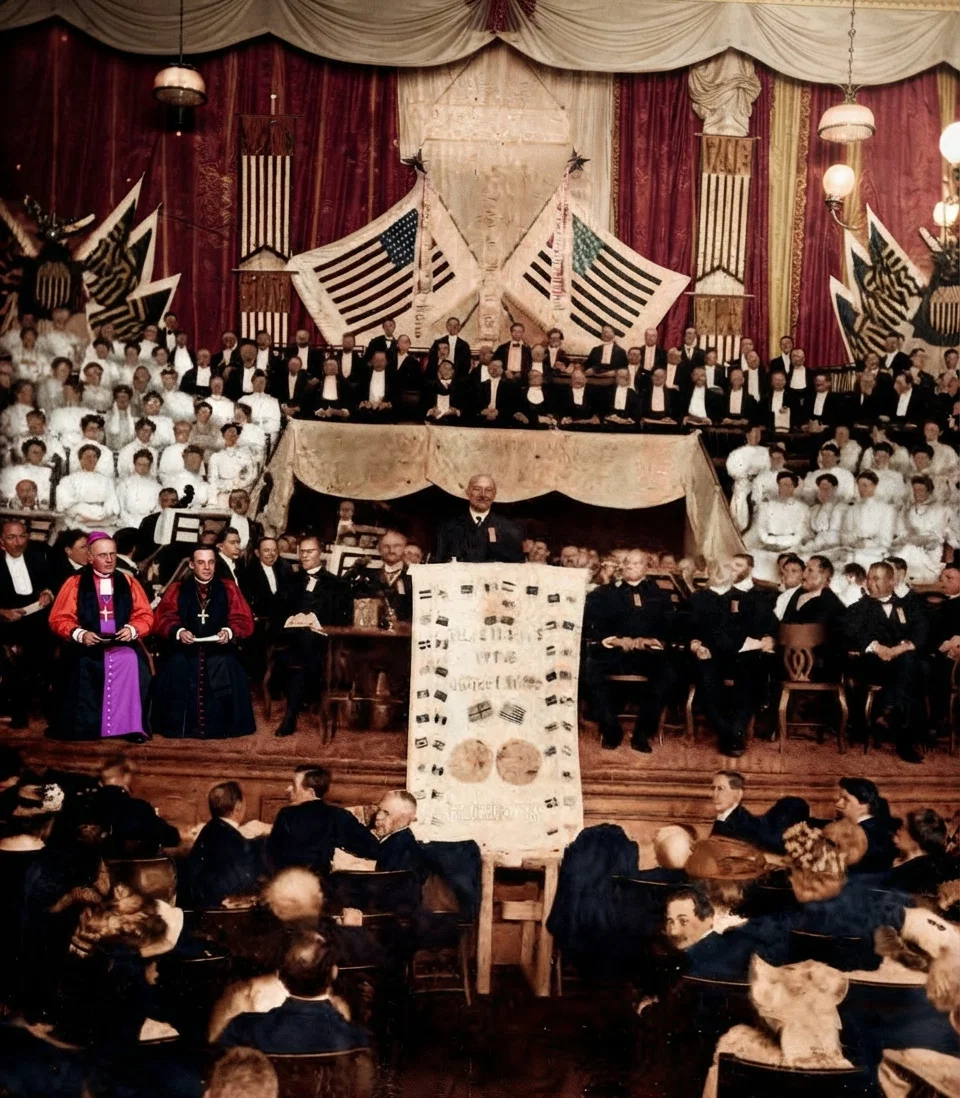
From Stereograph, Copyright 1907, by Underwood & Underwood, New York.

You have reached the end of this edition.

Signs of the Times · May 15, 1907