The Youth’s Instructor, Vol. 31, No. 45.

THE WATERFALL

The Youth’s Instructor

Nov 7, 1883

S. D. A. Publishing Association · Battle Creek, Mich. · Nov 7, 1883

THE WATERFALL.

From its sources which well In the tarn on the fell; From its fountains In the mountains, Its rills and its gills; Through moss and through brake, It runs and it creeps For awhile till it sleeps In its own little lake. And thence at departing, Awakening and starting, It runs through the weeds, And away it proceeds, Through meadow and glade, In sun and in shade, And through the wood-shelter, Among crags in its flurry, Helter-skelter, Hurry-skurry. Here it comes sparkling, And there it lies darkling; Now smoking and frothing Its tumult and wrath in, Till, in this rapid race On which it is bent, It reaches the place Of its steep descent.
—Robert Southey.

“BONNIE MARGARET.”

IT WAS a beautiful morning in the month of May. The sky was serene and without a speck of a cloud, the orchards full of the scent of apple blossoms and the songs of birds. Far away the hills were all aflame with purple heather and patches of yellow gorse, while the little hamlets that nestled in the shadow of the glens looked as if they were abodes of peace and happiness.
But, alas, it was not so. This is a story of Scotland’s martyrs, nearly two hundred years ago, when God’s people were persecuted and slain only for asking to be allowed to worship him in spirit and in truth, according to the dictates of their own consciences.
The “puir hill folk,” as the Covenanters were called by their friends, were hunted from one rocky fastness to another, “wandering in deserts and in mountains and in dens and caves of the earth.” Often the escapes of these fugitives from their pursuers were so narrow as to appear miraculous—being, in truth, singular interpositions of God’s providence in the behalf of his persecuted people.
Yet many were taken, chiefly in their hillside meetings for worship, and were either shot at the time of their apprehension or brought to a mock trial and sentenced to death if they refused to abjure the faith and mode of worship so dear to them, and conform to that of their oppressors.
On that bright May morning two women were sitting together in a narrow cell of the roughly-built tolbooth, or jail, in the town of Wigton, in Galloway. They were both named Margaret; but while one was nearing her threescore years and ten, the other, though her face wore a saddened look, had scarcely seen eighteen summers.
She was full of life and energy, while her companion, although she had continued steadfast and faithful before the council, was now cast down by many fears and forebodings as the time approached for the execution of their sentence. For, in case they did not take the oath of abjuration, they were condemned to be fastened to stakes within tidemark of the sea, and slowly drowned by the incoming waves.
The older woman, worn out by want of needful rest and refreshment, had fallen into a light drowse, with her gray, uncovered head leaning against the rough stone wall behind her.
Suddenly she started to her feet with a sharp, wailing cry.
“O Johnnie, man, dinna lave me here to drown alane, all alane! Gin ye wad only gae wi’ me, lad, and tak’ a strong grip o’ my puir weak hand.”
“When thou passest through the waters, I will be with thee, and through the rivers, they shall not overflow thee. . . . For I am the Lord thy God, the Holy One of Israel, thy Saviour,” repeated the clear voice of the girl Margaret, as she gently forced her companion again on the low bench, and, kneeling before her, embraced and supported her with her strong young arms.
“Eh! is it you, lassie?—bonnie Margaret, as they ca ye. Ah, me! I dreamed I was back in the pleasant bit shieling on the green brae side, where I used to live lang syne with my John and the wee bairnies that are a’ dead and gane years ago. Then it seemed as if a great flood came to drown me, and I cried out; for the faces of the gruesome sea monsters looked like the faces of the cruel men who threatened us and drove us along wi’ their pikes. O lassie, I’m sore afraid.”
“I, even I, am he that comforteth you; who art thou that thou shouldst be afraid of man that shall die, and of the son of man which shall be made as grass?” quoted “bonnie Margaret.”
“O lassie, ye do me a warld o’ good. Can na ye tell me mair o’ thae blessed words that seem like honey and the honeycomb?” said the poor creature weeping gently, as she laid her head on her young companion’s shoulder.
“Deed and I can then,” cried the girl, her eyes kindling. “The troopers shied my precious wee Bible into the deep loch when they broke up our conventicle, as they ca’d it, and took us prisoners. But they could na’ root the holy texts out of my heart and memory.”
Still kneeling, she then repeated the greater part of that comforting chapter, beginning:—
“Let not your heart be troubled; ye believe in God, believe also in me. In my Father’s house are many mansions; if it were not so, I would have told you. I go to prepare a place for you. And if I go and prepare a place for you, I will come again and receive you unto myself, that where I am there ye may be also.”
Then, pausing awhile, as if she were turning the leaves of a book, she began again:—
“Who shall separate us from the love of Christ? Shall tribulation, or distress, or persecution, or famine, or nakedness, or peril, or sword? As it is written, For thy sake we are killed all the day long, we are accounted as sheep for the slaughter. Nay, in all these things we are more than conquerors through him that loved us. For I am persuaded that neither death, nor life, nor angels, nor principalities, nor powers, nor things present, nor things to come, nor height, nor depth, nor any other creature, shall be able to separate us from the love of God, which is in Christ Jesus our Lord.”
The morning passed swiftly away. High noon came, which was the time fixed for the execution of their sentence. The crowd that had been gathering since early dawn, now pressed nearer to the walls of the tolbooth; for it was announced that the Provost had arrived, and, at the head of a party of dragoons, he soon came clattering along the principal street of the town.
Then the two poor defenseless women stepped meekly out, and being placed in the midst of the rude soldiery, who greeted them with taunts and ribald jests, the procession moved on in the direction of the sea.
Many were the expressions of sorrow and sympathy from those who accompanied them on their melancholy journey. Few had tasted a morsel of food that day, or even kindled a fire in their habitations; for the hearts of the people were very sore at this pitiful sight of the two Margarets walking as calmly along as if they were “ganging to the kirk” on a bright Sabbath morning. The younger woman supported and aided her companion’s failing steps, golden locks mingling with the silver, both soon to wear the martyr’s crown.
When they reached the shore, over which the tide had even then begun to rise, a free pardon was offered to both the prisoners on condition that they would take an oath to abjure all connection with the persecuted covenant folk. But this they steadily refused to do.
“If we have no part with Christ’s dear servants,” they said, “we can have no part with him. And if we deny him, he also will deny us.”
So they took the elder Margaret, and bound her to a stake set far out into the sea, so that the waves had already risen to her knees, thinking to frighten her young companion with the sight of her dying struggles. But before she was led away, bonnie Margaret embraced and kissed her, praying God to be with her, according to his gracious promise, and adding, as a parting benediction, these words of the Lord Jesus:—
“Be thou faithful unto death, and I will give thee a crown of life.”
She was then herself tied to a stake placed nearer the landmark, and her face forcibly set in a position to watch the body of her friend, now sinking, now rising with the surging waves, until the last flutter of her garments had disappeared, and all was over. But Margaret was in no wise daunted by the sight; but, as the old chronicle tells us, sang in a clear, loud voice, several verses of the twenty-fifth psalm:—
“To thee I lift my soul, O Lord, I trust in thee; My God, let me not be ashamed, Nor foes triumph o’er me. “Turn unto me thy face, And to me mercy show; Because that I am desolate And am brought very low.”
As she paused for breath, a woman’s voice in the crowd arose with an exceeding bitter cry,—
“O Margaret, my bonnie, bonnie Margaret, gie in, gie in, my bairnie—dinna drown. Gie in and tak’ the oath.”
“Whist, mither dear,” replied the girl, “dinna ye ken, that if we be dead with Christ, we shall also live with him! If we suffer, we shall also reign with him.”
Then another cried,—
“Margaret, can na ye just say, ‘God save the king’?”
A thrill ran through the fast-chilling veins of the young martyr at the sound of that manly voice, but, after a moment’s struggle with the ties of earthly love, she answered in low but firm tones,—
“I pray God to save him of his great grace.”
“She has said it, my Lord Provost; she has said, ‘God save the king.’ Let her go,” cried several excited voices.
The soldier bent his head and whispered in Margaret’s ear,—
“Take the oath, foolish and obstinate girl, and I will save you even now.”
Finding, however, that the heroic maiden continued firm in her refusal, and worn out by what they called her “contumacy,” they left her to die. Her voice was still heard in prayer and praise until the water came up to her lips. Then her uplifted face seemed to shine with a glory not of earth, and, after a few more struggles, Scotland’s maiden martyr was numbered with “those who were slain for the word of God and the testimony which they held. . . . For they loved not their lives unto the death.”
But down through the ages, mingling with the mighty chant of old ocean, comes a voice from the dead to the living, “I have found redemption through the blood of the Lamb.”—Mary D. Boyd.

THE REAL BOY.

A real true, hearty, happy boy is about the best thing we know of, unless it be a real girl, and there is not much to choose between them. A real boy may be a sincere lover of the Lord Jesus Christ, and a godly boy in a boy’s way and place. He is apt to be noisy and full of fun, and there is nothing wrong about that. He ought not to be too solemn or too quiet for a boy. He need not cease to be a boy because he is a Christian. He ought to run, jump, play, climb, and shout like a real boy. But in it all he ought to show the spirit of Christ. He ought to be free from vulgarity and profanity. No real true boy chews or uses tobacco in any form, and he has a horror of intoxicating drinks. The only way he treats tobacco is like the boy who was jeered at by some older ones because he could not chew. His reply was, “I can do more than that; I can eschew it.” And so he did all his life. A real boy is also peaceable, gentle, merciful, generous. He takes the part of small boys against large boys. He discourages fighting. He refuses to be a party in mischief and deceit.
Above all things he is never afraid to show his colors. He need not always be interrupting, but he ought not to be ashamed to say that he refuses to do anything because it is wrong and wicked, and because he fears God, or is a Christian. A real boy never takes part in the ridicule of others; he is not ashamed to say father or mother will not like it if I do so and so. It is only the sham, milk-and-water boys that are afraid to do right. Every one respects the real boy, and every one despises the coward, who is afraid to do right for fear of a little ridicule.—Selected.

A BIRTHDAY GIFT.

When little Theodora was born, there came to her from grandpa and grandma, and the aunties and friends far and near, beautiful birthday things, in rosewood and silver and satin and lace. She was the first baby that family had possessed for a long time, and they made a great stir about her. And the same day that her little life began, in the big beautiful house under the old oaks at Creston, there came a wee daughter into a poor little house on the road-side, just where you passed out of the Creston gate.
One of the baby Theodora’s aunties lived at the Manse, being the pastor’s wife; and on her way home, after seeing the little stranger at Creston, she stopped at the road-side cottage with a glass of jelly for the other baby’s mother, and a small white garment for the other baby. “It’s not much as we have to share with her, mem,” the mother was saying; “but we’s monstrous proud, and glad to get her; and we can’t find any name just good enough for her, Andy and me can’t.”
“Oh! call her Dorothea,—that means gift of God too,” said the pastor’s wife, and then told of the new baby at Creston, and how the grateful mother there had called her treasure Theodora,—gift of God.
So Dorothea became the other baby’s name. There was no rosewood crib, nor silver spoon, nor satin quilt, sent to greet Dorothea’s coming; but she had a wonderful birthday gift nevertheless; for two shining angels stood over the little wooden cradle, and brought her a gift from her heavenly Father. Their names were Contentment and Thankfulness; and the gift was a gossamer veil, too fine to be seen by mortals, but throwing a brightness all about Dorothea. Seen through this veil, the sky was always blue, the earth always green, and sunshine rested on everything. “The best baby ever was,” the happy mother said; while the little Dorothea sat, and cooed, and laughed, and played with her bare toes and her rag baby. “My Dolly never loses a chance for a smile,” the father used to say, as she grew into a merry, useful daughter of the house; and all the while the angel gift lay across her eyes, making every day’s life beautiful and sweet.
The little daisies that grew by her door made her glad; the bare cottage in which she lived seemed a beautiful home to her; the plain gowns her mother could afford pleased her simple taste, and every kind look and tone from the neighbors touched her to gratitude.
I do not know about Theodora; I hope she grew up wise and kind, and anxious to share her abundance with everybody else; I hope so, but I do not know, for it is not always so with the little ones rocked in rosewood cradles; but I am sure that Dorothea’s birthday gift was worth a prince’s fortune to that little road-side cottage.
And, dear little people, though silver and gold may not be waiting for you, the white-winged angel Prayer, stands ready to bring you from above, and your heavenly Father is ever ready to bestow—Dorothea’s birthday gift, a contented spirit.—Elizabeth P. Allen.

AUTUMN

SHORTER and shorter now the twilight clips The days as through the sunset gates they crowd, And Summer from her golden collar slips, And strays through stubble-fields, and moans aloud;
Save when by fits the warmer air deceives, And stealing hopeful to some sheltered bower, She lies on pillows of the yellow leaves And tries the old tunes over for an hour.
The wind, whose tender whisper in the May Set all the young blooms listening through the grove, Sits rustling in the faded boughs to-day, And makes his cold and unsuccessful love.
The rose has taken off her tire of red, The mullein-stalk its yellow stars has lost, And the proud meadow-pink hangs down her head Against earth’s chilly bosom, withered with the frost.
The robin that was busy all the June Before the sun had kissed the topmost bough, Catching our hearts up in his golden tune, Has given place to the barn-cricket now.
The very cock crows lonesomely at morn; Each flag and fern the shrinking stream divides; Uneasy cattle low, and lambs forlorn Creep to their strawy sheds with nettled sides.
Shut up the door; who loves me must not look Upon the withered world, but haste to bring His lighted candle and his story-book, And love with me the poetry of spring.
—Alice Cary.

CHEERFUL GIVERS.

THERE lived in a little village an old man and woman who were very poor. They earned their living by weaving. By working hard they could earn about four shillings a week. By being very careful they managed to live on this sum. They had no debts, but not a penny to spare.
One day they returned home from a missionary meeting feeling very sad. They had nothing to give.
“Wife,” said the husband, “doesn’t it make you feel bad to think that we haven’t a penny to give for the heathen? We both know how blessed it is to have a Saviour, yet we cannot help to spread the news.”
“I’ve been thinking about it,” she said; “if we only knew a way to earn a little money. There is what we put aside to bury us, but it wouldn’t be right to take it, for then somebody else would have to pay our funeral expenses; and as for eating less than we do now, that is impossible, for then we should get sick, and other people would have to take care of us. I don’t see any way.”
“We must just tell the Lord about it,” the old man said. And then it was time for family worship, and they knelt down to pray.
Two months afterward, one cold winter evening, there came a knock at the minister’s door. When he opened it, there stood the old woman, her face bright with joy.
“I’ve brought our money for the missionaries,” she said. “My husband and I are so glad to show somebody else the way to the Saviour.” Then she unwrapped a large piece of paper, and carefully counted out five pennies.
The minister was surprised, for he knew that these two people were very poor. How could they spare even five pennies? But she had a joyful story to tell.
“Why, we wanted to give something, and we didn’t see how; so we asked the Lord about it; and he put it into our hearts to save the potato-parings. We have to use a dozen small potatoes in a day, for it is about all that we have to eat. Well, I dried them, and kept them in a bag until I got a nice lot, and this morning I took them to a neighbor who keeps pigs, and she gave me five cents. We are so glad to give it!”
Then the old woman, nearly eighty years old, limped away, leaning on her cane, her face aglow. Her pastor said he could not keep back the tears as he looked at the five pennies. “O thou faithful God!” said he. “How well these children of thine have understood thee. And thou wilt, by and by, give to them good measure, pressed down, shaken together, and running over.”—The Pansy.

NEW-TESTAMENT HISTORY.

LESSON 160.—PAUL EXHORTS TO PURITY, BROTHERLY KINDNESS, AND CONSTANCY.

In the former part of his letter, Paul thanks God for the gifts bestowed upon his Corinthian brethren; admonishes them to put away their dissensions; contrasts the vain philosophy of men with the infinite wisdom of God, and speaks of the glorious things which have been revealed by the Holy Spirit. He tells why he could teach them only the rudiments of the gospel; calls them God’s building, reared upon Jesus Christ as a foundation; regards himself as a mere workman on that building, and God as the one to whom all honor and glory should be ascribed. He warns them against judging hastily, and against self-exaltation; contrasts their easy circumstances with the destitution and suffering of those from whom they had received the gospel; promises to send Timothy to them, and speaks of his intention of soon visiting them in person.
After this, he reproves them for going to law with one another before worldly magistrates. He says: “Dare any of you, having a matter against another, go to law before the unjust, and not before the saints? Do ye not know that the saints shall judge the world? and if the world shall be judged by you, are ye unworthy to judge the smallest matters? Know ye not that we shall judge angels? how much more things that pertain to this life? If then ye have judgments of things pertaining to this life, set them to judge who are least esteemed in the church. I speak to your shame. Is it so, that there is not a wise man among you? no not one that shall be able to judge between his brethren? But brother goeth to law with brother, and that before the unbelievers. Now therefore there is utterly a fault among you, because ye go to law one with another. Why do ye not rather take wrong? Why do ye not rather suffer yourselves to be defrauded?”
Paul then exhorts them to purity and chastity. After instructing and admonishing them at some length, he breaks out with the following exclamation: “What! know ye not that your body is the temple of the Holy Ghost which is in you, which ye have of God, and ye are not your own? for ye are bought with a price; therefore glorify God in your body, and in your spirit, which are God’s.” And again: “If any man defile the temple of God, him shall God destroy; for the temple of God is holy, which temple ye are.” He also gives them counsel and various admonitions relative to marriage and connubial life, enjoining continence, fidelity, and patient forbearance.
He says, “Circumcision is nothing, and uncircumcision is nothing, but the keeping of the commandments of God.”
“Let every man abide in the calling wherein he was called. Art thou called being a servant? care not for it; . . . for he that is called in the Lord, being a servant, is the Lord’s freeman; likewise also he that is called, being free, is Christ’s servant.”
In speaking of meat that had been offered unto idols, and afterward sold in the market, Paul tells them that to eat of such flesh is no sin, since there are really no gods but the one true God; yet he thinks it better to avoid such a practice, for the reason that some regard it as sanctioning the worship of the idol. He says, “If meat maketh my brother to stumble, I will eat no flesh forevermore.”
The apostle then shows how reasonable it is that those who spend their time in preaching the gospel, should have their support from those who are benefited by their preaching. He says, “If we have sown unto you spiritual things, is it a great thing if we shall reap your carnal things?” The priests who served in the temple, partook of the offerings. “Even so hath the Lord ordained that they who preach the gospel should live of the gospel.” Yet although this support was due Paul, he had not taken it; but had labored with his own hands, and been chargeable to none of them. All this he did for the gospel’s sake, that he might win the more to Christ. For the same purpose, too, he tried, as far as was consistent with right principles, to adapt himself to the customs and peculiarities of whatever people he was among.
Paul also calls attention to the care and self-denial practiced by those who strove for the mastery in the public games. We ought certainly to take as much pains to win the incorruptible crown which Christ has promised, as they to win a perishable crown of evergreens. Of himself he says, “I keep my body under, and bring it into subjection; lest by any means, when I have preached to others, I myself should be a castaway.”

QUESTIONS.

  1. For what does Paul thank God in the first part of his letter?
  2. What admonition does he give them?
  3. What does he contrast?
  4. To what other things does he call attention?
  5. To what does he compare them? 1 Cor. 3: 9, 10, 11.
  6. How does he regard himself, and to whom does he give all the glory?
  7. Against what does he warn them?
  8. How does he show them that they have small cause for discouragement?
  9. To what does he point forward?
  10. For what does he reprove them? 1 Cor. 6: 1-8.
  11. What pointed questions does he ask them? Verses 1-3.
  12. What does he ironically advise them to do? Verse 4.
  13. What does this advice seem to imply?—That it would be better to take the judgment of the weakest saint than to bring their difficulties before unbelievers.
  14. What does Paul finally suggest as being preferable to taking the law? Verse 7.
  15. To what virtues does Paul then exhort them?
  16. With what exclamation does he finally break forth? Verse 19.
  17. Why are they not their own?
  18. What will be the fate of him who destroys the temple of God? Chapter 3: 17.
  19. What temple is here meant?
  20. What counsel and admonition does he then give them?
  21. What does he enjoin upon them?
  22. What does he say of circumcision? Chapter 7: 19.
  23. What encouraging words does he speak to servants? Verses 20, 21.
  24. Why is their social position a matter of indifference? Verse 22.
  25. What does Paul say about the eating of meat that has been offered to idols?
  26. Why does he think it better to avoid such a practice?
  27. What does he say about his own course? Chapter 8: 13.
  28. What does he afterward show?
  29. What questions does he ask to show the consistency of this doctrine? Chapter 9: 11.
  30. What application does he make? Verse 14.
  31. Why had not Paul taken the support which was so richly due him?
  32. What other things did he do for the same purpose? Verses 19-22.
  33. What lesson does he teach from the public games so much practiced at Corinth? Verses 24-26.
  34. What does he say about his own habits of temperance and self-denial? Verse 27.

The Quiet Spirit: Life as a Gift from God

BETTER than all the selfish enterprise and cleverness which men are wont to praise, and which men are apt to strive for, is the quiet spirit which recognizes life as a gift from God, to be used as God directs; and which seeks no great thing for one's self, knowing that what God gives is for each one the best and the greatest of blessings.

TO THE CHILDREN.

Dear little children, where'er you be, Who are watched and cherished tenderly By father and by mother; Who are comforted by the love that lies In the kindly depths of a sister's eyes, Or the helpful words of a brother:
I charge you by the years to come, When some shall be far away from your home, And some shall be gone forever; By all that you have to feel at the last, When you stand alone and think of the past, That you speak unkindly never!
For cruel words, nay, even less, Words spoken only in thoughtlessness, Nor kept against you after; If they made the face of a mother sad, Or a tender sister's heart less glad, Or checked a brother's laughter, Will rise again, and they will be heard; And every thoughtless, foolish word That ever your lips have spoken, After the lapse of years and years, Will wring from you such bitter tears As fall when the heart is broken.
May you never, never have to say, When a wave from the past on some dreary day Its wrecks at your feet is strewing, “My father had not been bowed so low, Nor my mother left us so long ago, But for deeds of my misdoing!”
May you never stand alone to weep Where a little sister lies asleep, With the flowery turf upon her, And know you would have gone down to the dead To save one curl of her shining head From sorrow or dishonor; Yet have to think, with bitter tears, Of some little sin of your childish years, Till your soul is anguish riven; And cry, when there comes no word or smile, “I sinned, but I loved you all the while, And I wait to be forgiven!”
May you never say of a brother dear, “Did I do enough to aid and cheer, Did I try to help and guide him? Now the snares of the world about him lie, And if unhonored he live and die, I shall wish I were dead beside him!”
Dear little innocent, precious ones, Be loving, dutiful daughters and sons To father and mother; And to save yourselves from the bitter pain That comes when regret and remorse are vain, Be good to one another!
—Phoebe Cary.

SKIPPER BEN.

On a rock-bound coast of Maine stood the little cottage where Ben Walton lived. He always went by the name of Skipper Ben; half the people on the coast could not have told you his real name. He was a kindly old man, always ready to tell the boys stories, or to rig them out little boats to sail in the bay.
Up the beach a ways stood a hotel, that all through the summer months was filled with people who came to enjoy the cool sea breeze. This was Skipper Ben’s busiest time. He had grown too old and stiff to go to sea; and so he made his living by carrying pleasure parties around the bay in his little skiff, and by selling to the hotel the fish that he caught, and the blueberries that grew on the mountains back of his house.
This afternoon the wind blew gently from the shore, and the waves lazily lapped the pebbles on the beach. The sun shone hot on the sand. Once in a while a loon or a sea-gull, flapping his wings, rose from the waters, and uttering a dismal cry, sailed slowly over the house.
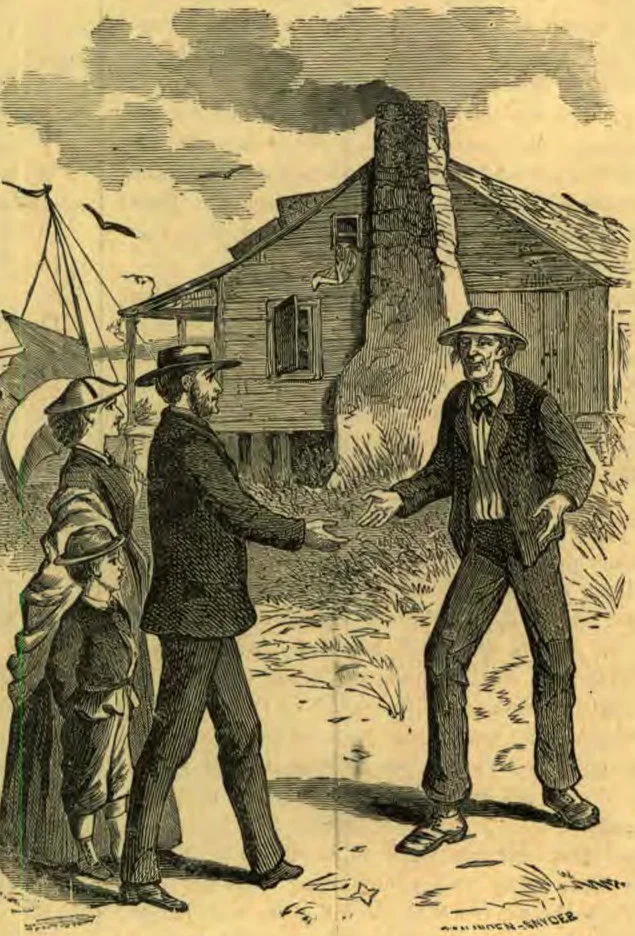
Mr. Harris and his wife, who, with their little boy Fred, had come to the seaside for a few weeks, walked slowly down the beach, till they came to Skipper Ben’s house.
“Here,” said Mr. Harris, “lives an old playmate of my father’s; I can remember coming down to his house with my father when I was a boy, and carrying home a boat he made for me.”
Just then old Ben came round the house, and holding out his hand said, “How are you, my boy? It’s many a year since I’ve set eyes on your face; but I should know you anywhere, you look so like your father.” Then he led them into his sitting-room. The floor was as white as soap and sand could make it, and the brass candle-sticks on the shelf shone till you could see your face in them. The cool breezes swept through the room, rustling the snowy curtains.
“Where’s Aunt Mary, Uncle Ben?” said Mr. Harris, after a pause.
“Ah,” replied the old man, drawing his rough sleeve across his eyes, “it’s six years come next May since they laid my Mary to rest up yonder on the hill. This is my main comfort now,” said he, taking his well-worn Bible from the window-sill, where it lay open, and putting it up on the shelf. “If you’d like to take a boat-ride, I’ll tell you about it.”
When they were safely seated, Ben said, taking his place at the helm, and hoisting the sail, “It’s just seven years ago this fall since my two strong lads set sail from this bay, and never came home again. For weeks the ship had been wind-bound, and the captain was getting impatient to be off. They’d no business to set sail in such weather, sir; the sea was smooth enough, for that matter, but it looked dirty to the wind’ard, and it was dead ahead. I knew we’d have a squall and stormy weather before a day was over. But the captain was a rough man, sir. He said he’d been lying round these weeks, and he wouldn’t wait longer; he’d go to sea if he knew he’d drown the next minute.
“Well, in the night the wind began to rise, and clouds scud across the sky; the snow fell thick. I felt uneasy for the vessel, and went down to the beach to see if I could hear anything, but the roar of the surf drowned all sounds. In the morning my Mary and I heard that the wrecks of a ship lay down the beach a ways. The snow was deep, but Mary was bound to go to see if it was the one our boys sailed in; the Isidore was her name, sir; and she was a fine ship; but her ropes were new and kinky, and the snow and sleet froze to her rigging, so the crew were helpless. She drove on before the gale, and split all to splinters on the rocks. When we got down to the beach, there the boys lay washed up on the sand, and a clinging to a bit of the mast.”
“Mary never spoke a word,” said the sailor, tacking about to return to land; “she just went to work a helping the folks. But she never smiled afterward. It was pitiful to see her pinched, white face, as she went so quiet about her work. In a little more’n a year she died. It broke her heart, sir, it broke her heart; she set such store by them boys.”
“I should think,” said Fred, as the boat grated on the beach, “that you’d be afraid to go on the water any more.”
“I can trust Him who ‘gave to the sea his decree, that the waters should not pass his commandment.’ We’re just as safe on sea as on land, my lad. There’s a deal of comfort in the Scriptures for old sailors like me.”
When they turned to leave him that night, Uncle Ben gave Fred a boat just like the one he had made for his father when he was a little boy.
“Now, my lad,” said he in parting, “remember that we’re all sailors, sailing the sea of life. My voyage is almost done, and yours is but just begun. Look out for the breakers, and steer clear of the rocks, and don’t mind the false lights along the shore; but take aboard the Great Pilot, Christ Jesus, and he will guide your boat safe into the harbor of heaven.”
W. E. L.

GOOD BOOKS.

Sabbath-Readings. In four volumes, containing moral and religious reading for the Home Circle. Vols. 1, 2 and 3, each 60c.; Vol. 4, 75c.
Life of Elder Joseph Bates, relating his experience of twenty-five years on ship-board, with incidents of his rise from cabin-boy, up to master and owner. The closing chapters relate to his labors in the ministry and in the cause of temperance and other moral reforms. 352 pp. $1.00
Week-day Religion, by the Rev. J. R. Miller, is a handsomely bound book, printed on fine calendered paper, in large clear type. It is eminently practical in matter, and no one can fail to be benefited by reading so pure and earnest a book. 315 pp. $1.00
Home-making is a book of the same size and style, and by the same author as the one above. It aims to mark out the duties and responsibilities of each member of the household, and to suggest how each may do a part in making the home-life what God meant it to be. 310 pp. $1.00
David Livingstone: The Story of One Who Followed Christ. By Louise Seymour Houghton. This book tells in an interesting style the life of the great missionary traveler and explorer of the dark continent. 330 pp. $1.25
Address, REVIEW & HERALD, Battle Creek, Mich.

You have reached the end of this edition.

The Youth’s Instructor · Nov 7, 1883