The Youth’s Instructor, Vol. 30, No. 47.

THE ACROPOLIS OF ATHENS

The Youth’s Instructor

Nov 22, 1882

S. D. A. Publishing Association · Battle Creek, Mich. · Nov 22, 1882

THE ACROPOLIS OF ATHENS.
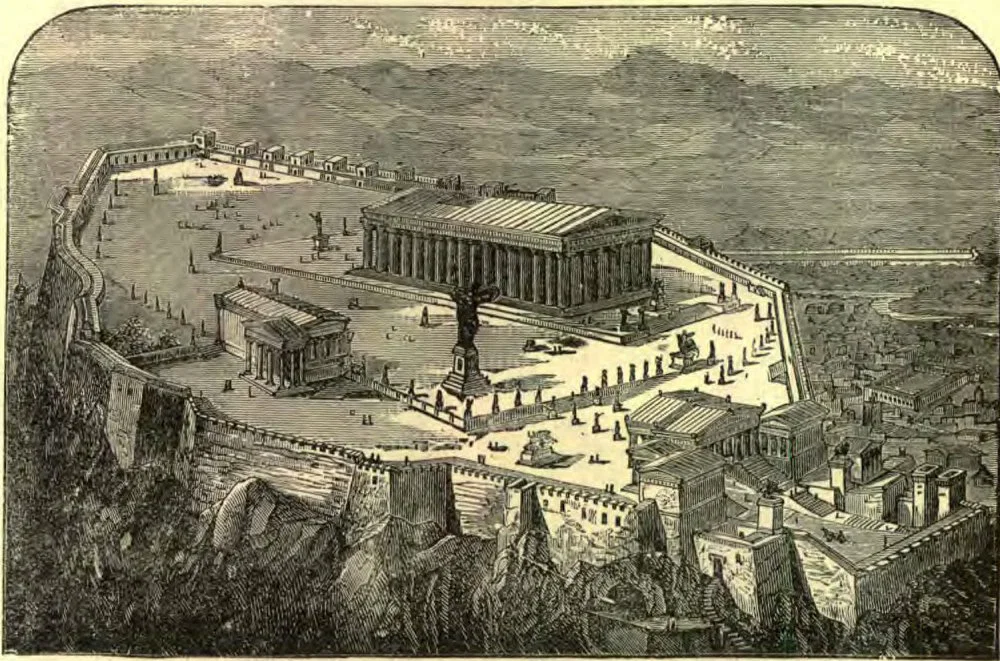
MANY walled cities of the East, especially those of historic fame, had within their inclosure some hill or rocky elevation, which was doubly fortified, and into which the citizens withdrew in time of war when the outer walls had failed to keep out the enemy. In these citadels were usually placed the shrine of the patron god of the city, and various other buildings of art. Such an inclosure was known by different names in different countries. They were most common, however, among the Grecians, who gave it the name of Acropolis, a word which meant in their language “the highest part of the city.”
The people of ancient Athens gave themselves up almost entirely to art, religion and philosophy; and they made their Acropolis so resplendent with temples, statues, and shrines, that it far excelled that of any other city, and was called by way of pre-eminence “The Acropolis.” The accompanying cut gives but a faint idea of the magnificence and grandeur displayed upon that huge rock; for the Acropolis at Athens was nothing else than a huge rock, rising five hundred feet above the plain and over one thousand feet above the sea. The top was flat, and one thousand feet long by five hundred broad. Three of its sides were almost perpendicular by nature, and when they were carried still higher by massive walls, the place was absolutely unapproachable, except at one end, where the ground sloped quite steeply down to the city below. Here the only entrances were through long winding passages left in the ponderous wall. A winding stair leading to one of these passages can be seen in the front of the picture.
Imagining ourselves just inside this entrance, in the old days of the city’s glory, we stand in a large court surrounded by a high wall, and containing several temples and arches built of different colored marble, while in front of us are flights of stairs leading up to the grand entrance to the Acropolis proper. Mounting these stairs and passing through this magnificent portal, we are for a moment blinded by the dazzling scene that meets our view. Directly in front of us, on a pedestal twenty feet high, towers the brazen form of the goddess Minerva, holding aloft her shield and spear, and her head crowned with a helmet of war. Minerva was thought by the Athenians to be their guardian goddess, and hence they called their city by her name, for the Greek word for Minerva is Athene. So this image was put up where it could be seen from all parts of the city and surrounding country, and even from far out on the sea, which was several miles away. The superstitious people were foolish enough to think that as long as this huge brazen form remained, their city could not perish.
To the right, we view the world-renowned Parthenon, or temple of Minerva. Though there exist many other structures of greater size, none are so noted for architectural beauty, symmetry of form, and rare sculpture, as this heathen temple. It was built entirely of white marble. On the inside of the walls were scenes cut in the marble, which the most skillful sculptors the world ever produced were years in executing. At one end of the temple stood another figure of Minerva thirty-nine feet in height, and made of solid ivory, covered with gold. The gold that covered this image was alone worth over a million dollars. Scattered over the remainder of the surface of the Acropolis, and built in the walls, were many other small temples and shrines, each a wonder in itself, glittering with gold and peopled with statuary; and in the open courts between, were scores of marble figures representing heathen gods, illustrious generals and philosophers, in all kinds of attitudes, making the place look as though it were inhabited by a race of giants, whose dwellings were the temples around them. But all these works of art have long since perished or have been carried away by conquering nations, and to-day it is with difficulty that even the location of the walls can be determined with accuracy.
Before the city had fallen into decay, however, the great apostle Paul visited it, and the Bible says his spirit was stirred within him when he saw the city so full of idols. This good man tried to show the people that though they had so many gods, yet there was one they did not know, and that He was the only true God, and did not dwell in their temples, nor did he need help from them; that he it was who made the heavens and the earth, and the people in it, and so they ought not to think he was like gold and brass and stone graven by their hands. Many of the people listened to Paul’s words, among them the wisest philosophers of the city. But they were so wrapt up in their grand buildings and idols that only two are recorded as having believed him and turned from their idolatry to the worship of the true God. But “the truth of God standeth fast,” while the vain philosophy of the Athenians and their works of art have come to naught. Acts 17 gives a full account of Paul’s visit to Athens and the speech he made before its wise men. C. H. G.

THE SONG OF THE CLOCK.

EVERYTHING was hushed and quiet, Ticked the clock upon its shelf; All at once it voiced its ticking, Sang this song unto itself:
“Time is going; time is going; Minutes hasten by; Every one with treasure laden,— Catch them as they fly.
“Catch them! make your own, the treasures That the moments bring. If you linger, they will vanish— Even on the wing.
“Minutes do not yield their treasures With a lavish hand; They alone can hope to win them, Who with workers stand.
“Work away with will, and wisely, Till the tasks are done; Then for you some of the treasures, Fairly will be won.
“Time is going; time is going: Minutes hasten by; Every one with treasure laden, Catch them ere they fly.”
—The Myrtle.

THE MINISTRY OF A HYMN.

It was Communion Sabbath in the little church on B—— street. The minister had read the 26th chapter of Matthew, and now announced the hymn, “Jesus, Lover of my Soul.” He read the verses slowly and distinctly, and the congregation rose to sing; but Sylvia sat in the end of the pew thinking so busily that she almost forgot where she was. “And when they had sung a hymn, they went out.” Someway that verse that the minister had read would run through her mind, and she kept thinking and thinking. She remembered that the disciples, as they “went out,” took their way unto “the Mount of Olives”—but where were these people going? That was the query in Sylvia’s mind.
The Emersons, she knew, would go to their elegant home, and find luncheon ready for them, spread in the daintiest way imaginable. They never cooked on the Sabbath. Lucy Mather and her mother would go back to her brother Ralph, who had been an invalid for nearly a year, and would minister to his wants. Lucy would lay his weary head on her lap, and while she stroked the soft waving hair, would tell him about the morning’s sermon, and sing to him, perhaps. The mother, meanwhile, having prepared the simple meal, together they would sit down and enjoy with grateful hearts what the Lord had given them; for were they not all of the same mind,—“the mind which was also in Christ Jesus”?
Her eyes wandered from pew to pew, and she saw those that she knew would go to their homes to begin anew to serve the Lord, and others who would go back to their troubles and trials determined to be more patient and to live nearer to Him who is their pattern.
“Thou, O Christ, art all I want; More than all in thee I find,” were the words that awoke her from her reverie. She joined in the singing of that verse very heartily, for was it not what she wanted? Yes, more of Christ, or, perhaps, a deeper realization of what she already knew of him.
They sang the doxology, the benediction was pronounced, and the congregation “went out.” Several shook hands with Sylvia as she passed down the aisle. In the vestibule the superintendent of the Sabbath-school invited her to join one of the Bible classes, or to take a class of little girls if she desired to teach; but Sylvia, as she thought of her duties at home, could only reply, “I will think about it.”
“Seems to me Sylvia’s a long time coming home this morning. I don’t see what that girl wants to go to church for when there is so much to be done; ’tis the only day father and the boys are home, and the dinner’s to be cooked. Are the potatoes done, Annie? Seems to me you’d better set the table, and we’ll eat; she can have what’s left.”
“I don’t know how many to set the table for,” said Annie, after she had looked to the potatoes and slammed things around a good deal; “after this she can set the table ’fore she goes.”
“Don’t you forget me,” said Jack, who had overheard the conversation. “If you don’t hurry up, there won’t be much left; I’m as hungry as a bear now. I’ll count for you, Annie. There’s father, Jim, and me—that’s three; mother, Sylvia, you—that’s six; Nellie, Carrie, Ben, and the baby—that’s ten. That is not so bad; over to Riley’s they’ve got fourteen. I’ll help you,” and he jumped up, leaving his book on the bureau as he passed.
Sylvia had saved him from a whipping the night before, and he had not forgotten it. Mrs. Bennett put the baby into the cradle, not very gently, and was thickening the gravy when her husband came in, grumly demanding dinner. This woke up the baby again, who began to cry lustily; Jim came in and began to growl when he saw Annie dish up the potatoes with “jackets” on. “Take a feller half an hour to peel his ’taters ’fore he can eat them!”—and in the midst of the confusion Sylvia came in.
“Time you were coming,” said her mother as she washed Ben’s face, before sitting down to the table.
“I hope you’ll stop that baby’s squalling soon!” and the father seated himself at the head of the table.
“I’ll take her,” said Sylvia gently, as she came out of the little bedroom where she had taken off her hat and shawl. “I’m not hungry; I can wait.”
“Well, I can’t wait much longer,” thought Jack. “I wonder what she lives on.”
Ah, well could Sylvia have said with the Master, “I have meat to eat that ye know not of,” as she quietly took the baby from the crib, and walked into the sitting-room with it, where she sat rocking and singing one of the verses of a favorite hymn:—
“The midnight may be dreary, And the heart be worn and weary, But there’s no more shadow yonder, In the presence of the King.”
Over and over again she sang the verse, her voice floating out to the room where the family were eating. The noise at the table subsided, and unconsciously each one listened to the quiet, soft strains, so soothing in their melody.
The mother’s thoughts went back to the time when she used to attend church with her parents and brother, and as she contrasted those Sabbaths with the present, she too yearned for something; was it the presence of the King in her heart? The father was living over again the moments spent at the bedside of a dying mother, who with her last breath committed him to the care of the “King eternal;” and as he looked around him at his own children, he thought, “Surely I have neglected bringing them up to love the house of the Lord;” and his responsibility as a father loomed up before him.
Sylvia cradled the baby, and as she looked at the quiet group about the table, she said within herself, “Did the Lord speak ‘peace’?”
After the dishes were washed and she had coaxed Jack, Jim, and Annie to go to Sabbath-school,—it was too late for her to go, for the baby needed attention,—she took out her little textbook and read again her verse for the day:—
“In quietness and confidence shall be your strength.”—Church and Home.

TRUSTING

DAYLIGHT’S sun was slowly dropping Into coming night; And the twilight shadows falling, Hid the world from sight.
Waiting by the busy crossing, Stood a little one; Golden curls and eyes of azure— Waiting all alone.
Listening oft to catch a footstep, Strained the little mind; But the blue eyes ne’er glanced upward, For the boy was blind.
“Shall I help you o’er the crossing?” Spoke a passer-by— “Come, I’ll bear you safely over In my arms so high.”
“I am waiting for my father,” Said the child, “to come; He will take my hand in his, And lead me safely home.”
“But perchance, my boy, your father’s Stopped along the way, And forgets his child is waiting Here, at close of day.”
Softly came the earnest answer, Lisped so sweet and low: “Ah! I know he’ll come; I’ll trust him, For he told me so.”
Oh! the earnest, childish trusting To a father’s care— Knowing, though all around is darkness, That his hand is there.
Would that we could have this simple, Child-like trust in God; Would that we by faith could lean Upon his very word;
Trust our Father’s hand to lead us Where we cannot see; Trust his gentle voice to call us— “Come, blind child, with me.”
—Selected.

BEAUTIES OF NATURE.

THERE is a gladness in the sunshine, And a quiet in the shade, Which makes me feel as if the earth For happiness were made.
There's a grandeur in the forest, And a beauty in the dell, Where the singing birds and wild flowers Of a long-lost Eden tell.
In the joyousness of friendship There's a sunlight for the soul; And there's happiness in everything Where sin has no control.
Let us prize those heavenly blessings Which are given to us in love, While we seek for brighter treasures Of the pure in heart above.

A WISE CHOICE.

A GOOD minister, whom we will not name, while sitting at the dinner-table with his family, had these words said to him by his son, a lad of eleven years: “Father, I have been thinking, if I could have one simple wish of mine, what I would choose.”
“To give you a better chance,” said the father, “suppose the allowance be increased to three wishes; what would they be? Be careful, Charley!”
He made his choice thoughtfully, first, of a good character; second, of good health; and third, of a good education.
His father suggested to him that fame, power, riches, and various other things, are held in general esteem among mankind.
“I have thought of all that,” said he, “but if I have a good conscience, and good health, and a good education, I shall be able to earn all the money that will be any use to me, and everything else will come along in its right place.”
A wise decision, indeed, for a lad of that age. Let our young readers think of it, and profit by it.

The Painter and Alexander's Scar

A PAINTER was once employed to paint a picture of Alexander the Great. In one of his battles he had been struck with a sabre upon the forehead, and a large scar had been left upon his right temple. The artist sketched him leaning upon his elbow, his fingers covering the scar. The likeness of the king was taken, but without the scar. So when we hold up the characters of others before the world, let us lay the finger of Christlike charity over the scars.

The Old Lady Who Was Not Afraid

During an earthquake the inhabitants of a village were very much alarmed, but were at the same time astonished at the calmness and apparent joy of an old lady whom all knew. Some one asked her if she was not afraid. “No,” said she, “I rejoice to know that I have a God that can shake the world.”

SCENES IN THE LIFE OF CHRIST.

LESSON 96.—DESTRUCTION OF JERUSALEM, AND THE SIGNS OF OUR LORD'S SECOND COMING.

In the latter part of our last lesson, Jesus gave his disciples a brief account of what was to take place among the nations of the earth, and of the experiences that the people of God should pass through, from that time down to his second coming. He also said that when the gospel of his second coming, to set up his kingdom upon the earth, should have been preached to all nations, then the end of the world should come.
He then went on to answer their question about the destruction of Jerusalem and the temple. He said, “When ye shall see Jerusalem compassed with armies, then know that the desolation thereof is nigh. Then let them which are in Judea flee to the mountains, and let them which are in the midst of it depart out, and let not them that are in the country enter thereinto.” “And let him that is on the housetop not come down, neither enter therein to take anything out of his house; and let him that is in the field not turn back again for to take up his garment.” “For these be the days of vengeance, that all things that are written may be fulfilled.”
After this, he told them of the great papal persecution spoken of by Daniel, saying that it would be more severe than anything of the kind that had ever been in the world, or ever would be. He also said that except those days should be shortened, no flesh would be saved, or in other words, that all God’s people would be destroyed; but that for the elect’s sake, those days of persecution would be shortened.
Speaking of the last days, Jesus said, “Then if any man shall say unto you, Lo, here is Christ, or there; believe it not. For there shall arise false christs, and false prophets, and shall show great signs and wonders, inasmuch that, if it were possible, they shall deceive the very elect. Behold, I have told you before. Wherefore if they shall say unto you, Behold, he is in the desert; go not forth: behold, he is in the secret chambers; believe it not. For as the lightning cometh out of the east, and shineth even unto the west; so shall also the coming of the Son of man be. For wheresoever the carcass is, there will the eagles be gathered together.”
After having thus answered the first question, and having given so many precious admonitions, Jesus went on to answer their second question. He said that just before the close of the 1260 years of papal persecution, and after the severe tribulation of those days should be chiefly past, certain wonderful signs should be given in the heavens. That the sun should be darkened, and the moon should not give her light; the stars should fall from heaven; and the powers of the heavens should be shaken.
The great persecution here spoken of, was carried on by the Roman Catholic Church, with the pope at its head. It is thought that as many as fifty million Christians were put to death by order of the Church of Rome. Many of these were tortured in the most cruel manner. Some were pulled in pieces by horses, some were cast headlong into deep wells, some were burned at the stake; others were cut in pieces with knives, or tormented in ways too horrible to mention. The time set in prophecy for this persecution to close, was the year 1798. At this time, Rome was entered by a hostile army, the pope was made prisoner, and the Catholics no longer had power to put Christians to death. But about twenty years before this time, the power of the pope was so far restrained that the tribulations of the Christians nearly ceased.
On the 19th of May, 1780, the sun was darkened, and the day became so dark that the people had to leave their work in the field; candles had to be lighted in the houses; fowls went to roost; and the cattle came lowing to the barn, thinking that night had come. On the evening that followed, the moon appeared like blood, and gave no light. There were no clouds in the sky, and no eclipse could have occurred at that time, for the moon was full; yet it was one of the darkest nights ever known. A few years later there was a remarkable falling of the stars, such as was never known before. Thus we may see that all the words of our Saviour have been fulfilled, except those about the shaking of the powers of the heavens. And they will undoubtedly be fulfilled before long.

QUESTIONS.

  1. Of what did Jesus give his disciples an account in the latter part of our last lesson?
  2. When did he say the end of the world would come?
  3. What question did he then proceed to answer?
  4. How were they to know when the destruction of Jerusalem was nigh? Luke 21 : 20.
  5. What were those to do who were in Judea?
  6. What caution was to be observed by those who were in the country?
  7. What was said with reference to those who should be upon the housetop?
  8. What was said with reference to those who should be in the field?
  9. Why was that time to be so perilous? Luke 21 : 22.
  10. Of what did Jesus tell them after this? Matt. 24 : 21.
  11. What did he say about the severity of that persecution?
  12. What did he say would be the consequence, if those days were not shortened?
  13. What promise did he make?
  14. What caution did Jesus give with regard to false teachings in the last days?
  15. What did he say should arise?
  16. What would they show?
  17. How complete would this deception be?
  18. What false teachings concerning his second coming were to be avoided? Matt. 24 : 26.
  19. What characteristics of his second coming did he give them?
  20. After thus answering their first question, and giving these precious admonitions, what did Jesus go on to do?
  21. What did he say should take place just before the close of the 1260 years of papal persecution?
  22. What would be chiefly past, before these signs should appear?
  23. What signs did he foretell?
  24. By what power was the great persecution here spoken of carried on?
  25. How many Christians are supposed to have perished at the hands of the Church of Rome?
  26. What sufferings did many of them have to endure?
  27. What was the time set in prophecy for this persecution to come to an end?
  28. What happened at this time to take away from the Roman Church the power to put Christians to death?
  29. What took place about twenty years before this time?
  30. When was the sun darkened, according to the prediction of our Lord?
  31. Describe that day?
  32. Tell how his prediction concerning the moon was fulfilled?
  33. What took place a few years later?
  34. Which one of the predictions already noticed, remains unfulfilled?

NEW-TESTAMENT HISTORY.

LESSON 110.—REVIEW.

1. WHERE was Jesus on the Sabbath before his crucifixion?
2. What occurred on that day?
3. What were the leading events of Sunday?
4. What did our Saviour do on Monday?
5. Where did he spend the entire day on Tuesday?
6. Give the leading topics and occurrences of that day.
7. Give the main features of what he told his disciples that night, as they rested on the Mount of Olives while on their journey to Bethany.
8. Where does our Lord seem to have spent Wednesday?
9. What preparations for his destruction were making that day?
10. On the evening after that day, what preparations did the disciples make for holding the Passover?
11. Describe the Passover Supper.
12. Tell how the ordinance of feet-washing was introduced.
13. Tell how the traitor was pointed out.
14. Describe the institution of the Lord’s Supper.
15. What profession of constancy did Peter make?
16. What chapter contains our Lord’s last discourse before his crucifixion?
17. What chapter contains his prayer for his disciples, and for those who should believe on him through their word?
18. Describe the agony of Jesus in the garden.
19. Tell how he was taken and led to Annas and the high priest.
20. Tell what condemnation was passed upon him by Caiaphas and the Sanhedrim.
21. How did the Jews then try to legalize their proceedings.
22. What suggested to Pilate the thought of sending Jesus to Herod?
23. How was Herod disappointed in his interview with Jesus?
24. Tell how Pilate tried to secure the release of Jesus?
25. Tell how our Lord was led forth to be crucified.
26. Describe his crucifixion.
27. Tell how he was mocked on the cross.
28. Tell what was said by the penitent thief.
29. What promise was given him?
30. How did Jesus manifest his care and affection for his mother?
31. Describe the noon-day darkness.
32. What loud exclamation did Jesus utter about this time?
33. What was done for him when he said, “I thirst”?
34. What words did he speak after this?
35. Tell what happened when Jesus expired, and what effect these things had upon those who saw them.
36. What was done to Jesus while he still remained on the cross?
37. When was Jesus taken down, and by whom?
38. What was done with his body?
39. By whom were these things closely observed?
40. What anxiety was manifested by the priests and Pharisees concerning the body of Jesus?
41. How were they authorized to make it secure?

ILLUSTRATIONS

ILLUSTRATIONS are often powerless, because they are far-fetched. Sometimes a teacher hears of an interesting incident, and bends his energies to work it somehow into the lesson. But it is seldom a success. We remember a public speaker who was once so taken with a witty story that he shaped his address to make a place for it. In its proper setting, it had had a telling effect on an audience. But as this speaker told it, it fell flat; and a listener was heard to remark in passing out, “Well, didn’t he lug in that story by the neck and heels?” The teacher who “lugs in” an illustration will make a failure of it. Dr. John Hall says, “Any incident or story which will not keep with itself in the memory the appended lesson, is a waste of teaching power, though it may for the moment keep up attention.”

WHO CAN SUCCEED.

Some good Christian people have an idea that it requires peculiar genius to teach in Sabbath-school, and that, as they are not geniuses, the Master cannot mean to ask them to go and work in that vineyard. Capt. C. C. Duncan, at a Sabbath-school convention held in Boston, told what plain people can do as teachers, who have no special genius, and have had no unusual opportunities of education. He says that such a teacher can ask help of the Lord and get it; can faithfully study the lesson; can come to Sabbath-school regularly; can come early; can secure the confidence and affection of his class; can strive for good order; can live what he teaches, or at least try to; can be kind and loving, and yet firm; and can try to win souls. He believes that any teacher who does faithfully these things which he undoubtedly can do, will succeed, and so do we.

A REAL THANKSGIVING.

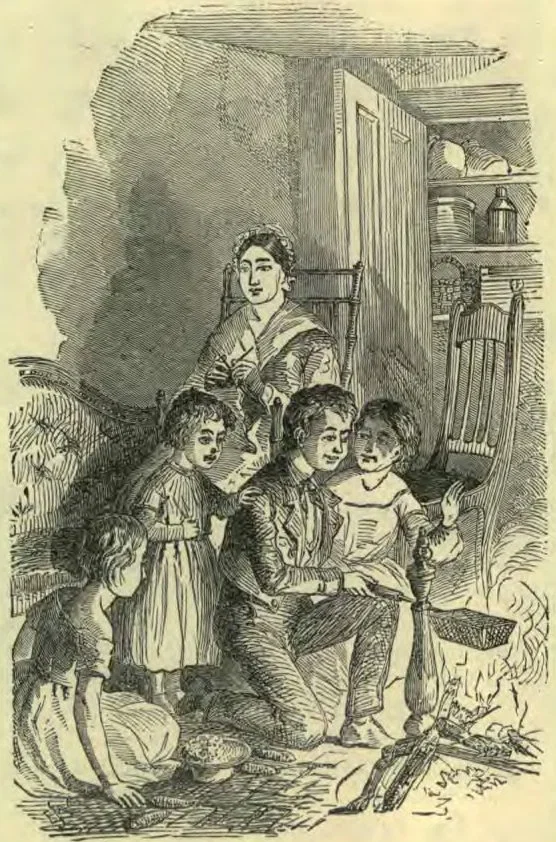
It was the day before Thanksgiving, and there was sore trouble among the little folks in Mrs. Lee’s home. Thanksgiving Day had always been a great event to them, and they looked forward to it through the whole year; for then they either went to Uncle John’s, or Uncle John’s folks all came there. And they always had a roast turkey and other good things for dinner, and then in the afternoon and evening came the merry romps with their cousins. But this year had brought many changes to the Lees, and things were all to be very different this Thanksgiving. Uncle John had gone away to Kansas to live in the spring, and then in September their father had sickened and died with that dreadful disease, typhoid fever.
Mr. Lee had been a hard-working man and always gave his family a good living; yet he was poor, and his sickness had used up what little money he had saved up. And now at the beginning of a cold winter Mrs. Lee was left with four children to care for. They had a snug little home which was theirs, but all the living had to come by the mother’s sewing and the little that Eddie could earn by doing errands and chores for the neighbors. Mrs. Lee was not strong, and she looked forward very anxiously to the long winter before them. Eddie was twelve years old, the twins, Susie and Sadie, ten, and Effie six—just the ages when children think most of such things; and you may be sure they looked pretty sober and the twins cried some when mamma told them that she could not get them a Thanksgiving dinner nor make the day a holiday for them in any way.
“Now,” said the mother, “you know I should be very glad to do all that you wish; but since it cannot be, if I were in your places, I should try to make the best of it, and instead of going about sad and cross, would try to see how happy a day I could have, after all. You know Thanksgiving is a day when we are to be thankful for the blessings we have, and not a time to feel bad because we have not more. Now just think of all the things you have to be thankful for, and see if you cannot make it one of the best Thanksgiving Days you ever had.”
“What can we do?” cried they all in a breath, “you help us plan, mamma.”
“Well,” said she, “what about that sack of nice pop-corn that Eddie raised in the garden last summer? I think it must be dry enough to pop by this time.”
“O yes!” cried Eddie, “it is in the garret, and I will go and fetch it this minute.”
The corn was brought, and found to be just right to pop out nicely, so that evening Eddie and Susie pulled out the coals from the grate and popped a large pan full of the snowy kernels, while the others stood looking on. Then their mother boiled some molasses candy. And early the next morning in came farmer Brown, who lived just out of the village and had known their father many years. He said he thought as he was coming down, maybe they wouldn’t mind his bringing them along a nice young chicken for dinner, as he was foolish enough to think his chickens were better than any one else’s. And away he went, without giving them time to thank him. So they had quite a dinner after all, but the children declared that the pop-corn was the best part of it. They had more than they could eat though, and after dinner their mother told them they might carry some to a poor little lame boy and his sister who lived in the village.
In the evening their mother told them stories and among other things, how, many, many years ago, our fore-fathers came across the ocean in a little ship called the May-Flower. They landed in December, and that winter quite a number of them died from cold and want. The next spring they planted corn and vegetables among the stumps, and in the autumn, when they had gathered in a nice harvest of provisions to last them through another winter, they appointed a day to thank God for the blessings of the season. This was the first Thanksgiving Day, and every year since then, when the harvests are all gathered in, a day is set apart as Thanksgiving Day. We should be sure that we remember why the day is kept, and not think only of the good dinner and nice times we are to have.
Before the children knew it, bed-time had come, and as little Effie kissed her mother good-night, she said, “I guess this is the realest Thanksgiving Day we ever had, mamma.” E. B. G.

MAKING OTHERS HAPPY.

We know a little girl who one morning pinned a piece of paper upon her apron in front, with these words upon it: “I am going to try to make others happy.” The word “happy” was printed in large letters which all could read. When asked why she placed the paper there, she said, “I want it there, so that I shall be reminded of what I want to do; I might forget.” The paper did help this little girl to remember what she wanted to do, and all the day she tried to make every one happy; and, if you will believe me, she was much happier herself. I know that every mother’s heart is made glad when she sees her little ones trying to make each other happy. She doesn’t have nearly the trouble with them, when they do this. When they don’t try to make each other happy, then it is that their mother has to talk with them, and sometimes has to do something else. Children are not happy when they are unkind to each other, and their mother has to correct them.
A dear mother can help her children to be kind and make each other happy, but there is one who can help them more than she can. This is Jesus. Only Jesus can help us to be really good. If children ask him to help them to make others happy, he will hear them, and do it. Father and mother want to be made happy, and there are none that can make them so happy as their children. Good children always make their parents happy.
Jesus wants to make us all happy; and by coming to him, believing in his dear name, we can be happy and useful in our lives, and shed joy and happiness on all around us. It was for others that Jesus came into the world,—to save and bring all who will come into his fold, and into a beautiful country where all will live and be happy forever.—Young Pilgrim.

Letter Budget

Here we have a letter from a lady, Mrs. C. P. Ashbaugh. She says, “I want to tell the little readers of the Instructor about my Sabbath-school class. There are seven of them,—five little boys and two girls, all between the ages of three and nine. They had such good lessons last quarter; there were only six questions missed in the whole class. They are about through Bible Lessons, No. 1. I have written this to encourage them and other children to be faithful in learning their Sabbath lessons.”
George N. Richer writes from Westville, Montcalm Co., Mich., as follows: “We have had the Instructor in our family several years, and would not know how to do without it. It comes in my name this year. I am eleven years old, and the youngest of the family. I have two sisters and one brother. We live about five miles from where meetings are held, and as we have only an ox team, we do not go very often. I am trying to be a good boy.”
Flora Nourse, of Chittenango Falls, New York, says: “I have written a letter for the Instructor once before, but would like to write again. I enjoy the paper very much. It used to come in my name, but it now comes to my sister, who is eight years old. I am trying to do missionary work by sending away papers and tracts. My father and mother and sister went to camp-meeting this year. I have been to school this summer, and we had a picnic the last day. I hope my letter will be printed.”
Ora Johnson writes: “The Instructor is one of my very best friends, but I have not written for it since I came to Texas. My pa takes the Review and the Herald, but he loves to read the Instructor too. We keep the Sabbath, but there is no Sabbath-school here. There was a Sunday-school, but it has been disorganized. I have two brothers and two sisters; and when we have read our papers, we give them to other children. I send my love to the Instructor family, and hope we may all be ready to meet the Lord when he comes in the clouds of heaven.”

“POPPING CORN.”

The roof-tree that shows in the attic Its arms bare and leafless and brown, To the eyes of the dear little children Is reaching all wistfully down With fruitage; they troop there and always Bring treasure. To night in the dusk They come and bring corn silver-kerneled, Each ear tied by silver-white husks.
The tiny ears shelled, now the children Are gathered around in the glow To see how the small kernels blossom To leaves that are white as the snow. The eyes that are watching are eager; The myst’ry to them as new As if never before in the fire-heat Leaf on leaf frail white blossoms grew.

You have reached the end of this edition.

The Youth’s Instructor · Nov 22, 1882