The Youth’s Instructor, Vol. 48, No. 32.

PICTURES FROM REAL LIFE IN CHINA

The Youth’s Instructor

Aug 9, 1900

Review and Herald Publishing Company · Battle Creek, Mich. · Aug 9, 1900

PICTURES FROM REAL LIFE IN CHINA

Happy New Year
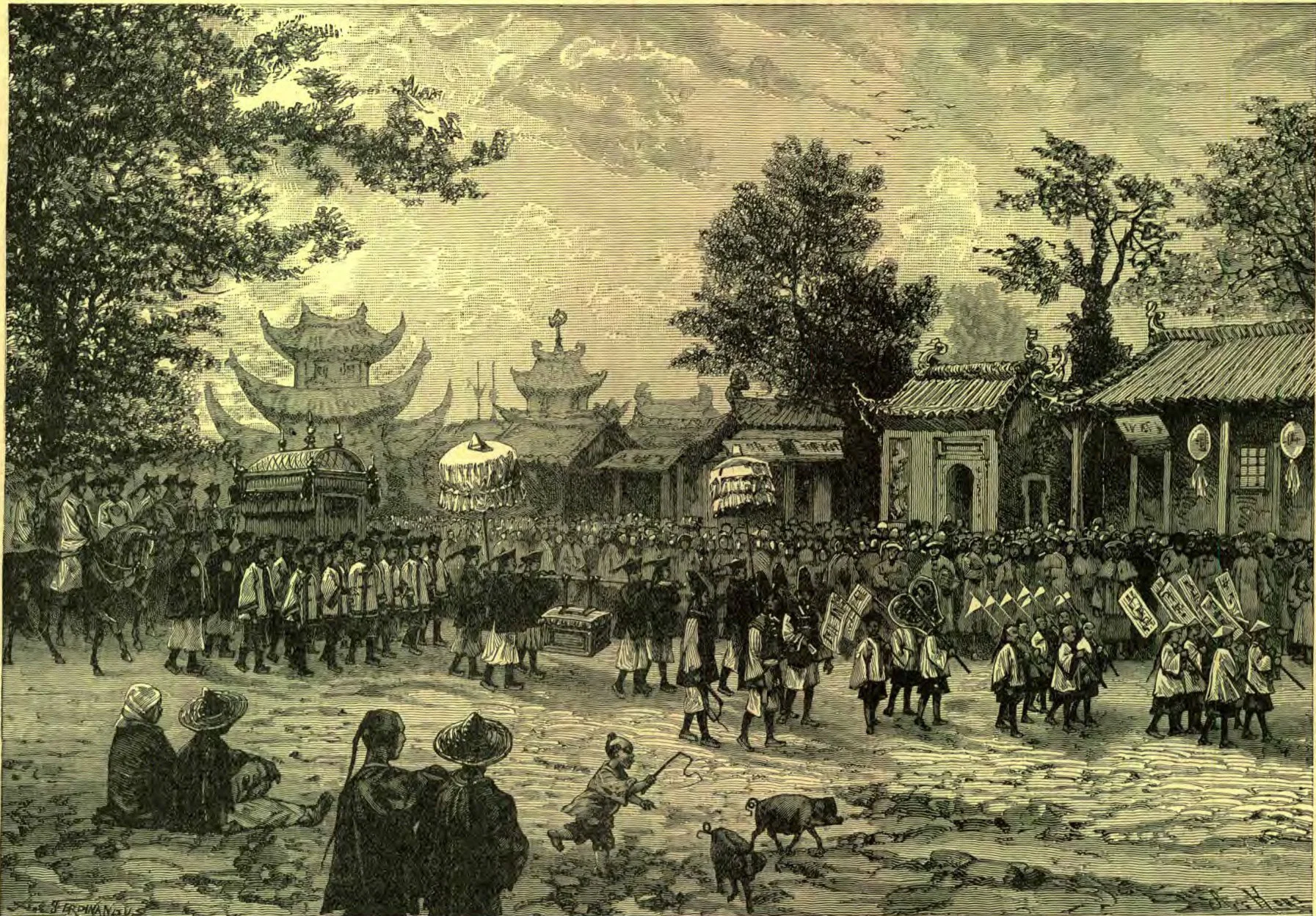
New Year’s day, with its clear, blue sky, seems to spread a holiday air over both city and country. Everything breathes festivity. Now and then a bomb or a skyrocket is fired off, not to disturb the peace, but rather to try the strings of the Æolian harp, and fill all the air with the sound of delightful music.
About ten o’clock in the forenoon the great mass of humanity is set in motion. Mother and daughters remain at home, while father and the boys go out to make their friends a call, and greet them with, Hao-ko-nien (Happy New Year!). All are well dressed; hands and faces are clean, and the hair is combed. Little boys who but the day before were ragged and filthy are now as neat and tidy as can be.
Rich and poor all are dressed alike. If it were not known to us how the common people had obtained their fine clothes for the festival, we might be tempted to think that Tsai-shen-ie—the god of wealth—had already demonstrated his power to make people rich. However, a few words of explanation will show that Tsai-shen-ie and U-fu have this year neither more nor less treasure to bestow than had the old gods. The wealthiest man in China, Li Hung Chang, and others of like character, have pawn-shops all over the country. On the shelves of these stores are the richest festival robes one could wish to wear.
FESTIVAL STREET SCENE IN PEKING
Garments made from the finest silk, in all colors of the rainbow, embroidered with gold, such as the sons of the Orient love, are seen on New Year’s day in China. These garments are rented for the occasion, as but few are able to buy such clothes. The poor pay a certain sum for these borrowed articles, returning them after one day’s wear and pleasure. But what of that? The festival comes but once a year, and one must take part, in spite of borrowed clothes and empty purses. He must greet his friends with a “Happy New Year!” The whole of New Year’s day is spent in making calls. But it would not do to get tired of the endless greetings. No; one should rather be pleased to see the large number of Chinese come, and in their most polite manner bring their greetings, “Mu-si, Hao-ko-nien” (Happy New Year, pastor), bowing low in their respect, and offering their card as a token of friendship. The Chinese receive with gratefulness the missionaries’ cards. This small act of kindness leads to an intimate friendship between the missionary and the Chinese. When one goes to China, it is wise to be friendly and accommodating, as far as is in accordance with the word of God; for thereby many may be won to the gospel.
But little thought is given to eating and drinking during the first and second day of the New Year; for every one is busy going from house to house with the New Year’s greeting. At each house, however, simple refreshments are offered, such as dried peas, peanuts, and a certain kind of berries. Melon seeds are chewed as a pastime. As the festival-robed friends come with their hearty Hao-ko-nien, we are obliged, by the etiquette of the country, to urge them to crawl on hands and feet onto the kang, and partake of the food there.
The mandarins, the highest civil and military officers, also parade the streets. But they are out to exhibit their official rank more than for anything else. Their rank is shown by buttons, and by the peacock-feather in their cap. These officers are clothed in the finest and costliest fur I have ever seen. They are seated in gold- and silver-mounted sedan-chairs, carried by eight or more men, who are usually dressed in uniform. Heading the procession is a company of the strangest-looking men one can imagine, from fifty to one hundred of the most noted beggars in the community. These are trained to act a part in the festivities of the day. It matters not whether they have any clothing or not. The more ragged they are, the better the procession is enjoyed. Each is given opportunity to earn at the most twenty “cash” (one cent), which is regarded as a great deal for them, even on New Year’s day.
During the festival the mandarins supply these sons of misery with a uniform, consisting of a long red shirt. Trousers are not needed, but a high paper helmet is worn. These men carry the banners, and lead the band music, which is of such a character it is impossible to describe it. Following the mandarin in his sedan-chair are subordinate officers on horseback. Each rider is accompanied by a soldier, who holds the horse’s tail so as to keep up with the rider when he gallops down some side street with a greeting in behalf of the mandarin to some of his friends. The streets through which the mandarin passes are packed with persons of all classes and ages.
Brother Pilquist's signature, in Chinese characters.
This year the Chinese New Year’s day fell on the 31st of January.
Erik Pilquist.

IN THE LAND OF THE DRAGON

THE mystery of race—that humanity has divided sharply upon lines so divergent that science fails to account for the marvel—is but another of the problems for whose solution no mere study seems to bring us one whit nearer, and for which the Sacred Book alone furnishes a hint. The African, in his ignorance and dullness, and the dreamy Mongol, in his apathy and stolid indifference, roused on occasion to ferocity, stand apart from all the progress of the world. In one way, and one alone, African and Asiatic doff the filthy tatters of their racial inheritance, and stand up, “quitting themselves like men,”—having accepted in the spirit the washing away of sin in the blood of the Lamb of God. In Jesus Christ are neither bond nor free, nor are there Caucasian nor Ethiopian nor Malays nor Mongolians.
Some say that it costs more than it is worth to convert the Chinese. With less than two hundred thousand Christians in all that vast empire of four hundred million souls, the statement is plausible. But remember that if but one soul had been saved for all eternity, it had been worth the seeking; and since Christ said, “Go ye into all the world,” who shall gainsay the supreme duty of missions?
Alas! at the hour when I write, the missionary is indeed in that unhappy country as a sheep among wolves. And who shall say that the next tidings sweeping round the world on the electric girdle may not be that these brave soldiers of the cross have died martyrs? God save them!—the loving, loyal men and women who are holding up the gospel light in that darkened land,—so that when these written words are printed, we may all thank him that the terrible danger is over.
Protestant missions have not failed in China: they can not fail. Great as are the obstacles in that country, in the end they must be overcome. Many of the followers of Gautama, Confucius, and Laotze must eventually be brought to see and realize the folly and futility of these erroneous and strange doctrines, and to find joy in the true gospel of the Son of God.
G. I. CERVUS.

OUR TIME

It is a matter of regret that so much precious time is wasted, not only by careless worldlings, but also by those who profess to believe in the soon coming of our Saviour. Especially is this noticeable among the youth.
When one is asked if he has read a certain article in the Instructor or Review, the answer often is, “I haven't had time.” The same answer is also given as an excuse for not studying the Sabbath-school lesson, and for other neglect of duty. I have noticed that those who are first to make this excuse have plenty of leisure time, which they might profitably spend in study or reading, but which, instead, is spent in idle conversation. The moments go by very rapidly when engaged in conversation; and many hours are thoughtlessly spent in this way, leaving only a few moments for prayer and study of God's word.
Often, while older women are wisely improving their spare moments in doing necessary work for the household, the daughters are wasting in idle talk the hours that have been given them for study. At last, when they are asked to help a few minutes with the housework, their neglected studies immediately come to mind, and they have “no time” to help the tired mother; for “the lessons must be learned.” Then they begin to study; but the mind will wander away to the things of which they have just been talking, and perhaps their study will be continually interrupted by short chats on unimportant subjects.

ROBBERY

In order to improve our time to the best advantage, we must do with our might whatever comes to us to do. The work that has been assigned us for a certain day or hour is the work that “our hands find to do” in that day or hour; and we should do it then, and with our might. To put it off is to procrastinate—and “procrastination is the thief of time.” It is true that we do lose time by putting things off; and though it is sometimes necessary to do this, we should, as far as possible, do each piece of work at the proper time.
When we do a thing with all our might, we do it better and more rapidly than if we work at it when the mind and conversation are upon something else. It is a mistake to think that we should be continually talking, even of spiritual things. There is “a time to keep silence, and a time to speak.” If we carry on a conversation, and at the same time do our work as thoroughly and as quickly as we could if silent, conversation may not be out of place. But if our conversation causes us to forget our work, and we are led to stop for minutes at a time, and, forgetful of our work, do nothing but talk, we can not be doing that work with our might. And if we are working for some one else, and are paid for the time we spend in talking, we are robbing our employer. “In all labor there is profit, but the talk of the lips tendeth only to penury.”
We should take an interest in the work we are doing, and strive to do that work as well, as thoroughly, and as rapidly, as possible. God is not honored by careless, heartless service; but he is honored when we do faithful work. When the time comes to do a certain work, it should be done heartily, as to him, and with an eye single to his glory. If it is physical labor, talking may be neglected, and perhaps with profit; but the work should never be neglected.

HOW TO STUDY

If one takes up his book to study, that is his work for that time. The mind should be concentrated upon the lesson. Simply reading it over, with the mind somewhere else, will do no good. If one wishes to learn a thing so that it will not be forgotten, he must think of it to the exclusion of everything else. When he catches the mind wandering away to something else, he should bring it back immediately. We are told to “gird up the loins” of our minds; that means to control our thoughts, and keep them where they should be. The length of time it takes to learn a lesson depends upon how strongly the mind is brought to dwell upon it. If the mind is wholly concentrated on one thought, an impression is made upon the brain that can not be easily effaced. So, as with work, when we wish to learn a thing properly, we must give it our undivided attention.
In view of the great amount of work to be accomplished in the world, it is surely our plain duty to seek to improve wisely and well our time and our talents. Why should we idle away our time, when so many are working far beyond their strength? Would it not be more Christlike to economize our time, that we may be able to help others bear their heavy burdens?
MRS. B. J. CADY.

PLANTING FOR OTHERS

MY next-door neighbor is going to move away this summer. By June, or July at the latest, the pretty brown house will be vacant, or filled with stranger-folk. I am so sorry! We have been such good friends all the year and a half we have known each other. I said as much to her.
“I’m just sorry, Mrs. Lowell! I can’t tell you how I’ve enjoyed our chats over the fence! That’s about all the time either of us has had for calling. I don’t mind telling you that I’ve fairly invented excuses dozens of times, to come and crony with you. This time it is nasturtium seeds. It’s about time to plant them, if you mean to have any coming up this summer. But now I suppose you don’t care.”
“Why not?”
Her blue eyes looking so wonderingly into mine seemed to have an innocent, childish rebuke in them. I am sure she was wholly unconscious of it.
“Why should I not care now as much as any time? The house will not move away. I can plant for others, if not for myself, you know. It is kind of you to offer the nasturtium seeds. I shall be very glad of them.”
The summer is getting on, now. My friend is almost ready for her flitting. But I see a host of little leaves starting, and I saw her yesterday out tying rows and rows of strings for them to run on.
To me, all the summer, those flowers will indeed be “living preachers”—“each flower a pulpit.” Perhaps there will be a good many; but I am sure they will all teach much the same lesson—plant for others! Don’t build a high, close fence around your own garden joys, and refuse to let one little straggling blossom of pleasure peep through for those on the other side. Plant for others! What if you should not live the year out?
Cultivate spiritual far-sightedness, and look ahead a little. Think of child-eyes that will gladden at the bright hues of the pretty things you took pains to plant. Think of the sick persons who will get some of them. Think of stranger-eyes that will grow bright as they catch a glimpse of that bank of beauty, while tired feet take the dusty road again more easily, as they always do when the spirit finds some unexpected well of refreshment. Plant for others! I myself am beginning to crave the experience of “the joy of the unpaid service,” as some one finely calls it.—Well-Spring.

TEMPUS FUGIT

I STAND on the brink of eternity, But pause to cast A backward glance at Time's swift flight O'er earth just past.
The Angel of Time speeds silently by, On pinions two, Each softly plumed, but strangely dyed A different hue;
For one of Time's wings is spotless white As drifting snow; While the other's sable is all a-shine With starry glow.
Each phantom-like wing has a name we know: The left is Night; And airy, fairy, fleeting Day Is on the right.
They flutter away from us unaware, Those misty wings; For we ignore the plumage soft That on them clings.
Those delicate plumes, that are minutes marked By dial's shade, Are above a downy layer, frail, Of seconds laid.
And never yet did the power exist (Save that divine) To rob, of plume or flake of down, A wing of time!
MINNIE ROSILLA STEVENS.

Jupiter's Moons

ASTRONOMICAL STUDY—NO. X

Jupiter's Moons

LAST week we learned many interesting facts regarding the planet Jupiter. We learned where, in the heavens, to find this planet, and have begun to watch its course as it moves along in its yearly journey around our sun. The first illustration shows the relative position of our sun, the earth, and Jupiter as it appears to be passing among the stars.
As we learned last week, it is many millions of miles this side of the other stars that appear to be shining all around it.
If you will notice this illustration, you will see an arrow drawn through the earth, also through Jupiter; these arrows show the direction in which these two worlds are moving round their common center,—the sun. You will notice that they are traveling in the same direction, but that our earth is much nearer the sun than is Jupiter; consequently we get around to our starting-point much sooner than does that planet. As we have already learned, we make our yearly circuit nearly twelve times while Jupiter is getting around once. On the 27th of May our earth was exactly between the sun and Jupiter as indicated by the letter “a” in the diagram. At that time we were at our nearest conjunction with the planet; since that time we have been speeding on, leaving it far behind in our race around the sun.
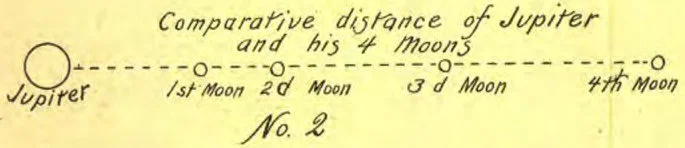
Jupiter has four moons, all larger than our moon. A smaller, fifth moon has been lately discovered, about which we know comparatively little. The second illustration shows the relative positions of the planet and four of his moons as they revolve about their primary. The first moon—the one next to the planet—is Io, two hundred seventy-eight thousand and five hundred miles from the planet, around which it revolves once in one day, eighteen hours, twenty-seven minutes, and thirty-four seconds of our time. The second is Europa, four hundred and forty-three thousand miles from its primary, and requiring three days, thirteen hours, fourteen minutes, and thirty-six seconds to revolve once around the planet. The third is called Ganymede. It is seven hundred and seven thousand miles from the planet, and requires seven days, three hours, forty-two minutes, and thirty-three seconds, to make its monthly journey around this world about which we are studying. The fourth is Callisto, 1,243,500 miles away, and requires sixteen days, sixteen hours, thirty-one minutes, and fifty seconds to pass once around this same world. Imagine, if possible, the beauties of a home upon a world having so many massive moons, each revolving so rapidly about the world that one night there might be all four in the heavens at once, again, only three, or perhaps two, or one, or, as frequently happens, no moon at all, the same as we have. Is not the privilege of visiting these noble worlds that our Saviour has created worth striving for?

DR. O. C. GODSMARK

These moons, revolving in nearly the same plane, pass through many eclipses. In one month of our time Io suffers eighteen; the second eight or nine; the third about four; the fourth does not pass through an eclipse nearly so often. This fourth moon, Callisto, is quite different from the others, being much darker, and always keeping the same side toward the planet, the same as does our moon. We have reason to believe that these moons, unlike our own, have both moisture and an atmosphere; and for all we know, they may be inhabited.
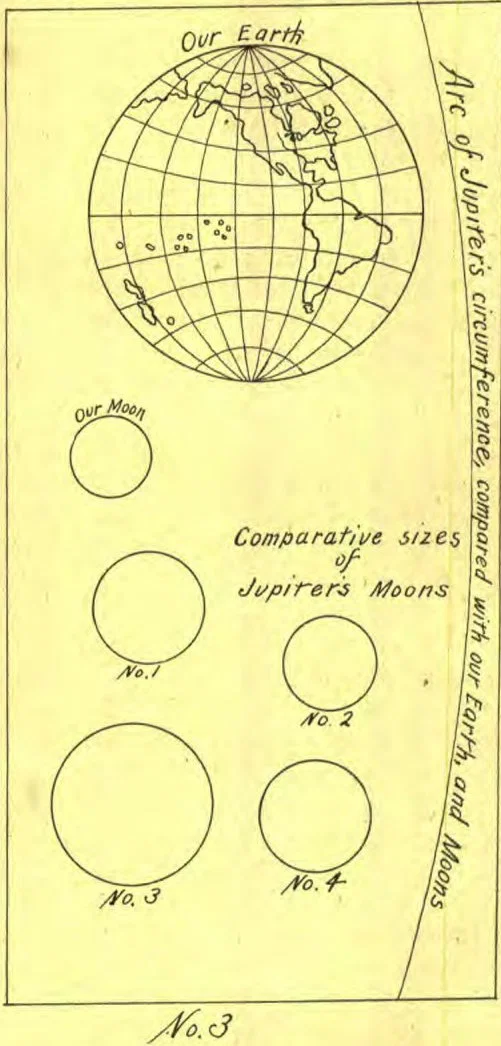
The third illustration gives an idea of the size of these moons as compared with our earth and moon. By comparing the size, as given in the engraving, of our earth and moon with the moons of Jupiter that appear just below, we see something of the magnitude of Jupiter’s family, which travel with this planet in its journey (occupying nearly twelve years) around the sun. No. 1, which is Io, is 2,440 miles in diameter; No. 2, Europa, is 2,190 miles in diameter; No. 3, Ganymede, is 3,580 miles in diameter; while No. 4, Callisto, is 3,060 miles in diameter. Our own moon is 2,163 miles in diameter, and our earth is 7,926.
The planet Jupiter itself has the enormous diameter of 88,439 miles. To get an idea of this, continue, with a pencil, the arc of the circle that appears in the right of this engraving so as to make a perfect circle, and you will have a comparative illustration of the size of Jupiter, as shown in connection with its moons, our moon, and our earth.
In some future article we will learn more about these interesting satellites. May we all so live that Jesus may trust us with a home in his eternal kingdom, where we may study his wonderful works throughout eternity.

DR. O. C. GODSMARK

861 5th St., Milwaukee, Wis.

THE BETTER WAY

'Tis better to laugh than to cry, dear,— A proverb you'll grant me is true; 'Tis best to forget to be sad, dear: The heart's-ease is better than rue.
'Tis more to be good than be great, dear; To be happy is better than wise. You'll find, if you smile at the world, dear, The world will smile back in your eyes. — Helen L. Towne.

SHALL WE READ CHEAP MAGAZINES AND POPULAR POETRY?

Hundreds of young men and women have an earnest desire to become cultured and great, and they imagine that the only way they can become so is to live in the shadow of others who are great; that is, pore over their productions. What the world needs to-day is not so much those who are acquainted with what great men have done, but young men and women who themselves can do great things; not so much those who are acquainted with literature as those who themselves can produce literature,—those who have drunk from the snow-water in the mountains rather than from the murky streams in the valley.
What a bitter disappointment it is to a young woman, after she has thoroughly saturated her soul with grand and beautiful poetic effusions, to learn that nobody cares for or appreciates her repetitions of the same, and that her friends fail to recognize in her any particularly valuable trait of character that has been wrought out as a result of her inmost soul.
Shall the reading of poetry, therefore, be discarded?—No. Shall we lay aside the popular magazines of the day, containing as they do so much that is useful and helpful, and which has been gathered at such expense of time and money?—No, indeed; but the taste by which we estimate the correct flavor must be educated from a higher source than these.
The man who has never studied the correct principles of diet, and has always eaten at the average hotel table, is not the one who can readily select from such complicated menus a few simple, nourishing, and healthful dishes. Just so our moral and intellectual taste must be continually educated from inspired sources, in order that we may unconsciously and instinctively recognize, in whatever comes to our hands, that which will tend to nourish us morally and mentally, and that which will simply produce mental and moral indigestion.
The student who has secured his standard of what poetry should be from a careful study of the poetry of the Bible, will have no difficulty in discriminating between what is helpful and what is useless in the poetry that comes from human sources.
He whose standard for productions on moral topics is guided by the sermon on the mount will soon recognize whether or not a book on human ethics, no matter if written by one of the greatest of men, is worth while for him to read.
He who has spent some time in Paul's beautiful theological garden will recognize at sight a wilderness of rocks, thorns, and stunted shrubs in some human production on religious subjects, and will not be tempted to wander there long.
He who has become accustomed to the frank, unprejudiced, unbiased stamp of the inspired historian, will be disgusted with the intriguing, flattering, unreasonable work of many human historians.
That student to whom God has revealed his plan for the universe will not be misled by some false human interpretation of the same, whether accounted for in false deductions of geology or in an unreasonable explanation of evolution.
In conclusion, then, there is nothing from human sources that it is worth while for us to read unless it is an echo of the divine; and in order to recognize whether or not it is an echo of the divine, the ear of the student must be trained to hear again and again God's voice. Then he will recognize instantly its echo when it is sent back to him from human productions.
DAVID PAULSON, M. D.

19—YARROW, OR MILFOIL

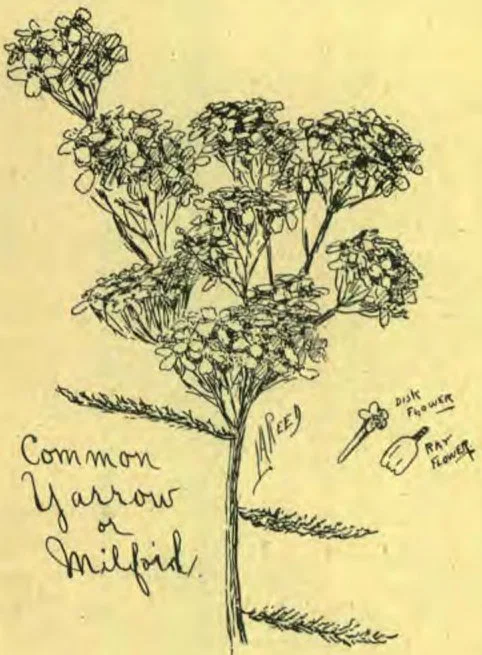
Achillea Millefolium is the botanical name of one of the most common weeds that grows in this country. Achilles is said to have been the first to discover its healing properties, and on this account we have the first of its two names. The second name, which botanists call the specific name, is derived from mille, “thousand,” and folium, “a leaf;” that is, thousand leaves, evidently from its finely cut, much divided, tansy-like leaves.
This plant belongs to the Composite Family, along with ironweed, asters, fleabane (already described), daisies, goldenrod, ragweed, sunflower, marigold, dog-fennel, tansy, wormwood thistles, and burdock. If you look carefully at the flower-head of the Yarrow, you will notice that what appears at first glance to be one large flower is really a bunch of smaller flowers. What looks like the center of the single flowers is really a bunch of what are called disk-flowers. They are something the same shape as the single blossoms in the flower-head of the lilac. The ray-flowers are a brighter white, and look something like a paddle with a very short handle. The disk-flower is the flower that produces the seed; the ray-flower is for display, and is a sort of sign that the flower hangs out to attract insects, which help it to produce seed by bringing about fertilization.
The flower-heads of the yarrow that I have seen are a grayish-white, but I have heard of a pink variety. Among the common people for many centuries, yarrow-tea has been used as a medicine. The plant has a strong herby smell, not at all unpleasant. There is a small steamboat-landing and settlement in southwestern Oregon, within sound of the roar of the Pacific Ocean, which, from its immense fields of the weed, has been called Yarrow.
L. A. REED.

GARNET GIRLS

A KIND friend gave me, the other day, a little bit of solid flame, which had been chipped from a rocky ledge in far-off Alaska. It is a crystal, about one inch long, with some two dozen faces of regular shape. It is that wonderful compound of quartz and iron and the aluminum of common clay which is called a garnet, the pomegranate stone.
Its color appears to be a deep reddish-black; but as you turn it over listlessly, you soon see that something marvelous lies beneath the dull surface. In the garnet's interior, under this angle as I am now looking at it, lies a crumpled plane of orange light, with a deep-blue square at one corner. Below that face runs a single vein of the most vivid scarlet imaginable. I turn it to a different light, and all this projecting pyramid flashes out with wine-hued fire. In one part lies a nest of rubies; in one, a tangle of pink flakes. The most sullen portions of the crystal, seen at the right angle, glow with the most superb colors. And I often plunge below the stupid surface of my garnet, exploring, fascinated, its flame-caverns, and meeting rich color-treasures at every turn.
It may be a foolish fancy of mine; but, do you know, I can never look at that masked battery of beauty without thinking of some garnet maidens I have known. Dull girls they were to the careless eye. Irregular features and poor complexions and coarse hands they doubtless owned. They were not skilled in repartee. Yet daily, as their lives turned before me, beautiful surprises would flash out. A rich, red love would kindle the rude features. A golden reverence would light up the small, gray eyes. Some deed of tender sacrifice would transform the skin to softest pink and white. Pale lips would glow like rubies with sweet words. And as I came to know the spirit of light that dwelt within the dull bodies, I would call them my garnet girls.
Jewelers sometimes take these deep-colored garnets, and hollow them out, fill them with silver, or back them up with a silver plate, so that all their beauty lies on the outside, ready for the passing glance. No more mystery, no more charm of discovery and delight of sweet surprises. Garnet girls, watch, lest that sad thing happen to you! Hollow-headed, shallow-hearted women with a silver backing may be admired by the careless and the thoughtless; but God is the best artist to fashion a human gem, and nothing in all fashion's show-cases is half so beautiful as his garnet girls.—Amos R. Wells, in “Sermons in Stones.”

BE STRONG

Be strong! We are not here to play, to dream, to drift. We have hard work to do, and loads to lift. Shun not the struggle. Face it! ’Tis God’s gift.
Be strong! Say not the days are evil. Who’s to blame? And fold the hands and acquiesce,—oh, shame! Stand up, speak out, and bravely, in God’s name.
Be strong! It matters not how deep intrenched the wrong, How hard the battle goes, the day how long; Faint not,—fight on! To-morrow comes the song.
— The Sunday School Times.

Sacred Silences of the Soul

Our souls have sacred silences, and we Tread softly where their mystic byways lie; God speaks to us from thorn and budding tree, And heaven bends lower than our childhood's sky! — Antony E. Anderson.

THE BURRO-BACK RIDE

“Oh, there is Don Pedro!” small Dolly Bell cried; “Come, girls, let us go for a burro-back ride! And as I'm the youngest and smallest,” said she, “To let me be first I know you'll agree.”
“A burro-back ride you shall have, one and all; Although you can not have the first one, Miss Doll; Because, as you know, old Don Pedro is mine, So I'm going first,” said Maria Trevine.
“I never heard any one talking so mean; I'm really surprised,” said Cicely Green. “When I'm here to visit, 'tis only polite That I should ride first. Now isn't that right?”
“Now, girls, let me tell you, you're every one wrong—I'll show your error,” said Isabelle Young; “For I am the eldest, and tallest, and so 'Tis 'age before beauty,' you very well know.”
“O girls! let's not quarrel over matters so small; Don Pedro is able to carry us all!” So they filled all his back, from his neck to his tail,—But the patience of even a burro will fail.
In vain alike coaxing, and punching, and blows, And the sweet, tempting carrot in front of his nose: Up and down, on the very same spot, did they get,—This sadder and very much wiser quartet.
ELIZABETH ROSSER.
Continue reading: THE STRANGE FREAK OF A CAT