WE had all gathered around the wide fireplace, and were watching the unsteady play of the flames, and the flickering of the shadows on the wall. This was the fourth evening we had been at grandma’s, and we remembered with regret that we had only two more to spend thus. It was not often we visited her, for we lived a long way off; but the roomy, old-fashioned farmhouse, with its setting of trees and smooth fields, its every path and wood and brook so interwoven with our childish memories, had a charming fascination for us, which time and the absorbing cares of middle life could not utterly efface.
The two-year-old baby had climbed into the huge rocking-chair where grandpa sat in a reverie, and perched on one of the arms; and little Lois suddenly left her place by the fire, and, going over to grandma, sat down on the floor, with her head in that sunny-faced lady’s lap, and begged for a story. Grandma smiled, and stroked the wavy hair, but put the little maiden off with, “Wait a bit, dearie,” while she settled her head back, and once more watched with thoughtful eyes the glowing coals and dancing flames.
Now and then she stroked the little head, saying, softly, “Pretty kitty, pretty kitty.” By and by there was a sudden thump in grandma’s lap, and that same little head bobbed up to encounter the round eyes and furry countenance of the family cat. There was a laugh,—one of those that sound like babbling brooks,—and grandma’s eyes sparkled with stored-up sunshine as she stroked the heads of both pets.
“Ah!” she said, after a time, “I had a kitty once, a white one. She had a nest up in the open chamber, just where the big chimney went through, and where in the winter there was always a corner warm enough and secluded enough to satisfy the most fastidious pussy. There were only two finished rooms on the second floor; and one day in early spring, on going into this open chamber, which was used as a sort of storeroom, I found a nestful of kittens. Three were dark-colored, but one was white like its mother. Old Snowball seemed very fond and careful of them all; but sometimes I fancied she washed the fur of the white one a little the oftenest.
“In those days I was spryer than I am now; and partly to add to my limited income from the farm products, and partly because I liked them, I raised ducks. You know no young fowl is quite so cunning as a baby duck—just a little, soft, yellow, waddling ball of down. Well, when those kittens up-stairs were about five weeks old, a proud old duck out in the barn was carefully sheltering a nest of these downy little balls. In a day or two she led them out across the small pen where they were confined, and introduced them with much concern to everything in which she thought them likely to be interested. It was not long before they learned to nibble at the fresh sod thrown over to them, and to swim and dive in the pan of fresh water kept in the middle of the pen; and often I would find the brood dozing in the warm sunshine that came through the single window.
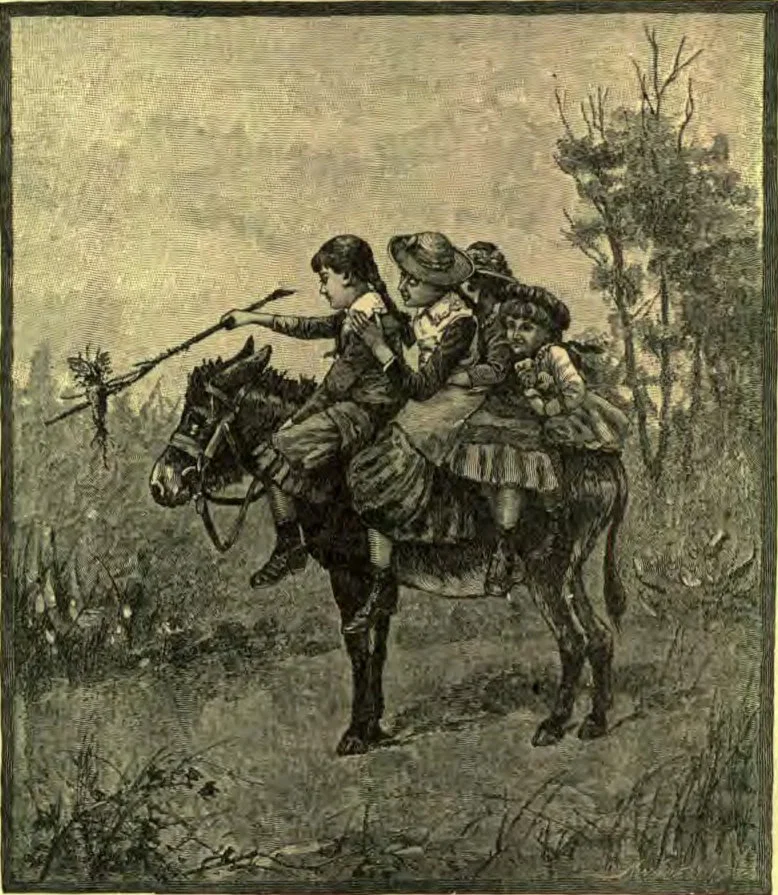
THE SWEET, TEMPTING CARROT IN FRONT OF HIS NOSE
“Snowball admired the little ducks, too, and even left her own babies for an hour at a time to sit on the edge of their pen and watch them; at last she grew bolder, and took up her station inside the pen, lying on the floor, her head on her paws. At first the ducks seemed to object; but finally they became accustomed to Snowball’s daily visits, and paid no more attention to her. In the meantime they had grown stronger; and the weather being warm, were allowed the freedom of the yard, returning to their pen only at night.
“But I am ahead of my story,” grandma said, patting the child’s smooth cheek. “There were eleven of these ducks, and all but one were of a yellowish-brown color. That was at first a deep yellow, and consequently the most noticeable, and rather the prettiest, of them all; but as it grew, the color seemed to fade to whitish, and I knew from experience that it would be white when grown, though the general color of the ducks I raised at that time was a mixed brown or black. Pussy seemed to detect this difference, too, and to develop for the little yellow duck a fondness, which she showed in various ways as she watched the brood about the yard. She divided her time between the young ducks and her kittens, and seemed unconscious of everything else as she lay quietly watching the young ducklings trail after one another in the short grass, nipping it here and there, or pushing their flat bills ahead of them through the mud that lined the shallow puddles.
“Whenever she thought the distance between them had so much increased as to be unfavorable to the exercise of her admiration, or affection, or amusement, whichever it was, she would walk slowly toward them, settling down again as close to the little yellow duck as its nearly constant motion or the presence of the others would permit. Once when she brought a mouse and laid it down before her pet, she realized that she had made a mistake; for it slowly turned tail-to, and walked away, looking at the strange object, first with one eye, then with the other, over its back. Snowball sat for a minute, her long tail whisking the grass uneasily; then she picked her burden up meekly, and slunk noiselessly up the stairs, as if she hoped no one had witnessed the experiment. She knew where the mouse would be appreciated.
“The doors of the house almost invariably stood open through these sunny spring days. I liked the scent of the fresh earth, and the sound of bird songs, and the feeling of the invigorating spring air, that floated in to me at my work. One day a plaintive ‘peep! peep! peep!’ greeted me as I passed through the front of the house; but supposing it came from outdoors and being busily occupied, I scarcely noticed it till again, on passing in the same direction, I heard the same sound. I followed it to the head of the stairs, then across the chamber to the chimney corner; and there, in Snowball’s nest, was the little yellow duck. She and her babies were curled up cozily, and the kittens were taking their supper, while their mother was intent on holding the little alien close to her side with one paw. It did not seem to enjoy its position, and was offering a feeble resistance. I returned it to the pen, but again and again it was found in the chamber. Snowball carried it carefully in her mouth, as she would one of her own kittens; and in vain I scolded her, and shut the ducks away from her for days at a time,—she always took the duck to her nest when it was allowed its freedom again. The duck did not thrive. Its mates outgrew it, and in the late summer it died. The children buried it after the manner of deceased pets, and often told their playmates about the odd freak of the cat that tried to adopt a young duck.”
MARIAM E. WEBBER.
AUGUST STUDY OF THE FIELD
PART III: "THE PEOPLES OF RUSSIA"
(August 12-18) *
1. Basis of Study.— As the different nationalities represented in the Russian Empire are treated quite fully this week in the article in the Missionary Magazine, instead of preparing additional notes on this subject we have culled from "Historical Sketches" a few paragraphs from a report of one of the first missionary visits into this country ever made by a Seventh-day Adventist minister. A brief view of his experience will no doubt add to the interest as well as benefit to be derived from a study of this vast field. Let us bear in mind that the message is due to Russia just as it is due to the United States, and that some will be called to carry the light of truth to its many peoples.
2. How the Message First Reached Russia.—God, in his wonderful providence, opened the way for the truth to reach Russia by repeating the experience of the Pilgrim Fathers. Thousands of earnest souls, attracted by the story of a distant land, where civil and religious liberty was granted, left Russia, and crossed the Atlantic to find homes in America. Not only did they find homes and freedom, but some received the precious message of mercy for the last days. Erelong the light found its way back to their old homes near the shores of the Black Sea, at the foot of the Caucasus Mountains, and along the great River Volga, to the very border of Asia, the cradle of humanity and religion. Soon the Macedonian cry was raised, "Come over, . . . and help us."
3. Elder Conradi Went to Russia.—In answer to these calls Elder L. R. Conradi went to Russia during the summer of 1886. One incident occurred on the way, which showed that the Master had a care for his child as he entered this benighted land. He made the acquaintance of a German minister, who had been converted from Judaism, and had united with the Presbyterian Church. From him he learned the difficulties of trying to enter Russia as a minister of the gospel. Fortunately, Elder Conradi had served as an apprentice in our publishing house at Battle Creek, and could enter as a printer; thus he profited by the experience of the other minister, and was able to secure his passport, and enter without molestation.
4. Imprisonment.—Elder Conradi had united with him in labor a brother who understood both the German and Russian languages, who served as interpreter. They had spent about two weeks in active labor in the Russian field, visiting several companies of Sabbath-keepers, besides organizing one church and speaking to large audiences in friendly German communities, when both were arrested and hurried off to Perekop, where they were imprisoned for five weeks, during which time it was almost impossible for them to receive or convey information to their anxious friends. The charge upon which they were arrested was that they were teaching Jewish heresy. The usual penalty for this offense was exile to Siberia. This charge, made in anger by a gentleman whose family were deeply interested in a discourse by Elder Conradi on the Sabbath question, might have resulted in a long imprisonment, without trial, had not the American minister at St. Petersburg taken active and energetic measures to secure the release of these brethren. In this case, as of old, the imprisonment of the minister resulted in the "furtherance of the gospel," for the report of the arrest, imprisonment, and release of Elder Conradi and his companion went everywhere, and aroused much inquiry as to the doctrines they taught, and opened the way for other reading-matter to be circulated, and, later, for the labors of the minister.
5. Religious Toleration.—While the government of Russia tolerates many creeds, the toleration is somewhat peculiar. Every one is free to practice the religion of his fathers; he can also leave other denominations and join the Greek Church; but woe to the man who tries to leave this church to join another. The "Orthodox," as the Russians style themselves, are encouraged to proselyte; but if another dares attempt it among them, he is liable to be exiled to Siberia. The fact is that while the state church is ready to receive from all, she gives to none. Notwithstanding this, there are many sects among the Russians, some numbering millions; and many are won to the Protestant faith. But the greatest care has to be exercised by all dissenters who labor there, and nearly all that is done is accomplished by colportage. As preaching is forbidden, the believers have only so-called "experience meetings," in which the leader, remaining in a sitting position, reads from the Bible, and comments as he goes. The laborer is very careful that his converts shall never mention him, but the Bible, as the cause of their change of faith. Yet as these converts are closely questioned by the priest, then by the bishop, and finally by the civil authorities, the work is always attended with considerable danger.
6. Leaving Russia.—After laboring about five months, Elder Conradi thus describes his experience when almost across the Russian border: "On the evening of October 6, we reached Alexandrov, the border station. Here our passes had to be given up to the police for examination; and while they looked them over, I went to a restaurant for supper, as I had had nothing to eat all day. Hardly had I commenced my meal when an officer called out some name. I listened—it was mine. For a moment I grew pale, wondering why I should be singled out among so many passengers, after all the care I had taken to get my pass in order. Could it be that I was again arrested, when almost beyond danger? Once more he called, and this time more sharply. I arose, and told him that I was the person. In a harsh tone he bade me follow him; and we entered a room where a number of officers were receiving the passes of the passengers. There I was informed that the officials in one place had neglected to affix the stamp to my pass. I never paid thirty cents more cheerfully in my life. I went back to the restaurant, finished my supper, and then entered the German cars. A few moments later the officers returned our passes, the engine whistled, gave a few puffs, and soon we crossed a little stream—thank God, in Germany."
7. Dangers and Difficulties.—The Russian Mission has been opened. Not without cost, it is true: dangers and difficulties are still in the way. Imprisonment and persecution threaten the laborer. The preacher is not at liberty to present the message; but as it is God’s cause, who can hinder? Satan is fully aware that there is a vast field opened in Russia; and he uses every means to bar the entrance. But could the veil be lifted, we should see hundreds and thousands of Germans in Russia, yes, and Russians also, who are investigating the truths of the last message. Of those who are obeying, some, notwithstanding the dangers, are nobly dedicating themselves to the work. The truth has found an entrance in this empire; the seed is already planted; and, God giving the increase, it will undoubtedly grow and prosper, so that a number from this nation also may be among the one hundred and forty-four thousand.
DON'T SKIM IT FIRST
Somebody quotes a quaint old grandmother as saying, “If you're going to give me a pan of milk, don't skim it first.” Most of us would be indignant if accused of such smallness; but a recent writer shows that very much the same thing goes on in ordinary family intercourse.
“Another errand? I can never go down town without half a dozen commissions!” complains Rob, when his sister asks him to bring a book from the library. He never refuses to oblige her; he does not really count it an inconvenience; he only takes the cream off his kindness.
“Those gloves ripped again!” exclaims Mary, when John wants her to take a few stitches. “It seems to me they always need mending when I am in a hurry with something else.” She would be shocked at his going shabby, and distressed if any one thought her unwilling to render such offices; but she makes it a little unpleasant to ask the favor.
The children follow the fashion. Tommy shuts the door at Bridget’s request, but he grumbles at having to leave his top. Susie goes to the door when she is sent, but she departs with a protest that “it is Tommy’s turn.” Thus all day long, people who love one another, and who at heart are glad to serve one another, skim the sweetness from every service they render.—Selected.
“AS YE WOULD”
By Edith V. Bradt
If I should see
A brother languishing in sore distress,
And I should turn and leave him comfortless,
When I might be
A messenger of hope and happiness,
How could I ask to have what I denied
In my own hour of bitterness supplied?
If I might share
A brother's load along the dusty way,
And I should turn and walk alone that day,
How could I dare,
When in the evening watch I knelt to pray,
To ask for help to bear my pain and loss,
If I had heeded not my brother's cross?
If I might sing
A little song to cheer a fainting heart,
And I should seal my lips and sit apart,
When I might bring
A bit of sunshine for life's ache and smart —
How could I hope to have my grief relieved,
If I kept silent when my brother grieved?
And so I know
That day is lost wherein I fail to lend
A helping hand to some wayfaring friend;
But if it show
A burden lightened by the cheer I sent,
Then do I hold the golden hours well spent,
And lay me down to rest in sweet content.
— Edith V. Bradt.
THE MEETING IN JERUSALEM — A QUESTION OF SALVATION
The Lord had given Peter a lesson concerning the gospel’s going to the Gentiles. Read carefully the account of this in Acts 10. Read also Acts 15 : 12–29, to learn the outcome of this council in Jerusalem. A decision was reached that the Lord approves in his word. Read again the first chapter of Galatians, also chapter 2 : 1–6. Notice that the question that troubled the Galatians was the same question that was considered in this council in Jerusalem.
QUESTIONS
1. To what place did Paul and Barnabas return after their missionary journey? Acts 14 : 26. Who else came to Antioch about this time? What did they teach? Acts 15 : 1.
2. What experience did Paul and Barnabas have with these men? What was it finally decided to do? Who were to go to Jerusalem? V. 2. How does Paul say he was led in this matter? Gal. 2 : 2.
3. Through what parts of the country did they pass? What message did they bring to the brethren in these places? How was it received? Acts 15 : 3.
4. By whom were they received at Jerusalem? What account did they give of their work? V. 4.
5. How did certain men criticise Paul’s work among the Gentiles? V. 5. What kind of brethren does Paul say these were? Gal. 2 : 4.
6. By whom was the matter considered? Acts 15 : 6. After much discussion, who rose to speak? Of what experience of his own did Peter remind them? V. 7.
7. To what experience does Peter doubtless refer? See Acts 10. What did God do for the Gentiles who believed? Vs. 8, 9.
8. What question did Peter then ask? What does he say of this yoke? V. 10. How does he say both Jews and Gentiles are saved? V. 11.
9. How does it differ from Christ’s yoke? Matt. 11 : 30. How did this teaching about circumcision tend to lead men into the bondage of sin? Note 1.
NOTE
1. The gospel saves men by faith, not by works. To require the Gentiles to be circumcised in order to be saved would be to lead them to trust in their own works for salvation. But our salvation is wholly of faith, so that anything that leads people to trust at all in themselves for salvation, is contrary to the gospel, and brings them again into the bondage of sin. “For whatsoever is not of faith is sin.” Rom. 14 : 23. And sin is bondage. Prov. 5 : 22. The rite of circumcision was first given to Abraham as a “seal of the righteousness of the faith which he had yet being uncircumcised.” Rom. 4 : 11. He believed God, and the Lord accounted him righteous because of his faith. Afterward he was circumcised. Plainly, then, circumcision did not make him righteous. Abel, Enoch, Noah, and all the righteous who lived before Abraham’s time, were also saved by faith, but without circumcision.
AN OLD COLLEGE
THERE is an interesting study for students in 2 Kings 6 : 1–7—experiences in a small college of olden times.
We may study it under two heads—(1) The Students; (2) The Professor.
THE STUDENTS
1. The students were a typical class.
2. The students were poor, for they must avoid expense.
3. The students desired education, and were willing to endure privation to get it.
4. They were humble—witness the style of living planned by themselves.
5. They were co-operative—“Every man a beam.”
6. They were not afraid of work—“They cut down wood.”
7. They were not the best of workmen, for they used borrowed tools. A good ax would have been wedged to the helve.
8. They were conscientious and honest. The one who lost his ax-head was troubled, because “it was borrowed.”
9. The students were helped of the Lord—“The iron did swim.”
THE PROFESSOR
1. The professor was an exceptional man.
2. He was a man who had managed large affairs.
3. He was a spiritual man. Elijah had the Spirit of God, but this man had a double portion of it.
4. He gladly consented to wise petitions from students. He said, “Go ye,” and, “I will go” with you.
5. He superintended the work of students, and was with them in their struggles and necessities, thus imparting to them by his life what he could not have imparted by his tongue.
6. He called to his help and theirs the strength of God.
Such schools, with such a professor and such students, with such environments and such purposes and struggles, will produce men of tact and men of honor. Great men arrive at greatness through manifold victories over self and temptation and hindrances and uncongenial environment.—Findlay College News.
— Selected
More faith, O Lord!
When trusted hearts deceive,
And friends let go my hand;
Strengthen me to believe
Thy love will ever stand.
More faith, O Lord!
More faith, O Lord!
When sorrow seeks my side,
And I am crushed with grief,
In thee let me abide.
Cast out my unbelief.
More faith, O Lord!
— Selected
A Bonanza for Live Agents!
MEN OR WOMEN
The Magic Pocket Vaporizer
Is one of the best-selling articles on the market to-day. Compact and effective, it appeals at once to the man or woman suffering from catarrhal affections.
Energetic agents throughout the country are making good wages by its sale.
It will be to your advantage to read every word of the following unsolicited letter from one of our salesmen:—
1101 LINCOLN AVE., SAGINAW, W. S., MICH., Feb. 6, 1900.
Modern Medicine Co., Battle Creek, Mich.
GENTLEMEN: I have canvassed the greater part of the time for more than thirty years, keeping my eyes open all the time for the best-selling books and other articles that might come upon the market, but do not hesitate to say your Magic Pocket Vaporizer is the best thing I have ever found to pick up money with. It is a real money catcher, as you will see by the following. On arriving in my territory, I went directly to work. At sundown that day I had sold four and taken five orders; the second day I put in about eight hours, and had fourteen in orders and sales. I can usually average eleven orders out of fifteen exhibitions, or a profit of from four to six dollars a day. I have succeeded in putting thirteen Vaporizers in one home, receiving $12.50 for them; eight Vaporizers in another family; five to a Baptist minister; three to another family. Yours truly, H. S. MERCHANT.
Write at once to the MODERN MEDICINE COMPANY, 105 Washington Ave., Battle Creek, Mich., for terms and territory.
To Reach BATTLE CREEK
FROM
CHICAGO, BUFFALO, DETROIT, OR TOLEDO,
Purchase Tickets
Reading over the MICHIGAN CENTRAL
“The Niagara Falls Route.”
A First-class Line for First-class Travel between Chicago and New York and Boston. Elegantly equipped through trains pass Battle Creek in each direction daily.
R. N. R. WHEELER,
Ticket Agent, Battle Creek. O. W. RUGGLES,
Gen’l P. and T. Agt., Chicago, Ill.
TAKE THE Canadian Pacific Railway
for . . . CHATHAM, LONDON, WOODSTOCK, PORTLAND, OTTAWA, GALT, TORONTO, and MONTREAL, QUEBEC, BOSTON,
All points in New England, the Maritime Provinces, Great Britain, and the Continent.
Illustrated literature, time-tables, and full particulars, upon application to—
J. FRANCIS LEE, GEN. AGENT,
Passenger Dep’t. 228 SOUTH CLARK ST., CHICAGO
Branch Offices: 76 Ottawa St., Grand Rapids, Mich.; Room D, Chamber of Commerce, Cincinnati, Ohio; 315 Chestnut St., St. Louis, Mo.
Cincinnati Northern Railroad Co.
TIME TABLE NO. 3.
IN EFFECT SEPT. 24, 1899.
Trains Pass Battle Creek, as follows:
WEST-BOUND.
No. 21, Mail and Express ................. 6.58 P. M.
No. 23, Accommodation ..................... 2.07 P. M.
No. 27, Local Freight .................... 8.25 A. M.
EAST-BOUND.
No. 22, Mail and Express ................. 8.25 A. M.
No. 24, Accommodation ..................... 1.45 P. M.
No. 28, Local Freight .................... 5.30 P. M.
Direct connections are made at Toledo with all roads diverging. Close connections for Detroit and Cincinnati.
J. L. READE, Ticket Agt., Battle Creek.
E. R. SMITH, City Pass. Agt., 6 West Main St.
E. W. Meddaugh and Henry B. Joy, Receivers,
CHICAGO & GRAND TRUNK R'Y.
By A. S. Parker
Trains arrive and leave Battle Creek.
WEST-BOUND FROM BATTLE CREEK.
No. 9, Mail and Express, to Chicago ... 12.15 P. M.
No. 1, Chicago Express, to Chicago ... 9.00 A. M.
No. 3, Lehigh Valley Express, to Chicago ... 3.40 P. M.
No. 5, Pacific Express, to Chicago, with sleeper ... 1.10 A. M.
No. 75, Mixed, to South Bend ... 8.20 A. M.
Nos. 9 and 75, daily, except Sunday.
Nos. 1, 3, and 5, daily.
EAST-BOUND FROM BATTLE CREEK.
No. 8, Mail and Express, to Pt. Huron, East, and Detroit ... 3.45 P. M.
No. 4, Lehigh Express, to Port Huron, and East ... 8.27 P. M.
No. 6, Atlantic Express, to Port Huron, East, and Detroit ... 2.25 A. M.
No. 2, Leh. Exp., to Saginaw, Bay City, Pt. Huron, and East ... 6.50 A. M.
No. 74, Mixed, to Durand (starts at Nichols) ... 7.15 A. M.
Nos. 8 and 74, daily, except Sunday.
Nos. 4, 6, and 2, daily.
A. S. PARKER, Ticket Agent,
Self-Pronouncing S. S. Teachers’ Reference Bible.
CONTAINS the celebrated Teachers’ Helps, comprising nearly 400 pages. Also a complete series of fifteen new maps.
Description. — Imperial Seal Binding, Tuck Edges, known as “Divinity Circuit,” Rounded Corners, Full Red under Gilt Edges.
We offer this Bible, post-paid, for only SIX NEW YEARLY SUBSCRIPTIONS at 75 cents; or TWELVE NEW SIX MONTHS’ SUBSCRIPTIONS at 40 cents.
We will also send it, post-paid, with the INSTRUCTOR one year for $2.25. For 20 cents extra we will stamp your name in gold upon the cover.
A CALL FROM INDIA
Many readers of the Instructor will remember the call made through these columns about a year ago for money to send our youth’s paper to a school in India, where it has gone for several years, and where it is read and valued. At that time a portion of a letter from a returned missionary, Miss Anstice Abbott, who was interested in this school, was printed; and some of you may remember her earnest plea that the papers might not be discontinued, but might still be sent to that distant land to continue their mission of “making the paths straight for the King of glory.”
Through the kindness of friends who read the Instructor, and who love the truths it stands for, and are anxious that others may come to a knowledge of them, enough money was raised to send a club of twenty-five papers to this school. Now the time has come when we should begin to send in contributions that the club may be continued. A small gift from each one who can spare something for this work will, we are sure, be sufficient to extend the grant of papers for another year—and should there be anything over, there are unanswered calls from Sumatra and China and other needy fields. Sabbath-school classes will find a blessing in working together for the amount they wish to give; others might try a “self-denial” week; and still others can earn the money in some way—there will surely be a way for those who wish to find one.
Miss Abbott has been for some time in this country, and has spoken in behalf of her special work in India in many places. On August 4 she left New York City, “to return,” as she says, “to the land of sorrow and misery.”
In a recent letter, after speaking of the famine in India, and the dire need of that great country, in view of the prevailing distress, she says:—
“I suppose that those to whom the Youth’s Instructor has been sent, being of the high and educated classes, have not actually suffered from want. Some may have fallen from cholera, or plague, yet I have not heard any such news.”
“This fearful famine has some bits of light about it—enough to show us that our Heavenly Father has not forsaken that nation, although he is bringing severe chastisement upon it. Thousands of persons throughout all India are appreciating the love that is trying to help them; and as a result they are willing and anxious to hear the gospel as they have never been before. Then, too, the law of caste is being wonderfully undermined. The common distress brings high and low together in many places; and for them the power of caste is broken forever. The most direct good is seen in the thousands of children, some say twenty thousand, who will eventually come under the care of the missionaries all over India. Not only children, but child-widows, many of them are.”
“My Widows’ Home is full to running over, they write me, and ask whether they may rent another house to take those who are begging to be taken in. I take widows young and old, with their little children—those who are too young to be sent to our boarding-schools.”
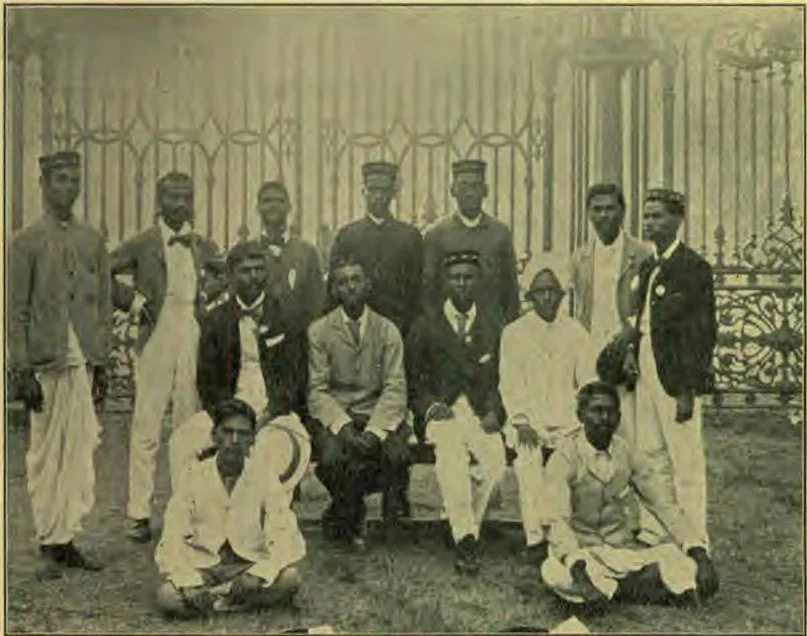
“After my return to India [this was written shortly before Miss Abbott’s departure], I will try to get some photographs of the Hindu young men who read the Instructor. With this I send a picture of some Christian young men who read, and greatly enjoy, the paper.”
The accompanying illustration was made from the photograph sent by Miss Abbott. Surely the opportunity we have of sending our paper to our brothers in India is one we should be not only willing, but glad, to improve. Who will be the first to respond to this call?
In sending your contribution, mark it plainly, “For the Instructor Mission Fund.”
Heart Sunshine: The Jewel of a Willing Heart
CHRISTIAN YOUNG MEN WHO READ THE INSTRUCTOR
HEART-SUNSHINE—the kind that does not go under a cloud when dark days come, and that is unaffected by the season’s changes, shining as brightly in gray November as in sunny June—is such an invaluable possession,—such a jewel of great price,—that the wonder is that all do not strive to obtain it. A willing, obedient heart, lighted by God’s smile, will always overflow with this sunshine. No clouds can hide it, no biting wind of unkindness or misunderstanding can chill its warmth; for its source is with him who is the Light of men, and in whom is no darkness at all.
Smallpox Cases in Chicago and the Unvaccinated
ACCORDING to the Teachers’ Sanitary Bulletin, published at Lansing, Mich., by the State Board of Health, “every case of smallpox in Chicago during the last fifteen months, both the imported cases and those contracted by residents from the imported cases, has without exception been unvaccinated. There has been no case among the vaccinated. The verdict of the medical profession at the end of a century of vaccination is that, with the exception of a small number of insusceptible individuals, every unvaccinated person would contract smallpox in the course of a natural life, if exposed to the contagion; and fully one half of those attacked would die, while of the survivors a large number would be hideously disfigured, maimed, and disabled. On the other hand, if efficiently vaccinated and revaccinated, an equally infinitesimal number of hypersusceptible individuals would contract the disease on exposure, and of this small number less than one in a hundred would die. One tenth of the human race, on the average, died annually of this disease for centuries before the discovery of vaccination.”