The Youth’s Instructor, Vol. 30, No. 29.

BISHOP CRANMER

The Youth’s Instructor

Jul 19, 1882

S. D. A. Publishing Association · Battle Creek, Mich. · Jul 19, 1882

BISHOP CRANMER.

THIS great man took as important a part in the Reformation of England as did Bishops Latimer and Ridley, whose cruel martyrdom was related a few weeks ago. Born in 1489, he early became connected with the government, being sent by King Henry VIII. to transact business with several of the chief courts of Europe, and with the pope at Rome. His success was so satisfactory to the king, that on returning home, Cranmer was made Archbishop of Canterbury, the highest office of the church in England. This office gave him the privilege of crowning the kings and queens of the realm.
Now this man started out in life a Catholic in faith and practice, and while doing business for the king on the continent of Europe, he visited the Lutherans in Germany for the purpose of restoring them to the faith. But instead of accomplishing his purpose, they converted him to their belief. So when Henry VIII. threw off the yoke of the pope, Cranmer was glad of it, and did all he could to help on the Reformation. Although he differed from the king in some of his beliefs and practices, and wished him to lead a better life, yet they both continued friends till the king’s death; and it was wholly owing to Henry’s protection that the enemies of Cranmer were prevented from taking his life during that king’s reign.
During the first few years of the reign of Henry’s successor, Edward VI., the government was carried on by a body of men called the Council of Regency, because Edward was too young to be king. Cranmer was a member of that body, and used the power which the position gave him, in establishing the Church of England. He labored hard to put the Bible into the hands of the people, and a large number printed in his lifetime, had his picture printed on the frontispiece. His system of church government and form of worship have been changed but little to this day, so that the Church of England still stands a monument to his learning, foresight, and ability.
It would be of great interest to know the complete history of his life, but you are all anxious, no doubt, to know how he came to die. So you will now be told the story of his martyrdom, and when you are older you may be able to read the book entitled, “The Life and Times of Thomas Cranmer,” which will tell you all about the man.
You perhaps remember that Queen Mary reigned next after King Edward. During her reign, when Latimer and Ridley were taken from prison to Oxford, to dispute with the learned men there, Cranmer, who had then been imprisoned some time, was taken with them for the same purpose. As with the other two men of God, so with him; his enemies could not prevail in argument, and could only use their power in sentencing him to death.
He was not condemned at once, however, but after suffering a long and cruel imprisonment was led to hope for pardon and life if he would recant. That is, if he would sign certain papers stating that he did not believe what he had preached concerning the Roman Catholic church. In a moment of weakness, he consented to do so; but soon afterwards he bitterly repented his cowardice. He made a public confession of his weakness and sin in recanting, and wept so exceedingly that many, even of his enemies, were moved to tears, to see him suffer such anguish of mind. Being sentenced to be burned alive, he said that his unworthy right hand should be burned first for having written contrary to his heart.
He was brought to the same spot, where, about five months before, Latimer and Ridley had sealed the truth with their blood. Here he made a short prayer, and then gave himself into the hands of the executioners. He wore a long shirt, reaching to his feet, which were bare.
When his cap was removed, his head appeared perfectly bald. This, with his long beard, gave him so venerable an appearance that one of his most bitter enemies said: “I think there was none that pitied not his case, and bewailed not his fortune, and feared not his own chance, to see so noble a prelate, so grave a counselor, of so long continued honor, after so many dignities, in his old years, to be deprived of his estate, adjudged to die, and in so painful a death to end his life.” As the flames arose, he thrust his right hand forth to meet them, and held it there until all the people could see it burning, before the fire reached any other part of his body, saying at the same time, “This hand hath offended! This unworthy right hand.” He remained as immovable as the stake to which he was chained, and the only words that escaped his lips were, “Lord Jesus, receive my spirit.”
C. H. G.

Trusting God's Protection in the Path of Duty

MAKE the best use of what you have, and then you may look to the Lord with confidence for more. In the path of duty, God promises his special protection. He will keep us safe and bless us.

THE USEFUL PLOW.

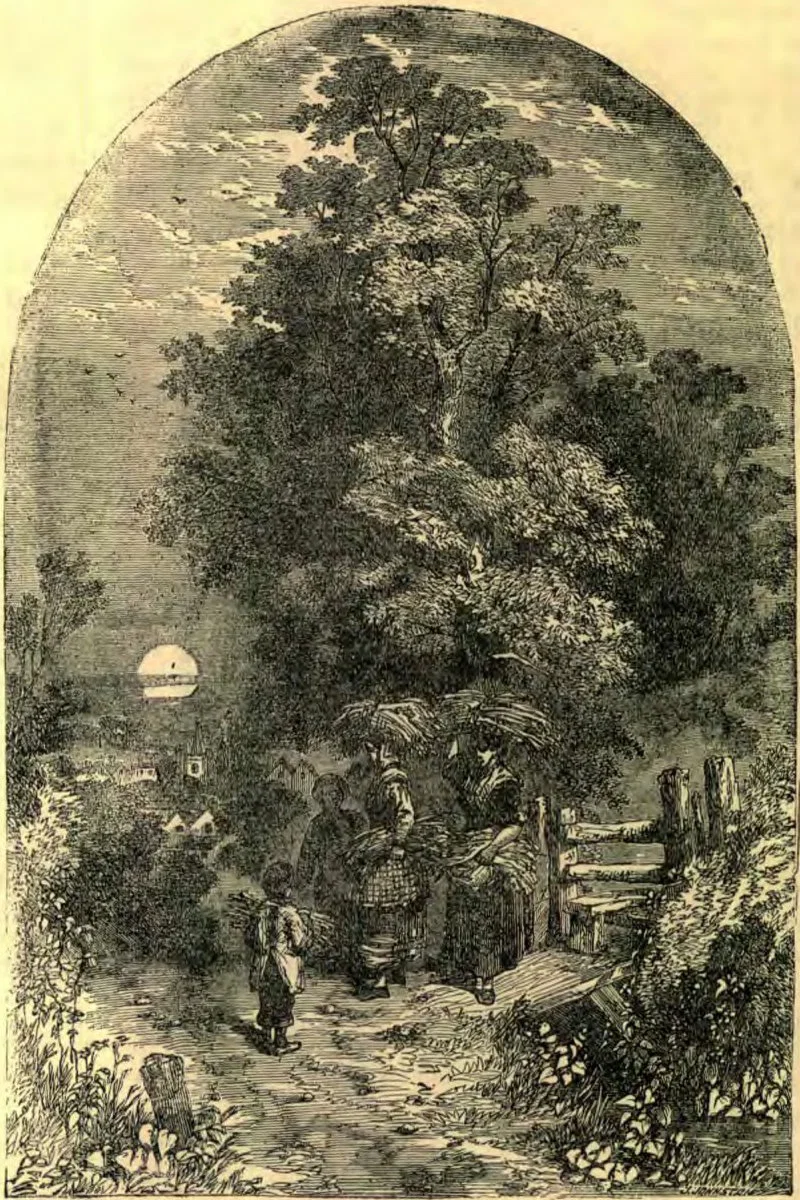
A COUNTRY life is sweet! In moderate cold and heat, To walk in the air how pleasant and fair! In every field of wheat, The fairest of flowers adorning the bowers, And every meadow’s brow; So that I say, no courtier may Compare with them who clothe in gray, And follow the useful plow.
They rise with the morning lark, And labor till almost dark, Then folding their sheep, they hasten to sleep, While every pleasant park Next morning is ringing with birds that are singing On each green tender bough. With what content and merriment Their days are spent whose minds are bent To follow the useful plow! —Selected.

BEARING ONE ANOTHER'S BURDENS.

It was the afternoon of a sunny day, and little Lottie, after vainly trying to study indoors, brought out book and slate, and seated herself on the doorstep of her mother's cottage, hoping to find some freshness there.
“Well!” exclaimed her brother Willie, as he leaned against the wall laughing, “you look as forlorn as a sparrow in winter, your hair stands up like feathers. I have finished my tasks; they are easy enough, and I see yours are not even begun. Do you think sums are to be done by staring?” and he laughed again.
The perplexed look on Lottie's face deepened into sadness, but she did not raise her head. Willie was clever, and learned things quickly, while she often could not understand what she had to do.
It was very hot, the slate—an old one—was very greasy, and the crack seemed to come in the most awkward part, and confuse all the figures. Big tears gathered in Lottie's eyes, and she tried to wipe them away without attracting Willie's notice.
“Crying again!” he exclaimed. “No wonder the boys mock me for having such a stupid sister.”
“I am not stupid at everything, Willie,” said the little girl gently, “and I think if you would help me a little, I could do better.”
Just then a boy's voice was heard calling “Willie, where are you? Come and have a game with us.”
Off ran Willie; for the village boys met together for play at this hour, and he did not wish to miss the fun.
He had a merry time, and was just turning homeward when Peter proposed a race.
As he was nearing the bottom of the hill, Willie's foot slipped, he fell, and Peter on top of him.
Of course he struggled up quickly enough, dusted his knees and elbows, and was starting afresh when he gave an exclamation of dismay. He had split his jacket right across the shoulders. This was a misfortune indeed. Willie was always neat in his dress, and was particularly proud of this nice jacket. Now he had spoilt it entirely. And how could he go to school in rags?
Lottie was still sitting on the doorstep when Willie returned. The sum was done, but she knew it was wrong. Her spelling was learned, but she feared that a scolding for her bad Arithmetic would send it quite out of her head. She looked up as heard Willie's step, and was amazed to see him come slowly along, with a face as woe-begone as her own.
Now Lottie, with few opportunities for learning about good things, had one great treasure, a little brown book which she dearly loved. In this book were some words written to people who did not know what they ought to do, in order to please and obey the Lord Jesus, who died to save us from our sins. These were the words: “Bear ye one another's burdens, and so fulfill the law of Christ.”
Lottie often thought about them, because, being a quiet, gentle child, she noticed people in trouble, and was able to help and comfort them sometimes. This made her glad, for she said to herself, “Although I am so stupid, yet in this way I can keep the commandments of Jesus. He said ‘If ye love me, keep my commandments,’ and I do love him.”
In a moment she ran up to Willie, and asked what had happened.
At first he would not tell her, but a stray sun-beam, dancing down, quickly showed the mischief.
Lottie got him to take his jacket off, and then examined it carefully.
“I can mend it, Willie,” she said brightly. “It will take a long time, but I am almost sure that I can manage so that the slit will hardly show.”
And with a light heart Lottie took up her brother's burden. The torn jacket was a heavy trouble to him, though some boys would have cared little for it.
“Mother will not be home till late,” she said. “Don't you sit up for me. I shall have to work slowly if it is to be neat.”
So by-and-by Willie went to bed, while Lottie darned steadily on. Her eyes winked and blinked, her needle once or twice pricked her fingers, but at last the task was done, and the jacket, almost as good as ever, was hung by Willie's bed-side.
Willie awoke with his little sister's words ringing in his ears: “I am not stupid at everything.”
His eyes fell on the beautifully mended jacket, and again the soft voice sounded: “I think if you would help me a little, I could do better.”
“Ah, how kindly she has helped me,” thought the boy. “I wonder what put it into her head.”
But it was the voice of God in Lottie's heart that had made her act thus, and at last Willie heard it also.
“Here, Lottie dear,” he said, as they greeted each other in the morning, “bring me that sum and I will explain it. Perhaps I can make it clear to you.”
Thus that day Lottie walked to school with a face as bright as that of Willie.
It is a wonderful thing that the more of other people's burdens we carry, the less we have of our own.—Child's Companion.

THE LITTLE CHILDREN.

“Suffer little children to come unto me and forbid them not.”
Down from the long past ages, Down through the mists of years Cometh a ray of gladness Gleaming athwart our tears; Cometh a voice—how gentle, Tender and soft and low! As when he spoke of the “little ones” In the days of long ago.
Into our night of sorrow— Dark with a bitter pain, Fraught with a thirst for the cup of joy That cometh not again; His loving rebuke falls gently, And our grieving lips are dumb, “Suffer the little children, And forbid them not to come.”
“Suffer the little children,” O Saviour, unto thee, Into thy hands we give them, Forever thine to be. We know thy love is tender; We know thou knowest best; We know that in thy circling arms Our darling ones are blest. —S. J. Jones.

THE SEA CAPTAIN.

About fifty years ago a party were traveling in a stage-coach from one town to another in Scotland. A lady saw from the coach window a little barefoot boy walking along the highway. He looked so tired that she pitied him, and asked the driver to give him a seat in the coach, saying that she would pay for it at the end of the journey.
The lady asked where he was going.
“To the sea-coast,” he replied. “I want to find a captain who will let me go to sea with him as a cabin-boy.”
The lady talked kindly with him, and gave him some good, motherly advice. When she said “Good-by,” she slipped half a crown into his hand.
He went to sea, and that is the last we hear of him for twenty years. A stage-coach was going over the same road twenty years later, when a tall sea captain looked from the coach window and saw an old lady walking. He stopped the coach and asked her to get in, telling the driver that he would pay for the seat.
“I always feel like being kind to tired travelers,” he said. “Twenty years ago I was walking over this same road, a poor barefoot lad, when a lady stopped the coach and took me in.”
The lady looked at him a moment, and then exclaimed, much astonished, “Why, I am that very lady! I was rich then; now I am poor and alone.”
“Dear madam,” exclaimed the captain, “how glad I am to see you! I want to thank you for your kind words that day. I can never really repay you for the good you did me. But always after this you shall receive fifty pounds a year from my estate.”
This touching story shows how God remembers the kindness that we show to others. He often lets it come back to us just when we need it the most.—S. S. Visitor.

Doing Good Brings Love and Welcome

Do good and be good, and despite all that is said about this world's ingratitude, some one will love you and greet your coming.

The Five Loaves.

WHAT if the little Jewish lad, That summer day, had failed to go Down to the lake, because he had So small a store of loaves to show?
“The press is great,” he might have said; “For food the thronging people call; I only have five loaves of bread, And what are they among them all?”
And back the mother’s words might come, Her coaxing hand upon his hair: “Yet go; for they may comfort some Among the hungry children there.”
So to the lakeside forth he went, Bearing the scant supply he had; And Jesus, with an eye intent, Through all the crowds beheld the lad;
And saw the loaves and blessed them. Then Beneath his hand the marvel grew: He brake and blessed, and brake again— The loaves were neither small nor few.
For, as we know, it came to pass That hungry thousands there were fed, While sitting on the fresh green grass, From that one basketful of bread.
If from his home the lad that day His five little loaves had failed to take, Would Christ have wrought—can any say?— This miracle beside the lake?
—Children’s Friend.

THE WATER-BLOOM.

A CHILD looked up in the summer sky Where a soft, bright shower had just passed by; Eastward the dusk rain-curtain hung, And swiftly across it the rainbow sprung.
“Papa! papa! what is it?” she cried, As she gazed with her blue eyes opened wide At the wonderful arch that bridged the heaven, Vividly glowing with colors seven.
“Why, that is the rainbow, darling child,” And the father down on his baby smiled. “What makes it, papa?” “The sun, my dear, That shines on the water-drops so clear.”
Here was a beautiful mystery! No more questions to ask had she, But she thought the garden’s loveliest flowers Had floated upward and caught in the showers—
Rose, violet, orange, marigold— In a ribbon of light on the clouds unrolled! Red of poppy, and green leaves too, Sunflower yellow, and larkspur blue.
A great, wide, wondrous, splendid wreath It seemed to the little girl beneath; How did it grow so fast up there, And suddenly blossom, high in the air?
She could not take her eyes from the sight; “Oh, look!” she cried in her deep delight, As she watched the glory spanning the gloom, “Oh, look at the beautiful water-bloom!” —Celia Thaxter.

NEW-TESTAMENT HISTORY.

LESSON 31.—THE SECOND COMING OF OUR LORD.

When Jesus told the disciples that the time would come when the beautiful buildings of the temple would be entirely destroyed, they asked him at least two distinct questions. Instead of answering either question immediately our Lord first warned his disciples against being deceived by the false christs that should come in his name.
He then went on to give a brief outline of the history of the church and the world down to the end, speaking of the wars and the tumults that should arise, the famines and earthquakes, the sorrows and persecutions of his people, the unfaithfulness and apostasy of many, and winding up with the promise that all who would endure to the end should be saved, and with the assurance that the end would not come until the gospel of his approaching kingdom should be published to all nations.
Then, as recorded in verses 15–20, he speaks in answer to the first question. His mind seems to have immediately passed from the destruction of Jerusalem to the terrible sufferings which his people would have to endure before his second coming; for in verse 21 he takes up the subject of the great Papal Persecution, and runs rapidly down through the trials and dangers they would have to encounter, giving them suitable warnings and instructions. He then enumerates the signs that should begin to appear just before the close of the 1260 years, and gives in order the several events that pertain to his second coming,—the sign of the Son of man in heaven, the mourning of the tribes of the earth, the coming of Christ upon the cloud, the sounding of the trumpet, and the gathering together of his elect from all quarters of the earth.
After he had thus described the signs of his coming, he said, “And when these things begin to come to pass, then look up and lift up your heads; for your redemption draweth nigh.” And then, to make a still deeper impression, he gave the following parable:—
“Now learn a parable of the fig-tree; when his branch is yet tender and putteth forth leaves, ye know that summer is nigh: so likewise ye, when ye shall see all these things, know that it is near, even at the doors. Verily I say unto you, this generation [the generation which shall see these things] shall not pass away, till all these things be fulfilled. Heaven and earth shall pass away: but my words shall not pass away. But of that day and hour knoweth no man, no, not the angels of heaven, but my Father only.”
Then follows the solemn admonition: “Take heed to yourselves, lest at any time your hearts be overcharged with surfeiting, and drunkenness, and cares of this life, and so that day come upon you unawares. For as a snare shall it come on all them that dwell on the face of the whole earth. Watch ye therefore, and pray always, that ye may be accounted worthy to escape all these things that shall come to pass; and to stand before the Son of man.”
“For the Son of man is as a man taking a far journey, who left his house, and gave authority to his servants, and to every man his work, and commanded the porter to watch. Watch ye therefore: for ye know not when the master of the house cometh, at even, or at mid-night, or at the cock-crowing, or in the morning. Lest coming suddenly he find you sleeping. And what I say unto you I say unto all, Watch.”
“Then shall the kingdom of heaven be likened unto ten virgins, which took their lamps, and went forth to meet the bridegroom. And five of them were wise, and five were foolish. They that were foolish took their lamps, and took no oil with them: but the wise took oil in their vessels with their lamps. While the bridegroom tarried, they all slumbered and slept. And at midnight there was a cry made, Behold, the bridegroom cometh; go ye out to meet him. Then all those virgins arose, and trimmed their lamps. And the foolish said unto the wise, Give us of your oil; for our lamps are gone out. But the wise answered, saying, Not so; lest there be not enough for us and you: but go ye rather to them that sell, and buy for yourselves. And while they went to buy, the bridegroom came; and they that were ready went in with him to the marriage: and the door was shut. Afterward came also the other virgins, saying, Lord, Lord, open to us. But he answered and said, Verily I say unto you, I know you not. Watch therefore, for ye know neither the day nor the hour wherein the Son of man cometh.”

QUESTIONS.

1. What two questions did the disciples ask Jesus, when he foretold the destruction of the temple?
2. Did he answer either question immediately?
3. What did he do instead?
4. What did he then go on to give?
5. Of what particular things did he speak in giving this outline?
6. What promise did he make at the close of these remarks?
7. What assurance did he give with reference to his second coming?
8. Upon what subject did he then speak?—Matt. 24:15–20.
9. To what did his mind pass after speaking of the destruction of Jerusalem?
10. What does he take up in verse 21?
11. From that subject what did he pass on to notice?
12. What did he then enumerate?
13. What did he give in order?
14. Name some of these events?
15. After he had thus described the signs of his second coming, what solemn admonition did he give?—Luke 21:28.
16. What parable did he relate in order to make a still deeper impression?—Matt. 24:32.
17. How did he apply the parable?—Verse 33.
18. What did he say of the generation who should see these things?
19. What did he say about the certainty of the fulfillment of his words?—Verse 35.
20. What did he say about the day and hour of his coming?—Mark 13:32.
21. What important admonition did he give?—Luke 21:34.
22. Why are Christians to watch and pray always? Verse 36.
23. To what did he compare the Son of man?—Mark 13:34.
23. In applying this parable, what cause did he give for our watching?
25. How did he solemnly repeat the admonition?—Verse 37.
26. To what is the kingdom of heaven likened in another parable supposed to have been given at the same time?—Matt. 25:1.
27. What was the character of these virgins?
28. What course was pursued by each class?
29. What did they all do while the bridegroom tarried?
30. What cry came at midnight?
31. How did the virgins respond to the cry?
32. Who of them were shut out?
33. For what cause?
34. What solemn admonition did the Lord repeat after this parable?
Continue reading: SCENES IN THE LIFE OF CHRIST