Pacific Press Publishing Company · New York · Jul 23, 1896
"CHRISTIAN ENDEAVOR" AT THE NATION'S CAPITAL.
By S.
A cloud, larger than a man's hand, has appeared upon the national horizon. It is rising from a quarter which history tells us may well be looked to with apprehension,—that of religious zeal. It was not called up in answer to the prayers of an Elijah.
The past few years have witnessed the rise and unexampled growth of a great religious organization,—the Young People's Society of Christian Endeavor. To-day this organization presents to the world 46,125 local societies and a membership of 2,750,000. About four-fifths of this membership is represented in the United States.
The young people of this organization belong to the flower of American youth. They are the young men and young women of intellect and influence, of enterprise and resource. They are devoted to their cause; they are full of zeal for “Christ and the church.”
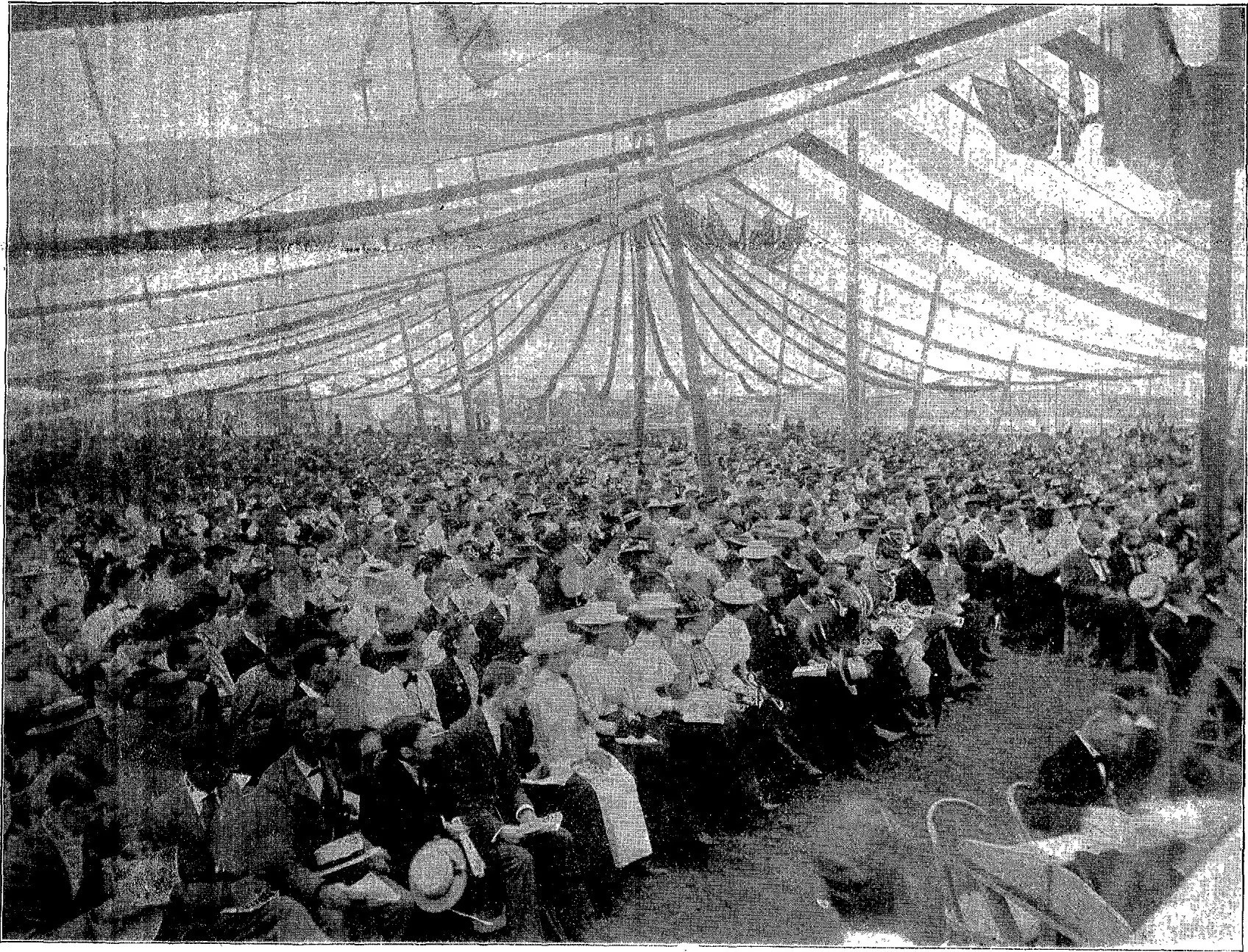
The National Christian Endeavor Convention, Washington, D. C.—View in Tent “Endeavor.”
Their number is not the measure of their power.
These facts together do not constitute the cloud which we view with apprehension. Religious power and zeal are not in themselves226a menace to national prosperity; but they become such when directed in wrong channels. It is from this fact that an ominous cloud has developed out of the Endeavor movement. The organization is being led into a path which leads to no Christian goal. What that path is the action of the convention reveals.
Our illustration presents a view of the interior of “Tent Endeavor.” This was one of three mammoth pavilions which were filled in like manner while the various themes under consideration were presented. The attendance from the Endeavor ranks is stated as in excess of 30,000, and represented nearly every country on the globe.
The Endeavor organization stands committed to the use of political methods for the attainment of its “Christian” aims. The adoption of this policy marks the point of its departure from the pathway of Christian usefulness. Among the chief “planks” of the Endeavor platform, as defined by President Clark in his annual address, was “Our Christian citizenship plank; our country for Christ; but as a society, no entangling political alliances.” It is in an utterly misleading conception of “Christian citizenship,” entertained by these young people, that the threatening danger lies.
They have determined upon securing this country for Christ not only by means of the winning influence of precept and example, but also by the immense power of compulsion which they can exercise through political methods, at the polls, and in the halls of legislation.
They have before them the view that this country is to be made Christian in all the aspects of its social and governmental life; that this change is to be brought about through the exercise of powers and the use of methods common to the conducting of any worthy human enterprise; that thus evil is to be driven out, righteousness established, and the kingdom of God set up. Stupendous error! Across the perspective of this view, the plain declarations of the Almighty interpose a barrier as high as the very heavens.
There is nothing more plainly stated in God's Word than that this present world is “reserved unto fire against the day of wrath and perdition of ungodly men.” 2 Pet. 3:7. It is not to become the abode of righteousness except through the most fearful process of purification from sin and sinners, by the seven last plagues (Rev. 16), the second coming of Christ in the clouds of heaven to gather his saints and execute vengeance upon the wicked (Rev. 17:11–21), and finally the melting of the very earth itself in the fires of the day of God (2 Pet. 3:10–12). We are told that in the last days iniquity of every kind will abound in the church itself,—among those “having a form of godliness.” 2 Tim. 3:1–5. We are told that the setting up of the kingdom of God as a visible kingdom on the earth, is to be “without hands,” and that it is to be set up by the breaking in pieces of all earthly kingdoms, which are to be swept away like chaff before it. Dan. 2:34, 35, 44, 45. See also Ps. 2:9. This is nothing else than the destruction which comes in the great day of God, as set forth in the texts above cited. And to those scores of other texts might be added. In short, the whole testimony of God's Word concerning the establishment of righteousness and his kingdom in the earth, utterly forbids this line of thought and work upon which the Endeavor forces are now proceeding.
To blend that which is heavenly with the earthly, has been the dream of the ages. Men have attempted this because they were unwilling to give up the earthly. They were willing to receive divine power and to embark both fortune and life in divine enterprises, if only they might use that power and conduct those enterprises according to their own ideas. But to give these up for the ideas and methods of God's choosing,—there is the test. It was much easier for the disciples to leave all and follow Christ, than to give up their cherished ideas which were directly contrary to what he spoke concerning his mission and kingdom.
The earthly and the divine will not blend together; yet to-day, as of old, the impossible is still being essayed in the attempt to join the two for the working out of purposes pertaining to the kingdom of God. There was a time when men thought that the earth and sky met,—that somewhere, on the far-distant horizon, terrestrial and celestial things touched each other. To-day it is believed just as firmly that somewhere and somehow the plane of things earthly comes into touch with the encircling sphere of things heavenly,—the affairs of civil government meet and blend harmoniously with the purposes of the gospel of God. They do not meet where we now stand,—that is evident; but many good people seem to see a blending line on the horizon of the near future. The Endeavor society have set out to reach that place. Alas! to what lengths will they go, and where will they lead the country, in the attempt?
The earth and heavens do not meet. They are everywhere an infinite distance apart. Only the ladder of Jacob's dream—the Lord Jesus Christ—connects the one with the other.
The Endeavorers have joined with the movement represented by the “National Reform” party, which aims to legislate this nation into righteousness. At the “Sabbath observance” meeting held Sunday, the 12th inst., the speakers advocated the stopping of Sunday trains, Sunday mails, Sunday excursions, etc., basing such action upon the language of the fourth commandment, which enjoins the observance of the seventh day, and no other! In their enthusiasm for that which promises speedy and glorious triumphs of Christianity, they have become strangely blind to most prominent Scriptural truths pointing away from their chosen path. They have even set their hand to the enforcement of a law of the most high God! As well might men undertake to enforce the law of gravitation. We may live in harmony with God's laws, and persuade others to do so; but to enforce them is the province of the Eternal One alone.
When human force enters the spiritual realm—for the law of God is spiritual—it can produce only evil results. “Whatsoever is not of faith is sin.” Rom. 14:23. Men may be forced to observe the sabbath, but it is then not of faith, and therefore is actual sin. It is mocking God with an empty form. How careful ought man to be not to force his fellowman in religious observances!
A far easier task to which the Endeavorers have also set their hand, is that of changing the fundamental law of this Republic. They are joining hands with the “Christian amendment” party, to secure an alteration of the preamble to the National Constitution, which will make it proclaim as the voice of the American people, that the revealed will of Jesus Christ is of supreme authority in civil affairs. This change, when it is secured, will mean the exclusion from “we, the people,”—in other words, the disfranchisement—of all citizens who cannot conscientiously indorse such a statement. It will mean the exclusion of multitudes of conscientious citizens from participation in the government and the retention of every person who has not conscience enough to care whether his profession is sincere or not. And this, it is expected, will purify the fountain of government and make this a Christian nation!
We have no word of condemnation for the Endeavor movement, as represented by its earnest work in very many departments of truly Christian activity. Pure motives, high aims, Christian integrity, enthusiasm, devotion, are features which appear upon the face of the Endeavor body at their general gatherings. All these have they possessed from their youth up; yet one thing they lack. There may be zeal, devotion, enthusiasm, which are not according to knowledge. How often has the world witnessed the same, and suffered because of it! Error is never so dangerous as when combined with a large amount of truth.
The interests of every American citizen are concerned in this Endeavor movement. The welfare of the whole country is concerned. For, masked beneath its Christian exterior, disguised even to the mass of the Endeavorers themselves, there moves with it the deadliest foe of our civil rights and liberties. In the proposed change in the Constitution's preamble, the arm of this foe is seen uplifted to strike at the Magna Charta of American freedom. In the zealous movement for legislation to compel Sunday observance, its hand is stretched forth to seize upon liberty of conscience. It is high time that the American people were aroused to the peril of the situation. The SENTINEL sounds the alarm. And the voice of history utters again the warning words, “Eternal vigilance is the price of liberty.”
S.
RENDER TO GOD THE THINGS THAT ARE GOD’S.
FREQUENT appeal is made to the 13th chapter of Romans to sustain the assumption that unquestioning obedience to civil rulers is a moral duty; but that Scripture teaches us no such doctrine. We sometimes hear about harmonizing texts of sacred Scripture, but the expression should never be used. Where there is an apparent conflict man’s duty is, not to harmonize passages in God’s Word, but to discover the harmony which already exists.
The principle so plainly stated in Acts 5:29: “We ought to obey God rather than men,” is nowhere contradicted in the divine Word. On the contrary we find it to be the rule of action of the servants of God in all ages. It was fidelity to this principle that brought the three Hebrew worthies face to face with death in the burning fiery furnace, but which also on the same occasion brought them face to face with their Lord, whose form was “like the Son of God,” and who gloriously delivered them. It was likewise obedience to the same unwritten law, that caused Daniel to be cast alive into the den of lions, from which he also came forth alive, and gloriously vindicated, though he had violated a law of the realm and defied the authority of his earthly sovereign.
The key to the 13th of Romans is found in the words of our Lord recorded in Matt. 22:21: “Render therefore unto Cæsar the things which are Cæsar’s; and unto God the things that are God’s.” The Jews were living under Cæsar’s government and were therefore in duty bound to render to Cæsar his due; but this did not release them from their obligation to render to God his due, even if to do so would bring them in conflict with Cæsar, for it has ever been true that man’s first and highest allegiance is due to his Creator, hence227he is to love God with all his heart, with all his soul, and with all his mind, more than he loves himself even; while he is to love his neighbor as himself. Matt. 22:37–39.
It should never be forgotten that God’s moral government and proper, legitimate, God-ordained civil government, occupy entirely different spheres, and in their respective spheres a man can be loyal to both. No man is better qualified to render honest, efficient service to his country than he who does it for conscience’ sake.
The whole subject under discussion in the 13th chapter of Romans is man’s duty to his fellows. This is evident from verses 8–10: “Owe no man any thing, but to love one another: for he that loveth another hath fulfilled the law. For this, Thou shalt not commit adultery, Thou shalt not kill, Thou shalt not steal, Thou shalt not bear false witness, Thou shalt not covet; and if there be any other commandment, it is briefly comprehended in this saying, namely, Thou shalt love thy neighbor as thyself. Love worketh no ill to his neighbor: therefore love is the fulfilling of the law.”
This the divine law requires and it is more than the civil law can possibly exact. The Christian must not—yea he cannot, do wrong, but he can suffer and will suffer wrong, and that patiently. Said the Saviour: “Ye have heard that it hath been said, An eye for an eye, and a tooth for a tooth: but I say unto you, That ye resist not evil: but whosoever shall smite thee on thy right cheek, turn to him the other also. And if any man will sue thee at law, and take away thy coat, let him have thy cloak also. And whosoever shall compel thee to go a mile, go with him twain.” And again the apostle says: “What glory is it, if, when ye be buffeted for your faults, ye shall take it patiently? but if, when ye do well, and suffer for it, ye take it patiently, this is acceptable with God. For even hereunto were ye called: because Christ also suffered for us, leaving us an example, that ye should follow his steps.” 1 Peter 2:20, 21. Even should the civil law strip the Christian of his earthly possessions, it would still be his duty to quietly submit, trusting his cause to God who judgeth righteously, and remembering that “all things work together for good to them that love God.” Non-resistance is the rule of the Christian’s life.
But while the Christian is to yield to man everything, yea and much more than the civil law requires, and this for conscience’ sake, he must not render to Cæsar that which is God’s. The divine mandate is, “Render to God the things that are God’s.” And neither the 13th chapter of Romans, nor any other Scripture, contradicts this in any degree. The whole subject matter of that chapter is concerning the Christian’s duty to render to Cæsar (the civil authorities) the things that are due to civil authority, and nothing else.
“WHITHER ARE WE DRIFTING?”
By S.
THIS question is propounded and considered in a very serious tone by the N. Y. Mail and Express, of July 9. It contemplates the situation as revealed by the action of the Democratic National convention at Chicago, and declares that the strength of the forces which that action represents has been underestimated. It concludes that the nation is drifting towards anarchy, and will speedily reach it unless the people unite upon certain lines of action which it defines.
Making due allowance for the influence of political partisanship upon newspaper utterances, it is evident that a feeling of real concern for the safety of the nation is beginning to take possession of thoughtful men who have the interests of the country at heart. Statesmen look out upon the prospect with feelings of fear and perplexity. There is a war of words about the relative merits of gold and silver as currency; but the real contest is not between metals, but between men. Nor is it so much a contest between political parties, as a contest between those parties, or classes, who from time immemorial have stood facing each other in hostile attitude,—namely, the laboring men and the men of wealth.
This is what gives the situation its serious aspect. Under the impetus of a great political demonstration, the forces have been swung into line for a renewal of the old struggle between wealth and want,—a struggle which it is well known will not be confined in its conduct to political methods. The workingmen feel that they have just grievances which must be settled by a readjustment of the relations between capital and labor. And whether they are right or wrong, wise or foolish, in their choice of methods for a solution of the difficulty, without doubt the party of wealth are largely responsible for the danger which now threatens the nation’s prosperity and peace. The workingmen have been oppressed, and if their proposed methods for relief and redress seem to savor of madness, it is only an indication of the climax which is being reached in the controversy.
Truthfully has the prophet spoken in the words, “Go to now, ye rich men, weep and howl for your miseries that shall come upon you. Your riches are corrupted, and your garments are moth-eaten. Your gold and silver is cankered; and the rust of them shall be a witness against you, and shall eat your flesh as it were fire. Ye have heaped treasure together for the last days.” James 5:1–3. The source from which these words come is a source of truth to which the statesmen of this day would do well to turn for light. S.
THE GOSPEL AND CIVIL LIBERTY.
By S.
THE gospel is not against civil liberty. On the contrary it promotes civil liberty, and reveals by its light what perfect civil liberty is.
Civil liberty has been often denied in the name of Christianity. But this is not an indictment of Christianity any more than is a counterfeit dollar an indictment of the money system which it is made to represent. For the real teachings of Christianity on this as on every other point we turn to the words of Christ. We find that he said to his disciples: “Ye know that the princes of the Gentiles exercise dominion over them, and they that are great exercise authority upon them. But it shall not be so among you: but whosoever will be great among you, let him be your minister; and whosoever will be chief among you, let him be your servant.” Matt. 20: 25-27.
This is the spirit of Christianity; and though the Saviour was not here speaking with reference to the conduct of civil government, his words are a condemnation of that dominion of man over his fellows which is so naturally sought by those who have been raised to positions of eminence. The Christian will not seek, under any circumstances, to make any of his fellows his subjects. He will seek to be the servant of his fellowmen, but not their master.
And this will be the spirit of that government under which the citizen enjoys perfect civil liberty. It would be the spirit of this Government if it were in fact what it is in theory; for it is the theory that in this Republic, public office is a public trust, and that those in office, from the President down, are the servants of the people and not their rulers. We find, as a matter of fact, that the arbitrary exercise of power by those in governmental positions, is almost as common here as elsewhere; but in principle this Government proceeds upon the Golden Rule,—“Whatsoever ye would that men should do to you, do ye even so to them.” Matt. 12:7. In no other way could it be, what it is in theory, a “government of the people, by the people, and for the people.”
God himself, in his government of all his creatures, does not exercise arbitrary dominion. Whatsoever his creatures have, they possess by their own free choice. The very principles upon which his government is established are principles of their own choosing. The very decrees of heaven are their own decrees. God might decide the destiny of every case by his own omniscience, and pronounce judgment upon every transgressor who rejects his mercy; but he will not do so, but on the contrary has committed the judgment of wicked men and even of angels, to his saints. The books of record will be examined,—not by the Lord, for he knows all that they contain—but by saints and angels, in order that the sentence pronounced in every case may be their sentence.
God will not proceed to the final settlement with sin without the concurrence of every righteous being in every step that is taken. Thus the very government of heaven itself is, in a sense, a government of the people, by the people, and for the people.
Would that this generous spirit might animate every move in the conduct of civil affairs! Then every one in office would remember that he is a servant and not a ruler of the people, and would strive to do to others that which he would wish done to himself. We should then have a government far better than anything which assumes shape in the dreams of “national reform.” S.
LEO'S REPLY TO GLADSTONE.
By S.
The Roman pontiff, Leo XIII., is again before Christendom with an encyclical on Christian unity, which, it is understood, is intended as a reply to the appeal from Mr. Gladstone on that subject.
In this encyclical the pontiff flatly denies not only the validity of Anglican orders, but every ground upon which a recognition of the same might be sought from him, by declaring that Mr. Gladstone and the party for whom he speaks, and all others outside the papal fold, are schismatics having no connection with Christ; and that there can be no Christian unity without assent to “an authoritative magisterium,” which, he says, was lodged in Peter and transmitted through him to his successors, the popes. There must be, he declares, a recognition of papal primacy,—of the pope's authority as superior to every other man or to any council of men.
In the “light” of this encyclical the papal system stands clearly forth as a religious despotism. Its “Christian unity” is the unity of submission to man. It is a unity which excludes reason and liberty. It is the unity of mental and spiritual slavery.
Christianity, on the other hand, means perfect liberty. It stands for individualism; it228means that the individual shall be complete in Christ,—that through the Spirit of Christ which is to dwell in him and animate him, he will enjoy that perfect freedom which means the liberty to fulfill every desire, with the approving judgment of a perfect mind. It means independence for each one, yet perfect harmony for all, because all are animated by that one Spirit which proceeds from the Father and the Son.
Who that loves the freedom which God has given to him, as to every man, would wish for “unity” by incorporation with a religious despotism? Who that values those mental powers with which the Creator has endowed him, can be willing to surrender to a man the right to use them,—in other words, the right to think for himself, when the Almighty himself demands no such surrender? The fact that the Creator has endowed man with reasoning faculties, is prima facie evidence that it is not in his purpose to forbid the exercise of the same in all that which concerns man's highest interests. He himself says to man, “Come now, and let us reason together.” Isa. 1:18. He came down and reasoned with Job. The Christian faith is not unreasonable.
He who surrenders his right to think, surrenders his very soul; for without the liberty to think and believe God's word for himself, no individual can have faith, and without faith he cannot be saved. The papacy invites all men to be joined to a human god, in the bondage of a spiritual slavery which involves the surrender of the soul. Christianity, on the other hand, invites every man to think, to believe, and to come into that Christian unity which is the unity of love for God, and for our fellowmen. S.
WHERE “REFORM” SHOULD BEGIN.
By S.
In a denunciation of the Sunday newspaper, by Hon. John Charlton, member of the Canadian Parliament (published in the Christian Work, of June 18, 1896), the following reference is made to the responsibility of church members for the Sunday paper’s inroads upon the religious interests of the day:—
It is a question of deep importance as to the extent of the complicity of professing Christians in this great and growing evil. How large a proportion of church members in the United States in good and regular standing, habitually buy and read Sunday newspapers? How large a proportion of them put aside the Bible and all religious reading matter in order to wade through interminable columns of gossip, slander, descriptions of crimes, sporting news, police court news, and the prurient and filthy incidents that are served up to meet the demands of prurient and filthy tastes on the Lord’s day? How large a proportion of the professing Christians in the United States gradually fall from the standard that the Bible prescribes down to the moral standard of the Sunday newspaper, and while they have a name to live in the churches, are morally and spiritually dead.
No church member who is a reader of a Sunday newspaper is free from the great crime of being a supporter and abettor of the most pernicious and unchristian influence that exists in the United States, and sad as the case may seem, it is unquestionably a truth that the Sunday newspaper depends for its existence upon the support of professing Christians. If every church member in the United States would refuse to buy or read Sunday newspapers; if every Christian man in the United States would refuse to advertise in the Sunday newspapers, the Sunday newspaper evil would speedily die an inglorious death.
Then is it not perfectly evident that the reform movement which seeks to eliminate “the Sunday newspaper evil” should begin with the members of the church? The Hon. Mr. Charlton is not the only Sunday advocate who has broached this (to the churches) disagreeable topic. We have been told that but for the Sunday patronage of street railways by church members, this form of Sunday desecration would soon cease; and the patronage by the same class of Sunday-desecrating enterprises at camp-meetings and other religious gatherings, is a fact which is not infrequently brought to public notice. Why then do not the churches begin at home the work for reform in Sunday observance?
What kind of Christian reform work can it be which instead of seeking to work a change of heart, passes by the heart and endeavors to eliminate wrong-doing by legislating temptation out of the world? That is not the means by which Christ sought to make men righteous. If our “reformers” of to-day would preach reform to the Church as much as they do to the State, if they would first seek to heal their own households before administering their medicines to those outside, their course would be much more reasonable and commendable than it is.
S.
FACTS VS. RIDICULE.
A good deal of ridicule has, by the advocates of Sunday laws, been heaped upon all constitutional arguments against Sunday legislation; but why not answer the constitutional objections rather than ridicule them, if they can be answered?
It has been said that the various Supreme Court decisions touching this question are a sufficient answer. But are they? Of course such decisions show clearly the strength of religious sentiment and its influence even upon Supreme Courts; but they by no means prove that such legislation is constitutional in the sense of being in harmony with the purpose and intent of the Federal Constitution or of the State constitutions containing similar guarantees of freedom of conscience.
To understand the real purpose and intent of any constitution, we must, as Chief-Justice Waite remarked in 1878, go, not to recent decisions, but to the history of the times in which it was adopted, and give to the language of such constitution the meaning that it had at that time. By this rule we shall find that the First Amendment to the Federal Constitution was designed not only to make impossible the setting up of a State Church, but to forbid religious legislation, i. e., legislation upon religious questions.
The term “religion” is not defined in the Constitution, but the Virginia Declaration of Rights, adopted in 1776, furnishes us a definition as follows: “Religion, or the duty we owe to our Creator, and the manner of discharging it, can be directed only by reason and conviction,” etc. This, then, is what the men who were largely instrumental in securing the adoption of the First Amendment to the National Constitution meant by “religion,” and in the light of this definition that amendment would mean just what it was intended to mean, if it read, “Congress shall make no law regarding the duty which we owe to our Creator, or the manner of discharging it.”
That this is the meaning of the First Amendment is evident also from the fact that the exact language of the Virginia Bill of Rights was used in the form of the amendment proposed by three of the six States which proposed an amendment on this subject, namely, Virginia, North Carolina, and Rhode Island; while New Hampshire used equally unmistakable language, namely, “Congress shall make no law touching religion, or to infringe the rights of conscience.” It was evidently the purpose of the several States to utterly prohibit to Congress all legislation upon religious questions, and no number of decisions, even by the Supreme Court, can make it otherwise. This is not so much a question of law as of fact, to be tried by the jury of the people rather than by the Justices of our Supreme Courts.
That the First Amendment to the Constitution was designed not only to keep Church and State separate in the sense of preventing an ecclesiastical establishment, but in the sense also of separating religion from the State—making the Government absolutely secular, is evident not only from the facts cited, but also from other considerations. In fact, this seems to have been the universal opinion until in recent years degenerate sons of noble fathers have sought to subvert the grand charter which those sires gave to their posterity.
In 1797, Washington and his cabinet and the United States Senate declared in the Treaty with Tripoli: “The Government of the United States is not in any sense founded upon the Christian religion.” It is, perhaps, not saying too much to assert that President Washington and his advisers were in a position, at least as to the point of time, to understand the intent of the Constitution very much better than the Supreme Court of to-day. They knew what it meant, for they helped to make it, and were familiar with the reasons for its adoption and for the adoption of the First Amendment; and it is perfectly evident that they did not see in it much that the Supreme Court has professed to find there.
THE GREAT “ENDEAVOR” CONVENTION.
By Allen Moon
BY ALLEN MOON.
THERE is no denying the fact that a great deal of enthusiasm is displayed at these conventions, which, with the majority of people, would pass for true Christian zeal. Nor can the fact be concealed that the Endeavor Society consists of the very best element of the church of to-day.
It is evident that many are seeking a higher spiritual life and character, and that this great movement is the result of the arousing of the nobler impulses of the soul by the touch of the Spirit of God.
The Author of our divine religion and the Founder of the Church on earth, does not forsake his people, although the Church through the errors brought into it from the heathen world, has lost its power in large measure, and is living on traditions rather than the living word of God.
The Young People’s Society of Christian Endeavor movement in its inception was an effort of the soul to break the chains of creed and ritual in which it had been bound, and soar into the free atmosphere of God’s word and love. But alas, the work was not thorough, and those whose business has ever been to make merchandise of the church, seeing in the Endeavor movement an element of power, were filled with a desire to possess it.
During the progress of the convention just closed, as well as those that have preceded it, the leaders of the Church-and-State party of this country have seized the reins and attempted to drive the entire procession into their own line. But their success has not yet been complete, and no doubt they would have had less of success if the earnest people of the society had fully known the logical result of the carrying out of the plans presented to them.
Early in the program for the last convention229provision was made for holding what were called Good Citizenship Meetings, and the time fixed was Thursday evening, July 9. Meetings were held at a number of places in addition to the three tents, and were addressed by the following speakers: Miss Anna Ackerman, of Chicago—Subject, “The Christian Citizen’s Responsibility;” Rev. Franklin Hamilton, Newtonville, Mass.—Subject, “The New Patriotism;” Rev. D. F. McGill—Subject, “A Christian Citizenship Platform;” S. E. Nicholson, Kokomo, Ind.—Subject, “Christian Citizenship in Politics;” Rev. H. H. Russell, Columbus, Ohio—Subject, “Christian Politics and the Saloon;” and many others, including Rev. C. H. Mead, of New York; Rev. R. S. McArthur, of New York; and P. S. Henson, of Chicago. The effort of each of the orators was to impress the young people with the idea that the numbers of the Endeavor Society ought to make politics the leading branch of their religious work.
One speaker counselled that they leave the prayer-meeting in the hands of the women and children and go to the Primaries, the Convention and the Polls, turn the bad politician out, and put the good citizen in his place. Rev. Howard Russell regaled his hearers with a recital of how the power of the “Good Citizen’s League,” a factor of the Christian Endeavor, had been exerted in the State of Ohio to dethrone certain officials distasteful to them, and fill the places with those in every way satisfactory. He urged the members of the society everywhere to go and do likewise. The evident purpose of these religio-political leaders is to wheel the vast body of would-be followers of the meek and lowly Jesus into line to work for the political elevation of some lovers of worldly honor.
Another feature of the convention was the effort to secure the coöperation of the entire body in support of Sunday legislation. The Sabbath Observance Committee held meetings in various parts of the city at the headquarters of the different State and National delegations in the interest of their scheme.
On Sunday, July 12, a general meeting was held at Central Hall in the interest of Sunday observance. The meeting was addressed by Rev. J. E. Gilbert, of Washington, D. C., Mrs. Henry T. McEwin, of New York, Rev. J. B. Davidson, of Milwaukee, Wis., Rev. Alexander Alison, of New York City, and Wilbur F. Crafts, of Washington.
It may be said to the credit of the Endeavorers that comparatively few of the thirty thousand in the city gave their endorsement to the Sunday-law movement by their presence. The small attendance of the delegates seemed to dampen the ardor of the projectors, and they contented themselves with making some strong addresses.
The resolutions and petitions that were expected were omitted. One of the speakers declared that the Jew should be compelled to observe the Christian sabbath, according to his own law, for he is now the stranger within our gates. “The law for the individual must be the law for every man.”
Dr. Crafts urged the organization of the Endeavorers for local work in enforcing Sunday observance, and to secure the closing of post-offices on Sunday, by petition to the postmaster-general, by boycott, or any other means that could be made effectual. The tone of the oration from the public desk was a clear indication of an overwhelming desire to transform this great Christian Endeavor Society into a political party.
Oh, that this mighty host might devote all its God-given energy to the proclamation of the gospel of the Son of God, and to saving men and women from the world and sin to become the followers of Him who said, “My kingdom is not of this world.”