SEVERAL years ago a telegrapher in Rangoon became interested in our work, but was soon after transferred to Meiktila. Brother Votaw found opportunity to follow him for a stay long enough to present our belief more thoroughly. The government prosecutor of the district attended the readings, and in a short time united with us. Through his influence many prominent persons in the town became interested in our system of education, and urged that we start a school. Some money was raised, and the opening seemed so providential that I was called from America to begin educational work. This was late in 1909; in March, 1910, the institution took form. That was “the day of small things” indeed; but in the four and one-half years since then God has helped us to gain much in facilities and efficiency.
The school is the most successful of its kind in Burma; but to say this is not rating it high compared with schools of like nature in other Eastern countries; for industrial education is at a low ebb in this land of the toil free. As a people, the Burmese do not appreciate skilled workmanship in the ordinary trades. They continue to class work with drudgery, and take no pride in training the hand to accuracy. Many parents highly approve our work—for the other man’s boy. Until the people are educated away from this erroneous idea, technical education will not be popular in Burma. While we knew this from the beginning, our work has been to identify this truth with a growing cause; for from economic necessity the industries are forcing attention from the natives. Commercially they are giving their country to foreigners, while we are taking the best methods of saving Burma to the Burmans. Perhaps all we have been able to do by way of creating sentiment has yet to be seen; but we are gaining souls for God’s kingdom, and that is our chief aim. We shall not take space to give an account of all our struggles during the past four years, but shall show the aspects and prospects of the institution as it stands today.
ROBERT MAPEPUKA
Meiktila is three hundred and twenty miles north of Rangoon on the railway. It is a town of about seven thousand people, and an important civil and military station. We have twenty-five acres of land, one and one-half miles from the station. This land is nearly all cleared and tillable. Although near the shore of a lake, we are in the dry zone, and irrigation is needed during the dry season to make crops succeed. Because of a lack of proper fences, a water supply, and an able man to lead out, we have not done much in agriculture. But the soil is excellent for such crops as watermelons and peanuts.
There are five permanent buildings on the land: a school, a workshop, a dormitory, the superintendent’s house, and a teacher’s house. The land and buildings are the property of the mission, and are free from debt. Approximately six thousand dollars has been invested in the institution, about half of this coming from mission funds and half from the interested people of the country.
Because of peculiar conditions, the number in attendance has varied greatly. We shall try in a few words to describe these conditions. The Burmese are an agricultural rather than a manufacturing people, and those who are educated prefer office work to anything else. The various branches of the government provide many openings in this line, and Burmans are given the first choice, because it is their country. But no one can get a clerkship who has not passed a certain grade in the government-aided schools. These schools are usually conducted by the various missionary societies, and charge a small tuition; but the government pays half the teachers’ salaries, and helps also in buildings and equipment. To secure government aid a certain curriculum must be followed, authorized textbooks used, and the teachers must hold government certificates. The nature of our work compelled us to do without this aid. The textbooks and teachers did not suit our work, and we had no teachers of our own who held certificates. Attracted largely by some new thing, many boys attended the school at first, most of whom, however, were undesirable. But many were easily coaxed away to other schools, when, in their ignorance, they were told that we would make coolies of them, while with a government certificate they would become magistrates and judges. The truth is, many of the other schools are fitting their boys for neither trades nor professions, but are making idlers of them.
Our new workshop is well built, having a cement floor, tile roof, and corrugated iron siding. It measures seventy-two by thirty-two feet. Part of the side is composed of huge doors, which can be raised outward, providing an awning under which the boys can work. Thus the structure affords ample room for the three trades, and also a room for a fourth, which we hope will be printing.
The leather-, cane-, and wood-working divisions are making and repairing boots, shoes, harness, belts, wood and cane furniture, baskets, etc. Besides what can be sold from the shop, an agency is maintained in Rangoon; and ordinarily we have no difficulty in disposing of the finished products. These trades are nearly self-supporting. The fact that there is some waste incurred in teaching the boys, and that scarcely any capital has been put into the business, keeps them from being able to stand alone. With proper supervision there is no reason why they should not be made a source of profit.12
For a long time we have been calling for a capable layman to take charge of this industrial work and business; and we hope soon to be able to welcome one to the field. It has been necessary for me almost entirely to neglect gospel work and teaching and to give my time to buying and selling. This is not as it should be. There is a great opportunity here for a consecrated young business mechanic.
LATIN UNION ENCAMPMENT
Twelve students from the school have been baptized. Three have gone into the canvassing work, and the school has been instrumental in better fitting other native laborers for places in the work. This institution is now known and watched throughout the length and breadth of Burma; and it must and will succeed.
(To be continued)
The Latin Union Meeting
By N. Z. Town
N. Z. TOWN
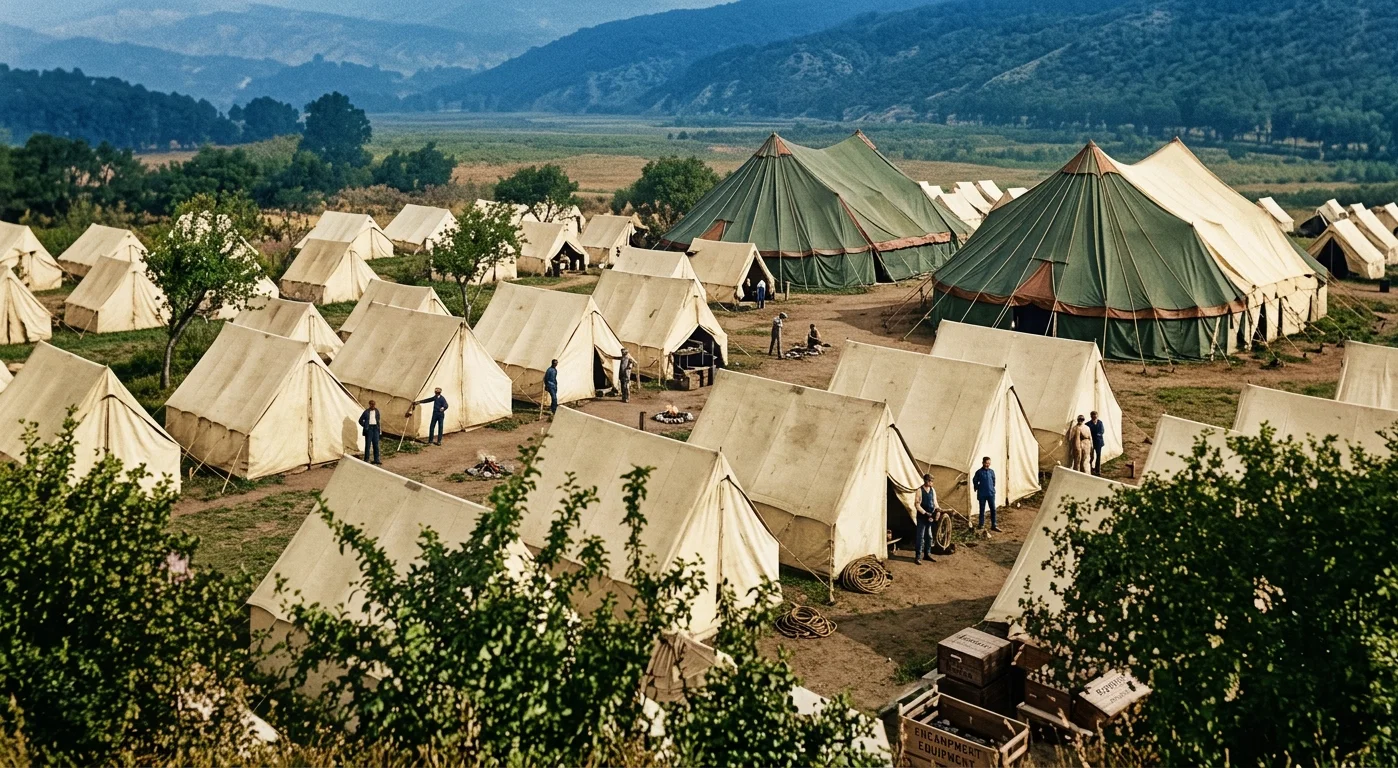
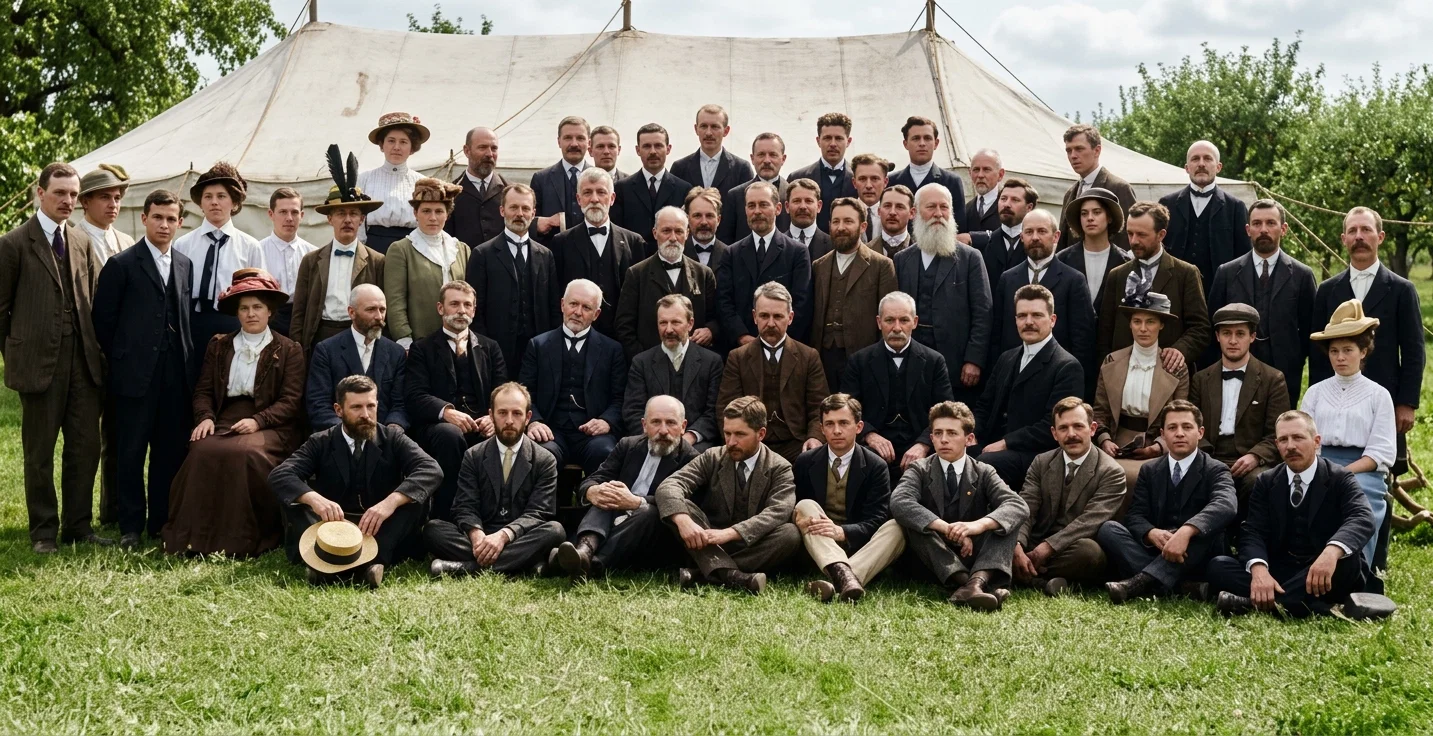
The biennial session of the Latin Union Conference was held July 7-12, at Yverdon, a beautiful town of about eight thousand inhabitants, on the banks of Lake Neuchatel, Switzerland. The Leman Conference also held its annual session in connection with this meeting. The camp was pitched in a pretty orchard on the outskirts of the town. There were sixty-two family tents, a large dining tent, and for the public meetings a pavilion which would seat about five hundred persons. About three hundred of our people camped on the ground, and on Sabbath this number was increased to over five hundred. Besides the laborers of the union, Elders L. R. Conradi and H. F. Schuberth, Brother L. Spicer, and the writer attended these meetings.
This union has entered heartily into the plan inaugurated by the General Conference for a home missionary campaign, and a recommendation was passed that this work be better organized in the conferences and mission fields of the union. It was also recommended that earnest efforts be made to secure competent colporteurs for each field in the union.
The past year the Lord has greatly prospered the colporteur work in parts of the Latin Union. The Gland publishing house reported a gain during the year of 8,800 francs, 6,700 of which was earned by the Barcelona branch.
When the work in Italy was considered, the committee voted to divide that territory into two mission fields. The provinces of Piedmont, Lombardy, Venice, Liguria, and Emilia will constitute what will be known as the Upper Italian Mission field, with a population of about fifteen million. Brother C. Kamm, who has done successful work in Germany, was asked to take charge of this part of Italy. Brother Zecchetto remains director of the southern portion. It was also voted to secure the release of Brother Knitter, the field agent of the West German Union district, to take charge of the colporteur work in Italy.
The location of several workers was changed at this meeting. Elder H. H. Dexter, the president of the Leman Conference for the past four years, was asked to take up evangelical work in the city of Paris. Elder L. P. Tieche, who was reelected union president, will also act as president of the Leman Conference for the time being. Elder Ulysse Augsbourger, who has been working in the city of Paris, will enter evangelical work in the Leman Conference. Elder J. Curdy, of the Northern France Mission, and Elder T. Nussbaum, of southern France, were to exchange places.
Sabbath was a good day. After a stirring discourse by Elder L. R. Conradi in the morning, all present reconsecrated themselves to God. Several who had lost their hold were reclaimed. Over twenty presented themselves for baptism, five of whom were buried with the Lord in baptism in the afternoon. The others were recommended to their home churches. At the close of the afternoon service, a special collection for missions was taken. This, with the Sabbath school offerings in the morning, amounted to 3,065 francs.
GROUP OF WORKERS AT LATIN UNION MEETING
In the union committee meetings following the conference, some important decisions were made. As the Italian Mission expects to get a good man as leader of the colporteur work in that field, and as our experience in other Catholic fields has demonstrated the advisability of going over the ground first with a health publication, it was voted that “Practical Guide” be translated and published in the Italian language as soon as possible.
Spain is proving to be a good field for the circulation of our literature, and Barcelona will doubtless become an important publishing center. It was therefore decided to place an experienced man in charge of the publishing work in that city, and the committee recommended that Brother L. E. Borle move to Barcelona, and that Brother Jules Robert take charge of the publishing work in Gland. A committee of five was appointed to examine “Heralds of the Morning” with the view of adapting it to Spain; and if this can be done, it will be translated and published at an early date.
Brother John Brown, who has charge of the work in Spain, was asked to extend his field to France at the beginning of the new year.
The home missionary work and the young people's work received careful attention during the meeting. Brother L. Spicer, of Hamburg, had charge of the latter. Twenty-two young persons gave their hearts to God for the first time. Advance steps were taken in the organization of the young people's work, and the brethren are hopeful of seeing good results from this effort.
The workers in the Latin Union have a big problem on their hands to warn the hundred million in their field, but they took up the work again after the meeting with new courage, believing that greater blessings are in store for them.
The Power of Right Living
A MAN who lives right and is right has more power in his silence than another has by his words. Character is like bells that ring out sweet music, and that, when touched, accidentally even, respond with sweet music.—Phillips Brooks.
Prayer Brings Heaven’s Blessings
“By prayer we receive within us heaven with all its blessings, the Holy Spirit with all his graces, God himself with all his promises.”
Implicit Obedience
THE following incident has so much food for thought that I give it here. There is, however, a point or two I wish to refer to. The “sister-in-law” has the right viewpoint for the young child. Firmly, yet kindly, parents should require unquestioning obedience from the child. But as the years go by and the child reaches the period of developing reason, his reason should be appealed to. Perhaps not always but usually it is helpful to the parent who wants obedience to explain to the child why a certain course should be pursued. It also helps the child to develop his reasoning faculties. This recognition of the individuality of the child is right and proper, and is not inconsistent with the principle of requiring and cultivating implicit obedience.
“I spoke to a lady the other day of her sister-in-law, who is one of our neighbors. ‘How well she manages her four children without any nurse!’ I exclaimed. ‘She looks calm and untroubled, and yet I know she is delicate.’
“‘She is a woman of great decision of character,’ was the answer. ‘She never allows them to question what she says, and you know that saves a great deal of fret and worry.’
“The next morning I made a short call on the subject of our remarks. The lady came into the parlor, and, after shaking hands with me, turned to take a chair, and found that the two-year-old baby had followed her.
“‘Why, baby, I didn’t know you were here! Run out to brother.’
“‘No; me don’t want to.’
“‘O yes,’ was the smiling answer; ‘brother will play school with you!’
“The baby retreated slowly till she reached the middle of the room, and there she stood, with her finger in her mouth, eying her mother closely. The mother had turned in her chair away from me and was watching the baby smilingly. It was evident that the caller was entirely forgotten for the moment; it was of first importance that the baby should mind. I made a little note of the fact, too, that there was no ‘prunes and persimmons’ expression on the mother’s pretty face. She had simply spoken, and expected the baby to do as she said.
“‘No!’ burst from the baby.
“‘O, yes,’ said mamma, smiling; ‘brother is all ready to play with you!’
“The baby stood a moment longer, finger in her mouth, studying her mother’s face, and then ran out of the room. Then, and not until then, did the mother give me her attention.
“The incident made such an impression on me that I want to write it for young mothers. I began with the theory that the best way to bring up a child was to reason with him, and in that way teach him obedience. I abandoned that theory long ago, and wish now that I had never held it for a day. When ‘implicit obedience’ was brought to my mind I rejected it, largely because, under my new responsibility, I was newly conscious of my own fallibility.
“‘How can I,’ I would say to myself, ‘always know the right command to enforce?’ Now I say to myself, ‘Be as nearly right as you can, but go ahead.’ Implicit obedience, lovingly enforced, is the only way to bring up a child; and ‘eternal vigilance’ is its price.”
Home Environment
By Roxetta Runck
ROXETTA RUNCK
In studying the best environments of home life let us try to picture the home our Heavenly Father chose for his Son on this earth. It was surrounded by the beauties of nature, and God's handiwork spoke to its inmates. The mother had14time to take Jesus to the fields and woods, there to listen to the songs of the birds and to study the grandeur of the trees and the beauty of the flowers. This home was a home of simplicity and toil, and in it Jesus learned lessons of economy and hardship, as he grew to manhood.
“A home cannot be a home if the element of stability is lacking in its construction. Satan's greatest apparent triumph in earth was in making it seem that the home must necessarily come under the same law of mutability by which he had succeeded in honeycombing all human conditions. But the home is established forever, though its counterfeits may come and go with every change of wind and tide. It is the privilege of every home maker to build on the foundation that cannot be moved.”
Home makers should consider the environment of the home. Lot located his home for wealth. His children grew up in a wicked city, and the time came when he had to flee for his life, leaving the greater part of his family behind to be destroyed with the wicked city. Plan for health, for comfort, and for purity. Systematize the labor and minimize the work. Then the mother will have time to read and study and be a companion to her husband and her children.
Each member should share the work of the home. Train the child early to bear responsibilities. Children are anxious to be helpful. It will take time and patience to train the little hands to be skillful, but it is worth while. This privilege should be a pleasure, not a task. Soon the little one will learn to be a real help, and the active mind and hands will be occupied, giving the tempter no time nor room to sow his seeds of evil in these young, tender lives. Thus reared, their minds and bodies will develop in the right way.
The mother should be careful not to work beyond her strength. Overtaxing the nerves causes her to become irritable and fretful, and unfitted to direct the child, and to bring the cheer and comfort into her home due her family. If the mother is nervous and irritable, she conveys her feeling to the children, and instead of harmony and peace, discord and fretfulness reign. Under such strained conditions, the tempter seeks entrance, and in an unguarded moment harsh words are uttered, sharp blows are given, and little hearts are made sad and hungry for mother's love. The husband and father, finding his home in such a warped condition, seeks comfort elsewhere. By degrees the parents grow away from each other and from their children. Love no longer crowns this home. Children do not develop characters in such homes that enable them to cope with the deep problems of life.
In these days of increasing evil, let us guard against the tide of wickedness that is overtaking our youth and homes. It is the home that binds society, and links hearts in the most sacred ties. So strive for the betterment of the home. Create normal conditions in which the youth can grow up with healthy minds and bodies. Send pure, noble manhood and womanhood from the parental roof, characters that will inspire and uplift humanity.
The Home Life
By Mrs. C. C. Lewis
Conducted by Mrs. C. C. Lewis, Takoma Park, Washington, D. C.
Through the columns of this department, hints will be given on all matters pertaining to the home life. Short articles and letters are solicited from home makers, telling of their everyday experiences,— their joys and sorrows, their failures and successes.
My Saviour’s Love
By Pearl Waggoner
PEARL WAGGONER
Though the lofty hills dissolved should be,
And the mountains planted within the sea,
Though the stars above from their course should fade,
With my Saviour’s love, I am not afraid.
Though the leaf should perish, or vine should fail,
Though the hosts of ill may seem to prevail,
Though the earth and heavens should pass away,
Yet the Saviour’s love is my hope and stay.
When portentous signs are thickening ’round,
Whether rumors dread or the battle’s sound,
When hearts grow faint for the things that be,
Still my Saviour’s love will my refuge be.
Whatsoever changes, or test, or trial
Should come to us in “earth’s little while,”
Though the eye should dim, or the heart ache sore,
Still the Saviour’s love changeth nevermore.
O my Saviour’s love! It is sweet to me,
And through endless ages my song shall be.
In the time of trouble, in time of fear,
Still my Saviour’s love bringeth hope and cheer.
The Keeping Power of God
WE are living in a world of sin and iniquity, but God can keep us even in the midst of it all. It is necessary, however, for us to partake of the divine nature in order that we may be protected. We must have a desire for the help we need. God does not force us to yield to him. He says, “With loving-kindness have I drawn thee,” and again, “My son, give me thine heart.” He invites us, and his goodness ought to lead us to repentance of all our iniquities.
We are in the closing moments of time, and we must make no delay in seeking the kingdom. “Let not the sun go down upon your wrath,” says the heavenly messenger. We must make straight paths for our feet. May we as parents work as never before to live clean, godly lives in our homes and before our children. The Lord says he will keep the feet of his saints. We must have this keeping power with us every day.
When Satan came to Christ, he found nothing in him; and we must reach the place in our experience where sin will be hateful to us. We must so partake of the nature of the Master that the allurements of Satan will not appeal to us; then we shall find no pleasure in unrighteousness. God is waiting to clothe us with his robe of purity, which will make us able to resist every dart of the enemy.
The following beautiful story illustrates what God can do:—
“A traveler once went with a party into a coal mine. On the side of the shaft a perfectly white plant was growing. ‘How is this?’ exclaimed the traveler. ‘Here where the coal dust is continually flying about, how can this little plant remain so pure and white?’ ‘Look here, sir,’ said the miner, and as he spoke he threw a handful of coal dust upon the plant. Not a particle remained upon it. The visitors repeated the experiment, with exactly the same result: the coal dust would not cling.”
“On the white plant there was something that appeared like white enamel, and to this not the tiniest speck could adhere. Living there amid clouds of black dust, its snowy whiteness remained unchanged. Beautiful as is the thought of this pure blossom, it is not so lovely as a white life in a sin-stained world. Let us remember that the same God who made and kept the little plant stainless amid clouds of black dust can make our hearts pure and keep our lives free from sin.”
If he could create a plant with power to resist every impurity, will he not do as much for his children, created in his own image?—Yea, verily.
The Marriage Altar
By C. C. Lewis
(Concluded)
C. C. LEWIS
The Goal of Affection
MARRIAGE is the goal of true affection. But we should not rush to the goal with unseemly haste. Better consider the step long and deeply. It is one of the most important issues of life. Above all things else that are kept, keep thy heart with all diligence. The forces we admit enter for weal or woe. Let us be sure we want them to stay before we unbar the gates. Once in, it will be difficult to expel them, however treacherous they may prove. Even if they are driven out, the fortress may be injured beyond repair.
The Education First
This is no child's play, this matter of choosing a companion for life. Better leave it until a reasonably good education is acquired. This will bring one to a proper age for marriage. A man should be twenty-five years of age; a woman, at least twenty-one. Authorities agree that not until this age are the physical powers sufficiently mature properly to discharge the grave responsibilities of married life. Nor is the judgment sufficiently well equipped. And this emphasizes the necessity of deferring this step until the education is complete. One needs all the judgment and wisdom a good education is likely to give to select wisely a companion for life, or properly to manage one after the selection is made. And one needs just as much wisdom to know when and how to be managed.
Select Your Business First
Prudence also would indicate that it is wise to defer marriage until the life work has been selected and fairly well established. It is but reasonable to suppose that one's companion should be in sympathy with one's work and a true helper in the successful accomplishment of that work. But if the companion is selected first and the work afterward, it is a mere chance if they fit well together. To the man, even after the life work and the companion have been selected, there comes an additional reason why the marriage should be deferred until his business is fairly prosperous. He ought to have something to offer his wife as a token of his love and of his worth. It need not be much, but at least it ought to be enough to prove his ability to provide a respectable living. It need not be a costly home, but at least it should be the earnest of a cozy nest for the birdlings that are to be. And yet I would not insist too strongly upon this principle; for even the birds teach us to unite in building the nest. It is not the best to press a comparison too far. I think, however, that the superiority of the bird's instinct over man's is sufficient to confirm our first conclusion. No prospective father bird ever failed to provide a suitable home for his companion and little ones. Some men have.
Be Not Unequally Yoked
This discussion of the keeping of the heart in its relation to the life issue of marriage cannot properly close without reference to the exhortation of Scripture, “Be ye not unequally yoked together with unbelievers.” The principle is broad enough to include other relations, but it is especially applicable to marriage and to matters of religion. By “unbelievers” evidently are meant those who do not believe in and love Jehovah, the true God, and who do not trust in Jesus Christ, his Son, for salvation; and those who do not believe in the present truth; and the exhortation, or rather command, is given men and women who do thus believe. The wisdom of the requirement is apparent. The marriage relation should be one of closest sympathy and union; else how can the “twain be one flesh”? But how can those who radically disagree in belief in regard to vital questions be of one heart and soul, as man and wife should be? There are, indeed, some men and women broad-minded or indifferent enough to grant to a companion liberty of conscience and religious belief; but are toleration and indifference a proper basis for the building which man and wife have covenanted to erect?—Nay, verily. It needs the most perfect union and the warmest sympathy to complete this work properly.
Whose cast of mind shall the children inherit, whose example follow, the father's or the mother's? If either or both, there is ground for alarm. A house divided against itself cannot stand. These considerations emphasize the importance of delaying marriage until the persons become settled in their religious belief, and then choosing in harmony with that belief; for whoever enters the marriage relation with one of opposite belief or no belief, not only goes contrary to the Word of God, but as a result invites disunion and sorrow into the life.
Rarely indeed does a believing wife or husband win an unbelieving companion to Christ. Rarely are promises made before marriage to gain the object of desire carried out after the object is gained. There is, of course, the possibility, but it is not strong enough to warrant the risk. Let the unbelieving party first believe, apart from the consideration of marriage, and demonstrate his faith by his life. Then, and not till then, should two dare the risk of uniting life with life.
But sometimes after marriage one of two unbelievers accepts Christ, or one of the contracting persons, believer or unbeliever, changes his or her belief. The only course then to be pursued is for both persons to make the best of the situation, exercising wisdom and patience, each mutually agreeing to grant full liberty of conscience to the other.
Cumberland Conference and Camp Meeting
By W. W. Eastman
DOUBTLESS one of the best meetings ever held was the Cumberland conference and camp meeting held at Lenoir City, August 27 to September 6.
The people seemed to have been previously prepared for a rich blessing, and came to the meeting to seek for and to find God more fully in their personal experience, and they were not disappointed. The Spirit of the Lord was present from the very beginning. It was frequently remarked that not a word of criticism or faultfinding had been heard on the ground.
The camp was pitched alongside the railroad switch and depot, and switch engines and frequently passing trains made it a rather noisy place. Besides, there was no shade, the camp being pitched in the open, exposed to the direct rays of the sun, and the weather was extremely warm. Yet all this seemed to be overcome by the good spirit of the meeting.
Most excellent dining accommodations were provided on the cafeteria plan, in a well-screened tent, where first-class food was properly served for the campers—an object lesson to all.
The laborers present and sharing the responsibilities of the meeting were those of the union and local conference, with the writer representing the North American Division.
Elder W. H. Branson holds a warm place in the hearts of his people, and was again chosen president of the conference. Mrs. Clara Russell was elected secretary and treasurer of the conference and tract society; Mrs. C. R. Magoon, educational, Sabbath school, and young people's secretary; and L. L. Lawrence, field missionary agent.
Beginning with the first Sabbath of the meeting, several revival services were held. Perhaps the most marked feature of the meeting was the spirit of giving that seemed to possess all hearts. When the call was made for mission funds, without any urging the brethren and sisters gave in cash and pledges $13,713.50. It was indeed refreshing to see the brethren putting houses and lots and farms into the cause of God, and could not but impress those who were present with the scenes accompanying the latter rain. Later, nearly $1,000 was given for local work. The Sabbath school offering for the two Sabbaths of the meeting was $87.89. This was all the more remarkable when we consider that there were less than two hundred in attendance at the meeting.
On the last Sabbath afternoon a baptismal service was held, thirty-three candidates going forward in the ordinance. The last Sunday a religious liberty rally was held, with a view of promoting the true principles of religious liberty and stimulating the people to greater activity.
During the day meetings, plenty of time was given to the consideration of the colporteur and home missionary work, to which the people readily responded and pledged their lives to the service of God for souls.
There can be no question but that the work in this conference during the year will be one of advancement.
W. W. EASTMAN.
The Middletown (Conn.) Post Office
By C. H. REIMERS
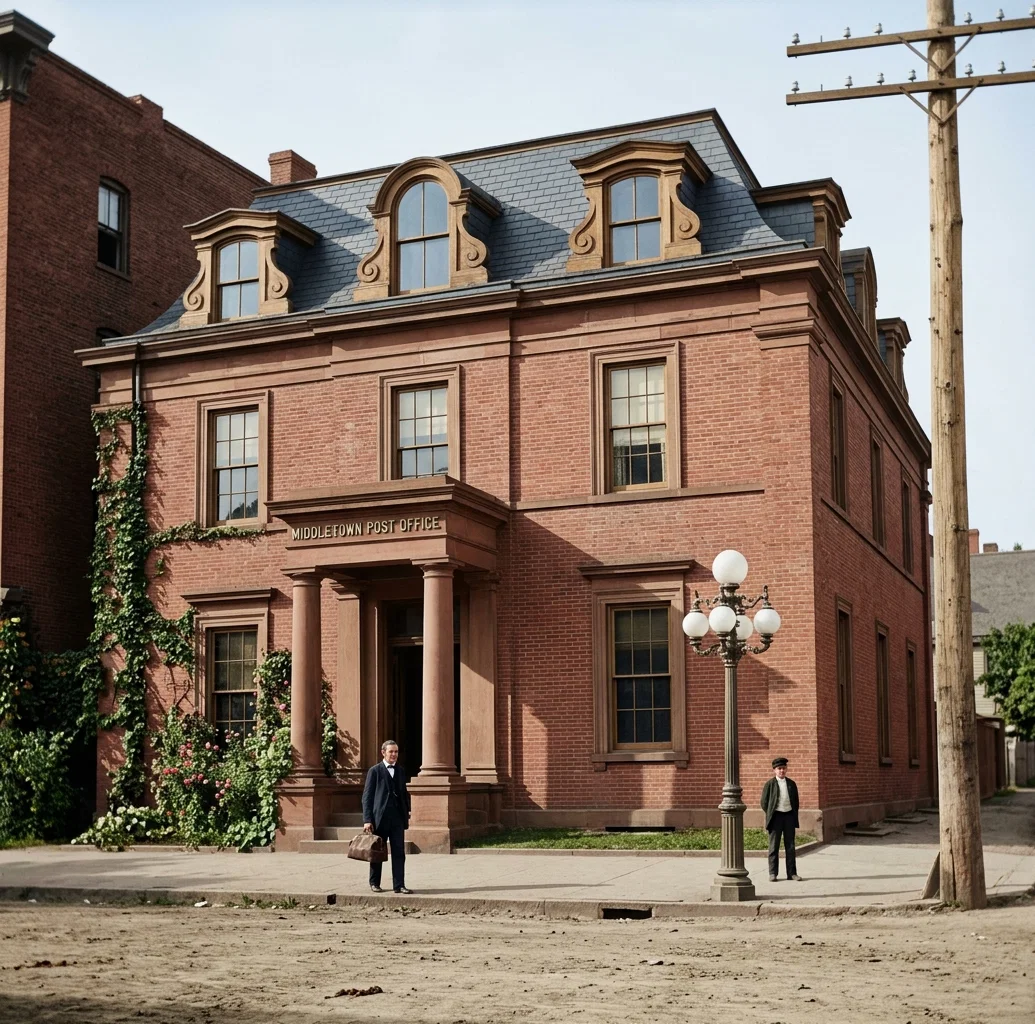
For the benefit of the readers of the REVIEW I have taken this picture of our post office. Every time I enter it, which is quite often, I think of the beautiful life of Elder James White, and what he sacrificed for this message. I think of how he entered the same building away back in 1849, carpetbag in hand, filled with copies of the Present Truth, to be mailed to its readers. The Present Truth was the beginning of our good paper the REVIEW AND HERALD. You will find a picture of the Present Truth on page 277 of “The Great Second Advent Movement,” and on page 153 of “Rise and Progress of Seventh-day Adventists.”
Sister White’s account of this first paper is as follows:— “He [Elder White] began to publish a small sheet entitled, the Present Truth. The office of publication was at Middletown, eight miles from Rocky Hill, and he often walked this distance and back again, although he was then lame. When he brought the first number from the printing office, we all bowed around it, asking the Lord, with humble hearts and many tears, to let his blessing rest upon the feeble efforts of his servant. He then directed the papers to all he thought would read them, and carried them to the post office in a carpetbag. Every number was taken from Middletown to Rocky Hill, and always before preparing them for the post office, we spread them before the Lord, and with earnest prayers mingled with tears, entreated that his blessing might attend the silent messengers. Very soon letters came bringing means to publish the paper, and the good news of many souls embracing the truth.” —“Testimonies for the Church, Vol. I, page 88.
The Lord willing, I hope in the near future to give you an account and a picture of a beautiful little chapel which we are now finishing, which stands in this city as a memorial for this truth and the work begun here by Elder and Sister White. C. H. REIMERS.