It may seem to many that the will of God is a very hard, stern, cold, and disagreeable thing, and that to yield to that will is a very sad alternative. Jesus, in Gethsemane, with the blood-drops dripping from his face, said, “O my Father, if it be possible, let this cup pass from me: nevertheless not as I will, but as thou wilt.” The will of God meant Calvary, the cross, the agony, but remember, beyond that the rent tomb, the resurrection, the glorious ascension with the trophies of the conflict, the opening of the glittering gates of the holy city that the triumphant train might enter in, and beyond that forever the comforting, the blessing, the lifting up of poor, broken-hearted sinners, the final resurrection day, the glorious eternal triumph.
God’s will is a blessed will. In it is hope, comfort, life everlasting. Just for a little time the cross, the pain; but even then, in the sad “now” his grace is sufficient. When the Holy Spirit is received, one marked change that will come into the lives of every one will be that the will of God, the blessed, holy, mighty will, takes the place of our weak, broken will, or rather, I may say, is interwoven with ours, and the mighty, unyielding, conquering will of God brings us victory and eternal hope.
Poor, broken soul, with hopes crushed, with will power fallen, when you have submitted to God, and have surrendered your will to him, he will give you a new will, his will, and with the hope there will be the determination to conquer, to overcome, to win, and not to fail where you have failed a thousand times before. “I will do God’s will.” “If any man willeth to do his will, he shall know of the teaching.”
When the will is surrendered, the man is surrendered, the heart is surrendered. The surrender is complete; and as Jesus said, “For the Lord God will help me; therefore shall I not be confounded: therefore have I set my face like a flint, and I know that I shall never be ashamed” (Isa. 50:7), so may we, with a new spring of divine energy within and a determination that can not be overthrown, say with him, I have “set my face like a flint, and I know that I shall not be ashamed.”
It is the will of God that none should perish. That will, when permitted to be interwoven with ours, will not permit us to fail. The will of God is good. It is almighty. May his will be done in us, as it is in heaven.
“Renew my will from day to day;
Blend it with thine, and take away
All that now makes it hard to say,
‘Thy will be done.’”
Nashville, Tenn.
Day by Day
By Julia Harris May
I HEARD a voice softly say,
Bear not thy yesterday into to-morrow,
Nor load this week with last week's
load of sorrow.
Lift all thy burdens as they come, nor
try
To weigh the present with the by and
by.
One step and then another, take thy way;
Live day by day.
Live day by day.
Though autumn leaves are withering
round thy way,
Walk in the sunshine. It is all for
thee.
Push straight ahead, as long as thou
canst see;
Dread not the winter whither thou
mayest go,
But when it comes, be thankful for
the snow.
Onward and upward look and smile and
pray;
Live day by day.
Live day by day.
The path before thee doth not lead
astray.
Do the next duty. It must surely be
The Christ is in the one that's close
to thee.
Onward, still onward, with a sunny
smile,
Till step by step shall end in mile by
mile;
“'I'll do my best,'” unto thy conscience
say;
Live day by day.
Live day by day.
Why art thou bending toward the back-
ward way?
One summit and then another thou
shalt mount;
Why stop at every round the space to
count?
The past mistakes if thou must still
remember,
Watch not the ashes of the dying
ember.
Kindle thy hope. Put all thy fears in
away;
Live day by day.
— Julia Harris May.
Our Cooking Class
By F. O. Raymond
F. O. RAYMOND
Legumes as Foods
“REPRESENTATIVES of the legume family are found in all climates and countries, and, taking the world over, they are, next to the cereals, the most valuable and the most extensively used among vegetable foods. Judged by chemical analysis alone, we should give them the highest place, containing, as they do, more protein than the best cuts of meat, and in some cases a large percentage of fat, besides a considerable amount of starch. Experiments on men and animals have made it evident, however, that the true value of a food does not depend alone on the contained nutrients, but also on the ease and completeness with which the system is able to utilize them.
“As generally prepared and used, the nutrients of vegetable foods are enclosed in cells composed of cellulose or woody fiber, which is more or less hard, and greatly interferes with their absorption. Also, vegetable food is prone to fermentation in the intestines, thus increasing the peristaltic movements, and, if large amounts are eaten, hastening the food onward before there has been sufficient time for the absorption of its contained nutrients. The cellulose present acts as a local irritant and produces the same effect.
“Different individuals vary in regard to their ability to digest beans, but it seems fair to conclude that when properly combined with other foods, they should not be considered indigestible. As pointed out by Professor Snyder, of the Minnesota Experiment Station, beans are slow of digestion, and require more intestinal work than many foods; but when properly combined with other materials, so that they form a fair part of the ration, the work of digestion is more evenly distributed than when they are used alone or in very large amounts. In using beans in the dietary, they are frequently eaten in excessive quantities at irregular intervals rather than in reasonable amounts combined with other foods as a regular part of the ration. It seems fair to conclude that when used in the diet in a reasonable way, no difficulty is experienced in eating beans. The entire removal of the skin by sieving is to be recommended in the case of persons with whom they seem to disagree. When properly cooked, they need not be excluded from the dietary of those engaged in light muscular exercise, though they should not form so large a part of the ration as in the case of active working men leading outdoor lives.”—United States Department of Agriculture, Farmers’ Bulletin, No. 121.
The Cooking of Legumes
There are many varieties of peas, beans, and lentils, but those in most common use in this country are the white navy bean, the red kidney bean, the Lima or butter bean, the dry Scotch or English pea, the blackeye pea, the whippoorwill pea, and the brown German lentil. The frijole of Mexico and the southwestern States and the soy-bean of China and Japan are also valuable varieties, deserving of wider use. The structure and composition of these (except the soy-bean being so nearly alike, the same general principles of cooking apply to all.
In any case, the legume will cook more quickly and better if soaked overnight in cold water. In the morning remove to fresh hot or cold water, bring to a boil, remove the scum, and allow to boil gently for several hours, or until well softened. In case of lentils and strong flavored beans or peas, it is advisable to parboil by pouring off the water after a few minutes’ boiling, and then supplying more fresh hot water. The nutrients of legumes being so closely bound up in little sacs of tough woody fiber, or cellulose, long cooking is necessary to soften and disintegrate them and prepare them for most easy and complete digestion and assimilation. After boiling for a time on the top of the stove, it is well to remove to the oven, where the cooking may be continued without danger of scorching. Soft water, or hard water which has been boiled and the lime precipitated, is best for cooking purposes. As the addition of salt also has a hardening effect, it is well to withhold it until the cooking process is well under way.
For soups or purées, pass the well-cooked legumes through a fine colandar or sieve to remove the hulls, and to the pulp make such additions of water, milk, cream, strained tomato, and seasoning as the dish may require. These soups and purées are largely used in our sanitariums, with excellent results.
An even better form for most persons is the dry mashed pea, bean, or lentil. In this case, cook as before, only be sure to bake down quite dry before sieving. Only a little seasoning of salt, and perhaps cream or dairy or nut butter, will be necessary. If too soft to slice well when done, stiffen with toasted bread or cracker crumbs. Turn the seasoned pulp into a pan and bake to a nice brown, or form into patties and bake. Serve with or without a tomato sauce or other dressing. In these forms, eaten in moderation, legumes are found to agree with nearly every one. As split peas and beans have the hull already removed, they are to be highly recommended for soups, purées, etc. The Lima or butter bean, being so rich, well flavored, and easily slipped from the skin, is a general favorite.
For baking, soak beans (preferable the white navies) overnight, and boil until they begin to crack open, then season with salt and a little molasses, butter, or tomato as preferred, turn into a suitable crock, jar, or pan, and bake for at least three or four hours in a moderate oven, adding water from time to time as needed. Those engaged in active outdoor labor find baked beans a very appetizing dish, and one well suited to sustain strength.
Throughout the South the cow-pea is extensively grown, the table varieties of which, such as the whippoorwill and the blackeye, are excellent when boiled a long time, and simply seasoned with salt and perhaps a little cream or butter. The peanut, though generally regarded13as a nut, is in reality a legume, requiring very similar preparation.
Suggestive Winter Menus
BREAKFAST
Corn-meal Porridge
Baked Potato with Tomato Cream Sauce
Pease Purée
Bread and Butter Zwieback
Stewed Raisins Fresh Apples
DINNER
Lentil and Tomato Soup
Mashed Turnips Creamed Hominy
Sliced Beets with Lemon
Bread and Butter Zwieback
Canned Peaches
Nuts
“To make plain natural law, and urge the obedience of it, is the work that accompanies the third angel’s message, to prepare a people for the coming of the Lord.”—“Testimonies for the Church,” Vol. III, page 121.
Washington, D. C.
Keep the Dish-Cloth Clean
BE particular with your dish-cloth. Do not hang it in a damp warm place in the sink cupboard, there to breed disease germs. Wash it in soap and clean hot water each time after using, and then hang where it will dry in the sun and fresh air.
Clean dish-cloths and towels are as necessary for health as is clean, inviting tableware. Even though rinsed and carefully dried each day, they should be placed in the wash each week, and put through the same process to which other soiled articles are subjected.
Too many housewives neglect to oversee this highly important part of the household machinery. Ignorant domestics frequently use one dish-cloth until it has become so greasy, stained, and ragged that it is hardly fit to touch, to say nothing of being fit to wash the family plates and cups.
Soft pieces of the checked linen crash, hemmed (in order that the raveled ends may not make work for the plumber), make the most satisfactory cloths for the silver and china; while coarser pieces of crash, unbleached, may be used for enameled ware and tinware and the iron cooking utensils. The cloth should be soft and pliable and easily absorbent. Good results can not be obtained from a harsh, starchy cloth. Do not use old pieces of muslin, lest the lint and ravelings work havoc in the drain pipes.
It is a very simple matter to keep clean cloths in use, and any woman with a well-developed sense of nicety will make this a part of her household discipline.—Selected.
Hot Water as a Remedy
HOT-WATER applications will relieve the pain of a nervous headache. Bathe tired and inflamed eyes in it. Sprains, too, can be greatly relieved by soaking the part in hot water for half an hour at a time, afterward bandaging it with flannel. Bruises can be healed with the same treatment. Very hot water poured over a bleeding surface will stop hemorrhage. Those who suffer from insomnia will find themselves drowsy after a full bath at the temperature of about ninety-six degrees.—Selected.
What One Little Worm Did
A NUMBER of persons were once assembled in a grand park; and the owner pointed to a magnificent sycamore tree, which was dead and decayed to the core. “That tree,” said he, “was killed by a single worm.” Two years before it was as healthy as any tree in the park; but one day a worm about three inches long was seen to be forcing its way under the bark. A naturalist who saw it told the owner that if left alone it would kill the tree. The master of the park scarcely believed it possible; but, next summer, the leaves of the sycamore fell very early, and in the following year it was a dead, rotten thing. One worm can kill a whole tree. One sin or evil habit persisted in can ruin a child for whom Christ died.—Children’s Bread.
Property Rights
By Mrs. D. A. Fitch
MRS. D. A. FITCH
USUALLY property rights are more carefully regarded in the community than in the family, and who can say it is not in the home that habits concerning possession of property are taught both 'by precept and 'by practise?
The father gives Jamie a hen, the profits to belong to the boy, but when the poultry buyer comes along, the chickens reared at the cost of much labor and anxiety, are sold, and their price is put with the general fund. Jamie’s tears and words of disappointment are of no avail in setting matters right. “Right!” exclaims some parent who has been in the habit of dealing in the same unfair way. “Has not a father a right to make use of the money? Does it not really belong to him?” Yes, legally speaking, he has, but from a moral standpoint, no, many times no. It is not even good policy from either a business or a parental view-point. The boy is disheartened, discouraged for future efforts, and has been given a lesson that will cause him to have less regard for the property rights of members of his own home, and of his schoolmates as well. He thus sees no wrong in appropriating to his own use the book belonging to Mary, or the bat and ball in the yard of his neighboring playmate. Should he feel the need of a little money to use for a purpose not countenanced by the paternal holder of the family purse, he thinks it not out of place to help himself if he can.
Children should be taught to freely give as occasion may present itself, to “lend, hoping for nothing again,” but never to take that which belongs to another without the permission of the owner, nor to borrow with no intention of returning. Justly to regard property rights does not inculcate selfishness, but rather leads to an excellent system of honor and order in family, community, or country.
National City, Cal.
The Two Roads
By Jean Paul Richter
It was New-year’s night; and Von Arden, having fallen into an unquiet slumber, dreamed that he was an aged man standing at a window. He raised his mournful eyes toward the deep-blue sky, where the stars were floating like white lilies on the surface of a clear, calm lake. Then he cast them on the earth, where few beings, more helpless than himself, moved toward their certain goal—the tomb.
Already, as it seemed to him, he had passed sixty of the stages which lead to it, and he had brought from his journey nothing but errors and remorse. His health was destroyed, his mind vacant, his heart sorrowful, and his old age devoid of comfort.
The days of his youth rose up in a vision before him, and he recalled the solemn moment when his Father had placed him at the entrance of two roads—one leading into a peaceful, sunny land, covered with a fertile forest, and resounding with soft, sweet songs; the other leading the wanderer into a deep, dark cave, whence there was no issue, where poison flowed instead of water, and where serpents hissed and crawled.
He looked toward the sky, and cried out in his agony, “O days of my youth, return! O my Father, place me once more at the entrance to life, that I may choose the better way!” But the days of his youth passed away.
He saw wandering lights floating away over dark marshes, and then disappear; these were the days of his wasted life. He saw a star fall from heaven, and vanish in darkness: this was an emblem of himself; and the sharp unavailing remorse struck home to his heart. Then he remembered his early companions, who entered on life with him, but who, having trod the paths of virtue and labor, were now honored and happy on this New-year’s night.
The clock in the high church tower struck, and the sound falling on his ear, recalled his parents’ early love for him, their erring son; the lessons they had taught him; the prayers they had offered in his behalf. Overwhelmed with shame and grief, he dared no longer look toward heaven; his darkened eyes dropped tears, and with one despairing effort he cried aloud, “Come back, my early days! come back!”
And his youth did return; for all this was but a dream which visited his slumbers on New-year’s night. He was still young; his faults alone were real. He thanked God fervently that time was still his own; that he had not yet entered the deep, dark cavern, but that he was free to tread the road leading to the peaceful land where sunny harvests wave.
Ye who still linger on the threshold of life, doubting which path to choose, remember that, when years have passed, and your feet stumble on the dark mountain, you will cry bitterly, but cry in vain: “O youth, return! O, give me back my early days!”—Jean Paul Richter.
The Bengali Christian Convention
By W. W. MILLER
A Sign of the Times
W. W. MILLER
SOME weeks ago the editor of the REVIEW AND HERALD apologized for giving so much space to reports of the National Reform Convention and the Catholic Church Federation. Such an apology seems unnecessary, for surely all who are watching the unfolding of events which will soon bring bitter persecution upon loyal Seventh-day Adventists are only too glad to acquaint themselves with the advancement which is being made in this direction.
India, as well as America and other countries, is making rapid progress. In company with Brother J. C. Little and Babu Mitter, I attended a convention held in Gopalgunj, East Bengal. This is the place where Lolgopal Mookerjee and his wife started a mission last spring. Some of the members of the Scotch mission which is located in Gopalgunj became interested, and began to observe the Sabbath and attend Brother Mookerjee’s meetings. This enraged the leaders of the Scotch mission, and they requested us to buy land and move our converts off their ground. We replied that we were not buying converts by offering them land. Many, however, were expecting us to do this, as such has been the custom of some of the other missions.
Hundreds of people visited our mission to see what new enterprise was being started, for Brother Mookerjee was putting up several small buildings, and giving work to quite a number of laborers. Tracts and Bible readings were given to those who came. Many of these tracts were carried to other villages. In this way a great number of persons became interested, and quite a number began to keep the Sabbath, on account of which we had many calls for workers to visit the surrounding villages.
All this seemed to alarm the leaders of the other mission. A convention was called, and delegates came from nearly all the different denominations. Forty-one went from Calcutta, most of whom were ministers and mission workers.
The program announced that on the last day of the meeting five speakers would present the Sunday question, after which time would be given for five-minute talks. We armed ourselves with tracts, and went to hear what they had to say. The house was crowded. On either side of the room were two rows of benches. One side was occupied by the Bengali women, all of whom kept15their faces about half veiled. We were seated toward the front on the opposite side, but nearly all the congregation sat on the floor, in the center of the room. The musicians sat on the ground in front. Their instruments were very appropriate for such a meeting, and reminded us of those sanctioned by the old blue-laws of Connecticut. Then, it was the drum, and the jew’s-harp; here, it was the tum-tum drum and cymbals.
Only three Europeans were present,—Brother Little, the secretary of the Calcutta Y. M. C. A., who was a delegate to the convention, and the writer. The remainder of the congregation consisted of Bengalies, Hindus, and Mohammedans. All the speeches were delivered in Bengali.
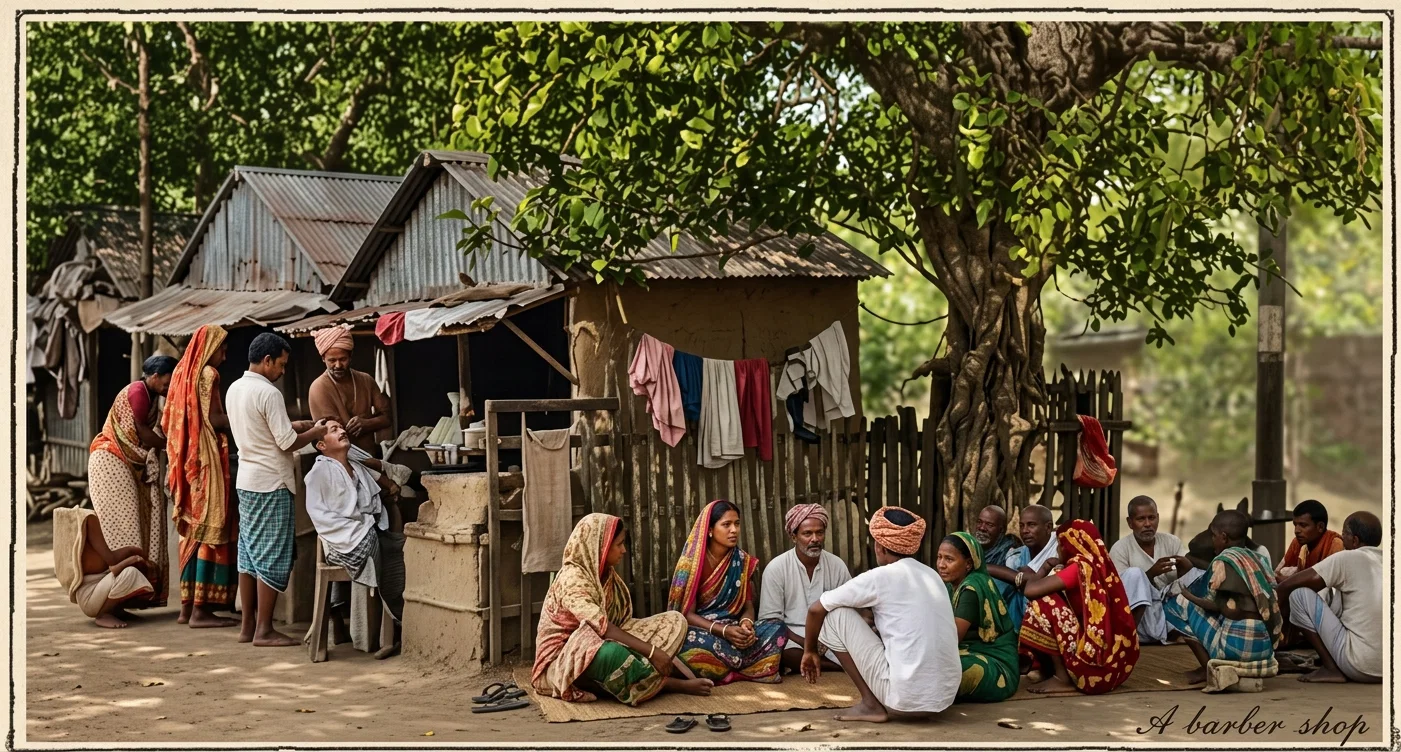
A BARBER SHOP IN INDIA
The chairman, Dr. Rouses, translator for the Baptist Mission Press, gave a few texts to prove, as he thought, that Sunday is the Sabbath, then spent the rest of his time abusing Seventh-day Adventists. One speaker accused Brother Mookerjee of offering land to the people as an inducement to join his mission. A man with long hair then shouted in English, “Shame! Papists!” The speaker then asked what should be done with such people. At once the reply came, “Beat them!” An expression was taken of the congregation to see how many condemned Seventh-day Adventists for these things, and nearly every one arose to his feet. The excitement began to get intense as the speaker thundered his abuses, until it looked as if the suggestion to beat them would be carried out at once.
But the next speaker, a man who seemed to have great influence over them, arose and spoke of Seventh-day Adventists in quite glowing terms. He said that when a new doctrine came into a community, it should not be hastily condemned, but tested in the light of the Bible. He confessed that he knew some Seventh-day Adventists who were very good people, and knew their Bibles better than many belonging to his own mission. This quieted the people for a time. But before he finished his talk, he tried to outdo all the other speakers in condemning us.
Mr. N. J. Bose, the leader of the Scotch mission in Gopalgunj, tried to give a history of Seventh-day Adventists, but he made such a complete failure that it was very evident to all that he was not acquainted with his subject. He declared that the Adventists had come to Gopalgunj because they dared not preach their doctrines to the educated Christians of Calcutta. If they should try to do so, he said, they would be beaten out of the churches. Since the doctrine of the seventh-day Sabbath had been rooted up, he said that the Adventists were going around with charts, on which were pictures of a lot of beasts, and trying to explain Daniel and the Revelation, books which no one could understand. He also said that while at first we taught that all Sunday-keepers would go to hell, now we declared that there is no hell. Whenever cutting remarks were made about us, many clapped their hands. In concluding, Mr. Bose advised them to have nothing to do with Adventists, not to give their daughters in marriage to them, nor eat, nor smoke the hooka (pipe) with them.
These speeches occupied about four hours. Then they abruptly closed the meeting, giving no one opportunity to say a word. The man who offered the closing prayer thanked the Lord that the Adventists were present, and took the remarks made about them so patiently. He also returned thanks for the wisdom used by the speakers, as undoubtedly their words would uproot all that the Seventh-day Adventists had done in East Bengal.
At the close of the meeting, one of the speakers asked me what I thought of the talks. I replied, “You made a great deal of noise and talked a long time, but none of you gave any proof that Sunday is the Sabbath.” He thought they had given plenty of evidence, but when pressed for a text, he replied that any day which a man might set apart to observe after working six days was all that God required. When asked if, according to his argument, the seventh day was not as much the Sabbath as the first day of the week, he said that he would talk with us further about it on the boat. But we did not see him again.
Two different tracts on the Sabbath question were distributed, one written by Dr. Rouse, who is at the head of the Baptist Mission Press, and the other by a Bengali minister. Both contained the same old arguments which we meet in the States.
The morning after the meeting, there was a slight earthquake, which they claimed was the outpouring of God’s Holy Spirit upon them, giving evidence that they had his approval.
We all had to go in small boats to the steamer. We were the first to arrive at the wharf, and when the rest came, they carried out the instruction they had received at the meeting, and took no notice of us. After we boarded the steamer, however, we were so close together that they could not easily avoid us, so we talked with some of them, and gave them to understand that what had been said about us was not the truth. They replied that if such were the case, they had been misinformed and would be glad to be set right in the matter. The man who shouted “Papists” tried to get out of it by saying that we misunderstood him.
Several remained to the celebration of the ordinances, which took place the day after we left; but some, who were close communists, would not remain lest they might be defiled. Thus we see how these churches are ready to unite to persecute Adventists, but they separate when it comes to the communion service.
We left many tracts with those who attended the meeting, among which was “The Law of God as Changed by the Papacy.” Two Hindus who could read Bengali went to the ministers and asked them to show them where they could find a text to prove Sunday to be the Sabbath. They wanted to show it to the Adventists, and get the money offered in the tract. They never came with the text.
While we were in Gopalgunj a Bengali convention was also held in Calcutta. Some Bengalese who believe our doctrines printed tracts and distributed them at the close of each meeting. One of the young men got his ears pulled, one was pushed out of the church, and another was told that the tract would be shown to the lord bishop, and they would hear what he had to say about them.
We have more to fear from the heathen who profess Christianity and are tutored by the churches than we have from the heathen who still worship their idols. All these things are signs of the times, and show that even in India steps are being taken toward the enforcement of Sunday observance.
Calcutta.
Algeria
By S. JESPERRSON
S. JESPERRSON
Our first year of work in this country is now in the past, and we are glad to say that the Lord has been with us and has blessed our efforts and given us souls for our labor. We have now believers in the third angel’s message in all three departments of Algeria. If they were all here in Algiers, we should soon be able to form a little group, but it seems that the Lord wants them to be scattered as far as possible so as to do all the more good. Here in Algiers there is one who is keeping the Sabbath who was formerly a Catholic. Her husband is very much against her, but she has taken a decided stand. One day he told her that he would move to a place where there were no Adventists, to which she replied, “But I would be there, and I would make more Adventists.” In the province of Oran and near the frontier of Morocco we have a family who are walking in the commandments of God and doing what they can to reach others with the truth.
STREET IN ALGIERS
The capital of Constantine has one representative of the message. This is a young lady who was studying here in Algiers last winter, and thus became acquainted with us and with the truth for this time. We were sorry that we had to part with her so soon, as she had got only a glimpse of the doctrine, but judging from the letters she has written us since she left, she stands firmly for what she believes to be right. Her mother is the “concierge” (keeper) of the Protestant church, and of course used to clean the church on Saturday, but the young lady has succeeded in her effort to have the cleaning done Sunday morning instead of on the Sabbath, although none of her family is in favor of her principles. When she went home, she spoke to the pastor about the truth, but he simply tried to confuse her. She wrote us what the pastor had said, and we sent her a reply to his objections, but when she wanted to show him our letter, he would not even look at it. She then showed it to a missionary, but he also rejected the plain truth presented. Nevertheless, she keeps firm, and in one of her letters she said: “As for me, I want to believe what you had the kindness to teach me.”
As the other missionaries see that we begin to gain ground, they feel uneasy and begin to work against us. When one day one of our friends told a Baptist missionary that she was about to become an Adventist, he warned her not to take this step, and to quiet her mind, he pointed her to Col. 2:16; Rom. 14:5; Gal. 5:1, etc.; but the Spirit of God is still working on her heart, and we hope that she will some day take her stand on the right side.
Most of our work is done in the French language, but many other languages are represented. The Arabs constitute the largest part of the population, and will have to be reached in their own language. Then we have multitudes of Spaniards who must hear the message in their native tongue. I said that they must hear the message, because most of them can not read, so they can not be reached by means of the printed page, and with the Italians it is about the same. For all these and many other different races my wife and myself are the only workers. Is that enough to finish the work in this generation? We praise God for what has been done, but should we not soon have more workers and begin in at least one more place?
Algiers.
H. J. LOEBSACK
By H. J. Loebsack
From the Border of Asia
H. J. LOEBSACK
“Lengthen thy cords, and strengthen thy stakes.”
OUR organized mission fields and conferences extend to the very borders of Asia, in European Russia. But we would speak here of the East Russian Conference. Bounded by the Don and Ural Rivers, the Caspian and Black Seas, and by the Caucasian Range, with its peaks covered with eternal snow, this conference contains six governments, and the territory of the Cossacks in the Don, the Ural, the Kupan, and the Terek district, with about fifteen million inhabitants. Here we find the Russians, the Tartars, the German Cossacks, Armenians, Kalmucks (Buddhists), and about ten smaller Caucasian-Asiatic tribes. Among the latter is the Christian tribe known as the “Chewsuren,” now numbering about seven thousand souls, in the almost impassable mountains not far distant from Tiflis. From very ancient times they have celebrated the Sabbath,16but accepted Sunday later from Rome, and, perhaps because of persecution from the Mohammedans, outwardly celebrate Friday. The tribe is apparently dying out. They are said to be friendly and hospitable, and to bear to this day traces of the persecution to which they were subjected. We have not yet formed any nearer acquaintance with them.
We have four ministers, one Bible worker, one nurse, and two colporteurs in our field. There are thirty-eight churches and companies, among them twenty-six German, eleven Russian, and one Cossack church. Last year we were able to receive through baptism and vote, one hundred and nine, while in North Russia one hundred and five were accepted, and sixty-two in Middle Russia. From January to July of this year, we have received seventy-five, twenty-five among them being Russians and Cossacks.
The manifesto of the government assuring freedom of religious belief and worship to all the subjects of his majesty the czar, has not been violated in the least, so far as we know, for which we feel to heartily thank God and the government.
In the army none of our brethren fell in battle, none were placed direct in the firing line, all had the Sabbath free, and some of them even did not need to handle firearms at all. On the other hand, during these troublous times two Russian and two German brethren were murdered in their fields, or upon the way, or in their dwelling.
For nine months the people have been driven hither and thither like the waves of a billowy sea, but God has protected his ship in the midst of the storm. He is with us ever, unto the end of the world. One hundred and thirty-five million human beings, the sixth part of the inhabited earth, shall hear the last message of warning. The land and the people will not yet see destruction, even though the storm may roar among them. The land is open to the gospel, and the servants of God must enter the open doors, to prepare the way of the Lord.
Brethren, who will go? Who will send means for this work? Pray for this land, and await the signal of God for you to enter this land before it be too late.
Hamburg, Germany.
Japan
By T. H. Okohira.
DURING the summer I made a visit to our little company at Wakamatsu. I found them all of good courage. During the week of my stay, I studied the Scriptures with them, and on the Sabbath we celebrated the ordinances. During my stay one old lady, a widow, began to observe the Sabbath, and desired to be baptized; but her two sons opposed her so bitterly that she decided to wait and be baptized at the time of my next visit.
After spending a week at Wakamatsu, I went to visit the interested subscribers of our Japanese paper in several villages of Fukushima province. I had very interesting experiences among these people. One young man had been interested in the truth for some time, but at the time of my visit he had not fully decided to obey. Since my return I have received word from him that he has made the decision, and desires baptism at my next visit.
Another young man whom I visited is the principal of a country school. He was much pleased to have me visit him, for he is an earnest Christian. He took me to the home of a friend of his, who is also a Christian, and I gave them a study on the second coming of Christ. They were much interested, and wished me to remain longer, so I arranged to meet some of their friends the following day. At the appointed time I found many persons from several distant villages assembled in the schoolhouse. They were mostly country-school teachers. I presented to them the Bible reasons of our faith, and they were much interested, especially to know that the coming of the Saviour is so near. I remained with them nearly half a day, studying the Word, and left them with the promise to visit them again.
I visited still another young man, who has been suffering for a long time with consumption. He first heard the truth from one of our canvassers, and since then has been reading our paper, and is now keeping the Sabbath. I went over all the main points of our faith with him, and he gladly accepted the truth presented, and expressed his desire to be baptized. But the next morning he had a bad hemorrhage, and was too weak to go to the river. So I comforted him, and encouraged him to wait till I could come again.
After this I visited many others of our subscribers, and had such joyful visits with them that all desired me to stay longer, and tell them more about the third angel’s message. It was a source of much joy to me to see how highly all our subscribers value the Owari. Some bind the papers together and carry them about and read to others. One young man said to me, “The Owari is my best teacher of the truth. I need only the Bible and the Owari for my spiritual food.” All this was a great encouragement to me in my work as editor. My hands have been so tied by the translation work for the paper that I have often wished that I might go out as a field worker. I have thought that this would be better missionary work than sitting in the office writing. But this short trip among our readers has greatly encouraged me in my editorial work, and I will be more faithful and earnest in the future. But, brethren in the faith, “the harvest truly is great, but the laborers are few: pray ye therefore the Lord of the harvest, that he will send forth laborers into his harvest.” Indeed, the field is ripe for the message, and everywhere in this country souls hungering for the truth are awaiting our help. Brethren, let us do all we can to hasten the coming of the Lord Jesus; then we shall soon have a joyful gathering day from every part of the harvest-field.