“As in water face answereth to face, so the heart of man to man.” Prov. 27:19. As we look into the water or mirror, we see reflected our countenances. If it is a pleasant face, the water reflects a pleasing face. If a mournful look or sad countenance, the water reflects the same. So the heart of man reveals itself to man. Wherever he looks, he sees reflected what he is. If the heart is mournful, the whole world appears in mourning. If the heart is selfish, everything and everybody appear selfish. Wherever I look, I see myself. The tobacco user pollutes and poisons the pure air that he is compelled to breathe. After a time he becomes ill, and then finds fault with the climate, and says, “This climate does not agree with me. I must seek a more healthful one;” not knowing that he is creating his own climate, and that the curse goes with him wherever he goes.
We are surrounded with an atmosphere of grace as real as the air we breathe. But a mournful spirit, a depressed or selfish soul, pollutes or poisons its own atmosphere. Then when spiritually sick, man complains of his unfavorable or disagreeable and unhealthful surroundings. He longs to escape, but if he does, he finds, after a time, that there is no difference. He makes his own surroundings wherever he is. Heaven itself would be an undesirable place for a selfish soul. He feels and considers himself an abused man, a persecuted saint, not knowing that his injuries are self-inflicted. Instead of saying, Who shall deliver me from my unfortunate surroundings, my disagreeable wife, children, or neighbors? he should say, “O wretched man that I am, who shall deliver me from this body of death?” Who shall deliver me from myself?
There can be no peace on the outside anywhere, until there is peace on the inside. “Cleanse first that which is within the cup and platter, that the outside of them may be clean also.” There is beauty all around when peace and love are in the soul. “A merry heart maketh a cheerful countenance.” With a cheerful countenance cheerfulness is expanded and reflected everywhere. All nature smiles, and wears a cheerful aspect. We see a reflection of what we are wherever we look. “He that is of a merry heart hath a continual feast,” no matter where he is. He sees the roses where others see only thorns. “Blessed [happy] are the pure in heart: for they shall see God.” “Unto the pure all things are pure.” They will say, “Thou preparest a table before me in the presence of mine enemies.” “But unto them that are defiled” is nothing pure; even their mind and conscience are defiled. Heaven itself would not be pure for them; for they would pollute their soul’s atmosphere. Even there the selfish soul would ascribe selfishness to the angels in their unselfish service of love. Selfishness would be seen everywhere. Soon the cry would be heard, O wretched man that I am, who shall deliver me from this place?
The object of the gospel, or good tidings of great joy, is to “appoint unto them that mourn in Zion, to give unto them beauty for ashes, the oil of joy for mourning, the garment of praise for the spirit of heaviness; that they might be called trees of righteousness, the planting of the Lord, that he might be glorified.” “Whoso offereth praise glorifieth me.” The man that mourns, complains, and is bowed down with a spirit of heaviness, will never be called by his children or neighbors a tree of righteousness, the planting of the Lord. Such a life can never glorify God. He is a body of death instead of life. He, like the tobacco user, has an atmosphere surrounding him that is just as dangerous for others to inhale as it is for himself. The wife and children become sick spiritually, because they are compelled to live in the depressing atmosphere of selfishness.
A Caged Bird
By E. J. D.
E. J. D.
I SAT in my room at twilight, the
shadows were gathering round,
Thinking of my cares and trials, the
thorns in my pathway found;
I thought of the pleasures beyond, of
the joys that might be mine,
If ’twere not for the fetters that were
keeping me to the line.
I felt like a bird imprisoned behind cruel
iron bars,
That looked between the grating at the
beautiful, shining stars;
I wondered why in my sadness, with a
heart that ached so sore,—
Why life in each passing moment
brought but sorrow more and more.
In the dark I could not see the Father’s
pitying look of love,
Or feel his hallowed presence, but the
storm-clouds hung above:
And so, with a soul in prison, like a worn
and weary bird,
I hung my head in deep sorrow, with
never a tear nor word.
But suddenly I heard in the silence of
that weary, waiting hour,
A sound of untold sweetness,—of a
voice of heavenly power;
I listened in rapt attention; for somehow
it seemed to me,
Perhaps a message was coming,—a mes-
sage to set me free.
“Dear child! don’t you know I am with
you whether you work or rest?
Don’t you know I am caring for you,
and giving my very best?
Surely, you must know my meaning after
all these passing years!
Have I ever neglected you, child, or
caused you any fears?
“Then give me the key of your prison,
give me the full control;
And when your wings are all ready, and
when strengthened is your soul,
Then will I unfasten the lock, and the
gate push open wide,—
Then only can I trust you, birdling, to
fly around outside.”
“Savory Meat”
LEVI TURNey
I RECENTLY talked with a stock-raiser, formerly in business in Wichita, Kan., now in Kansas City, Mo., who stated to me, without any hesitation or reserve, that when cholera or some other disease prevailed among his hogs, he kept a man with a lantern among the herd all night, watching to discover the first symptom of sickness. Whenever such a discovery was made, the beast was immediately slaughtered, a large kettle of water being kept hot all night, and everything in readiness for scalding and dressing the animal at once. He also stated that the same night-watch was kept up among other animals, especially sheep, whenever there was any suspicion of disease. When asked what was done with these diseased carcasses, he unhesitatingly replied, “Sold for people to eat.” I had just been giving him my reasons for a non-flesh diet; and after his statement, I told him that he had refreshed my mind with another reason, which I had known for years existed to a greater or less extent—usually to a greater.
Rational Treatment of Disease
By T. J. Evans
T. J. EVANS, M. D.
THE treatment of disease is one of the oldest sciences known to man; for there is a desire to relieve pain whenever it manifests itself. This may be done by changing the position, making a local application, or administering a drug that will deaden and stupefy the nerve-centers that have to do with this sensation. Our improvement over our ancestors lies in our being more rational than they. It was customary in years past to draw blood from the veins of those who were suffering with fever, but now we know that the flow of blood can be changed from one part of the body to another, accomplishing the same results without the loss of the fluid that is so essential to life. There are those living who remember when this practise was in vogue. We thank the Lord that light is shining from the throne of God, and is being appreciated and used by many in this generation.
A thorough understanding of a disease is essential to the successful treatment of it. One should not only be able to name the disease, but should know the actual working of the system under its abnormal condition. A certain disease will not manifest itself the same in two individuals. Every individual has his own characteristics, and these characteristics cause the disease to vary in its manifestations; therefore a different line of treatment may be called for in the same disease. For instance, two individuals may have rheumatism; one may be strong and robust, the other may be weak and emaciated. The treatment that is essential to the first would be destructive to the latter. The thing, then, to keep in mind is the condition of the patient, and not so much the disease. It is the system that wages war against the disease, and it is the duty of every physician to see that the patient is provided with all necessary material during this time of trial. One eminent professor of Rush Medical College has said that all a physician can ever expect to become is a hod-carrier to nature. He, as well as other careful observers has recognized that recovery lies in sustaining and assisting nature. Tissue-building material is what the body wants, and not so many stimulants.
Besides supplying the body with good food, it is often necessary to change the circulation so that there will not be too much congestion in one place. This can best be done by the application of heat and cold. The blood is a great germicide, besides having in it the white blood corpuscles, whose function it is to destroy or carry away any material that is working injury to the system. The application of heat draws the blood, causing the capillaries to dilate, or enlarge, so that they will contain more blood. Then, by applying cold, the small blood vessels contract, forcing the blood to another portion of the body, and in this way a pumping process is carried on which assists nature in carrying off diseased material. The blood in the body is constantly changing from one place to another, but sometimes, in case of disease, the congestion is so great that the blood can not flow freely without assistance. It is our duty to assist nature whenever there is a call, and we should act intelligently.
In pneumonia the lungs are so congested that the blood can not flow freely through them. The heart, being forced to work against a full, hard lung, often fails as a result. Hot applications to the lower extremities would take the blood from the congested area, and the patient would be relieved from much labored breathing that always accompanies this trouble. A hot hip-and-leg pack is of great value in many of these cases, and relief comes almost at once.
Sometimes fomentations are of great value, especially where there is much pain. Treat the patient in such a way that you meet all emergencies, and you will accomplish more than you will by treating the disease.
God Is Love
“He is in God, and God in him,
Who still abides in love;
’Tis love that makes the cherubim
Obey and praise above;
For God is love; the loveless heart
Hath in his life and joy no part.”
A Gentleman
He is above a mean thing. He can not stoop to a mean fraud. He invades no secret in the keeping of another. He betrays no secret confided to his keeping. He never struts in borrowed plumage. He never takes selfish advantages of mistakes. He uses no ignoble weapons in controversy. He never stabs in the dark. He is ashamed of innuendos. He is not one thing to a man's face and another behind his back. If by accident he comes in possession of his neighbor's counsels, he passes upon them an act of instant oblivion. He bears sealed packages without tampering with the wax. Papers not meant for his eye, whether they flutter at the window or lie open before him in unguarded exposure, are sacred to him. He invades no privacy of others, however the sentry sleeps. Bolts and bars, locks and keys, hedges and pickets, bonds and securities, notices to trespassers, are none of them for him. He may be trusted alone, out of sight, near the thinnest partition—anywhere. He buys no offices, he sells none, he intrigues for none. He would rather fail of his rights than win them through dishonor. He will eat honest bread. He tramples on no sensitive feeling. He insults no man. If he have rebuke for another, he is straightforward, open, manly; he can not descend to scurrility. In short, whatever he judges honorable, he practises toward every man.—Selected.
“The Hand of the Lord”
By G. F. Jones
G. F. JONES
ONE can do but little for the people of these islands until he has acquired a knowledge of their language. We are glad that our difficulties in mastering the native tongue are nearly over, and that we can understand and be understood. So it is only a question of time before we can feel perfectly at home with the people. We long for this above all things. Seven months with our tongues tied, as it were, has been a most trying time, with the need of workers staring us in the face. Yet we have endeavored to improve every opportunity and have held Bible studies through an interpreter.
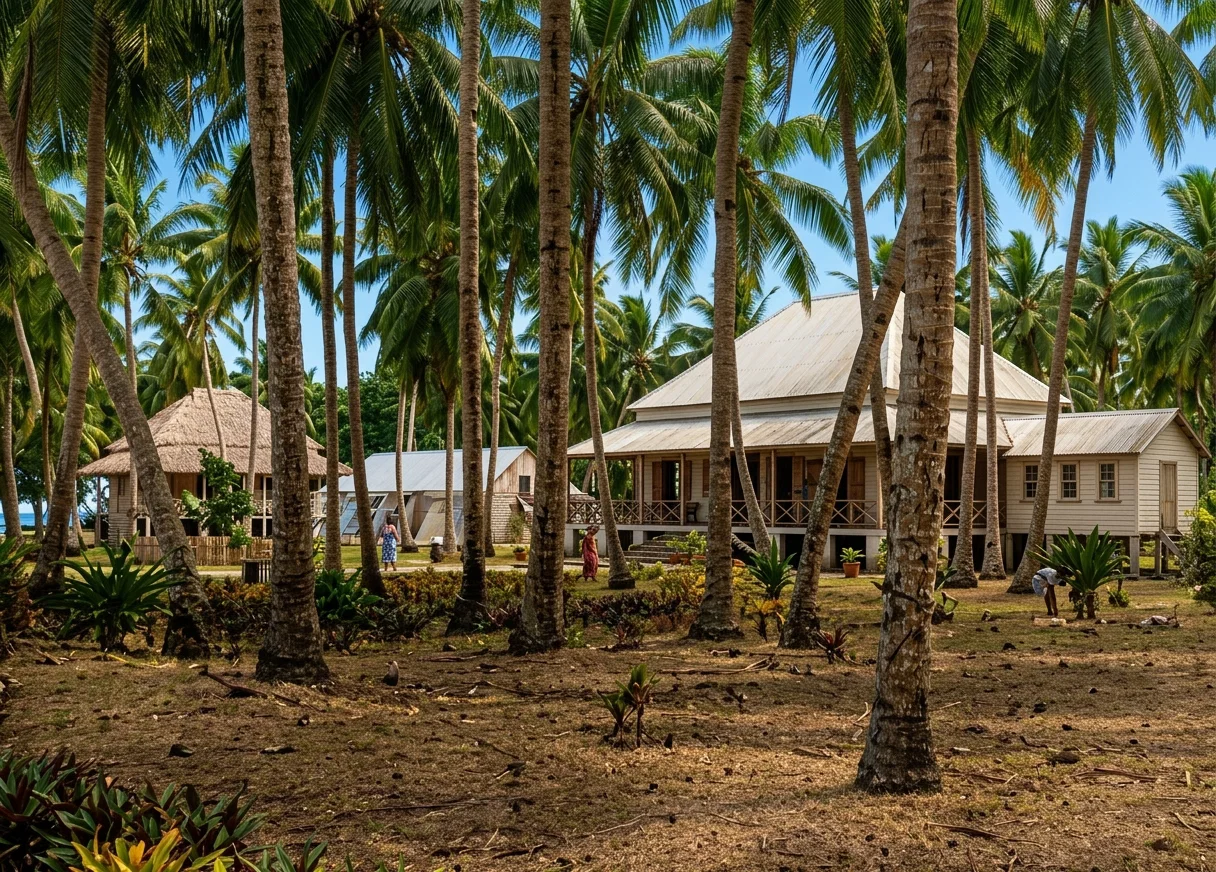
A SCENE IN TAHITI
Hanging together in our house, one over the other, are a prophetic chart and a map of one of the American States. One morning we were impressed to place the prophetic chart on top. During the course of the day a young man came in, stared at the chart, and desired to have it explained, which we immediately did, and also planned a course of study at his father’s home, where each week we had an interesting time with a roomful of people. This young man recently left for another island, to build himself a home, and, as he told his parents before leaving, to keep the Sabbath, and have his home for a meeting-house.
The hand of the Lord is further seen in this. Another brother, hearing of our Bible class, desired one at his home. We met two nights in the week, and many of the neighbors came in. This is the way the Lord is working for us, even before we are prepared to speak to the people in their own tongue.
My chart story is not yet finished. About two weeks ago a young native woman who comes to see us occasionally would steal away from us, and go to the room where the chart was hanging, and sit on the floor and look at it as if an angel pointed it to her. One day she brought her husband, and seeing they were anxious to know what it meant, we began holding studies with them twice a week. The young husband is very quick and intelligent, and we trust will take his stand with us some day. We long to see these young people efficient workers in the cause. We feel sure that what is needed to make the work a success here, as elsewhere, is native laborers. A conscientious native laborer is worth half a dozen foreigners in any country. There are other young men whom we visit, of whom we have great hopes.
We are known everywhere here as “the Pittarnia people,” meaning “Pitcairners,” so called from the “Pitcairn,” when she sailed in these waters. The prejudice against us is very strong in this island, and we are closely watched, especially by those who keep alive this flame of prejudice. I overheard the following jocular remark from a group of this class: “The Mormons can show you how to make money, and the Adventists how to go to heaven.” So, notwithstanding their enmity, they have learned concerning us the best thing worth knowing. Thank the Lord, we are not afraid of the lions’ roar, but know that, like the two lions in “Pilgrim’s Progress,” they are chained.
A young man—a leper—through his isolation has been brought to study the truth for himself, and I have been privileged to meet with him and read the Bible with him. He is more firm every time I see him, and has begun to observe the Lord’s Sabbath. When his relatives heard this,—and he has a great number of influential ones,—they tried to dissuade him. But he has made the Bible his trust, and has become another channel through which the Lord can pour his holy oil to give light to others. He uses the outcast and despised. “He raiseth up the poor out of the dust, and lifteth the needy out of the dunghill; that he may set him with princes.”
Dear friends, if we have omitted to tell you anything about the deep blue sea, the blue and starry heavens, the high mountains, the sparkling brooks, the tall trees and lovely fruit, the tropical beauty, etc., it is because we believe you would rather hear of that which will endure forever, and of those who will meet upon the “sea of glass,” and upon “Mount Zion,” who will drink of the “pure river of water of life, clear as crystal.” All this beauty from heaven is reflected in earthen vessels, and by beholding such scenery our hearts rejoice with you.
Papeete, Tahiti.
Second Trip Through Asia Minor
By J. H. Krum
J. H. KRUM
OCTOBER 16 I left Beirut, Syria, for Asia Minor, arriving on the 19th in the historic town of Tarsus, the birthplace of Paul, where we now have one representative of our faith. I had the pleasure of baptizing two young Armenian brethren here who had been waiting to take this step for more than a year. From Tarsus I proceeded to Adana, taking our native worker to accompany me on my tour.
After meeting the company in Adana and holding several services with them, we proceeded to Hadjin, a ride of four days on horseback, up in the Taurus Mountains. When we arrived, the police stopped us outside of the city, because some one said that we were Sabbatarian ministers. I was taken to the chief of police, where a great crowd collected. After some questions had been answered, they allowed me to go to the house of one of our brethren. Soon after the kaimakam sent the chief of police, forbidding me to hold any meetings. I told him that the command of Christ is to go into all the world and preach to every creature, and as I had come a great distance to see our people, it was impossible to obey this order. He replied, “Very well; you can speak with your people, but must not hold meetings for others.” Many were desirous of coming, but an officer was stationed for two days near our house, preventing them.
When we saw that we could do no public labor, we began visiting our friends in their homes. We also made the acquaintance of six Protestant ministers, who treated us exceptionally well. We attended two of their meetings, and I was invited to give a testimony in the one held by the Mennonites, who are doing successful orphanage work here. I had not only the pleasure of meeting Christian friends among them, but to my14great joy the leader of the work is also a native of my city, Reading, Pa.
On account of the population of Hadjin being Armenian, with the exception of about thirty families, they have a Christian kaimakam, a Catholic Syrian from Beirut. I went to him and spoke with him concerning my trip to the province of Aleppo, asking him not to put any obstacle in the way. As I came from his native city, and spoke Arabic with him, he was kindly disposed toward me. He said, “I have nothing personally against your people here, but as the government has instructed me to prevent your work, I arrested some who met on the Sabbath for worship, and who persisted in doing so after they were notified.” Further he asked, “Is it true that you baptized some of your people here?” I answered, “Yes.” After a few remarks, he passed this by, and I left him, knowing that God had given us favor with him.
In Hadjin I baptized three brethren and one sister, and then we proceeded on our journey, accompanied by a sabdiye, captain of ten men, who was placed at my disposal by the Kaimakam.
The country in this district beggars description. It must be seen to be understood. In the rainy season the roads are almost impassable, and at some points exceedingly dangerous, because of narrow, precipitous places, and of roaming Turkomans and Circassian villagers, who are noted for their robberies.
After two days we arrived at Göksin. It being Friday, we resolved to spend the Sabbath here. As the small towns have no hotels, strangers are usually taken in by families. We were taken to the teacher of the Protestants, who conducts a church school besides holding several meetings weekly for the people. We were treated very hospitably, and were invited to preach. We were the first to bring the truth to these people, and were glad to see an interest in the coming of Christ.
Here again some people spoke against us to the Turkish authorities, saying that we were bad, dangerous men. But as I had gained the friendship of the jüs pacha, captain of one hundred men, who had once been stationed in Jerusalem, and therefore understood Arabic, it was easy for us to explain the nature of our great evil; namely, Sabbath-keeping. This man afterward sent us a Circassian sabdiye to take us safely to the next city, Albistan, where we arrived after a two days’ journey through the mountains on horseback.
This town of about thirty thousand inhabitants is located very near the borders of Armenia and Kurdistan. During the massacres, the Armenians of this place nominally accepted Mohammedanism until the trouble was over, and in this way escaped martyrdom. They say this was the darkest period of their lives. With heavy hearts they daily were forced to go to the mosque to pray; but fearing death, and the fate of their wives being uncertain, they chose the friendship of the world rather than remain faithful unto death, and receive a martyr’s crown. This made a great impression upon me. My thoughts at once turned to the future when the mark of the beast shall be forced upon all who do not stand thoroughly rooted and grounded upon the Word of God. Rev. 13:15, 16. Not until brought face to face with the realities of similar experiences, can one forcibly realize the situation of those who have to face death in the last test which shall be brought upon the whole world. Rev. 3:10.
In Albistan we have a group of nine Sabbath-keepers. While here, we baptized two sisters and one brother in the Djihan or Gihon River, which rises from a great spring near the city named after Gen. 2:13. These were received into the church by vote. The brother was the first Protestant of that whole region. He helped to organize the church about forty-six years ago; but when light on baptism came through the Disciples, he accepted it; and when further light on the Lord’s coming and the commandments of God was brought to him, he again was the first to lead out, and hold up the lamp of truth.
After remaining here one week, we departed for Marash. All the brethren accompanied us to the suburbs, where we all lifted up our hearts to God in thanksgiving for his many blessings bestowed upon us. This was an impressive farewell. These brethren appreciate a visit, which occurs only about once in five years.
The way to Marash is very difficult. We crossed the Berut and Achyr Mountains, which are from seven to nine thousand feet above the sea. On entering the first-named mount, we had rain; but after getting nearer the summit, we encountered a driving snow-storm. I remember very distinctly my feelings while descending this mountain. The rain poured down, but no shelter was to be seen. At last, wet and weary, we found a large rock, which projected like a roof about five feet above the earth, and out far enough to cover sufficient space for all of us to find shelter, where we cuddled together to get warm, and partook of some food. My thoughts were forcibly drawn to the beautiful Scriptures of Job 24:8 and Ps. 61:1-4.
On the fourth day after leaving Albistan, in the afternoon we beheld the city of Marash down in the valley below, partly obscured by the clouds between. In this city, which is a very important Protestant center, we have six brethren and many friends. Our meetings were attended very well in a private house, and a great interest to hear prevailed. During my stay of six days I baptized five young men—one, a former Catholic, another, a Gregorian Armenian, and three Protestants. I also visited two American Protestant ministers, and had a profitable talk on righteousness by faith and the law and the gospel with a German missionary and his family, who are doing good work for the orphans. Since the massacre many orphanages have been established; and as I have thus far visited four of them, I can say that the people conducting them all seem to experience the blessing of God. And from what I have seen, God surely has men among them who are preparing the children to receive the last message.
On leaving the city, all the brethren and some friends, among them a wealthy merchant, accompanied us to the suburbs, where, after prayer, they walked beside us, singing, “It is well, it is well, with my soul,” with a strength and joy which only the indwelling presence of the Holy Spirit can bring forth.
We arrived in Aintab after two days of riding. This is another important center for gospel work. Here I was glad to notice a good religious experience in some young men. We have not actively prosecuted our work here. A young brother began the work six months ago, at the same time taking English lessons in the Aintab Protestant College. One man who had become discouraged and given up the Sabbath promised to begin its observance.
From Aintab we proceeded to Aleppo, arriving there after three days of exceptionally hard riding. This is the center and meeting-place of Turkish, Armenian, and Arabic influence. Although the Arabic prevails, the other languages are largely spoken. This is the principal trading city for hundreds of miles to the north and east, and has a large population. In this great city we have only three brethren, two of them baptized. Here Brother A. B., our Bible worker who accompanied me, was arrested for some irregularity in his passport, and afterward they suspicioned that he was a man whom they were hunting from Diarbekir. Although I tried to free him, through the American consul, I succeeded only in securing his release from prison to accompany me on my journey to Adana, he going as a prisoner, accompanied by a soldier.
In four days we reached Alexandretta, where we have a brother. We remained over the Sabbath. On Sunday morning the news came from the prison that they had decided to send Brother A. B. that day. So I prepared, and we went around the Bay of Alexandretta to Adana on horseback in four days. From Adana he was sent to Hadjin, four days by horse, to his home, where I hope he has been discharged by this time. Brother A. B. told me that he greatly enjoyed his experiences in the various prisons, as he had a good opportunity to speak words of encouragement to some discouraged souls.
After remaining in Adana one week with our church, and refreshing myself in body and spirit, I proceeded to a mountain town nine hours from Tarsus, named Kozuluk, to baptize a young man and his wife. Returning to Adana and Tarsus, I baptized a young brother in the latter city, then came on to Mersina, where I am now waiting for a steamer for my home in Beirut, Syria.
On my trip I preached thirty-two sermons, held twenty-nine Bible readings and twenty-seven other meetings, besides making fifty visits. I baptized sixteen,—all Armenians,—three others were accepted by vote, making a total15addition of nineteen members. Of these, six were married men, four married women, and nine young men. We rode on horseback thirty-one days, often late in the night, sometimes sleeping in the mountains with the heavens as a roof and the earth as a bed. Through all, the hand of God was with us to help. To him be all the praise.
Beirut, Syria.
General Notes
SINGAPORE, in the Malay Peninsula, is perhaps the most cosmopolitan city in the world. The British and Foreign Bible Society sells Scriptures in over seventy-five languages and dialects in and about Singapore, and nearly forty languages and dialects are spoken among the six hundred boys of the Anglo-Chinese college in that city.
A CONGREGATIONAL church in Chicago has a membership of twenty Chinese enrolled on the record as a result of a Chinese Sunday-school conducted in that church. Five members of this school have gone as missionaries to their own countrymen. One is preaching in Canton, one in Hongkong, one in Hoinjen, and another in his native town, to which, before he returned, he sent sixty dollars a year to support a native teacher.
A ROAD has recently been constructed in the Congo Free State ninety-three miles long, which is thirty-nine feet wide, with a space twenty-six feet wide available for vehicles. The surface is especially hard and durable, and there is no incline of more than one foot in ten, the hills being few in number, and short. It is said that the road is practicable for automobiles of all kinds. The survey for the extension of the road sixty miles farther has just been completed.
“CORSICA has for long years appeared utterly intolerant of Protestant teaching. The few McAll missionaries who years ago entered upon the Corsican field were driven from the island with open violence. Three times has it been necessary for Protestant Bible colporteurs to flee from the island, barely escaping with their lives. But the truth they sowed found good soil at last, and formal application has been made to the minister of the interior to recognize the Protestant church at Aulene, Corsica, as the parish church, and to allow to it the support which was formerly given to the Romish priest. The petition declares that as a body the village has renounced Romanism, and has embraced the Reformed faith. In four villages of Corsica regular evangelical worship is held.”
Week of Prayer—British Guiana
By D. C. Babcock
D. C. BABCOCK
As the readings for the week of prayer did not reach us on time, we postponed our meetings one week. As soon as the announcement of the appointed time was made in the REVIEW, I at once corresponded with our different companies, urging upon them the necessity of preparing for the occasion. I have been informed, through the good reports they have sent in, that the Lord especially blessed them, and all are encouraged by the presence of the Spirit of God.
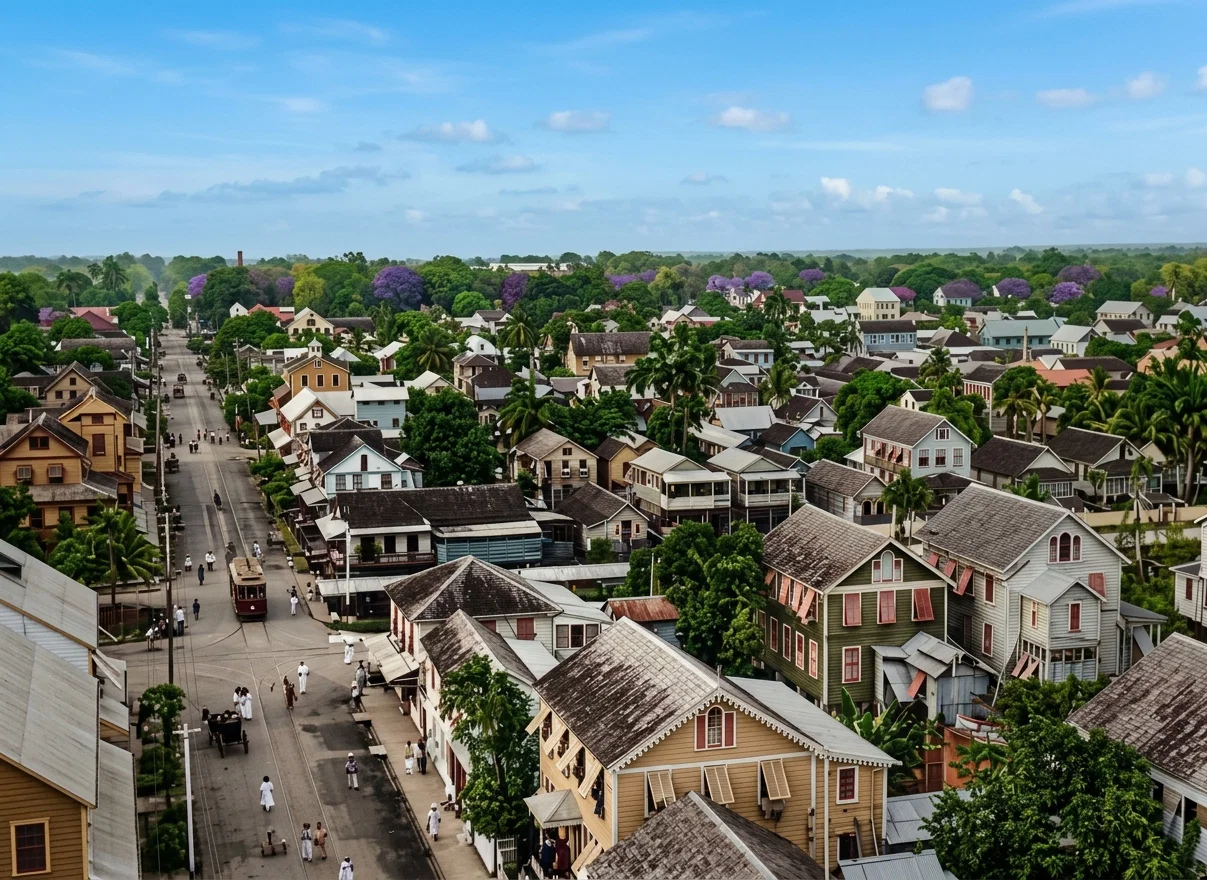
A VIEW OF GEORGETOWN
In Georgetown it was a season of refreshing. There was an earnest seeking of God, and a cry for help from his throne. The Lord worked mightily; and I know of some who had had dark experiences in the past, who gained a victory over self and over dispositions that had long marred the work of God. For this we praise our Heavenly Father. It is evident to my mind that God is especially working for this people, and that he is going forth from his place to prepare Israel for redemption. In many ways the path has seemed dark, and the trials have been severe; but God has given us the victory, and for this we praise his holy name.
At the close of the week of prayer, it was my privilege to visit again the Indian church at Tapercruma. Some difficulties had arisen there since my previous visit, but the tender influence of the Holy Spirit worked so mightily that these difficulties all vanished, and the presence of God was realized. At the close of the meeting on Sabbath afternoon, January 10, two precious souls were buried with Christ in baptism, and, I believe, were raised to walk in newness of life. It was encouraging indeed, as we moved onward through the little Indian village to the water's edge, to hear them singing praises to God for the victories gained. After baptism I took a boat with an Indian, and went down to Sand Road to visit our friends there, who are somewhat interested in the third angel's message. It was there that we held a meeting about three weeks ago, and an urgent invitation is extended to us to continue our work in this village.
From there I went to Aurora, and visited Brother and Sister Giddings, who are now located in this place to continue the work of the Lord. I found them of good courage. The following day I returned again to Georgetown, and the next Sunday I baptized three precious souls. Our house of worship is almost completed, and I am glad to say nearly paid for. In this the Lord has surely blessed. We began the work with a small amount of money on hand, and as the work demanded means, the Lord graciously provided it. The erection of this house of worship is having its influence in the advancement of the cause of God in this city. The earnest prayer of this church is that God may prepare their hearts as they enter the new place of worship, to live such a life before the people of this city and this colony as will tell for the cause of present truth.
Encouraging words come to me from Marawakna, in the northwestern district. A sister who lives there has been distributing our literature, and it has had a good effect. A letter received from her yesterday reports several keeping the Sabbath. The Lord is marvelously opening the way for the advancement of his message, and I long to see laborers prepared to fill the many calls that are coming to us at the present time. God is blessing the efforts his people are putting forth, and as a result there are new Sabbath-keepers springing up in different places. I believe that new life and light are taking hold of the people in British Guiana. A deeper earnestness seems to be manifested by the people in this field than ever before, and I expect to see good results the coming year from the efforts that shall be put forth.