The Youth's Instructor, Vol. LI, No. 48

God Commanded the Light

The Youth's Instructor

December 1, 1903

Review and Herald Publishing Assn. · Washington, D. C. · December 1, 1903

God Commanded the Light

(Continued)
KNOWING something of the nature and source of light, we see that if we were able to pick up a ray of sunlight anywhere in space, and follow it, as the spider follows its web, back to its source, it would lead us eventually to the sun, whence it came. As sunlight comes to us from the sun, so spiritual light comes to us from God. And as we see that it is possible to follow the ray of sunlight back to its source, even so we should see that every ray of wisdom, followed back to its origin, leads us indeed to the God of all wisdom, from whom it came.
All lines of truth are able thus to lead us back to God. Whether we study and investigate the things of the physical, mental, or spiritual worlds, we shall find each and all of these pointing us back to Him who is over all. Whatever line of investigation we pursue, by it we shall be led back to the unseen, unmeasured Intelligence of the universe. And if we follow no by-path of sin, but with sincere purpose seek only the truth, we shall at last be brought into communion with the Creator of all things.
The finite will meet the Infinite.
When the sunlight flashes to us as it is reflected from some window or roof or quiet pool, we do not mistake the origin of that light, and affirm that it is in the glass or the roof or the pool.
No, indeed.
We know that these are merely the reflectors of the light, and that the light itself comes from the great sun shining in the heavens.
So when any rays of knowledge or learning come to us from some of earth’s great men, we should not glorify them, as if the light had come from them alone. They are merely the reflectors of the abundant light of God,—that light which lightens every man that cometh into the world.
There have been great minds, whose mental vision pierced with eagle-glance the wide-reaching fields of Truth. There have lived great teachers, whose words have provoked thought, and opened to the minds of men vast fields of knowledge.
But there is One who is greater than they. His wisdom is higher than the wisdom of the world, for he is the Light of the world. He giveth wisdom to all men liberally, and upbraideth not. His is the light that lighteth every man that cometh into the world.
“As the moon and the stars of our solar system shine by the reflected light of the sun, so, as far as their teaching is true, do the world’s great thinkers reflect the rays of the Sun of Righteousness. Every gleam of thought, every flash of the intellect, is from the Light of the world.”
The sun shines for all; for God makes it “rise on the evil and on the good.” Even so the Light of truth shines for every man. We would not be content, to have only the few rays of light that are reflected to us by moon or stars, and forego the bright days, filled as they are with the radiance of the sun. Moonlight and starlight are indeed often beautiful; and we love to look upon such skies, and think of their glory, and of him who made them. But more than these we love the day, and the sunlight that makes the day, and that brings to each of us our portion of labor.
“Truly the light is sweet, and a pleasant thing it is for the eyes to behold the sun.” Eccl. 11:7.
For a similar reason, we should not be content alone with the reflected rays of light that come from other men’s minds; but we should remember that there is a Sun that shines for every man, and that it illumines every man.
That light shines for you and for me, and we ought to learn to be reflectors ourselves, taking the light direct from the great central Sun, and shedding it forth for the illumination of those who yet walk in darkness.
There is danger in shining by another’s light. Light, once reflected, becomes polarized, and can not be again reflected in every direction. Only light from a self-luminous body can be universally reflected. If you get your light direct from God, you will be able to reflect it out over the world at every angle. If you get your light from man, sometime, somewhere, it will go out in utter darkness.
For this reason there can be no higher education than to direct men’s minds to God’s own revelation of himself. There can be no higher educational effort than to train minds to be thinkers indeed, and not mere reflectors of other men’s thought.
A plant growing in the damp and dark of a cellar is pale, sickly, and weak. The same plant, given its place in the world of sunshine, soon becomes green, lusty, and strong.
Studying only that which men have said or written or taught, it is not strange that we have so many “educated weaklings.” If, instead, students will go direct to the great sources of truth in nature and Revelation, if they will follow back every ray of light to its Source, they will learn the great purpose and destiny of life, their minds will expand and strengthen, and all their efforts will be crowned with victory.
Such men stand forth in the strength of unviolated principle. They are men whom even the world must recognize as masters, and whom God will most signally protect and honor.
In God’s light should we see light. Starlight and moonlight can never compare with the days of sunshine. We love daylight better than darkness, and, if we are unperverted in heart and mind, we shall never love the fainter light that comes from the minds of men above the wonderful light that flows out from the infinite mind of God himself.
Of course there is a place for moonlight and starlight. They have guided many a pilgrim of earth, many a voyager of the seas, in the way that he should go; even as the teachings of men, under God, help and inspire many who otherwise might be overwhelmed in the darkness.
The greater the light, the more clearly do we see the way in which we should walk; and, if the fainter light is at all a guide, much more is the full and complete light of day a guide for the steps of men. Therefore, “If any man walk in the day, he stumbleth not, because he seeth the light of this world.” John 11:9. And, “If we walk in the light, as he is in the light, we have fellowship one with another, and the blood of Jesus Christ his Son cleanseth us from all sin.” 1 John 1:6, 7. L. A. REED.

Lessons From the Life of Daniel—XVI

God's Prophetic Word

WHEN Nebuchadnezzar's dream of the great image was revealed to Daniel in a night vision, his first act was to thank God for this revelation . “Blessed be the name of God forever and ever,” he exclaimed; “for wisdom and might are his: and he changeth the times and the seasons: he removeth kings, and setteth up kings: he giveth wisdom unto the wise, and knowledge to them that know understanding: he revealeth the deep and secret things: he knoweth what is in the darkness, and the light dwelleth with him. I thank thee, and praise thee, O thou God of my fathers, who hast given me wisdom and might, and hast made known unto me now what we desired of thee: for thou hast now made known unto us the king's matter.”
In past ages the Lord God of heaven revealed his secrets to his prophets. The present and the future are equally clear to him. The voice of God echoes down the ages, telling man what is to take place. Kings and princes take their places at their appointed time. They think they are carrying out their own purposes, but in reality they are fulfilling the word that God has spoken.
Paul declares that the records of God's dealings with mankind in the past “are written for our admonition, upon whom the ends of the world are come.” Daniel's history is given us for our admonition. “The secret of the Lord is with them that fear him.” Daniel's God still lives and reigns. He has not closed heaven against his people. As in the Jewish age, so in this age, God reveals his secrets to his servants the prophets.
The apostle Peter says: “We have also a more sure word of prophecy; whereunto ye do well that ye take heed, as unto a light that shineth in a dark place, until the day dawn, and the day-star arise in your hearts: knowing this first, that no prophecy of the Scripture is of any private interpretation. For the prophecy came not in old time by the will of man: but holy men of God spake as they were moved by the Holy Ghost.”
The unbelieving and godless do not discern the importance of the signs of the times, foretold in the prophetic word. In ignorance they may refuse to accept the inspired record. But when professed Christians speak sneeringly of the ways and means employed by the great I AM to make his purposes known, they show themselves to be ignorant both of the Scriptures and of the power of God. The Creator knows just what elements he has to deal with in human nature. He knows what means to employ to obtain the desired results.
Man's word fails. He who makes the assertions of men his dependence, may well tremble; for he will some day be as a shipwrecked vessel. God's word is infallible, and endures forever. Christ declares, “Verily I say unto you, Till heaven and earth pass, one jot or one tittle shall in no wise pass from the law, till all be fulfilled.” God's word will endure throughout the ceaseless ages of eternity. MRS. E. G. WHITE.

B. F. M. SOURS

Arise!

ARISE! ARISE! the early skies Are glowing with streaks of gold; The coming day is not far away, The night is growing old.
O morning star, how pale you are, How faint thy silvery beam, While over the hills the glory thrills Of joy in a living stream!
Arise! arise! the beaming skies Are chasing away the night; A living day has come this way, And floods the world with light.

B. F. M. SOURS

Rome Victorious in Italy

History Stories — No. III

Rome Victorious in Italy
Thus far Rome included but little more than the territory along the Tiber; but during the third century before Christ, the republic conquered her immediate neighbors, and was first noticed by that powerful city which was soon to be her greatest enemy, Carthage. It was the time when the great Macedonian conqueror, Alexander, finished his remarkable wars in the East, and the mention of his name has led historians to reflect upon what would have been the results if Alexander had marched against Rome. This, however, he did not have the opportunity of doing, for he died ere he returned from the East. With what might have been, we need not concern ourselves; God's hand has ever guided in the affairs of nations, and the destiny of Rome had been outlined long before by the angel Gabriel.
Just now we wish to consider what the Roman arms actually accomplished. Of all the inhabitants of Italy, the rough and warlike Samnites, who held the Apenines, were the most powerful rivals of the “children of Mars.” The great struggles between these two races are known as the First, Second, and Third Samnite wars. They lasted for a period of half a century, and in their course involved nearly every state in Italy. Many were the battles fought, and great is the honor attached to the names of heroes and patriots during these wars; but it is not our purpose to linger here. During the first war, the Latin cities which were the most powerful allies of Rome revolted because they were given no part in the government nor any share in the land gained by conquest. It took three years of hard fighting to put down this rebellion; and when peace was at length proclaimed, Rome was compelled to acknowledge the freedom of some, and to grant full Roman citizenship to others. Thus Rome was again taught that she must not withhold from others the rights she herself enjoyed.
In the third war a powerful alliance was formed against Rome; but her courage rose, and the armies of the league met with final defeat. One after another they were all forced to acknowledge themselves subjects of Rome (290 B. C.); and within a few years almost all the Greek cities of Southern Italy, except Tarentum, came under the Roman yoke.
Ten years later, in the midst of a winter storm, a brave man was shipwrecked upon the shores of Southern Italy. Pyrrhus, king of Epirus, taking Alexander the Great as his model, was aiming to build up for himself a great empire. He had a counselor named Cineas, who asked him what he would do if he should be so fortunate as to overcome the Romans.
“The Romans overcome,” replied the king, impressively, “no city, Greek or barbarian, would dare oppose me, and I should be master of all Italy.”
“Well, Italy conquered, what next?”
“Sicily next would hold out its arms to receive me,” Pyrrhus replied.
“And what next?”
“These would be but forerunners of greater victories. There are Libya and Carthage,” said the king.
“Then?”
“Then,” continued Pyrrhus, “I should be able to master all Greece.”
“And then?” continued Cineas.
“Then I would live at ease, eat and drink all day, and enjoy pleasant conversation.”
“And what hinders you from taking now the ease that you are planning to take after such hazards and so much bloodshed?”
Pyrrhus could not answer this question any better than thousands of other worldly wise men can tell why they have done the same thing, causing so great suffering and death, simply that their names might be honored.
Tarentum was a city of Southern Italy, and Pyrrhus had accepted an invitation to come over and help them in their struggle with the Romans. He brought with him twenty war-elephants, and in the first battle these won for him the victory. He had, however, lost thousands of his best soldiers, and as he looked over the battle-field, he is said to have remarked, “Another such victory, and I must go back to Epirus alone;” and, speaking of the Romans, he said, “Had I such soldiers, I should be master of the world.” He then proposed a treaty of peace, but the Roman senate would not “treat with a victorious foe.”
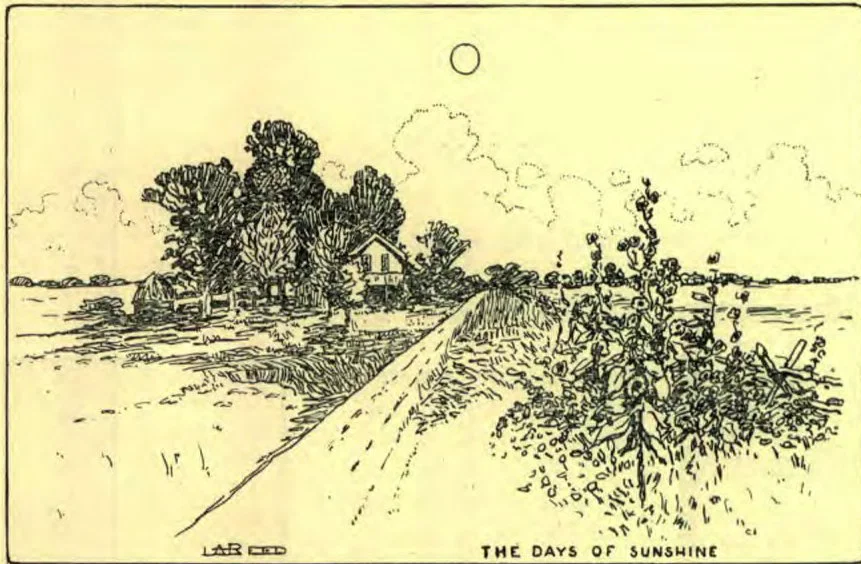
“THE DAYS OF SUNSHINE” — page I
After another victory, much like the first, Pyrrhus crossed over into Sicily to help the Grecians in war against the Carthaginians. He met success at first, but finally was glad to escape from the island. Back he came into Italy, and in the battle of Beneventum suffered final defeat at the hands of the Romans (247 B. C.), which sent him back to Epirus almost alone.
All Italy south of the Arnus and the Rubicon soon fell under the sway of Rome, and she strengthened her hold upon the peninsula by a splendid system of colonies and military roads.
Roy F. Cottrell.

“As Ye Sow”

WHEN days are o’erburdened with trouble, And life is o’erburdened with wo, When pain and unkindness seem double, ’Tis because we deserve it, you know; ’Way back in the past we have planted Unkindness and hatred to grow; We gather the seed that we sow without heed; For always we reap as we sow.
When life seems o’erburdened with sadness, And hope on bright pinions has fled, And all the sweet roses of gladness Lie withered, forgotten, and dead, Blame none but yourself for the shadows, Blame none but yourself for the wo, For sometime, somewhere, you have planted the tare, And always we reap as we sow.
When every day holds a full measure Of joy and of peace and content, ’Tis because we are reaping some treasure That back in the past we have sent On its mission of love and of kindness, To find a heart where it may grow; The rule is quite just, and believe it we must; For always we reap as we sow.
O, which would you gather, to-morrow,— The seed of contentment or wo? The seed of forgiveness or sorrow— The seed that will kindle love’s glow? The spirit of right and of justice Will follow wherever we go; And, cruel or kind, we shall certainly find That always we reap as we sow. — Benjamin B. Keech.

Two Gospels: Being Helped and Being Helpful

Two gospels lie side by side in the New Testament. There is the gospel of being helped, and the gospel of being helpful—good tidings of God’s mercy upon us, God’s salvation brought to us; and good tidings of how we can show mercy unto others, and bring the message of salvation near to them. Beside the parable of the Prodigal Son stands the parable of the Good Samaritan. Beside the blessed invitations stand the Beatitudes on service. We have only half the blessing if we stop short after hearing the first glad word. We have the full message when we hear the lips that whispered “Come unto me” saying also “Go ye” into all the world.—S. S. Times.

How to Give a Chemical Lecture for Young People
Undoubtedly one of the sweetest and grandest promises in the Bible is that found in the first chapter of Isaiah, and the eighteenth verse. “Though your sins be as scarlet,” it begins, “they shall be as white as snow.” Why “scarlet”?—Because in the dyer’s art of old, the cloth that was dyed with scarlet was dyed forever. The wonderful color penetrated every finest fiber; and, when fixed there by the mordant, no human art known to the Jews could remove it. It was inseparably fixed in the garment, and was spoken of in figure as a type of that which could not be changed.
And so it is with sins. They are as indelible as the deepest dye; and any amount of good works that men may perform is simply like washing the red garment with water. And yet, though they be red like that,—“though they be red like crimson,—they shall be as wool,” says the writer.
One of the most impressive lessons that can be given to a gathering of young people is a chemical demonstration of this verse and others that correspond to it. Such lectures have often been given with black and brown liquids, but it does not seem to the writer that these are nearly so striking as the real crimson. The only difficulty in making the crimson is in securing a certain coal-tar product called phenol-phthalein. This may be had from large drug houses, and any druggist can get it for you. A half-ounce will cost from fifteen to twenty-five cents.
Proceed as follows: Dissolve say half an ounce of phenol-phthalein in a two-ounce bottle of alcohol, and mark it No. 1. Dissolve an ounce of caustic soda in from four to six ounces of water, and label the bottle that contains it No. 2. Provide another bottle containing muriatic acid. Get the pure kind, which is white, and mark this bottle No. 3.
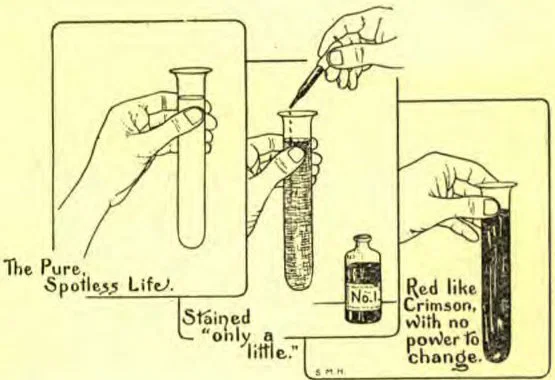
It is always well to go through the experiments by yourself before you come to the lecture, in order to be sure that everything will pass off smoothly. Into one of the narrow glass tubes that chemists use, called test-tubes, pour some of the No. 2 solution. This represents the pure, spotless life—a life in which sin has not entered.
Drop by drop into this liquid the No. 1 solution is poured. A fountain-pen dropper or medicine dropper is generally used by professional lecturers to do this. Notice that the phenol-phthalein is also clear and beautiful. There is nothing about it to alarm; nothing to indicate that, like sin, it has terrible power to stain. But, little by little, as it is added to the soda solution, it changes it to rosy pink, still beautiful, still attractive, like sin in its first stages. But at last the color begins to change, and the roseate hue gives place to an angry red, as deep and dark as clotted blood. In order to secure the best results, the liquid should be shaken after each addition, in order that the color may be evenly distributed through the glass.
Now we come to the illustration of the second part of our verse, “They shall be as white as snow.” To this crimson, scarlet dye, we add a few drops of solution No. 3, and instantly the fiery red gives place to a water whiteness. No trace of the former red remains. The life that is forgiven is as pure as the driven snow.
Of course the ingenuity of the speaker will suggest many other things that can be shown with these same liquids. A small quantity of muriatic acid, for instance, added to the solution without shaking it, will leave it spotted,—“partly converted.” A single shake of the tube makes it as bad as ever.
Now if one wishes to secure a heavy, deep brown-black to illustrate death, degradation, or anything of that kind, it is only necessary to add to the beautiful rosy liquid as above described, a few drops, according to the blackness desired, of a solution of iron chloride. This makes hydrate of iron, which is brown-black. To clear it away, add muriatic acid as before, and the color will soon disappear, leaving a yellow fluid. It may be remarked that it is not possible to altogether wash away the result of sin in this world; it may be forgiven; but, like the yellow in the liquid, the scars will often remain. Or, again, the black hydrate of iron may be compared to paganism as it existed in the days when Christianity first made its way through the Roman Empire. The changing of the black for the yellow may typify the putting on of the pale-yellow clothing worn extensively by the Christians of the early church.
Other solutions for producing changes of color are numerous, but few of them work quickly or decidedly enough to be very satisfactory.
Edison Driver.

Grandpa Talks about Centrifugal Force

Joe and Jennie had just been to see Professor Balour perform the wonderful feat of “looping the loop” on his bicycle.
“They didn’t have loop the loops when you were a boy, did they, grandpa?” asked Joe.
As grandpa folded his newspaper, he said: “No—at least not for bicycles. But still many is the loop the loop I have made, children. Suppose now, you find me a spool, the shears, some thin cardboard, and the mucilage.”
Joe went one way, Jennie another, and presently both came back with all the needed articles.
“See,” said grandpa, “we first cut our cardboard into strips very slightly narrower than the spool is long.
“Then we paste them all together, making a strip over six feet long. Now we will let them dry.”
From another piece of cardboard he cut two circles the size of a half-dollar, and stuck them firmly on the ends of the spool.
“Now, children, get us two high stacks of books,” said grandpa. And when these were provided, he took the cardboard strip, bent it till there was a complete loop in it, and secured it across the table by means of the books. Placing the spool car on this ingenious railway at its highest point, he allowed it to go free. Gathering momentum as it went, the little car struck the loop with a rush, and turned it as neatly as ever did Professor Balour on his wheel.
“Why doesn’t it fall off?” asked the children.
“That,” said grandpa, “illustrates centrifugal force. You wonder what causes it to turn the loop without falling. It is the same power that swings the world around our sun, or a ball at the end of a string. Everything tries to move, when it does move, in straight lines. If you swing a weight on a string, and the string breaks, the weight will fly straight from that very instant of breaking, just as a stone flies from a sling, and just as our world would fly, should the attraction of the sun snap some day. But of course that can never be; for our good Lord holds the earth, though it pulls millions and billions of tons, as easily as a grain of dust.”
Strip of pasteboard bent to hold loop off the table.
“So this little spool-car, in trying to go straight, constantly presses outward against the paper track, and can not fall. It is for this reason that the bicyclist is able to stand on his head in the very air while looping the loop.”
EDISON DRIVER.

A Hallowe’en Prank

THE evening paper’s cartoon was the first reminder that Hallowe’en was upon us. Secluded from village influence behind miles of country-stretch, and acquainted, more intimately than is everywhere common, with cabbages, ladders, signboards, and gates, the relation of these articles to the last night of October had failed to impress us as being other than usual. The quiet Sabbath services of school and church and Young People’s Society had blended perfectly with the mild, sweet calm of a late Indian summer day. “Peace on earth, good will to men,” had been breathed in every zephyr, and smiled by every sunbeam through all the dreamy haze that hung over river and field and wood. All Saints’ day it might have seemed, if the remembrance had come to any mind; yet never a day or night for revelry.
But scarcely had the dark mantle of night wrapped the scene, when down behind one of the big buildings, before the open door of the school store, there gathered around the Master Mechanic and the Farm Superintendent a growing host of enthusiastic young men, for the Master Mechanic and the Farm Superintendent were planning deeds. Five minutes later there was marshaled, in work array, a little army of thirty, counting the laggards; and a line of march was taken up. Well equipped for service, with planks and shovels and coils of rope, the band struck out upon the doublequick, following their leaders out upon the beaten path, down the sunken road between the bluffs, and defiled upon the plain below.
The dancing lights of the lanterns here and there along the files played weirdly among the bushes and trees that lined the narrow, winding road, following the creek’s course. The corn shocks upon the other side, anxious to maintain their assumption of Indian mysteries, whispered in the light breeze, and cast their shadows in the half-moonlight with cautious indistinctness; while the chance ray of a lantern here and there revealed, half hidden in the tepees’s depths, a gleam of yellow teeth. The procession was nearing the peaty bog that lies against New Bashan’s Hills, and already the foremost lanterns, like will-o’-the-wisps, danced over its slippery clumps, and lured the stragglers on.
At last the stage for action was reached, and the play was begun. Floundering shoulder-deep in the muck of the treacherous bog, a big draught-horse desperately pleaded for help. Behind him were two other horses in similar plight. A Florida log-roller and a Nebraska plainsman from either side worked their long arms down underneath, and dragged a rope through. The end of a long line was fastened, with a bowline knot, around the neck, and twenty pairs of muscles strained and heaved to bring sixteen hundred pounds out from a sucking, clinging, miry bed. In vain!
The floundering of the other two horses whenever their heads were not held, was making their condition momentarily worse, and attention was quickly turned to them. Less badly mired, one was quickly lifted, only to fall helpless and exhausted upon the quaking, yielding ground. Then, with half a hundred hands holding the rope, the legs, and the tail, the inert mass is rushed ten paces,—a pause to give him breath, which his labored breathing loudly demands,—then another rush, another pause, and, with a tremendous effort the exhausted beast struggles to his feet, delivering a grateful kick squarely upon one man’s mouth, and is propped up, and led a few steps to firmer ground.
The second horse goes through the same process, and then attention is given to the big black. The shovels are plied upon one side; he is found to be kneeling, it is thought, upon all four knees; ropes are again attached, and a tremendous sidewise pull is put forth in a vain endeavor to extract him from the vise-like grip of the yielding soil. But the effort brings only groans and snorts from the victim, and does not relieve him. Another investigation shows one leg extended straight beneath, and a reversal of direction is ordered.
Again a mighty pull from thirty strong young human engines, and the weight gives—moves—is out! A rod away, firmer ground is reached, and the lines are cast off, while a dozen pairs of hands begin to rub warmth into the cold, stiff limbs. With a quick rush the group scatters as the big fellow leaps to his feet, and then closes in again to keep him up.
An advance corps of engineers is detailed to mark a path for a safe road across the marsh, and shortly the procession takes up its homeward march, the three rescued creatures in the van.
Mustered at the barns, the party distributed implements, acknowledged the thanks of the Farm Superintendent, and mutually agreed that it had been a most profitable “lark.” In darkness the disintegrating host climbed the steep paths that lead to the various domiciles on “The Heights of Abraham,” and with their disappearance ended the first and last disturbances of Hallowe’en at Emmanuel Missionary College.
A. W. SPAULDING.

Cheering Words from Kingston, Jamaica

We have two excellent reports from the Young People's Society at Kingston, Jamaica, this week. The first was received a few weeks ago, and speaks of the organization of the work in that place. It is written by Rhoda Rashford, the secretary of the Society:—
“In the latter part of 1899 the young people of our church met together, and formed a Young People's Society. Not having any knowledge as to the way in which the work was carried on in the older churches, we started out the best we knew, having Bible studies on the prophecies of Daniel and the Revelation; distributing tracts, books, and papers; and visiting the sick and the distressed. Some time later we learned that Societies of the same order had been formed in the United States. We soon adopted the same plans, and are now doing the same kind of work. We meet twice each month, and have a Bible study that will fit us to present the truth in an intelligent manner. Since our Society was organized, we have sold over three thousand periodicals (Missionary Magazines, Signs, etc.). More than sixty thousand pages of tracts have been distributed, and many books loaned. The meetings are usually encouraging, reports being made of work done, etc. We are all of good courage, and mean to keep working with the Lord, and to be faithful till he comes.”
The following extracts from a recent letter to the Secretary show that the spirit of work is indeed animating the hearts of the young people in Jamaica, and that they are taking up the tasks that lie nearest at hand. If all would do the same thing, there would be less sighing for opportunity, and far more accomplished:—
“Your letter of September 4 is received. I was much pleased with the inclosed pamphlet, ‘Save the Boys,’ and handed it to the superintendent of our Young People’s Society for consideration. We met and counseled over the advisability of sending for some copies, with which our young people could work; but we find that they can not use them now. Our young people have all been selling the Caribbean Watchman, and are doing well. Just before receiving your letter, we gave orders for the Good Health, from England, and shall begin to sell them along with the Caribbean Watchman in the coming month; so we can not work on ‘Save the Boys.’
“We are not asleep to the evil of the tobacco and alcohol habit, and have just sent to the Mission Board for a large supply of tracts on the subject. My heart is made sad to see the havoc wrought by the cursed thing in the ranks of the youth of our city. We are up, and as soon as we receive our tracts, we shall begin to storm the battlements of the enemy in that direction, and in the name of the Lord we shall march forward to the salvation of the boys.
“Your fellow laborer in the Lord, “NORMAN JOHNSTON.”

DECEMBER FIELD STUDY

Our Attitude to the Great Commission

(December 12)
Opening Exercises.
Reading:—
  1. The All-Comprehending Missionary Circle. Review and Herald, November 19.
  2. Tidings from the Field.
Consecration Service, in which all should have a part.

Notes

This study falls upon the opening Sabbath of the week of prayer, and should mean more, if possible, than any other field study during the year. This is a day of prayer, and we can do nothing more profitable than to spend the study hour in a prayer service. The Scripture readings and the article from Brother Anderson present very vividly the attitude we should occupy in this closing work. Let the service be a consecration service, in which we renew our consecration to our Father and his great closing work. Let it be a meeting of heart-searching among our young people everywhere. A crisis has come in our work. Confusion has entered the ranks, and we are safe only as we know the Lord, and are fully established in his word.
Beginning the first Sabbath, let us make this week of prayer the best week of prayer that has ever come to us. May it date the beginning of a new and living experience to many of our young people, and a greater consecration to the closing work on the part of every one of us.
Tidings from the field may be gathered from the numerous encouraging articles and reports that have appeared in the Review during the last four weeks.
E. H.
Continue reading: Hope Villa, Louisiana