The Youth's Instructor, Vol. LI, No. 48

God Commanded the Light
Earlier text: God Commanded the Light

Hope Villa, Louisiana

Our Young People's Society is progressing nicely in its blessed work. On Sabbath afternoon, October 24, after the consecration service a Tract and Paper Band was organized by the unanimous vote of the Society. An interested brother offered to supply us with all the tracts we could make use of. We expect to go to work as never before. With hearts filled with the love of Christ, we are inspired to fulfil our aim,—“The Advent Message to all the world in this generation.”
As the leader, I am glad to notice the spiritual growth of our Society. The lessons outlined in the YOUTH'S INSTRUCTOR are grand,—just what we as young people need in our day and time.
May God bless all efforts put forth by the young people is my prayer. STELLA M. PERDUE.

An Opportunity for Home Study

DURING the last few years, courses in study by correspondence have been organized by various educational institutions. At first only special studies were offered in this way; but as the plan was tried, and its success demonstrated, wider fields were entered, until now one may carry on almost any line of study at home, without interfering with his regular work.
While the first thought might be of the things that would be missed by one taking a course of study in this way, rather than of the advantages he would enjoy, still there are a number of very decided advantages. President Harper, of the Chicago University, which offers an extensive correspondence course, says, speaking of the person who is studying to improve himself in the line of work that he is doing, that he “gets his knowledge, like his daily bread, when he can make best use of it. Consequently it is better assimilated than if he acquired at one time a larger mass of information, and stored it, more or less securely, up for future use.”
Besides, the correspondence student has the advantage, in the first place, of studying what he needs most. He also has the personal attention of his instructor in a much larger degree than would be possible in the class-room. Accuracy and definiteness are encouraged as would not be possible in a large class, and abundant opportunity is given for the expression of the thought developed by the study. Moreover, the expenses are much lighter than is possible when a student leaves his home, and must meet the expenses of living, besides the various fees for instruction.
Realizing the advantages that a course of home study would be to many of our young people, and others who for various reasons can not leave their homes, the Emmanuel Missionary College has for some time been planning to open a regular school of correspondence. This work was formally begun the first of October, under the name of The Missionary School of Correspondence. The purpose of this school is “to give students an opportunity to co-ordinate physical, intellectual, and spiritual growth, by offering a course of instruction which is based upon the Scriptures, and which will tend to develop in the student a desire to assist in the evangelization of the world. In brief, it is the object in this school of correspondence, to educate for missionary work.”
Young people seeking a general education, teachers who wish to prepare for advanced work, and Bible workers who wish to gain a greater degree of efficiency in their work, will find the courses offered by this school a great help to them.
As the Bible is the basis of all instruction in this school, a general course of forty lessons in Bible is the first subject taken up in the correspondence course. Other subjects will be offered later.
All who are interested are invited to write for full particulars to the Missionary Training School of Correspondence, Berrien Springs, Michigan.

Three Little Friends

Please, dear little brother, please sit very still, And come, doggie Doidle, come here; Now look very wise in your funny old eyes,— We are having our picture, my dear.
Hold tight to him, Edgar, and don't let him jump; He is only a doggie, you know, And if he should run, he would spoil all our fun,— If he should get frightened and go.
So be very kind, Mr. Artist, indeed,— I am sure you'd be kind if you knew,— He can “speak” and shake hands, and I'm sure understands Every word I am saying to you.
O, yes, little girl, with your sunny brown eyes, I will picture you all with my lens, And we'll send one away to dear grandma to-day, And will call it the THREE LITTLE FRIENDS.
Mrs. L. D. Avery-Stuttle.

Scares That Are Useless

I THINK it was King James II who said to one of his soldiers, when he was boasting that he did not know what fear was, “Hech, mon! then you never snuffed a candle with your fingers.” We jerk our fingers away from anything hot because we know they will get burned. This is a proper scare. We are saving our personal property; our fingers belong to us. It is always right, and never cowardly, to keep ourselves and others from being hurt.
It is a good thing to think about what we would do in different kinds of danger; because if we should ever be in the kinds of danger we have studied, we would know what to do, having already made up our minds.
If we know what to do or say instantly, it is called presence of mind. The English comic paper, Punch, once said: “There is but one thing better than presence of mind, in danger; that is, absence of body.” This is true, but we do not always know when to be absent.
A great many persons, young and old, think they are in danger when they are not. They get scared. These scares are useless. As they are very uncomfortable to the person getting scared, and often frighten other persons, it is well to know how to avoid them. Mice come first as the makers of scares. Yet mice are the smallest and prettiest animal we have. They are shy, easily frightened, and scamper to their holes on hearing the least noise or seeing the least motion. A mouse never hurt any one. If mice happen to be white, and have pink eyes, we make pets of them. If their fur is brown, we prance about, get on the piano, and scream. There is a consolation in all this,—the mouse is scared as badly as we are. The best plan is to sit still, make a little noise if the presence of the mouse is unpleasant, and it will quickly disappear. Exactly the same thing can be said of rats, excepting that as they are a few times larger than mice, the scare is bigger. Another very good plan to avoid these scares is to think for five minutes how very uncomfortable it must make the little animals to frighten them badly.
Next, spiders. How exquisite their webs are when strung with dew-beads, or when sparkling with raindrops, or stretched as perfectly made nets to catch their maker’s food. Then, too, how exquisitely decorated spiders are when examined under a magnifying-glass! How neatly joined are their legs! How delicate their spinners! How wonderful their eyes! How industriously they attend to their own business! How many flies, mosquitoes, gnats, bugs, they capture, and take from bothering us!
THE THREE LITTLE FRIENDS
Yet, oh, horrors! Let one—even a timid daddy-long-legs—come anywhere near, and great big human bodies will jump, strike, shoo, screech, grab the broom, and be in mortal terror. A useless scare. Few spiders will bite any one unless coaxed to do it. If, then, they do bite, their bite is no more than that of a mosquito or flea. There are but two spiders whose bite is severely poisonous: that of the tarantula, a native of hot countries; and the female of a pretty, black, polished, red-spotted spider, which belongs to a family noted for staying at home.
There is no use in being frightened by spiders.
There is nothing that will stir up more racket, and make the girls—young girls, old girls, and grandmother girls—get their heads covered quicker with newspapers, sewing, aprons, even coal scuttles and dustpans, than a bat in the room. The bat is not a bird; it rears its little ones as the cow does her calf. The bat is the only four-footed animal that flies. The flying-squirrel does not fly; it floats or sails from one tree to another. It always lights lower down than the place it starts from. The bat flies to catch insects. Attracted by a light, it comes into a room. Then it flies about wildly, trying to get out. The way to get it out of a room is to take the light out; the bat will follow the light. Really, now, who ever knew of a bat getting in any one’s hair? And if one did, did it carry the hair off? Bats do not bite unless they are taken hold of. Their ugly, wrinkled faces are very much like those of pug dogs. Yet who is afraid of pugs? Brace up, and keep braced, when a bat is about. The bat should be honored; its squeak is the highest sound we can hear.
The most of us do not like snakes. The dislike is bred in us. We do not try to stop it. We either scamper as fast as we can from a snake, or kill the poor creature, and are frightened all the time we are doing it. Stand still when you see a snake; it will slowly, bashfully, steal away. It will live to do more good for the farmers than any other wild creature. It eats mice and insects that injure their crops, and it kills the insects in cellars, gardens, and about the milk-houses. Very few snakes bite. Our common snakes never do. Their tongues are soft, and can hurt no one. The rattlesnake lives in wild places, and it is polite enough to tell you to stand a little farther off. No snake in America will chase you. The copperhead, viper, puff-adder, are all cowards.
Not one of the beetles that come buzzing into the light at night, and drop on the floor with a bang and straddle, will bite. Pick it up fearlessly. When bees, wasps, hornets, come about, keep perfectly still, and they will not sting. Make a quick motion, strike at them, and they probably will. Almost every year I have two or three pet hornets. I stroke them, and they like it. They are very interesting. I would as soon think of stepping on my watch as I would of stepping on an insect; they are so perfectly made, such fine pieces of machinery.
Before you get scared by anything, always think how much scared that other thing is.—Charles McIlvaine, in S. S. Times.

Monkey Discipline

One of the monkey cages in the New York “Zoo” contains a mother monkey and her baby. Some visitors one day gave the mother a chocolate peppermint. She tasted it, smacked her lips, winked, and put it all into her mouth—only to remove it at once, and smack and wink much harder. After a second she repeated her experiment, and again hastily removed the peppermint.
Once more she put the dainty in her mouth, but once more took it out. Then, with watery eyes, she laid the candy carefully on the ledge of her cage, turned her back, walked over to the opposite side, seized the rails with both hands, and gazed out as if she had never seen a peppermint.
Meanwhile the baby, which had been engaged with visitors in a corner, had returned to the front. Seeing the peppermint, he picked it up and tasted it. But his mother’s three experiments had left only a nibble for him. That disposed of, he, too, walked to the opposite side, seized the rails, and stood gazing out with the same air of utter absorption as his mother’s.
As soon as the latter had cooled down, she came back again, and looked for the peppermint. Not seeing it, she swept with one paw all along the ledge where she had left it, but in vain. Suddenly she ran to the baby, and twisting his head to face herself, put one hand on each of his jaws, pulled his mouth wide open, stuck her head in, and gave a big sniff. Then she turned him over and spanked him soundly.— Selected.

Signs in the Sun and Moon

The Second Coming of Christ—No. 4

Signs in the Sun and Moon

The Saviour's promise to his disciples that he would “come again” (John 14:1–3) has not yet been fulfilled. But his word is sure. “Heaven and earth shall pass away: but my words shall not pass away.” Luke 21:33. Those who have trusted in this cheering promise have not leaned upon a broken reed. Those who during the past fifty years have been cheered with the hope of soon seeing their Redeemer, and have given life and treasure to extend the warning to earth’s remotest bounds, have not followed “cunningly devised fables.” He is coming soon.
“Lift up the trumpet, and loud let it ring; Jesus is coming again! Cheer up, ye pilgrims, be joyful and sing; Jesus is coming again!”
That his children might know when this grand and thrilling event was near, the Lord promised to hang out signs that would herald his coming. “And I will show wonders in heaven above, and signs in the earth beneath; blood, and fire, and vapor of smoke: the sun shall be turned into darkness, and the moon into blood, before that great and notable day of the Lord come.” Acts 2:19, 20. “And I beheld when he had opened the sixth seal, and, lo, there was a great earthquake; and the sun became black as sackcloth of hair, and the moon became as blood; and the stars of heaven fell unto the earth, even as a fig-tree casteth her untimely figs when she is shaken of a mighty wind.” Rev. 6:12, 13. “And there shall be signs in the sun, and in the moon, and in the stars; and upon the earth distress of nations, with perplexity; the sea and the waves roaring; men’s hearts failing them for fear, and for looking after those things which are coming on the earth: for the powers of heaven shall be shaken. And then shall they see the Son of man coming in a cloud with power and great glory.” Luke 21:25, 26. In these verses God has not only told us what the signs would be, but has hung them out in the most conspicuous position possible, and in every possible place. Sun, moon, and stars,—where else could one sign be placed in the heavens? on the earth, in the sea, among the nations, and in the hearts of men,—what more absorbing topic could engage our attention than a study of signs which are to appear as precursors of the close of human history? God is not trifling with us. These signs will surely appear; and, once seen, though unbelief may cavil, they bear the solemn tidings. And the next thing seen will be our Lord.
The signs in the heavens were ushered in by a mighty earthquake, doubtless the one known in history as the “Lisbon earthquake,” which occurred in 1755, laying the city of Lisbon in ruins, causing the death of fifty thousand persons, and destroying property worth many millions of dollars. It was then that the Lamb opened the sixth seal, and the heralds of the end were soon to appear.

A Definite Sign

“The sun shall be darkened.” This occurred on May 19, 1780. Last-day scoffers are on hand who say: “O, the sun has been darkened many times.” But while history does record eclipses of the sun, and other phenomena occurring at other times, when “the dark day” is referred to, the mind invariably reverts to the darkening, mentioned above. A brief study of the Bible will reveal the fact that the sign here mentioned was to occur at a certain time, and in a certain way; and if the sun were darkened a thousand other times, that could not constitute the sign of the end here spoken of. Let us note carefully the language of the different inspired writers who have mentioned this sign, and thus be better able to see how definitely the Lord has located it:—
1. It was to be after a certain tribulation, known as the “tribulation of those days.”
2. It was to be darkened “immediately after” this tribulation. “Immediately after the tribulation of those days shall the sun be darkened.” Matt. 24:29.
3. It was to be darkened in the forenoon, or while rising in the heavens. “The sun shall be darkened in his going forth, and the moon shall not cause her light to shine.” Isa. 13:10. By reference to Gen. 19:23 (margin), we learn that “going forth” and rising are synonymous.
4. The darkness would be the most dense at midday.
5. The day would be clear. “And it shall come to pass in that day, saith the Lord God, that I will cause the sun to go down at noon, and I will darken the earth in the clear day.” Amos 8:9.
6. The darkness was to occur “in those days, after that tribulation.” Mark 13:24.

“In Those Days”

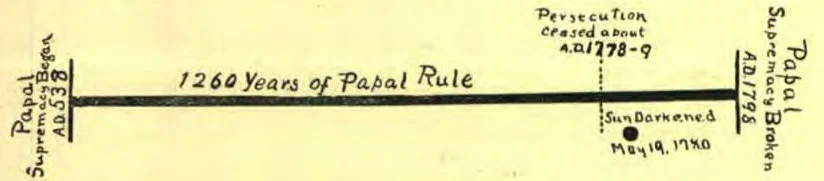
The tribulation here spoken of is that prophesied of by Daniel (chapter 7:25), when the papal power for twelve hundred and sixty long, dreary years was to wear out the saints of the Most High. During this time, history records that at least fifty millions of the elect perished by every means of torture and destruction which evil men could invent. The total number will never be known till the “earth shall disclose her blood, and no more cover her slain.” This bloody period, known in history as the Dark Ages, began in A. D. 538, when the bishop of Rome was made by imperial decree the head of all the churches, and corrector of heretics. So terrible was the relentless warfare waged against the elect, that Jesus declared that “except those days should be shortened” no flesh would be saved; every saint of God would have been slain. Matt. 24:22.
The days ended in A. D. 1798, when the pope was taken prisoner by the French general, Berthier, and banished. But the tribulation ended about twenty years earlier. Thus was brought about by the power of the Reformation under Luther and others, the influence of whose writings and preaching led prominent men and nations in Europe to espouse the cause of the Reformation. In 1776 the United States declared herself a free and independent country, and offered a refuge to the persecuted of the Old World. Thus the long, bloody persecution, which for over a thousand years had held sway, came to an end. The last act of public burning was in 1779, as recorded by at least one writer. Now the sun was to be darkened in those days, or before 1798, and after the persecution had ceased. Hence any darkening of the sun taking place before the persecution of “those days” ended, would not be the one here mentioned. Neither could it be a fulfilment of the Saviour’s words if it occurred after 1798, when the “days” had ended. So we are shut up to a short period of about twenty years between the ending of the persecution and the ending of the days, in which this sign must occur. Then, too, it must be immediately after the persecution ceased. The persecution ceased in 1778 or 1779; and May 19, 1780, the remarkable “dark day” occurred. A simple diagram will make this plain:—
Much historical data can be given, showing that this remarkable sign in the sun occurred in all particulars just as the Bible declared it would, and that no scientific reason can be assigned for it. It was not an eclipse; “for the moon was more than one hundred and fifty degrees from the sun all that day, and more than forty hours’ motion past her opposition.”—“Great Events of the Greatest Century,” page 46. Note the following clear historical statement from an eyewitness:—
“The 19th of May, in the year 1780, I well remember. I was then in my sixteenth year. The morning was clear and pleasant, but somewhere about eight o’clock my father came into the house, and said there was an uncommon appearance in the sun. There were not any clouds, but the air was thick, having a smoky appearance, and the sun shone with a pale and yellowish hue, but kept growing darker and darker until it was hid from sight. At noon we lit a candle, but it did not give light as in the night, and my father could not see to read with two candles.”—Milo Bostwick, Camden, N. J., March 3, 1848.
When we compare this statement with the scriptures quoted, we see how accurately God has fulfilled his word, and most certainly we know that this sign stands as a sure evidence of his near coming.
“And the moon shall not give her light.” The moon depends for its light upon the sun, and the rays of the sun being interfered with, it affected the moon, and on the following night when it appeared, it looked as the seer had said it would—like blood. The night was uncommonly dark, so much so that white paper held a few inches from the eyes was as invisible as the blackest velvet. G. B. THOMPSON.

Do as You’d Be Done By

If you’d help the world a bit, Do as you’d be done by; If you’d help to brighten it, Do as you’d be done by; If you have a blessing, let Some one share it; don’t forget, Selfishness will bring regret,— Do as you’d be done by.
If you’d help the world along, Do as you’d be done by; If you’d help to fight the wrong, Do as you’d be done by; Sing a happy, gladsome song, Sing it steady, sing it long, Sing it to the listening throng,— Do as you’d be done by.
If you’d help the world to-day, Do as you’d be done by; If you would its grief allay, Do as you’d be done by; Say your kind words while you may, Do your good deeds right away, Peace shall come, with you to stay,— Do as you’d be done by.
Let the old world sneer at you,— Do as you’d be done by; Keep your purpose strong and true,— Do as you’d be done by; Every unkind deed you do Bears its seed of bitter rue; Don’t expect the good in lieu,— Do as you’d be done by.
— Benjamin B. Keech.

INTERMEDIATE LESSON

XI—David a Fugitive

(December 12)
LESSON SCRIPTURE: 1 Samuel 24 and 26.
MEMORY VERSE: “Love your enemies, do good to them which hate you, bless them that curse you, and pray for them which despitefully use you.” Luke 6:27, 28.
This week’s lesson shows the difference between the Spirit of God and the spirit of Satan. The evil spirit that was on Saul made him hate David, who had done him no harm, and pursue him to kill him. But the Spirit of God in the heart of David made him forgive Saul, his enemy, and spare him when he had it in his power to do him harm.
When Saul came into the cave where David was hiding, the men who were with David said, “Behold the day of which the Lord said unto thee, Behold, I will deliver thine enemy into thine hand, that thou mayest do to him as it shall seem good unto thee.”
God was trying David, to see what he would do to his enemy when he had him in his power. David’s men advised him to kill Saul. David might have thought that God had given him the kingdom, and now it was in his power to put forth his hand and take it. But he said, “The Lord forbid that I should do this thing unto my master, the Lord’s anointed, to stretch forth mine hand against him.” David waited for the Lord, who had put Saul on the throne of Israel, to remove him from it, and to bring him to the kingdom in his own time and way.
David cut off a piece of Saul’s robe because he wanted to show him how near he had been to him, and how easily he could have killed him. He wanted Saul to know that it was not in his heart to do him any harm. But his conscience smote him, even for cutting the king’s robe. His heart was tender, and easily influenced by the Spirit of God.
When David called to Saul, and told him all that had happened in the cave, and that he would not put forth his hand against the Lord’s anointed, Saul’s own conscience must have troubled him. He had cruelly slain all the anointed priests of the Lord, who were innocent. But David spared him, although he was even then hunting after him, who was also the Lord’s anointed, to kill him. Saul wept, and said to David: “Thou art more righteous than I: for thou hast rewarded me good, whereas I have rewarded thee evil.” The Spirit of God touched his heart as he saw the difference between David’s character and his own. He said, “I know well that thou shalt surely be king;” and he made David swear that when he took the throne, he would spare the lives of his children.
Saul’s repentance did not last long; the evil spirit soon got control over him again, and drove him out to kill David. God gave him one more opportunity to stop his evil course. David went down by night into the camp of Saul, and found all the people fast asleep. Abishai, who was with him, asked for permission to smite Saul and slay him. But again David refused, saying, “The Lord shall smite him; or his day shall come to die; or he shall descend into battle, and perish.” He knew that God’s time would come to put Saul out of the way, and he was content to wait.
David carried away Saul’s spear that was stuck in the ground by his head, and the cruse of water that was by him. He stood on the top of a mountain a long way from the camp, and called to Abner, the captain of Saul’s host, and reproved him for not taking better care of his master. How easily David could have come and taken Saul’s life while he slept was shown by the spear and the cruse of water in his hand. Again Saul had had an opportunity to see that David did not wish to do him any harm. Why, then, should he hunt him “as when one doth hunt a partridge in the mountains”? For the last time David reasoned with Saul. He showed him that in driving him out from Israel, it was as though they were saying to him, “Go, serve other gods;” for there was no resting-place for him except he could find it among the heathen.
Saul acknowledged that he had sinned, and that he would no more do David any harm. But David would not trust himself with one who changed so quickly. He would not even take back the cruse and spear, but asked Saul to send a man to fetch it. Saul was convinced of David’s innocence, and the greatness of his character. His last words to him were: “Blessed be thou, my son David: thou shalt both do great things, and also shalt still prevail.”
But David was discouraged. He felt that if he stayed where he was, he would surely perish by the hand of Saul. So he went and took refuge with the Lord’s enemies, the Philistines.

Questions

1. How did David get an opportunity to render good for evil? When God gave Saul into his hand, how did he treat him?
2. What made David so forgiving? What made Saul hunt David and try to kill him? How did Saul get into the power of the evil spirit?
3. What did the men with David want him to do? Who was really speaking through them? What does Jesus tell us to do? (Memory Verse.)
4. How did Saul find out that he had been in David’s power? What had Saul done to the Lord’s anointed? What was he even then trying to do? Yet what would not David do?
5. What did Saul say to David? How did he contrast David with himself? What did he feel sure would come to David? What did he make him swear?
6. Did this end Saul’s pursuit of David? Where was their next meeting?
7. Who went with David to the camp of Saul? What did they find there? What would Abishai have done? How did David prevent him?
8. What did David take away from Saul’s pillow? Where did he go? To whom did he call? What did he say to Abner?
9. What did David tell Saul he was doing by hunting him out of the land of Israel? What did Saul say about his own conduct?
10. Did David trust the king’s word? Where did he go for refuge?

XI — The Second Angel’s Message—The Fall of Babylon

(December 12)
MEMORY TEXT: “We would have healed Babylon, but she is not healed: . . . for her judgment reacheth unto heaven, and is lifted up even to the skies.” Jer. 5:9.

Questions

1. What message is given by the second angel? Rev. 14:8.
2. To what is the term “Babylon” applied in Revelation 17? Verses 4 and 5.
3. What does woman represent in prophecy? Rev. 12:1, 6, 17. Note.
4. Then what is the import of the second angel’s message of Rev. 14:8? — The church has fallen.
5. How is the condition of the same church in the last days described in 2 Timothy 3? Verses 1–5.
6. What evidence do we have that this is in the church and not in the world? Verse 5. Because these sins are among the people who have the form of godliness but deny the power thereof.
7. Do leading churchmen sense this condition? Note.
8. How was this fallen church presented to John in Revelation 18? Verse 2.
9. Where will many of God’s people be found when the second message is given? Rev. 18:4.
10. In the description in 2 Timothy 3, what admonition is given? Verse 5.
11. In what does the admonition become a warning? — In the second angel’s message.
12. What is the second angel’s message? Rev. 14:8.
13. Just before the close, how will the second angel’s message be strengthened? Rev. 18:1, 2.
14. What final appeal will be made? Verses 4 and 5.
15. How will the earth be affected by this message? Verse 1.

Notes

1. A woman in prophecy denotes a church. Frequently in the New Testament we find the illustration used. In Revelation 12 the history of the church is described under the symbol of a woman. This is the true church. A glance at the chapter will make the matter plain. First, verse 2, the birth of Christ is described; then, verse 6, the 1260 years of papal supremacy; then the Reformation, near the close of that period; and the last verse describes the church, under the symbol of a woman, just before the coming of the Lord. In chapter 17, verse 3, the apostate church is described, and this church is called Babylon. It is the fall of Babylon that the second angel’s message announces.
2. Leading churchmen to-day deplore the condition of the church, and are urging the people back to the simplicity of the gospel. A short time ago a prominent bishop in the Methodist Church described their condition in the words of 2 Tim. 3:1–5. Mr. George F. Pentecost is authority for the statement that the church has degenerated into a great, strong, social, fashionable organization.
Robert Atkins, in a sermon preached in London, said: “The truly righteous are diminished from the earth, and no man layeth it to heart. The professors of religion of the present day, in every church, are lovers of the world, conformers to the world, lovers of creature comfort, and aspirers after respectability. They are called to suffer with Christ, but they shrink from even reproach. Apostasy, apostasy, apostasy, is engraved on the very front of every church; and did they know it, and did they feel it, there might be hope; but alas! they cry, ‘We are rich, and increased in goods, and have need of nothing.’” It is important that we do not apply this text entirely to other churches, and neglect to examine our own hearts in the light of this scripture.

Entering Life with a Resolve to Rise Above Littleness

“THERE is nothing more beautiful in God’s world than a young man or young woman entering upon life with a firm resolve to rise above all that is little and unworthy of an immortal soul, and spend their lives amid good thoughts, good deeds, and good events.”

Vocal Music

The Christian Banner, 25 cts.
Thoughts of Eden, 10 cts.
The Song of the Angels, 10 cts.
Send your order to OTTO LUNDELL, 28-33d Place, Chicago, Ill.

New Every Morning

THE daily returning morning watch is the time to renew our strength for the day's duties. To-day events are occurring so rapidly; God's work is hastening so surely; Satan is sending out his deceptions so stealthily; and confusion is fastening its grip upon the unwary so securely, that safety, individual safety, lies only in individual experience. Yesterday's victories will not conquer to-day's battles. What need there is for meditation and prayer morning by morning to get a true vision of God's work in the world, his plan for its accomplishment, and our place in that plan,—your place and my place. Nothing less than this should be the attitude of every young man and young woman in the issues of to-day. We can not afford to allow another to dictate where we shall stand in this crisis, what our attitude toward God's work shall be in these closing days; neither can we afford to choose for ourselves. The enemy, the arch-deceiver, will not miss an opportunity to turn us into the wrong path. But morning by morning there is safety in watching with Him, in communion with him, in yielding anew to him, and in listening to his voice, who gave up all that we might enjoy this precious privilege. Here is our strength and our boldness in the issues of to-day, and our inspiration to lead others into this same experience. “It is God that energizeth you both to will and then to work for his good pleasure.”
E. H.

A Means of Self-Improvement

ABOUT seventy-five years ago there lived a young boy who was destined to occupy one of the most prominent positions in the history of the United States. His father was extremely poor. More than once the only article of food on the table was Irish potatoes. He wore trousers of roughly tanned deer-skin; his foot-covering was a home-made moccasin; and his cap was a coon skin. This young boy had an intense desire to learn to read. He used to sleep in the loft, to which he climbed by pegs in the wall of the log cabin. He slept on a pile of leaves in the loft. The books which he read were usually borrowed from the neighbors, and these he would read as long as daylight lasted. He would often lie on the floor in front of the fireplace. The wooden shovel was his usual slate, and on its back he ciphered with a charred stick, shaving it off when it had become too grimy for use. It was his custom to make long extracts from the books he read. He used a turkey-buzzard pen and brier-root ink.
I presume you recognize this description as applying to the young Abraham Lincoln. The Lord used that young man because he was diligent, and because he was always searching for truth. Through him God did a great work for this nation.
I can not help wondering how many of our young people would be willing to put forth one half as much time and effort as Abraham Lincoln did in order to obtain an education. Do you not think that if we were as zealous for the cause of Christ as that young man was to fit himself for a position in the world, the gospel would be preached to all the world in a very short time?
The Lord is calling you to do some work, and yet you allow hours to go to waste when you might be improving your mind. I know this is true, for I have watched young people. I do not say this to condemn you, but I want to call your attention to the fact. We must wake up. It is time for us to have an ambition. It is possible for every young person in the church to have a good education.
You know something about the schools which the Lord has provided for the training of workers. There is another means of education which you should know about. I refer to the Correspondence School. I presume that it is impossible for some young people to become resident students of one of our schools this winter, but if I were in your place, I would not let the winter go by without doing some systematic studying. The Correspondence School will guide you in that study so that at home you can do good, thorough work. When you enter school, you will be that much ahead.
I wish I could say something to you to really make you feel the need of workers, and to show you that if you will put forth an effort, you might quickly occupy a position of responsibility. The Lord wants you to do it. He has a high standard for you. Why is it that you will go on, month after month, and be no better off by the end of the season than you were when the season began? If you can not attend school, my advice would be to begin work by correspondence, and begin it at once. You know that the home is the ideal school. In the course that is offered by correspondence, not only every child in the family may be students, but fathers and mothers may unite with their children in a study which will make every one of them stronger and more efficient workers.
If you will give yourself up to this work, I believe God can use you to bring light and strength into your home church. Do you desire to become an active worker? Have you looked forward to the time when you would be a worker? If you have, the thing for you to do is to begin now. I therefore urge upon you to write me that I may have the privilege of telling you what I know of the Correspondence School, and helping you to get started in a work that will help you. M. BESSIE DE GRAW.
Berrien Springs, Michigan.

Full Surrender in Confession to the Lord

CONFESSION that is acceptable with the Lord makes no reserves. It does not say, “I am sorry, but —” It does not plan to keep one little corner of the heart for some favorite sin. No; it makes a full surrender, holding nothing back. For such confession, and only for such, “the pardoning blood availeth to cleanse the mortal stain.”

Meeting Jesus: Preparing to Welcome Our Lord

MEETING Jesus! We talk a great deal about the day when we shall meet Jesus, and shall be with him; but do we often stop to think what it will mean to meet him, really? Are we getting ready to meet him? Do we truly desire to meet him? Then we need not put it off a single day or another hour. He says, “Behold, I stand at the door, and knock: if any man hear my voice, and open the door, I will come in to him, and will sup with him, and he with me.” And it is “this same Jesus” who makes this promise, and holds out this invitation, who will one day come in the clouds; with all the holy angels. Shall we be glad and rejoice in that day of his appearing? Then we must know him now, we must become acquainted with him; we must have his presence dwelling in our hearts. If we welcome his presence now, we shall surely meet him with joy then.
Continue reading: $50,000 for Missions