ALMOST all of us know what it is to have best things. In dress, furniture, rooms, and personal belongings generally, there are almost always an upper and an under crust, and a division into two classes—one for show, and the other for use. But it is not merely our persons and our rooms that we put into company dress for high days and holidays; we put our minds, our tempers, and our manners as well. Only the most marvelously amiable people have no company tempers at all, but are as sweet and placid on work-days as on Sundays; and only the very highest state of artificial good breeding combined with this natural perfection of temper, makes us uniformly courteous to every one, irrespective of station or of degree of intimacy.
Nothing is more rare than this unvarying good breeding; for just as fine ladies wear their court plumes only on court days, and as queens lay aside their crowns and go about in caps and bonnets like ordinary folk, so the gala dress of minds and manners, which is adopted for society, is dropped for the slipshod undress of home; and the people who have just now been the very pink of politeness in a neighbor's drawing-room, became nothing better than boors at the family fireside, where there is no one to dazzle or to win.
The perfection of manner alone, even if it go no deeper than the outside, is a charm beyond that of mere beauty. The one is the result of education—that is, intellectual and spiritual; the other is only the raw material—a natural gift, not won but bestowed, and, though attracting personal love, reflecting no honor. What we mean by a thorough gentleman or a high-bred lady is one who has no veneer of company manners, but whose whole nature is so penetrated with the self-respect of courtesy that nothing coarser can be shown under any provocation. This is an immense power in those who possess it. Nothing weakens a righteous cause so much as intemperate language in supporting it; and nothing tells more against a good principle than bad manners in those who uphold it. When men swear and fume, and use hard names, and make themselves generally disagreeable and insulting, it does not signify to the aggrieved in what cause or in whose service they are so comporting themselves. Human nature is but a weak vessel for holding justice at the best, and we may be sure that the natural inclination of most people would be against the cause advocated by such unpleasant adherents.
Speaking broadly, and from the widest stand-point of national characteristics, we would say that the Italians, of all European nations, have most of this solid courtesy throughout; not a stately, but a good-tempered courtesy—by no means chivalrous in the way of the stronger protecting the weaker, and for self-respect keeping watch and ward over the fiercer enemies within the soul, but rather deferential, as assuming that every one is better than themselves. When an Italian does give way to passion he is dangerous; but when in a good fair-sailing humor nothing can well exceed the almost feminine sweetness of his courteous demeanor. The French have a coarser core, that comes through the veneer on occasions when you touch their self-love or their jealousy; and the core of French discourtesy is very coarse indeed when really got at. We English have not a very fine veneer at any time, and the rougher grain below even that not overpolished surface rubs up without much trouble. But then we pride ourselves on this rough grain of ours, and think it a mark of honesty to let it ruffle up at the lightest touch. Indeed, we despise any thing else, and have hard names for a courtesy that is even what the Americans call "clear grit" throughout; while as for that which is only veneer, stout, or slender, there is no word of contempt too harsh for the expression of our opinion thereanent.
We are so far right, in that company manners put on for show and not integral to the character, nor worn in daily life, are an abomination to souls understanding the beauty of truth. But we need not be so frightfully severe against all kinds of surface smoothness as we are, and condemn the polish of material, and the seeming of veneer as sins identical with each other. In this confusion of cases we are wholly wrong and unjustifiable; the one being a virtue attained only as an ultimate grace, and by immense labor—the fruitage of a long and well-cultivated garden; the other being just so much poonah-painting, or potichomania, or wax-fruit show—got at with no trouble at all—pretense and pretentiousness, and nothing more.
What can be more detestable than the things we see and hear at times from gentlefolks, whose gentlehood is in name, and appearance, and style of living, and the banker's book, rather than in anything more substantial? Take the woman who rates her children, and flouts her husband when they are alone, but who is all smiles and suavity to the people next door, whom she despises—the girls, who are snappish and peevish to each other, but who put on their sweetest graces for the benefit of young Corydon and his sisters, diligently ironing down those rugged seams of theirs while turning the smooth side outermost, that young Corydon may think the stuff all of a piece throughout, with no jagged joinings anywhere—papa, who comes home "as cross as the cats," as the Irish say, letting the home life go shabby and slipshod for want of a little of the courtesy he bestows so lavishly on his guests, not a man of whom he likes, nor a woman of whom he fancies—"the boys," who make their sisters feel the full weight of masculine insolence and neglect, while to their sisters' friends they are everything that is chivalrous and devoted, as "boys" should be—can anything be less of the substance of gentlehood than these? And yet how often we meet with them in the world! Each of these represents a distinct section of the coarse core veneered—just so much plausible hypocrisy covering up an inner sin, as a silken coat hides ragged linen—just so much domestic misery that might be avoided if folks cared more for reality than for show, and thought the solid pudding of happiness better worth having than the frothed cream of praise. The fiddle is hung up behind the house door in too many homes, and suavity is laid aside with the dress suit. And yet it would seem by the merest common-sense calculation that as home is the place where we live, and where nine-tenths of our days are passed, home happiness and family peace are far in advance of any outside pleasures or barren social reputation, and should be the possessions we ought most to cultivate. But common-sense calculations have very little to do with the arrangement of our affairs. We lay aside our company manners with our company coats, and make ourselves what we call "comfortable" at home; that is, we give way to any natural peevishness of temper we may have, and suffer ourselves to go slipshod and unpleasant, both in mind and body, for the benefit of those who are nearest and dearest to us.
The cause of this lies in the kind of home we of the middle classes make for ourselves; in the excessive exclusiveness and isolation which we think the only safe or decent mode of life; in the belief each man has that the four walls of his titular castle are built of better brick than any other man's four walls, and inclose pearls of price that would be spoilt if allowed to be set beside other pearls of as great price. No check of public opinion reaches the home circle of the middle classes, save on those rare holiday occasions which call forth company manners. Even a "lodger," though becoming by time part of the family, necessitates a little self-control, wanting in the ordinary conditions of a home life; for no one likes to show the worst of himself, or herself, to a person not connected with him, or her, by blood or marriage. To people who can take up their hats and umbrellas, and walk out of the house at their own sweet wills we are considerate and courteous. We lavish on strangers, and we starve our own.
There is no greater education into vulgarity than home carelessness. A man or woman brought up under such a system is ruined for all the reality of refinement in after years. The surliness too often allowed at home, where children are permitted to be snappish to each other, disobligeing and discourteous, ruins the manners as much as it hurts the mind. Hence we come to company manners, to a sickly sweetness put on simply for the occasion, to a formality of speech, and an oppressiveness of attentions, to an exaggerated politeness that is so terribly afraid of transgressing into liberties as to be absolute bondage, and to all the silly little affectations belonging to the condition.
We never know any one whom we have not lived with, and even then not always. To be admitted into the Temple does not include entrance into the adytum; and we may remain for weeks in a house where master and mistress and maids are all reticent alike, and may know nothing of the reality underlying the surface. People of whom I once knew something, and who were notoriously ill-matched, but marvelously polite, could keep their house full of company, and yet allow none of their guests to find out that the husband and wife were not on speaking terms. All the communication between them, that was absolutely necessary, was carried on by writing. Personally, these two, dispensing smiles and civilities to all around, held no direct intercourse. Yet they managed so well that no one saw through the screen.
With company manners and company dress, there is also a company voice. Who does not know that false voice of society? Mincing or thrown boldly forward, flung into the chest or pitched up into the head, it is all the same—the company voice, accent, choice of words, and register—all artificial alike. And there are company gestures. People sit, and stand, and walk, and use their hands according to the different degrees of familiarity in which they stand toward their society. There is a vast deal of company make-believe among us; and if we would only give half the time we now bestow on "looking pretty" and "behaving pretty" in society, to being sweet tempered, and amiable, and careful of pleasing, at home, it would be all the better for ourselves and our families, and a gain in the way of true civilization.—All the Year Round.
BEYOND THE GRAVE.
By G. E. Smith
WHAT man can doubt there is a God?
Or who can think without a pain,
When friends are laid beneath the sod,
That we shall see them ne'er again?
Indeed, the parting must be drear,
And doubly sad the heavy heart,
If not a ray of hope can cheer
When dearest friends this life depart.
And well the mourner's tears may fall,
If death shall never more release
The loved ones who await the call
Of Christ, the mighty Prince of Peace.
Our lives at best are here so brief,
And oft with sorrow so forlorn,
That death is almost a relief,
In view of resurrection morn.
No mortal man can fully sense
The bliss that waits us o'er the wave,
But still we hope for recompense—
Eternal life beyond the grave.
Oakland, Cal. G. E. SMITH.
KNEW HIS DUTY.
OWNERS of ships, (especially when they are mere landsmen), are as unwise to interfere with the sailing-orders of their skillful seamen as the President would be to interfere with the command of one of his generals on a battle-field. It is, however, not every officer placed in such embarrassment who knows how to put the case so skillfully as did the captain of the steamer Commonwealth, as told by the New York correspondent of the Boston Journal:—
I was on board a Sound steamboat in a snow-storm one night before Thanksgiving. The president of the company, the treasurer, and two directors were on board. All at once there was a rattling of the chains, and it was evident the anchor was down. The officers rushed up to the captain’s office and exclaimed—
"What does this mean, Capt. Williams?"
"It means that I have anchored the boat."
"But to-morrow is Thanksgiving. We must get home anyhow. The old Commonwealth has weathered worse gales than this."
The captain sat down at the table and wrote a positive order from the president, treasurer and directors, to raise the anchor and proceed against his own judgment.
"Sign that order, gentlemen, and I will proceed."
Of course not one of them would sign it.
"That's the way it is," said Williams. "Not a man of you would take the responsibility. You want me to violate my own judgment, and if anything happened, you would turn on me and say, 'You are a sailor and we are not.'" And the old boat did not budge until morning.—Youth's Companion.
Overcoming Satan
One cannot overcome Satan by feeling nor by past experience.
NOT INCORPORATED INTO THE NEW COVENANT.
By R. F. Cottrell
"There is no possible way to sustain the seventh-day Sabbath but by proving one of two things: 1. That the old covenant is now binding upon all mankind; or 2. That the fourth commandment has been incorporated into the new covenant; neither of which has yet been done." So says a recent writer.
One other way is possible; and that is to prove that the ten commandments are not the old covenant. Whoever will read the old covenant, as recorded in Ex. 19:3-8, will see that the covenant was made before the people heard the voice of God proclaiming his commandments. And in chap. 24, where we have the account of its dedication with blood (Heb. 9:20), Moses said, "Behold the blood of the covenant, which the Lord hath made with you concerning all these words." The words and the covenant concerning them, are self-evidently two things. The covenant consisted of mutual promises. The people promised to obey the voice of God, and on this condition God promised to make them a peculiar treasure to himself above all other people. And after this, God uttered his voice in the hearing of all the people. Concerning this, Moses said, "And the Lord spake unto you out of the midst of the fire: ye heard the voice of the words, but saw no similitude; only ye heard a voice. And he declared unto you his covenant, which he commanded you to perform, even ten commandments; and he wrote them upon two tables of stone." Deut. 4:12, 13.
That person's mental powers are not to be envied, who cannot see the distinction between the covenant and the commandments of God, obedience to which was made a condition of his promises; and the candor and honesty of those who will not see it are not to be coveted.
The old covenant, we admit, is superseded by a better one, the new. But this writer says that the fourth commandment has not been incorporated into the new covenant. Where does he find the new covenant? I suppose he alludes to the revelations written in the New Testament. In this volume the Sabbath is mentioned nearly sixty times, and it is always designated by its sacred title, as if no strange thing had happened to it. But says our writer. "The Lord's day is the memorial day of the new covenant." By the Lord's day he means the first day of the week. Now we ask, when and where was the first-day Sabbath incorporated into the new covenant? Can any one tell? Where is the record of this new "memorial day?" Is there any "possible way to sustain" the first-day Sabbath, but by showing its place either in the old or the new?
"Memorial day of the new covenant!" who ever read or heard of such a thing? New inventions must have new titles; and of course every one may give names to his own children. And it seems much easier for some to invent new doctrines, than to yield to those that are taught in the word of God.
R. F. Cottrell.
ITEMS OF NEWS.
By Editor
-San Francisco's "Emperor Norton" is dead.
-Trevina has defeated the Revolutionists in Mexico.
-The Czarina of Russia is at the point of death at Cannes.
-Senator Lamar, of Mississippi, has been stricken with paralysis.
-The tendency of the price of wheat at Mark Lane, London, is downward.
-The Brooklyn (N. Y.) Board of Aldermen have a prize fighter for clerk.
-Sir Garnet Wolsley becomes Commander-in-chief of the armies of the Indies.
-A terrible famine prevails in the districts of Baskaleh and Bayazaid, in Armenia.
-General Daza, President of Bolivia, has been deposed, and has fled the country.
-President Prado, of Peru, has left for Europe, and Pierola is announced as Dictator.
-The Presse, Vienna, is of the opinion that a war between Russia and England is inevitable.
-A collision of trains occurred on the New York elevated railway January 4th. No one was hurt.
-The Unitarian and Jewish congregation at Kalamazoo, Mich., united in service on Thanksgiving day.
-The fund instituted by the Lord Mayor of London for the relief of the distress in Ireland, aggregates £5,000.
-Advices from Havana report the steamer Pico a total wreck, near Maracaibo. The passengers and crew were saved.
-By an explosion in a celluloid factory at Newark, N. J., January 5th, four men were killed and two seriously injured.
-Dr. Rudolf Falb claims to have discovered that the languages of the Indians of Peru and Bolivia, are from Semitic roots.
-The buildings of Carlton College, Northfield, Minn., were burned on the 23d ult. The college was closed at the time for vacation.
-Maine is now in the position which Louisiana occupied several years ago. It has two Governors and two organized Legislatures.
-As the result of General Mosby's pointing out the incapacity of Minister Seward, he is likely to lose his Consulship at Hongkong.
-The Kanawha Valley (Va.) miners are in a state bordering upon insurrection, and the militia have been called out to preserve order.
-The recently appointed supervising architect of the New City Hall, San Francisco, is denounced by the papers of that city, as thoroughly incompetent.
-Jan. 14, four hundred and eighty sacks of Australian mail left Omaha, via. San Francisco; the heaviest Australian mail that ever passed over the road.
-The St. Petersburg Golos considers that events are taking such a direction that in all probability the Balkan and adjoining provinces will come under Russian influence.
-The death of William Hepworth Dixon, the writer and traveler, and long editor of the London Athenaeum, at London, on the 27th ult, is announced. The cause was apoplexy.
-The Catholic Review says:- "A man cannot be a good Catholic and be ignorant." To which the Christian at Work responds:- What hosts of bad Catholics there must be!"
-The Philadelphia Times thinks that "a proud desire for showy and costly houses of worship is at the bottom of the financial troubles of nearly all the debt-burdened churches."
-Kossuth, the Hungarian patriot, is said to spend ten hours a day in preparing a book of his memoirs, writings, and speeches, which is to be published in five languages.
-The Commune of Oberammergau has built a new theater for the representation of the "History of the Sufferings and Death of Jesus," which will be given in the famous valley next summer.
-For the past week the overland trains have been frequently delayed by the snow in the Sierras. The storm there was one of the severest for years. Sheds were destroyed, the snow in some places being twenty-five feet deep on the wrecks.
-The Mt. St. Gothard tunnel is now within less than 500 metres of completion, but the difficulties encountered during the past few weeks, owing to a fault in the strata and an influx of water, will retard by a month, the junction of the two galleries.
-The Keene Wheat Syndicate have 16,000,000 bushels of wheat shut up in the Chicago elevators, and as the price of wheat at New York is lower than the prices paid for the wheat, the "corner" is evidently a failure, and the biters are likely to get bitten.
-The late Bishop Whittingham, of Maryland, if not a Ritualist, suffered the Ritualistic party to have all things their own way in Baltimore. But one of the first official acts of Bishop Pinkney, his successor, is a pastoral forbidding any Ritualist officiating in any church in the diocese of Maryland. It entirely cuts off from service, unless they submit, some Ritualists against whom it was aimed.
-Clerical intolerance in England is not confined to the church-yard, as the Rev. Carr Glyn, Vicar of Kensington, is finding out. This gentleman is lessee of a house in Kensington, the lessors being the vicar and curate of another London parish. Mr. Glyn has turned the house into a boys' coffee palace, and, it will hardly be credited, the reverend lessors have begun an action of ejectment against him for so doing. It is pretty well understood that if Mr. Glyn, who is one of the most hard working clergymen in London, had stuck to questions of candles, ornaments and vestments, instead of trying to do some real good in the world, he would have been free from such annoyance and parsonic opposition.—Christian at Work.
-Dr. Philip Schaff, President of the American Bible Revision Committee, says, concerning the work of Bible Revision, that the New Testament Company of the American Bible Revision Committee held their last meeting on Friday and Saturday, December 26th and 27th, and finished the second revision of the Book of Revelation. In their next meetings they will consider the final action of the British Company on their work. It is expected that the revised New Testament will be finished and published by the English University presses during the year 1880, which is the fifth semi-centennial of the publication of Wickliffe's Bible, the first complete translation of the Old and New Testaments into the English language. The Old Testament Company have at their last session revised for the first time the translation of the Book of Job up to Chapter 11:14.
SIGNS OF THE TIMES TO ENGLAND.
By W. C. White
Much good has been done by our T. and M. workers in sending the Signs of the Times to Eld. Loughborough, who has remailed them to all parts of the British dominion. This work has been hindered of late by the new and oppressive postal law which requires two cents postage for each paper not exceeding two ounces in weight.
“We have just received an inquiry from one of our tract society members in reference to transferring copies of Signs from clubs here, to Bro. Loughborough in England. I write to ask what the extra charge would be per copy, or what would it be for five copies?
Addie S. Bowen.
Rome, N. Y.”
We have just completed arrangements with Maurice’s European Express Co., by which we can send the Signs and other papers to Southampton at one-half of the rates of postage. Let those who wish to send clubs of the Signs, Review, and Good Health to Eld. Loughborough, order them mailed, “Eld. J. N. Loughborough, care Review and Herald, Battle Creek, Mich.” Here they will be made up weekly into a small package, and forwarded by express. The yearly expense per copy of forwarding our papers to Eld. Loughborough would be on the Signs, 50 cts; Review, 75 cts; Good Health, 25 cts; Youth's Instructor, 15 cts.
Let those wishing to send clubs of these papers to Eld. Loughborough add the sums named to the price of the papers to American subscribers. W. C. WHITE.
BUSINESS DEPARTMENT.
By Editor
"Cursed be he that doeth the work of the Lord deceitfully," (margin, negligently). Jer. 48: 10.
RECEIVED FOR THE SIGNS.
$2.00 EACH. J Edgerton 7-1, J K Wilbur 7-1, J M Little 7-1, Loren Negus 7-6, Mrs I L Decker 7-1, Wm Harper 7-1, Mary Gould 7-1, H H McKinstrey 7-1, J W Allen 7-2, Eva A E Surdam 7-1, W F Nickel 7-1, Chas H Lawrence 7-1, Allen D Smith 7-1, Miss Julia A Jenks 7-1, Jas H Munro 7-1, L P Anderson 7-1, Mrs F S Austin 7-1, James Blair 7-1, Wm Butcher 7-1, John J Bolton 7-1, H E Richardson 7-1, Mrs S A Banks 7-1, Wm Moller 7-1, Clinton Owen 7-1, James Woof 7-1, A O Thompson 7-14, Robert Sawyer Senior 7-1, Sally Hugaboom 7-1, Hermon Jenkins 7-1, Thomas Pritchard 7-1, John Pritchard 7-1, Parker Ryon 7-1, Mrs A P Nichols 7-1, J M Jones 7-35, Mary A Teeters 7-1, S Morton 7-1, John Clasby 7-1, Susan Southworth 7-1, H H Stevenson 7-1, Mrs Jennie Borden 7-1, Amos Snyder 7-1, A C Hardy 7-1, Lucinda Ross 7-1, Mrs Maggie Brothers 7-1, George R Drew 7-1, Mrs Harriett McKen 7-1, Alfred E Dyebury 7-1, A H Cochran 7-1, Mrs M Borland 7-1, J Dimmick 7-1, B F Harris 7-1, Mrs Maggie Snook 7-1, G A Baker 6-15, Mrs Oliver Kirkpatrick 7-1, R E Mehaffey 7-1, J L Voris 7-24.
$1.50 EACH. Thomas Williams 7-1, James Cline Sen 7-1, J H Rowe 7-24*. S S Surely 7-1, Mrs P John 7-1, Mrs L A Tarbell 7-1, Lucy Gardener 7-6, Fanny Shircey 7-1, Joseph Terrell 7-1, Royal Phelps 7-1, J M Richard 7-1, Jacob Snyder 7-1, J P Kelly 7-1, J F Carpenter 7-1, H D Clark 7-1, J B Slevers 7-1, J W Stephens 7-1, Samuel Grigsby 7-1.
$1.25 EACH. D M Stonehill 7-1, Mrs M A Walker 7-1, Mrs Archie Mc Henon 7-1, Mrs Mollie Journey 7-1, Mrs L C Lindsey 7-1, Mrs M C Truedale 7-1, Samuel Dimmick 7-1, E Dimmick 7-2, Samson Hancock 7-1, S E Booth 7-1, A Fisher 7-1, S D Fresh 7-1.
$1.20 EACH. Mrs Hettie Wilton 6-44, Mrs P H Johnson 7-1, Mrs W R Arnold 7-1.
$1.00 EACH. J B E Young 6-25, H S McKyes 6-25, Mrs John Truesdell 6-25, Mrs C C Whitman 6-31, Mary E James 6-24, A C P Rowlings 6-24, R W Bolton 7-1, A D Benton 7-1, J K Cartwright 7-1, Mrs Mary Woof 7-1, John B Stone 7-1, Rev C H Pope 7-1, N N Jenkins 7-1, H H Schuasby 7-1, Mrs Lydia Cook 7-1, Levina Munn 7-1, Emma Thomas 7-1, Persida Me Mahon 7-1, Mrs Fanny Kingsbury 6-8, R E Jackson 7-1, John Potter 7-1, Jas P Nelson 7-1, F M Currier 7-1, Andrew Kingsey 7-1, C F Finley 7-1, H G Washburn 7-1, Lorane Haynes 7-1, Mrs John Rawley 7-1.
75 CTS EACH. S S Gilkey 6-24, Rev L Edwards 6-24, G Mitchell 6-24, Jacob Deeds 6-24.
50 CTS EACH. Phebe Lyon 6-13, Mrs Emma Wetmore 6-13, David James 6-13, F Rothrick 6-13, Mr. Dr Weyl 6-13.
MISCELLANEOUS. Mrs T C Evetts $4.00 8-1, Mrs I L Decker (3 copies) 3.00 7-1, Jacob Shively (5 copies) 5.00 7-1, Mrs Mary Ober 30c 6-12, Mrs Sarah Clark 30c 6-12, Mrs Charles Jones 30c 6-12, Mrs Joseph Holmes 30c 6-12, Henry Linder 30c 6-12, Nahum Orcutt (10 copies) 3.00 6-12, Mrs Laura Holland 80c 6-27, Clinton Owen (3 copies) 3.00 7-1, A Cameron 60c 6-24, A G Hedgecock (5 copies) 5.00 7-1, J Buckley (5 copies) 5.00 7-1, M L Rider (3 copies) 3.00 7-1, E Heltsman (10 copies) 10.00 7-1, Chary Dryden (11 copies) 11.00 7-1, Mrs H M Greenlaw (25 copies) 25.00 7-1, Mrs E Powen (16 copies) 16.00 7-1, Emma D Green (32 copies) 32.00 7-1, Mrs Maggie Woods (21 copies) 10.50 6-24, Mrs S A Lawrence (15 copies) 15.00 7-1, Sarah Taliaferro (8 copies) 8.00 7-1, Flint V M Society (5 copies) 5.00 7-1, Mrs Harriett McLearn (11 copies) 11.00 7-1, R McElroy (15 copies) 7.50 6-24, Florinda Hall (16 copies) 8.00 6-24, Mrs E Lockwood (10 copies) 5.00 6-24, Lester Rogers (10 copies) 5.00 6-24, Fred A Lashur (39 copies) 39.00 7-1, Murdock McGregor (3 copies) 3.00 7-1, Philinda Moon (10 copies) 10.00 7-1, Wm Perkins (12 copies) 12.00 7-1, E S Babcock (10 copies) 10.00 7-1, Ella J Harris (5 copies) 5.00 7-1, H Nicola (10 copies) 10.00 7-1, A C Hardy (6 copies) 6.00 7-1, J K Housel (10 copies) 10.00 7-1, Amos Amburn (3 copies) 3.00 7-1, Christian Appeal (3 copies) 3.00 7-1, Alice J Green (15 copies) 15.00 7-1, W G Myers (12 copies) 12.50 7-1, G P Davis (21 copies) 21.00 7-1, Eld Loughborough (7 copies) 12.00 7-1, Geo R Drew (25 copies) 25.00 7-1, Ella Saunders (113 copies) 113.00 7-1, E A Chapman (10 copies) 10.00 7-1, Mrs H M Church (72 copies) 72.00 7-1, Geo R Drew (12 copies) 12.00 7-1, E A Chapman (5 copies) 3.12, 6-24, A LaRue (5 copies) 3.12 6-24, W T Eddy (5 copies) 3.12 6-24, J McCulloch (5 copies) 3.12 6-24, W Hutchings (15 copies) 15.00 7-1, Wm Stewart (2 copies) 4.00 7-1, John Woof (5 copies) 5.00 7-1.
CALIFORNIA CONFERENCE.
Lone Oak church $11.65, Napa church 63.00, Woodland church 196.77, Petaluma church 100.00, Santa Rosa church 20.00, Lemoore church 87.50 R A Morton 16.00.
OAKLAND CHURCH.
H E Richardson $1.00, Mrs C C Whitman 2.00, Mrs Betsey Landon 6.00, H H Bramhall 1.20, Mrs L A Bramhall 1.20, Frank D Starr 60c, Mrs Mary O Starr 30c, S G Knight 30c, Amos Snyder 7.00, Mr and Mrs J N Loughborough 4.00.
ENGLISH MISSION.
Elisha Sharpe $10.00.
DONATION TO SIGNS.
J L Voris $3.00.
SYNOPSIS OF THE PRESENT TRUTH.
NUMBER TWO.
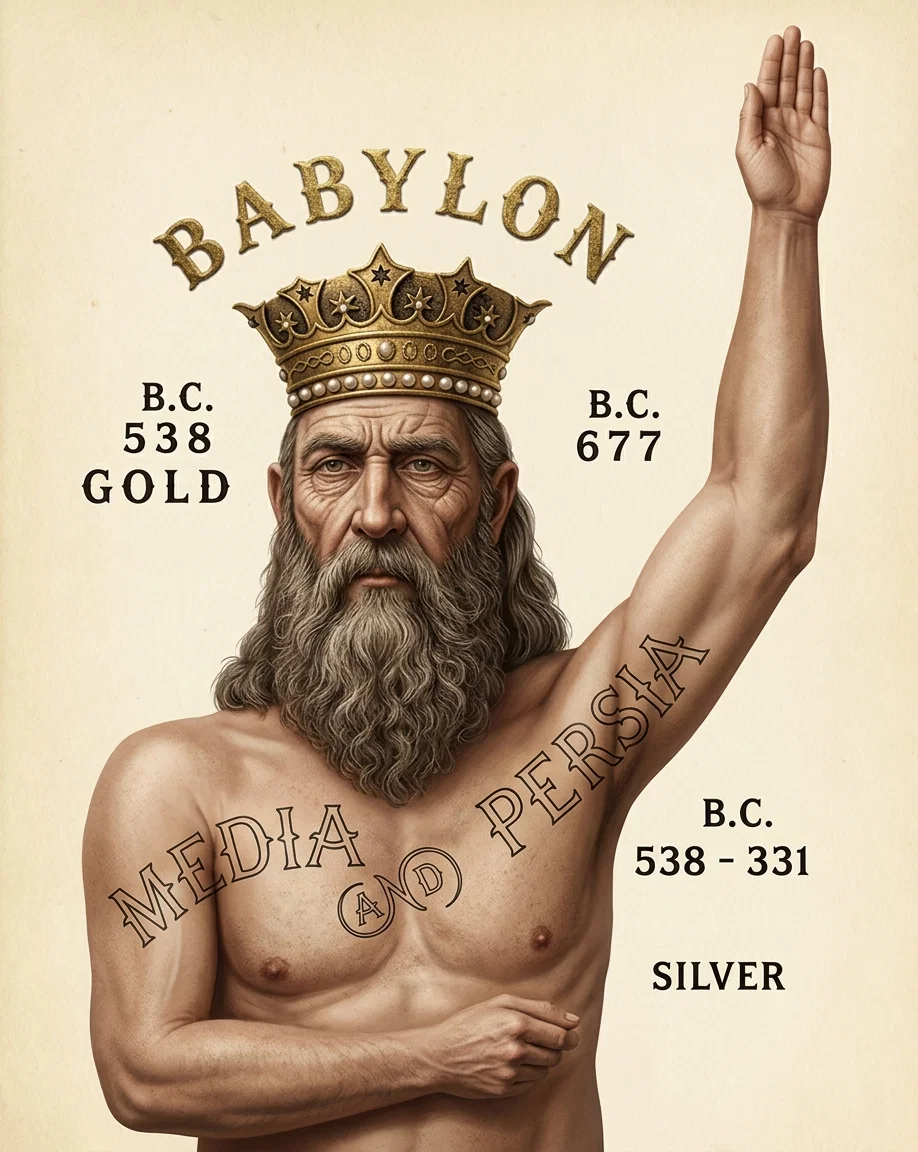
The year 599 B. C. is marked by the birth of Cyrus, the famous founder of the Persian monarchy. His mother was Mandana, daughter of Astyages, king of the Medes; and his father was Cambyses, king of Persia. A year before the birth of Cyrus, a son was added to the royal family of Media. This was Cyaxeres, called in the book of Daniel, "Darius the Median." He was brother to Mandana, the mother of Cyrus, and consequently bore the relation of uncle to Cyrus himself.
When Neriglissar came to the throne of Babylon, a violent war sprung up between him and the Medes, whereon Cyaxeres, who had just then ascended the throne of Media, called Cyrus out of Persia to his aid. In the first pitched battle the Assyrian army was routed and Neriglissar slain. He was succeeded in the kingdom of Babylon by Laborosoarchod, nine months, and then by Belshazzar, who was the last of the Babylonian, Assyrian, or Chaldean kings, as already noticed.
The war continued with uninterrupted success on the part of the Medes and Persians, under the command of Cyrus, who was generalissimo of both armies, until in the beginning of the sixteenth year of Belshazzar, Babylon was the only city that held out against him in all the East, and he sat down before that in a regular siege. To attempt the conquest of such a city was no ordinary undertaking. Babylon was sixty miles in circumference, perfectly square, the length of each side being fifteen miles. Its walls were impregnable, being eighty-seven feet thick, and three hundred and fifty feet high. The number of troops within for its defense was very great, and the city was stored with all sorts of provision for at least twenty years. Thus furnished the Babylonians scoffed at Cyrus from their lofty walls, and derided every effort he made against them. But he had been called by name and appointed to his work, by the Lord of hosts, over two hundred and sixty years before (Isa. 44), and therefore, as an instrument of Providence though he knew it not, he moved on in his great undertaking. The predictions concerning the taking of Babylon, the people who should accomplish it, and the particular circumstances that should attend it, may be found by those who take pleasure in noting the exact accomplishment of God's word, by a reference to the following passages: Isa. 13:17–22; 21:2; 47; Jer. 50:51.
Though an apparent digression, the reader will be interested to spend a moment considering by what means destruction came so suddenly upon them ere they were aware (Isa. 47:11; Jer. 1:24), while the king and the whole city were giving themselves to feasting, drunkenness and revelry, in the most apparent security. Dan. 5. The river Euphrates, upon the banks of which Babylon was situated, ran directly through the city. The banks being low, in order to secure the city from inundation (as the river overflowed every year when the snows melted upon the mountains of Armenia, as the Nile overflows Egypt), high walls of brick and bitumen, of the same thickness as the outer walls, were built on each side of it along its entire course through the city. While these were building (their foundations being laid as low as the bottom of the river), the whole river was turned from its channel into an artificial lake, forty miles square, prepared to the west of Babylon to receive it during this time. This being found convenient for the receiving of the surplus waters every year, to be from thence let out to water the country as needed, through the year, it was preserved till the time of Cyrus. In the walls above mentioned, against every street that crossed the river, on either side were gates of brass, and from them steps leading down to the water.
With these facts before us, we are prepared to understand the stratagem by which Cyrus, after a siege of nearly two years, made himself master of the place. He first dug a trench broad and deep around the city, and having ascertained that upon a certain day approaching, an annual festival was to be kept, in which the whole night was usually spent in revelry and dissipation, he resolved to take advantage of the disorder that would then prevail, and execute his scheme. He therefore stationed a body of men at the point where the river came out of the city on the lower side, and another at the upper side where it entered, with orders that when they should find the water of the river so reduced as to make it fordable, they should rush into its channel, and thus enter the city. He then sent up a body of men with orders at a given time to break down the embankment at the head of the canal leading to the lake above mentioned, and thus turn the river that way, while at the same time he opened the trench which he had dug around the city, and turned the water of the river also into that. Thus its channel through the city was rendered comparatively dry, and the soldiers entered in as ordered. But having secured this object, what was now to be done? for the walls on each side of the river were closed with huge gates of brass; and there was no earthly power then available that could scale those walls or force those brazen gates. But Providence had removed all difficulty here; for in the confusion of that night of impious feasting, these gates were all left open. It was doubtless in reference to this that the Lord had spoken by the prophet, I will "open before him (Cyrus) the two-leaved gates; and the gates shall not be shut. I will break in pieces the gates of brass, and cut in sunder the bars of iron." Isa. 45:1, 2. Thus the army of Cyrus found free entrance into the very heart of the proud city of their enemy.
From this scene turn to the palace of the king. "Belshazzar the king," says Daniel, who was there to witness it, "made a great feast to a thousand of his lords." Chap. 5. And when he had brought forth the vessels of gold and silver, which had been taken by his grandfather, Nebuchadnezzar, from the temple of the great God at Jerusalem, and was drinking wine from them with his princes, wives and concubines, and praising their gods of gold and silver, suddenly there flashed out upon the wall the appearance of a part of a man's hand, tracing mysterious characters, of fearful import. Then did the king's countenance change, the joints of his loins were loosed, and his knees smote together under the keener smitings of his conscience. The astrologers were called in haste to interpret the writing. Failing in this as they before had failed on the dream of Nebuchadnezzar, Daniel is called in to explain the mystery. Then the hand vanished; and the writing that was written had this interpretation: "MENE; God hath numbered thy kingdom and finished it. TEKEL; Thou art weighed in the balances, and art found wanting. PERES; Thy kingdom is divided and given to the Medes and Persians." And while the recording angel was writing out this sentence before the eyes of the guilty king, the legions of the Medes and Persians were pouring in through the two-leaved gates of the river walls, to its execution. They met at the palace as previously concerted, and upon the guard's opening the gates to ascertain the cause of the uproar without, they rushed in and slew the king. "That night was Belshazzar king of the Chaldeans slain," says the simple and comprehensive record of the Scripture, "and Darius the Median took the kingdom." We fear that not to Belshazzar alone is the sentence applicable, "Thou art weighed in the balances and art found wanting." How many of us, dear reader, should we be weighed in those scales by which God estimates the moral worth of mankind, would be found wanting?
U. S.
THE HONOR THAT COMES FROM GOD.
By John Nevins Andrews
THIS alone is worthy of being sought by us. It is never bestowed upon those who are unworthy to receive it. It is never gained by false pretenses. Intrigue will not secure it. Selfishness will not accomplish anything in the effort to wrest it from its rightful possessor. It is given only to those that God approves. He judges of men's conduct by the motive which prompts that conduct. He confers honor when the motives are pure, and the acts are right. But he is very careful to know that his honor is our highest aim. That this may be manifested beyond all dispute, he takes care to test his servants by placing them in such spheres of action as shall show that they labor not to please themselves, nor even to gain the applause of their brethren, but solely to honor him whose servants they profess to be.
When he finds those who seek his honor only, how greatly pleased is he with them! "Them that honor me," says God, "I will honor, and they that despise me shall be lightly esteemed." 1 Sam. 2:30. And Jesus says, "If any man serve me, him will my father honor." John 12:26. There is one direct road to this honor. It is to seek only to please God. Humiliation, and not advancement, will come first. The singleness of our purpose, the purity of our motives, and the unselfishness of our character, is to be made evident by the course we pursue. Indeed, he may withhold everything but humiliations and crosses. If so, let us say, "Even so, Father, for so it seems good in thy sight." Let us accept these things with cheerfulness. They are tokens of the loving kindness of God to us. The course we pursue in these very things is to determine whether we are worthy of honor from God or not. If we are found ready to bear the cross of Christ, even where we cannot always have the approval of the people of God for the time being, our singleness of purpose is thereby plainly revealed. Let us remember to honor God, and he will in due time honor us. Let us wait the Lord's time, and fill up the interval by patient continuance in well-doing.