The Youth’s Instructor, Vol. 43, No. 34.

THE CHRISTIAN STAIRWAY

The Youth’s Instructor

Aug 22, 1895

S. D. A. Publishing Association · Battle Creek, Mich. · Aug 22, 1895

“THE CHRISTIAN STAIRWAY.”
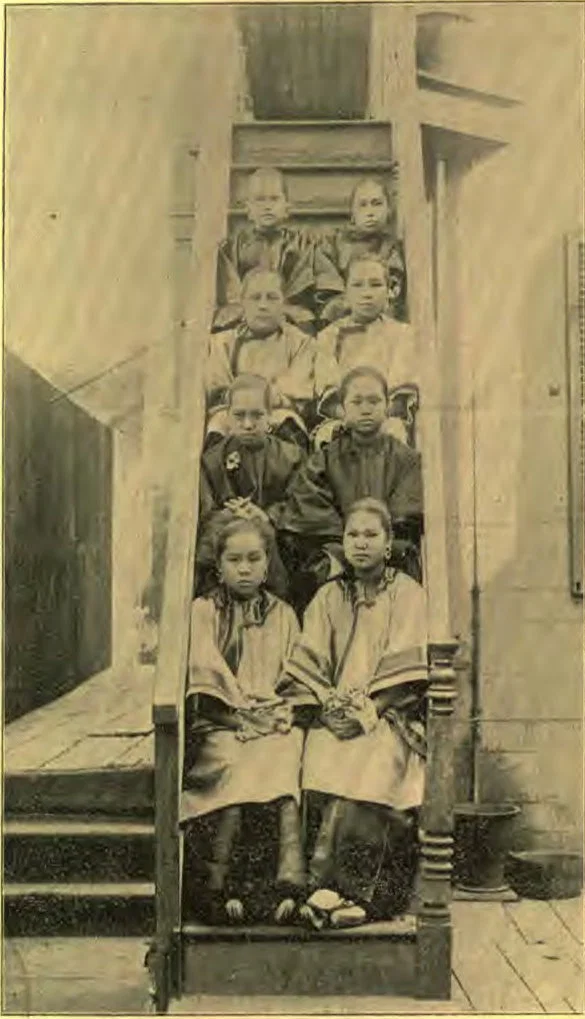
This stairway is found in San Francisco, back of a large building fronting on Sacramento street, where the Presbyterians have a mission school for young Chinese women. Several women give their time to rescuing these young women from dens of iniquity where they are held as slaves, and bring them to this home, where they are taught to read and write, also how to do all kinds of useful work. These young women are usually quite bright and willing to be taught; but more than that, they are glad to be free from the bondage in which they are held. Many of them are purchased in China, and are brought to the United States, where they are bought and sold by Chinamen who think that a woman has no rights of her own.
“THE CHRISTIAN STAIRWAY.”
The missionaries of the Presbyterian home, believing God has something better for these women, have put forth earnest efforts to gather them up and educate them, so that they may be able to support themselves. They also seek to turn them to the Lord as soon as they teach them to read. Thus many of them are led to give their hearts to the Lord, and become earnest Christians. The eight girls in the accompanying cut are all Christians, and are engaged in instructing others who are brought into the home from time to time.
When we visited the home, they were all engaged in sewing, and seemed to enjoy their work. After we entered, the matron had them lay aside their work and give us an exhibition of their reading and singing. All entered into the work with an earnestness that showed they knew something of the sentiments they read and sang. Those who had been there the longest were quite Americanized, and in conversation might be taken for American-born girls. The most of them keep up the Chinese custom in dress and in arranging the hair.
This society also works for the conversion of the men of this nationality, by holding night schools and missions. Many Chinamen are converted, and become earnest workers among their own countrymen in San Francisco. A few have received a fair education, and have returned to China as missionaries, to work for the conversion of the millions in that country who are still in heathen darkness. Some of these converted men marry young women from this Christian home. It is said that a Chinaman looks upon the privileges of a woman very differently after he is converted. Thus we can see what Christianity does for this people.
If a knowledge of the true God will change these minds from darkness to light, so that they will recognize each other, regardless of sex, as of equal standing before God, is it not a great and good work to carry the gospel to them? If it will work such remarkable change in those who are in this country, will it not do the same for those who are in China?
These young women who are now Christians, living a pure life, are only a few of the millions in China who would be glad to do so if they could only be free from the bondage that holds them. Then should we not put forth earnest efforts to carry the light of the gospel to this nation with its four hundred million people? We can give of our means to send some one upon whom God may lay the burden. In this way we can all have a part in sending the light of truth to these hungry souls.
J. H. D.

THE SAINTS SHALL REIGN WITH CHRIST ON THE EARTH.

Of the twenty-four elders who are before the throne of God in heaven, we read that they fell down before the Lamb to adore him. Every one had a harp, that he might accompany the songs of praise with sweet heavenly music. “And they sung a new song, saying, Thou art worthy to take the book, and to open the seals thereof: for thou wast slain, and hast redeemed us to God by thy blood out of every kindred, and tongue, and people, and nation; and hast made us unto our God kings and priests: and we shall reign on the earth.” Rev. 5 : 9, 10. They do not say that they are now reigning on the earth, but “we shall reign on the earth.” This reign is still in the future.
“But the saints of the Most High shall take the kingdom, and possess the kingdom forever, even forever and ever.” “And the kingdom and dominion, and the greatness of the kingdom under the whole heaven, shall be given to the people of the saints of the Most High, whose kingdom is an everlasting kingdom, and all dominions shall serve and obey him.” Dan. 7 : 18, 27. The glorious kingdom which the saints shall possess forever is “under the whole heaven,” that is, on the earth. Jesus, their king, shall reign over them, and all dominions shall serve and obey him.
Jesus says, “To him that overcometh will I grant to sit with me in my throne, even as I also overcame, and am set down with my Father in his throne.” Rev. 3 : 21. Jesus shall reign on the throne of his father David. Luke 1 : 32. This reign shall be without end, and his kingdom shall fill the whole earth. Dan. 2 : 35, 44. Jesus promises his saints that they shall reign with him on his throne, and his throne will be on the earth. From this follows evidently that the saints shall reign with Christ on the earth. And since the kingdom shall be without end, it cannot exist in the present corrupt state of the earth. It can only be in the world to come when God creates new heavens and a new earth.
The disciples of Jesus understood that they should reign with Christ, and they longed for that time. When Jesus was about to return to his Father, they asked him, and said, “Lord, wilt thou at this time restore again the kingdom to Israel?” Acts 1 : 6. Jesus did not tell them that the kingdom was already set up, neither did he say that it should not be a real kingdom, but he told them that it was not the plan of his Father that they should know the exact time. “It is not for you to know the times or the seasons, which the Father hath put in his own power.” Verse 7. The children of God must wait patiently. They must watch and pray, and not grow weary until the glorious eternal day dawns, never more to be darkened.
“In that day, saith the Lord, will I assemble her that halteth, and I will gather her that is driven out, and her that I have afflicted [the children of promise who have suffered persecution in this world]; . . . and the Lord shall reign over them in mount Zion from henceforth, even forever. And thou, O tower of the flock, the stronghold of the daughter of Zion [Christ is the tower and stronghold of God’s people], unto thee shall it come, even the first dominion; the kingdom shall come to the daughter of Jerusalem.” Micah 4 : 6–8.
The New Jerusalem is the mother of us all. Gal. 4 : 26. For this reason the people of God are called the daughters of Zion or Jerusalem. They are not daughters of that Jerusalem which is now, for she is in bondage with her children (verse 25); but the Jerusalem which is above is presented under the symbol of the free woman. The children of the free woman are the children of God who do not live after the flesh, but after the spirit. They fear and love the Lord, and look with joy for his appearing. They have not received the spirit of bondage, but the spirit of adoption, whereby they cry, Abba, Father. Rom. 8 : 13–15.
From the prophecy of Micah quoted above we learn that the Lord shall reign over his people forever and ever, that he is their stronghold and tower, or place of refuge, and that the kingdom which Christ shall obtain is the first dominion.
What is the first, or former, dominion?—It is the dominion which God gave unto man in the beginning. “And God said, Let us make man in our image, after our likeness: and let them have dominion over the fish of the sea, and over the fowl of the air, and over the cattle, and over all the earth, and over every creeping thing that creepeth upon the earth.” Gen. 1 : 26. And again we read: “And God blessed them, and God said unto them, Be fruitful, and multiply, and replenish the earth, and subdue it: and have dominion over the fish of the sea, and over the fowl of the air, and over every living thing that moveth upon the earth.” Verse 28.
The dominion which God gave unto Adam is the first dominion. Adam had dominion, or reigned, over all the earth and over every living thing that moved upon it. Thus likewise Christ and his people shall reign over the new earth and over all the animals that God will create upon it. This is the original plan of God, and all the cunning devices of Satan cannot overturn it.
How beautifully the condition of the new earth is presented by the prophet Isaiah: “For, behold, I create new heavens and a new earth: and the former shall not be remembered, nor come into mind. But be ye glad and rejoice forever in that which I create: for, behold, I create Jerusalem a rejoicing, and her people a joy. And I will rejoice in Jerusalem, and joy in my people: and the voice of weeping shall be no more heard in her, nor the voice of crying.” Isa. 65 : 17–19. “The wolf and the lamb shall feed together, and the lion shall eat straw like the bullock: and dust shall be the serpent’s meat. They shall not hurt nor destroy in all my holy mountain, saith the Lord.” Verse 25.
Then the lion shall again be peaceful, and the wolf be gentle as a lamb. They shall no more be ferocious nor make a prey of their weak fellow-beings. The green herbs shall again be their feed as it was in the beginning. “And to every beast of the earth . . . I have given every green herb for meat.” Gen. 1 : 30.
Then the earth was perfect. Everything that God had made was very good. Gen. 1 : 31. This happy state shall come again. Once more the Lord shall be able to look upon all that he has made, and pronounce it very good. There shall be no more crying, no more pain, and no more death. The Lord shall wipe away all tears from their eyes, and the tears and the sorrow that caused them shall never more return. Then Jesus shall dwell with his people, and they shall reign with him in glory in the land of immortality. Their friends, relatives, parents, and children, the sick and the poor, the despised and persecuted who have loved the Lord, shall meet, nevermore to part. Is not this a glorious kingdom worth living for, even if we have to suffer with Christ a little while? J. G. MATTESON.

BLESSED ARE THEY THAT DO.

If thou wouldst have an abundant part In the harvest field so white, Then think of thy Maker while thy heart Is young, and thy hopes are bright.
Yes, think of Christ who, when but a child, Spake with wisdom from on high; Who was lowly, humble, meek, and mild, Though Lord of earth and sky.
Do not wait the time when thou shalt see An opening large and wide; But start at once, e'en though it be At home, where you abide.
'T is sweet to work in the bloom of youth, When the heart and mind are fair; To have a place in the glorious truth, The message of Christ to bear.
'T is nobler far to offer the Lord A heart that is pure and free, A life devoted to his word, Though humble and poor it be,
Than to tread the path of sin and shame, Till thy best of days are gone; Lost is thy honor, thy hopes, thy name, And treasures thou might'st have won.
HARRY ARMSTRONG.

ARE YOU BUYING THE TREASURE?

“The kingdom of heaven is like unto treasure hid in a field; the which, when a man hath found, he hideth, and for joy thereof goeth and selleth all that he hath, and buyeth that field.”
Christ drew his lessons from the customs of the people, and from facts with which they were familiar. They knew that when a man found a treasure, or knew that a certain field contained valuable stores, he invested all his property in buying the field. Christ used this fact to illustrate the value of the treasure of truth. In the days of Christ the people generally thought that to bury their treasures was to preserve them in safety, and many placed their gold in the bosom of the earth. At times the buried treasure was lost to its possessor by his sudden death, and the secret of his hidden wealth was locked up from his relatives and friends with its possessor in his grave. Afterward, when the land was worked, the treasure was discovered. Sometimes the gold was brought to light by some one who was not related to its possessor, and the secret of the hidden treasure was not disclosed until the man had made arrangements to buy the field for himself. This fact is taken to illustrate the value of the kingdom of heaven, and how those who appreciate its value are willing to dispense with all in order to obtain it.
Without the kingdom of God we are lost, we have no knowledge of God, and are without hope in the world; but salvation has been provided for us through faith in Jesus Christ. He is the treasure, and when the rubbish of the world is swept away, we are enabled to discern his infinite value. He says, “I am sought of them that asked not for me; I am found of them that sought me not: I said, Behold me, behold me, unto a nation that was not called by my name.” The divinity of Christ was as a hidden treasure. At times when he was upon earth, divinity flashed through humanity, and his true character was revealed. The God of heaven testified to his oneness with his Son. At his baptism the heavens were opened, and the glory of God in the similitude of a dove like burnished gold hovered over the Saviour, and a voice came from heaven, saying, “This is my beloved Son, in whom I am well pleased.” But the nation to whom Christ came, though professing to be the peculiar people of God, did not recognize the heavenly treasure in the person of Jesus Christ. They had had light upon light, evidence upon evidence. “God, willing to show his wrath, and to make his power known, endured with much long-suffering the vessels of wrath fitted to destruction: and that he might make known the riches of his glory on the vessels of mercy, which he had afore prepared unto glory, even us, whom he hath called, not of the Jews only, but also of the Gentiles.” “What shall we say then? that the Gentiles, which followed not after righteousness, have attained to righteousness, even the righteousness which is of faith. But Israel, which followed after the law of righteousness, hath not attained to the law of righteousness. Wherefore? Because they sought it not by faith, but as it were by the works of the law. For they stumbled at that stumbling-stone; as it is written. Behold, I lay in Sion a stumbling-stone and rock of offense; and whosoever believeth on him shall not be ashamed.” “Esais is very bold, and saith, I was found of them that sought me not; I was made manifest unto them that asked not after me. But to Israel he saith, All day long I have stretched forth my hands unto a disobedient and gainsaying people.”
Jesus Christ, the Majesty of heaven, was not discerned in the disguise of humanity. He was the divine teacher sent from God, the glorious treasure given to humanity. He was fairer than the sons of men, but his matchless glory was hidden under a cover of poverty and suffering. He veiled his glory in order that divinity might touch humanity, and the treasure of immense value was not discerned by the human race; “but as many as received him, to them gave he power to become the sons of God, even to them that believe on his name: which were born, not of blood, nor of the will of the flesh, nor of the will of man, but of God.” The man who finds Christ, the man who beholds the treasure of salvation, has found the field and the hidden treasure. “The Word was made flesh, and dwelt among us, (and we beheld his glory, the glory as of the only begotten of the Father,) full of grace and truth. . . . And of his fulness have all we received, and grace for grace.” The treasure indeed is hidden under the garb of humanity. Christ is the unsearchable riches, and he who finds Christ, finds heaven. The human agent who looks upon Jesus, who dwells by faith on his matchless charms, finds the eternal treasure. In the parable he who finds the treasure is represented as so well satisfied with his discovery that he sells all that he has to purchase that field.
Mrs. E. G. White.
(To be concluded.)

Tokens of Mercy in Common Things

“If we only knew how much we are surrounded with the tokens of mercy! The earth is full of them; grains of wheat, leaves, flowers, the commonest things, all have their tales to tell. Our ignorance hinders our thanksgiving—not that we are as thankful as we might be for the mercies that we know of; perhaps if we were, more would be revealed to us. We should say, ‘Lord, that I may praise thee, let all things have their voice for me.’”

BRITISH SEIZURE OF TRINIDAD.

Several months ago, when the British government tried to gain possession of a small island belonging to the Hawaiian group, it was prevented from doing so by the prompt action of the Hawaiian government. Immediately after that, a comic paper printed in this country contained a picture representing England as the traditional John Bull, looking eagerly at a map of the Pacific Ocean, and exclaiming, “What, that an island! I thought it was a fly-speck, or I would have collared it long ago.” This was a good hit; for it has been the custom of England to “collar” islands wherever they may be found. It has been said that a genuine Yankee is always ready to steal any railroad that he can find lying round loose; but England prefers islands, and if every loose island has not yet been taken by her, it is either because she cannot take it, or that she would not know what to do with it after it was taken. The last-mentioned reason keeps some islands safe from her grasp; but if they should be wanted to serve England’s purpose, then they had better look out!
The little island of Trinidad, lying one thousand miles southwest of Rio de Janeiro, and belonging to the latter country, is the last island which England has “collared.” It seems that on April 17, 1770, this island was taken possession of by one Dr. Halley, in the name of King William III of England. Portugal also claimed the island, and when Portugal and her colony of Brazil parted company, the island was included as a part of the empire of Brazil, and it is now claimed by her accordingly. It is of no great practical value, and it has been generally regarded as a kind of “no man’s land” for many years; but as far as we can learn, the ownership of the island by Brazil has been very generally conceded. Suddenly England, perceiving that the island may be useful as a landing-place for her new submarine cable to the Rio de la Plata region, has reasserted her old claim, and taken possession of the island!
Some attempt to belittle the seizure of so small an island, and to justify England because the island is of no great value! But it evidently is of value to England, or she would not seize it as she has done. Again: if the island clearly belongs to Brazil, the seizure of the island is a wrong as truly as though it were worth millions. England would not part with her smallest possession without receiving an equivalent, unless compelled to do so. Naturally Brazil is very indignant, and much ill-feeling is expressed toward England.
The latest news in relation to this affair is that through the friendly mediation of the United States, the mutual claims of England and Brazil will be submitted to arbitration.
The reader must not confound this island of Trinidad with the larger island of the same name in the West Indies.

NEW YORK CITY AND THE SUNDAY LIQUOR LAW.

The city of New York has been convulsed for several months over the question of selling liquor on Sunday. It is not the question of liquor-selling and drinking of itself that is agitating the minds of the citizens of New York, but it is the Sunday-selling that is being discussed. In that city, as in many others, the law discriminates in regard to what may or may not be done on Sunday. The municipal laws of New York City, by the license of liquor-selling in thousands of saloons, virtually says that liquor-drinking is not wrong, is not a crime of itself; it is only wrong and a crime when done on Sunday! This is made clear from the fact that people are at full liberty to buy all the liquor Saturday evening which they think they will need on Sunday, and drink it as freely as they please on that day. The members of popular clubs can also drink as much as they please on Sunday, taking care, of course, that the liquor is bought some other day!
By this it is evident that those who made the laws, and those who enforce them, think that liquor-drinking is all right on Sunday, but that the selling of liquor on that day is a crime! In other words, a man who buys liquor on Sunday, but does not drink it at all, is much worse than a man who does not buy on that day, but does drink it every day! A liquor law of this kind is not a liquor law at all; it is simply a Sunday law, and its design is to honor Sunday—to discriminate between Sunday and the other days of the week, rather than to prevent liquor-drinking.
The people see this feature of the law, and many of them think that they are unjustly discriminated against, and so New York City has been, and is now, very much stirred up over this matter. This stir is not over the laws, for the laws are now as they have been for years, but lately, the police, acting under the instruction of the city authorities, are making a great effort to enforce the laws, and to prevent the sale of liquor on Sunday.
Much liquor is undoubtedly sold unknown to the authorities, and in Brooklyn, just across the river from New York, the saloons are open Sunday for the New York trade. The agitation over this question has increased to such an extent that the whole State is interested, and the probability is that the next legislature will grapple with the question of the liquor traffic, especially in its relation to Sunday.
Liquor-selling and drinking is a great evil every day, and it is the duty of every citizen to do all he can by voice, influence, and vote to curtail as far as possible the sale of liquor, not on one day only, but upon all days alike. If it is wrong upon Sunday, it is equally wrong upon Monday. Still it is very doubtful if at the present time public opinion is sufficiently against it to prohibit it altogether. Liquor-drinking is something that never can be entirely cured by law alone; it is so deeply rooted in the carnal appetite, that it is stronger than law; and while its grosser evils may be checked by law, nothing but the grace of God will ever purify a people from such evil indulgences.

PRIZE FIGHTING.

In defiance of the law and of public opinion, the brutal practice of prize-fighting still continues. Prize-fighting is of Anglo-Saxon origin, and it is almost entirely confined to the English-speaking race. A hundred years ago it was about as common in England as base-ball is in this country. It became so deeply embedded in the popular favor, that lawmakers treated it as they have liquor-drinking,— by trying to regulate it, rather than absolutely to prohibit it. To this end laws requiring that gloves shall be used in such contests were made; but the gloves used are so thin and tight that there is very little difference whether they are used or not.
America has had her share of these champion bruisers, and the evil is not yet eradicated; but the opinion is gaining ground every year that prize-fighting is a brutal practice, wholly out of place in a civilized country. The officers of the law in this country have made both successful and unsuccessful attempts to prevent these disgraceful contests. Now the State of Texas is to be dishonored by one of these brutal affairs, unless the law shall be stronger than the would-be law-breakers. Two champions in fistic encounters, Corbett and Fitzsimmons, have agreed to fight each other in that State; but Governor Culberson, by special proclamation issued July 27, prohibits it from taking place within the boundaries of Texas. It is to be hoped that the law and the right will be maintained, and that prize-fighting may be banished, not only from Texas, but from all the States of the Union and from the world.

RACE HATRED.

THAT the prejudice against the negro is felt and manifested in other sections of our country than the South, no one can deny. At the time of the war the Irish population of New York City thought it a proper thing to hang inoffensive negroes to lamp-posts, and we now see in Princeton, Ill., another exhibition of prejudice and hatred against a long-suffering race. The causes of this trouble go back to last year, when the foreign laborers in the coal mines went on a strike, looted the stores, and State troops were sent to preserve order. At that time the coal companies gathered a colony of negro laborers and their families to take the place of the strikers. After the strike was over, the companies felt under obligation to keep the negroes, and the Italians have felt that the negroes are interlopers. They have therefore attacked them again and again. The negroes complained to the local authorities, but as the mayor of the town is an Italian, no attention has been paid to their complaints. August 3 an Italian was killed by unknown parties, and the Italians have seized upon this as a pretext for driving all the negroes out of the town.
This resolve they proceeded to put into execution, beginning August 5. Three days were spent in their murderous work. The negroes were unprepared, and made scarcely any resistance. No respect was paid to age, sex, or condition. Some were killed, and all were despoiled of their goods, and driven from their homes. The mayor, being an Italian, has done nothing to interfere, and so the foreigners had everything their own way. There was intense excitement among the colored people of Chicago when they learned what was taking place, and indignation meetings were held. Some proposed to go en masse to Princeton, and avenge the death of their people. Others counseled moderation. There are three hundred and fifty colored troops in Chicago that are anxious to go.
No more shameful thing ever occurred in the South, and it is a comfort to know that the perpetrators were foreigners. If the claims of the negroes and the Italians to live in this country should be weighed in an even balance, the Italians would have to take a back seat. If the local authorities do not see that such actions are promptly punished, and the negroes be permitted to return to their homes and to their work, the State should see that it is done. The negroes were born here, and are citizens. Probably few of the foreigners are, and it is questionable if they ever should be allowed to become so, until they know more than they do now. M. E. K.

SENDING THE LIGHTNING.

“CANST thou send lightnings, that they may go, and say unto thee, Here we are?” When this question was asked by Jehovah, the answer had to be in the negative; but after centuries have passed, it can now be answered in the affirmative, though not because there is more electricity now than at that time. There is no doubt that electrical bolts splintered trees and other obstacles in Job’s days as well as at the present time. There were wonderful displays of electrical fire-works in the heavens then as now; but electricity was not controlled by man so as to be of any service in transmitting messages thousands of miles in a few seconds.
The same authority that asked the above question speaks again in as positive language that the day will come when “many shall run to and fro, and knowledge shall be increased.” Dan. 12 : 4. This is to take place in the “time of the end,” which can be demonstrated to be a period beginning in A. D. 1798 and closing with the coming of our Lord Jesus Christ. Since the date already mentioned, electricity has been brought into such a state of control that man can use it for rapid communication for long distances, thus bringing opposite parts of the globe into close connection with each other. Were it not for the delay in transferring messages from one line to another, the communication by telegraph would be almost instantaneous.
As an illustration of the degree of perfection to which telegraphy has reached, we quote from an article in the July number of Mc Clure’s Magazine, which shows the results of a trial of electrical transmission. It is as follows:—
“An incident famous in the telegraphic world shows what can be done in the act of transmission when the wires are free, and the operators waiting. Some years ago, at a telegraphic soirée in the Albert Hall, London, a feature of the evening’s amusement was the sending of a message to Teheran, in Persia, and back. A sending and a receiving instrument had been put up in the hall, and connected with the wires of the Indo-European Telegraph Company. This line crossed the channel by cable to Germany, and then by land lines ran over Germany, South Russia, Caucasus, Armenia, and Persia, to Teheran. At Teheran the wire was joined to a second line of the company, returning to London by the same route.
“The lines were cleared for the experiment, and at a given signal, the key of the sender was pressed by the Prince of Wales. The instant that the button of the instrument was touched, ‘click’ went the receiver! The current had been to Persia and back!”
If man can use God’s means of transportation to communicate with each other such long distances without taking time into account, what cannot God do with his own agencies in communicating with man? Away back of the days of telegraphy we read of God’s communicating with his servant in as miraculous a manner as that we have already considered.
Daniel was troubled in regard to some matters shown him in the future, and took the matter to the Lord with fasting and prayer. Dan. 9 : 3–19. This prayer would occupy but a few minutes of time, yet the angel that came to give him understanding, said, “At the beginning of thy supplications the commandment came forth, and I am come to show thee; for thou art greatly beloved.” Verse 23. After Daniel began to pray, Jesus Christ, the archangel, commanded Gabriel, and he reached the prophet while he was still praying.
Not only can Daniel have this quick transmission from the throne of God, but every one who fears him. Ps. 34 : 7. There is no need of wires, transmitters, or receivers, but a pouring out the soul to God. When the servant of God begins to pray, that instant the words are heard in heaven, and in a flash, as it were, the messenger of God comes to the rescue.
We may learn many valuable lessons by studying the works of electricity. We may be able to use it in conveying the gospel to the remotest parts of the earth, after lines are laid; but by considering the great power of God, who is the author of all electrical power, we may learn that we are not so far from heaven as it would at first seem. When the Prince of Wales touched the key of the transmitter, he heard the click of the receiver, signifying that the circuit had been made over thousands of miles of wire. When the sincere soul touches the key of heaven, that instant he may receive an answer to his prayer. There are many things in nature that reveal God, for he is the creator of nature, and it obeys the laws which he established; and if we have a proper and devout spirit, we may see God and his power in innumerable things. May the Lord help us to learn all the lessons God has for us to learn in nature, and above all, may we be able to use these so as to connect us more closely with himself. J. H. D.

HOW TO LIVE.

How to use the one life which is given to each one is the gravest problem which a sane man can be called upon to solve. A lump of salt is dissolved in a basin of water. The salt is gone, but its savor has reached the remotest atom in the basin. Our one life is like that lump of salt. Gradually it is melting away, and in a brief season it will be gone; but its savor will reach through every hour of time, and may reach into eternity. How is this one life to be lived? Where is the power that shall carry us triumphantly through the struggle? Can we find it at the monk’s pillar or the hermit’s cell? History records failure with all such efforts in the past. We must know how to go up to life’s battle, and to go through it erect and unharmed.
It was a fable of the ancients, that the god who presided over each river had his residence in a cavern at its source. Is not the fable an intense reality in each man’s course? Is not the presiding power of each man’s life at its source? It is of no use to deliver homilies about the beauty of virtue or self-sacrifice, or about the vanity of this passing scene. Men go from such homilies, complacently as before, to their worldliness or to their sins. There is one power, and only one, which can energize the heart. That power is divine, and comes from above. “Create in me a clean heart, O God; and renew a right spirit within me.” This admonition is just as necessary to-day as in the past. We can live to please God only when we have his abiding presence within. The life must be savored with the Spirit of God if it is to have a lasting influence for good.
J. H. D.

A COFFEE DRUNKARD.

A FEW days ago I picked up a daily paper, and read the following:—
“The most peculiar case of insanity in this city (St. Paul, Minn.), for twenty years or more, was brought in to-day by the deputy sheriff, when he reported the arrest of Johanna Lindberg, of 406 Arundel street, a woman forty-five years old, who has lived in this city for some time with her husband and three little children. The cause of her insanity is excessive coffee-drinking, and Johanna is what the doctors call ‘a coffee drunkard.’ It was brought out in the examination that for years she has been fond of coffee. The fondness has become gradually greater until recently she would drink from thirty to forty cups of coffee a day.
“She is said to be very violent, and her husband testified that she had threatened his life a number of times. This, he held, was no idle threat, as she is a large, powerful woman, who in a frenzy of rage could easily overcome all his strength. When she was brought into the court to-day, she was in a seeming stupor. Her hair was disheveled, and a part of her clothing had been torn off in the attempt to get away from her captors. She was committed to the insane asylum at Rochester.”
If coffee can have such a terrible effect upon the human system, should we not discard it as we would beer or whisky? It is true, it is not such a powerful stimulant; but when the appetite for it is once formed, and the habit grows, it may become as disastrous as the stronger drinks. Touch not, taste not, handle not, is a good rule to follow with all stimulating drinks. J. H. D.

IT IS WATER.

ONE of our exchanges relates the following interesting incident connected with the breaking of the long drought in the West:—
“There had been insufficient rain in this particular part for several seasons, the crops had been failures, or meager and unprofitable, and many of the farmers were utterly despondent and sick at heart through hope deferred; but the copious rains brought actual salvation to very many. A traveler was driving across a bridge over a creek that was running bank full after being dry for months, and noticed an old settler sitting on the bank with his feet dangling in the stream, bailing up the water first in one hand and then the other, and letting it trickle back into the creek. The traveler spoke to him, but the old man seemed not to hear at first, and continued to bail up the water as though in a dream. When he did finally hear, and look up, his face was wreathed in a happy smile, and tears were running down his cheeks. The traveler made some remark in the way of inquiry into the old man’s actions. The old settler bailed up the water in a double handful, and in a voice that trembled with the intensity of his realization of all it meant, he cried, ‘It’s water, friend. It’s water.’”
As we read the above, the thought of the water of life, which is Jesus Christ, was forcibly impressed upon our mind. Just as truly as people suffer from the lack of natural water, so do people spend long years of unrest and unhappiness because they do not go to the great Burden-bearer, do not take the water of life which Christ so freely offers to every one. All who are suffering from such a drought need not wait longer for it to be broken. When we are ready to receive, God is ready to bestow. Mercy like a flowing stream will be given.
M. E. K.
Continue reading: LESSON 10.—THE PROPER OBSERVANCE OF THE SABBATH