Industrial Progress — Commercialism — Skepticism — Socialism and City Life — The Only Remedy — Will It Be Applied?
Galen Fisher, National Secretary of the Y. M. C. A. in Japan, addressed the men's meeting of the Portland Y. M. C. A., Sunday afternoon, Jan. 8, 1911. He said, in part:
Fifty years ago William H. Seward, our Secretary of State, made the prophecy that the Pacific Coast and the islands of the Pacific would be the theater of the world hereafter. People did not at that time believe this would come to pass so soon. But we are witnesses of it to-day. This is a drama in which the nations of the world are playing the chief rôle. Japan, America, and China are the chief players.
A scene near Nagasaki, Japan, already a world power as well as a continental power in the acquisition of Korea
Every American and Canadian must play a part in this great drama which is reaching a culmination.
Ten years ago Japan was not recognized as a world power. She has shown her ability to master the tools of Western civilization of the modern day as well as to be the best exponent of Eastern civilization.
China has burst its chrysalis overnight. Five years ago, when Fletcher Brockman prophesied that a breach would be made in the awful wall of conservatism, it was considered as absurd. Last fall he said: "Gentlemen, I was wofully mistaken in my prophecy. I did not make the time short enough. It has come to pass in five years." The old educational system has been swept aside. The opium traffic is being stamped out, in spite of the fact that foreign governments have fostered rather than limited the traffic. It has taken great stamina on China's part to eradicate it.
We think of China as living in the Dark Ages, industrially. Yet one of her factories on the Yangtse-Kiang is shipping large quantities of pig-iron to this country.
Competition Sure to Come
Japan has forged at least thirty years ahead of China, industrially. She is now building her own battle-ships and making her own armament. Her colleges and schools rank with the best in America, Germany, and England.
All this means there is sure to be economic competition between the West and the East. The Manchurian problem arises from the effort to capture the market. There is bound to be a close struggle for the economic supremacy in the Far East. If this comes on without the uplifting influences which might have delivered us from internecine warfare, then our eyes will witness an awful sight.
A mighty current of commercialism is now sweeping through the East at a great pace. The Y. M. C. A. is striving to meet this in the Orient. The Association has fitted the need in the Orient as well or better than it has the needs of our own city life here. During the last few weeks we have raised $45,000 to expend upon the Y. M. C. A. in Tokyo.
Doubt and Skepticism
Another great peril has struck Japan with awful force during the last few years. This is an era of doubt and perplexity. The Japanese have come up against the old, old question of the Orient as to the how, when, and whither of life. All the Western doubts have been dumped upon them at once. Intellectual doubts have not been the only perplexities they have had to meet. They have also been perplexed as to how to earn a living. Many of them have been plunged into melancholia. Many have committed suicide to escape the unsolvable enigmas of life. The same phenomenon is sure to sweep over China in the next decade or so.
Just in proportion as Western influence is flooding Japan and China, just so rapidly do the old religions and theories crumble and fall away. They have had their social structure, but it will not stand the attacks of Western agnosticism, criticism, and materialism.
In old Japan money didn't count very much. A man was given his money by his lord. Since 1872 this system has been banished, and it is now upon a monetary basis. Every man is struggling to secure for himself all the money, position, and fame he can. Modern Japan is face to face with all the temptation of mammonism, without the restraints of Christianity which we have had in this country to keep us straight.
In Osaka young men come in from the country bent upon making money and a name for themselves. They buy from the priest charms to give them success in their business. When the old religion is swept aside they find nothing to take its place except the moral level of the community.
Socialism
Not long ago thirty-six Japanese were arrested on suspicion of fomenting a plot to kill the Emperor. They were called Socialists. These things have grown out of the contact of the East with the West. They are inescapable. Japan can not escape them unless she adopts the cure earlier than we have. They arise from that great rush toward the cities which has torn men and women away from old ties. A few years ago there were 800,000 factory operatives in the factories of Japan. I think there are now a million, for they are growing rapidly in number every year. The old institutions of the family, the clan, and the temple are broken up nowadays, and these people thrown into the maelstrom of city life. At the factory they engage in a discussion on labor. They see the capitalist, who rarely visits his factory, becoming richer and richer, and they themselves securing, perhaps, a little more wage each year. This causes discontent.
The natural submissiveness and contentedness of the peasant classes has kept them quiet. But there has been among them a group of agitators who have been unreasonable, and who have been fomenting a spirit of discord and insurrection, which has at last shown itself in this dangerous way. Many have been misguided by these agitators.
What Is the Remedy?
What shall we put against this? That is the question which faces every man who professes to be a Christian worker. No Christian agency has yet begun to address itself in a working manner to this great problem. It is very serious, undercutting all institutions, even the family. Unless some cure is found against these tendencies, which are leading Japan to this awful brink, the end will be terrible. But we have the cure in Christianity. We have heretofore been getting the leaders, and are now at the point where we can apply these men and methods to some problems like this.11First, we have been addressing ourselves to the army problem. Three weeks before war was declared we prepared to send men to minister to the soldiers at the front. The government thought we were intruders. But we convinced them we had practical results to offer. They allowed us to send two men over first, one an Episcopalian clergyman. They did such good work that within a month the officers of the regiment were sending back flattering reports. They asked for more men like them. In a few months we had twenty men at the front, scattered throughout Manchuria, attending the wounded as they arrived at the hospitals. They carried out Christ's own program of teaching and ministry, doing what they could for the sick, and distributing Bibles. Tens of thousands of little pocket editions of the Gospels were distributed over Manchuria.
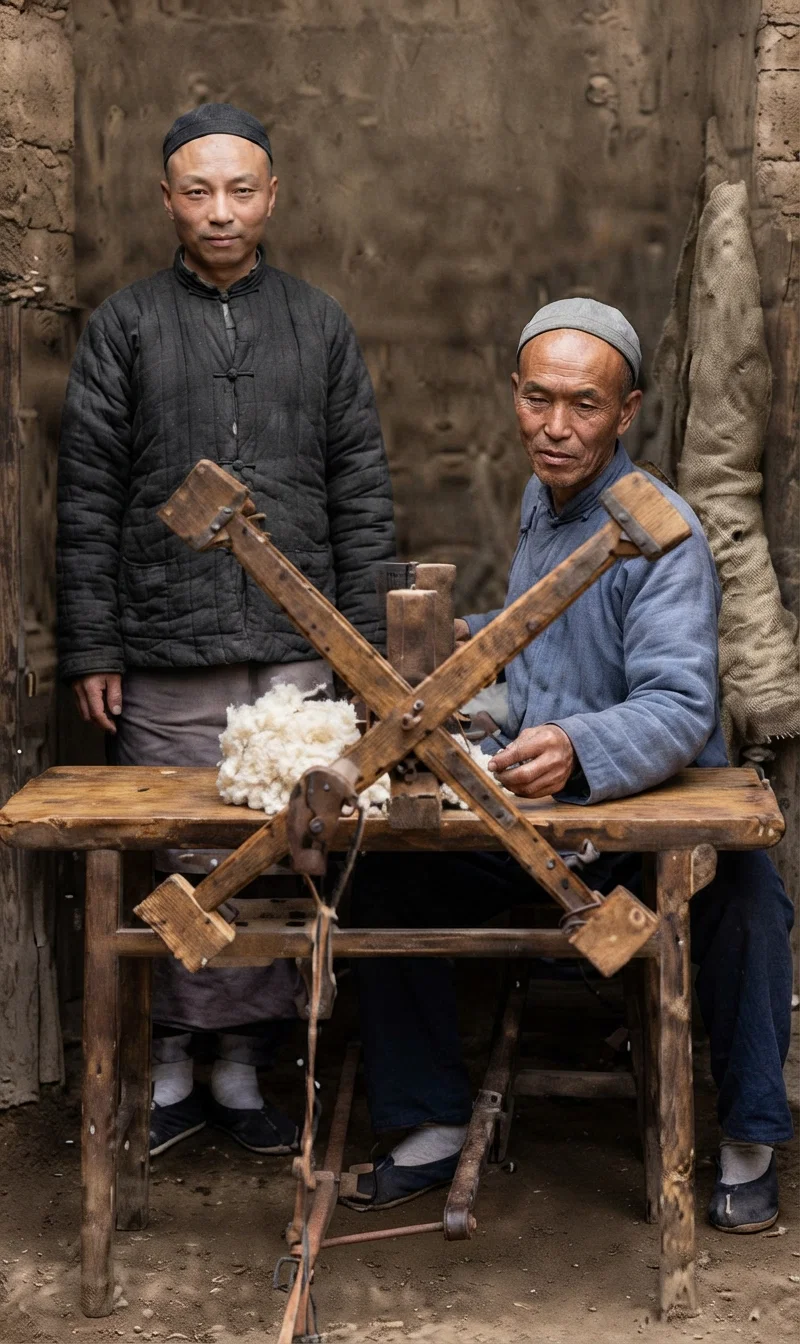
A Chinese reeling cotton in the old-fashioned way. It will not be long before the Orient, with improved machinery and methods, will be in fierce competition with the Occident. And this will not be an incentive to peace.
Favorable to Christianity
The labor market of Japan is recruited from the country districts. The soldiers were also recruited from the same districts. When the army disbanded the soldiers went to their homes with praise to the Association for what Christianity had done for them while they were at the front. The newspapers praised the work in one great chorus, and the Emperor finally gave $5,000 for its support.
Within our generation Christianity has been called an evil thing in some parts of Japan. Even within this generation they used to stamp upon the cross by hundreds annually to show their contempt for anything Christian. But after the war the news was carried that Christianity was a good thing.
I tremble as I think what may come to us if we do not Christianize the Oriental nations. It is an awful thing to contemplate what may come to us in a few years if it comes to a showdown of real force and numbers. We will not be in it. But if we get the world on a Christian basis as well as a self-protective basis we have little to fear.
Christianity in its own way, its old way, can meet all evils if it is accepted; but no national "christianity" can meet them, no corporation "christianity" can meet them. Better the heathen hopelessness than the deception of a religion of form. There is hope in Christ for the hopeless heathen; there is little hope for the self-righteous nominal Christian. One of the best forms of self-righteousness the world ever knew put to death the Christ of God.
— ★★ —
The Aeroplane in Warfare
The First One to Throw a Bomb from a Flying-Machine
"It was a great experience, and it demonstrated a great reality," said Lieut. Myron S. Crissy of the Coast Artillery, speaking of his successful trip with Philip Parmalee in the Wright machine, on January 15, at Selfridge field, near San Francisco, when for the first time in the history of the world an explosive projectile was dropped from an aeroplane at a given spot.
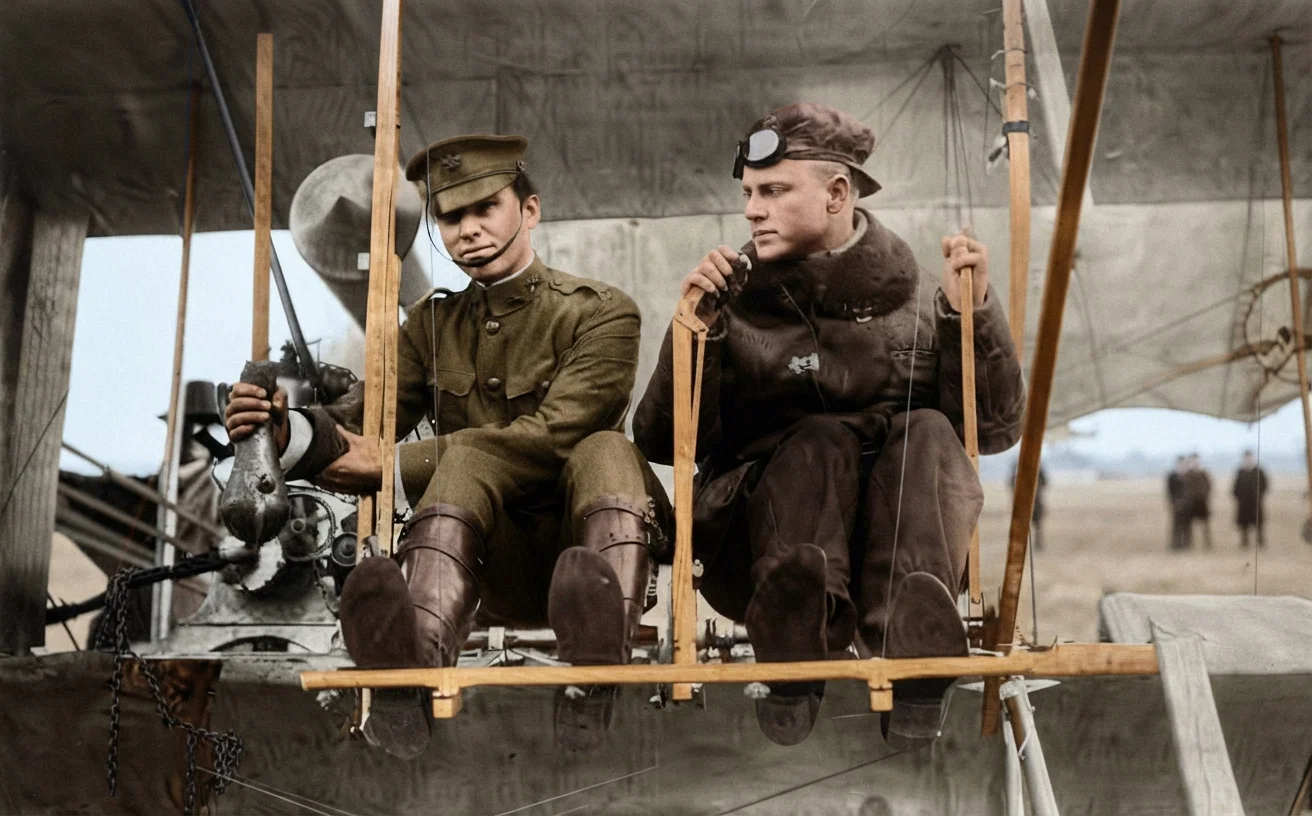
Lieutenant Crissy and Mr. Philip Parmalee about to start on their experimental bomb-throwing ride, January 15, 1911. The above is from the original photograph, kindly loaned us by the lieutenant. January 17 the same officer dropped two bombs from the same aeroplane. The first hit the water and failed to explode; the second, dropped from an altitude of 680 feet, at a silhouette target, missed it by only eight yards. It dug a hole 2½ feet in diameter by 2½ feet deep, scattering mud and pieces of the bomb over a circle 100 yards in diameter. Several pieces hit the target. On his next ascent Lieutenant Crissy will drop a 12-pound shrapnel bomb from an altitude of a thousand feet or more. Lieut. Paul W. Beck believes these experiments to be epochal.
"It proved without doubt," he said, "that the aeroplane is to be an important factor in the warfare of the future.
"For reconnoitering and scouting its practicability has been demonstrated; but not until this trip has an actual bomb been carried up in the machine, a percussion shrapnel, and the spot designated and aimed at, hit.
"I was not expecting to go up at that time," said Lieutenant Crissy to the "Signs" representative, "but the opportunity presented itself, and I availed myself of it. Mr. Parmalee consented to try, and I took my small bomb, as shown in the photograph, and decided to demonstrate if possible its usefulness in relation to the aeroplane in war."
"Were you frightened by the height, or did the experience of flying inconvenience you at all?" Lieutenant Crissy was asked.
"No! the ride in the machine was delightful, the sensation novel. I was not at all frightened, and it didn't even occur to me to hold on. After the rise it was smoother than an automobile on a good road, with an occasional dip very much like the rise and fall on a very smooth sea.
"After we had climbed to an altitude of about 550 feet, and far enough away from the crowd below to make it perfectly safe, we picked out the spot below, and, leaning forward, I threw the projectile.
"Previously, nothing larger than oranges and similar objects had been used, and of course with unsatisfactory results,—for their center of gravity varies and their sections and weights vary so that anything like accurate experimental work was impossible. But this bomb was built of iron, with a pear-shaped body, the short cylindrical part containing the
percussion fuse, and two thin strips of wood fastened to it to insure its dropping right end down, as in a sky-rocket. I devised it for firing data rather than for destruction."
"Many thought it rather dangerous to take even such a projectile aloft, because were it exploded in mid-air—"
"Yes," said the lieutenant, "but that is really a very slight consideration."
"And could you observe it as it descended?"
"We leaned forward slightly and watched it as it moved in a long arc of a parabola, rotating slowly at first. It struck the ground within four or five inches of the spot designated, burying itself about two feet, from the accelerated speed, before exploding. Then with a puff of smoke and splashing of mud it tore a hole about three feet deep and as big as a wash-tub." (See photo on next page.)12
"What do you consider the future importance of this feat, and the skill displayed in accomplishing your object?" he was asked.
He smiled. "It will be the greatest and the biggest argument for peace, and the most effective in case of war. It would be impossible to calculate the future advantages that will accrue to the nation using such defenses as aeroplanes. With time and percussion bombs of greater destructive force, the possibilities are innumerable."
"But in this war game there must be some limit to the advancement and the expense. The price of peace compels a great sacrifice."
"Yes, of course," he hesitated, "the people must decide that."
— **
An Expensive Peace
The battle-ship Arkansas, the largest warship ever constructed in this country, was launched recently at Camden, New Jersey. Her displacement is 26,000 tons, length 562 feet. Her main armaments will consist of twelve 12-inch guns, mounted in six heavy armor-protected turrets. She will have also a battery of twenty-one 5-inch rapid-fire guns, ten small guns, and two submerged torpedo tubes. She will have 28,000 horse-power and a speed of 20½ knots an hour. The vessel will be fitted for a flag-ship, her crew to consist of eighty-five officers and over 1000 men.
An Expensive Peace.—The peace of Europe the last quarter century, according to Edmund Thery, the French economist, has cost Europe the vast sum of approximately $29,000,000,000 (twenty-nine billion dollars!), increasing the public debt from twenty-one billion to thirty billion dollars. During this time it has excluded from productive industry in idle soldiers nearly 4,000,000 men. It is folly, isn't it?
The citizens of Liverpool, England, it is said, are greatly incensed over the fact that hundreds of girls are sent from that port every year to swell the Mormon colonies in America. Their transportation has been secured on the pretext of their becoming servants and filling other minor positions. It is thought the Home Secretary will take a hand in checking the crusade.
At Santander, Spain, 150 workmen were entombed when a mine in which they were working caved in, supposed to have been caused by a terrific explosion. Fire followed which prevented rescue of the miners. At the time of the report forty dead bodies had been removed, and it was feared that the entire force had perished, as the air supply was cut off.
Seventeen persons drowned when a barge driven by a strong wind was wrecked on a reef off the Massachusetts coast.
Notes
By Editor
President Taft says of the legal right invested in him by Congress to appoint a commission of five members "to consider the expediency of utilizing existing international agencies for the purpose of limiting the armaments of the nations of the world by international agreement, and to consider and report on any other means to diminish the expenditures of government for military purposes and to lessen the probabilities of war," "I have not yet made appointment to this commission, because I have invited and am awaiting the expressions of foreign governments as to their willingness to coöperate with us in the appointment of similar commissions or representatives who would meet with our commissioners and by joint action seek to make their work effective."
A new plaint of Oregon ranchmen is that the moving-picture show is spoiling the cowboys, by inducing them to ride bucking horses, in front of moving-picture cameras, or taking part in an alleged "Western Drama." The old ranchers declare, "The pictures only make ornery cowboys, and give Easterners wrong ideas of life in the cattle country."
In a severe snow-storm, fifty passengers on the Great Northern Railroad were in grave danger of starvation when two trains were stalled for four days, with no dining-coach, in the wilds of Montana.
The government of Bolivia has announced the resumption of diplomatic relations with Argentina, and United States is thanked for its part in bringing about a settlement.
"The Chinatown Trunk Mystery," a drama which has been staged in the East and played recently in Portland, Oregon, has been characterized13as "an outrage," "a whirlwind of lust and greed and sin and death." Its managers have been prosecuted.
Notes
The treaty right between China and this country, which provides that citizens of either nation shall be accorded the just treatment that is given citizens of "the most favored nation," may be invoked by the Chinese. Mr. O'Day, the attorney for the Chinese consul, contends that his clients are "warranted in objecting to a drama the central thought of which is hatred for their race, tending to encourage outrages upon them by hoodlums who have seen the play."
Bubonic plague in Manchuria is spreading rapidly. Reports say hundreds of persons are dying daily, and the number of fatalities is increasing. A French plague expert has succumbed to the disease. The Chinese government has appealed to the foreign community for assistance, and four medical missionaries, three British and one an American, have offered their services. It is planned to quarantine the railways and the Great Wall in the hope of arresting the spread of the scourge southward.
No little protest has been aroused in Honolulu by the appointment of a young Japanese lady as teacher of English in the Central Grammar School. While her qualification is not questioned, the reason given is that Honolulu is an American city, and a Christian city as well, and that the mixture of races in the student body does not justify the employment of teachers of an alien race and a different religion.
A most thoro investigation into the financial and administrative management of the thirteen New York State institutions for the insane is being made. Altho the State has been paying for the best supplies, repeated tests have shown the milk and meats furnished have been of inferior quality; and eggs supposed to have been of the "selected" quality, have proved to be scarcely fit for food.
Fifty thousand Orangemen in the Ulster province in Ireland have been enlisted to take arms if home rule is granted to Ireland. According to reports men are being drilled, and preparations are being made to recruit and equip cavalry brigades. The source of the vast amount of money appropriated by the Orangemen's Union for martial preparations is a mystery.
Dr. Edna D. Day of the University of Kansas advocates that connected with colleges and universities there should be a laboratory supplied with babies from orphan asylums, that young women who take domestic science courses may be taught, in advance of matrimony, the science of rearing the baby and the duties of motherhood.
Hon. Charles J. Hughes, Jr., United States Senator from Colorado, died at his home in Denver, Colorado, January 11, after an illness of nearly a year. His death adds importance to the present session of the legislature, which will select a successor.
It is rumored that Japanese in the Philippines are urging their home government to seize the islands before the completion of the Panama Canal, and that the slogan of these radicals is, "War with the United States for the Philippines before 1915 or never."
The introduction of a new bill by Representative Crumpacker of Indiana, chairman of the census committee, provides for a House membership of 435 members, an addition of 44 over the present Congress.
In a special message to the House of Representatives, President Taft asks that $5,000,000 be appropriated at once for the fortification of the Panama Canal.
Eight men met instant death as the result of a boiler explosion aboard the battle-ship Delaware. One other was so badly burned that he will probably die.
Twenty-five passengers were killed in a wreck at Rambouillet, France, caused by a careless employee's leaving a switch open.
James J. Gallagher, who shot Mayor Gaynor last August, has been sentenced to a twelve years' imprisonment.
Sleeping Sickness a Modern Plague
By Joel C. Rogers
SLEEPING SICKNESS is known to be propagated by the species of tsetse fly known as Glossina morsitans. In this family of African fly there are three common species, the other two being called G. palpalis and G. fusca. Since the appalling spread of this disease over Uganda a few years ago, where in some districts of that country it is said more than two thirds of the population were swept away, more than 200,000 dying there, the disease has been the subject of investigation by many scientists and physicians. The most alarming thing about it is the very few facts that have been established concerning its nature. Really, what is not known about it may be said to be more alarming than what is known. Beyond knowing that there is no recovery from its attack, and that it has no discovered remedy, little is really established.
When a man with a family of children awakes in the night with the dying cries and struggles of one of his loved ones, his first terrified question is, "What is killing my child?" Many missionaries and doctors of Central Africa are asking that question concerning their adopted children of these African wilds. The eminent missionary and scientist Robert Laws, M.A., D.D., M.D., F.R.G.S., of Livingstonia, for thirty-five years resident here, asks the simple but agonized question, "Can anything be done to prevent the terrible results so easily foreseen?" In the last issue of the monthly Livingstonia News, Dr. Laws says further: "In our last issue we had to chronicle the infection with this disease of one of our trusted native helpers, Noah Chiporopo; and now his death in the mission hospital at Karonga has to be recorded. Noah's illness was followed soon by that of his companion teacher Yohane, due to the same disease. . . . Almost simultaneously with Yohane's case, a native living between Mvera and the lake shore was found by Dr. Murray to have contracted the disease. Then came the startling news that the Rev. Paul Roux of Beaufort West, Cape Colony, who had come as a visitor to the Mvera conference, had contracted the disease while in the tsetse area along the south part of the lake shore."
The bomb which caused the explosion was not loaded for great destructiveness. It was of brittle cast-iron with two cavities, one filled with fine-grained black powder, a little less than four ounces; the other with small iron projectiles to be hurled in all directions by the explosion.
Over seventy Europeans were attending the mission conference mentioned by Dr. Laws, and it is not improbable that others were also infected. Several others were with Mr. Roux when he was bitten by the fly, supposed to be G. morsitans, which is common in many parts of Nyasaland. My wife met Rev. Mr. Roux in Blantyre, and had a number of conversations with him. She took special interest in him, as she noticed that he was rather an old gentleman, and not much noticed by people at the hotel. She will never see him again. The disease develops very rapidly with Europeans. Two others, both doctors, have contracted the disease in Nyasaland, and each died within a few weeks.
Dr. Laws further says: "It is with regret that we have heard of eleven other cases of the disease having been found, and of deaths having occurred frequently during the last eighteen months. . . . Moreover, during the past few years, a good many deaths of natives have occurred among those who have been at work in the Kambovi district, while returning to their homes near the lake [Nyasa]. . . . The question arises how many such patients have become foci of infection the results of which are as yet unknown."
Tsetse Fly. l. Larva; p. Pupa; i. Imago
The tsetse fly belongs to the family of the Muscidae, as does the house-fly. This species, the Glossina morsitans, is confined to South Africa. It is about 5/8 of an inch long, with about the same spread of wing. It is a blood-sucker, and it is believed leaves a parasite in the wound, similar to the work of the malarial mosquito. It is not harmless to man, as it was once supposed to be.
How long will the inhabitants of this earth last before plagues like this which have no remedy?
JOEL C. ROGERS.
Blantyre, Nyasaland.
IT PAYS
By Editor
3 WAYS
First, agents who sell the SIGNS MONTHLY magazine because of its religious features, find it pays in blessings received.
Second, it is possible to sell from 25 to 100 copies a day, which makes it pay well from a financial standpoint. A California agent recently sold 300 copies of the January number in three days in a city of 30,000.
Third, the outdoor exercise is healthful, and the work is educational too—of inestimable value.
The February number, which is now ready, would be a good one to begin with. Send a trial order to your tract society at once. 5 to 40 copies, 5c per copy; 50 or more, 4c per copy.
Signs of the Times,
Mountain View, Cal.
For Sale
Large, eight-room, strictly modern residence. Large pantry, four large closets, large basement, wired for electricity. House built for two families. Small barn and chicken yard. Lot 139 by 229 feet.
The above can be bought for cost of house alone — $3,000.
See owner, J. M. Benedict, corner California Street and Chiquita Avenue, Mountain View, Cal.
POPULAR
By Editor
MECHANICS
MAGAZINE
"Written So You Can Understand It"
300 Pictures
400 Articles
250 Pages
Every
Month
A wonderful story of the Progress of this Mechanical Age. Instructive, but more fascinating than any fiction. A magazine for Bankers, Doctors, Lawyers, Teachers, Farmers, Business Men, Manufacturers, Mechanics. Has 1,200,000 readers every month. Interests everybody. When you see one you understand why. Ask the man who reads it. Your newsdealer will show you one; or write the publishers for a free sample copy.
The "Shop Notes" Dept. of 20 pages, tells easy ways to do things—How to make repairs, and articles for home and shop, etc.
"Amateur Mechanics" 10 pages, tells how to make mission furniture, wireless, boats, engines, magic, and all the things a boy loves.
$1.50 per year, single copies 15 cents
ASK YOUR NEWSDEALER Or Address
POPULAR MECHANICS MAGAZINE
223 Washington St., Chicago
Life and Health
By Editor
A PRACTICAL health journal, published with a view of meeting hygienic needs in every home; teaching how to care for the health and how to preserve life; prescribing simple home treatments to assist nature in throwing off diseases rather than adding more poison by using drugs or unnatural stimulants as remedies; teaching how to avoid disease as far as possible, how to manage in the home when sickness does come, and how to combat the disease by simple remedies which nature provides.
Send for sample copy and special rates to agents. Price 10 cents per copy or $1.00 per year.
Address, LIFE & HEALTH, Takoma Park, D.C.
Bibles
By Editor
Bibles.—Remember that we are headquarters for anything in the Bible line. We shall be pleased to send you our catalog of Bible selections on application. Pacific Press, Mountain View, Cal.
Helps to Bible Study
By Editor
Helps to Bible Study. A series of Bible readings, simple and easy, designed as an aid to the personal study of the Scriptures, and adapted to the use of individuals or families; also a valuable assistant for Bible workers. 125 pages. Paper covers, 25 cents; cloth, net 50 cents. Address this office.
IN THREE DAYS
SAN FRANCISCO
Overland Limited
TAKES YOU
To Chicago
ACROSS GREAT SALT LAKE
AND
HIGH SIERRA BY DAYLIGHT
Luxurious High-class Equipment
Electric Lighted Throughout
Pullman Drawing-room
Stateroom
Vestibuled Sleeping-cars
Careful and Attentive Dining
Service
Parlor Observation-car with
Library and Cafe
Ladies' Reading-room
Gentlemen's Smoking-room
Daily News Bulletins
Latest Papers and Magazines
Southern Pacific
LIBERTY
THE OFFICIAL ORGAN OF
THE RELIGIOUS LIBERTY BUREAU
AN illustrated, 48-page, quarterly magazine, published as an exponent and advocate of true religious liberty; defending Christianity and the rights of conscience; upholding the Bible as the infallible word of God; recognizing the church and state as ordained of Heaven for specific and distinct purposes, but vigorously protesting against the alliance of the church with the state in the attempt to advance religion and to promote the state.
Price 25 cents per year. Liberal terms to agents.
Address, LIBERTY, Takoma Park, D. C.
Our Little Friend
By Editor
Are you acquainted with OUR LITTLE FRIEND? This favorite of children wishes to extend its acquaintance and usefulness, and is therefore willing to make a special visit to the home of any child or its parent who would appreciate an interview with a "friend" of such good character. Simply make the request and we will send the special double holiday number with beautiful colored cover.
OUR LITTLE FRIEND
Mountain View, California
UNDERWOOD TYPEWRITER COMPANY
Underwood Bookkeeping is as perfect as Underwood Correspondence.
The Underwood Billing, Invoicing, Bookkeeping, Correspondence TYPEWRITERS make it possible to thoroly systematize any business.