Your ShelfYour Projects

Review and Herald, Vol. 66, No. 38.

CHRIST AND HIS WORK
Earlier text: CONDEMNED BY THEIR OWN TESTIMONY

LETTER TO THE HEBREWS.

LESSON 1.—HEBREWS 1:1-7.

  • (Sabbath, Oct. 5.)

Introductory Notice—To Teachers.

There is one thing I would like to impress upon the mind of every teacher, that is, the importance of knowing that his pupils understand the words of the lesson. The letter to the Hebrews is among the things of which Peter wrote (2 Pet. 3:16), and not a little study is required to obtain clear ideas of these things.
I have had considerable opportunity to observe that pupils often go groping through their lessons for want of a proper understanding of the terms used. In the letter to the Hebrews are found many words not often heard by young people, the meaning of which may not be perfectly clear to them. In studying such a book as this, the teacher could not engage in a more profitable exercise than to spend a minute or two in questioning the class on the meaning of the words, before he engages in the regular class work. In most cases he will not only find that he has not lost time by so doing, but he will soon perceive that his work has been more satisfactory, the truths of the lessons being more deeply impressed on the minds of the scholars.
J. H. W.
1. To whom was this letter written?
2. Compare the opening words of this epistle with those of other epistles, and state the differences observed.
3. By whom did God speak in times past?
“God, who at sundry times and in divers manners spake in time past unto the fathers by the prophets.” Heb. 1:1.
4. In what different ways has God spoken to men? Ib.; also compare Gen. 15:1; 18:1, 2; 19:1; 20:3; Num. 12:6-8.
5. By whom has the Lord spoken in these last days?
“Hath in these last days spoken unto us by his Son, whom he hath appointed heir of all things, by whom also he made the worlds.” Heb. 1:2.
6. What do the words “these last days” mean?
7. To what is the Son appointed heir?
“Hath in these last days spoken unto us by his Son, whom he hath appointed heir of all things, by whom also he made the worlds.” Heb. 1:2.
8. Are any other heirs with him?
“The Spirit itself beareth witness with our spirit, that we are the children of God: and if children, then heirs; heirs of God, and joint-heirs with Christ; if so be that we suffer with him, that we may be also glorified together.” Rom. 8:16, 17.
“Therefore let no man glory in men. For all things are yours; whether Paul, or Apollos, or Cephas, or the world, or life, or death, or things present, or things to come; all are yours; and ye are Christ’s; and Christ is God’s.” 1 Cor. 3:21-23.
9. By whom were the worlds made? Heb. 1:2. (See John 1:1-3; Col. 1:16.)
10. In whose glory and image is the Son?
“Who being the brightness of his glory, and the express image of his person, and upholding all things by the word of his power, when he had by himself purged our sins, sat down on the right hand of the Majesty on high.” Heb. 1:3.
“Who is the image of the invisible God, the first-born of every creature.” Col. 1:15.
11. How only can we learn and understand the glory and fullness of God’s power and grace?
“No man hath seen God at any time; the only begotten Son, which is in the bosom of the Father, he hath declared him.” John 1:18.
“If ye had known me, ye should have known my Father also: and from henceforth ye know him, and have seen him. Philip saith unto him, Lord, show us the Father, and it sufficeth us. Jesus saith unto him, Have I been so long time with you, and yet hast thou not known me, Philip? he that hath seen me hath seen the Father; and how sayest thou then, Show us the Father?” Chap. 14:7-9.
“And we know that the Son of God is come, and hath given us an understanding, that we may know him that is true, and we are in him that is true, even in his Son Jesus Christ. This is the true God, and eternal life.” 1 John 5:20.
12. How and by whom are all things upheld?
Ans.—All things were made by the Word, and are upheld by the same. Heb. 1:3.
13. How did this mighty and exalted Being purge us from our sins? Ib.; compare chap. 9:26.
14. How could a being of such glory and power purge our sins by the sacrifice of himself?
“And the Word was made flesh, and dwelt among us, (and we beheld his glory, the glory as of the only begotten of the Father,) full of grace and truth.” John 1:14.
“Who, being in the form of God, thought it not robbery to be equal with God: but made himself of no reputation, and took upon him the form of a servant, and was made in the likeness of men: and being found in fashion as a man, he humbled himself, and became obedient unto death, even the death of the cross.” Phil. 2:6-8.
15. Did this mighty One exist before he came into this world?
“I came forth from the Father, and am come into the world: again, I leave the world, and go to the Father.” John 16:28.
“And now, O Father, glorify thou me with thine own self with the glory which I had with thee before the world was.” Chap. 17:5.
16. Where is he now sitting?
“Who being the brightness of his glory, and the express image of his person, and upholding all things by the word of his power, when he had by himself purged our sins, sat down on the right hand of the Majesty on high?” Heb. 1:3. (Compare chap. 8:1; Rev. 3:21.)
17. What has he obtained by inheritance?
“Being made so much better than the angels, as he hath by inheritance obtained a more excellent name than they.” Heb. 1:4.
18. What is that more excellent name?
“For unto which of the angels said he at any time, Thou art my Son, this day have I begotten thee? And again, I will be to him a Father, and he shall be to me a Son?” “But unto the Son he saith, Thy throne, O God, is forever and ever: a scepter of righteousness is the scepter of thy kingdom.” Verses 5, 8.
19. Who are commanded to worship him?
“And again, when he bringeth in the first-begotten into the world, he saith, And let all the angels of God worship him.” Verse 6.
20. What are the angels in their nature?
“And of the angels he saith, Who maketh his angels spirits, and his ministers a flame of fire.” Verse 7.
21. What office do they fill? Ib. Ministers are servants. (Compare Rev. 19:10.)
22. Describe their power and glory. (See 2 Kings 19:35; Eze. 1:14; Dan. 10:6.)
23. What assurance does this afford to the saints in the dangers of this world? (For an illustration see 2 Kings 6:12-17.)
“The angel of the Lord encampeth round about them that fear him and delivereth them.” Ps. 34:7.

NOTES.

For the omission of the apostle’s name to this epistle, several reasons have been conjectured, the most plausible of which are, (1) that as it was designed to be read by the unbelieving Jews, Paul omitted his name on account of the prejudice against him among that class; and (2) that as Paul was particularly an apostle to the Gentiles (Gal. 2:9; Rom. 11:13), he refrained from assuming any character of authority over the Hebrew converts, who were in the care of other apostles.
This letter evidently was written to those who were familiar with the Scriptures—with those things which the Lord had spoken by the prophets. It is from the very beginning an argument from the Scriptures on the dignity, the Messiahship, and the priesthood of Christ. It argues most conclusively the typical character of the sacrifices and services of the Levitical law, and the insufficiency of those offerings to take away sin. It was, no doubt, written “to the Hebrews,” being a commentary on their laws. It contains convincing proof of the truth of the gospel as it was then preached by the apostles.
In all the other epistles, except those of John, the writers place their names at the beginning. This to the Hebrews gives no intimation of its authorship. Luther suggested that it was written by Apollos, and his suggestion has been taken up and followed by a number of writers on the continent of Europe. But we see no reason to believe that he was correct. Paul was a ready writer, having written thirteen letters under his own name, several of them of considerable length. Of Apollos as a writer we know nothing. Paul was a strong and logical reasoner. The letter to the Hebrews shows his cast of mind. Though Apollos was mighty in the Scriptures, of his style we have no possible means of judging. For ascribing this letter to Paul we have good reasons; ascribing it to Apollos is a mere conjecture without satisfactory reasons. It is a striking fact that no early writer ever suggested Apollos as its author.
This letter reminds us of the abrupt manner of the beginning of Genesis and the Gospel according to John, in announcing God and his works. It does not deal with personal, or private, or even church matters, as do the other letters. We cannot be too thankful for the instruction it contains.
The expression “these last days” does not mean the same in all places of its occurrence. When spoken before the advent of the Saviour, it generally means the last dispensation, the gospel age. Joel 2:28 is not rendered “the last days” in the English version, but Acts 2:16-20 contains an inspired comment on the text, and proves that it means the last days. The original will bear that construction. Acts 2 also shows, by the events prophesied of, that the expression there covers the entire gospel dispensation. But when spoken in this dispensation, as in 2 Tim. 3:1 and 2 Pet. 3:3, it refers to the last days, or last part of this dispensation. The words of Jesus in John 6:39, 40, 44, 54, refer “the last day” to the day of his coming and the resurrection. Hence the last days of this age are the days just preceding his coming. In Heb. 1:2, the last dispensation is meant.
In the former dispensation, God had spoken through holy men, patriarchs, prophets, and others, revealing himself in such a manner as was possible with the imperfect instruments through which the operations of his Spirit were conducted; but in Christ, who is the Son of God, this revelation is made perfect. Christ is “the way, the truth, and the life,” and being infinitely superior to men and angels, that which he speaks has the highest possible claim upon our attention. Dr. Barnes says: “There is a great variety of subjects which we now see clearly, which were very imperfectly understood by the teaching of the prophets, and would be now if we had only the Old Testament,” among which he enumerates, (1) the character of God; (2) the way in which we may be reconciled to him; (3) the perfection and breadth of the law; and (4) the future state, including the judgment and the resurrection of the dead.
As God made the worlds by his Son, and all things are upheld by him, and as “God was in Christ, reconciling the world unto himself” (2 Cor. 5:19), it follows that we see and know absolutely nothing of God the Father, either in creation, in providence, or in salvation and redemption, but what is revealed to us through his Son. The Lord Jesus Christ is, in every respect, the manifestation of God to man. “For it pleased the Father that in him should all fullness dwell.” Col. 1:19.
Heb. 1:3 corresponds to Col. 1:16, 17, which says that by him, that is Jesus, “were all things created, that are in heaven, and that are in earth, visible and invisible, whether they be thrones, or dominions, or principalities, or powers; all things were created by him, and for him; and he is before all things, and by him all things consist.” The word “consist” means literally, stand together; and the text means that as Christ created all things, so he preserves them; he upholds them by the word of his power—the same word that caused them to exist.
“Purged our sins.” A reference undoubtedly to the sacrifice of Christ on the cross, by means of which the sins of all believers are taken away. The text does not teach that the work of redemption had been completed by this act, or that the sins of all mankind had been removed; but that he had made the sacrifice which had power to remove sin in all who would avail themselves of it.
“Being made so much better than the angels.” The word “better” here does not refer to moral character, but to exaltation of rank. As Mediator, as the Son of God in our nature, he is exalted far above the angels.—Barnes.
“By inheritance.” As a son has a rank in a family above servants; as he has a control over the property above that which servants have, so it is with the Mediator. He is the Son of God; angels are the servants of God and the servants of the church.—Barnes.
The words which the apostle quotes from the second psalm, “Thou art my Son, this day have I begotten thee,” have their application to Christ at his resurrection. Acts 13:33. On the meaning of the expression, “this day have I begotten thee,” Dr. Barnes says: “It must, from the necessity of the case, be understood figuratively; and must mean, substantially, ‘I have constituted or appointed, thee.’ . . . He [Christ] has been addressed and treated as a Son—which none of the angels have. They are regarded simply as ministering spirits. They sustain subordinate stations, and are treated accordingly. He, on the contrary, is the brightness of the divine glory. He is treated and addressed as a Son. In his original existence this was so. In his incarnation this was so. When on earth this was so; and in his resurrection, ascension, and exaltation to the right hand of God he was treated in all respects as a Son—as superior to all servants, and to all ministering spirits.”

MAINE CONFERENCE PROCEEDINGS.

The first meeting of the twenty-third annual session of the Maine Conference of S. D. Adventists was held in connection with their camp-meeting at Pittsfield, at 4 P. M., Aug. 20, 1889. The President occupied the chair. Prayer was offered by Prof. G. W. Caviness. Four churches were represented by delegates. The reading of the minutes of the last annual session was postponed till some future meeting. All ministering brethren from other Conferences, and all visiting brethren in good standing in their respective churches, were invited to take part in the deliberations of the Conference.
Several persons presented themselves as delegates, but not having credentials, it was voted that a committee of three be appointed by the Chair, to examine the claims of such applicants, and report at the next meeting. The Chair named as that committee, R. S. Webber, S. J. Hersum, P. B. Osborne.
The Chair was authorized to appoint the usual committees, which were announced as follows: On Nominations, W. R. Clarke, I. C. Choate, Geo. W. Whitney; on Resolutions, R. A. Underwood, R. S. Webber, H. C. Giles; on Credentials and Licenses, T. S. Emery, E. C. Taylor, G. B. Umberhind; on Auditing, B. F. Davis, J. L. Prescott, J. W. Keniston, Timothy Bryant, Amos Rowe, Wm. H. Moody.
Adjourned to call of Chair.
SECOND MEETING, AT 10 A. M., AUG. 22.—Delegates recommended by the committee appointed at the previous meeting, were received from fourteen additional churches and bodies of Sabbath-keepers.
Voted, That the church recently organized at Danforth, with its delegates, be received into the Conference.
The minutes of the last annual session were read and accepted.
The Committee on Resolutions offered the following as their report:—
Resolved, That we deem it the duty of our churches to be more prompt in the election of their delegates.
Resolved, That the clerk of each church make out credentials for the delegates, and send them to the State Secretary two weeks prior to the session of the Conference, and notify the delegates of the fact.
Resolved, That the Conference Committee be authorized to appoint the Auditing Committee, year by year, at least two weeks prior to the session of the Conference.
Resolved, That it is the sense of this Conference that the interests of the cause in the provinces of New Brunswick, Nova Scotia, and Prince Edward Island will be best promoted by the formation of a separate Conference, with auxiliary organizations to include the territory named, and we hereby request the General Conference to take favorable action in this matter at its next session.
Resolved, That we recommend students from this Conference to take their preparatory course at South Lancaster Academy.
G. W. Caviness spoke at some length of the advantages of South Lancaster Academy as a preparatory school for those students desiring a collegiate course; also of the excellent work done by canvassers sent out from the school. Eld. R. A. Underwood said that as the school at South Lancaster and others were branches of the College at Battle Creek, and the College could not accommodate all, it was the mind of our educators that the preparatory course should be taken before entering the College. S. J. Hersum and H. C. Giles coincided with the previous remarks, after which the resolution was adopted.
The Committee on Nominations recommended the following persons for officers of the Conference for the ensuing year: For President, J. B. Goodrich, West Palmyra, Me.; Secretary, T. S. Emery, Cornville; Executive Committee, J. B. Goodrich, T. S. Emery, E. C. Taylor (So. Norridgewock); Camp-meeting Committee, Geo. B. Umberhind, Richmond; B. F. Davis, Presque Isle; G. W. Whitney, So. Norridgewock. The report was accepted, and the persons named were elected as recommended.
Adjourned to call of Chair.
THIRD MEETING, AT 9 A. M.—The report of the Committee on Credentials and Licenses was presented as follows, and credentials and licenses granted accordingly: For Credentials, J. B. Goodrich, R. S. Webber, S. J. Hersum, P. B. Osborne; for License, H. C. Giles, G. W. Howard, S. H. Linscott.
Adjourned sine die.
J. B. GOODRICH, Pres.
T. S. EMERY, Sec.

MISSOURI TRACT SOCIETY.

Report for Quarter Ending June 30, 1889.
No. of members ............................ 317 “ reports returned ........................ 105 “ members added ............................ 4 “ “ dismissed .............................. 3 “ letters written .......................... 210 “ “ received ............................... 88 “ missionary visits ....................... 1,241 “ Bible readings held ..................... 215 “ persons attending readings ............... 433 “ subscriptions obtained for periodicals ... 59 “ periodicals distributed .................. 1,793 “ pp. books and tracts distributed ......... 50,801
Cash received on sales, $747.12; on first-day offerings, $54.27; on city missions, 25 cts.
JAMES KLOSTERMYER, Sec.

News of the Week.

FOR WEEK ENDING SEPTEMBER 21.

DOMESTIC.

—Santa Ana, Cal., was shaken by an earthquake Monday afternoon.
—Heavy frost, Sunday night, in the Necedah, Wis., district caused serious losses to cranberry growers.
—One hundred Arabs from Syria arrived at New York on Monday, and were locked up, pending action as to their admission.
—The New Era Exposition at St. Joseph, Mo., with all the exhibits, was burned Sunday night. The total loss is figured at $259,000.
—Throughout Northwestern Illinois and Southern Wisconsin, the thermometer fell nearly fifty degrees from Saturday to Sunday night.
—Citizens of Hackberry, Arizona, are fearing an attack from the Indians located near that place, and are preparing to defend themselves in case of an outbreak.
—By the fire in Bamberger, Bloom & Co’s. establishment at Louisville, Sunday night, five men lost their lives, and others were wounded. The total financial loss aggregates $1,263,000.
—The steam yacht “Leo,” with nine men on board, was wrecked on Lake Erie, Sunday night, off Avon Point, near Cleveland. All hands were lost. Two of the bodies were recovered Wednesday morning, and search is being made for the others.
—The bursting of a dam, Tuesday night, at Springton Forge, near Coatesville, Pa., flooded the district, and caused farmers to flee to the hills for safety. The damage done will reach thousands of dollars.
—The dam of the Kennebec Ice Company at Hibernia, Pa., gave way Tuesday. A large amount of water rushed down the Brandywine, causing it to overflow its banks, carrying away one bridge and several buildings. As far as is known, no one was drowned.
—Wet weather and high winds have ruined the peach crop in New Jersey. In Hunterdon County alone the loss will reach $100,000.
—During the three months ending Aug. 31, there were exported to England 90,000 head of cattle, 40,000,000 pounds of fresh beef, and 34,000,000 pounds of canned beef.
—Fire at Snohomish, W. T., Thursday night, entirely destroyed the extensive saw-mills of Blackman Bros. The loss is estimated at fully $150,000, on which there is no insurance.
—An accident on Friday to the electric railway up Mission Ridge, near Chattanooga, Tenn., resulted in injuries to a number of persons from Illinois and Indiana who were attending the reunion of Wilder’s Brigade.

FOREIGN.

—The Paris exposition will be closed Oct. 31.
—The Mexican congress and the Dutch parliament are now in session.
—Cholera has made its appearance in Bagdad, and the disease is spreading in Western Persia.
—The floods of Aug. 20, in Japan, resulted in the drowning of 10,000 persons; 20,424 are now receiving relief.
—Malietoa, the deposed Samoan king, has returned to power, and German support has been withdrawn from Tamasese.
—Owing to his articles on Siberian prisons, George Kennan was, on Monday, elected an honorary member by the Polish National Alliance.
—The Vienna correspondent of the London Times says that negotiations have been privately begun for an offensive and defensive alliance between Montenegro and Servia.
—The Chinese Government has decided that several railways shall be built in the empire, and a decree has been issued ordering the beginning of work on the proposed road to Han-Kow.
—The French Chamber of Deputies is split into two factions, represented respectively by M. Clemenceau and M. Ferry. The former favors constitutional revision, and the latter violently opposes it.
—The latest news from Stanley reports him as marching toward Mombasa, on the east coast, which he is expected to reach in about six weeks. Emin Bey still sticks to his province in Central Africa.
—The greatest known depth of the ocean is midway between the island of Tristan d’ Acunha and the mouth of the Rio de la Plata. The bottom was there reached at a depth of 40,236 feet, or seven and three-quarters miles.
—On the night of Sept. 19, several thousand tons of rock slid from the end of Dufferin Terrace, Quebec, to Champlain St., 300 feet below, demolishing seven dwellings and killing a large number of people. Twenty-five bodies have been recovered.
—The English and Italian governments have signed a more stringent anti-slavery convention than has hitherto existed. The new convention declares the slave traffic to be an act of piracy, and enables cruisers to deal more promptly with captured slavers. The Mediterranean is excluded from the operations of the treaty.

RELIGIOUS.

—There are five classes of Adventists in the United States. They have 1,575 churches, chapels, and halls, 840 ministers, and 100,712 communicants.
—Bishop Fowler, of the M. E. Church, has warned the United States that the blood of their best residents in China will pay for the violation of treaties with that country.
—At the close of the National Colored Baptist Convention at Indianapolis on Thursday, the Rev. E. K. Love, of Savannah, Ga., said that out of 3,000,000 Baptists in the United States 1,362,273 were colored; and that when the emancipation proclamation was issued, there were but 300 colored Baptists in the country.

THE MINNESOTA CONFERENCE SCHOOL.

DESCRIPTIVE circulars of the Minnesota Conference School are now ready, and may be had by sending address and stamp to the principal. The school will open Oct. 2. Those who desire to come, whether old or new students, should make application, and be notified of their acceptance before coming. This is necessary that we may know for how many to provide. See circulars for form of application. Many applications have been received, and the prospect is good for a larger and better school than last year. Those coming should apply at once. Direct all communications concerning the school to C. C. Lewis, 338 (not 336) E. Lake St., Minneapolis, Minn. CONFERENCE COMMITTEE.

ADDRESS

Appointments.

“And he said unto them, Go ye into all the world, and preach the gospel to every creature.”—Mark 16:15.
PROVIDENCE permitting, I will meet with the church at Iroquois, S. D., Sept. 28, 29. I hope all within a reasonable distance will be present. W. W. SHARP.
THE next quarterly meeting of the church at Syracuse, N. Y., will be held Oct. 12, 13, the second Sabbath and Sunday of the month. Eld. A. E. Place is expected to be present, and there will be an opportunity for baptism. Let all scattered members of this church take note of this. C. E. GILBERT, Elder.
THE district quarterly meeting for Dist. No. 2, Ohio, will be held at Waterford, Oct. 12, 13. We trust our brethren in the district will make it a point to be there in full force, with delegates from every church in the district. H. M. MITCHELL, Director.
THE quarterly meeting for Dist. No. 11, Kan., will be held at Severy, Oct. 19, 20. We hope to see a good attendance. It is expected that Bro. Haskell and Brock will be present. Please bring comfortables for bedding. Come prepared to have a good meeting. ROBERT AITKEN, Director.
THE Lord willing, I shall meet with the churches in New York as follows:— Newburg, Oct. 1-6 Lancaster, “ 12, 13 As these may be the last meetings I shall hold in New York for some time, I trust there will be a large attendance at all these meetings. M. H. BROWN.

ADDRESS

THE permanent address of Eld. Geo. O. States is Boulder, Colorado.

Obituary Notices.

“Blessed are the dead which die in the Lord from henceforth.”—Rev. 14:13.
FLEMING.—Died at Newark, Ohio, Aug. 5, 1889, of flux, Emmet Ray Fleming, aged 2 years, 11 months, and 20 days; also his little brother died of the same disease, only three or four days later. Both rest together, side by side, waiting the voice of the Son of God which will raise the dead. Thus in a few short days Bro. and sister Fleming were bereft of their only children, and left to the uncertainty of human life and worldly anticipations. May God lead their minds for comfort and consolation to the promises of the dear Saviour, that there shall be no more death. O. F. Guilford.
FELSHAW.—Malinda Felshaw, wife of George Felshaw, died Sept. 7, 1889, in Arcola, Tuscola Co., Mich., aged 78 years, 1 month, and 26 days. Being aged and feeble, a slight cold in three days terminated in her death. Sister Felshaw from her youth was possessed of a sympathetic spirit and a remarkably tender conscience. These, combined with the religion of Christ, made her an amiable woman. She, with her husband, who survives her, embraced the third angel’s message at Brock’s Bridge, N. Y., in 1852. They both attended the camp-meeting at Saginaw, Mich., and were much blessed. The husband and two daughters mourn the loss of a wife and mother, but they have the assurance that she will come forth in the first resurrection. A funeral address was given from Rev. 14:13. M. B. Miller.
MIKKELSON.—Died at his home near Wesley, Iowa, Sept. 3, 1889, of typhoid-pneumonia, Bro. Halver Mikkelson, aged thirty-one years. Bro. M. embraced the Sabbath and kindred truths in the year 1884, since which time he has lived a devoted Christian. He leaves a wife and three small children to mourn his loss, besides an aged father and mother and many other friends. He was perfectly reconciled, and before dying called all his friends around him, and admonished them to be faithful to the end, also to keep up the prayer-meeting, of which he was the leader. He died in hope of the first resurrection. As we failed to get a minister of our faith, the services were conducted by the M. E. minister, in the M. E. meeting-house at Wesley. The church will feel the loss of Bro. Mikkelson, and especially the little company at Wesley, of which he was the leader. Wm. Cleary.
GOODNOUGH.—Died near Chadron, Neb., Aug. 10, 1889, Harvey, son of Geo. and S. M. Goodnough, aged 8 years, 5 months, and 7 days. The circumstances connected with his death are indeed sad. After Sabbath-school, on the day of his death, he started, in company with his uncle, to go to his sister’s home. After they had gone several miles, and while near the crossing of a creek, a high wave of water, caused by a waterspout, swept down upon them, and little Harvey, with the two teams, was carried away and drowned. The next morning his lifeless form was carried home to the grief-stricken family, who entertain hopes of seeing him again when Jesus shall make up his jewels. Harvey was a member of the Sabbath-school, and was much loved by all who knew him. He leaves parents, three sisters, and three brothers to mourn his loss. Funeral conducted at the home by G. J. Powel (Congregationalist). M. N. Jenkins.
RICKABAUGH.—J. M. Rickabaugh died in Pueblo, Col., Aug. 21, 1889, of a complication of diseases which finally terminated in consumption. Bro. Rickabaugh was born April 3, 1829, in Cumberland, Pa., and was, at the time of his death, aged 60 years, 4 months, and 18 days. He united with the M. E. Church at an early age. In 1863 he moved to Colorado. In August, 1888, Eld. Pegg was holding tent-meetings in Pueblo, and Bro. Rickabaugh accepted the truths of the third angel’s message. Since that time he has been an active member of the Adventist church in Pueblo. He professed great faith in the soon coming of the Lord. He bore his sickness, of about two months’ duration, with much patience. During this time he was very anxious to be at rest in Jesus until the first resurrection. He passed away with the hope that when the Lifegiver should come, he would be awakened out of sleep. He was a kind husband and father, and his loss is deeply felt by his sorrowing family and brethren. Remarks from Ps. 4:8, first clause, by J. B. Wilson, local elder of Pueblo church. H. A. Whittaker.
STRONG.—Died in Battle Creek, Mich., Sept. 11, 1889, Earl Jay Strong, only child of Philip and Roby Strong, of Kalamazoo, Mich., aged eighteen years lacking one day. The circumstances connected with the death of this young man were peculiarly painful. He had completed a course of study in the Kalamazoo city schools, where he had resided with his parents the past eight years, and obtained a situation in the Review Office to earn means to pursue an advanced course of study. He had been but two or three hours at his work, taking up books on the elevator to an upper store-room of the building, when by some means—how, it is not known, as he was alone on the floor where he was working—he was caught by the elevator and instantly killed by a fracture of the skull. The funeral was held in the Tabernacle, Sept. 13, and largely attended by a sympathizing congregation. Earl was always delighted with books, and possessed a special aptitude for mastering their contents. His ambition was strong, and his hopes high for the future. He was a dutiful and obedient son, and at times had manifested considerable interest in religious things. A universal favorite with his fellow students at Kalamazoo, his death was keenly felt by them. They sent one of their number, on the day of the funeral, with a beautiful floral tribute, and addressed to Bro. and sister Strong the following note:—
DEAR MR. AND MRS. STRONG: The girls and boys of Earl’s class wish to extend to you their sincere sympathy in your great sorrow. We feel that in his loss we lose a friend who was always remarkable for his good nature and happy ways among us. Hoping that you may be comforted in your bereavement, we are, Yours sincerely, Class of ’88.
The blow naturally falls with great severity upon Bro. and sister Strong, but they hope in God, and confide in his wisdom in the disposal of all events. It has been a pleasure to the friends here to show them all the kindness and sympathy in their power, but only the Lord can heal hearts so sorely tried. To this end we trust he may work for, and abundantly bless them. U. S.

THE TITHING SYSTEM,

OR GOD'S PLAN FOR SUPPORTING GOSPEL LABOR.
A forcible argument, showing the obligation of the tithing system in the gospel dispensation, and an application of its principles to the present time. By G. I. Butler. 112 pp., 12mo, 10 cents.
Address REVIEW & HERALD, Battle Creek, Mich.; 26 and 28 College Place, Chicago, Ill.; or Toronto, Ontario.
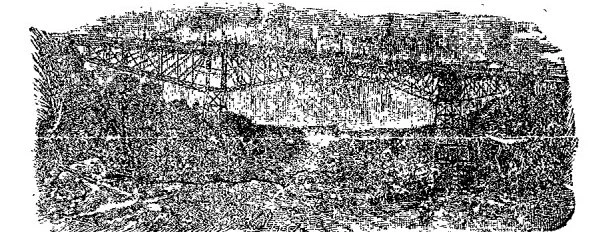
Michigan Central New Cantilever Bridge, Niagara Falls.

MICHIGAN CENTRAL

“The Niagara Falls Route.”
EAST †Mail. †Day Express. *N. Y. Express. *Atl’ntic Express. †Night Express. †Kal. Accom’n †Local Pass’gr.
STATIONS.
Chicago am 7.55 am 10.35 pm 3.10 pm 10.70 pm 11.10 pm 4.50
Michigan City pm 10.08 12.28 4.51 am 12.78 11.27 6.58
Niles 11.40 pm 1.30 5.49 1.50 am 12.65 8.17
Kalamazoo 1.12 2.45 6.58 3.85 2.27 am 7.00 pm 5.30
Battle Creek 1.55 3.20 7.53 4.25 3.15 7.55 6.25
Jackson 3.35 4.39 8.49 6.15 4.45 9.35 8.20
Ann Arbor 5.04 5.43 9.41 7.00 6.00 10.43
Detroit 6.30 6.50 10.46 9.20 7.30 11.50
Buffalo 8.30 am 4.25 am 7.15 pm 5.55 9.05 pm 8.00
Rochester 6.50 9.15 8.00 11.45
Syracuse 9.30 11.35 10.15 am 2.15
New York pm 7.00 pm 8.50 am 7.20 11.15
Boston 10.00 10.50 9.35 pm 2.50
WEST †Mail. †Day Express. *Chicago Express. *Pacific Express. †Evening Express. †Kal. Accom’n †Local Pass’gr.
STATIONS.
Boston am 8.30 pm 3.00 pm 9.15
New York 10.03 6.00 11.30
Syracuse pm 7.40 am 2.10 am 9.05
Rochester 9.55 4.20 11.30
Buffalo 8.30 am 12.55 6.15 pm 1.30
Detroit am 9.00 8.00 pm 2.01 10.15 pm 8.00 pm 4.00
Ann Arbor 10.27 9.02 2.24 3.95 9.15 5.22
Jackson pm 12.05 10.03 3.27 am 12.54 10.55 7.10 am 6.25
Battle Creek 1.55 11.36 4.38 2.15 am 12.27 8.52 7.55
Kalamazoo 2.45 pm 12.13 5.15 3.07 1.20 pm 9.45 8.40
Niles 4.20 1.30 6.24 4.52 3.06 am 6.07
Michigan City 5.42 2.52 7.32 5.43 4.32 9.00
Chicago 7.55 4.35 9.30 7.45 7.00 11.20
  • Daily. † Daily except Sunday. ‡ Daily except Saturday.
O. W. RUGGLES, JR., General Pass. & Ticket Agent, Chicago. O. E. JONES, Ticket Agent, Battle Creek.
Continue reading: CHICAGO & GRAND TRUNK R. R