Your ShelfYour Projects

Review and Herald, Vol. 81, No. 27.

Publishers’ Page
Earlier text: Genuine Conversion

A Safe Prescription

ALL physicians know what a placebo is, but many druggists do not. It is a harmless or inert remedy which we are sometimes obliged to give to nervous patients who need no medicine, but who think they must take something,—bread pills, colored water, etc., placebos; the word “placebo” means in Latin “I will please.” The following placebo is reported to have cured a large number of neurotic and cranky women of their imaginary ills: it was prescribed for one court lady by Napoleon III’s physician, and was greatly in vogue by the grand dames de la cour. The ingenious prescription is as follows:—
R;   Aqua fontana..... 100 Grms.       Illa repetita....... 45 “       Eadem destillata... 12 “       Hydrogenii protoxidi 0.5 “       Nil aliud........... gtt VI! Sig.— One drop in a teaspoonful of           water thrice daily.
I translate the ingredients into English: (1) Spring water; (2) the same repeated; (3) the same distilled; (4) hydrogen protoxide (H² O) [water]; (5) nothing else. Had the demon of curiosity not taken possession of the grand dame, she might have gone on to her last day praising and presenting to her friends the great prescription of the famous Dr. N. But she could not resist the temptation. She wanted to know what the wonderful ingredients were. She presented the prescription to numerous physicians and pharmacists, but they evaded a direct answer, or said that those were rare medicaments, the nature of which she would not understand. At last she found a druggist, who, for a considerable sum of money, revealed the fatal secret. The wrath of the grand lady against the physician can be better imagined than described.—Critic and Guide.

My Best Work Has Not Yet Been Done

NEVER be content with the victory you have won. Always look higher than you have climbed, and expect greater and better things than you have gained. One who is growing in strength, as all may constantly do, on mental and moral lines, should expect to surpass his previous achievements, however grand they may have been. When Mr. Hawkins, the English author, was asked: “What, in your opinion, is your greatest work?” he instantly replied: “Sir, it has never been written!” Let us, like this eminent author, say: “My best work has not yet been done.” Let us keep in mind that God and men expect best things. Be not satisfied with what you have done. He that is, will disappoint his best friends, for he will climb no higher. Indeed, he who will not advance must recede, for it is only through new growth that one holds his own.—Pittsburg Christian Advocate.

The Work in Turkey

Z. G. BAHARIAN
I FEEL sure the readers of the REVIEW are waiting to hear the outcome of my case. My petition to the minister of the interior was given attention. I had to wait about six weeks for the answer. As far as we knew, the commission below the minister of the interior regarded our case with favor, but we could not know what their decision was, until it was sent to the minister of the police for execution.
The first intimation of the actual state of things which we perceived, was the closing of our three meeting-places. When this happened, I began to expect a very unfavorable decision. After several days, I was called up, and told that I must go to Aintab, province of Haleb (Aleppo). I could take my family with me if I desired. I thanked God for this news, and received it as an answer to my prayers. I decided to go alone. A free transport was granted me, and a policeman accompanied me to an Austrian steamer. Our boat started, and the officer returned, leaving me to make the trip alone. This was on the seventeenth of February. I found myself in a foreign boat, free to go to any country. This tried me. I was strongly tempted to stop at Cyprus, and labor there under the protection of the British flag; for six days I was in the midst of a severe mental struggle over the subject.
When we arrived at Larnaka, Cyprus, Brother —, who had been in the truth for several years, met me, and I landed, and baptized him in the sea. While we were earnestly praying, God led me to decide to stand firm by my conviction that it would be best for me to go to Aintab, although the way seemed dark and indistinct before me, and I felt that not many troubles awaited me there. Therefore I returned to the ship. I have committed my soul and my all to the Lord as I never did before. As I decided to step forward into an unknown future, God promised me that in every step my feet should stand on the Rock; I never had such an experience, and I am glad to have it now, as it is teaching me what it is to walk by faith.
On the twenty-fourth of February I landed in Alexandretta. From here I am to go to Aintab. The police took my passport, and read in it that, because my staying in Constantinople was unlawful, I must not be permitted to return to that city, and that I was to be sent to Aintab. I supposed he would arrest me, but he did not. God had already wrought one deliverance for me. I was left free to pursue my journey to Aintab alone. I thank God for this bit of light amid the darkness. As we have several believers in this seaport, I have thought to remain here over the Sabbath. Many others also are coming to hear the truth. I expect to leave within three days.
Yesterday I heard that Brother —, a pharmacist in Antioch, has been under arrest for a week. It is commonly reported now that all Sabbath-keepers in Turkey are to be soon placed under arrest. I hear that a brother from Hadjin, in Cilicia, has also been arrested while preaching in the villages. Brother — has been imprisoned for five months in Ourfa. It seems to me that our time of trial is right upon us.
While en route to this place, I met a governor who was going to the province of Bitliss. As he was a member of the commission of the sublime porte, where my case had been decided, he was curious to know more of our truth; several times he called upon me, and I improved the opportunity to preach to him a crucified and risen Saviour. During the seventy-nine days of my imprisonment in Constantinople, I came in touch with many souls from various parts of the field, and God enabled me to call their attention to the gospel truth for this time.
God has taken me from the city of Constantinople, and sent me to this southern field, teaching me that I must trust in him. My future is unknown to me, but God is my light and my guide. Thanks to him forever.
“Father, I know that all my life Is portioned out for me. The changes that are sure to come I do not fear to see. I ask thee for a present mind Intent on pleasing thee.”

A Trip From Honan to Hankow

H. W. MILLER, M. D.
To take a journey in China requires not only time, but a great deal of patience, as conveniences for this purpose are very meager. Our mission station is located about eighty miles from the nearest railway station, and two hundred miles from Hankow, the nearest city, where we secure our supplies, so it is necessary for one of our workers to make this trip every few months.
Dec. 21, 1903, I left our mission station, en route for Hankow, traveling in a two-wheeled cart, drawn by two donkeys, one hitched in front of the other. The bed of the cart is fastened directly on the axle, so the occupant gets the full benefit of the bumps, which are many, the roads being very poor. In this part of China the roads are composed entirely of red clay; and if it should happen to rain during your journey, you would be compelled to wait until the roads dry, and in the meantime you would find no provision made for your comfort.
There are evidences in many parts of China, that there once existed great imperial highways, connecting the most important cities. Vast sums were expended in the construction of these roads, and it would have been easy to keep them in repair, but this has not been done, and they have of necessity been abandoned on account of the ruins. The people consider the roads, mountains, and rivers as belonging to the emperor; and if anything needs to be done to them, they let him do it. If a heavy rain washes some of a farmer’s land onto the road, he goes to the road and digs it out again, and takes more away than was washed into it, which results in making a road a canal.
We took our bedding with us, as the Chinese inn supplies its patrons with only a dirt floor to sleep upon. We left Sin Tsai Hsien (our station) at 5 A. M. The distance to the next town was one hundred and ten li, or thirty-seven miles. Every few miles we came to an inn, where our driver would stop for a smoke, and perhaps a cup of tea and small lunch. At about 2 P. M. we stopped for dinner. I remained in the wagon while the driver, and the evangelist who accompanied me, ate their dinner; during that time at least two hundred persons gathered around the wagon to look at me. Perhaps I was the first foreigner some of them had ever seen, at least I thought so; for many of them stood and gazed at me all the time we were there, which was about one hour. The native evangelist had several copies of the Gospel of St. John with him, and while he was eating dinner, he thought it a good opportunity to sell some of these copies, so held out the books, quoted them the price, and as a result sold four. Certainly China is ripe for the harvest. If a foreigner should stop at any place in the country, in a half-hour’s time he would have a large audience about him.
After dinner we resumed our journey, this afternoon meeting a Chinaman with a camel. He used the animal as a beast of burden, as the camel could carry more baggage than could be carried with the little donkey carts and wheelbarrows. Late in the evening we reached our stopping place, and prepared to spend the night in the Chinese inn, for there are no others.
The inn consisted of one room with no windows in it, but a door with cracks in it large enough for everything to pass through but the dog, and he would run back and forth through the door, often leaving it wide open. In one end of the room there were three horses and four donkeys, and in the other end we slept. It is a typical Chinese inn.
It might be of interest to know how the Chinese sleep. They carry very little bedding with them, simply stretching out on the floor, and spreading their cotton-padded clothing over them. In the winter time the Chinamen wear several coats, which are made of two layers of cloth with cotton between, like comforters are made in America. They wear as many coats as they can afford, making their arms stand out from their bodies in a very queer fashion. They are all mouth-breathers, and make considerable noise during their sleep.
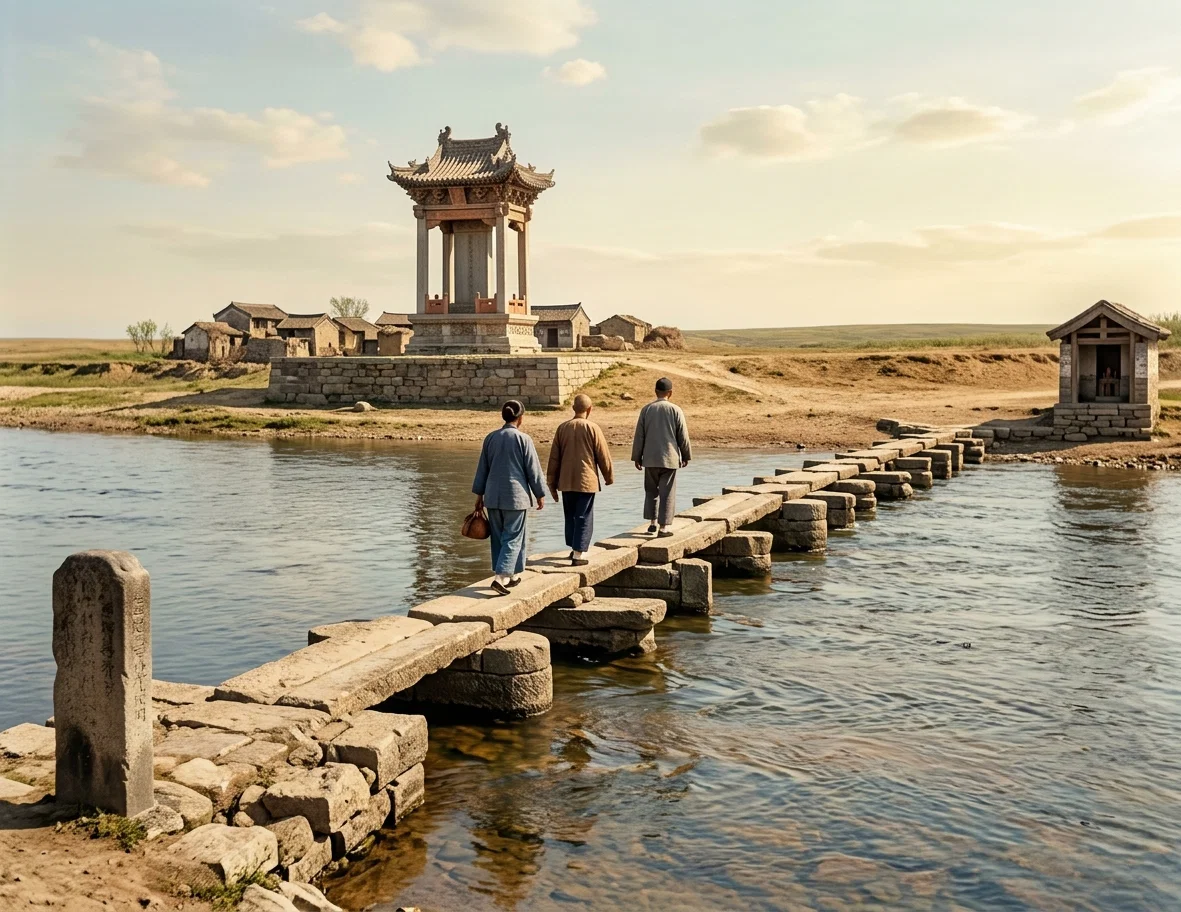
The next morning we resumed our journey, having a distance of thirty miles to drive. The roads were very hilly, and the bridges numerous. Chinese bridges are made of stone, and were all built several centuries ago, and have never been repaired. There is a rise of from six to eight inches in going onto the bridge, and a similar drop in going off. These bridges were built by wealthy Chinamen, who wished to bring their names into prominence in after generations; and with every bridge will be seen a monument, with an inscription on it bearing the name and history of the man who built it. Near a small stream which we crossed, we saw a large monument, but no bridge, as after building the monument, the man did not have enough money to build the bridge. All the rivers without bridges are crossed with ferry-boats, and this always takes a great deal of time, as the Chinaman moves very slowly.
We arrived at our station at sundown, and lodged in another inn similar to the first. We were quite chilly, and the Chinamen’s feet, which are poorly clothed in winter, were very cold, so they built a straw fire, but the smoke was almost as disagreeable as the cold.
The next morning we changed our mode of travel, finishing our journey to Hankow by rail. About one half the distance is mountainous. We passed through a tunnel one-half mile long. Every few miles we passed a Chinese village, and graveyards are never out of the foreigner’s sight while in China. The location of the grave is indicated by a conical mound from one to eight feet high, varying in height according to the wealth of the occupant. The grave is not dug very deep, the coffin being placed on the ground, and dirt thrown over it. A great many men are needed to carry coffins, as they are very large and heavy, being made of wood from four to six inches thick.
Many small temples are to be seen along the road, filled with idols, and the pagoda affords a striking spectacle to the Occidental. These structures are usually built seven or eight stories high, with no windows or stair steps. The Chinese claim they are a protection against the evil spirits, and have them in or near the graveyard, although they are found in other places.
We see nothing recently built in China; everything is in decay. There are no new cities, walls, roads, or pagodas. They have lost the spirit of enterprise and patriotism. One of the ancient classics of the Chinese has a proverb, “May it rain first on our public fields, and afterward extend to our private ones.” This was true of the people before and during the Chou dynasty; but to-day the Chinaman has changed: “I must look out for myself,” and if he thinks of the government, he says, “It is old enough and strong enough to take care of itself without my help.”
The Chinese not only feel no interest in public property, but if it is unprotected and available, they will appropriate it to their own use. The walls that are crumbling they carry away to build their own houses.
Hankow is the great commercial center of China. The foreign portion of the city has been built during the last decade. It is the Chicago of China, located on the Yangtse Kiang River, which puts it in easy communication with Shanghai on the coast; and this river and the Han River, which joins it at Hankow, connects it with Western China. The railway between Hankow and Peking is nearly finished, and the one between Hankow and Canton is in process of construction.
The city has all the modern improvements except the street-car, which is not needed; for there are plenty of comfortable jinrikishas, and coolies to draw them.
The improvements are not made with machinery, but by hand labor. Pilings are driven by a company of Chinamen, and by raising a large stone and allowing it to drop on the pole. The iron-roller is drawn by thirty Chinamen, instead of by a steam-engine.
As you pass from the wide, roomy streets of the foreigners into the narrow, crowded streets of the Chinese city, a great contrast is noted. These streets are choked with every form of industrial obstruction; the butcher, the barber, the itinerant cook with his travelling restaurant, the carpenter, the cooper, the tailor, and countless other workmen station themselves by the side of the small passage which beats with the life of a great metropolis, and do all they can to form a strangulating clot. The tanner spreads his hides in the street, the women bring out their quilts and spread them, for they have no room in their own close quarters. Nearly all that the Chinese do is done on the street.
Nor are all the obstructions of a movable character. The carpenter leaves a pile of huge logs in front of his shop. The dyer hangs up his long bolts of cloth to dry, and the flour dealer his strings of vermicelli. These all hang across the principal thoroughfare; for they claim the space opposite their shops. On account of the large number of people walking in both directions, especially coolies carrying luggage, the passenger makes very slow progress, and comes in direct contact with Chinamen.
But in this vast number of people crowded together, we must stop to think about the gospel which is to be given to them in this generation.
The reader would comprehend better the work to be done in China if he could have a view of the average farmhouse family grouped together. There are enough people at every farmhouse for a good congregation. The farmhouses are especially numerous on the great plain, where we are located. The Chinamen in the country seldom sit down to take their meal, but stand around the stove while eating the contents of their bowl.
CHINESE BRIDGE, SHOWING THE MONUMENT
A greater work is needed in China than ever before, and a greater work than man can do. Let all our people in America pray God that his Spirit may be poured out in these last days upon China.
LARGE AND SMALL PAGODAS FOR TRANSMISSION OF SPIRITS
OF THE DEAD
LARGE AND SMALL PAGODAS FOR TRANSMISSION OF SPIRITS OF THE DEAD

The European General Conference, 1903

GUY DAIL
The tabulated report of the European General Conference for the year 1903 lies before me. The various unions have sent in their latest corrections, and the summary given is, we believe, reasonably correct.
The area of this field is six million square miles, including German East Africa and excluding Siberia, and its population is four hundred and seventy-three million. There are three union conferences and two union missions in our territory,—the German, the British, and the Scandinavian Union Conferences, and the French-Latin and Oriental Union Missions.
We have 276 churches, with a membership of 8,274; 105 companies that are unorganized, with 892 members; and 381 isolated Sabbath-keepers, making a total of 9,547 members in this field. About seventy of these are Sabbath-keepers in the Oriental Mission, who have not yet been baptized. During the year, the Rhenish and Prussian Conferences have been added to the fields of the German Union, and the Spanish and French-Belgium Missions to the French-Latin Union. At the end of 1902, our membership was 8,274. During the twelve months following, 1,373 were baptized, and 495 were added by vote, and the net increase for the year was 1,273.
Our tithe for 1903 amounted to $68,650; annual offerings, $9,770; First-day offerings, $1,380; Sabbath-school donations, $5,079; the items for the corresponding time in 1902 were as follows: Tithe, $59,010; annual offerings, $2,570; First-day offerings, $828; Sabbath-school donations, $4,240. There has been some increase in our gifts and tithes, the amount of tithe per capita increasing about sixteen cents during the year.
At the close of 1903 there were engaged in our five union fields 70 ministers, 37 licentiates, and 106 Bible workers, or one gospel worker for every 2,216,000 of the population. Certainly there is still room for more workers. There were 450 canvassers in the field, and their sales amounted to $115,130. During 1902, 323 canvassers were in the field, and the sales amounted to $102,650.
In view of the greatness of our needs, and the millions upon millions who know nothing of the special work God will do to prepare the world for his soon coming, we request our brethren in America to keep the European field before God in their prayers. Remember especially the newly entered mission in German East Africa, and the work of our brethren in all our other mission fields, where the work is hard, and things often seem to go more slowly than we would like, because of the difficulties that prevent a rapid progress.
We are cheered with the knowledge that God is doing a mighty work, and we rejoice that the time of waiting will not be long. The first quarter’s reports for 1904 show signs of constant advancement. Those who are willing to deny self and live for others, will never lack plenty of work to do; such ones will always find that God has employment for them. Men of the right kind are scarce; but God has them somewhere, and as soon as we more fully awake to our high privilege, there will be plenty of the right kind of men, and there will be enough means in the treasury to complete the carrying of the glorious third angel’s message to the world in this generation. However, he who is not willing to forsake all that he has can not be the Lord’s disciple. Luke 14:33.
Hamburg, Germany.

Progress of the Message in Rome

CHAS. T. EVERSON
Our meetings in Rome have been in progress now a little over three months, and already some results begin to appear, although the ground here is naturally so strongly contested by the papacy. Here the forces of the papacy are most perfectly organized, and number legions. It is estimated on good authority that in this city there are about sixty-five thousand prelates, priests, nuns, and monks. We can readily understand that with this immense army so well organized, the Church of Rome is able to present a strong opposition to all Protestant efforts to evangelize the people. To this large force of workers new ones are continually being added from the orders that are driven out from France, so that new convents and monasteries are springing up very rapidly. With such a large corps of workers to watch all the movements of the Protestants, we can well understand that nothing escapes their attention. Therefore, as we noted in a previous article, we had just presented the Sabbath question when a priest took up a consideration of the subject in one of the leading churches of Rome. Yet in spite of all the opposition, the third angel's message must be given at “the seat of the beast,” that here also a people may be gathered out who shall be ready to meet the coming King.
Already some are beginning to recognize the claims of God's law in this city. It is very difficult to get a settled congregation in a place like this, but for the preaching of our message that is absolutely necessary. We have now a number that come to almost every service, and seem much interested. After we had placed the Sabbath question before the people in a thorough way, we began our regular Sabbath services at the hall. These have now been in progress about five weeks.
Thus far, as a result of our work here, ten have begun to keep the Sabbath of the Lord. The young minister that we mentioned in a former article as being the first-fruits of our work here, is growing rapidly in the truth, and seems like one who has known the message for several years, instead of a few months. He continues to be of great service to us in the work, preaching two or three times a week.
Another one of those who have begun the observance of the Sabbath is a gentleman who has been for many years a leading member of the Methodist Church, where he was also a member of the consistory, and has made an extensive study of the Bible. Among those that have recognized the claims of God's law is a very intelligent man; we believe that he will prove of value to the work in Italy. He was brought up in the Catholic Church, studied for the priesthood, and was consecrated priest when but a very young man. In the Church of Rome no one can say mass until he is twenty-four years of age, but this man, because of his exceptional talents, received a special permission directly from the pope to say mass when but twenty-two years old. He also received a yearly allowance from the church that he might prosecute his studies at the great Jesuit seminary at Rome. He was thus enabled to obtain a splendid education, so that he first obtained the degree of bachelor of philosophy, and later took the degree of doctor of theology.
After finishing his course he became a professor in one of the seminaries of Rome. Before leaving the Church of Rome, he became a canon, an office that ranks next to a bishop in that church, and was also one of the leading priests in one of the large churches of Rome. We can see by this that he was highly favored by the Catholic Church, and was well situated both for salary and position when he left the Church of Rome. He left it all when he became convinced that the doctrines of the Catholic Church are contrary to the truth. He spent two years studying Protestantism while a priest, before he finally decided to abandon Catholicism, and now he has begun the observance of the Sabbath, and attends our services regularly, and is present at the Bible studies that I am giving daily at our home. His wife also has begun to walk in the commandments of the Lord. She is from a fine family, her father having been a leading lawyer. This ex-canon has not only left a good position in the Church of Rome for the truth, but has also been disinherited by his parents. He has been offered positions by the other denominations, but has refused, owing to his belief in this truth. There are a number who come to the services, including the Sabbath meeting, who have not as yet expressed their decision. Among them is a young professor who is here attending the university; he seems much interested in the subjects presented, and attends almost every service. The Lord is blessing the presentation of his message in Rome, and to him be all the glory.
Rome, Italy.

The Work of Christ for Men

‘THE work of Jesus Christ for men is the concern of each member of his body. Here there is no reason why the left hand should not know what the right hand does.

East Michigan

SABBATH and Sunday, June 4 and 5, I spent with the little company at Mt. Forest that had come into the truth under the labor of Brother Wood and Brother and Sister Lauda. We held our Sabbath meeting on the bank of a small stream, in which we baptized twelve honest souls at the close of the services. The next day one more was baptized. The Lord blessed in the meetings there, and the brethren are of good courage to go forward and do the Lord's work.
From the tenth to the thirteenth we had the privilege of being with the Edenville church. The Lord came near in these meetings, and all present were blessed. We were glad for the privilege of burying seven at this place with their Lord by baptism. These were mostly the fruit of the good church-school held there the past year. Does the church-school pay? The church at Edenville says Yes. A. R. SANDBORN.

India

CALCUTTA.—There are many encouraging things connected with the work in India. I believe we are on the eve of a great move in this land. There never was a better time to work here than now. Peace reigns in every part, and railways are plying into every corner. According to last year's statistics, there are twenty-six thousand miles of railway in this country. Is not this an evidence that the time has come to warn the people? They are getting aroused through the distribution of our literature, and especially through the circulation of the Oriental Watchman, which is higher now than in any previous year at this season. We hope to reach a circulation of five thousand this year.
Last week I received a well-written manuscript from a gentleman living in Agra, dealing with the Eastern question. I was surprised to see how this man handled the subject. If I had not known the circumstances, I should have said he was a Seventh-day Adventist. He dealt with the question in a very able manner, and in such a way as to convince the reader that he was acquainted with his subject.
A native man in southern India has begun translating some of our tracts into the Canarese language. He has already translated, and printed the following tracts and articles from the Oriental Watchman, in a neat tract form: “Turkey in Prophecy,” “Christ’s Second Coming,” “The Coming of the Lord,” and “Russia in Prophecy.” I do not know when anything gave me more inspiration than these tracts, so nicely and neatly printed at this native brother’s expense. I quote the following from his letter:—
“We have but a short time to work for the Lord, and to give the message for this time to the world; for the coming King is surely at the door. We must give the trumpet a certain sound, and tell the people to prepare to meet their God.”
Such work as this by a man who has never seen one of our people shows clearly that there are forces in preparation to carry this message that we know not of, and unless we arouse and do the work appointed to us, others will be raised up to carry it forward. May God give us health and strength to do our part in this work. And more than all, may he give us his Holy Spirit, that our message may have power with the people. J. L. SHAW.

F. W. FIELD

Japan

Tokyo.— Since my last report, the work in this field has made steady progress. I recently spent a week in Kobe in the interests of the work. The little congregation there now numbers thirty or more, and they have found it necessary to rent larger quarters for their meetings. The medical work is progressing in an encouraging manner. Brother Kawano, recently from America, will unite with our native physicians in their work. Five of the brethren are engaging in the canvassing work, with Kobe as headquarters. One has gone to the northern coast, another to his home province in Shikoku. Thus the seeds of gospel truth are being scattered.
Brother Matsukura has recently been laboring in the country district east of Tokyo. Opposition to Christianity is especially strong there; but some encouraging openings were found. One man over seventy years old, and a Christian for about twenty years, has been reading our Japanese papers for two or three years. As a result of Brother Matsukura's visit, both he and his wife decided to observe the Sabbath. But the tobacco habit has a strong hold on him, and he has not yet the victory over it. His wife fully decided to be free from this hurtful indulgence. The Lord truly worked upon their hearts. One more has fully accepted the truth here in Tokyo, being led to seek the Lord through deep affliction in the loss of his wife and only child. The Kobe workers report that a young man in Kiushu has become deeply interested through reading. It has encouraged us very much to learn that a young person of little education and no previous knowledge of Christianity could gain such an experience as he relates, from the reading of our little paper. It is truly a miracle of God's grace.
Several of our young men must pass their military examination this summer, and we are much concerned for the outcome. But God has shown himself able and willing to work for us in these matters, and we are still trusting in him. Truly, these times call for a full consecration and much prayer.

F. W. FIELD

China

HONGKONG.— Since the middle of October, Mrs. Wilbur and I have each studied Chinese two hours a day, without interruption. I am now studying Mark's Gospel in Cantonese colloquial, and enjoy it very much.
During the winter most of the British fleet on the China station have been in Hongkong. Very few of the men have any desire for religious reading. Out of five hundred men on one ship, there may be half a dozen earnest Christians. Even these are warned against us by other ship missionaries here and in Shanghai. Still an occasional one “breaks over the line,” and comes up to see us. Once a man becomes interested in the truth, he is not content until he has purchased a good collection of our books. I often think of the words of Eze. 13:18: “Will ye hunt the souls of my people, and will ye save the souls alive that come unto you?”
If we are permitted to go back to Canton, we can begin to work at once. I have the Canton dialect well enough now so I can sell literature, give Bible readings in a quiet way, visit in the homes, dictate letters, etc. Many of the characters that we have learned so far are colloquial—absolutely necessary for talking here, but of no use in north China. Elder and Mrs. Anderson wish us to join them in Canton. We shall be glad when it is our privilege to return. Though the streets there are narrow and dirty, while here they are broad and clean, and it is not so pleasant a place in which to live as Hongkong, that is the gateway to the thirty million of the Quangtung province.
Hongkong is one of the great waterways of the world. I wish our successor in the work here might be supplied by some friends at home with a good club of our papers, so that he could place them regularly on the principal mail steamers. I have not been able to do anything at this, although I have personally ordered and paid for one hundred periodicals a month the past year. I have sold on an average a little over two thirds of these, and given the remainder away. The periodical work has taken considerable time, and there has been some expense connected with it, besides a good many sneers and jeers; nor have we been permitted to see much fruit from it. But the Lord has said, “Cast thy bread upon the waters: for thou shalt find it after many days.” Eccl. 11:1. Though we do not see fruit, we know that his word will not return unto him void. So I have tried to be faithful in the work, though it seems we ought to have done ten times as much as we have.
Our Chinese teacher seems much interested in the truth. He has been teaching us a year. Little by little he has been learning the truth, and I hope that in time he will fully take his stand with us. He has had experience in editorial work on a Chinese daily, and is a practical school-teacher of Chinese. Of all the Chinese teachers employed in the public schools of Hongkong, this man is the one selected by the board of education when they wish anything written out in proper “book language.”
My heart is in this message, and I am anxious to see it pushed forward to completion. EDWIN H. WILBUR.

Southern Jamaica

CLARENDON.—Since our report in the REVIEW of April 28, we have had our baptism, May 8, when eight precious souls were baptized. These are the first to become Seventh-day Adventists in this part of the island! We expect to have another baptism soon.
The enemy of souls is hard at work. The tempest of persecution is at its height now. Many are interested, and some expect to take their stand on the Lord’s side. Among these is a young man who has given his employer four weeks’ notice to leave his employment. His parents are determined to turn the doors against him; but he is still firm in his resolutions.
In our last report we made an appeal, after stating the situation of the place and the work, to our brethren of the home field, for one hundred dollars to help this needy field establish a little memorial building. Shall we hope in vain? “Hope maketh not ashamed.” Our company is composed mostly of women, having only five men in it, and three of them are blind. So, you see, we greatly need your help. If at the time of this writing, June 5, no one has responded to this appeal, we hope that some readers of the REVIEW will now help us. Let us not be weary in giving; for Jesus says, “When ye shall have done all those things which are commanded you, say, We are unprofitable servants; we have done that which was our duty to do.” Luke 17:10. Let us not look in vain. Contributions may be sent through the Mission Board to the president here, Elder J. B. Beckner. We are well, and of good courage.
F. HALL, A. N. DURRANT.
Continue reading: South Carolina