The Youth’s Instructor, Vol. 30, No. 28.

THE MOCKING-BIRD
Earlier text: THE MOCKING-BIRD

NEW-TESTAMENT HISTORY.

LESSON 90.—JESUS FORETELLS THE HISTORY OF THE CHURCH.

On Tuesday, the third day of the week, as Jesus entered the temple in the morning, and began to teach, the chief priests and scribes questioned him saying, “By what authority doest thou these things? Jesus, after confounding them by a single question, went on to give them a series of parables in which he set forth in the strongest light the hypocrisy and depravity of the Jewish leaders. After this he answered the questions of the Pharisees, the Sadducees, and the lawyer, in such a way that no one dared ask him any more. He also warned the people against the wicked practices of the scribes and Pharisees, and gave an instructive lesson based on what he observed in watching the people as they cast their offerings into the treasury. Before night some of the Greeks desired to see him; he spoke of his approaching death; and a voice from Heaven gave unmistakable evidence that he was the Son of God.
At the close of the day, as he was leaving the temple, the disciples called his attention to the buildings of the temple; the costly stones which composed them, and the exquisite workmanship displayed in their construction and ornamentation. But Jesus told them that the time would come when there would not be left there one stone upon another that would not be thrown down. Then they left the city and made their way over the Mount of Olives to Bethany. As they drew near the brow of the hill, they sat down and looked back upon the city and the temple. From this point they could look down upon Mount Moriah, and have a full view of the temple and all its courts. Then some of the disciples, remembering what Jesus had lately said about the destruction of the temple, came to him privately, and said, “Tell us, when shall these things be? and what shall be the sign of thy coming, and of, the end of the world?”
Then Jesus said, “Take heed that no man deceive you; for many shall come in my name, saying, I am Christ; and shall deceive many. And ye shall hear of wars and rumors of wars; see that ye be not troubled; for all these things must come to pass; but the end is not yet.
“For nation shall rise against nation, and kingdom against kingdom; and there shall be famines and pestilences and earthquakes in divers places. All these are the beginning of sorrows. Then shall they deliver you up to be afflicted, and shall kill you; and ye shall be hated of all nations for my name’s sake. And then shall many be offended, and shall betray one another. And many false prophets shall rise and shall deceive many. And because iniquity shall abound, the love of many shall wax cold. But he that shall endure unto the end the same shall be saved. And this gospel of the kingdom shall be preached in all the world for a witness unto all nations; and then shall the end come.”
Thus Jesus gave his disciples a brief outline of the history of the church from that time down to his second coming. Then, going back, he speaks of the destruction of Jerusalem; saying, “When ye therefore shall see the abomination of desolation, spoken of by Daniel, the prophet, stand in the holy place (whoso readeth, let him understand), then let them that are in Judea flee unto the mountains; let him that is on the housetop not go down to take out the things that are in his house; and let him that is in the field not return back to take his cloak.” He also exhorted them to pray that their flight might be under favorable circumstances.
Then, referring to the 1260 years of papal persecution, he says, “Then shall be great tribulation, such as was not since the beginning of the world to this time, no, nor ever shall be. And except those days should be shortened, there should no flesh be saved; but, for the elect’s sake those days shall be shortened. Then, if any man shall say unto you, Lo, here is Christ, or there; believe it not. For there shall arise false Christs, and false prophets, and shall show great signs and wonders; insomuch, that if it were possible, they shall deceive the very elect. Behold, I have told you before. Wherefore, if they shall say unto you, Behold, he is in the desert; go not forth; behold, he is in the secret chambers; believe it not. For as the lightning cometh out of the east, and shineth even unto the west; so shall also the coming of the Son of man be. For wheresoever the carcass is, there will the eagles be gathered together.
“Immediately after the tribulation of those days shall the sun be darkened, and the moon shall not give her light, and the stars shall fall from heaven, and the powers of the heavens shall be shaken; and then shall appear the sign of the Son of man in heaven; and then shall all the tribes of the earth mourn, and they shall see the Son of man coming in the clouds of heaven with power and great glory. And he shall send his angels with a great sound of a trumpet, and they shall gather together his elect from the four winds, from one end of heaven to the other.”

QUESTIONS.

1. How did the priests and scribes question Jesus when he began to teach in the temple on Tuesday morning?
2. How did he silence them?
3. What parables did he then give?
4. What was the nature of these parables?
5. What questions did he afterward answer?
6. What warning did he give the people?
7. What instructive lesson did he teach?
8. Who sought an interview with him?
9. Of what did he speak?
10. What evidence was given to show that he was the Son of God?
11. To what did his disciples call his attention, as he was leaving the temple at the close of the day? Matt. 24:1; Mark 13:1; Luke 21:5.
12. What did he say about these magnificent buildings?
13. Where did they go as they left the city?
14. What did they do when they drew near the top of Mount Olivet?
15. What then lay in full view at their feet?
16. Of what were the disciples reminded?
17. What did some of them privately ask him? Matt. 24:3.
18. What warning did he first give them? Verses 4, 5.
19. What did he say about the wars that were to take place and how they were to be regarded? Verses 6–8.
20. What did he say of the persecutions that his followers would have to suffer? Verse 9.
21. What dissensions were to arise? Verse 10.
22. How would many be deceived?
23. What would cause the love of many to wax cold?
24. What precious promise did he give? Verse 13.
25. When did he say the end should come? Verse 14.
26. What is meant by this gospel of the kingdom? —The gospel of the coming kingdom of Christ, to be set up on the earth.
27. Of what did Jesus thus give a brief outline?
28. What subject did he then take up?
29. When did he say they must flee into the mountains? Verse 15.
30. What is meant by the abomination of desolation? Luke 21:20, 21.
31. What caution did he give them in regard to any delay? Matt. 24:17, 18.
32. For what were they to pray?
33. To what subject did he then pass over?
34. What did he say about the tribulation of those days? Verse 21.
35. What did he say about the shortening of these days? Verse 22.
36. What is meant by the shortening of the days? —The persecutions were very much abated just before the close of the 1260 years.
37. When did this long period of persecution terminate? —In A. D. 1798.
38. What cautions did Jesus give to prevent any from being deceived with regard to the manner of his second coming?
39. What did he say his coming would be like?
40. What wonderful phenomena did he say should begin to appear just before the close of the 1260 years? Matt. 24:29.
41. When did these signs take place? —The sun and moon were darkened in 1780; the stars fell in 1833; the shaking of the heavens is yet to come.
42. What is to take place immediately after these signs are fulfilled? Verse 30.
43. What will Jesus do at his coming? Verse 31.

HOW A SPIDER GETS OUT OF PRISON.

Much amusement and information in regard to the habits and structure of spiders can be given to one or more children by securing a stick upright in a dish of water, placing on it a spider. Allow the dish to stand in a draught of air, with some article of furniture near, upon which he can throw his web when he finds that is the only way he can escape from the prison. His antics in trying to get away from the pole—which to him is not a liberty-pole—are very funny to watch. He will stretch out one foot, and when it touches the water, he will shake it as pussy does when she walks in the wet grass. After several unsuccessful attempts to effect an escape, he will scamper to the top, and begin to whirl around like a spinning wheel—as he is, inside—then throw out a line, and as soon as the air has carried it to a resting place, he will begin to try its strength—as an elephant does a bridge that crosses a stream and he fears will not bear his weight—first with one leg and then the other; if not strong enough, he goes back—not as the elephant, through the water—but to send from his body a little more material to make it secure; and when the bridge is completed he will scamper across, delighted with the liberty he has earned.—Sel.

VACATION-TIME

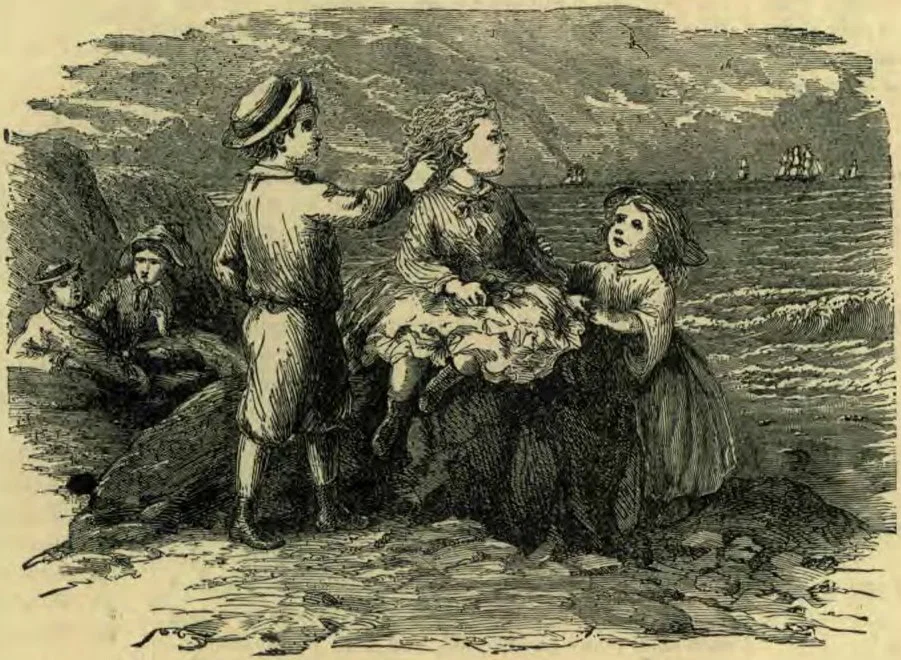
All the year Fred and Gracie Somers were promised that if they would be good children and learn their lessons well, they should go with their mamma to the sea-shore when the long summer vacation came. Well, they tried so hard to be good, that the promise was kept to them, and the next week after school closed, they went with their mother and little sister Ethel to spend a few weeks in a pleasant cottage by the sea.
And what fine times they did have! The children had never seen the ocean before, and never tired of playing on its shore, and of watching the ships and boats going to and fro over the waters. There was a great rock down by the sea where they would often sit when the tide was out, and there they would watch the ships, and wonder where they were going, and who were in them, and wish they too might go sailing away over the great deep. Then they would wander along the sandy beach, and gather the bright seaweeds and beautiful shells which the waves had washed ashore. These they carefully saved to take home with them. At other times they would amuse themselves for hours by building sand houses and forts, and drawing pictures in the sand with a stick; and then when the tide came in, watch the waves creep up slowly, little by little, until all their work was washed away. But the children did not feel bad at this, for they knew when they built their houses that it would come; and so that was the part of the fun which they enjoyed most.
There was an old fisherman who lived in a little hut down by the sea, and with him they soon became good friends. He told them many things about the grand old ocean, which he loved so well; and sometimes when the sea was smooth, he would take them out a little way in his boat. He was a very kind old man, and their mother always felt safe about them when they were with him. So the summer passed, and the children grew strong and rosy; and when papa came for them, the first of September, you would not have known them for the pale little city children that came to the sea-side in July.
Well, vacation-time has come once more; and all over the land, in dusty cities, and in quiet country homes, the children are wondering how they shall spend it. Probably some of you will go to the sea-side, or to the mountains, as so many people do; but quite likely most of you will just stay at your own homes through all the hot summer. And maybe some of you will feel very sorry and unhappy because you cannot go away, as some of your school-mates do, and will think that because you do not go, you cannot have any good times this vacation.
But children, let me tell you that is not true. If you are happy and cheerful, and try to be helpful to those around you, you can have a good time almost anywhere. Your mother will get very tired these long hot days, and if you will see how much you can help her, I think it will make her happy and you too. Do cheerfully all the little chores she asks you to do, and save her all the steps you can. Take pains to amuse your younger brothers and sisters, and some bright day perhaps you can all take your dinners and go to the woods and have a nice time. If you use your vacation in this way, it will seem all too short, and who knows but you will have a “good time” too? Then when school commences again, your mother will miss you instead of being glad to have you gone to school.
E. B.

SATAN'S CHAIN.

Do you ever think, boys and girls, that each sin indulged in is one of Satan's links which he is sure to slip into the chain by which he will hold you? Satan delights to see those chains lengthen day by day, for they are thus binding you the more surely for him. You must watch every day and hour if you do not want him to hold you. We must beware of the little hidden sins, for Satan's small links are often the most dangerous because we do not notice them.
There is another thing to do, and that is, pray. God is stronger than Satan. If we get the Lord's help every day, we shall be able to keep Satan from adding to the chain, and to loosen those links that are already around us. We must not think the least evil too small to pray about or to watch against.
Then, if you are to keep free from this chain which brings so much trouble and sorrow, you must remember to watch and pray.

HOW TO BE A MISSIONARY.

“Mother,” said May, one morning, “I wish I could be a missionary, and teach the poor heathen to read the Bible.”
“You need not go to heathen lands to do that, May. There are people in this town who cannot read. Suppose you were to be a home missionary, and teach little Tom Briar to read and spell?”
“Oh, do you really think I could?” cried May.
“Yes, indeed! If you would be patient and give up a little of your play-time, I am sure you could.”
May was delighted with this plan, and went at once to tell Mrs. Briar, who was very glad to have Tom learn his lessons. Every day after that found the little teacher and scholar hard at work in the pleasant library until Tom learned to read. Then May gave him a Bible of his own.
May was a true missionary; and she told her mother, when the summer was over, that it was the happiest one she had ever spent.—The Sunbeam.

CRADLE SONG.

SLEEP, little baby of mine, Night and the darkness are near, But Jesus looks down Through the shadows that frown, And baby has nothing to fear.
Shut, little sleepy blue eyes; Dear little head, be at rest; Jesus, like you, Was a baby once, too, And slept on his own mother's breast.

CATCHING A SUNBEAM.

Look at the baby sitting so still, Close to the nursery window-sill, With dimpled smile on his rosy face, And hands held up with a childish grace, As he tries to catch, on his flannel red, The light which gleams on his curly head.
For though the blind is closely drawn, The sun has shone since early dawn, And through a crack now takes a peep On Harry, just roused from his peaceful sleep; So the dear little fellow, with innocent glee, “Catching a sunbeam” here we see.
Will he succeed? I hope he may; And though now doing it only in play, Yet when he is grown to be a man, If he catches life's sunbeams when he can, He will find that pathway easier trod We all must tread on the way to God.
So happy and bright may he ever go, With blessings to follow him here below,— Loving and loved with a faithful heart Manfully bearing on earth his part,— Catching the sunbeams on his way, Till life is merged in the perfect day.
—Ellen Isabelle Tupper.

You have reached the end of this edition.

The Youth’s Instructor · Jul 12, 1882