Chapter XIV—The Carboniferous Age: the Earth's Vegetation before the Flood
§149. “BEFORE the flood there were immense forests. The trees were many times larger than any trees we now see. They were of great durability. They would know nothing of decay for hundreds of years.”—“Facts of Faith,” page 80 “There were evident tokens of decay, but the earth was still rich and beautiful in the gifts of God’s providence. The hills were crowned with majestic trees supporting the fruit-laden branches of the vine. The vast, garden-like plains were clothed with verdure, and sweet with the fragrance of a thousand flowers. The fruits of the earth were in great variety, and almost without limit. The trees far surpassed in size, beauty, and perfect proportion, any now to be found; their wood was of fine grain and hard substance, closely resembling stone, and hardly less enduring.”—“Patriarchs and Prophets,” page 94.
§150. These words, some of them written years ago, state facts which to-day scientists have proved to be the truth. Men have long known that the prehistoric vegetation was of immense proportions, but only recently has it been confirmed that the woody texture of many of those trees was so close-grained as to resemble stone. Professor Bailey, in an able paper upon this subject, shows from specimens of anthracite coal, that it is of vegetable formation, the fibers of which are so compact as to be but one four-thousandth of an inch broad; that is, the grain of that wood was so fine and firm that it would require four thousand of the fibers composing it placed side by side to measure one inch. Professor Dawson reports the same thing in his experiments with bituminous coal.
§151. When we consider that our present coal-beds are the accumulated deposits of the vegetation existing upon the earth at the time of the flood, we get some idea of the vastness of those immense forests. It is estimated that if all the forests in the United States to-day were gathered together into one place, they would not make a coal seam equal to the one known as the Pittsburg Field, in Pennsylvania.
§152. Wood—and the same is true of all vegetable tissue—is composed principally of carbon, hydrogen, and oxygen in nearly equal proportions. If we take from this wood a large proportion of the oxygen, and compress together the remaining carbon and hydrogen, with various degrees of pressure and heat, we shall have coal in its different forms and varieties.
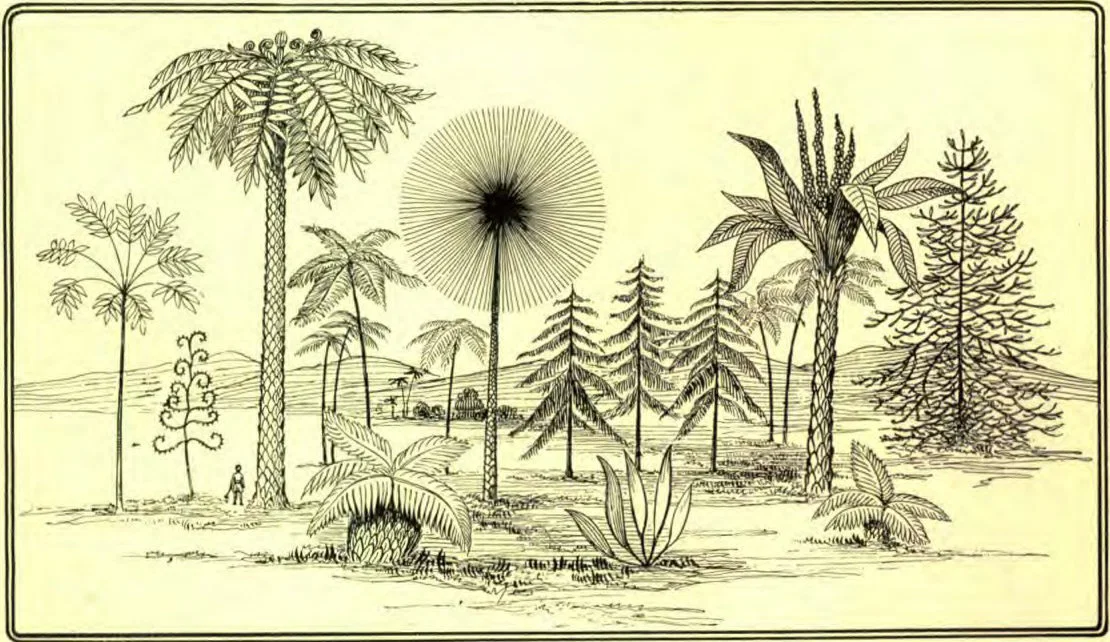
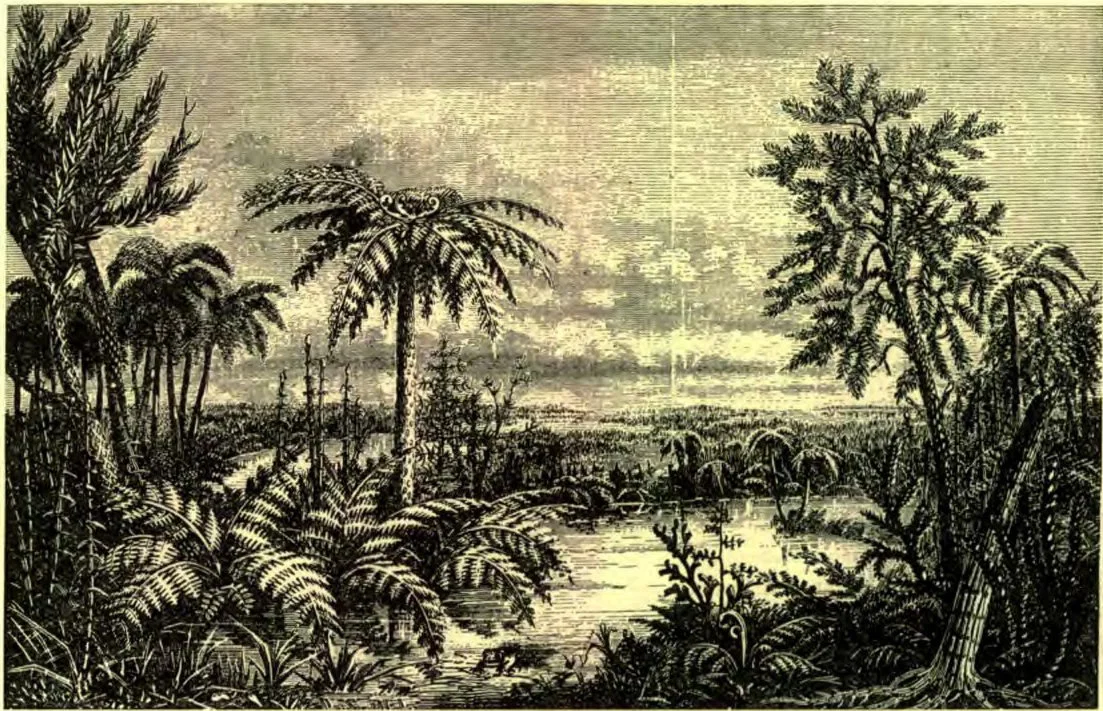
§153. By a careful study of our coal deposits we learn many interesting facts concerning this earth’s climate and vegetation before the flood. The hills and plains were not then largely barren, as now; but were profusely covered with a beautiful, varied, and stately vegetable growth. In the foreground, also to the left, in the accompanying illustration, we have reproduced some of the kinds of foliage that grew within what we now term the temperate zones; in the background, and to the right, appears the class of vegetation that then covered the polar regions, which were not then the frozen, dreary wastes they now are. (See sections 47 and 53.) Specimens of the vegetation of the torrid zone appear in the second illustration.
As far north as geological explorations have been carried, the strongest proofs of a once luxuriant vegetation occur. Even in Norway, the Spitzbergen coal contains specimens of petrified tropical fruit.
§154. In the description given in “Spirit of Prophecy” of the Garden of Eden,—that portion of this earth on which the curse never fell,—we find the following: “There were trees laden with luxuriant fruit, of rich fragrance, beautiful to the eye, and pleasant to the taste, designed of God to be food for the holy pair. There were lovely vines, which grew upright, laden with their burden of fruit, unlike anything man has ever seen since the fall. The fruit was very large, and of different colors, some nearly black, some purple, red, pink, and bright green. This beautiful and luxuriant growth of fruit upon the vine was called grapes. They did not trail upon the ground, although not supported by trellises, but the weight of the fruit bowed them down. “It was the happy labor of Adam and Eve to form beautiful bowers from the branches of the vine, and train them, forming dwellings of nature’s beautiful, living trees and foliage, laden with fragrant fruits. Earth was clothed with beautiful verdure, while myriads of fragrant flowers of every variety and hue, sprung up in rich profusion around them. Everything was tastefully and gloriously arranged. In the middle of the garden stood the tree of life, the glory of which surpassed all other trees. Its fruit looked like apples of gold and silver, and was to perpetuate immortality.”
§155. Dr. Buckland, in the “Bridgewater Treatise,” in describing the foliage that existed before the flood, as now found in many coal-mines, says: “The most elaborate imitation of living foliage on the painted ceilings of Italian palaces, bears no comparison with the beauteous profusion of extinct vegetable forms with which the galleries of many of our coal-mines are overhung. The roof is covered as with a canopy of gorgeous tapestry, enriched with festoons of most graceful foliage, flung with wild, irregular profusion over every portion of its surface. The effect is heightened by the contrast of the coal-black color of these vegetables with the bright groundwork of the rock to which they are attached.
§156. “The spectator feels transported, as if by magic, into the forests of another world; he beholds trees of a form and character now unknown upon the surface of the earth, presented to his senses almost in the beauty and vigor of their primeval life; their scaly stems and bending branches, with their delicate foliage, are all spread forth before him, little impaired by the lapse of centuries, and bearing faithful records of extinct vegetation, which began and terminated in times of which these relics are the infallible historians.”
§157. Yes, in a marvelous way God has preserved the exact remains of both the animals and the vegetables that inhabited our earth before the time of the flood, that we may know these things, and prepare for the time when this earth shall once more robe itself in immortal verdure,
§158. In order to grasp some idea of how superior4in size and beauty those forests were to the ones we now look upon, and how even the vegetable kingdom has degenerated beneath the curse that sin brought upon this earth, consider the fact that the small scouring-rush, called also “horsetail” and cattail,” that grows along our ditches and marshes to a height of three, or at most, six feet, then reached a height of from fourteen to sixteen feet, and was often from six inches to one foot in diameter, in place of the little jointed stem of about one-half inch, as now. The club-moss, known also as “trailing pine,” which reaches now, even in the tropics, scarcely above three feet, stood then an erect tree, forty to eighty feet high, with a diameter, at the butt, of three or more feet.
§159. The trees of those times had the characteristic concentric rings of annual growth, giving positive proof of the ever-changing seasons of those days. The accompanying illustration gives an ideal view of a secluded nook as it then was when the palms and ferns, the latter reaching a height of from forty to fifty feet, grew in profusion as far north even as the present location of Baffin’s Bay.
QUESTIONS
Let each pupil explain fully some definite fact that we learn from our coal-beds regarding the climate and vegetation before the flood.
DR. O. C. GODSMARK.
2005 Magazine St., Louisville, Ky.
A STUDY ON THE SECOND ADVENT
By W. A. Spicer
(December 29 to January 4)*
EVERY one of us ought, at a moment’s notice, to be able to give a Bible reading on the great truths of this message. We all believe that Jesus is coming soon, do we not? But are all sufficiently familiar with the Scriptures to be able to give a reason for the “blessed hope” in clear and well-defined outline?—Very likely not. We need to read the Bible continually, and think of what we read, until we can recall this or that scripture as we desire to use it. Any one of the phases of the Advent doctrine furnishes splendid material for a profitable Bible study, if all will join in heartily. Here is a suggestive program for a meeting in which the central feature is an outline covering the general subject of Christ’s second coming:—
NOTE.—Let the leader of the study call for texts to fill in the outline following. Ask first for the reference, so that all may quickly turn and follow the reading of the text. The leader will need to have an outline in mind, so as to ask questions which will suggest scriptures if the company do not readily respond. If all have been studying the subject, a variety of texts will very quickly be submitted, from which those that most clearly bring out the leading phases of the topic may be selected and placed upon the black-board (or large sheet of paper):—
(a) Promise of his coming—three references.
(b) Why he comes—two references.
(c) Manner of his coming—three references.
(d) Events associated with advent—four references. (Note how it affects righteous and wicked, and earth itself.)
(e) Influence of this hope on our life and work—such scriptures as 1 John 3: 3; Rev. 3: 10, 11; and others.
NOTE.—As the main texts are written down, ask questions about what they say. Bible study means a questioning of the text until exactly what is said is fixed upon the mind. Every text says a great deal more than anybody gets by a first or a second casual reading.
6. Song.
7. Five-minute Reading of Selection: Twenty paragraphs from “Great Controversy,” Chapter XL, beginning with sixteenth paragraph, “Before his presence, ‘all faces are turned into paleness,’” etc.
NOTE.—In the Scripture reading (Isaiah 52) Egypt and Assyria are mentioned. Where is Egypt? Assyria? Why should the prophet say that the Assyrian oppressed Israel in Egypt? See how many can give the reason. This query will be answered later in these columns.
8. Closing Song. W. A. SPICER.
THE BATTLE CREEK COMPANY
It has been some time since the Battle Creek Young People’s Society has reported through the INSTRUCTOR; but the work has gone forward steadily, and with many encouraging tokens. Following the recommendation passed by the General Conference Committee, the company was organized on the simple lines suggested; and up to the present, something over one hundred Membership Cards have been signed.
It is realized, however, that this part of the work, while commendable and proper, is not all that there is to this movement. The young people are to organize for service,—a service that is definite, and fraught with most solemn responsibilities. In order to ascertain something concerning the condition, aims, and desires of the members, as well as to gain a better understanding of what is being done, and the work for which the different members are best fitted, a list of questions was prepared, and a copy sent to each member, to be filled out and returned to the secretary.
A large proportion of these question blanks has been returned, and the answers set forth a number of interesting items. First, nearly all the members reporting, are, as they should be, members of the Sabbath-school, many of them bearing responsibilities as teachers and officers. A number are attending the regular missionary meeting in their district; others name definite work they are doing, and signify their willingness to devote a certain amount of time every week to various lines. Still others, whose time is so taken up as to leave little opportunity for independent work, are trying, as one of their number expressed it, to “live each day as a Christian should.” And there is no more potent means of carrying this message for Jesus than the influence of a truly consecrated life.
It is cheering to note the spirit of the younger members of the society, and their desire to work for the Master. One little boy says that he can do something, and is willing to work before and after school hours. Another young member says: “I am only a little girl, but willing and anxious to do all the Lord would have me.” That is the spirit that must fill the heart of each one who would render acceptable service.
Altogether, we take up the winter’s work with a feeling of good courage, and go forward confident that the Lord of the harvest will bless every effort put forth for love to him.
SABBATH, DECEMBER 14
THE meeting of the Battle Creek Y. P. S. on Sabbath, December 14, was one of unusual interest. It being the Sabbath for the regular “Field Study,” the first half of the hour was devoted to that, and various mission fields were presented by different members, who had studied the subjects in the Missionary Magazine. It seemed to be the general feeling that this source of information concerning the work already done in the fields abroad, as well as what is being carried forward, should be more carefully read by our young people.
Following this, Elder Daniells spoke of the coming season of prayer, and the relation of the young people to it, and to the words of their aim: “The Advent Message to all the world in this generation.” He spoke of the hope that the second advent had been to all ages; of its special meaning to us who live in the very closing hours of earth’s history; of the preparation that must be had by each one who shall be fitted to have a part in carrying this message to the world; and urged that even now the young people of this great church begin to seek God earnestly, that they may enter upon the week of prayer with his own spirit of love filling their hearts.
CORRESPONDENCE-STUDY DEPARTMENT
For the benefit of the young people, the General Conference counseled the opening, by Emmanuel Missionary College, of a Correspondence-Study Department. This will co-operate with the regular organized societies of young people. If the work of these societies is to prove successful, every member must be a missionary; and should therefore seek to improve, that he may do better work. The Correspondence-Study Department is for the hundreds of young people who can not yet leave home. It offers work in the common branches. If your former school work has been neglected, perfect yourself by study where you are. This course also offers advanced work in English, science, history, Bible, and technical studies for teachers, besides stenography and bookkeeping.
Besides acting as auxiliary to the Young People's societies, the Correspondence-Study Department has work for parents, teachers, and gospel laborers. INSTRUCTOR readers may therefore feel free to recommend it to their friends. If you are interested in this work, write to the Correspondence-Study Department of Emmanuel Missionary College, Berrien Springs, Mich.; and full details of the plan will be sent you at once.
The True Calling of the Christian
THE true calling of the Christian is not to do extraordinary things, but to do ordinary things in an extraordinary way.—Dean Stanley.
HE COMES A KING
By Mrs. P. Alderman
Go work to-day the Lord commands,
And speak my message to all lands;
Tell to the world, till Christ appear,
The glorious news that he is near.
It comes low whispering on the breeze,
It comes to me on bended knees,
I learn it from the sacred page,—
That Christ is promised to this age.
Once as the Lamb of God he came,
And brought redemption, and was slain;
But now he'll come a conquering king,
And with him hosts of angels bring.
How will the sons of men appear
When on the cloud he draweth near
Whom they despised, his word ignored,—
How will they meet the mighty Lord?
But there's a little company,
Who shout for joy their Lord to see;
With patient hope they've waited long;
Now theirs shall be the victor's song.
O, let me stand with these, I pray,
My robes washed white in that great day,
In him restored, my labors done,
When time rolls down her setting sun!
MRS. P. ALDERMAN.
THE CHESTNUT-BUR
By Companion
Three little babies in white silk robes
Lay in a cradle of green.
The cradle, with lining of satin white,
Was the coziest ever seen.
Far from the world the little ones slept,
In a castle strong and tall;
And never could passing stranger’s eye
On the precious babies fall.
The months flew by, and the babies three
Grew stronger by day and night;
And to shiny satin of nut-brown hue
Were changed their robes of white.
The fall winds blew, the castle rocked,
The cradle broke in two,
And down to the ground from a tree-top tall
Three little brown chestnuts flew.
— Companion.
A LITTLE BIRD TOLD HIM
LITTLE Mrs. Bird built her nest in the apple-tree near the kitchen door; and before her children were half-grown, Mr. Thomas Cat ate them every one. Mrs. Bird fluttered among the leaves of the apple-tree, and cried for a whole day. Then she went down into the corner of the orchard, and built another nest. But Master Tommie Spratt found it, and took all the eggs away. Mrs. Bird cried over the empty nest all day. Then she went far, far away into the woods, and built another in a thorn-tree.
One morning, while she was sitting peacefully on her eggs in the nest in the thorn-tree, she heard footsteps on the stones below. She looked over the edge of the nest with startled eyes. At first she did not know whether to be afraid or not. The creature she saw had on a very short dress, but it also wore a small, round straw hat and short hair. Mrs. Bird did not know whether it was a girl or boy. Girls were harmless creatures, she knew. Suddenly the creature jumped over a log, and whooped wildly.
“Oh me! oh me! it is a boy!” shrieked poor Mrs. Bird. She sprang from the nest, and darted through the branches around and around her nest, screaming and scolding furiously.
Foolish Mrs. Bird! Why, almost any boy in the world would have been sure, from the noise she made, that she had a nest hidden there. But this boy did not know it. He was a very young boy, far too young to be wandering in the woods alone. To tell the truth, he had run away, and, although he did not know it, he was quite lost.
The boy walked on past the tree, and, after a little, Mrs. Bird lost sight of him, and settled quietly down again. After a long time she heard a queer noise, and, peeping over the edge of the nest, she saw the boy coming back again. His hat was gone, his feet were covered with mud, his hands and face scratched with briars, and he had discovered that he was lost, and was sobbing bitterly. He was so tired and blinded with crying that he tottered as he walked, and, when he reached the tree where Mrs. Bird had her nest, he dropped in a weary, muddy little heap on the dead leaves, and fell asleep.
Mrs. Bird screamed and scolded, and darted about the tree, swooping so low that her wings almost brushed the boy’s head; but he did not hear her. Presently poor, distracted Mrs. Bird heard other strange sounds. She heard voices calling “Harold! Harold! Harold!” and the echoes caught up the words, and tossed them back and forth until the trees and rocks seemed to be crying, “Harold! Harold!” too. But Harold did not hear. He was too sound asleep. Soon two figures appeared in the distance.
“More boys! more boys!” shrieked Mrs. Bird. “Oh, my poor eggs! What shall I do?”
They were very large boys. We should have called them men, but Mrs. Bird did not know the difference. She was afraid of anything that wore trowsers and short hair, and a small, round straw hat.
Suddenly one of the men stopped, and caught the other by the arm.
“Listen, Charlie!” he cried. “Do you hear that bird scolding down yonder in the thicket?”
“Yes. What of it?” said the other.
“Something has disturbed her. It may be the boy. Let us see.”
“P-papa, how d-did you know where I was?” asked Harold, sleepily, when he awoke, a moment later, to find himself safe in his father’s arms.
“Oh, a little bird told me!” answered papa, laughing.—Sunday School Times.
THE RAVEN'S FRIENDSHIP
By Edith E. Adams
THERE is a beautiful story, or rather legend, told in Germany about the friendship and fidelity of the raven, which recalls the honor paid to that bird when it was divinely chosen as the bearer of food to the suffering prophet. In a village near Warsaw there lived a pious peasant of German extraction named Dorby. Without his fault he had fallen into arrears with his rent, and his landlord determined to eject him; and it was winter.
The tenant went to the landlord three times in vain. It was evening, and the next day he was to be turned out with all his family, when, as they sat there in sorrow, the church bell pealed for the evening prayer, and Dorby kneeled down with them, and they sang:—
“Commit thou all thy griefs
And ways into His hands.”
FAST FRIENDS
As they came to the last verse, there was a knock at the window. It was an old friend,—a raven that Dorby's grandfather had taken out of the nest, tamed, and then set at liberty. Dorby opened the window; the raven hopped in, and in his bill there was a ring set with precious stones!
Dorby was now strongly tempted. At first he thought he would sell the ring; but he thought again it could not be lawfully his. Finally he took it to his minister; and the good man, who saw at once by the crest that it belonged to King Stanislaus, took it to him, and related the story. Then the king sent for Dorby, and rewarded him, so that he was no more in need. The next year the king built Dorby a new house, and gave him cattle from his own stall; and over the house door there was placed an iron tablet, whereon6was carved a raven with a ring in his beak, and underneath this verse:—
“Thou everywhere hast sway,
And all things serve Thy might;
Thy every act pure blessing is,
Thy path unsullied light.”
EDITH E. ADAMS.
FANS
By Edgar L. Vincent
Just who first thought of fans, I do not know, and I do not think any one knows. But it is believed that the inventor, whoever he was, lived in China. I think it is quite certain that he had his home in some very warm climate, where he often felt the need of some way to make a little breeze to cool his face.
Nor are we certain by what name this man called the queer implement which he waved to and fro to stir the air about him. Our word for it comes from an old name the Romans gave to a broad and shallow basket, in which they received grain at the time of threshing, for the purpose of tossing it up into the air, so that the wind might blow away the chaff. They called their basket a vannus. We have shortened it up a little, and call it just a fan.
Probably the leaves of the palm-tree were first used for making fans, and these, you know, grow in great abundance in China and Japan, where the people use more fans than in other countries of the world; but nowadays many other kinds of material are used for this purpose. The Egyptians knew about the use of fans very long ago; for pictures have been preserved until the present, showing some most wonderful fans.
Some of the most ancient fans were used by slaves to keep flies from the table and person of the distinguished people of the East. The fans thus used were placed on the end of long poles, and waved ceaselessly back and forth. Gradually fans came to be looked upon as objects of no small importance, having a significance as emblems of authority among princes and potentates. And in Japan, fans are to this day considered indispensable in the lives of all classes.
At first fans were all of the kind which could not be folded; then some one, probably a native of Japan, looking at the wing of a bat, and noticing how nicely it would fold, thought up the plan of making fans which would do the same thing. And so for the past twelve hundred years or more, folding fans have been very popular. It was a long time before the people of Europe would use them, however, and not until they had been known in Japan several hundred years did the Western nations accept them.
From being a very simple affair, made of plain palm-leaves, the fan has developed until it is often most costly and beautiful. In France a hundred years ago fans were made which called out the work of some of the most skillful artists, goldsmiths, jewelers, and carvers of the country. These were made sometimes of satin, sometimes of gauze, tulle, parchment, or crepe, and upon them were painted most beautiful pictures. Some of these elaborate creations sold for as much as five hundred dollars.
Queen Elizabeth had a truly wonderful supply of fans, as many as twenty-seven being told of, one of which cost forty pounds, or almost two hundred dollars of our money. So many fans were brought into England from other countries in the time of Charles II, that he placed a duty of forty shillings a dozen upon them to protect the poor people who made a living in the fan factories, and it was forbidden any one ever to bring a painted fan into the country.
In the time of the revolution, fans went quite out of fashion; but since then we have greatly increased our manufacture and trade in this article. From France alone we have imported in some years fans to the value of $400,000. Ingenious machines have also been invented for the making of fans, so that thousands of persons and immense sums of money are employed in that industry.—Edgar L. Vincent.
STILLING THE TEMPEST
By W. S. Sadler
(Continued)
The Waves Beat into the Ship.— The disciples’ bark, tempest-tossed on the sea of Galilee, is a beautiful illustration of the church of Christ, storm-tossed and wave-beaten, oftentimes to human eyes in great danger. Sometimes, it would seem, it is doomed to go down; but the Master is with and in the church to-day, as he was with the disciples that night on the sea of Galilee. Though persecuted from without, and torn by dissensions within, the church will sail on to victory. There is no more danger of her light going out in darkness than there was that the bark wherein Jesus slept would sink beneath the waters.
Asleep on a Pillow.— Christ had worked very hard throughout the day, and this undoubtedly accounts for the soundness with which he slept during all this excitement. What an instance of our Lord’s humanity and divinity!—in the stern of the ship, asleep on a pillow, so worn in body that he failed to wake, notwithstanding the excitement of those on board, and the noise of the storm whose waves swept over the boat. He became weary, like other human beings; but see him a moment after he has arisen, and rebuked the unbelief of his disciples! Hear him speak the words that quiet the angry waves! Here we see his divinity,—his perfect control of all things in nature. He who keepeth Israel neither slumbers nor sleeps. What a contrast to Jonah, who slept in a boat in a time of great danger, because his conscience was dead and unresponsive. Jesus sleeps in calm repose because of a conscience pure, and a mind in perfect touch with his Father’s will. The Saviour was asleep on a pillow. While he made no special provisions for his physical comfort and need, at the same time he did not ignore these things when they were at hand.
And They Awake Him.— What can be the meaning of this indifference, or rather apparent indifference, on the part of the Master?—for truly the Lord is never really indifferent to the needs of his children in their peril. Was not this apparent indifference calculated to strengthen the faith of the disciples? Had they trusted him fully, they would not have addressed him in such words of doubt as, “Master, carest thou not that we perish?” The apparent forgetfulness on the part of God in our times of trial, temptation, or affliction, is designed to strengthen our faith and ripen our confidence,—to show us our weakness, and bring us to a realizing sense of our extremity. Then by the word of his power, he will dismiss our present fears, calm our disturbed spirits, and erect in our minds a landmark, as it were, of loving watchfulness over us when tempest-tossed on the sea of life.
Master, Carest Thou Not That We Perish?— Oh, if they had only realized the meaning of the word “Master,” they would have no thought of perishing. If the boastful Cæsar could say that no vessel that bore him and his treasure could sink, how much more the Master of earth, sea, and sky, when the vessel had him on board in times of danger. Christ himself was tossed by the same tempest that tossed the troubled disciples. They asked of him, “Carest thou not that we perish?” But they could not perish; for Christ was with them. He in whom the fullness of the Godhead dwelt bodily was asleep407in the stern of the ship. How beautiful to think that the storms which assail us, assail Christ. The winds and the waves that blow and beat upon us, blow and beat upon Christ. In all our afflictions he is afflicted. He is with us in times of sunshine and peace; and he is with us, even though he appears to be asleep, in times of danger and peril. When Jesus embarked with his disciples, he knew there would be a storm, and yet his knowledge of the difficulties that lay in the way did not prevent his accompanying them. Through sunshine and shower the blessed Redeemer accompanies the chosen sheep of the heavenly flock. “Lo, I am with you alway,” he says. “I will never leave thee, nor forsake thee.”
W. S. SADLER.
(Concluded next week.)
WHY HE FAILED
A YOUNG man who had failed by only three points in an examination for admission to the marine corps, appealed to his Representative in Congress for assistance, and together they went to see the Secretary of the Navy in the hope of securing what is known as a “rerating” of his papers.
“How many chances do you want?” asked Secretary Long. “This is your third time.” And before the young man had a chance to answer, the Secretary continued: “How do you expect to get along in the world when you smoke so many cigarettes? Your clothes are saturated with their odor. Pull off your gloves and let me see your fingers. There, see how yellow they are!” pointing to the sides of the first and second fingers.
Before the young man found his tongue to offer an explanation, the Secretary asked him if he drank.
“Only once in a while,” was the sheepish reply.
Secretary Long then invited the Congressman into his private office, and while offering to do everything that he could consistently, added: “I am sick of trying to make anything of these boys who are loaded with cigarette smoke, and drink ‘once in a while.’ They are about hopeless.”
When they left the department building, the young man, half apologizing for his poor showing, remarked: “Drinking, my father says, is the bane of the navy.”
“I guess it is,” replied the Congressman, laconically.—Selected.
GOOD THINGS FOR BOYS TO REMEMBER
That it takes more than muscle to make a man.
That it requires pluck to be patient.
That selfishness is the most unmanly thing in the world.
That consideration for mother and sister does more to mark a gentleman than the kind of necktie he wears.
That the only whole man is the holy man.
That to follow the crowd is a confession of weakness.
That one real friend is worth a score of mere acquaintances.
That to be afraid of one’s noblest self is the greatest cowardice.—Selected.
“STILL WITH THEE”
By Frances R. Havergal
Another year is dawning!
Dear Master, let it be,
In working or in waiting,
Another year with thee:
Another year of leaning
Upon thy loving breast;
Of ever-deepening trustfulness,
Of quiet, happy rest;
Another year of mercies,
Of faithfulness and grace;
Another year of gladness
In the shining of thy face;
Another year of progress,
Another year of praise,
Another year of proving
Thy presence all the days;
Another year of service,
Of witness for thy love;
Another year of training
For holier work above.