The Youth’s Instructor, Vol. 29, No. 25.

THE PITCHER PLANT

The Youth’s Instructor

Jun 22, 1881

S. D. A. Publishing Association · Battle Creek, Mich. · Jun 22, 1881

THE PITCHER PLANT.
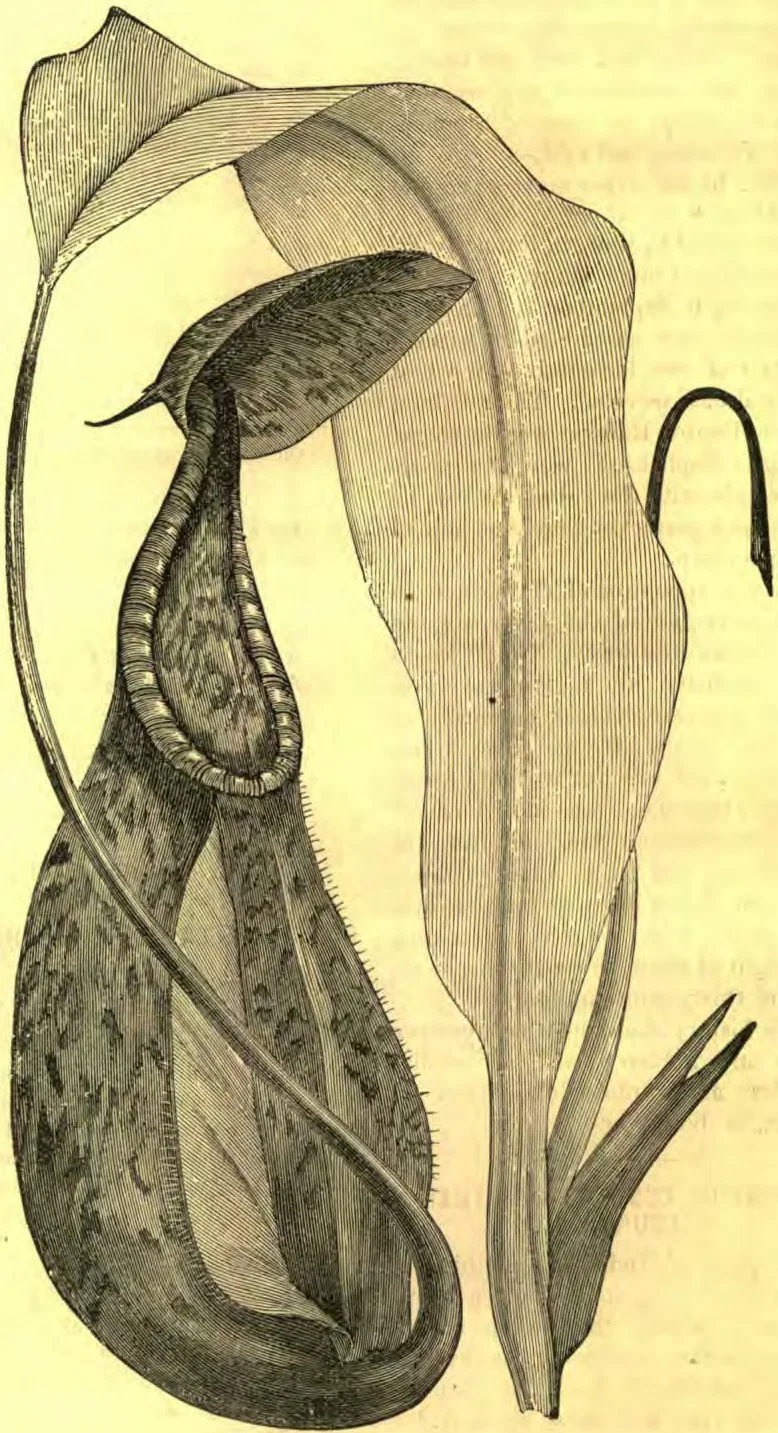
Certain plants and trees which spring up in dry and sunburnt soils have the wonderful power of secreting pure water for the use of birds and animals, and even human beings who reside in or pass through these regions. The most remarkable is the Pitcher Plant.
From the end of each of the large leaves there hangs a pitcher with a lid moving on a hinge. The lid is wide open when the weather is moist, and shut up quite close when it is dry. In each of these pitchers is about a pint of pure water, which is not received from the summer shower, or from without, but is distilled from within the plant itself. When full of water, the pitcher might turn over from the weight, and its contents be spilled; but behind the lid there is placed a little hook, which, with marvelous sagacity, catches hold of some twig or tendril, and thus obtains the required support.
What a wonderful and merciful provision of Providence is this for the benefit of the creatures which live in or pass through those regions of Southern China, India, Africa, and other tropical countries, in which, during a portion of the year, the streams are dried up! The following story well illustrates this:—
“Two brothers who were traveling in South America, one day found by the roadside a little monkey which had broken one of its legs. The elder brother immediately with his handkerchief and a small stick bound up the broken leg, and taking the small creature in his arms, went on his way. Though sharply ridiculed by the younger for wasting his time and strength on ‘only a monkey,’ he persevered, knowing the animal would die if left to itself.
“After some days the travelers found themselves in a region destitute of water. The burning sun seemed to dry up the very blood in their veins. A whole day passed, and another, and no water was to be found. At last the younger brother threw himself upon the ground, declaring that he could go no farther; he would lie down on the hot sand and die. At this critical moment the sagacious little monkey started up and hobbled away as fast as his crippled legs could carry him, but soon returned and tried to induce his preserver to follow him. The man did so, and the monkey led the way to a large, open field, covered with the pitcher plant, each cup filled with pure, fresh water.
“With eagerness the thirsty travelers took the cooling draught, and they thanked God, then and ever after, for the means by which he had preserved their lives; for the monkey every day led them to these natural reservoirs, until they reached their journey’s end in safety.”
There are many different kinds of the pitcher plant. That represented in the picture is from a tree which grows to the height of twenty or thirty feet, and the pitchers are twelve inches long by six broad. They vary in size from these trees to the small plants with very little pitchers, specimens of which are sometimes seen in florists’ windows.

The Little Engine-Builder.

A little cottage boy, whose feet pattered upon a clay floor, and whose eyes looked up to bare rafters and unplastered walls, became in due time the inventor of the steam-locomotive, originating a speed of travel till that time incredible; and this has made his name famous throughout the world.
George Stephenson, the son of a common laborer, was born in Wylam, a colliery-village about eight miles from Newcastle-on-Tyne, in 1781. Here the little fellow used to watch the wagons, laden with coal, as they were drawn from the pit to the quay, while keeping his younger brothers out of the way of the horses. When he was eight years old, his parents removed to Dewley Burn; and George was hired by a farmer as “cow-boy,” much to his delight.
Here he had plenty of leisure, and his active mind led him to employ it in creating mimic mills in little water-courses, and in making clay engines, with imaginary steam-pipes of hemlock-stems. These were the great engineer’s first attempts at modeling.
Next he figures as a plow-boy, with advanced wages; then he becomes “picker” in a colliery; then driver of a gin-horse; and all this time “the little bare-legged boy” is on the road to wealth and usefulness.
His aim at this period is to be an engine-man, which hope he realized when about fourteen years old, receiving a shilling a day for his services; and when, not long after, he received twelve shillings a week, he felt, as he expressed it, “a made man for life.”
“His engine becomes a sort of pet with him,” says his biographer, Smiles. “He studies its working, and masters it perfectly.”
And now commences his struggles with and gradual triumph over many difficulties. His father, a hard-working man, could not possibly afford, with the wages of a common laborer, the expense of his schooling, and George could neither read nor write. But he is determined to learn, and his resolute will soon finds a way.
We now find him by the engine-fire, listening to anybody who will read to him by its light. The little knowledge he thus gains gives him an insatiable desire for more. He has learned that the wonderful engines of Watt are described in books. He is determined to learn to read, that he may study them; so, at the age of seventeen, a man in size, he goes to a night-school to learn his letters, at threepence a week. He also taught himself to write.
Next he advanced a step higher: he goes to a “Scotch dominie” night-school, and learns arithmetic, solving his problems by the light of the engine-fire. At length he has made such “wonderful advances” that his master is outstripped, and can teach him no more.
Still he goes on, improving all his leisure hours, in studying mechanics and the laws which govern the working of his engine. He makes a little money, and outdoes all the engineers of the vicinity by curing a “wheezy engine.” This gave him much repute.
He was the means of saving the lives of many at an explosion in one of the mines. As soon as he knew of the accident, he rushed through a crowd of terrified cottagers, descended the shaft, and, reaching the bottom, cried out,—
“Are there six men who will follow me?”
All had confidence in Stephenson, and under his direction, a wall was soon raised with the bricks and mortar that were at hand. This prevented the air from entering into the main, and the fire went out.
After this, he went to work to devise a safety-lamp; that is, one which will not set fire to the inflammable gases which are common in mines. He did not know that Humphrey—afterward Sir Humphrey Davy—was engaged in the same attempt. However, the lamp of Stephenson was first made public. For this he received a testimonial, and a prize of a thousand guineas. This enabled him to establish a locomotive manufactory at Newcastle, which soon became famous, and brought him great wealth.
Stephenson, when a workman in collier’s clothes, gained the respect of his associates, and was as much a gentleman as when in later life, clad in broadcloth and fine linen, he addressed large assemblies with perfect ease and self-possession. In one of these speeches at Newcastle, referring to his early career, he says, speaking of his only child, who also gained honorable distinction:—
“When Robert was a little boy, I saw how deficient I was in education, and made up my mind that he should not labor under the same defects, but that I would put him to school, and give him a liberal training. I was, however, a poor man; and how do you think I managed? I betook myself to mending my neighbors’ clocks and watches at night, after my daily labor was done, and thus I procured the means for educating my son.”
George Stephenson’s goodness is seen in his care for his aged father, providing for him when an accident unfitted him for work; and, while still an engineer at Kenilworth, he removed both his parents to a comfortable cottage.
“But were there no engines before Stephenson’s?” Yes; James Watt, about whom you have read as watching the steam lift the cover of his mother’s tea-kettle, invented the first steam-engine; but Stephenson was the first successful inventor of a traveling engine. Some had tried and failed; others had constructed engines, but none so perfect as those of Stephenson. Yet many had said,—
“Oh! he can never make an engine travel.”
But he did it, though, through perseverance and much study.
One day in September, 1825, a great multitude were assembled to witness the trial of two locomotives, the first that had ever traveled. The Stockton and Darlington Railway was the scene. George Stephenson won the prize. After this, with the aid of his son, he made more perfect engines, and gained much renown.
He was appointed chief engineer in the construction of the Liverpool and Manchester Railway. There was a very extensive bog in the way, over which the professional engineers of the day declared “no man in his senses would attempt to build a railroad.” But there was no “I can’t” with Stephenson. He built over the great bog; and on the 6th of October, 1829, he drove his own engine over this road with wagons containing a weight of about thirteen tons, at the rate of thirty miles an hour.
His history shows us what perseverance and industry will accomplish amidst many obstacles.—MARY P. HALL, in Well-Spring.

TRUST

Searching for strawberries ready to eat, Finding them fragrant, large and sweet, What do you think I found at my feet, Deep in the green hill-side? Four brown sparrows, the cunning things, Feathered on back, and breast, and wings, Proud with the dignity plumage brings, Opening their four mouths wide.
Stooping lower to watch my prize, Watching their motions with eager eyes, Dropping my berries with glad surprise, A plaintive cry I heard; And looking up at the mournful call, I spied on a branch, near the old stone wall, The poor little mother bird.
With grief and terror her heart was wrung, And while to the slender bough she clung, She felt that the lives of her birdlings hung On a still more slender thread. “Ah, birdie,” I said, “If you only knew That my heart was tender, warm and true!” But the thought that I loved her birdlings too, Never entered her small, brown head.
And so through this world of ours we go, Bearing our burdens of needless woe, Many a heart beating heavy and slow Under its load of care; But oh, if we only, only knew That God was tender, and warm, and true, And that he loved us through and through, Our hearts would be lighter than they are.

CURIOUS CUSTOMS OF OTHER COUNTRIES.

In parts of India, the clothing of the natives consists of cotton cloth, yards of which they wrap around them, leaving ten or fifteen over to wrap their heads in. The men appear to wear very loose trousers, but these are really only straight pieces of cloth, which they wrap themselves up in very ingeniously. They wear their hair in long black locks, which rest on their shoulders. There are no fashions in India; every person is free to choose the color and texture of his own garments.
In Southern India a curious law of inheritance prevails. A father cannot leave his property to his son, but it descends to his nephew.
In Sicily, time is counted from sunset; that is, at sunset it is twenty-four o'clock, and the next hour it is one o'clock.
In Bankok, a city in Siam, some of the houses are built on rafts, so that they rise and fall with the tide. There the ships are built with two large, staring eyes in front, it being thought that eyes are as necessary to a ship as to a man.
The above bits of information I have gathered from various reliable sources.
ELMER E. BURNS.

SCENES IN THE LIFE OF CHRIST.

LESSON 32.—MIRACLES IN CAPERNAUM.

The partners of Simon and Andrew were James and John. It seems that, when called to assist their friends in taking in the miraculous draught of fishes, they were in their boat mending their nets; and when they returned to the shore, they probably went back to the same work again.
Before leaving Simon and Andrew, Jesus said to them, “Follow me, and I will make you fishers of men. And straightway they left their nets and followed him.” Then, going along to where James and John were mending their nets, he called them; and the Bible says, “They left their father Zebedee in the ship with the hired servants, and went after him.” Of course the ship was nothing but a fishing-boat, and not what we would now call a ship at all; but it seems to have been the custom in those days to call any kind of boat a ship.
We may learn a good lesson from the example of these fishermen. They followed Jesus to help him in doing good, and to learn the precious truths he had to teach. Jesus calls us by his written words as truly as he called them by his spoken words. We need to leave our bad ways, our bad words, and our bad thoughts, and learn the ways of holiness. We, too, may aid in doing good. When Jesus called the fishermen, they immediately left all and followed him. Jesus is now calling us, and will we follow him as promptly?
After this, Jesus and his disciples went into the city of Capernaum, and there Jesus taught the Jews who came together to worship on the Sabbath day. A Jewish house of worship is called a synagogue, and while Jesus was teaching in one of these on the Sabbath, a man who had an unclean spirit cried out, saying, “Let us alone, what have we to do with thee, thou Jesus of Nazareth? art thou come to destroy us? I know thee who thou art, the Holy One of God.” And Jesus rebuked him, saying, “Hold thy peace, and come out of him.”
“And when the devil had thrown him in the midst, he came out of him, and hurt him not. And they were all amazed, and spake among themselves, saying, What a word is this? for with authority and power he commandeth the unclean spirits, and they come out. And the fame of him went out into every place of the country round about.”
And he arose out of the synagogue, and entered into Simon Peter’s house. Now Simon’s wife’s mother lay very sick with a fever, and her friends asked Jesus to heal her. Coming to her bedside, Jesus rebuked the fever, and taking her by the hand, lifted her up; “and the fever left her,” and she immediately went about her work, waiting upon those who had come in.
Now, when the sun had set, and the Sabbath was passed, all who had any sick brought them to be healed. This attracted so much attention that nearly all the people of the city gathered near to see what would be done. Then Jesus touched every one who was sick, and as soon as they were touched, they were well. He also cast out many devils, but would not allow them to speak, because they knew that he was Christ, the Son of God.

QUESTIONS.

  1. Who were the partners of Simon and Andrew? Luke 5: 10.
  2. What do they seem to have been doing when they were called to help take the miraculous draught of fishes?
  3. What did they probably do when they returned to the shore?
  4. What did Jesus say to Simon and Andrew before leaving them? Matt. 4: 19.
  5. What did they do when he said this?
  6. Tell how James and John were called? Verses 21, 22; Mark 1: 19, 20.
  7. What did they do?
  8. What is meant by the word ship as it is used in this lesson?
  9. What may we learn from these fishermen?
  10. Why did they follow Jesus?
  11. How does Jesus call us?
  12. What ought we to leave?
  13. What ought we to learn?
  14. How may we aid Jesus?
  15. What good example did the fishermen set?
  16. Where did Jesus and his disciples go? Mark 1: 21.
  17. What did he do on Sabbath days? Luke 4: 31.
  18. What is a Jewish house of worship called?
  19. Who broke in upon Jesus one Sabbath as he was teaching?
  20. What did the man with an unclean spirit say?
  21. How did Jesus rebuke this wicked spirit?
  22. What then happened?
  23. What did the people think when they saw this?
  24. What did they say?
  25. How did this miracle affect his fame?
  26. Where did Jesus go when he came out of the synagogue? Mark 1: 29; Matt. 8: 14; Luke 4: 38.
  27. What member of the family was sick?
  28. What disease had she?
  29. What did Jesus do for her?
  30. How did she show that she had been made entirely well?
  31. What caused nearly all the people of the city to gather around Simon’s house after the Sabbath had passed?
  32. What did Jesus do for those who were sick?
  33. What happened to them as soon as Jesus touched them?
  34. What other miracles did he perform?
  35. Why would not he allow the devils to speak?

JUNE

June comes to train the roses About the cottage door, To teach the little rills to sing Far sweeter than before.
June comes a fairy artist, To deck the hills and plains; Her pencil is the golden sun, Her brush the summer rains.
June comes in skylark's carol, In robin's song of glee, In bluebird's trill so beautiful, So tender and so free.
June comes in rippling waters, In laughing streams and brooks, In gurgling rills that hide away In grassy clover nooks.
June brings the sweetest music That ever charmed the ear, The woodland choir of singing birds That echo far and near.
June tells her tales of gladness, And drives away all grief; She writes her lessons in the woods, On blossom and on leaf.
June touches softly, lightly, The wheat tops and the rye, The barley and the clover blooms That on the meadows lie.
June builds the fairest dwellings, With every dainty rife, For butterfly and honey-bee, And all the insect life. —Selected.

NEW-TESTAMENT HISTORY.

LESSON 35.—PARABLE OF THE TARES, AND OTHER PARABLES.

“Another parable put he forth unto them, saying, The kingdom of heaven is likened unto a man that sowed good seed in his field; but while he slept, his enemy came and sowed tares among the wheat, and went his way. But when the blade was sprung up, and brought forth fruit, then appeared the tares also. So the servants of the house-holder came and said unto him, Sir, didst thou not sow good seed in thy field? from whence then hath it tares? He said unto them, An enemy hath done this. The servants said unto him, Wilt thou then that we go and gather them up? But he said, Nay! lest while ye gather up the tares, ye root up also the wheat with them. Let both grow together until the harvest: and in time of harvest I will say to the reapers, Gather ye together first the tares, and bind them in bundles to burn them; but gather the wheat into my barn.”
After this, our Lord spoke several parables illustrating the growth of the grace of God in the heart. “And he said, So is the kingdom of God, as if a man should cast seed into the ground; and should sleep, and rise night and day, and the seed should spring and grow up, he knoweth not how. For the earth bringeth forth fruit of herself; first the blade, then the ear, after that the full corn in the ear. But when the fruit is brought forth, immediately he putteth in the sickle, because the harvest is come.”
“Another parable put he forth unto them, saying, The kingdom of heaven is like to a grain of mustard seed, which a man took and sowed in his field, which indeed is the least of all seeds; but when it is grown, it is the greatest among herbs, and becometh a tree, so that the birds of the air come and lodge in the branches thereof.
“Another parable spake he unto them; The kingdom of heaven is like unto leaven which a woman took and hid in three measures of meal, till the whole was leavened.”
“And with many such parables spake he the word unto them, as they were able to hear it. But without a parable spake he not unto them; and when they were alone, he expounded all things unto his disciples.” Thus was fulfilled the prophecy which says, “I will open my mouth in parables; I will utter things which have been kept secret from the foundation of the world.”
“Then Jesus sent the multitude away, and went into the house; and his disciples came unto him, saying, Declare unto us the parable of the tares of the field. He answered and said unto them, He that soweth the good seed is the Son of man; the field is the world; the good seed are the children of the kingdom; but the tares are the children of the wicked one; the enemy that sowed them is the devil; the harvest is the end of the world; and the reapers are the angels. As therefore the tares are gathered and burned in the fire, so shall it be in the end of this world. The Son of man shall send forth his angels, and they shall gather out of his kingdom all things that offend, and them which do iniquity; and shall cast them into a furnace of fire: there shall be wailing and gnashing of teeth. Then shall the righteous shine forth as the sun in the kingdom of their Father. Who hath ears to hear, let him hear!”
“Again, the kingdom of heaven is like unto a treasure hid in a field; the which when a man hath found, he hideth, and for joy thereof goeth and selleth all that he hath, and buyeth that field.”
“Again, the kingdom of heaven is like unto a merchant man, seeking goodly pearls, who, when he had found one pearl of great price, went and sold all that he had, and bought it.”
“Again the kingdom of heaven is like unto a net, that was cast into the sea, and gathereth of every kind, which, when it was full, they drew to shore, and sat down, and gathered the good into vessels, but cast the bad away. So shall it be at the end of the world: the angels shall come forth, and sever the wicked from among the just, and shall cast them into the furnace of fire: there shall be wailing and gnashing of teeth.”
“Jesus said unto them, Have ye understood all these things? They said unto him, Yea, Lord. Then said he unto them, Therefore every scribe which is instructed unto the kingdom of heaven, is like unto a man which is an house-holder, which bringeth forth out of his treasure things new and old. And it came to pass that when Jesus had finished these parables, he departed thence.”

QUESTIONS.

1. By what figure does our Lord show that the righteous and the wicked are to live together upon the earth until the end of the world? Matt. 13 : 24.
2. What weed appeared among the wheat?
3. When the servants discovered it, what question did they ask their master? Verse 27.
4. How did he answer them?
5. What inquiry did they then make? Verse 28.
6. Why did he not wish them to pull up the tares?
7. What course did he recommend?
8. What did he say should be done in the time of harvest?
9. For what purpose did he then give other parables?
10. Relate the parable contained in Mark 4 : 26–29.
11. To what did he next liken the kingdom of heaven? Matt. 13 : 31.
12. How did he describe the growth of the mustard plant?
13. In what way does this illustrate the kingdom of heaven?—It shows how the heavenly graces may be cultivated until a character is formed that will fit one for the kingdom of heaven.
14. By what other parable did he illustrate the same thing? Verse 33.
15. How did he continue to teach? Mark 4 : 33, 34.
16. What prophecy was thus fulfilled? Matt. 13 : 35; Psalms 78 : 2.
17. When he had sent the multitude away, what did his disciples ask him to do?
18. According to the Saviour’s explanation, who is represented by the sower?
19. Who are represented by the wheat, and who by the tares?
20. What does the field represent?
21. Who is meant by the enemy?
22. What is represented by the harvest?
23. Who are the reapers?
24. How is the fate of the wicked illustrated by the gathering and burning of the tares?
25. What will be the final condition of the righteous?
26. How is the kingdom of heaven illustrated in verse 44?
27. How in verses 45 and 46?
28. What do these two parables seem to teach?—That we can well afford to give up all things else for the kingdom of heaven.
29. What illustration did he next produce? Verses 47, 48.
30. How is this parable explained? Verses 49, 50.
31. What question did Jesus then ask his disciples? Verse 51.
32. What did he say of every scribe [teacher] who is well instructed in the things pertaining to the kingdom of heaven? Verse 52.
33. When Jesus had finished these parables, what did he do?

OUR REPORTS.

AGAIN a summary table of reports is published instead of the usual tables giving a report of every school in each State. Some have asked if the reporting system is dying out and becoming a failure. We answer No. The reports were, we think, received with less trouble and delay this quarter than they were a year ago. It will be remembered that this is the report of the quarter beginning with January and ending with March, which was rather an unfavorable time on account of the severity of the winter. Yet by comparing this table with the last, printed in Instructor No. 10 of this volume, you will find that more schools are reported and with better standings this time than then; and we may expect a much better report for the quarter soon to end. The State reports which appear here were all received three weeks ago, and it was no fault of yours that they were not printed sooner.
Now, at first the full reports of individual schools were printed, at no small expense, to encourage the system of reporting. This now appears to be quite well established, and it hardly seems necessary for the Gen. Asso. to go to the expense of having the reports printed in full every time. By examining the accompanying table, you may find the number of schools reported in your State, and their general standing; and you may know that your school, if reported, counts one on the list. So we say, Do not be any the less prompt in reporting. It helps you, and it helps us; and perhaps it will be thought best to have a double number and print the reports in full next time. We do not know how the State officers feel about this. If you are anxious to have your schools individually reported, write us to that effect; and then do your part toward furnishing something of general encouragement for the double numbers when they are printed. We want to hear from the State officers of the work in the several States. We want your help and advice. Some have written a few words with their reports, and others are silent. Shall we not hear from you all during the next few weeks?
Of course we have some discouraging things to contend against everywhere, but we must not let these so weigh us down as to take away our courage in the work. We know that the Sabbath-school movement of the last few years has accomplished much good; but we must not rest satisfied with this; nor, because the way is not all smooth, allow the hard-earned vantage ground to be lost. Is not the mission of the Sabbath-school worker as important as that of the minister? or rather is it not one and the same—in its aim at least? and does it not demand some of our best time and talent? Yet this work is too often treated as if it were a light and unimportant matter, unworthy the time and efforts of those of culture and experience.
But what work could be more encouraging and inspiring, to those who wish to do good, than this, if only looked upon in its true light! We teach the Bible, and that too during the most susceptible period of life, to those who, in their turn, will in a few years be able to do their part in teaching it to others. Thus we are not only instructing others in the ways of truth, but fitting up workers who shall, we trust, be stronger and more efficient laborers than we have been, in that they have had a better preliminary training. It is only through the Bible, “the sword of the Spirit,” that we expect to bring people to Christ, or to vanquish those who oppose the truth; and shall we not, by encouraging a thorough and systematic study of the Sacred Volume, help to make more intelligent and consistent Christians than those can be who believe merely on the word of another? E. B.

GENERAL SUMMARY OF S. S. REPORTS

For Quarter Ending with March, 1881.
Names of States Names of State Secretaries No. Schools reported Membership Average Attendance New Members Enrolled Dropped from Record Number Under 14 Number Over 20 Scholars, Church Members Number of Classes Number of Members in Primary Division Intermediate Division Senior Division Keep Complete Records Number of Instructors Taken Hold Teachers’ Meetings Contributions Received Amount Sent State Association Amount Sent General Association
California E. A. Chapman 25 897 686 163 151 331 417 436 114 220 123 528 18 544 7 $99 39 $8 36 $3 85
Colorado W. E. Cornell … … … … … … … … … … … … … … … … … …
Dakota M. M. Olsen 12 315 199 19 21 122 154 133 37 75 53 194 12 108 … 10 14 1 10 … 12
Indiana Mrs. Viola Shrock 18 766 302 54 28 151 219 246 54 139 80 205 15 239 … 21 08 1 82 18
Illinois Lizzie S. Campbell 38 759 414 46 27 251 344 258 83 70 97 291 17 269 … 32 45 2 81 28
Iowa L. T. Nicola 31 834 430 82 48 283 364 291 95 144 103 391 21 263 1 44 97 3 68 2 00
Kansas Chas. A. Gibbs 27 710 453 50 40 203 332 350 83 258 103 262 16 224 1 10 49 98 …
Kentucky Lulu Osborne 3 50 38 8 2 21 19 26 8 15 14 20 3 15 … 2 50 … …
Michigan Eva Bell 79 2574 1675 264 292 699 1039 1028 358 425 402 1222 75 1418 6 229 01 20 49 3 00
Missouri D. C. Hunter … … … … … … … … … … … … … … … … … …
Maine Isadore Baker 7 175 132 18 9 46 78 79 19 38 39 52 2 63 … 5 25 … …
Minnesota L. A. Curtis 44 1019 666 105 81 336 472 516 138 257 201 489 36 356 6 48 17 3 80 91
North Pacific R. D. Benham 4 112 68 16 14 34 66 51 11 24 30 58 3 55 … 4 50 … …
New York Mrs. N. J. Walsworth 23 412 246 9 28 116 263 261 61 58 71 244 20 160 1 9 55 1 15 20
New England Mrs. E. D. Robinson 26 462 278 32 23 127 277 211 60 64 94 278 18 296 3 53 96 6 37 1 00
Nebraska Mary V. Burke 21 523 290 19 57 185 228 201 49 104 53 286 9 182 3 46 46 2 11 …
Nevada … … … … … … … … … … … … … … … … … … …
Ohio Mrs. E. H. Gates 33 755 499 59 43 241 325 351 108 148 105 296 33 395 7 62 35 5 42 55
Pennsylvania Mrs. F. C. Oviatt 15 347 233 22 19 123 178 164 43 61 61 281 15 135 2 12 47 1 35 13
Texas T. T. Stevenson 8 234 158 19 18 64 82 78 30 69 23 129 7 99 … 22 13 2 26 …
Tennessee Mrs. Mary Remley 1 15 1 4 9 11 … … … … … … 1 5 … … … …
Vermont F. S. Porter 14 347 160 19 31 100 206 188 45 66 34 182 12 130 1 14 38 1 92 25
Wisconsin Mrs. Nellie Taylor 53 1198 766 106 77 466 449 458 145 287 189 503 49 424 3 40 73 4 17 55
Upper Columbia Mrs. Adda Hasseltine 3 97 57 13 3 23 43 56 11 23 27 50 2 34 … 13 10 01 55
Totals 479 12594 6761 1226 1019 4022 5556 5382 1549 2543 1902 5961 365 5404 41 $783 88 $68 57 $18 02
EVA BELL, Secretary General Association.
Continue reading: THE PHEBE-BIRDS