As noted in our article last week on the "Holy Roman Empire," Charlemagne was crowned emperor of the Romans by Pope Leo III on Christmas Day, 800 A.D. Charlemagne had done wonderful deeds for the Church of Rome, as already noted; and on that memorable day he was kneeling in worship in the basilica of St. Peter in the city of Rome, when the pope rose and placed the crown upon him, saying as he did it, "To Charles, the most pious Augustus, crowned of God, the great and peace-giving emperor, be life and victory." The story goes, altho it is questioned by many, that this crowning by the pope was without the previous knowledge or consent of Charles, but a sudden impulse or inspiration had seized him to do it, and hence he expressed it as "crowned of God."
To use the expression of Mr. Bryce in his volume on the "Holy Roman Empire:" "As Constantine founds so Charles erects on a firmer basis the connection of Church and State. . . . Again, it was by him first that the payment of tithes, for which the priesthood had long been pleading, was made compulsory in Western Europe, and the support of the ministers of religion recognized as a legally binding obligation." The idea of a holy or ecclesiastical empire had taken deep hold on the minds of men in general, and Charles himself took the question with serious solemnity. A sentence from Archbishop Trench reads: "Nor is it without its meaning that in the familiar circle of his intimate friends, in which each was called by some name, Scriptural or classical, which he had assumed, 'King David' was that by which Charles was willing to be known."
Rome's greatness during the period of her greatest glory had left a deep impression on the minds of men. Even the barbarians that came down from the North and broke up the old Roman Empire were so impressed by her greatness and grandeur that they thought she must in some way stand forever. And even tho the Northern barbarians had parceled up her territory, and even tho the ruin was being rendered more complete by the incursions of the Mohammedans, yet there was the exceedingly strong impression that Rome must endure till the end of time. With many there was the conviction that the passing of Rome would mean the end of the world. And when Charles the Great (Charlemagne) united his wonderful abilities and influence with the Papacy, it was an easy matter for them to turn this sentiment concerning the old Roman world into the forming of an ecclesiastical empire. A paragraph from Trench will give something of the historian's view of the greatness of the influence of Charles:
This casting of the whole weight of the Frankish monarchy into the Roman scale was one of the determining facts of medieval history. Charles, when he wrought this deliverance, already bore the title of patrician of Rome; this title, whatever it may have meant, having been first bestowed by a grateful pope upon his father. But Charles' relations with the Papacy were destined to be more intimate still. "The new Constantine," as he was
often called, he made over by donation to the Roman see large portions of the territory conquered by the Lombards from the Greeks, and now wrested by him from the Lombards. He was thus, with his father who had already done something of the same kind, tho on a more limited scale, the founder of the temporal dominion of the bishops of Rome,—the so-called patrimony of St. Peter dating back to this time.—"Mediaeval Church History," page 79.
Charles and Leo III having thus united in forming the "Holy Empire," they also took the step of reversing the act of Constantine by which he had removed the civil head of Rome to Constantinople. The city of Rome is made the head, both civil and ecclesiastical, of this new "Holy Roman Empire," and the emperor should be crowned there, even tho his official residence is elsewhere. The notions of the heathen that there were many gods of many kinds had now been supplanted, at least in their theories, by the doctrine that there was but one God. A paragraph from Bryce summarizes their views on the universality of the church of this new empire:
The doctrine of the unity of God now enforced the unity of man, who had been created in His image. The first lesson of Christianity was love, a love that was to join in one body those whom suspicion and prejudice and pride of race had hitherto kept apart. There was thus formed by the new religion a community of the faithful, a "Holy Empire," designed to gather all men into its bosom, and standing opposed to the manifold polytheisms of the older world, exactly as the universal sway of the Caesars was contrasted with the innumerable kingdoms and city republics that had gone before it. The analogy of the two movements made them appear parts of one great world-movement towards unity: the coincidence of their boundaries, which had begun before Constantine, lasted long enough after him to associate them indissolubly together, and make the names of Roman and Christian convertible.
Men who were already disposed (for reasons set forth above) to believe the Roman Empire to be eternal, came, under influences of far greater power, to believe the church, founded by the ever-living Son and guided by the ever-present Spirit of God, to be also eternal. Seeing the two institutions allied and conterminous, they took their alliance and interdependence to be equally eternal; and went on for centuries believing in the necessary existence of the Roman Empire, because they believed in its necessary union with the Catholic Church.—"The Holy Roman Empire," edition 1907, pages 33, 34.
The "Holy Roman Empire" being thus so strongly and so broadly established by the great power of Charles at the head of his ever-victorious and all-convincing armies, as the days wore on half the property of the empire is said to have been gathered into the hands of the churchmen. The greatness of the Rome of the Caesars is transferred to the "universal church" that has become an essential part of the great empire.
The visible church on earth must have its secular side, so they theorized, and the "Holy Roman Empire" was a necessary counterpart of the "Holy Catholic Church." But when this alliance of Church and State was formed by Charles and Leo it was with the distinct understanding that the State was at the head and the church must obey the dictates of the civil ruler. No pope could be legitimately installed in office until he had received the endorsement of the emperor of the "Holy Empire;" and in like manner the emperor must receive his crown from the pope. The first great emperor of
this "Holy Empire" had received his crown from the pope, and to this was added that he had also received it from God, since the theory was that the pope was the representative of God upon earth. And if the first emperor received his crown in this way, certainly all the rest that followed should.
It is a peculiar thing that this "Holy Empire" became a fixed thing in the minds of men the world over. As has already been intimated, the first of these "holy emperors" was a Teuton and more of a German than a Frank. And while in theory the office of emperor of the "Holy Empire" was open to all the world, yet in practise it was confined to the German nation. England, Spain, France, Denmark, and all the rest of the nations recognized it and had their part in the election of the emperor of this invisible empire.
Each nation that thus recognized this ecclesiastical empire, attended to its own affairs as if no such empire existed. For the "holy emperor" was not ruler of any one nation in particular, but was a sort of general ruler in behalf of the church over the whole world. In a sense this "Holy Empire" was only a fiction in the minds of men. But, says Bryce, "Never by their fiercest enemies in earlier times, not once by popes or Lombard republics in the heat of their strife with the Franconian and Swabian Caesars, had the emperors been reproached as mere German kings, or their claim to be the lawful heirs of Rome denied. The Protestant jurists of the seventeenth century were the first persons who ventured to scoff at the pretended lordship of the world, and declare their empire to be nothing more than a German monarchy."
As already stated, the civil power of the emperor was made supreme at the outset, and the church was a kind of fief or dependency, answerable to the civil ruler the same as any of the feudal lords of the middle ages. But the bishops, being relieved from the fears of the powers that threatened their destruction in the days of Charles, were not long in advancing the doctrine that the "vicar of God" should not be amenable to any human tribunal. Instead, all human authority should bow before the Roman pontiff. There were the two swords, the one to represent the civil and the other the spiritual power, and these were both in the hands of the church. And following these sentiments, Gregory VII in 1073 seized the power of choosing and crowning the pope, and his election was placed for all time in the College of Cardinals.
When the church thus usurped the civil authority, and taught that the State must bow before her, then followed the most terrible days of the Inquisition and the horrible persecutions that were inflicted upon them who refused to yield their individuality and their consciences to the bishop at Rome. And thus it remained till the great Reformation broke this power by preaching the freedom that there is in Jesus Christ through the Gospel.
Next week we will give some of the evidence that shows that the Protestant Reformation, that set so many captives free, became in its turn another despotism, and in many places established what amounted to a Protestant Papacy.
The Earth a Great Dynamo
NICOLA TESLA, the noted electrical scientist, has a theory, which he claims has been demonstrated, that the old law which declares that force diminishes with the distance, is not true of electricity, which may be made to increase in intensity with the distance traveled, and therefore there can be no limit to the power of an electric wave, which increases in intensity the farther it goes. Tesla's system, he claims, when it is worked out, will make the earth a gigantic dynamo, in which can be employed from five million to one hundred million volts; that a message can be sent around the world in forty-three thousandths of a second — fifty per cent more rapidly than light. Out of this he predicts television, making it possible to see any object at any distance, universal twenty-four11hour daylight by wireless illumination; operation of flying-machines by wireless power; communication with Mars; and twelve other things, which will probably be demonstrated to be equally impossible, or at least not developed by Mr. Tesla. It will be worth while to remember that he has promised so many things in the past which have not been met.
The War Between Italy and Turkey
By C. Voigt
By Our Own Correspondent
Why It Came
TURKEY was formerly in possession of Tunis. Her padishah is still formally suzerain over Egypt. The influence of Turkey went in former times as far as Algeria and Morocco. In Europe her border lines came near to the walls of Vienna. But matters are quite changed now. Since one century ago many of her Christian subjects have become independent and formed native principalities and kingdoms. The Servians began in 1817, and were followed by the Greeks, Bulgarians, Montenegrins, and Rumanians. Turkey became more and more feeble, and the poor state of her inner affairs gave rise to the expression "the sick man." Also the great powers used the opportunity, and began to seize portions of the man, cutting off his arms and legs. Tunis and Egypt went; Cyprus, Bosnia, the Herzegovina, and Crete followed. Enormous territories were lost in the Caucasus. The state of "happy Arabia," of Syria and Palestine, is not yet finally settled. But the last real loss is the vilayet of Tripoli and Benghazi, the sandy plateaus between Egypt and Tunis, the very last remainder of real Turkish rule in Northern Africa, the last reserve of the califate over the millions of Moslems on the dark continent.
Motives for the War
How it came? Yes, it is true that the hand of the Lord is ruling over the nations of the earth; He is placing the borders and ordering governments. But as far as man is allowed to have an influence on the shaping of countries, his motives are in general money, and his rage for power.
European and American capitalists need fields where they can invest money and expect big returns. The vast plains of Turkey, her mountainous districts, are such a field; and there is a race among the nations, to get the best places for mining and railway purposes and to exercise political influence. Those concessions, given by the Sublime Porte to foreign companies, give always reason to the representatives of their respective governments to interfere in the one or the other way, often supported by threatening with the superiority of rude power.
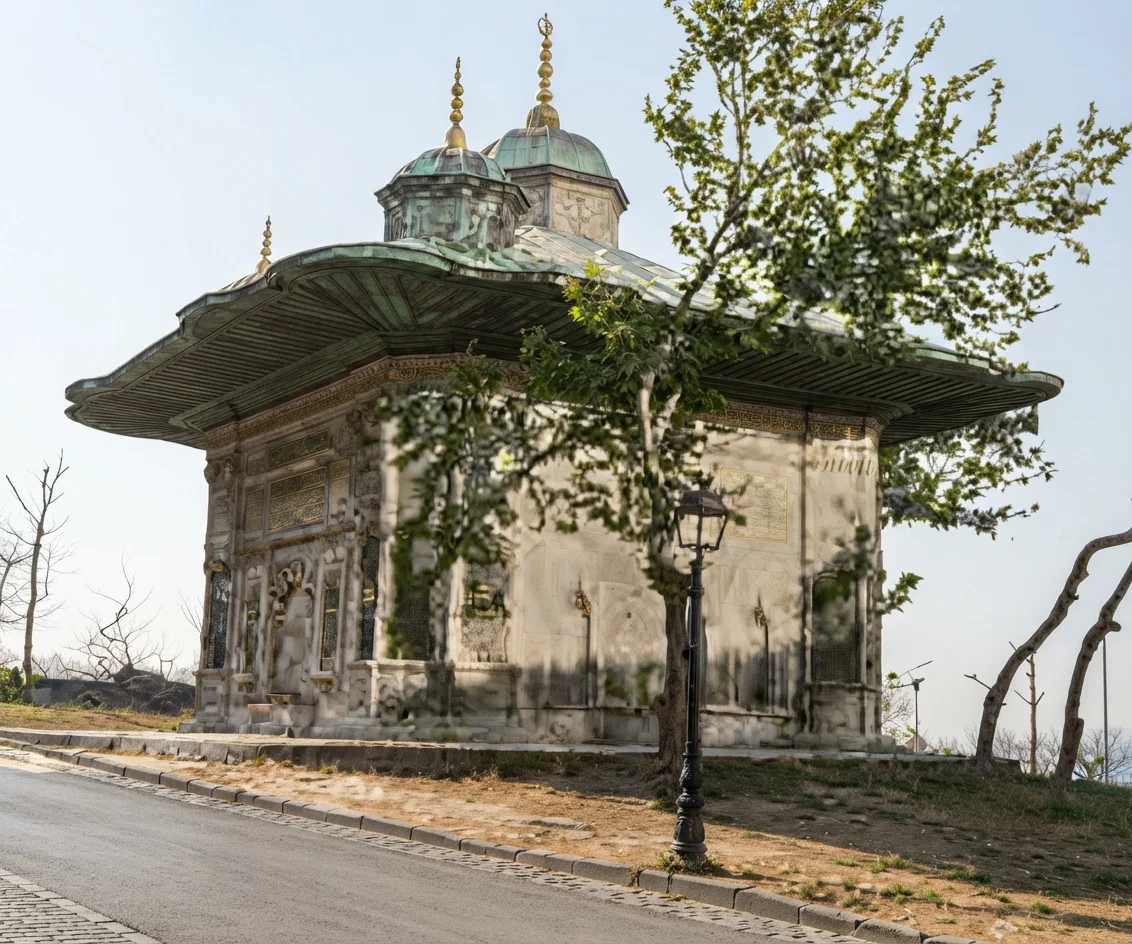
Fountain of Sultan Ahmed, typical of all the "Tsheshmes"
Indeed, Turkish officials see how the future of their country will end. They try often enough to hinder the work of the "foreigner," and often enough without any reasonable backing. Surely it is in many cases difficult to ascertain by what motives the foreign resident is guided.
Italy's complaint was that her peaceful enterprises in Tripoli did not find the support of the Turkish officials, that her representatives were fed with promises again and again. Also the unsettled case of an Italian girl in Adana was mentioned, who, it is said, had accepted Islam by force. There were also some other quarrels in the Red Sea. There happened some things in the capital, too, which lessened the respect for the Italian ambassador.
All of the above may be true, but there is another reason for the present war, and it is understood at once when we look to the map. Italy has only one African colony, Eritrea. There it had bad experiences. The Italians are quite sorry that Tunis is occupied by France, tho it is directly opposite Italian ground. Italy has lost a chance there. Her interest has centered therefore for some years on the neighboring part of Turkey, on Tripoli. Italy may think that her many emigrants will find there a suitable place to settle. It may be true that the ground contains riches which need only to be unearthed. The country was rich in the time of the Cæsars.
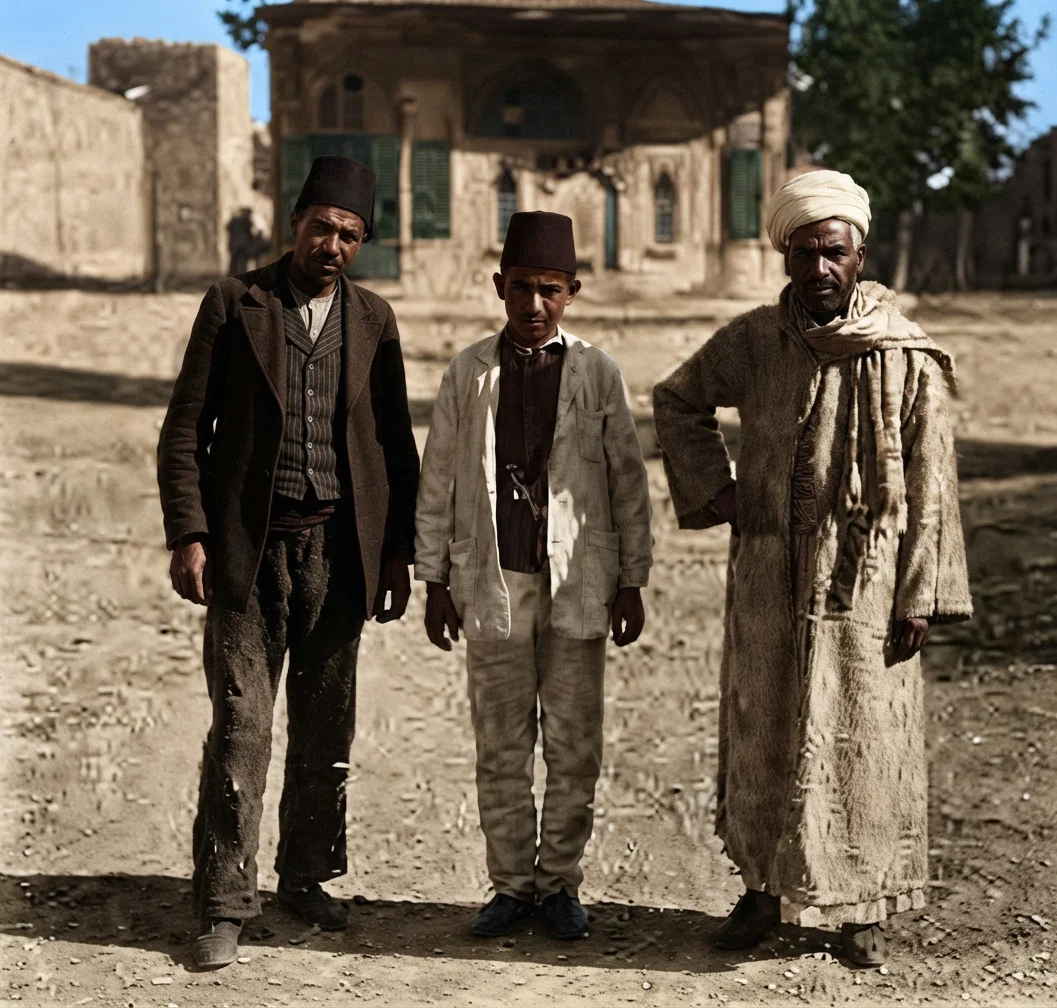
Group of natives in Constantinople
Italy has also to quiet the voice of her people, who want to have their part under the sun. She had to do it at the expense of Turkey, which is strong if she could use her army, but is feeble, extremely feeble, with regard to her fleet. Add to this the fact also that England does not allow communications over Egypt, and France is doing the same with reference to Tunis. Nevertheless many Turkish officers find their way to the battle-field around the cities at the coast of the Mediterranean.
The Moslem View of the Case
How matters will develop, none can say today. But it is taken as sure that Tripoli will finally remain in the hands of the Italians. Strong efforts are made everywhere to strengthen the Turkish navy. How Moslems think about the whole case, we learn from an appeal in behalf of the Turkish navy fund:
Those of you that are living under non-Moslem governments possess a certain amount of prestige amongst your rulers, not because you are Moslems, but because your coreligionists still count amongst the rulers of the world. Let these Moslem countries go, and your lot will be that of the once great but now most unfortunate of peoples—the Jews. It is universally recognized in Europe that the only reason of the inability of Turkey to check the aggression of Italy to-day is her want of an efficient navy. . . . Let not this impotence last any longer. To-day it is Italy; to-morrow it might be another of the European powers, to whom, in the words of the Tanin [the leading Turkish daily], "treaties are merely instruments of deception which may be destroyed when any advantage is to be gained thereby."
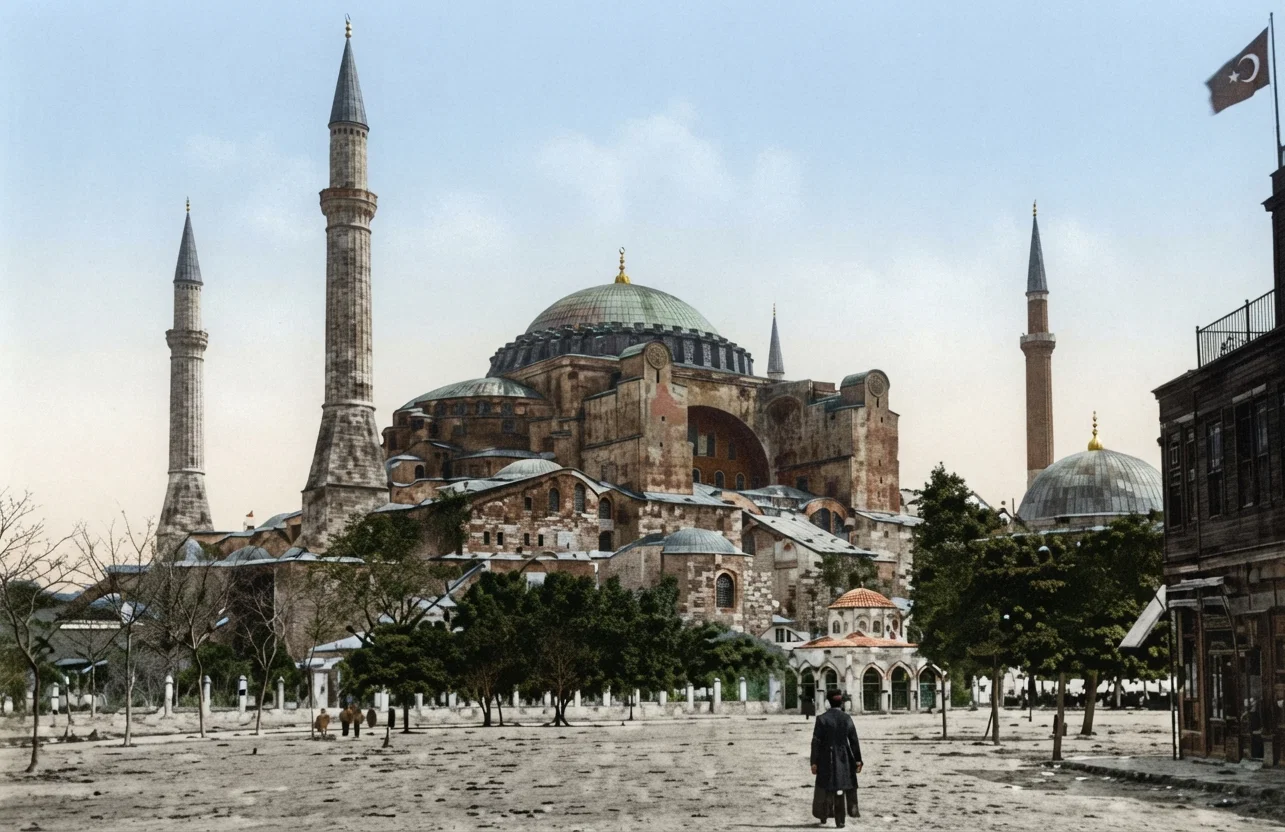
The celebrated cathedral of St. Sophia in Constantinople
This is the fate of Turkey. Mohammedanism had once its mission in the history of this world. But its time has gone, its influence dries up, just as is said in Rev. 16: 12.
The Quirinal and the Vatican
Let us mention one point more. The struggle between Quirinal and Vatican in Italy is well known. Clericalism seemed to lose ground. But it has regained its former position for a good part by its friendly attitude to the Italian march to Tripoli. The priests blessed the young soldiers going into a fight with an arch-enemy, against whom already their ancestors had fought in the time of the Crusades. On the other hand, Italy protects the money which is invested in numerous undertakings on African ground by the Banco di Roma, an institution with clerical money, and the position of which had become dangerous for the too large extension of the enterprises.
France and Germany are charging each other with the cause for Turkey's present difficulties, as the final settlement of the Morocco problem and the Tripoli affair came into being at the same time. Until now Italy has not gained much honor from her efforts. They have to thank the Turks that the latter did not repay the Italian cruelties by doing harm to the 50,000 Italian subjects who live by the grace of their Turkish hosts.
Constantinople is quiet. The same is reported from the provinces. Certainly there have been some doubtful hours, when none could say how matters would turn. But there are signs that the present state will remain until the Turko-Italian war ends. May it be soon!
Why We Oppose Its Passage
By W. A. Colcord
The Johnston Sunday Bill—No. 5
Why We Oppose Its Passage
SUNDAY laws do not make even for good Sunday observance. This can be easily demonstrated. It is generally conceded that Sunday is as well observed in Washington, where there is no general compulsory Sunday law, as it is in those cities and States of the Union in which there are the most rigid Sunday laws. The same may also be said of Arizona and California, which have no Sunday law. Europe has been deluged with Sunday laws; but in spite of them all, there has grown up there what in this country is commonly known as the "continental Sunday," a synonym for anything but good Sabbath observance.
Neither do Sunday laws preserve a nation, as some are wont to argue. In the Roman Empire, where Sunday laws originated, there were all the kinds of Sunday laws which men could frame or invent, and yet that empire fell. They do, however, unite Church and State; they do enter the realm of religion and conscience; they do interfere with the inalienable rights of man; they do place a convenient weapon in the hands of the bigot; they do pave the way for religious intolerance and oppression, and for these reasons are inimical to the best interests of both Church and State. It is a notable fact that where there has been the most Sunday legislation, there has been the most religious persecution. The two go hand in hand. Every American colony which had an established religion, and persecuted dissenters, had its Sunday law. Rhode Island for many years had neither, and oppressed no one.
What a National Sunday Law Would Mean
For over one hundred years the National Government of the United States has not only got along without a compulsory Sunday law, but has steadily refused to enact one. The passage of such a law now would mean a reversal of this splendid record, and a repudiation of the great Christian and Protestant principle upon which the Government was founded,—that of religious liberty. This fact is recognized by Roman Catholics themselves. Thus the Rev. Thomas Cashman, a Catholic priest of Chicago, quoted in the Chicago "Evening Journal" of April 8, 1893, says:
The position of coercion taken by so many of the Protestant clergy — the position that altho they are admittedly in a hopeless minority of all the people of these United States, they would compel all the rest of us to accept of their Sunday dogmas by recourse to law and other methods — is a grievous departure from their old battle-cry of civil and religious liberty.
In the Sunday Mail Reports of 1829 and 1830, already alluded to in this series of articles, the Congress of the United States definitely took its stand against such legislation. For it to enact a Sunday law now would be a rejection of the principle then approved, and a reversal of the decision then so carefully arrived at, and which for so many years has stood as the verdict of Congress upon this subject.
State Laws Not a Precedent
The fact that most of the States have Sunday laws is cited by some as evidence that the National Government also should have a Sunday law. Such show either their ignorance or their utter disregard of the Constitution of the United States and one of the great fundamental principles of our National Government. When this Government was founded, nearly all the original States had religious establishments; but this was not regarded by the founders of the Government as a reason why they should disregard the national Constitution and create such an establishment for the nation. The same argument exactly applies to Sunday laws. Because the States have such laws is no reason why Congress should disregard the Constitution and enact such a law. The States are not the guide, the model, or the criterion for the National Government to follow in this matter. The reverse is the case. The NATIONAL CONSTITUTION is, or should be, the guide for NATIONAL LEGISLATION, and this a model for the States to pattern after.
The Question of National Constitutionality
In support of national Sunday legislation, decisions of State courts, and even of the United States Supreme Court, upholding STATE Sunday laws, are likewise sometimes cited. But such citations are irrelevant in determining the constitutionality of NATIONAL Sunday legislation, because STATE decisions on STATE laws, or even UNITED STATES decisions on STATE laws, do not necessarily indicate what should be a UNITED STATES decision on a UNITED STATES law. There must first be a Federal law before there can be a Federal decision upon the constitutionality of a national Sunday law. But up to the present time there has been no such law.
The District Law of Far-Reaching Effect
While in its direct application the enactment of the Johnston Sunday Bill into law would affect only the District of Columbia, yet influentially, and as a precedent, its enactment would be far-reaching. Ever since the first measure for a national Sunday law was introduced in Congress in 1888, the following statement has stood in print as expressing the real reason why such a law was especially desired:
The national law is needed to make the State laws complete and effective.—Christian Statesman, April 11, 1889.
Twenty-one years later, with the Johnston District Sunday Bill pending in Congress, this same authority says again:
Washington and the District of Columbia have no Sunday law. . . . The value of such a law would lie not only in the relief which it would bring to many who are now deprived of their weekly rest, but in the support which it would lend to the cause of our national Christianity.—Christian Statesman, April, 1910.
These statements reveal the real reason why national Sunday legislation is desired. It is to make COMPLETE and EFFECTIVE the STATE Sunday laws, and to give SUPPORT to a NATIONAL RELIGION. This is all any advocate of a religious establishment ever wanted any religious law for — TO SUPPORT HIS RELIGION! But any religion which needs State support is not worth supporting. Benjamin Franklin never spoke more truly nor reasoned more soundly than when he said:
When religion is good it will take care of itself; when it is not able to take care of itself, and God does not see fit to take care of it, so that it has to appeal to the civil power for support, it is evidence to my mind that the cause is a bad one.
The enactment of such a law will open the way for that religious despotism which has long been watching an opportunity to spring again into active operation, to manifest itself. It will give life to that spiritual tyranny which, tho long repressed and held in check by the victories gained in the great struggles for religious liberty, is ever ready and eager to assert itself and dominate the religious conduct and consciences of men.
In Conflict with the Law of God
Lastly, this measure is in direct conflict with the law of God. If civil government has12no right to enter the religious realm and enjoin a religious observance which is CONFORMABLE to the law of God, it certainly has no right to enter that realm and command that which is CONTRARY to that law. The law of God defines in language too plain to be misunderstood, which day is the Sabbath. It says, "The SEVENTH day is the Sabbath of the Lord thy God: in it thou shalt not do any work." In direct conflict with this, this bill commands men to observe another day as the Sabbath — the FIRST day of the week. It is therefore doubly wrong and out of place. It not only violates the Constitution of the United States by entering the realm of religion, but it contravenes and sets aside the higher law, the law of God itself, by assuming the right to change that law, and, under pains and penalties, command that men shall observe as the Sabbath a day which that law designates as a day of labor. It is therefore both uncivil and iniquitous, both un-American and unchristian, both unconstitutional and idolatrous.
For these reasons we most earnestly protest against the passage of this or any similar measure by Congress. And we are glad that we are not alone in making this protest; that there are men in Congress, and in the Senate itself, who see the evils involved in such legislation, and have the courage to express in the halls of Congress their views upon this question.
In our next article we shall present the greater part of a speech against the Johnston Bill made recently by a prominent United States senator.
Alcoholic Drinks
By T.
DURING the year 1910 the United States consumed 1,851,000,000 gallons of malt liquors, Germany 1,704,000,000, the United Kingdom of Great Britain and Ireland 1,397,000,000, Austria 493,000,000, Belgium 412,000,000, France 376,000,000, and Russia 231,000,000.
In addition to the foregoing, France led the world by drinking 1,541,000,000 gallons of wine, and the United States consumed 133,333,000 gallons of spirits, while the United Kingdom consumed 100,000,000.
Of wine alone the consumption per capita in France is 39.36 gallons, Italy 31.17, Portugal 27.39, Switzerland 14.55.
A little study of the foregoing figures will give an idea of the hold the drink habit has on the world. France, for instance, drinks an average of about fifty gallons of wine and beer, besides other liquors, for each man, woman, and child in the whole nation. The babies, as well as many of the older ones, do not drink any alcoholic beverages at all, and hence some of the population are exceedingly heavy drinkers.
The government records show without any mistake the awful amounts of strong drinks that are consumed in the various nations of the world. And no one will point to the saloons and other dispensaries of intoxicants as among the morally uplifting influences. On the other hand all are forced to admit that drunkenness goes hand in hand with crime and every form of degradation and vice.
Right in tune with this appalling amount of liquor drinking, are the crimes and vices that are in open outbreak everywhere and the constant recital of which forms so large a part of the reading matter of the average daily paper. Divorces, defalcations, embezzlements, graftings, robberies, murders, etc., are weighing the world down with their load of iniquity.
Organizations are formed to combat these evil things; they are discussed from the rostrum and the pulpit; they are written against in the papers, in the magazines, and in tracts, pamphlets, and books. And who can depict how much worse the conditions would be were it not for this strong opposition that is waged! But despite the opposition, the evil goes on. There are social and moral problems before the world to-day the like of which have never before existed. These problems are not only immense, but they are charged with intensity, and they fill every part of the world.
God has said in His Word, "This know also, that in the last days perilous times shall come." And that same Word also declares that "evil men and seducers shall wax worse and worse, deceiving, and being deceived." 2 Tim. 3:1, 13. As we view the conditions in the world to-day in the light of these and many other scriptures, the conviction of what they mean irresistibly takes hold of us. The "perilous times" of the "last days" have reached us, and far more perilous times lie just before us. There is no occasion for our being led astray upon this subject, for God's Word is too definite and explicit in its prophetic utterances to leave the issue in doubt.
But this does not mean that everything is going to pieces. By no means is this the case. Wickedness is rising in so mighty a tide in the world, that it will call for the divine Father to arise in His majesty and power in harmony with His predictions and promises to meet it with one death-dealing blow. And this will be done by the second coming of Christ in all His great glory. And then will the reign of eternal day and eternal joy and eternal right begin. The heart thrills with joy as we look forward to the great event. The outlook in the world presents no gloomy forebodings to him who is viewing the conditions of this time in the light of God's sure and accurate prophecies. T.