S. D. A. Publishing Association · Battle Creek, Mich. · May 15, 1889
FOREBEARING ONE ANOTHER IN LOVE.
By Sydney Dayre
Alice entered her room with a scowl on her face, and petulantly threw her books on to the bed. It was very easy for her room-mate, who was busily engaged with her studies, to see that she was unusually annoyed and out of temper.
With quick, impatient movements she searched about the room.
“Seems to me your things take up a wonderful amount of room, Ruth,” she said, crossly.
“Do they?” said Ruth, very pleasantly. “Well, I don’t mean to take up more than my share. I’ll settle them back into closer quarters when I’ve done this lesson.”
“You promised me you’d water my ivy this morning when I was so busy,” said Alice, in a voice that showed it a comfort to have something to find fault with. “It’s all drying up.”
“Oh, I forgot it. I’ll do it this moment, Alice. I was thinking I’d wash the leaves off, too; they always seem to me to shine out a thanksgiving for it. I’m sorry I didn’t do it before, but I don’t believe it’s dry enough to hurt it.”
“I wonder where my pencil is,” said Alice, still continuing her hunt about the room. “I believe you have it, Ruth. That one looks exactly like mine.”
“No, it isn’t, dear; but I’ll help you look for yours.”
She got up and searched industriously until Alice explained,—
“Oh! I believe I lent it to Janet Ware in the classroom. How I wish people would return things they borrow!”
“Never mind,” said Ruth, “I’ll be done with my examples in a few minutes, and then you may have mine.”
“I wonder if you want the whole window,” growled Alice, with an injured tone joining the cross one.
“Excuse me,” cried Ruth. “What a rude thing I am to take it all! Come, Alice, there’s plenty of room for both of us, I’m sure.”
Alice fussed restlessly about for a few minutes longer, and then seated herself near Ruth, looking so fixedly at her as to cause her presently to raise her eyes inquiringly.
“Are you always this kind of girl?” asked Alice, in answer to her look.
“What kind of girl?”
“This kind. I came into the room fifteen or twenty minutes ago cross enough to drive anybody away from me. I’ve done nothing but snap at you, and snarl at you, and disturb and annoy you ever since I came. The girl I roomed with last would have gathered up her books with an air of high dignity, and with a ‘When you are less disagreeable, Miss Garland, I will return,’ would have swept majestically out of the room. And the girl before that would have given me snap for snap and snarl for snarl until we would have got into a first-rate quarrel, and not have spoken for days. But you have given me a pleasant word for every crabbed one, and a smile for every scowl. Why don’t you give me as good as I send?”
Ruth laughed at the rattling speech; but a sober look took the place of the merriment, as she said, affectionately, “Why, dear, I don’t want to give the Devil a stronger hold on you than he has already.”
“What?”
“Yes, I mean it,” said Ruth, unable to repress a smile at her room-mate’s look of half horror, half amusement. “It sounds dreadful, I know; but I learned it from one of the dearest old Christians I have ever seen, and she wouldn’t say it if it wasn’t so.”
“What did she mean? And was it she who taught you to stand my ill temper like an angel?”
“Oh, I fancy it would take more even than dear Aunt Faith’s teaching to make me angelic,” said Ruth, laughing. “But I will try to tell you how she used to talk, and then you will understand what I mean.”
“My mother died when I was a very little girl, and left me, with my two brothers and two sisters, with no one but servants to look after us for several years. It is of no use for me to tell you what a quarrelsome little set we grew to be. I don’t know what would have become of us if Aunt Faith hadn’t come to take a little pity on us.”
“I remember that one of the first things she tried to teach us was the beauty of loving and trying to be kind to one another. And she always made a special point of our being forbearing with any one who was out of temper.”
“‘Don’t sin against one another by making a bad matter worse, dears,’ she would say. ‘When we poor mortals give way to these evil tempers of ours,—the dear soul always said “we” in talking to us, just as if she knew what it was to be in bad temper!—the Devil gets a very strong hold on us. Do not let us, by word or deed, help him make that hold stronger. What can be sweeter or more Christ-like than for us, by our patience and forbearance, to hold out a helping hand to those we love? Must not the Devil rejoice when we, by irritating words, add fuel to the flame of anger burning in a poor heart?’”
“Yes, indeed; she used very strong words, and she meant them,” continued Ruth. “And I am sure they did us good. The time had been when a cross word from one of us would set all the others on edge, and how we would sting and irritate one another!—we who ought to have loved one another all the more tenderly for being left motherless. But Aunt Faith impressed it upon us that the Lord would hold us accountable for the sin which we made darker in the hearts of others, when we might, instead, help them over a rough place by a few gentle, patient words.”
“It is a hard thing to do, though,” said Alice; “but it’s a pity more of us girls don’t think as you do about it, Ruth. Time and again I’ve got into such a temper that—well, it’s just as you say—it seemed as if the Devil had me right in his grasp,—as though I hadn’t a bit of power except to say angry words. And then some one would sneer at me, and some one would tease me until I felt full of hate and bitterness, and said the very worst things that I could.”
“Poor girl!” said Ruth, caressingly.
“Oh, I don’t deserve your pity,” said Alice; “for I’ve done the same by others, often; and when I came in just now, after having been kept in for failing in my Latin, it would have been just so with me, except for your blessed patience.”
“Then let us try the better plan, dear,” said Ruth, affectionately. “When we see people weak and ready to fall, do not let us lay a stumbling-block in their78way. Let us try what a kindly hand-grasp will do, and a word of good cheer to stir up the good in their hearts, and to help them trample down the evil, for the sake of the Master, who bears so much from us.”
—Sydney Dayre.
IN BLOSSOM TIME.
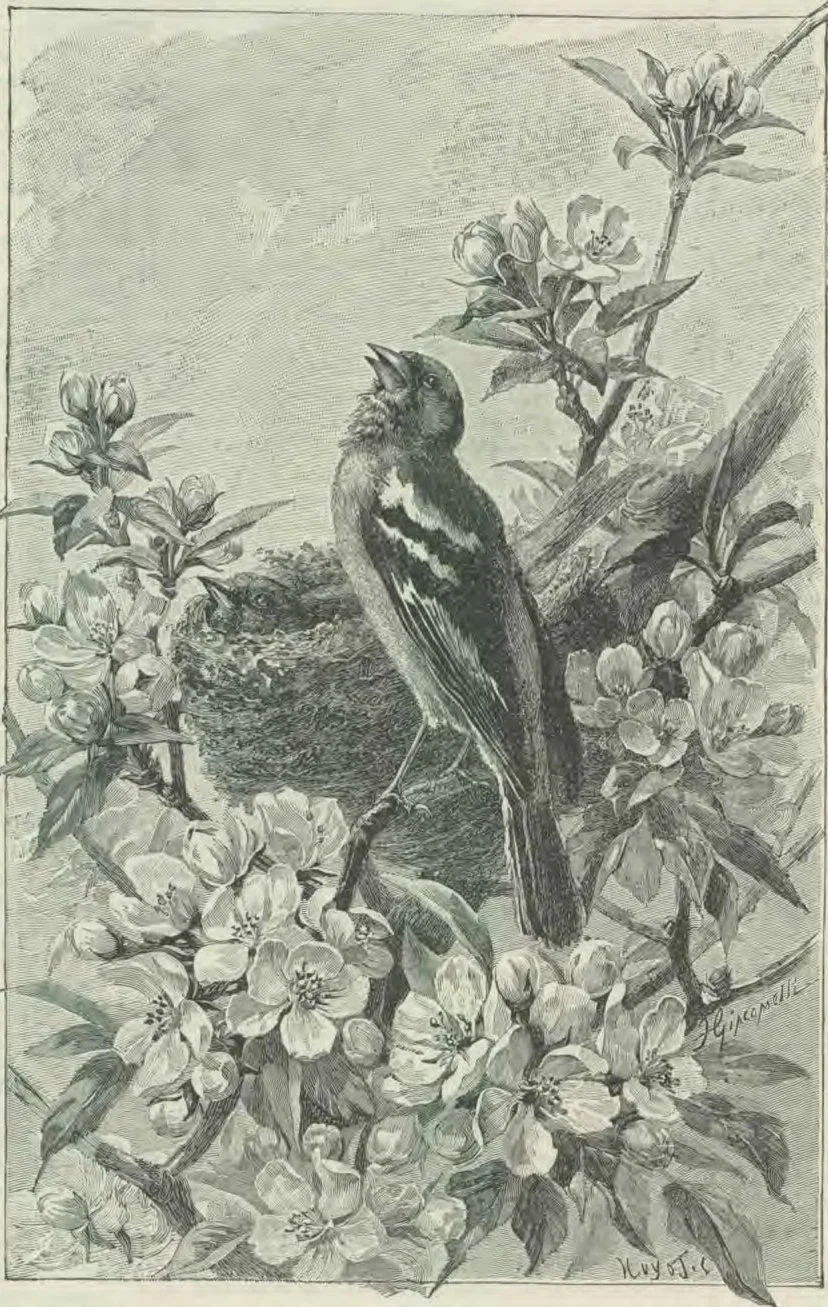
In blossom-time the world is fair,
A thousand scents are in the air,
And myriad bells of beauty chime,
From bush and tree in blossom-time.
On every leaf, in letters clear,
The promises of God appear,
And faith, in ecstasy sublime,
Sings with the birds in blossom-time.
The cherry-trees are all in flower,
Their blossoms drop in fragrant shower,
And orchards flaunt the augury
Of happy harvests yet to be.
The birds appear in cheerful throngs,
And carol forth their sweetest songs,
And every heart is set to rhyme,
And earth revolves in blossom-time.
In blossom-time new hopes we build
Of promises yet unfulfilled,
And toward celestial regions climb,
Courageously, in blossom-time.
A newer gospel then is writ,
And birds and blossoms herald it,
And all the bells of heaven chime,
With fuller joy in blossom-time.
—Selected.
Unquestioning Obedience.
Among the private memoirs of noted men of the last generation, we frequently find incidents which illustrate strongly the singular difference between the training of boys now, and that of a century ago.
The venerable Bishop Meade, of Virginia, for example, gives in his “Reminiscences” an account of an insurrection which took place at Princeton College while he was a student there, and in which he took part with such zeal that even in his old age he felt and said that no collegiate outbreak ever occurred in which there was less guilt on the part of the rebel boys.
One hundred and fifty students out of two hundred revolted, and all of them were sent home. Young Meade, on reaching the old homestead in Frederick County, vehemently poured forth the story of his wrongs to his mother, a high-spirited Virginia woman.
She listened in silence until the whole story had been told to the least detail; then she commanded him to return at once to the college, humbly acknowledge his errors to the faculty, and ask to be taken back on the promise of future amendment.
“Nor,” says the bishop, “did I hesitate to obey; for the habit of submission to her authority had been established since my earliest years.”
Fifty other young men were thus peremptorily sent back by their parents, and went without remonstrance.
Mrs. General Nelson, a personal friend of Washington, finding that two of her boys had run away from school to enter the army, beckoned them from the ranks while on the way to battle, and ordered them to get into the family coach and accompany her home. From thence she sent them to Philadelphia to school. The significant point in this story is that it did not occur to either of the young men nor to the officers commanding them to dispute her authority.
Bishop Meade, writing half a century ago, declared that the day for such prompt, unquestioning obedience from adult children to parents was over. It certainly is long past now.
Whether it was a better system in all respects than that of the sympathy and confidence which usually exists in families of the higher class at the present day is not to be decided off-hand.
It is recognized by the proverbs of all countries that only the man who has been taught to obey knows how to command; and it is certain that the men whose authority led this country through her darkest straits into freedom and light had borne the yoke in their youth of a stern, inflexible discipline.—Youth’s Companion.
THE POOR AMERICAN LEPERS.
By W. S. C.
LEPROSY is a terrible disease, and is very contagious. In olden times God gave, through Moses, explicit directions to avoid its spreading in the camp of Israel. The poor soul became an outcast, dwelling alone, or in company with other lepers only, until death, perhaps, ended his misery. If you will read Numbers 12:1, 14 and 2 Chron. 26, you will learn how leprosy was sent upon Miriam and Uzziah the king as a direct punishment for sin.
Most of the young readers of the INSTRUCTOR know that there are lepers in America, though but few are aware that in the State of Louisiana there is a settlement of lepers, who live in exile, and who have resided there for many years, constantly receiving additions to their numbers as death carries off others, so that their numbers do not sensibly decrease.
On the banks of the bayou (creek) called “La Fourche,” which empties into the Gulf, is the dreaded “Terre aux Lepreux,” the Leper’s Land, or home. The tangled mass of tropic vegetation, always growing and decaying, create miasma impossible to present intelligently in words. Huge cypresses rear their gigantic heads in the deep morasses, and here and there a massive oak presents itself, covered with long garlands of Spanish moss, while climbing vines cling to the cypress trees like huge serpents.
If a “lugger” is taken at Thibodeaux, the capital of La Fourche parish, and a party should sail up the inky black water of the bayou, a landing would be found at a considerable distance. At the wharf at Thibodeaux, and at intervals on the uplands bordering the bayou, can be found some very curious appearing men. These are the “Catfish Cadjuns,” the Acadians, who live on the uplands, and raise cattle. They inhabit the swamps and islands along the Gulf, and live almost entirely on rice and fish. It is from among them that Cheniere Caminada, the village of the lepers, receives its recruits.
As the lugger sails up the gloomy bayou, hundreds upon hundreds of great gray-black and red-banded snakes can be seen curling and writhing around the butts that spring from the roots of the cypress trees growing on the banks. Congos, whose bite is deadly, the brown snake, blowers, cotton-mouths, and moccasins abound in great numbers.
If the journey is pursued past a point called Havang’s Landing, occasionally a group of lepers, or an isolated individual, gunning or fishing, will be met with. Their appearance is generally “that of an emaciated person, with a face deeply scarred and seamed, the brow and lower part a dingy brown, while from the eyes to the lips it will be as white as though dusted with flour. The eyelids are generally gone, and the eyes seem covered with a film without color or expression.”
Terre aux Lepreux has been a home for poor lepers for at least a hundred years. The disease runs in families among the Cadjuns. When one is stricken, he leaves his home and enters these regions, an exile forever. Game is plenty, and his friends keep him supplied with rice and groceries. There is a trading boat, owned by one Captain Vance, that enters the bayou at regular intervals, and trades necessaries for the hides of wild animals the lepers capture. They leave the pelts on the bank, and the captain takes them, leaving supplies in return. Up a connecting bayou, past the Ourblanc plantation, is quite a settlement of lepers, and there the priest—for they are all Catholics—lives. His title is Father Villevé. Most of the huts in which the people live are built on piles driven into the mud, as the ground is scarcely more than a foot above the water.
How true is the saying that one half the world has no idea how the other half is living; and how thankful all ought to be for health and strength.
W. S. C.
WHAT JESUS SAID.
By Francis Hope
“NEVER man spake like this man.” This is what wicked men were forced to admit about Jesus; and surely he did say some wonderful things. One day, sitting on the mount of Olives, talking to his disciples, he quietly said, “Heaven and earth shall pass away, but my words shall not pass away.” No other teacher ever dared to assert that; if he had, the people would have thought him insane. But here was a poor carpenter’s son saying that his words would endure forever! What do you think of that?
One would think that to make sure of this coming true, he would at least carefully write out all his sayings in some book, to be handed down and preserved. But Jesus never left a single page. The only writing we know of his doing, was once when he stopped and wrote with his finger in the dust, and the first breeze wiped it out; and shortly after, Jesus himself was killed, and his followers scattered. It looked very much as if Jesus, and his words, and his religion were things of the past.
But years afterward, one of his disciples named Matthew thought he ought to write out what Jesus said, and so he did. Pretty soon a man named Mark heard Peter talking about Jesus, and he thought he would write it all out. Then two more men, living in different parts of the world, did the same; and strange as it may seem, they all wrote the same thing. Can you tell why?
Thus the words of Jesus were preserved. Cities and empires have gone since then, but these words still remain, and will remain forever. So when Christ spoke those words on the mountain, he did not say anything foolish; he only told the truth. He spoke with the composure and assurance of one who could see into the future. Do you know what that proves? It proves that Jesus was not an ordinary man, but must have been what he said he was—the Son of God.
Another time, while he was eating dinner with some friends, a woman came in and washed his feet, and this is what he said: “Verily I say unto you, wheresoever this gospel shall be preached throughout the whole world, this also that she hath done shall be spoken of for a memorial of her.” I can imagine how some of those Pharisees turned up their noses at that. To think that this insignificant Nazarene should have the conceit to say that his words were going to fill all the earth, and that people would speak also of that foolish woman. And surely it was a strange thing for any man to claim.
But over eighteen hundred years have passed, and how is it now? Is that story told in all the world? A few years ago I was in Europe, and every one was talking about the gospel of Christ. I went away to the other end of South America, and found that people knew all about that woman who washed Christ’s feet. Then I came out to California, and I find every one knows all about it here. And wherever you read this, if you are in South Africa, or Australia, or India, you will find people talking about it, too. Isn’t it strange that all that man has said has come true? We can only account for it by believing that Jesus was something more than a man, and the Bible says he is God.
Here is something else he says: “He that believeth on me hath everlasting life.” Let us believe on him, and he will finally take us to live with him forever.
FRANCIS HOPE.
HIS FIRST EARNINGS.
“Father, may I have a piece of ground for my very own?” asked a bright boy ten years of age.
“Why do you wish a piece of ground, my son?”
“I would like to raise some potatoes, father.”
“Potatoes! What will you do with them, Willie?”
“Sell them, father, and send the money to the school in Cornwall, where heathen boys are educated.”
“Hoeing potatoes is not easy work, Willie,” he said, doubtfully.
“I know that, sir, but I am not afraid of work. It will make me strong to know that I am helping some poor heathen to become a Christian.”
Willie’s face was full of earnestness, and his father laid his hand gently on his head, as he said,—
“You shall have the ground, my son, and do with it as you choose.”
Willie went to school that morning with a very light heart. He soon told his plan to a little playmate, and the two lads entered into a partnership for the cultivation of the promised plot of land.
It was a dry, hot summer, and the ground which Willie’s father gave him was very difficult to hoe. It was full of upturned pieces of sod. The boys were not to be discouraged in their good work, however. Throwing aside their coats, they toiled with a will, and the sod which gave them so much trouble proved their best friend in the end. It served to protect the growing potatoes from the fierce heat, of the sun. The little plot devoted to charity yielded a fine crop, while many broad fields produced almost nothing.
It was a proud moment in Willie’s life when he drove his wagon-load of potatoes to market, and gave his first hard earnings to the Cornwall school.
He afterwards became very wealthy, but he never forgot his boyish ambition to do good. William E. Dodge, for he was the noble boy, will long be remembered for the many deeds of mercy with which his long and useful life is filled.—Sel.
BABIES IN CHINA.
A GENTLEMAN who made a tour through China on a bicycle tells of some curious things he saw in out-of-the-way districts which travelers do not usually visit.
One of these was a company of babies picketed out in a field like so many goats or calves. Each baby had a belt about the waist; into this belt behind was tied a string about ten feet long, the other end of which was fastened to a stake. The stakes were set so far apart that there was no danger of the strings getting tangled up as the babies crept or ran about.
Some of them were creeping on all-fours, some of them were making their first attempt at standing, by balancing against the stakes, while older ones were running or playing in the grass. All seemed good-natured and happy, and though they gazed at the queer looking stranger and his wheels with an expression of surprise, they did not cry or seem in the least frightened. Nobody seemed paying any attention to the babies; but, as the mothers were seen working in a rice-field a little way off, they would of course have come to them had there been any need. The babies had plenty of fresh air and sunshine, and perhaps were as well off as some more petted ones at home.—Selected.
A COSTLY INKSTAND.
PERHAPS the most elaborate and costly inkstand in the country is the one now in the possession of Robert T. Lincoln, of Chicago, and which stood for a time on the private desk of his father, when the latter was the occupant of the White House. It seems that one of the delegates from Arizona in Congress, in 1865, had become so fond of President Lincoln that he wished to give him some memento of his friendship. He sent to Arizona for 400 ounces of silver, which he had molded into a handsome and uniquely decorated inkstand. The material itself cost $500, and the bill for the work upon it was $862. It had not been on the President’s desk a month before the assassination occurred, and for the twenty-three years since then it has lain in a vault.—Sel.
WHY NOT NOW?
By M. J. C.
A LITTLE girl writing to the Budget says, “I want to live so that if I am permitted to grow up, I can do something for the Master.”
BAD.
There is a good thought in her words; because persons who live sinful lives in their youthful days do not find it easy to break away from their sins when they are grown up. It was because of this that the wise King Solomon said to the children, “Remember now thy Creator in the days of thy youth, while the evil days come not, nor the years draw nigh, when thou shalt say, I have no pleasure in them.”
But none of you should get the idea that you can not do something for the Master until you are grown up. It is true that the earlier you begin in good earnest to serve God, the better fitted you will be to work for him when you are grown; but if from loving hearts you are trying every day to honor him in all your ways, it is also true that you are doing something for him now.
The Lord does not measure just as we do. You remember it was the widow’s mite that he said was a greater gift than the large sums the rich gave. So it is not because of great things you may do that the Saviour will be pleased, but because you do lovingly the little duties that belong to children, and do them the best you know how.
The Lord will look right at the heart when he measures your work; and then no matter how young you are, if he finds you have done honest work, all you could for him, he will put just as great value upon your work as upon any other that is done for him.
Then, dear children, why not begin work for the Master to-day? Leave future work with God. Even should time last a few years, you might die before you grew up, and then what would you have done for him?
Little thoughts of kindness and little deeds of love will make almost a heaven of one’s home, and win a place in the hardest heart. And it is known only to God what you might do for those whose hearts you enter with the wedge of love.
I would like to hear the whole Budget family say, “Well, I believe I have something to do for the Master as well as grown up people, and I am going to try to do it in a way to please him. I will not let Master Self rule me any longer; but instead, I will think pleasantly of all, and try by my loving ways to lead many to the Saviour.”
You need not expect to find everybody agreeable; for you will not. It is the unloving and the unlovely that need your help. The Saviour came to save sinners, who needed his help. So you must work for those who lack lovely traits of character. A loving spirit must shine from you on them, to make them lovely. You must first receive it from the Saviour, and then reflect it on those for whom you work.
Did you ever throw a pebble into a pond of water, and watch the wave-circles as they grew larger and larger, spreading away across the pond? In this way our actions reach out, and affect many lives. A good action starts a wave-circle of good, and no one but God knows where it will end.
May be you have read of great good which sometimes comes from the little acts of children. I think of an instance now which I want to tell you, that you may be encouraged to try to do something for the Master now, and in all the days of your lives. The story was told to a lady by a minister who said he was led to Christ by a little child. The lady repeats the story in this way:—
“He had been very wild as a young man, and the family, after doing all they could for him, turned him off. One day in a crowded city he was knocked down and badly hurt. While he was waiting for an ambulance to take him to a hospital, a little girl with tears in her eyes leaned over him and said, ‘I will ask God to make you well right soon.’”
“All through his sickness the thought of that child whom he had never seen before, praying to God for him, was ever with him. He wondered who she was, if he would ever see her again, and what she would think of him if she knew the kind of life he had led. He grew ashamed of it, and felt that he would not like her to know, and gradually he made up his mind to live a better life.”
These few kind, sympathetic words from a child melted his hard heart, and it ended in the man’s becoming a minister of the gospel. If he was a faithful minister, and led many to Christ, no one will know till the judgment all the good that came from the little girl’s act. Will you not in the same sweet way work for the Master now?” M. J. C.
LILY'S ENEMY.
“Mother, there is such a disagreeable girl at school; she pulled my hair this morning, and called me a cry-baby,” said Lily, looking up with tearful eyes into her mother's face. “Oh, you cannot think what a horrid girl she is; nobody likes her. I wish Mrs. Marsland would send her away from our school.”
“What is the name of this dreadful girl, and where does she live?” asked Mrs. Rushton, putting her arm round her little daughter in token of sympathy.
“She is called Dora Hilton, and lives in Grange Road with her grandmother. I think her father and mother are dead.”
“Poor child,” said Mrs. Rushton.
“Mother, why do you call her ‘poor child’?” cried Lily, excitedly.
“Isn't she a poor child, if she has no parents? Think how much richer you are. Now suppose you try to turn this enemy into a friend.”
“Oh, mother, I couldn't.”
“I think you could. What did Jesus tell us to do to our enemies?”
“He told us to love them,” answered Lily, hanging her head; “but I could never love Dora Hilton.”
“Have you tried?” asked Mrs. Rushton, gravely. “When Dora pulled your hair, and said rude things, what did you do?”
“I—I—made faces at her,” stammered Lily.
“That was not very kind. Well now, to-morrow try a different plan. Watch for a chance to help Dora in some way, and if she speaks rudely, answer her pleasantly.”
Lily thought this advice very hard to follow, but resolved to try. The very next day there came a chance.
Dora had forgotten her spelling-book, and tried to borrow one, in order to look over her lesson before the class.
But none of the girls would lend her a book, for they all disliked Dora.
Lily hesitated a moment, and then went quietly to her.
“You may have my book,” she said pleasantly; “I know my lesson.”
Dora looked very much surprised, but took the book without even saying “Thank you,” and Lily felt just a little angry.
That night Lily added to her usual evening prayer these words, “O dear Lord Jesus, help me to love my enemy;” and somehow she felt very happy as she crept into bed.
For several days Lily continued to do little kindnesses for her disagreeable school-fellow, whenever she found a chance.
One afternoon, as she was walking home from school, she heard a voice calling, “Lily—Lily Rushton, wait for me. I want to speak to you!”
It was Dora who came up, breathless with the haste she had made.
“Tell me why you have been so pleasant to me this week,” she began abruptly.
“Because I want to make you my friend instead of my enemy,” answered Lily, quaintly; then seeing that Dora looked puzzled, she told her what Mrs. Rushton had advised.
“I would like very much to be your friend,” cried Dora. “I will never tease you again.”—Child's Companion.
THE FIFTH COMMANDMENT.
“Honor thy father and thy mother. Honor thy father and thy mother, that thy days may be long upon the land which the Lord thy God giveth thee.”
Over and over again Harry repeated the words. In the long Sabbath afternoons after meeting he had learned many passages from the Bible. Sometimes it was a short psalm, sometimes part of a chapter from the New Testament; just now he was committing the commandments to memory—“learning them by heart,” he called it.
“Do you understand what it means, Harry?” asked Mrs. Mitchel.
“Why, yes, mamma. It means children are to mind their parents, and not talk back, and support them by and by, when the children are grown up, and the fathers and mothers are old.”
Mrs. Mitchel smiled, and returned to her reading. Presently Harry spoke again:—
“But there’s one thing about it I don’t need. It says, ‘Honor thy father.’ My papa’s dead, and I don’t see how I can honor him any more, do you?”
“I will not answer you to-day, dear. Think about it this week, and if you see any way in which you can honor the father who was so anxious for his little boy to be good, don’t forget to improve it.”
That week passed very much as other weeks had done. The hours spent in working examples and studying spelling seemed to Harry to drag themselves along. The hours spent in playing with the other boys seemed to fly as if they had wings. It was hard for the child to believe that holidays were just as long as the other days of the week.
Another Sabbath afternoon found him seated in the cozy sitting-room as before, his Bible before him.
“Well, my boy, do you know any more about the fifth commandment than you did last Sabbath?”
Harry suddenly found the fire too warm; then he must shut the hall door. There was his hat on the machine; that must be hung up at once. When he returned to his seat, mamma was still watching him, still waiting for an answer to her question. There was no escape.
“Yes, I do know more than I did. I hate to tell you, but s’pose I must. One noon, when a lot of80boys were playing in front of the school-house, an old cow came along, and we began to stone her. Pretty soon the others saw a man coming. They ran off; but I didn’t see the man, and kept right on stoning the cow. It was old Mr. Jason, and that was his cow. I tell you he was mad! He grabbed me by the collar, and shook me, and said how mean it was to stone a poor, helpless beast. After a while he sort of calmed down. Then he asked me whose boy I was. You ought to have heard him go on after I told him! He said my father was one of the best men he ever knew, and a minister of the gospel, and how bad he would feel if he could know I was doing such mean things, and reflecting discredit upon him. Yes, that was what Mr. Jason said, ‘reflecting discredit.’ I don’t know why, but just then I thought of that fifth commandment, and it seemed to me that reflecting discredit upon my father didn’t mean honoring him.”
“And in Sabbath-school to-day I was uneasy. I laughed and whispered some, and Miss Flint got out of patience with us all. She said she never saw boys so hard to manage, and she wondered our mothers didn’t teach us to behave better. I was right on the point of saying something to her, but I thought about honoring my mother, and kept my tongue still. What I had already done was bad enough.”
“Don’t look so sad, mamma; it hasn’t been all bad. Mr. Hall offered us boys some cider the other day. Some took it. I told him I didn’t want any. Then he kept asking why not, and at last I said mother wouldn’t like it. Mrs. Hall came out for a basket of chips, and she heard me. She looked up so kind of sorrowful. ‘I’m glad you’ve got a mother that teaches you to let cider alone,’ said she, ‘and I’m glad, too, you’re not afraid to obey her. I wish all boys were the same.’ Yes, mamma, I’ve learned that when we do what is right, and don’t do what is wrong, we are honoring the father and mother who taught us what is right, and what is wrong. But how about the last part of the commandment? I don’t fully understand that.”
“My dear child, if you follow the teaching of the first part, you may be sure God will take care of the rest. His promises never fail.”—S. S. Advocate.
BAD
By George Cooper
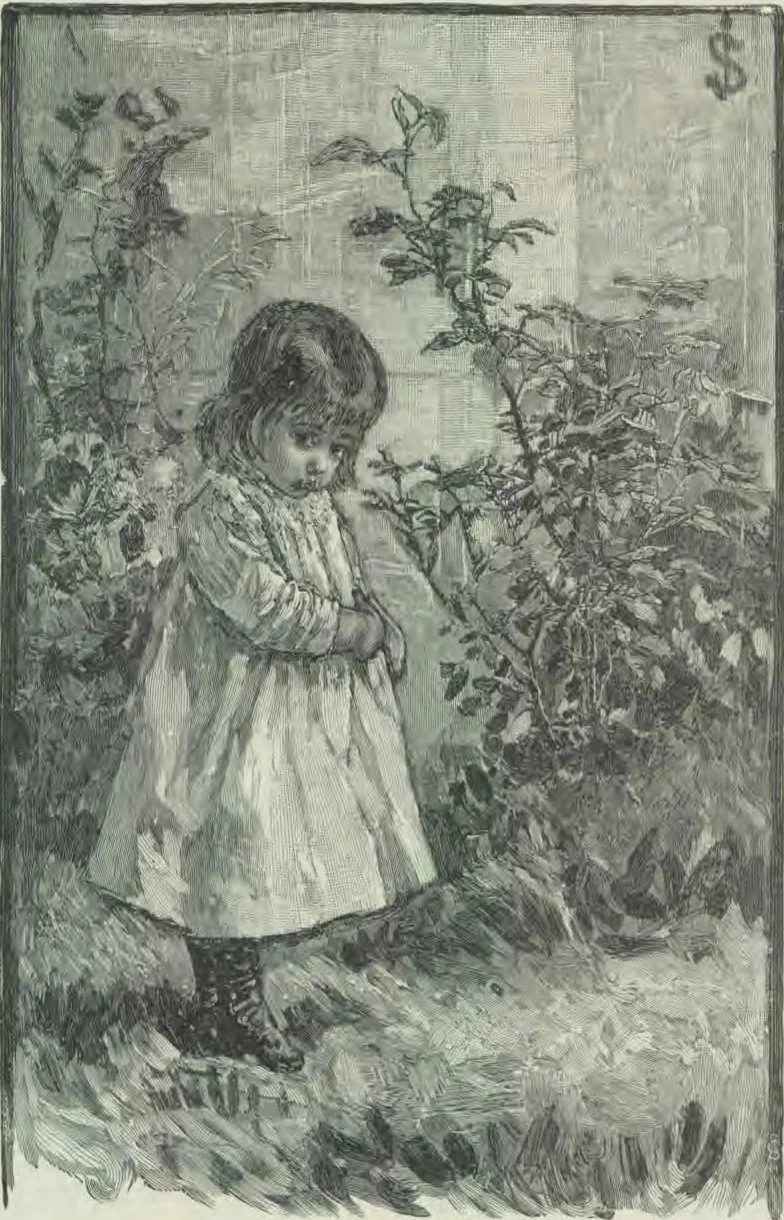
ALL among the dewy roses,
Stands our little rose-bud weeping.
Mother whispers, “Fie! for shame!
Every one will know your name;
See the baby roses peeping!”
Gone the pouting, gone the sighing;
Baby sees the roses pearly.
“Mamma, have they all been crying?
Have they, too, been bad so early?”
—George Cooper.
HOW THE CAT WAS GOOD TO A BIRD.
I can tell you a strange story of a cat. Is it true? Yes, it is true. A friend of mine had a pet cat and a tame bird. The name of the cat was Fun; and Fun was so fond of the bird that he would play with it for an hour at a time.
The bird would hop out of its cage and fly down to the cat, and the cat would put out its paw and give the bird a soft pat on its head, as much as to say, “How do you do? I am glad to see you!”
And then the bird would sit and sing to the cat, and the cat would say, “Mew, mew, mew,” as if it would like to say, “Thank you.” And then the bird would fly a short way off, and the cat would run to try and catch it; and then the bird would hop off once more, and the cat would run and jump and do all that it could to get up to the side of the bird, and then the two would have a game of play.
One day, when these two were at high romps, all at once the cat made a great spring, took the bird, and ran with it out of the room. Did it harm the bird? You shall hear. It was all done in so short a time that my friend could not stop the cat. As quick as she could, she got up from her chair, and went to see what the cat had done with the bird. But just then what should she spy but a strange cat, that lay hid like a thief at one end of the room. So my friend drove the strange cat from the room, and then called, “Fun, Fun, Fun! Come here, Fun!”
And then in came the bird, hop, hop, hop; hop, hop, hop; and our good cat Fun came close by its side. And when Fun saw that the strange cat was gone, it put its soft paw on the bird, and gave it a pat, as much as to say, “There, now you are safe, quite safe! That strange cat is gone; now we may play and romp again.”
And the bird sang a little song that seemed to say, as plain as words, “My good cat, my brave Fun, how I thank you.”—Selected.