The Youth’s Instructor, Vol. 30, No. 39.

THE PROPHET ELISHA

The Youth’s Instructor

Sep 27, 1882

S. D. A. Publishing Association · Battle Creek, Mich. · Sep 27, 1882

THE PROPHET ELISHA.
Of the many good men and prophets whom God sent to warn and instruct his ancient people, none has a more interesting history than the prophet Elisha. We first learn of him at his home, Abel-melolah, a little town situated in the valley of Jezreel, a few miles west of the River Jordan. Here he was plowing in the field with twelve yoke of oxen, when Elijah, who was at that time a great prophet in Israel, passed along, and casting his mantle upon Elisha, went on his way. Now the Lord had told Elijah of this man, and bade him call him to be prophet of Israel in his stead, for Elijah was then an old man. Elisha seemed to understand what Elijah wanted, and after bidding his family farewell, he followed after him. For some years after this, he went about with Elijah, both “ministering unto him” and learning of him invaluable lessons and truths, calculated to fit him for the high place of trust which he was soon to fill.
At last Elijah’s earthly work was done, but instead of his being called to meet death as other men do, the Lord saw fit to take him to himself alive. And on a certain day he and Elisha went up to Gilgal, a place between the Jordan and Jericho, where the Israelites first encamped in the Promised Land. The tabernacle was kept there for some time, and afterwards Saul was crowned king at the same place. It came to be an important town in Israel, and there was also a “school of the prophets” there, which would naturally make it an interesting place for Elijah and Elisha to visit. While here, Elijah told Elisha that he might tarry while he himself should go on to Bethel. Elisha, however, refused to do so, but said, “As the Lord liveth, and as thy soul liveth, I will not leave thee.”
And when they had come to Bethel, Elijah urged Elisha to remain there, saying that the Lord had sent him to Jericho. But Elisha again refused to leave him, and so they went on to Jericho and finally to the Jordan. And Elijah took his mantle and smote the waters of the river, and they two passed over on dry land. And when they had gone over, Elijah made known to Elisha that he was to be taken away from him, and told him to ask what he should first do for him. And Elisha said, “I pray thee, let a double portion of thy spirit be upon me.” And the prophet replied, “Thou hast asked a hard thing of me, nevertheless, if thou see me when I am taken from thee, it shall be so unto thee.”
“And it came to pass as they still went on, and talked, that, behold, there appeared a chariot of fire and horses of fire, and parted them both asunder, and Elijah went up in a whirlwind into heaven.” And Elisha saw it, and he cried, “My father, my father, the chariot of Israel and the horsemen thereof.” And he took up the mantle of Elijah which had fallen from him when he went up, and going back to the river Jordan, smote the waters, and they again opened for him to pass through. As he came to Jericho, the sons of the prophets came out to meet him and bowed themselves before him, saying, “The spirit of Elijah doth rest upon Elisha.”
While at Jericho, the people of the place complained to him because the waters of the spring which supplied their city were bitter, and made the land around barren. And he went out and cast salt into the spring, and said, “Thus saith the Lord, I have healed these waters, and there shall not be from thence any more death or barren land.” And so it has proved. The city of Jericho has gone to ruin, but near the old site is a pure, gushing spring of water, which travelers speak of as peculiarly sweet and refreshing. And as if ever to keep in memory the miracle, it is called by the natives, “Elisha’s Fountain.” All around it the land is very fertile, and it is altogether a very pleasant place, being well shaded by palms, fig-trees, pomegranates, and other fruitful trees.
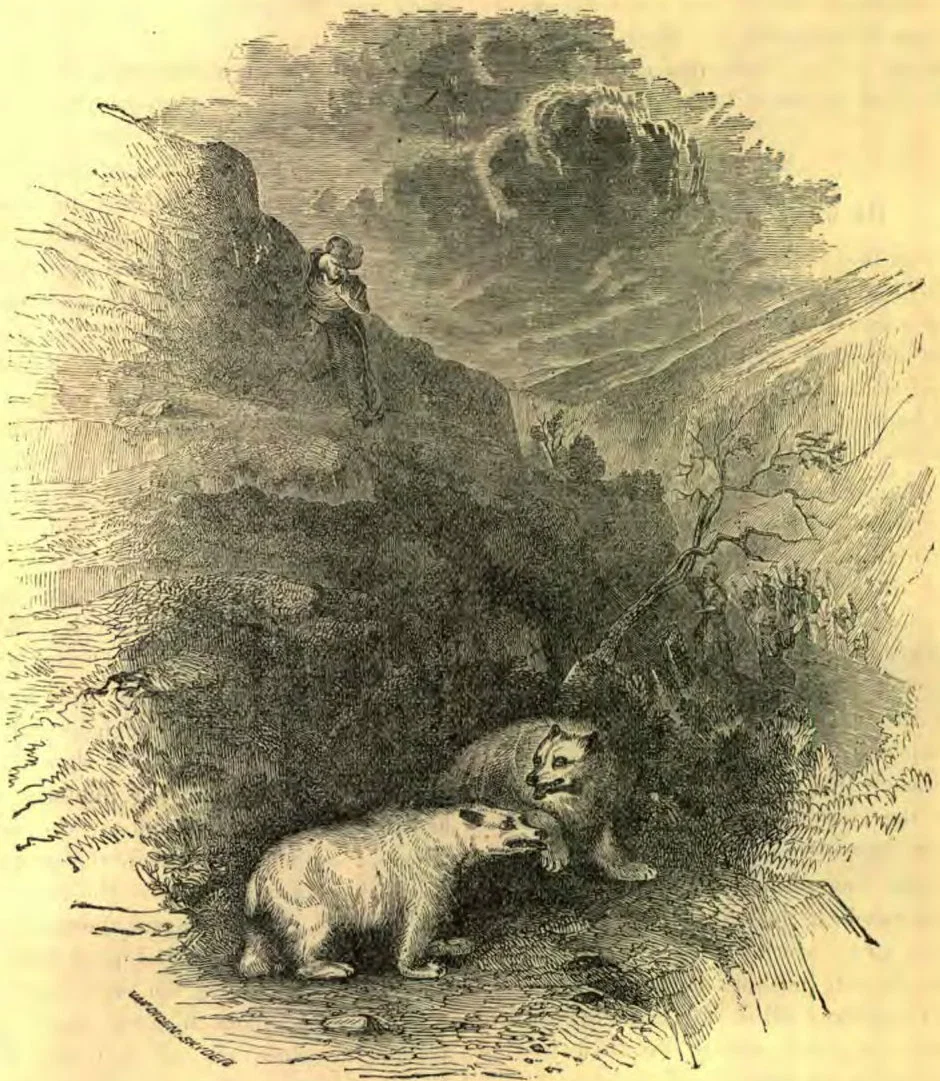
And as Elisha went on his way to Bethel, a town some distance northwest of Jericho, he must travel by a very rough and lonely road. But finally he came near to Bethel, and as he was going quietly along, probably thinking of the wonderful things he had just witnessed, a group of children came out of the town, and mocking him, began to cry, “Go up, thou bald head; go up, thou bald head.” And Elisha looked back upon them and cursed them in the name of the Lord. And there came two bears out of the woods and devoured forty-two of them. This seems a very hard fate for these thoughtless children to meet; but at this time many of the people of Israel were forsaking the God of their fathers, and worshiping idols and the strange gods of the heathen. This destruction of the children was doubtless meant to teach their parents and friends that there was a God in heaven, and that he, his works, and his servants, must be regarded with respect. It should also admonish children and young people of all times to treat the aged kindly and respectfully.
We have spoken of only a few of the interesting events in the life of this good prophet. During his long ministry he acted an important part in the public affairs of Israel; and many wonderful miracles were wrought at his word. They are mostly related in the first nine chapters of 2 Kings. He died lamented by king Joash and all the people.
E. B.

A LESSON.

Three children to their mother's side had pressed, And eager voices made their loud acclaim, Conflicting prayers, imperious request, Wide differing tastes, that could not be the same.
I marked with wonder, how with patience wise, Untroubled brow, and loving, gentle smile, She hears each one, to each she soft replies, And all their varying wants does reconcile.
One wish she grants, another must deny, Yet gives the pleader something in its place; Loves all alike, sees with impartial eye, And measures gifts to meet each suitor's case.
And thus, when once you said to me, dear friend, That you believed in God, but not that he To individual prayers his ear would lend, Since oft conflicting men's desires must be,—
I thought of this sweet mother, and her plan, How she the children's wants did satisfy, And learned how God's far wider wisdom can Most loving grant, and tenderly deny!
—Susan M. Day.

HE GAVE HIS LIFE.

Would you like to hear the story of a brave, unselfish boy? I can not tell you his name or the name of his native town. Somewhere near the bold shores and blue waters of Lake Michigan, he grew up from infancy to boyhood, and his heart was full of hopeful joy, with the promise of a long and useful life before him.
With a younger brother he went out upon the lake. He did not say “good-bye” to any one, for good. With all the earnestness of his young heart he enjoyed the bright hours of the morning as they passed away. But a storm had been gathering strength, and clouds, hidden by forest-covered bluffs, had risen unperceived. A strange dimness crept over the noon-day, and, in a moment as it were, a tempest had burst upon them with all its power, and their frail boat was tossed like a plaything upon the great waves that had been lashed into fury by the wind.
In the boat was one life-preserver, only one. With loving touch, he belted it about his younger brother, and, with cheerful words and a sad smile, he told him how to push off for the shore, where friends and neighbors, all in vain, reached out their hands, and sent their voices, drowned by the storm roar, to the perishing boys.
So one was saved. He reached the helping hands of those who waded out, breast deep, among the dashing waves and brought him to the land. And only one. They saw a hand through the wild, rushing rain, wave to them all a tender, mute farewell, and a pale face sink beneath the rocking, foaming waters of the lake.
Dear children, there are better things than a long life, and there are sadder things than an early death. There is a way of giving our lives that does not take us down to death. If we give of our strength to aid the weary, our time of rest for the comfort of afflicted ones, or even our comforts, perhaps, that the destitute may be better supplied, God will be as well pleased with us as though we gave our lives.
It is not what we get, but what we give, that will decide for us when we are weighed in the balances of God. There are those who always have something to give.
It may be only a beautiful flower, It may be only the work of an hour, It may be only a lifting hand, Only a sentiment, free and grand, Only a word when the rest deride, And pass us by with a step of pride; It may be little, but helps to live, Always something they have to give.
—Mary Brainard.

The Death of Queen Mary.

For two and a half years after the public burning of Archbishop Cranmer, the fiery persecution of the so-called “heretics,” continued to rage throughout Great Britain. About the end of this period five innocent persons suffered together at Canterbury, for adhering to the principles taught by the Reformers. Two of these were women, one of whom was very aged and helpless, whose condition it would seem would have excited the pity of any but the most brutal savage. These five martyrs lifted up their prayers from the midst of the flames, asking God that their blood might be the last that should be shed in England for his truth. These prayers were answered. One week later, on November 17, 1558, Queen Mary died.
During her reign of less than five years, nearly three hundred people suffered death by burning, including sixty women, and forty small children. All of this number were burned as heretics because they did not conform to the doctrines and practices of the Catholic church. Among them were some of the noblest and most learned men that England ever saw. Besides this number, scores of others suffered death on the scaffold, either because they were suspected of opposing Mary’s rule, or because they refused to aid in carrying out her wicked designs. No doubt great numbers who suffered death either by burning or the executioner’s ax, were sacrificed to appease the envy and malice of some of Mary’s ministers and advisers, and that, without her direct consent. But certain it is that she had hand enough in the matter to fully merit the title which is now universally accorded to her—BLOODY QUEEN MARY.
As soon as her death was made known, there was general rejoicing throughout all England. For though she had by her authority upheld the Catholic church, yet by her inhuman course she had really made more enemies to the church than friends. So when she died, the greater part of people were anxious to have the laws of Edward VI. restored, the Bible again allowed to be read in the churches, and the worship of God carried on in a manner that was not contrary to his word. All this came about in very short order. For before the close of the very day that Mary breathed her last, the lords of the Council went down to Hatfield, to hail the Princess Elizabeth as the new Queen of England. This woman was twenty-five years old, and was a stanch Protestant. Indeed, her life had been sought by many a Catholic during the reign of Mary, and for several months she was imprisoned in the Tower. So when she was made queen, the people just gave themselves up to feasting, building bonfires, and marching in processions around their cities. The great writer, Charles Dickens, in speaking of those times, says:—
“The coronation was a great success; and on the next day, one of the courtiers presented a petition to the new Queen, praying that as it was the custom to release some prisoners on such occasions, she would have the goodness to release the four Evangelists, Matthew, Mark, Luke, and John, and also the Apostle St. Paul, who had been for some time shut up in a strange language so that the people could not get at them.
“To this, the Queen replied that it would be better first to inquire of them whether they desired to be released or not; and as a means of finding out, a great public discussion—a sort of religious tournament—was appointed to take place between certain champions of the two religions, in Westminster Abbey. You may suppose that it was soon made pretty clear to common sense, that for people to benefit by what they repeat or read, it is rather necessary that they should understand something about it. Accordingly a Church Service in plain English was settled, and other laws and regulations were made, completely establishing the great work of the Reformation.”
In this way, the work begun in the days of Henry VIII. and Edward VI. was pushed rapidly forward. The writings of John Wycliffe, Mr. Tyndale, John Rogers, Hugh Latimer, Dr. Ridley, and Bishop Cranmer, which had been preserved from the flames during Mary’s reign, now began to appear once more, and to be read by the people, and it looked as though peace and harmony were to reign once more on the shores of England.
C. H. G.

“WHAT O’CLOCK?”

WHEN I was a boy, my father one day called me to him, that he might teach me to know what o’clock it was. He told me the use of the hands, and described to me the figures on the dial plate, until I could tell the time quite readily.
No sooner had I gained this additional knowledge than I scampered off to rejoin my companions, but my father called me back again. “Stop, Humphrey,” said he, “I have something else to say to you.”
Back again I went, wondering what else I had yet to learn, for it seemed to me that I knew all about the clock, quite as well as my father did.
“Humphrey,” said he, “I have taught you to know the time of day; I will now teach you to find out the time of your life.”
Here was a mystery; so I waited rather impatiently to hear how he would explain it, for I wished sadly to go to my marbles.
“The Bible,” says he, “describes the years of man to be threescore and ten or fourscore years. If we divide the fourscore years of an old man’s life into twelve parts, like the dial of the clock, it will allow almost seven years for every figure. When a boy is seven years old, then it is one o’clock of his life, and this is the case with you; when you are fourteen years old, it will be two o’clock with you; and then at twenty-one years it will be three o’clock, should it please God thus to spare your life. In this manner you may know the time of your life; and your looking at the clock may perhaps remind you of it. My great-grandfather, according to this calculation, died at twelve o’clock; my grandfather at eleven, and my father at ten. At what hour you or I shall die, Humphrey, is only known to Him to whom all things are known.”
Never since then have I heard the inquiry, “What o’clock is it?” without being reminded of the words of my father.
I know not what o’clock it may be with you, but I know very well what time it is with myself; and that if I mean to do anything in this world which hitherto I have neglected, it is high time to set about it. The words of my father gave a solemnity to the dial-plate of a clock which perhaps it never would have possessed to me, if these words had not been spoken. “What o’clock is it with you?”—Gospel Banner.

A Careless Watch Invites the Vigilant Foe

A CARELESS watch invites the vigilant foe.

NEW-TESTAMENT HISTORY.

LESSON 102.—GETHSEMANE.

When Jesus had finished his prayer, they sung a hymn, and went out over the brook Kidron, into a garden called Gethsemane. When they had come into the garden, Jesus said to his disciples, “Sit ye here, while I go and pray yonder.” But he took with him Peter, and James, and John. Presently he began to be sorrowful and heavy at heart, and said, “My soul is exceeding sorrowful, even unto death; tarry ye here and watch.” Then he went forward about a stone’s throw, and falling upon the ground, began to pray, saying, “Father, if thou be willing, remove this cup from me; nevertheless, not my will, but thine, be done.” Then there appeared an angel from heaven, strengthening him. And being in agony, he prayed the more earnestly, “And his sweat was as it were great drops of blood falling down to the ground.” When he had risen from prayer, he came to his disciples, and found them sleeping. Then he called to Peter, and said, “What, could ye not watch with me one hour? Watch and pray that ye enter not into temptation: the spirit indeed is willing, but the flesh is weak.” Then he went away the second time, and prayed, saying, “O my Father, if this cup may not pass away from me except I drink it, thy will be done.” Then he came again to his disciples, and found them sleeping, for their eyes were heavy. After this he went away the third time, and prayed, using the same words as before. On returning to his disciples, he said to them, “Sleep on now, and take your rest: behold the hour is at hand, and the Son of man is betrayed into the hands of sinners. Rise, let us be going: behold he is at hand that doth betray me.”
Immediately, while Jesus was yet speaking, Judas Iscariot came with a band of men and officers from the chief priests, and from the Pharisees. Judas knew where to find Jesus; for the Lord had often resorted to that place with his disciples. The men who accompanied Judas, bore lanterns, and torches, and weapons of various kinds. Now Judas had given the men a sign, saying, “Whomsoever I shall kiss, that same is he; hold him fast.” So as soon as Judas came near, he approached Jesus, saying, “Hail, Master,” and kissed him. Then Jesus said, “Judas, betrayest thou the Son of man with a kiss?”
“Jesus, therefore, knowing all things that should come upon him, went forth, and said unto them, Whom seek ye? They answered him, Jesus of Nazareth. Jesus saith unto them, I am he. And Judas also, who betrayed him, stood with them.”
“As soon then as he had said unto them, I am he, they went backward, and fell to the ground. Then asked he them again, Whom seek ye? And they said, Jesus of Nazareth. Jesus answered, I have told you that I am he: if therefore ye seek me, let these go their way; that the saying might be fulfilled which he spake, Of them whom thou gavest me have I lost none.” “Then came they, and laid hands on Jesus and took him.” “Then Simon Peter, having a sword, drew it, and smote the high priest’s servant, and cut off his right ear. The servant’s name was Malchus.” But Jesus said unto the servant, “Suffer ye thus far,” and touching his ear, healed it. Then speaking to Peter, he said, “Put up thy sword into the sheath. The cup which my Father hath given me, shall I not drink it?” “Thinkest thou that I cannot now pray to my Father, and he shall presently give me more than twelve legions of angels? But how then shall the Scriptures be fulfilled that thus it must be?”
“Then the band, and the captain, and officers of the Jews took Jesus and bound him.” But Jesus addressing the chief priests, the captains of the temple, and the elders, said, “Are ye come out as against a thief, with sword and staves, to take me? I sat daily with you teaching in the temple, and ye laid no hold on me, but the Scriptures must be fulfilled, and this is your hour, and the power of darkness.” Then all the disciples forsook him and fled.

QUESTIONS.

1. What did Jesus and his disciples do when he had finished his prayer? Matt. 26 : 36; Mark 14 : 26; Luke 22 : 39; John 18 : 1.
2. To what place did they go?
3. What did he say to the disciples when they came into the garden?
4. Which of them did he take with him?
5. What change came over Jesus, when he had gone out alone with these disciples?
6. What did he say about his feelings?
7. What did he tell them to do?
8. What action did he then take?
9. Repeat the words of his prayer.
10. Who then appeared?
11. Describe the agony of the Saviour as he prayed the more earnestly.
12. When he had risen from prayer, what did he do?
13. In what condition did he find the three disciples?
14. What did he say to Peter?
15. Were the disciples indifferent to the Saviour’s sufferings?
16. What did Jesus say when he went away the second time to pray?
17. What then followed?
18. After praying the third time, what did he say to his disciples as he returned to them?
19. Who came while Jesus was yet speaking?
20. How did Judas know where to find his Lord?
21. What was borne by the men who accompanied Judas?
22. What sign had Judas given them by which they might know Jesus?
23. What did Judas do as soon as he came near?
24. What did Jesus say to him?
25. What question did Jesus put to those who had come to take him?
26. When they said, “Jesus of Nazareth,” how did he reply?
27. Who were standing with them at the time?
28. What miracle was then performed?
29. What effect ought this miracle to have had? It should have convinced them that Jesus was the Christ.
30. When his enemies recovered, what question did he repeat to them?
31. After receiving the same answer as before, what did he say?
32. What Scripture was thus fulfilled?
33. What did they then do to Jesus?
34. What defense did Peter make?
35. How did Jesus treat this wounded servant?
36. What command did he give Peter?
37. What did he say about the cup which his Father had given him?
38. What did he say about obtaining help if he should ask for it?
39. Why could he not call for angels to rescue him?
40. What indignity did Jesus now suffer?
41. What did he say to those who took and bound him?
42. Why were all these things allowed to take place as they did?
43. What did the disciples do in this trying hour?

NOTE.

The Brook Kidron is a mountain torrent which must be crossed on the way between Jerusalem and Bethany. It runs through a valley of the same name, though it is now more frequently called the Valley of Jehosaphat. Near Jerusalem the valley is shallow and broad, and is dotted with cornfields and sprinkled with a few old olive trees. Here, in the days of old, were the “Kings’ Gardens.” But as the brook goes on its way, its path is less smooth, and it finally runs in a deep, narrow, wild chasm until it falls into the Dead Sea, not far from its northwest corner, about fourteen miles from Jerusalem. In the sides of the rocky walls, during a part of the way, are many caves and grottoes, once the abode of monks and hermits.

TO TEACHERS.

For a Sabbath-school teacher to look with indifference upon right methods of communicating is folly; to expect a knowledge of them without personal effort is presumption; and the error is only comparable to that of a missionary student, who should neglect the study of a language, on the ground that it was of no consequence to one who “understood the way of salvation,” or because he expected to receive the “gift of tongues” to the needful extent! Scripture truth has to pass from the revealed Word to the mind of the child, but it has been ordained that it shall pass by word of mouth—through the mind and lips of a teacher. Consequently, everything by which this transference of divine truth is affected, is to be regarded as of serious importance.
Success in teaching depends more on steadiness than on native gifts or learning. A teacher who is always present, and always prepared, will never fail of an attentive class. But a teacher, however gifted, who is variable in attendance or preparation, will demoralize the best class ever gathered. Patient continuance in well-doing is the secret of Christian success. It is also the object of the divine promises. The crown is promised to them who continue steadfast unto the end. God giveth eternal life “to those who by patient continuance in well-doing seek for glory and honor and immortality.”

SCENES IN THE LIFE OF CHRIST.

LESSON 88.—REVIEW.

1. What great feast caused many of the people of the Jews to come together at Jerusalem? John 12.
2. When they heard that Jesus was coming to the feast, what way did they take to show him honor?
3. How did the Saviour obtain a beast upon which to ride into Jerusalem?
4. What did the people do and say as they went with him into the city?
5. What prophecy did all these things help to fulfill?
6. Do you think either the people or the disciples knew at the time what they were doing?
7. What made the people so anxious to see Jesus and do him honor at this time?
8. How did the Pharisees show their displeasure at having so much notice taken of the Saviour?
9. How did Jesus feel as he drew near to Jerusalem?
10. Why were all the troubles which he foretold, to come upon that city?
11. What effect did Jesus’ coming into the city have upon the multitude gathered there?
12. Where did he go with his disciples as evening came on?
13. What caused him to pronounce a curse upon the fig-tree as they were on their way back to the city the next morning?
14. In what condition did Jesus find things in the temple?
15. How did he reprove the men who had brought about this state of things?
16. How did the chief priests and scribes receive the words of Jesus?
17. How did the common people show their confidence in him?
18. What caused the chief priests and scribes to be displeased more than ever with Jesus?
19. What did the disciples notice the next morning as they were again on their way from Bethany to the city?
20. Of what did Jesus talk to them by the way?
21. What question did the scribes and Pharisees ask him when he had again come into the temple?
22. Why did they not answer the question with which Jesus replied to them?
23. By what parable did Jesus that day represent the Jews and the Gentiles?
24. Who in this parable represented the Jews? Who the Gentiles?
25. By what other parable did he describe the course which the wicked Jews had taken?
26. By what words did some of them show that they understood this parable?
27. How had they acted just like the wicked husbandmen?
28. What kept the leaders of the Jews from laying hands on Jesus at once?
29. What words of the Saviour, if kept in mind, will keep us from making a mistake similar to that of these Jews?

MINNIE'S GRIEF.

For weeks little else had been talked of by the children in Mr. Newton's home, but the picnic at Grove Hill. And so it had been in almost every family in the village. The teacher had promised the children that if they were faithful and studious through the long summer term, on the last day they should all go to the woods together. And now the time had almost come; and at every recess and noon might be seen groups of boys and girls,—the girls chattering together like a lot of magpies about the dresses they were to wear and the nice cakes and other goodies their mammas were to make for them. The boys in turn were planning a little more quietly but just as earnestly about the swings, the rustic seats, and the tables, which it was to be their part to prepare; and I will not say but a few words were said about the fire-crackers and torpedoes with which they meant to celebrate the day—only of course they were not going to scare the girls with them. Of all the girls none were more interested than Minnie Newton, and among the boys none had more to say than her brothers, Fred and Parker.
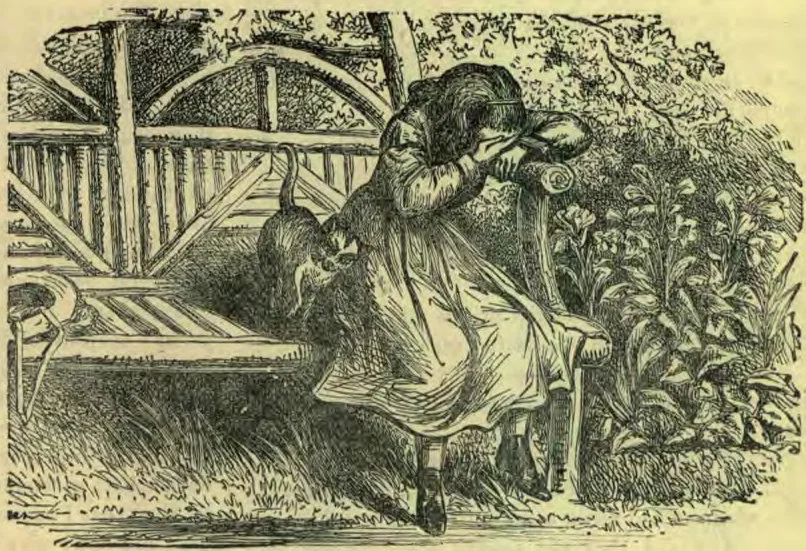
At last the morning so long looked for, came; and the children were up early to see if the sun was going to rise clear. Minnie and her brothers were busy getting ready to be off, when papa came out and called his little girl, saying that her mother would like to see her. She went softly into the bedroom, where she found her mother moaning with pain. “Minnie,” said she, “mamma has one of her bad nervous headaches; and though I am sorry about it, I am afraid you will have to stay home from the picnic to-day and mind the baby and get papa's dinner.” Minnie did not cry just then, but as she went out the door again and saw a group of schoolmates coming with the teacher, and her brothers ran to join them, she could keep back the tears no longer. Down the garden path she ran, to a rustic seat under the trees where she would not be seen. Sitting down here, she sobbed as if her heart would break. Her tabby cat had come with her, and now tried her best to comfort her little mistress; but she would not be comforted, and kept saying to herself some very naughty things about her papa and mamma. All at once she seemed to hear these words as plainly as if they had been spoken in her ear, “He that is slow to anger is better than the mighty; and he that ruleth his spirit than he that taketh a city.” It must have been her conscience that spoke so loud to Minnie, for she had learned this verse only the Sabbath before. Someway she did not feel like crying any more, and pretty soon she got up and walked to the house; and after bathing her tearful eyes, went in to her mother, a bright cheerful little girl. All day she sang about her work, and at night when papa came and found her mamma better, and called her his little housekeeper, she felt more than paid for staying at home. And when the boys came, bringing her a basket of nuts and pretty things from the woods, she almost thought she had had a happier day than as if she had gone to the picnic. “But” said she to herself as she went to-bed that night, “it would never have been if I had not learned that verse.” E. B.

IT’S VERY HARD.

“It’s very hard to have nothing but porridge, when others have every sort of dainty!” muttered Dick, as he sat with his wooden bowl before him.
“It’s very hard to have to get up so early on these bitter mornings, and work all day, when others can enjoy themselves without an hour of labor!
“It’s very hard to have to trudge along through the snow, while others roll about in their coaches!”
“It’s a great blessing,” said his grandmother, as she sat at her knitting, “to have food when so many are hungry; it’s a great blessing to have a roof over one’s head when so many are homeless; it’s a great blessing to have sight and hearing and strength for daily labor, when so many are blind, deaf, or suffering!”
“Why, grandmother, you seem to think that nothing is hard,” said the boy, still in a grumbling tone.
“No, Dick; there is one thing that I do think very hard.”
“What’s that?” cried Dick, who thought that at last his grandmother had found some cause for complaint.
“Why, boy, I think that heart is very hard that is not thankful for so many blessings.”

BAD BOOKS.

Those who read vulgar stories and allow themselves to think low thoughts will come to think meanly of themselves. They cannot forget, in the company of others, the thoughts with which they keep company when alone, and with the loss of self-respect will come the dislike to be with good people and a feeling of unworthiness when in their presence. A ragged boy was asked one day, as he sat poring over a low paper, why he was reading such a thing as that. “Oh,” he replied, “it is good enough for me.” He was a mere child, but he had already become content with the company of low thoughts.
If every life were not so largely molded by the literature on which it feeds, we could afford to treat the matter lightly. But nothing is “good enough” for our boys and girls except the best, and everything else must be excluded from the thoughts of those who wish to make themselves noble men and women. A well-known man lately said, “When I was in college, whenever a doubtful story was told, I excused myself and left the company, finding that such things are retained in mind long after many a good matter has been forgotten. The only way in which I have crowded out bad things, unfortunately learned, has been to fill my mind and heart with good things.”
When your parents keep bad books away from you, it is not to please themselves, but to help you to avoid great danger. Yield to them willingly. One of these days you will remember it gratefully. —Well-Spring.

FINGER MARKS.

A GENTLEMAN employed a mason to do some work for him, and among other things, to “thin whiten” the walls of one of his rooms. This thin whitening is almost colorless until dried. The gentleman was much surprised, on the morning after the chamber was finished, to find on the drawer of his desk, standing in the room, white finger-marks. Opening the drawer, he found the same on the articles in it, and also on the pocket-book. An examination revealed the same marks on the contents of a bag. This proved clearly that the mason, with his wet hand had opened the drawer, and searched the bag, which contained no money, and had then closed the drawer without once thinking that any one would ever know it. The “thin whitening” which happened to be on his hands, did not show at first, and he probably had no idea that twelve hours drying would reveal his wickedness, as the work was all done on the afternoon the drawer was opened. The man did not come again, and to this day does not know that his acts are known to his employer.
Beware of evil thoughts and deeds! They all leave their finger-marks, which will one day be revealed. Sin defiles the soul. It betrays those who engage in it by the marks it makes on them. These may be almost, if not quite, invisible at first.

GET AT THE ROOT.

I was weeding in my garden one day, when I saw a small young dock-weed. I pulled it with my hands, but it would not come up. I then dug at its root with a little spade, but only part of it gave way, so that I was obliged to take more pains and use more strength; and at last I dug up a large old root, which had been cut down and cut down, but never rooted up, and had now again sent out a young shoot. I thought directly that this great old root was just like sin in the heart. It may only show itself in a little fault, but still it is there, and the only cure is to root it out altogether, which you must ask God to enable you to do.

CHILDREN'S HYMN.

From the sunny morning To the starry night, Every look and motion Meets our Father's sight. From our earliest breath To our latest year, Every sound we utter Meets our Father's ear.
Let us, then, be careful That our look shall be Brave and kind and cheerful For our Lord to see. Help us, O our Father! Hear our earnest plea— Teach thy little children How to live for thee.—Selected.

You have reached the end of this edition.

The Youth’s Instructor · Sep 27, 1882