Signs of the Times, December 12, 1916

Proclaimed with Elijah Power
Earlier text: Proclaimed with Elijah Power

Grandest Since Apostolic Times

BUT thou, O Daniel, shut up the words, and seal the book, even to the time of the end: many shall run to and fro, and knowledge shall be increased.” Dan. 12: 4.
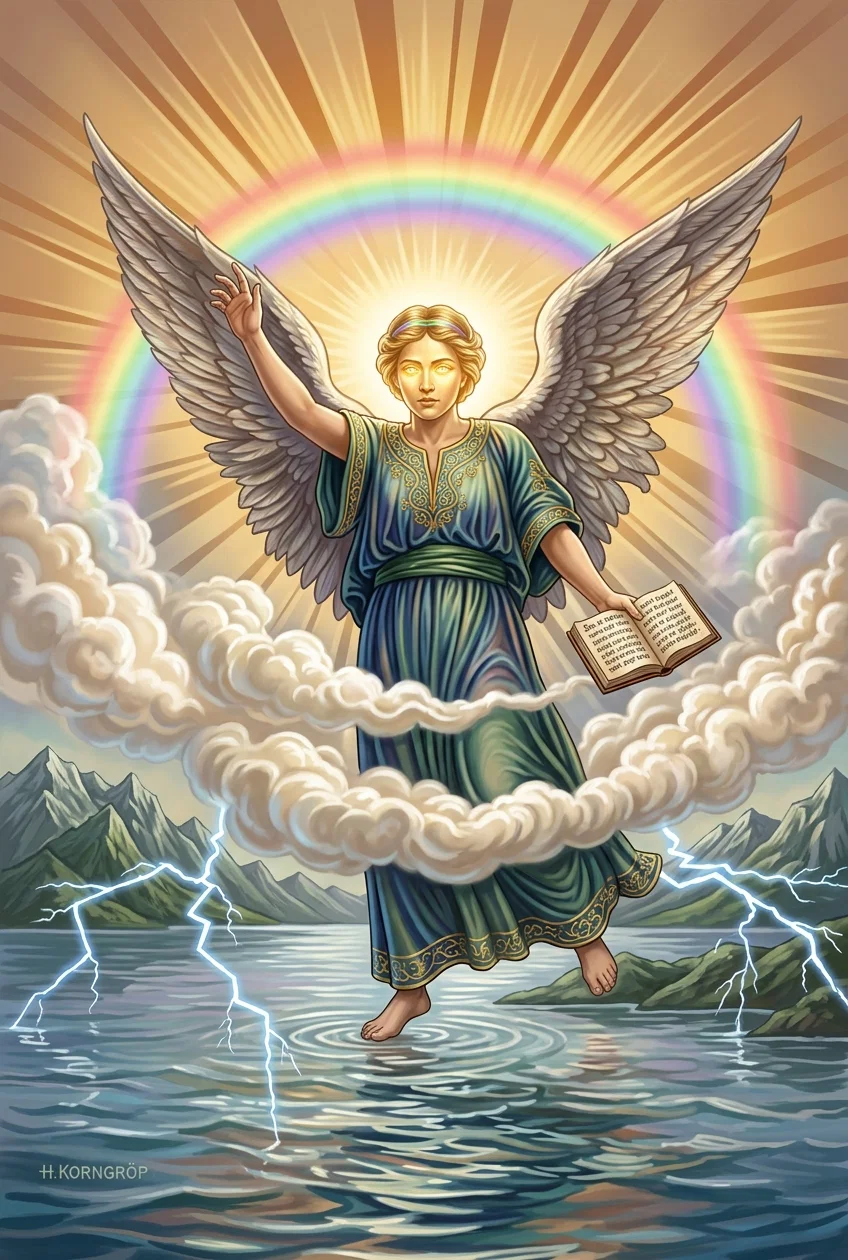
According to this scripture, the book of Daniel was to be a sealed book to a definite time, termed “the time of the end.” To John, on the Isle of Patmos, was given a revelation of what was to take place at “the time of the end.” He described it as follows: “I saw another mighty angel come down from heaven, clothed with a cloud: and a rainbow was upon his head, and his face was as it were the sun, and his feet as pillars of fire: and he had in his hand a little book open: and he set his right foot upon the sea, and his left foot on the earth, . . . and sware by Him that liveth forever and ever, . . . that there should be time no longer.” Rev. 10: 1, 2, 6.
At the period known as “the time of the end,” a great religious awakening occurred. Delaven I. Leonard, in his most excellent book, “The Story of Oberlin,” in referring to this period, says: “These seasons of refreshing, which first made their appearance in 1798-1803, were of frequent occurrence for two decades throughout the Eastern and Middle States, in 1825-1845 were well-nigh continuous and extended to the West and South. In 1826-1830, some two hundred thousand converts joined the leading denominations, sixty thousand of whom were young men. It is estimated that in five months following February 1, 1831, as many as fifteen hundred towns were profoundly stirred by the Spirit of God, and as many more spiritually aroused in a good degree, with more than fifty thousand renewed in heart and life, over three hundred of them in the colleges.”

Grandest Since Apostolic Times

In his judgment, there followed “the grandest advance of Christ’s kingdom since the apostles’ age.” We are informed that during a period of thirty years, or from “1800-1830, not far from one million one hundred thousand were added to four churches, thus increasing the Congregational membership twofold, the Baptist threefold, the Presbyterian fourfold, and the Methodist sevenfold.” “Mr. Finney, for forty years Oberlin’s central spiritual force and most eminent representative, had no equal between the oceans in calling men to repentance and leading them into newness of life. Naturally this was the beginning time of missions at home and abroad. . . . With thousands, reaching the destitute and perishing with the bread of life, came to be a ruling passion.”
The American Board; the American Home Missionary Society; the American Sunday School Union, which voted the famous project to open a Sunday school in every practicable place within two years; the American Bible Society, whose aim it was to supply every family in the land with a copy of the Scriptures; the American Tract Society; and other similar evangelizing agencies,—all these sprang into existence during this period. It is estimated that while for the period 1820-1829, the total contributions for missions, both home and foreign, were only $233,826, they increased tenfold during 1830-1839, rising to $2,342,712.
Organizations were formed to aid young men to enter the ministry. The theological seminaries rapidly increased in numbers. Colleges were multiplied. Religious literature felt the same grand impulse forward and upward. Tract and Sunday school societies and private publishers began to furnish religious tracts and books for the millions. The modern religious newspaper began its career.
To aid in the work of speedily carrying the gospel to all the world, the ox cart, the stagecoach, and the canal had to give place to more rapid transit,—the steamboat, the locomotive, et cetera. It was “the day of preparation,” when men should “run to and fro,” and knowledge should be increased.

Confusing Voices Heard

While this religious awakening was sweeping over the world like a great tidal wave, Satan was not inactive. He did his utmost to confuse minds and lead men astray. The “Lo, here,” and “Lo, there,” was everywhere heard. Probably never before did so many sects and “isms” arise in so brief a space of time. The movement inaugurated by Joseph Smith, which led to the organization of the Mormons, had its origin at this time. The Rochester rappings, or modern spiritualism, also sprang into being.
At this time, too, amid the multitude of voices, was heard another, proclaiming the end of all things. William Miller, an unassuming farmer, for many years a student of prophecy, to whose mind were unfolded the prophecies of the books of Daniel and the Revelation, appeared with the solemn message, “Fear God, and give glory to Him; for the hour of His Judgment is come: and worship Him that made heaven, and earth, and the sea, and the fountains of waters.” Rev. 14: 7. From the prophetic page, he produced evidence, which none could gainsay who made a study of the Bible, that in the year 1844, the great Judgment day would begin. This he fully believed to be the second coming of Christ.
This message was attended by a power that brought conviction to thousands. It was not a denominational movement, for ministers of all denominations joined in its proclamation. The entire religious world was stirred. The believers forsook their farms, and gathered together, fully expecting translation; but the time passed, and Jesus did not come. The disappointment was bitter, and to them unexplainable. The little book open in the angel’s hand, which contained truths that were “sweet as honey” to the believers, now had become “bitter.” Rev. 10: 1-10.

“Thou Must Prophesy Again”

The attention of Captain Joseph Bates, who had been a firm believer in Miller’s message, was directed to the eleventh verse of the tenth chapter of Revelation, “Thou must prophesy again before many peoples, and nations, and tongues, and kings.” “Can it be possible,” he queried, “that we have in some way made a mistake in the event that was to take place at the close of this long prophetic period? It would seem so,” he said, “from the expression, ‘Thou must prophesy again.’” This led him to study more closely into what was meant by “The hour of His Judgment is come.” He soon discovered that the Judgment hour precedes the second coming of Christ; for when Christ comes, His reward is with Him. He does not come to judge, but to give rewards. Rev. 22: 11, 12.
Mr. Bates found also that the cleansing of the sanctuary was not the cleansing of this world by fire, as had been supposed, but it was a work of investigation, or judgment, which was to be carried on in the heavenly sanctuary. The books were to be opened in heaven. “The Judgment was set, and the books were opened.” Dan. 7: 9, 10.
In studying the temple of God, he found these words: “There was seen in His temple the ark of His testament.” Rev. 11: 19. The ark contained the Ten Commandments, the fourth of which was being ignorantly violated by the entire Christian world. The commandment reads, “The seventh day is the Sabbath of the Lord thy God;” but all the world were keeping the first day. In Daniel 7, he found that through the papal power, this heathen day, known as “the venerable day of the sun,” was to be changed into a Christian institution, and that a demand would be made upon the Christian world, by this power, to acknowledge her authority by observing the first day of the week in place of the true Sabbath, the seventh day, the memorial of creation. He then understood clearly the significance of the words, “Thou must prophesy again before many peoples, and nations, and tongues, and kings.” Rev. 10: 11.

Sabbath Reform and the Judgment Hour

Sabbath reform now became associated with the proclamation of the Judgment hour. And the remarkable spiritual revivals that followed at the time of the end, had associated with them various educational reforms. The Bible became the basis in the entire system

Reforms That Were Marveled at

(Continued from page 4)
of education, not as something added, as a fringe to a rug, but woven into the entire fabric. At Oberlin and other educational institutions, manual labor was considered an essential part of every student’s program. From three to four hours’ work daily was demanded of each. Women received educational advantages, and were gradually placed on a plane with men. Church schools for the benefit of the children were started. The poor were cared for.
That period also marked the beginning of a great wave of temperance and health reform. Abstinence from tea, coffee, condiments, and all other unwholesome foods and drinks was urged.
Simplicity of dress was advocated. At Oberlin College, a covenant was drawn up, to which all were expected to subscribe, in which it was agreed that, in order “that we may have time and health for the Lord’s service, we will eat only plain and wholesome food, renouncing all bad habits, and especially smoking and chewing tobacco, unless it is necessary as a medicine, and deny ourselves all strong and unnecessary drinks, as far as practicable.” President Finney, with boundless energy and perseverance, pushed these reforms. They were by him considered an essential part of the gospel. Total abstinence from tea and coffee, and from the use of spices of any kind, was required. For several years, vegetarianism found quite general acceptance among both residents and students, not only at Oberlin, but at many of the other colleges. The habitual use of tea was on more than one occasion made a matter of church discipline.

Temperance Societies Organized

At this period, too, temperance societies were organized. At first, these only forbade the use of spirituous liquors, wine being permissible if used in moderation. As far as I am able to learn, Captain Joseph Bates, the first Seventh-day Adventist, was the organizer of the first teetotal temperance society in America. This society was organized in 1827, at Fair Haven, Massachusetts. Here originated the name “teetotalers.” He not merely abandoned the use of all alcoholic beverages, but gave up the use of tobacco, tea, coffee, and meats. Out of these reforms have grown the numerous sanitariums, vegetarian cafés, and food manufactories that are carried on by this denomination.

The Light Grows Dim

Many responded to the message that was borne by Miller and his associates, but the great institutions of learning and the popular churches rejected it. Those who held the views taught by Miller, and advocated them, were no longer tolerated in these bodies, and this led to a separation. The light which had shone so clearly, now began to grow dim. One by one, the important reforms were abandoned by these organizations. Manual labor was replaced by the gymnasium. The Bible was relegated to a secondary place in education, while church schools were altogether abandoned.
At Oberlin, we are told, when “some of the students ventured to ask for a taste of pork, mutton, or their equivalent, an emphatic negative was at first returned.” The executive committee, however, was finally compelled to permit flesh foods to be served to the students. Tea and coffee also began to be used by the students and by the faculty; and still later, the use of tobacco insidiously crept in.
That which took place at Oberlin, also took place in Williams College, Hudson College, Lane Seminary, and other educational institutions. The reforms had followed as a result of the spiritual awakening and the revival of that age. The decline in spirituality resulted in carelessness pertaining to bodily habits. Little was said after this, in the church, in regard to dress reform and food reform.
According to Revelation 14, just before the coming of the Son of man in the clouds, to reap the harvest of the earth (Rev. 14: 14), a message will go to the world, announcing the fall of Babylon, and calling upon lovers of truth and righteousness to “come out of her.” Rev. 18: 4. The same spiritual awakening will again bring about great reforms in physical habits. Revivals that are not accompanied by such reforms should be regarded with suspicion. Again “there shall be one fold, and one shepherd;” and among the called-out will again be found the reforms which belonged to the church before she fell.

When the Atonement Is Completed

The Great Day in Type and Antitype
By S. PARKER SMITH
The result of the daily service in the earthly sanctuary was that the burden of sin was in figure removed from the sinner and transferred to the sanctuary. The broken law in the ark demanded the blood, or life, of the transgressor, and in the sanctuary was provided the “blood of others” that was accepted at the typical throne of grace in place of the sinner’s life.
After he had received the atonement and forgiveness of sins, the question was, would he continue in his sins? If the sinner chose to go back into sin, he might; but could he carry his atonement and forgiveness back into sin with him? — No, indeed! If the forgiven and cleansed sinner, the righteous man, turned away from his righteousness, that is, from the forgiveness and cleansing he had received, these were not to be mentioned or reckoned to him longer, but he must die for his iniquity. Ezek. 18: 26.
Many, however, continued steadfast in the blessings they had received. Many who had left their first love renewed their hope, and received atonement and forgiveness anew. When individuals came to the last great day of the sanctuary services that they would ever participate in, completing the type, these cases were in figure forever sealed. Those who had lost the righteousness they had obtained through the provisions of the gospel as then summed up and presented to them through the sanctuary services, and all those who did not on the day of atonement cease from their works and afflict their souls, were cut off from the people.
The record of this “day of atonement” is found in Leviticus, chapters 16 and 23. This day was the day of final cleansing and remission of sins for the sanctuary and the people.

Two Kids Were Taken

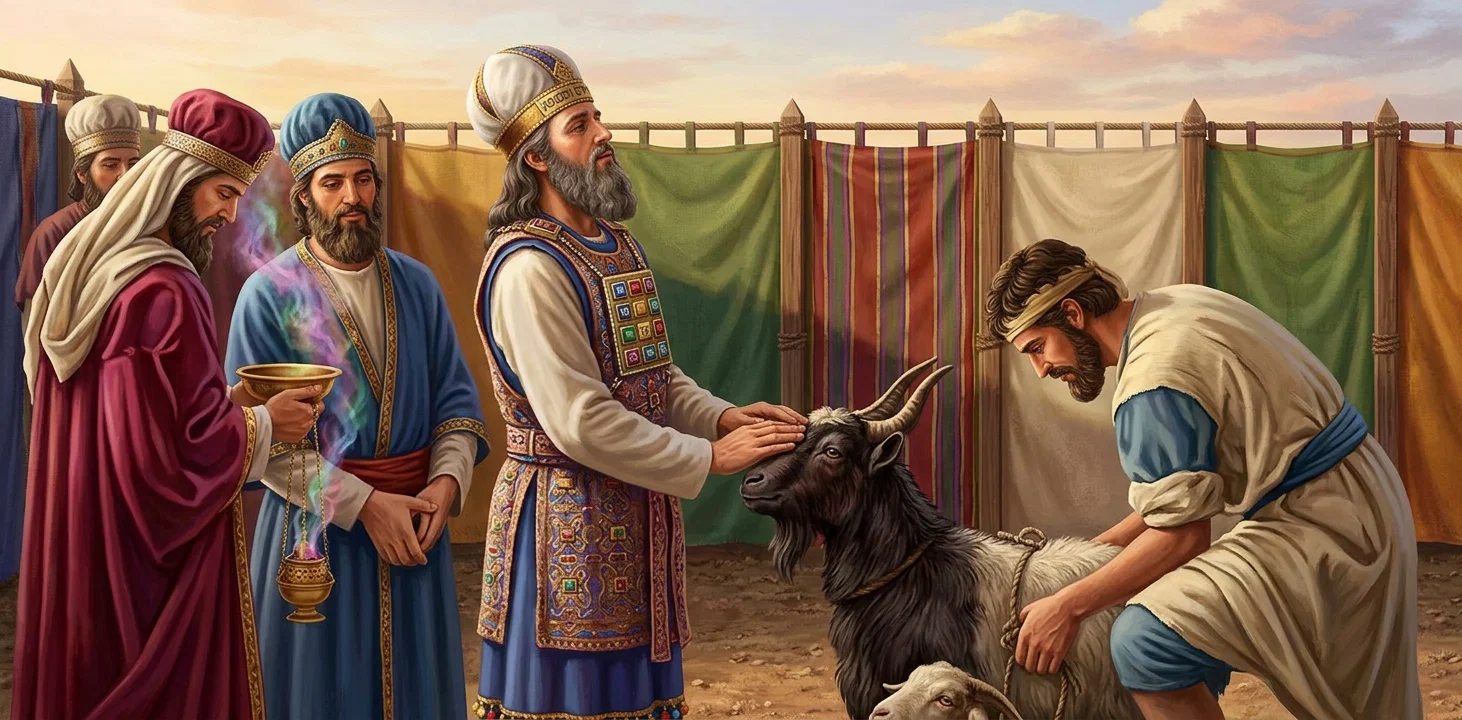
On this typical day of atonement, the high priest took two kids of the goats for a sin offering. By lot, one was chosen to be the Lord’s, or the sin offering for the people, while the other was to be the scapegoat. When everything was ready, the high priest took the goat on which the Lord’s lot fell, and killed it. He then took of its blood, and passing alone within the second veil, sprinkled it before the mercy seat.
He thus made “an atonement for the holy place, because of the uncleanness of the children of Israel, and because of their transgressions in all their sins.” Then he did the same “for the tabernacle of the congregation” and for “the altar that is before the Lord.” Lev. 16: 16-18. When he had so done, he had made an end of reconciling or cleansing the sanctuary.
The object lesson by which God taught men in those days the way of salvation was complete. Yet one thing more needed to be done to insure finally the blessedness of the people. By this last act, sin was in type removed from their presence. The typical accuser of our brethren was rebuked. See Rev. 12: 10 and Zech. 3: 1, 2, etc.
Every reminder of their past sinfulness was banished, nevermore to annoy and vex them with its presence. This last act was the placing of the iniquities of the children of Israel upon the head of the scapegoat and sending him away into the wilderness, or land of separation, a land not inhabited.

Disposing Completely of Sin

The service with the slain goat revealed the divine plan for disposing completely of the sins of those who, by confession, repentance, and faith in God, had placed the burden of their sins upon the sanctuary and its atoning blood. They had maintained the beginning of their confidence steadfast unto the end, and their enjoyment of the blessings of the sanctuary was sealed to them beyond the possibility of loss.
Thus the service with the slain goat represents the final blotting out of confessed sins. The service with the scapegoat represents the disposal of unconfessed sins. These were outwardly the same as the confessed sins whose burden was assumed by the sanctuary; but they pertained to a different individual altogether.
The placing of sins upon the head of the scapegoat was simply a declaration that he was guilty, without confession and without the benefits of the sanctuary, of the very sins which Israel had committed and confessed; for the scapegoat represents Satan, the instigator and author of all sin. Not till the scapegoat was banished, with all sin yet unatoned for upon him, did the people of God feel themselves free from its hated presence. This was the atonement with the scapegoat. The antitype of the atonement with the slain goat, or the sin offering that was for the people, is brought to view in Hebrews 9. The antitype of the atonement with the live goat is shown in Revelation 20, Malachi 4, and Matthew 25. In Hebrews 9, the apostle Paul gives a brief but comprehensive outline of the sanctuary on earth and the sanctuary in heaven, and the cleansing of each. In verses 22, 23, he says it was necessary that the patterns of things in the heavens should be purified by the blood of calves and goats, for “without shedding of blood is no remission.” “But the heavenly things themselves,” he continues, must be purified “with better sacrifices than these.” By “better sacrifices,” the context shows that he means Christ, who once in the end of the world appeared to put away sin from the heavenly sanctuary, and thus cleanse it, “by the sacrifice of Himself.” Heb. 9: 26.

Satan the Scapegoat

The antitype of the scapegoat is Satan. The atonement made with the scapegoat had no connection with the atonement for the people of Israel; for it was not introduced until after the sanctuary had been reconciled, and the people of God had been made clean from all their sins before the Lord by the blood of the slain goat, the sin offering for the people, whose antitype is Christ. Consequently for the antitype of this sin offering and atonement, we must look for one which has no value for others, which avails only so far as to pay in full the penalty for the sins of those who die. This is found in the final sin offering in the lake of fire prepared for the devil and his angels. Matt. 25: 41. Then will come the day described by Malachi, which shall burn as an oven, when the proud, and all that do wickedly, shall be stubble, and shall be burned up root and branch. Read Mal. 4: 1. This will be a thousand years after the people of God have been taken to heaven, a thousand years after they have been declared clean in God’s sight, and their sins, as far as they are concerned, blotted out and destroyed.
Thus all sin will come to an end, wiped out in the lifeblood of those who have committed it, and the universe will be eternally free from its presence. Thus the record in Leviticus 16 reveals in figure not only the closing of the work in the heavenly sanctuary for the blotting out of confessed and forgiven sins, but the final blotting out of sin and sinners from the universe, root and branch. Then will appear the new heavens and the new earth, “wherein dwelleth righteousness.”

Why Needed in Heaven?

It is an interesting question how anything in the heavens can need purifying, reconciling, or cleansing. As stated before, the daily service resulted in figuratively transferring the burden of sin from the sinner to the sanctuary and the priest, with the atoning blood; and there it would remain so long, and only so long, as the repentant sinner chose to keep it there. His sin was there as a matter to be disposed of, a court case to be decided only after the last bit of evidence was presented. On the last day of the ritual year, every case reached a final decision, and every individual was sealed unalterably for life or death. Thus the sanctuary was defiled, and thus it was cleansed. For the people having been made free from all their sins, or else cut off from among the people, every case that had been before the tribunal of the sanctuary was thereby disposed of, and it was no longer necessary to make remembrance of sins there, and defile it with their consideration. So it is with the true sanctuary. Sin is not literally and bodily transported from earth to heaven. The abode of sin is in the heart and conscience of those who sin; and there is where the real cleansing takes place, which results in the cleansing of the sanctuary above. Heb. 9: 14; 10: 22.
The thing that is literally and really transferred to heaven is the burden of sin. In 1 John 2: 1, we read: “My little children, these things write I unto you, that ye sin not. And if any man sin, we have an Advocate with the Father, Jesus Christ the righteous.” We have One who “maketh intercession for us” “at the right hand of God.” Rom. 8: 34. But this intercession is made only for those who come to God by Him. Heb. 7: 25. The lesson for us is clear. When the Holy Spirit, that strives with all flesh, has convicted us of sin, it is our privilege to go boldly to the throne of grace, and place that sin in the hands of our Advocate. The burden of that sin, the burden of our guilt or innocence in regard to it, now rests upon the sanctuary. No longer should we struggle to free ourselves from its defilement, or try to cover it with the filthy rags of our own works of penance and atonement; for our Advocate is mighty to save. All He asks is that we keep our cases in His hands, and He will bring forth our righteousness as the light, and our judgment as the noonday. Ps. 37: 5, 6. (Continued on page 6)

When the Atonement Is Completed

(Continued from page 5)
Said the patriarch Job, “Who can bring a clean thing out of an unclean?” Looking to ourselves, our only answer is to say with him, “Not one.” But looking to the sanctuary on high, we can say, “Thank God there is One.” “For there is none other name under heaven given among men, whereby we must be saved.” Acts 4: 12.
Christ can bring a clean thing out of an unclean, because He has creative power. And though equal with the Father, “He humbled Himself, and became obedient unto death, even the death of the cross.” The world was not with Him as He went into the tomb. He died alone, and left us an example, that we should follow His steps. He died to our sins once, and arose again, free, justified from those sins. And now, since for Himself He needs no such justification, and since “the Father judgeth no man, but hath committed all judgment unto the Son,” He has the infinite merits of His sacrifice to bestow on whomsoever He will. His death on the cross, under the imputed sins of the whole world, is acceptable before the law in place of the sinner’s death. And that death is imputed to all who will claim it by faith; and then they may reckon themselves “dead indeed unto sin, but alive unto God through Jesus Christ” their Lord. Rom. 6: 11. This Jesus “hath God exalted with His right hand to be a Prince and a Saviour, for to give repentance to Israel, and forgiveness of sins.” Acts 5: 31. And He is able to save to the uttermost all that come unto God through Him, no matter how unclean they are. He is the Author of eternal salvation to all that obey Him, “the Author and Finisher of our faith.”

Business & Religion

CAN THEY BE UNITED?
Mrs. L. D. AVERY-STUTTLE
“NOT slothful in business; fervent in spirit; serving the Lord.” Rom. 12:11. There is something in the religion of Jesus Christ that ought to be wonderfully appealing to the business man.
“What!” you exclaim. “Surely you must be mistaken. Why, I can scarcely think of more than a half dozen good business men—really good ones—who are even professed Christians.”
Yet I repeat, with ever increasing emphasis, that in my humble opinion, there ought to be a greater percentage of business men in the church of Jesus Christ than of any other class. Why?—Because, first, in order to be a successful man of business, one must accustom one's self to weighing evidence, both pro and con; second, one must appreciate the value of time; third, he must sense the necessity of making preparation for the future. Lacking these three qualifications, no man, however clever he may be by nature, can hope to attain any measure of success as a business man.
“Well,” you say, “I grant you this much; but what has all this to do with the matter of becoming religious—in other words, a Bible Christian?”
I am just now thinking of a man, a former friend of mine, who met with a painful, and sudden death some years ago. This man possessed all the qualifications above mentioned in at least sufficient degree to become what the world calls a successful man. He was noted for his desire and his ability to weigh evidence. Consequently, in all matters pertaining to business, he generally arrived at the truth. Had he been satisfied with less than this, his business must have suffered. Besides this, he knew the value of time. This he considered as his greatest asset. Furthermore, our friend fully believed in preparing for the future—that is, so far as the relieving of future temporal needs was concerned. His family never suffered for the necessities of life. His wife and children were well fed and well clothed. This much was assured, because the husband and father obeyed the first part of our text carefully.
But he never went any farther; he ignored the last part entirely. I used often to wonder about this. He was so careful to weigh every evidence pertaining to his business, that I wondered why he was so careless about weighing the evidence of the truthfulness of God's word. And as he industriously improved his time to the best possible worldly advantage, it seemed strange that he gave no thought to eternity, and that the same foresight which led him to such diligence in laying up a goodly store of perishable riches to supply future imaginary needs, should not have been used in laying up treasures in heaven.
Too bad! And it was astonishing, too.
“But,” some one objects, “it is not possible to unite business with religion; they won't mix.”

A Religious Business Man

Well, that is not what one young man thought, and he was one of the most remarkable business men I ever heard of or read about. His story is wonderful. It ought to be an inspiration to every one, and especially to business men. While yet very young, this man was cruelly abandoned by his own relatives, and finally imprisoned at the instigation of an unscrupulous woman. Seemingly everything militated against a successful business career. But that young man became one of the greatest financiers whose biography has been left us. By his marvelous sagacity and business foresight, he supplied an entire nation with food, and even sold to others. He prevented wholesale starvation, by his simple and effective method of food distribution. His responsibilities were greater than those of a Morgan or a Rockefeller.
He was an intellectual giant. But this was not all; he was a spiritual giant as well. He was acquainted with God; and that which he did, the Lord made to prosper. Ah, there is the secret!
This is conclusive to my mind, even were this the only example, that Christianity and godliness ought to appeal to the business man. Oh, why should the days pass by with no thought of eternity? Surely there is no day however crowded with care, but that the busiest of us might find time for one earnest prayer, one grateful acknowledgment to Him who alone ‘giveth us power to get wealth.’
But wait! I hear somebody speak. It is a very busy man, but he turns his head away from his ledger just long enough to answer me. His eyes are weary and restless, and there are dark lines beneath them. His cheek and brow are flushed and feverish. The hand that holds the pen which poises over the ledger trembles a little. Hear him:
“I have a family dependent upon me. If I fail, they must suffer. I have not yet made good. I want a home of my own. When my business stands upon a firm basis, then I will prepare for the other world. I must look out for the realities first. I must not neglect a certainty for an uncertainty.”
You want a home, my friend? That is a very laudable desire. Please listen; I have the greatest real estate proposition you ever listened to. I am sure it will appeal to you:
The Lord Jesus Christ is offering you a mansion in a city which He has taken the pains to describe very minutely. In the last two chapters of the Book, He gives you a description of it, which will thrill your soul to read. He gives the length of the city, and the breadth of it. He describes the composition of its walls, and the very material that composes its massive gates. He speaks of its lighting system. He names all the gems that garnish its immense, twelve-terraced foundation. He tells you about the fruit of the country, and of the wonderful river that gladdens its inhabitants; and as if this were not enough, you are told what material has been used in paving its shining streets.
Surely you will want one of the mansions of this wondrous city. Best of all, it is free. The invitation is alike to rich and poor. Listen as the sweet voice rings and echoes down the ages. The same invitation holds good to-day:
“Whosoever will, let him come.”
Then let us rejoice and be glad in the prospect, And anchor our faith in His glorious word; And soon the fair mansions of beauty we'll enter, And evermore rest in the arms of the Lord.

The Glory Land

By Worthie Harris Holden
In the glory land, there is joy and light; For where Jesus dwells, there can be no night; And the world knows not of the earnest given To the one who lives in the light of heaven. If the echo here is so sweet and true, Ah, what can await in that land, for you!
Have you had some word from the glory land Which your heart has heard and can understand? When you gave yourself, did the angels sing And rejoice that love was your offering? Is your home a Bethel, where angels dwell? Have you Jesus' peace, which no words can tell!

Liberty of Conscience

“LIBERTY of conscience is the inalienable right of each individual, and he is entitled to the protection of the state in the free exercise of his natural right so long as he does not interfere with the equal rights of his fellow men.”
Continue reading: The Times That Are upon Us