Signs of the Times, December 12, 1916

Proclaimed with Elijah Power
Earlier text: The Times That Are upon Us

A State Religion and Its Carnival of Blood

No human being can be genuinely human except in the unqualified enjoyment of this right.
By GEORGE W. RINE
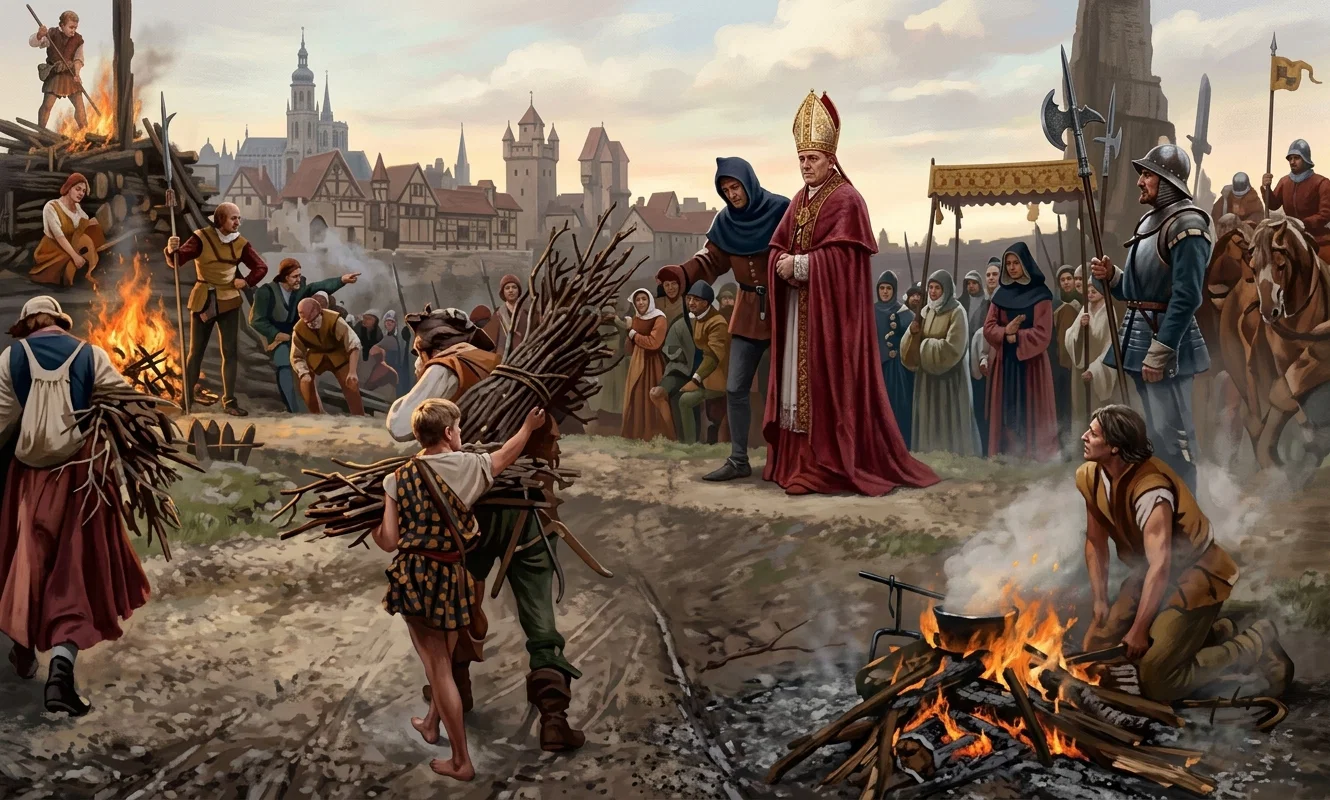
The uniform testimony of history is that an alliance between the church and the state inevitably issues in persecution. The annals of man afford no exception to the truth of this proposition. Complete freedom of choice is simply impossible where the authority of civil magistrates is made to cover religious dogma and practice. Yet it is morally and sacredly incumbent upon every human soul to maintain that very freedom inviolate, inasmuch as freedom of will—of choosing—inheres originally and therefore eternally in every man.
God created man rational and therefore free, for real intelligence apart from intellectual and moral freedom is not thinkable. The exercise of personal liberty in the realm of religion is an inalienable right. And no human being can be genuinely human except in the unqualified enjoyment of this right.

Greater than Gods

Early Christianity had its home in the Roman world. Like all pagan nations, the Roman state was theocratic. The head of the Roman world was not only her emperor, but her pontiff. He was conceived to be the embodiment of all religious as well as all civil authority. He was cherished as not only the prime ecclesiastical official, but he was actually apotheosised, and received the homage which was ascribed only to the gods. The Roman Empire was therefore the quintessence of church and state union. The genius of her state religion was polytheistic, and her pantheon embraced the emperor.
Naturally, then, the whole hierarchy of her officialdom was bent on the extirpation of any religious system which repudiated the authority of the state in the sphere of religion. In keeping with the express instruction of their Lord, the primitive Christians rendered to God alone the things that are God's; but at the same time, they freely rendered to Caesar the things that were Caesar's. Pursuing this course undeviatingly, they were brought into inevitable clash with the Roman magistrates.
Of course, we must not suppose that martyrdom was an everyday occurrence. In particular places and at particular times, considerable periods might pass during which the Christians were but little annoyed. The possibility, however, was always present; and once called to an account, the Christian must count on rigorous penalties, unless willing to save himself by recantation.
The state officials through whom the laws against the observance of religious practices foreign to the Roman practices were executed, were the governors of provinces or the prefects of cities. These were, as a rule, cruel men. They employed torture to break down Christian constancy, and lent themselves to give magisterial expression to the popular passion of scorn and hate against the followers of Christ.

Stained with Children's Blood

It was in the reign of Nero, A. D. 54-68, that one of the earliest and one of the most cruel persecutions in the history of the church took place. Many hundreds were condemned. “Mockery of every sort was added to their deaths. Covered with the skins of beasts, they were torn by dogs and perished, or were nailed to crosses, or were doomed to flames and burned to serve as a nightly illumination” of the emperor's gardens. One of the victims of the Neronian persecution was the illustrious apostle Paul.
Though Marcus Aurelius was one of the best of Roman emperors, benevolent and scholarly in his instincts, yet he permitted a campaign of terrible persecution to be waged against the Christians. The Roman rulers, though in many respects tolerant, were inexorable in their demands that persons of every faith should recognize and honor the national gods by burning incense before their statues. The Christians were inflexible in their refusal to do this; for, as an essentially idolatrous rite, it was interdicted by the first two precepts of the law of God.
A prominent victim of this outburst of persecution writes, “First we were driven from the baths, buildings, and all places open to the public; then we had to suffer the insults, blows, and violent acts of an infuriated multitude.” The authorities subjected Christians to hideous torture, and threw them to the beasts in the amphitheater for the diversion and amusement of the spectators.

Prefer Death to Liberty

The famous bishop, Justin Martyr, and a dozen humbler believers, were beheaded for their peremptory refusal to burn incense to the gods. Another famous victim was Polycarp of Smyrna, an old man of eighty-six. He passed through the awful ordeal of burning at the stake with perfect courage and even composure. The martyrdom of the venerable Polycarp closed the persecution in which scourging, and death by fire and wild beasts, had proved the absolute constancy of the church at Smyrna.
The emperor Decius, who reigned from 249 to 251, held the conviction that the progress of Christianity was ominous. At his instigation, special legislation was undertaken for the purpose of eradicating the menacing religion. His edict of A. D. 250 decreed that all Christians should be cited to perform the rites of the state religion. Those who fled were to have their property con- fiscated, and to be put to death if they returned. Priests were to be promptly put to death. Torture and death soon became the portion of all who resisted the decree.
The next year, Decius died in battle; but his laws were relentlessly executed against Christians by his successor, Valerian. Beginning with a system of coercion, which did not prove entirely effective, he proceeded to decree the execution of clergymen, the degradation of men of rank, with the confiscation of their goods, followed by death should they prove obstinate.

Women in Chains

Women who proved intractable were to be banished, and compelled to work in chains for the imperial service. Alexander of Jerusalem, Fabianus of Rome, Babylas of Antioch, and other bishops, were among the martyrs under Decius; Sixtus of Rome, and Cyprian of Carthage, were some of the bishops who suffered death under Valerian. In this pitiless onset against the worshipers of Christ, vast numbers sealed their faith with their blood, while hundreds of nominal believers gave way under pressure and abjured their faith.
In the year 303, Diocletian, persuaded by his colleague Galerius, began to prosecute the last great persecution under the pagan rule of Rome. By an imperial decree, it was ordered that the churches of the Christians should be demolished, and they themselves outlawed.
The fugitives were hunted in forests and caves. Some of the victims were burned. Others were thrown to the wild beasts. Many “were put to death by every torture and by every mode that ingenious cruelty could devise. But nothing could shake the constancy of their faith.” When at last Galerius, the successor of Diocletian, saw that it was by no means possible to exterminate the Christians or suppress their faith, he granted them toleration, and even requested their prayers for his welfare.

Religion Below Zero

The rapid declension in spirituality, and the departure from the plain teachings of the Bible, in the great body of the Christian church, during the second, third, and fourth centuries of our era, resulted in the evolution of the papacy, or the Roman Catholic hierarchy. It is a patent fact of history that during the long, dark centuries of the Middle Ages, this apostate church dominated the ecclesiastical world and to a large extent the political world.
All those whose religious faith and practice were in the least at variance with the dogmas of the papal church were stigmatized as heretics, and all heretics were placed under the ban of the church. They were denounced as infamous. It was decreed that the protection of the law and the claims of equity must be denied them. In one of his bulls, Pope Marcellus declared, “It is permitted neither to think nor to teach otherwise than the court of Rome directs.”
A fiat of Pope Innocent III runs thus: “The secular powers shall swear to exterminate all heretics condemned by the church; and if they do not, they shall be anathema.” In the “Directory for the Inquisitors,” we find the following: “A heretic merits the pains of fire. By the gospel, the canons, civil law, and customs, heretics must be burned.” “Heretics must be sought after, and be corrected or exterminated.”
That the Roman Catholic Church was in vital alliance with the state during the long medieval period is a commonplace of history. And the papacy itself does not deny that today she maintains an alliance with the state wherever such union is practicable. Again, no one who knows his history, will deny that during the period between the sixth century and the middle of the eighteenth century, multiplied millions of people suffered death for conscience' sake, at the instigation of the authorities of the Roman Church.

Philip's Cruel Crusade

The Waldenses, who were largely instrumental in preparing the way for the Protestant Reformation on the continent of Europe, suffered the loss of approximately one million souls—put to death for their faith, at the hands of papal inquisitors. Impartial historians inform us that within thirty years, the Jesuits compassed the death of nine hundred thousand persons. Under the duke of Alva, thirty-six thousand “heretics” were executed by the common hangman. Doubtless my readers are familiar with the history of the Inquisition, through the operation of which the blood of one hundred fifty thousand martyrs was shed. In the south of France was a body of Christians called the Albigenses, who had so far departed from papal orthodoxy that Pope Innocent III pronounced them “more wicked than Saracens.”
After a vain endeavor to reclaim them to the Roman faith, he called upon the French king, Philip II, and his nobles, to lead a crusade against the heretics. A great number of the French nobles responded eagerly to the call of the pope. “A great part of Languedoc, the beautiful country of the Albigenses, was made a desert, the inhabitants being slaughtered, and the cities burned. … The Albigensian heresy was soon wholly extirpated by the tribunal of the Inquisition which was set up in the country.”—Myers.
The foregoing facts are adduced only for the purpose of illustrating how that perfect system of a union of church and state, which obtained in Europe during the long ages of papal domination, resulted in a continual carnival of suffering and death inflicted upon those who could not conscientiously subscribe to the creed of the Roman Church. All those horrors would have been impossible had church and state, in harmony with the teachings of Christ, remained separate.

Pope of “Reformed” Church

When the Protestant Reformation of the sixteenth century found its way into England, in the reign of Henry VIII, it resulted in many changes in the articles of faith of the national church, but it left the church and the state as firmly united as they had been under papal domination. The Episcopalian or Anglican Church displaced the Catholic Church as the state church.
King Henry became virtually the pope of the “reformed” church, though he did not bear that title. After he had definitively broken with the pope, the obsequious English Parliament, in 1534, made haste to pass the Act of Supremacy, which declared Henry to be without reservation the sole head of the church, making denial thereof high treason.
Nearly all the members of the English clergy jointly declared Henry to be the supreme head on earth of the Church of England. Parliament humiliated itself still further by promulgating that law, in itself the nullification of all law, which authorized Henry, by his simple proclamation, to declare whatever opinions he disliked, heretical, and punishable with death. “No one was now safe who did not openly side with the king.” Sir Thomas More, who had been lord chancellor, and the aged Bishop Fisher, were executed, because, as devout Catholics, they could not affirm that they conscientiously believed that Henry was morally entitled to be the head of the English church.

England on Her Knees

In 1553, Mary Tudor, daughter of Henry VIII by his first wife, succeeded her brother, Edward VI, to the throne. She was an ardently pious Catholic. It was not long until the Protestants were at her feet, and she struck without mercy. She was determined to effect the submission of the English church to the Roman see.
American Press Assn.
The pope sent his legate to London to receive the submission of the realm. The two Houses decided, by a formal vote, to return to the obedience of Rome, and received on their knees the absolution which freed the realm from the guilt incurred by its schism and heresy. Laws against heresy were re-enacted, and Mary pressed the execution of all irreclaimable Protestants. In 1555, the work of death began. For months, Smithfield was kept ablaze with the burning of heretics. Some of the famous martyrs were Rowland Taylor, vicar of Hadleigh; Hooper, bishop of Gloucester; Ferrar, bishop of St. Davids; Bishop Ridley, of London; the famous Latimer; and Thomas Cranmer, formerly archbishop of Canterbury.
The historian Green writes regarding the progress of the work of persecution: “It had spread now from bishops and priests to the people itself. The sufferers were sent in batches to the flames. … Seventy-three Protestants of Colchester were dragged through the streets of London, tied to a single rope.”

Buried Alive

In the three and a half years of the persecution, nearly three hundred victims had perished at the stake. It was during nearly the same years that Philip II of Spain covered Holland with the graves of Protestants, tortured and put to the most horrible deaths, or buried alive, by tens of thousands.
A complete separation of church and state, agreeably with the plain teachings of the Author of Christianity, would have made these orgies of human massacre absolutely impossible.
After the overthrow of the Commonwealth, and the restoration to the English throne of the Stuarts in the person of Charles II, the Episcopal form of worship was restored; and in the course of a few years, severe laws were enacted against Nonconformists, or Dissenters. The Corporation Act ordered all holders of municipal offices to renounce the Puritan Covenant, and take the sacrament of the Church of England.
A little later, the Act of Uniformity enforced the use of the Episcopal prayer book upon all ministers of religion and congregations. Next, this was followed by a law forbidding all religious assemblies whatever, except such as worshiped according to the established church. Finally, the Five-Mile Act forbade all dissenting clergymen from teaching in schools, or settling within five miles of an incorporated town.
By these drastic laws, two thousand Presbyterian clergymen were driven from their parishes, and reduced to dire distress. “The old and the weak soon found their refuge in the grave.” The Covenanters were pursued with bugle and bloodhound, like so many wild animals, by Claverhouse and his brutal men, who, without mercy, hanged and drowned those who gathered secretly in glens and caves to worship God. They were condemned to death without trial.

Twelve Years in Jail

“The father of a family would be dragged from his cottage by the soldiers, asked if he would take the test of conformity to the Church of England. … If not, then came the order, ‘Make ready—present—fire!’—and there lay the corpse of the rebel.” The famous John Bunyan was arrested and convicted of having “devilishly and perniciously abstained from coming to church”—the established church. He spent twelve years in Bedford jail for his loyalty to conscience. Again, could these horrors have taken place if England had had no religious laws upon her civil statute books?
Former President Taft not long ago said: “We speak with great satisfaction of the fact that our ancestors came to this country to establish freedom of religion. Well, if you are to be exact, they came to establish freedom for their own religion, and not the freedom of anybody else's religion.” This lamentable fact is especially true in respect to the Episcopalians who founded the colony of Virginia, and of the Puritans who established the colonies of Massachusetts and Connecticut.
The legislative bodies of these colonies enacted laws forbidding the doing of ordinary labor on Sunday, laws requiring all to attend the regular church services on that day, laws forbidding travel, games, and other forms of sport or recreation “on the Lord's day, commonly called Sunday.”

Hanging Mrs. Dyer

We all know how the magistrates and clergy of Boston drove away such men as Roger Williams, and others whose opinions they disapproved. At length, some people who held very unpopular views came to Boston, and refused to go away when they were ordered to go. These strong-willed people were Quakers. Though they were sincere, earnest, thoroughly pure and upright, they were abhorred by the Puritans of New England; and all the colonies except Rhode Island made laws against them.
They insisted on coming into Massa-chusetts in order to teach their doctrines. Those who came were banished under penalty of death; but they returned, and finally, in 1659, two were hanged in Boston Common. The year following, Mrs. Dyer, a Quaker woman of good family, was hanged at the same place; and in 1661, there was one more victim. Popular opinion made the execution of the death penalty impracticable after 1661; but after that time, many persons of this faith were imprisoned or whipped. Yet they were only exercising an inalienable right.

Fettered by Tests

In nearly all the English colonies of the New World, men's religious rights were fettered by tests, and violated by penalties, solely because the civil magistrates undertook to enact and execute laws bearing upon beliefs and practices which are distinctively religious.
We see, then, that persecution is the logical and inevitable sequel of a union of the ecclesiastical and the civil powers. History teaches nothing more clearly than the fact that persecution for religious opinions or practices never occurred where religion and politics—state and church—were kept wholly separated. The same cause produces, and always will produce the same effect. No wonder that General Grant so urgently pressed the dictum, “Keep the church and the state forever separate.”

PIPE DREAMS OF PEACE

“THE American Neutral Conference Committee” of New York City has started a movement throughout the nation to present an appeal to the warring nations of Europe in behalf of peace. It is proposed to secure millions of signatures to petitions in favor of the project. In California alone, an effort will be made to secure at least 500,000 signatures. The people will be asked to declare their faith in “world organization for the development of international coöperation and the settlement of international disputes.”
While this is one of the newest movements looking toward world federation for peace, it is characteristic of the times. Society throughout the world is vibrant with the thought of internationalism. Men are springing up everywhere declaring in favor of it. This is one of the most portentous signs of our times. Such events are strikingly and literally fulfilling prophecies like those in the second of Isaiah and the fourth of Micah, which tell of the “many peoples” and the “many nations” that, in the last days, will say they will beat their swords into plowshares and their spears into pruning hooks. But if we study these prophecies closely, we will see that these people are working under a delusion, and that they will not be successful in their international plans. While the plans may be commendable in themselves, there is not the moral strength in society in these times to ripen them into success. The foundations of society throughout the world have been undermined.
The greed of the age, the lust for power, and the contempt for true morality, on the part of vast multitudes, have created conditions that can only be met by the infinite power of Jehovah, as manifested through the second coming of Christ. We should not allow ourselves to be deceived by the plausible presentations of many well meaning men and women of our day. The dreams of peace will not be realized. The coming of the Prince of peace Himself in the clouds of heaven is the only thing that can settle the quarrels of the warring nations in these times.

STARVING AMID HEAPS OF GOLD

WALL STREET is talking about “the menace of the gold flood,” and is telling us that “the banking community is being drowned in gold.” While the financiers thus have more gold than they know what to do with, we are informed that “New York faces the worst food famine in its history. Already the city’s poor are in unprecedented distress owing to the exorbitant prices of food and coal.”
On a recent Sunday, it was stated from various pulpits in New York City, that thousands of men, women, and children were suffering; and it was conceded that “if remedies are not promptly found before winter sets in, starvation will exact a toll that will startle the world.” “Hundreds of persons,” we are informed, are appealing “to the churches for aid.” “Large numbers of children are attending school in a half-starved condition.” In some sections, from twenty to thirty per cent of the children are said to be underfed.
The millionaire food speculator is charged with the responsibility, in a large measure, for these conditions, partly because he is withholding supplies of food in order to extort the highest prices, and partly because he is shipping supplies abroad, where high prices prevail.
From London comes the word: “One of the troublesome features of the situation is, how to equalize matters between the rich and the poor. On the theory of ‘equality of sacrifice for all,’ which is a popular war watchword, the newspapers are making a sensation of luxurious menus in fashionable restaurants and homes.”
Another statement reads: “The government has to deal, on the one hand, with increased consumption, due partly to the better scale of living practiced by a large section of the people getting unusual wages from war work; and on the other hand, with decreased imports and decreased home production.”
These times are giving us strangely contradictory conditions,—rivers of gold in New York that are perplexing financiers, yet thousands of the people crying for bread; Europe drenched with human blood, yet the newspapers “making a sensation of luxurious menus in fashionable restaurants and homes.” This world has gone mad. The sensibilities of men are blunted. They do not seem to realize the tremendous portent of the conditions that are upon us. We cannot be far from the time when God will fulfill His word by saying to the men who are so insanely grasping for gold: “Go to now, ye rich men, weep and howl for your miseries that shall come upon you. . . . Behold, the hire of the laborers who have reaped down your fields, which is of you kept back by fraud, crieth: and the cries of them which have reaped are entered into the ears of the Lord of sabaoth. Ye have lived in pleasure on the earth, and been wanton; ye have nourished your hearts, as in a day of slaughter. . . . Be patient therefore, brethren, unto the coming of the Lord.” James 5: 1-7.

MUST HAVE A NEW BIRTH

The man wise in the wisdom of this world needs to learn one fundamental lesson before he can ever be really wise. When one of the most learned men of the Jewish nation came to Christ, he was confronted squarely with this great, essential truth: “Except a man be born again, he cannot see the kingdom of God.” John 3:3. If without this birth he cannot see the kingdom of God, certainly, without this birth he cannot enter into the kingdom of God. Verse 5.
Here are the two great fundamental principles of life. Here are the two great principles of Christian education, first things to know. Without a spiritual birth, a man cannot enter God’s kingdom; and more than that, he will not personally recognize such a kingdom. He cannot see it.
This moral density cannot be removed by culture, any more than a bramble bush can be turned into a La France rose by pruning it, digging about its roots, fertilizing it,—in short, cultivating it. Cultivation brings out the nature already existing; it does not change nature.
The lesson of Christ to Nicodemus is, that man must be changed in nature before he can develop Godward. Yet God has promised to make a man more precious than the gold of Ophir, more precious than the costliest gems; but mind you, the promise is, to make him so, for of himself he is not so. This change of nature is not something entirely new in the world in which we live. All about us are examples of the same definite necessity. L. A. R.

SATAN CAUGHT IN HIS OWN TRAP

OVER and over again in the world's history has God taken Satan's plans and worked His own purposes out of them. And more than that, the devil has never yet got ahead of God. He has never planned a thing, in all his work of deception, but that God has outwitted him, if I may use the term, in that thing.
The devil started that scheme of sending Joseph down into Egypt. He thought he was rid of Joseph all right. Then he started a famine in Canaan, and thought he would starve the boys. But after he got everything just as he wanted it, God took those two things,—the sin of the brothers in sending Joseph down into Egypt, and the famine in Canaan,—and made the Hebrew people out of them.
When it came to the crucifixion of Christ, the devil had everything just as he wanted it. He had the Jews in the greatest apostasy they had ever been in; and he had Judas Iscariot, his own special representative, in the college of the apostles. But that thing which seemed to the devil like the biggest victory he ever gained was the very thing that put him out of business for all time.
There is coming a time when the devil will say, Those commandment keepers must get off the earth. Then God will say, That is true, and I am going to take them off before you are ready to have them go.
If we will only trust fully in God, He will take some of the worst schemes of the devil, and turn them into the greatest blessings for His people. I say again that Satan has never yet outwitted God in a single plan that he has laid. P. T. M.

Calvary’s Drawing Power

BY GEORGE F. ENOCH
“AND I, if I be lifted up from the earth, will draw all men unto Me.” John 12: 32. There is no other power in all the world equal to the drawing power of the cross of Calvary. Into that act of self-sacrifice was put the heart of Christ, the love of God; and through it the mighty influence of the Holy Spirit was brought within reach of the hearts of men.
In the beginning, Satan had declared that the law of God was unfair; that justice and mercy were not consistent; and that the law once broken, the sinner could neither be pardoned nor afterwards obey its holy precepts. God’s answer to this charge is the cross of Calvary and the mediatorial work of Christ.
God did not change His law, nor did He set aside its claims on man. He sacrificed Himself in Jesus, thus furnishing a Substitute, and then exalted Jesus to His own right hand, to work out, in the lives of those who would yield to Him, the principles of His character, thus making Jesus man’s Surety.

Marching Down the Broad Road

Jesus is “the propitiation . . . for the sins of the whole world.” Still the majority of the people of this earth march down the broad road to eternal ruin, and will perish as utterly as though no atonement had been made for them. Therefore the work of Christ as Mediator must be as much a part of the at-one-ment as was His death upon the cross. In fact, Jesus now lives at the right hand of the Father, for the purpose of making actual in the lives of men all that was made possible by His death on the cross; and the death on the cross proves ineffective in so far as it does not thus transform the lives of men.
“The law requires righteousness—a righteous life, a perfect character; and this, man has not to give. He cannot meet the claims of God’s holy law. But Christ, coming to the earth as man, lived a holy life, and developed a perfect character. These He offers as a free gift to all who will receive them. His life stands for the life of men. Thus they have remission of sins that are past, through the forbearance of God.
“More than this, Christ imbues man with the attributes of God. He builds up the human character after the similitude of the divine character, a goodly fabric of spiritual strength and beauty. Thus the very righteousness of the law is fulfilled in the believer in Christ. God can ‘be just, and the justifier of him which believeth in Jesus.’”—“Desire of Ages,” page 762.

Entering the Gates of Pearl

This work of building up in the lives of men a character after the similitude of the divine character is the work of the Holy Spirit. Jesus is our Advocate in heaven; the Holy Spirit is our Helper on earth. From the time we are born into the kingdom of Christ, the Holy Spirit makes our body His temple. As long as life shall last, He abides with us, building up in our hearts, brick by brick, that beautiful structure whose Pattern is in heaven.
This is the work of sanctification. It is not the work of an hour, nor of a day, but of a lifetime. Jesus, before leaving the world, rejoiced that He had brought within our reach such a mighty Helper. He knew that every heart that would surrender to the power of divine grace would have this Spirit ever abiding within, giving constant victory over sin.
This subject is of vital importance. No mere shibboleth will pass us through the gates of pearl. Nor will a mere shibboleth change our hearts and lives. The only way to work out in our character the reformation made possible by this blessed truth, is by long, persevering effort and stern conflict. Until Satan is bound, we will be compelled to fight this battle daily, subdue self, and overcome besetting sins. This daily battle is not evidence that we have not been pardoned, but rather that Satan is still alive.

Captives to Satan’s Chariots

In this mortal life, we will never be able to say that we have fully attained. Like the apostle, our cry will be: “Not as though I had already attained, either were already perfect: but I follow after, if that I may apprehend that for which also I am apprehended of Christ Jesus. Brethren, I count not myself to have apprehended: but this one thing I do, forgetting those things which are behind, and reaching forth unto those things which are before, I press toward the mark for the prize of the high calling of God in Christ Jesus.” Phil. 3: 12-14.
Each one can either resist this transforming power of the Holy Spirit in his life, indulge his selfish desires, and be bound an unwilling captive to Satan’s chariot; or, daily dying to self, and in humility overcoming sin, he can have the sweet presence of the Holy Spirit ever in his life as Sanctifier, building up in his heart a beautiful character that will stand the test of the Judgment.
“For our conversation is in heaven; from whence also we look for the Saviour, the Lord Jesus Christ: who shall change our vile body, that it may be fashioned like unto His glorious body, according to the working whereby He is able even to subdue all things unto Himself.” Phil. 3: 20, 21.

Alcohol Is Not a Food

ALCOHOL cannot, in the nature of the case, be considered a food.
Alcohol decreases the efficiency of muscle, glands, and nervous system.
Alcohol is a narcotic in its drug action.
Alcohol given in minute quantities to lower animals seriously impairs fecundity; it leads to race suicide.—Winfield S. Hall, M. D.

Civil Government and Conscience

“CIVIL government has no jurisdiction ever in the realm of conscience. The attempted exercise of authority in matters of faith is a flagrant usurpation of power.”
Continue reading: TEN CENTURIES OF SILENCE