The Youth’s Instructor, Vol. 63, No. 49.

Interesting and Instructive Books

The Youth’s Instructor

Dec 7, 1915

Review and Herald Publishing Assn. · Takoma Park Station, Washington, D. C. · Dec 7, 1915

Interesting and Instructive Books

“Woodsy Neighbors of Tan and Teckle”

MR. CHARLES LEE BRYSON is the author of “Woodsy Neighbors of Tan and Teckle,” which is a clever and most interesting nature book for children. It is so charmingly written that the adult reader also finds much entertainment in it. The chapter headings are:—
A Strange Flyer, The New Musician, The Woods Rabbit, The Silk Maker, A Weird Laugh, The Cannibal’s Fate, A Living Nest, The Minnow, An Unpleasant Neighbor, The Acrobat, The Mournful Singer, Old Croaker’s Cousin, The Soil Maker, Striped Face, The Scourge of Man, The Walking Stone, Another Killer, A New Way to Fly, Snake or Fish? The Carpenter, The Black Sheep, The Bird Who Doesn’t Care, Supper Time and Bedtime, Winter at Last.
Price, $1.25.

“Fifty Missionary Heroes” and “Missionary Crusaders”

“Fifty Missionary Heroes” gives brief sketches of fifty of the world’s most noted missionaries. Price, $1. “Missionary Crusaders” gives longer biographical sketches of David Brainerd, John Eliot, Hans Egede, William Duncan, Robert Moffat, David Livingstone, Adoniram Judson, and other noted missionaries. Price, $1.

“God’s Book and God’s Boy”

The name of this book shows that it will interest a large number of readers. All who want to know more about the Bible and more about the boy whom minister, teacher, and parent must deal with, will be helpfully entertained and instructed by reading Dr. A. F. Schauffler’s book entitled “God’s Book and God’s Boy.” Dr. Schauffler for more than a quarter of a century has been enthusiastically studying both the Book and the boy, and he knows how to tell the results of his study in a helpful way. Price, $1.

“The Glory of the Commonplace”

This is a book of helpful illustrations compiled from J. R. Miller’s writings. Price, $1.
These books may all be obtained from the Review and Herald Publishing Association, Takoma Park, Washington, D. C.

“The Vatican and the War”

ELDER J. N. LOUGHBOROUGH, one of the oldest pioneers in this message, now living, writes as follows of Dr. Magan’s new book, “The Vatican and the War:” —
“I have just completed a careful reading of the book, and trust it may receive the wide circulation which it deserves. I was especially interested in the many quotations from Catholic authors, predicting the very things which Bible students declare will take place, thus showing forth the determination of the Papacy that, out of the dreadful struggle of nations, it will again have power over them, even as the Scriptures predict, but which so few see. This volume is destined to open the eyes of many to the real situation.”
In three weeks from the time the first copies of the book were received from the bindery, the first edition of 25,000 was exhausted.
The book combines history with the unfailing word of prophecy in a most interesting and scholarly manner, giving a brief history of Rome, and an accurate account of the events that have led up to the European war. It contains 128 pages, and is illustrated. Price of single copies, postpaid, paper cover, 25 cents; cloth, 50 cents. In lots of ten or more, the price of the paper cover is but 12½ cents each, and the cloth 25 cents, plus transportation. Order of your tract society.

Request for Denominational Literature from Miami Reader

Lillian Hickok, R. F. D. 2, Miami, Florida, desires clean copies of any of our denominational literature.

Notes on Riley, Longview Hospital, Washington, and Bulgarian Roses

ON October 7, James Whitcomb Riley was honored everywhere in Indiana, on the occasion of his sixty-second birthday.
IN forty-eight years no editor, it is claimed, has been received as a patient at the Longview Hospital of Cincinnati, Ohio, and only one reporter. In that time the hospital has treated 2,159 housewives, 1,264 laborers, 553 domestic servants, 580 other servants, 305 farmers, 249 clerks, and 141 carpenters.
BOOKER T. WASHINGTON, the ablest leader of the Negro race, died on November 4, at his home in Tuskegee, Alabama. Bright's disease and hardening of the arteries caused his death. Dr. Washington's one purpose in his remarkable and untiring work as founder and principal of Tuskegee Institute, and as a national lecturer, has been the uplift and betterment of his race. He labored for the intellectual, industrial, and agricultural development of his people, and his labors have brought acceptable results.
IN Bulgaria roses are everywhere. They have bloomed there for centuries, but never so profusely as during the last two centuries. At certain seasons the air is almost oppressive with the scent of countless blossoms. Rose gardens, large and small, lie in all directions, in the plains and valleys and on the hillsides. They present a medley of whites, pinks, reds, and yellows, embedded in a mass of many-shaded leaves. Kazanlik is the world's greatest center for the preparation of attar of roses and rose water. Ages ago Persia and India supplied immense quantities of the former, but now its production has fallen very low. For some years France, Germany, and a few other states have manufactured a cheaper but inferior attar. Repeated experiments, however, have proved that no artificial product can equal the natural one.

In the South Seas

LILY M. THORPE
Far away from the noise of battle and whirling cities, and the pushing, restless crowd of men and things, set like an emerald in the azure seas of the South Pacific, is a group of islands where the miracle of God is being performed, and where glittering bands of holy ones strive with the hordes of darkness for the supremacy in human hearts.
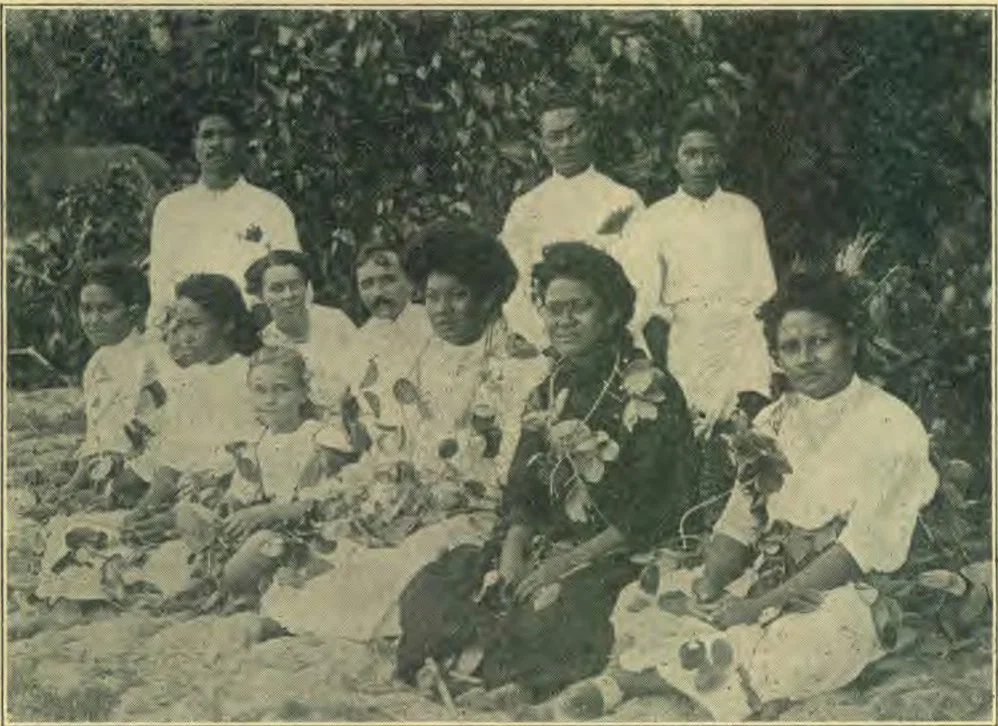
Did I say, far from the noise of battle? While this is indeed so as far as the greatest of all earthly wars is concerned, yet there is an unseen battle field here in the hearts of men, a place where battles are fought and won. Yes, thank God, they are won. Words are but tame instruments with which to convey to the mind’s eye those spiritual battles fought between powers seen and unseen—agonizing battles that leave their refining marks upon the features of our Tongan young men and young women. People say to us, “Your young women are different from others here.” Yes, they are different, and we are thankful.
There are many temptations to allure our boys and girls from the message and the church. Young men of pleasing mien but dissolute habits will attend our services with a great show of piety, in order to attract young women who live in our home. Others will sneak around in the dead of night and climb up to the girls’ windows and endeavor to get an invitation to go in. But our girls have proved stanch, and will not willingly bring dishonor upon the cause of God; and so their tempters content themselves in indulging in sneers and mockery. One of our girls, named Lusiane, a very sweet-tempered girl, which, by the way, is a wonderful thing, as the Tongans are fostered in passion and ill temper from their babyhood, was offered twelve dollars by a Free Church minister if she would attend his church. She excused herself, thanked him for his offer, and today stands stanchly for the truth.
We have Prince Tugi’s first cousin living with us, who takes her share in the work of the home, and loves the truth. Tugi (pronounced Tungi) offered her a head place in his household, but she begged that he would allow her to remain with us, much to the chagrin of the prince.
Another one of our girls received an offer of marriage from an American schoolmaster in Vavau, who says she is the cleverest and best-educated girl in Vavau. This girl’s father told her to make her own decision, and she decided by refusing the offer through her father. This is a signal victory, as the height of a Tongan woman’s ambition is to marry a white man. The sad part of this, however, is that some white men are not honorable enough to marry Tongan girls.
And now what shall I tell you about some of our boys? I call them boys, but in reality they are men; in other words, “boys grown tall.” Lasitani is a happy boy of twenty-one years, with a persuasive dimple in each cheek that gains him ready admittance into all hearts. To hear his great laugh and see his sometimes bantering ways, would not lead one to suppose that Lasitani knows what it is to strive with himself and agonize in prayer. But he has been shaken with emotion when he has poured out his heart to God for having given way to temptations that others had been strong enough to resist. He and his friend Famatau (a baptized member; Lasitani is not baptized) went to another part of the group to spend their Christmas holidays. Before they left, my husband admonished Lasitani, knowing his weakness, and Lasitani said, “Yes, I will try,” and went away with a new light in his eyes. He meant to try, and doubtless he did. But hear his own words when he came back: “Master, I am sorry I have fallen, and I hate my ways. Famatau is good, though; and when I saw him wave away the girls with the kara and the cigarettes and their allurements, I wondered how he could be so unmoved. But me? I am weak and bad.”
“SOME GIRLS CAN USE IN THIS WAY TEN ORANGES AT A TIME”
It is like cutting off the right hand and plucking out an eye for the boys and girls to give up smoking tobacco and drinking kara, the national drink. They are born and live in the fumes and dregs of these things. And then the old, established custom of friends and relatives meeting together almost every day of the week at kara parties, is inducive to the destruction of the young. But we thank the Master because Lasitani has now eschewed these things, and is living with us and entering heartily into the work. Famatau is teaching a school for the government, and out of his wages provides Lasitani’s food and clothes. We found this out by accident, as Famatau does not believe in letting his left hand know what his right one does. He is a silent man, but well liked . [[FIGURE]]
Then there is Finau, a baptized member of the church, who was formerly second head boy in the government hospital here. He has been connected with us for seven or eight years, and has clung to the truth in spite of opposition. This brings me to Lasikau, his bosom friend, who is one of our trusted boys. As I write, the voices of our little daughter and Lasikau reach me from the schoolhouse. She is explaining Matt. 5:38-48 to him. There is occasionally a heated argument when Lasikau fails to grasp such verses as verse 39, which she insists must literally mean what they say.
Lasikau carries in his face, and his heart, too, I ween, the marks of his tremendous struggle against tobacco and kara. It is likely that the majority of those who read these words have never known the craving for tobacco, and its soothing power. You do not know what it means to have every fiber of your being clamoring for the nicotine when you try to resist. You do not know what it means sternly to say No when the pungent fumes of the weed from one source or another float across your supersensitized senses, and the drumbeat in your temples is maddening, and your parched mouth refuses to be satisfied. You do not know what it means to agonize with your face pressed to the hard ground, and to rise up purged from the taste of the subtle curse. Lasikau knows all this, and his absolute happiness testifies to his emancipation.
Mate is head man in the Vavau government hospital, and is soon to be baptized. A deep sense of satisfaction steals over one when one looks at Mate’s large, expressive face, curling hair, and massive shoulders. His weight is nearly three hundred pounds. He is one of the most popular men in the whole of Vavau, chiefly because of his ministrations in his hospital capacity. But his popularity, as well as his being a big chief, has been his undoing, and the Christ stretched his hand very far into the miry clay in order to bring Mate up from the depths; and now where the truth is concerned, his mind is as the mind of a little child. His prayers and testimonies are expressive of a happy heart. He told my husband of a dream he had which decided him for the truth. He was standing on the doctor’s veranda, when his attention was directed to the sky, and he saw Christ with the angels descending to the earth. He described his terror as being abject until he saw Mr. Thorpe looking so happy, and then he (Mate) ran after him. The influence of this dream has never left Mate, and colors most of his actions. He bids fair to become a valuable worker. Pray for him.
Henele is a married man, and is greatly interested in the truth. It was not clear to him why we began the Sabbath at sunset, but when his questions were answered satisfactorily, his face beamed again, and he said, “I am so happy, because I now understand verses that before were dark to me.” He teaches our singing class, and accompanies the singing with his cornet. Remember Henele in your prayers, as his home affairs are very unhappy, and Satan is loath to let him go.
This would not be complete if I remained silent about George, David, and Fagalei, and their efforts to excel in school and in their industrial work.
Much could be written about the everyday trials and cares of our work, but they vanish in the shout of victory over Satan’s hosts, as the morning dew disappears in the light of the sun. Discouragements, disappointments—what are they? They are nothing when the streaming light from heaven lightens our pathway.
OUR TONGAN TRANSLATOR, VAI BUNA, AND HER FRIEND AT HER RIGHT
A YOUNG PEOPLE'S GATHERING BY THE SEASIDE

The Better Way

Who serves his country best? Not he who, for a brief and stormy space, Leads forth her armies to the fierce affray. Short is the time of turmoil and unrest, Long years of peace succeed it and replace: There is a better way.
Who serves his country best? Not he who guides her senates in debate, And makes the laws which are her prop and stay; Not he who wears the poet’s purple vest, And sings her songs of love and grief and fate: There is a better way.
He serves his country best Who joins the tide that lifts her nobly on; For speech has myriad tongues for every day, And song but one; and law within her breast Is stronger than the graven law on stone: There is a better way.
He serves his country best Who lives pure life, and doeth righteous deed, And walks straight paths, however others stray, And leaves his sons, as uttermost bequest, A stainless record which all men may read: This is the better way.
— Susan Coolidge.

Sin’s Strongest Bulwark

“My thoughts are not your thoughts, neither are your ways my ways, saith the Lord.”
Were we asked to point out the strongest bulwarks of sin, we should begin, no doubt, by calling attention to the dens of vice connected with the saloons and such places, which lead men and women on to complete abandonment in sin. Surely God knows the terrible depths of all this, and such lives seem utterly hopeless to us, so far as the gospel’s being able to reach them is concerned. While we look here for the stronghold of sin, God somehow sees another. Read carefully the following paragraph:—
“The strongest bulwark of vice in our world is not the iniquitous life of the abandoned sinner or the degraded outcast; it is that life which otherwise appears virtuous, honorable, and noble, but in which one sin is fostered, one vice indulged. To the soul that is struggling in secret against some giant temptation, trembling upon the very verge of the precipice, such an example is one of the most powerful enticements to sin. He who, endowed with high conceptions of life and truth and honor, does yet willfully transgress one precept of God’s holy law, has perverted his noble gifts into a lure to sin. Genius, talent, sympathy, even generous and kindly deeds, may thus become decoys of Satan to entice souls over the precipice of ruin.”
—“Education,” page 150.
This is a startling statement. God’s eye is upon that struggling one seeking to overcome some “giant temptation.” He knows that that soul is not looking to the abandoned sinner for help, but the hands are outstretched toward those whose lives appear very exemplary. These are looked to to catch the slipping one before he plunges into the awful abyss below. That one sin fostered, that one vice indulged, by this apparently good person, destroys his power to save the struggling one, and the soul plunges down to eternal ruin.
“Neither do I condemn thee: go, and sin no more,” was spoken to Mary Magdalene, as Jesus reached out his hand to lift her up from the pit of sin, rather than to the Pharisee who had lured her into the snare, and then turned to be her accuser. His most scathing denunciations were directed to the hypocritical Pharisee who posed as the guide to life, while in very fact, because of being corrupt in heart and life, he was luring souls on to eternal ruin.
And so it is that one fostered sin, whatever it is, one vice indulged, whatever its nature, in the heart of the otherwise virtuous and noble, the Lord says stands today in the world as sin’s strongest bulwark.
That searching question that passed from lip to lip in the upper room, as Jesus spent his last evening with his loved ones, is one that we all, old and young, may well ask of him who still reads unerringly every heart, “Lord, is it I?” T. E. BOWEN.

Hand and Heart

GIVE me the man who loves his work However hard it be, Who only thinks it mean to shirk, And hates the hireling’s plea. Though hands and face be hard and brown, That were a trivial thing; Who wears his duty like a crown Is every inch a king.
No honest labor can disgrace The man whose heart is true; He scorns himself and not his place Who can consent to do In any mean, half-hearted way The smallest service given; The common tasks of every day Are all ordained of Heaven.
Is thy task lowly? Lift it up! Let it be wisely willed. Who cares how poor and plain the cup, So it be richly filled? Be it thy task to till the soil, Or do the drudge’s part, Fill thy poor cup of common toil With nobleness of heart.
— Rev. Robert Whitaker.

Higher Education

UNDOUBTEDLY there are differences in opinion as to what constitutes higher education; but when we consider the matter thoughtfully and carefully, I am sure that if any one kind of education is higher than another it is a knowledge of God.
There are many branches of learning that it is necessary for us to study in order that we may be fitted for the duties of life, but a knowledge of God and of our relation to him and his requirements is far more important and higher than any other knowledge that human beings can possibly obtain.
Moral character is of infinitely greater value than anything else in this world; and if we would be instructed in the things that build moral character, the Bible is the source to which we must go for instruction. Any education that does not involve a knowledge of the Holy Scriptures, which impart a knowledge of God and our duty to him and to man, can in no sense be reasonably considered the highest kind of education. J. W. LOWE.

The Power of Kind Words

KIND words are the music of the world. They have a power which seems to be beyond natural causes, as if they were some angel’s song which had lost its way and come on earth. It seems as if they could almost do what in reality God alone can do to soften the hard and angry hearts of men.—Faber.

Truth as the Foundation of Beauty and Perfection

TRUTH is the foundation and reason of the perfection of beauty, for of whatever stature a thing may be, it cannot be beautiful and perfect unless it be truly what it should be, and possess truly all that it should have.—La Rochefoucauld.

“Who Then Can Be Saved?”—The Way of Life Made Plain
JOHN N. QUINN
A COMPANY of women and children were standing on the wharf of a fashionable watering place, awaiting a steamer on which were their husbands and fathers. A splash was heard, and the next moment revealed a young man struggling in the water.
He was unable to swim, and in his frantic efforts to save himself drifted into deeper water and farther from shore. The women found only one person who could render assistance—an old sailor, standing by motionless, watching the poor man drown. They appealed to him in vain.
As the young man arose the first time, a look of horror came over the little company, who were unwilling to be witnesses of his death. When all hope was gone, the sailor leaped into the water and when the youth arose for the last time, seized him and bore him safely to shore. As the women gathered around him, he said, “I was compelled to wait until he had ceased trying to save himself; for I could save him only when he was without strength.”
Sin drowns men in destruction and perdition. 1 Tim. 6:9.
“When we were yet without strength, . . . Christ died for the ungodly.” Rom. 5:6.
“What must I do to be saved?” (Acts 16:30) is ever the questioning cry of the sinner.
Heaven’s answer is: “If we confess our sins, he is faithful and just to forgive us our sins, and to cleanse us from all unrighteousness.” 1 John 1:9. Then after confession comes belief. We must believe that our sins are forgiven, because if we confess, God must forgive, for he cannot lie.
“Believe on the Lord Jesus Christ, and thou shalt be saved,” says the apostle Paul. Acts 16:31. “By grace ye are saved.” Eph. 2:5. “This is the work of God, that ye believe on him whom he hath sent.” John 6:29. “He that believeth on him is not condemned.” John 3:18. “Behold the Lamb of God, which taketh away the sin of the world.” John 1:29. “As many as received him, to them gave he power to become the sons of God, even to them that believe on his name.” John 1:12.
Believe God, and receive the forgiveness of sin. In the days of Napoleon a certain prince had proved a traitor. He was convicted, and the death warrant had been signed. His wife believed him innocent. For five hours she stood in the street, waiting for an audience with the emperor. With tears she pleaded that her husband might be spared. Napoleon looked at her without pity. At last he turned to Talleyrand and held out his hand. A letter was given to him. Napoleon handed this letter to the kneeling woman. “Is this your husband’s handwriting, madam?” Her sobs were her only answer. “What other evidence have we of the prince’s treachery?” “None other, sire,” replied Talleyrand. “Princess,” said Napoleon, tenderly, “put this letter in the fire, and then we shall have none.”
Jesus nailed sin to the cross, and there destroyed the evidence of our guilt. Just as the Israelite in whose veins coursed the poison of the serpent, was healed by a look outward and upward to the pole, where in type he saw sin conquered and the enemy’s head bruised (Gen. 3:15), so the one who beholds in Jesus the Lamb of God who bore sin to the cross, is pardoned and made whole.
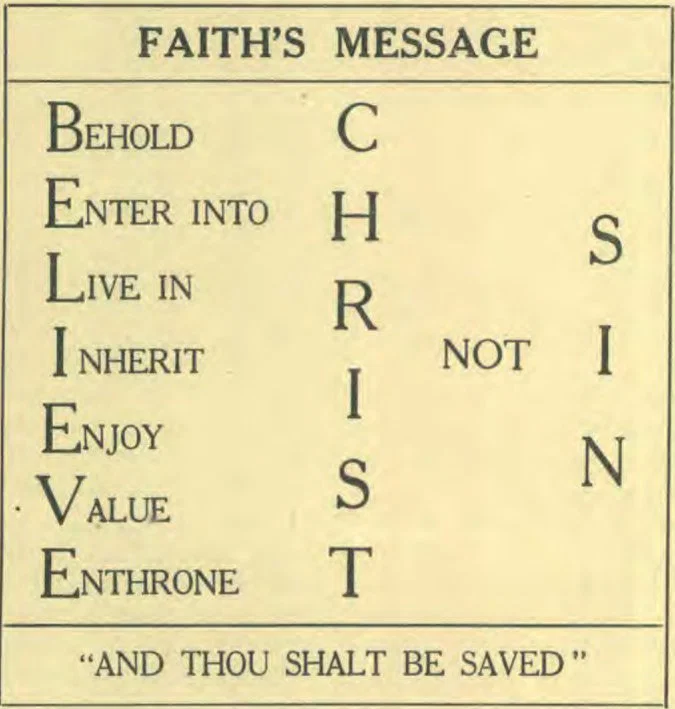
Behold Christ. By beholding we become changed.
Behold him as the Lamb of God, who bore your sins in his own body to the tree. Sin will certainly carry the sinner into the lake of fire. God has laid on Christ all your iniquity; then why bear it and its bondage? By faith, lay your hands on the Lamb of God, and by confession transfer your sin to Christ. Then God will declare his own righteousness for the remission of your sins, now past. God’s own righteousness will bear you into the everlasting kingdom of the God and Father of our Lord Jesus Christ. Behold Christ, and sin and self will disappear. See in Christ your surety, one who satisfies every claim of God’s law for you. Just as Judah became surety for Benjamin, so Jesus has become your surety to God, and his position at the right hand of the Father is his assurance that he will one day make you to sit with him on his throne of eternal glory.
Enter into Christ. The person fleeing for safety to one of the cities of refuge in the land of Palestine, in crossing the threshold could look his pursuing avenger in the face with quiet confidence. Once inside the city, no law could condemn him. There is no condemnation to the one who is in Christ Jesus. Rom. 8:1. He believes, and receives Christ (John 1:12), therefore he is not condemned. John 3:18. Uncondemned persons are not confined in prisons, neither are they punished. There is no wrath awaiting the one who by faith has entered into God’s strong tower—he is safe. Prov. 18:10.
Live in Christ. Our associations transform us. No one could live with Paul and remain indifferent to the salvation of his fellow men. To live with Christ is to behold his glory, and be changed from one glory to another glory of character, until at last the fullness of Christ is revealed in us. 2 Cor. 3:18; 4:4-6. Things that grow do so without consciousness of effort, so he who lives in Christ is growing in grace. He is not working into God’s favor. He believes, and receives; therefore he makes his boast in the Lord, and is glad.
Inherit Christ. On the death of the testator, his executor carries out the provisions of his will. The bequests cannot be purchased—they are received and enjoyed. Christ’s will was ratified on the cross, and the believer is made Christ’s heir, to receive everything promised. The gospel has promise of this life, and also of that which is to come. Eph. 1:11-13; 1 Tim. 4:8.
Enjoy Christ. Christ dwells in the heart by faith. Eph. 3:17; Rev. 3:20. How keen is our enjoyment when a loved friend from whom we have been long parted, comes to visit us in our home! This enjoyment but faintly illustrates that of the believer in whose heart Christ dwells. The gospel is “the expulsive power of a new affection.” Sin and its author are expelled from the life, and God and Christ and the Holy Spirit abide with the believer. John 3:29; 14:23-28.
Value Christ. A check for a large sum, properly signed, received from a millionaire, would be prized by any one. “We have this treasure [Christ] in earthen vessels.” 2 Cor. 4:7. “My God shall supply all your need according to his riches in glory by Christ Jesus.” Phil. 4:19. “All things are yours.” 1 Cor. 3:21. “All things are for your sakes.” 2 Cor. 4:15. God’s promissory notes are indorsed by Christ for the race; they are made effective by the Holy Spirit, who is received as a gift from God. John 14:15-26.
Enthrone Christ. The overthrow of Spanish rule in the Philippine Islands meant a new order of things. Christ, enthroned in the life, has the supremacy. He puts under his feet the necks of his enemies—our sins; he enlightens the mind; he educates; he transforms, so that the past degradation and shame are forgotten. He receives us as sons, not as servants. He gives to us fellowship with the Father. He makes us fellow citizens with all the saints; and citizenship means protection. He lifts us when we fall; he upholds us with the right hand of his righteousness; yea, he makes us to be in himself the very righteousness of God. 2 Cor. 5:17-21.
God’s promises are dependable; they are yea and amen in Christ Jesus. They rest upon four mighty pillars:—
“1. God’s justice, which will not suffer him to deceive. “2. His grace, which will not suffer him to forget. “3. His truth, which will not suffer him to change. “4. His power, which makes him able to accomplish.”
“I am the way.” Walk in Christ, abide in Christ; you will have peace, and at last the eternal inheritance of which the Holy Spirit, whom you have received, is the earnest. Eph. 1:14.
“Believe on the Lord Jesus Christ, and thou shalt be saved.”
“He that believeth on him is not condemned,” he is “accepted in the Beloved.”
“From morning until evening He sought for peace and rest— Rest for a weary spirit, Peace for a troubled breast; But vain was all his seeking From dawn till set of sun, His sins lay heavy on him, And comfort there was none.
“Then, in the gathering twilight, He knelt him down in prayer, And the stars shone in upon him, And smiled upon him there; And while he told his Father Of sins as black as night, The pure white snow fell softly And hid the earth from sight.
“And when, in bitter sorrow, He looked into the night, Behold, the earth shone brightly, Wrapped in its robe of white, And the promise came to cheer him And bring him peace: “Although Your sins be as scarlet They shall be white as snow.”
Yes, whiter than snow; for snow, white though it appears, when melted, reveals the presence of impurities. God not only makes the sinner look clean, he makes him clean by the regenerating power of the Holy Spirit. Not whitewashed, but washed white in the blood of the Lamb.

The Power of a Tract

SOME years ago a sister supplied herself with some tracts, and started out on a missionary trip. She had not gone far when she saw a farmer working in his garden beside the road. She stopped and kindly offered him one of her tracts, remarking that she gave her leaflets to only those who promised to read them. He accepted the tract, and promised to read it.
Upon going into the house, he laid it on the mantel behind the stove. Months passed, and it slipped his memory, until one evening after the chores had all been finished and the family was gathered around the cheery fire, he looked up and saw a corner of the tract protruding from the mantel. This brought to mind his promise to read the tract. Without waiting longer, he reached for it, and drawing his chair to the light, read the tract through. When he had finished, he handed it to his wife, asking her to read it. She pronounced it truth, and together they began to study the subject by hunting up in their Bible the references contained in the tract.
This simple leaflet, “Which Day Do You Keep, and Why?” was sufficient to convince them that the one who wrote it had truth they did not have. It created in them a desire to know more of the things of God, and they began a line of study which eventually led them into the full light of the third angel’s message, and this brother has been preaching that message with all the vigor of his soul for many years. Thus the influence of the tract still lives.—E. R. Numbers.

What Seven Men Did

It is said that in Hamburg, in 1835, seven men in a shoemaker’s shop resolved to attempt, by personal devotedness and effort, to spread the good news of the gospel and to win souls. Within twenty years they organized fifty congregations, gathered ten thousand converts, scattered half a million Bibles and eight million pages of tracts, and were the means of bringing the gospel to fifty million people.

Belief in the Good and Beautiful

THERE is scarcely a single joy or sorrow within the experience of our fellow creatures, which we have not tasted; yet the belief in the good and beautiful has never forsaken us. It has been medicine in sickness, richness in poverty, and the best part of all that ever delighted us in health and success.—Leigh Hunt.
Continue reading: Work for China’s Women and Children