The Youth’s Instructor, Vol. 63, No. 49.

Interesting and Instructive Books
Earlier text: Work for China’s Women and Children

Missionary Volunteer Question Box

[All our Missionary Volunteers are invited to contribute to this question box. The Young People’s Missionary Volunteer Department will be glad to answer through these columns questions pertaining to any phase of the young people’s work.]
SHOULD a person who does not observe the Sabbath and who uses tobacco be allowed to join the young people’s society?
The name of our young people’s society is the Seventh-day Adventist Young People’s Society of Missionary Volunteers. The members should, therefore, be Seventh-day Adventists, and they should be willing missionary workers. In the call that came to us through the Lord’s messenger, which led to the organization of our young people, were these words:—
“Will the young men and young women who really love Jesus organize themselves as workers, not only for those who profess to be Sabbath keepers, but for those who are not of our faith?”
This plainly points out who are to be members, and also the purpose of the organization. A true Missionary Volunteer Society is an association of young people who are earnest Christians, and whose hearts are burdened for the salvation of others, even those who profess to be Christians but are not. Such a group of young people will have “set times to pray together” for the salvation of souls. Those who join the Missionary Volunteer Society sign this pledge:—
“Loving the Lord Jesus, I promise to take an active part in the work of the Young People’s Missionary Volunteer Society, doing what I can to help others and to finish the work of the gospel in all the world.”
These facts clearly show that such persons as are mentioned above could not become Missionary Volunteers. Of course, any one whose conduct is becoming should be welcomed to the general Missionary Volunteer meetings; and when such persons show an interest in our work, we should foster that interest and work for their conversion, remembering always that young men should work for young men, and young women for young women.
There might be cases where it would be so apparent that persons were not coming for any good purpose, that they should be asked to remain away. As a rule, however, if the members conduct themselves “as becometh saints,” and the meetings are charged with spiritual power, such persons will not desire to attend.

Missionary Volunteer Society Programs for Week Ending December 18

It has been thought advisable to leave this date free for a special consecration service, to be arranged by the local leaders for both Seniors and Juniors. The article for the mission study—“Work for China’s Women and Children”—will be found in this INSTRUCTOR. The section of this article “Progress of a Chinese Four-Year-Old,” is recommended for a reading in the Junior Societies.

Reading Course Members, Attention!

DECEMBER 11-18 has been set apart by our denomination as a week of prayer, so you will find in this issue of the INSTRUCTOR no weekly Reading Course assignment. Once again you are asked to lay aside your Reading Course books, and to devote the fifteen or twenty minutes allotted to them each day to prayer.

Fiftieth Week

December 12. Hebrews 6 to 8: Christ the mediator of the better covenant.
December 13. Hebrews 9 to 11: The fruits of faith.
December 14. Hebrews 12, 13: “Looking unto Jesus.” Review Hebrews briefly, and mark the texts that impress you as especially encouraging.
December 15. James: Hearers and doers, respect of persons; dangers of the tongue; “the coming of the Lord draweth nigh.” With each book read its introduction.
December 16. First Peter: “Be ye holy;” Christ the chief corner stone; partakers of Christ’s sufferings; etc.
December 17. Second Peter: Christian addition; false teachers; etc.
December 18. First John: Keep the commandments; brotherly love; the test; etc.

If You Have Time

Add names of other Old Testament heroes of faith to the list given in Hebrews 11.
Make a list of the different Jameses mentioned in the New Testament, and study the facts given about each.
Write a brief outline of the book of Hebrews.

Hebrews

“The greater weight of testimony favors the opinion that Paul was the author (though probably Luke was the writer) of this epistle. It was probably composed by the former when in very strict custody, either at Cesarea or at Rome (A. D. 62-64), just before his martyrdom, when denied writing materials, and dictated by him to Luke, who then committed it to writing from memory.”
The epistle, which is supposed to have been written to the Hebrew Christians in Palestine, was designed to comfort them for what they had lost, and to strengthen them to endure persecution. In accepting Christ, these believers had lost much that was very precious to them. In this letter, Paul shows them how far Christ is superior to all these—“to angels, Moses, the ancient priesthood, taking these points in order. The apostle goes on to contrast the glorious new covenant with the old one, and closes with a splendid picture of faith and other virtues.”

The Epistle of James

Two of the twelve apostles were named James,—James the son of Alpheus, or Cleopas, and James the son of Zebedee. The former is known as James the Less, perhaps because he was younger or of lesser stature than the latter, who was put to death by Herod Agrippa I, in A. D. 44. (See Acts 12:1, 2.) But the author of the epistle was James the Just, who is spoken of by Paul as “the Lord’s brother.” He rose to a position of prominence in the early church, and at the famous Jerusalem council we find him presiding, as he pronounced the sentence on the question under discussion. According to tradition, he was thrown down from the temple by the scribes and Pharisees; he was then stoned, and his brains were dashed out with a fuller’s club.
The epistle of James is the first of the four general epistles. It was written at Jerusalem, about A. D. 62, for all the Christian Jews, those scattered abroad as well as those at Jerusalem. Its purpose was to warn them “against the sins to which as Jews they were most liable, and to console and exhort them under the sufferings to which as Christians they were most exposed.” “It is remarkable for its eminently practical nature, the homeliness and aptness of its illustrations, and the bold, plain-spoken rebukes of the oppressors of the poor.”

First Peter

Simon Peter, a fisherman of Bethsaida, was called to his apostleship early in Jesus’ ministry. His whole subsequent history is an example of what the grace of God can do in subduing the natural heart, and in working through human instruments to bring men to a knowledge of salvation. Under Peter’s ministry, by the blessing of God 3,000 persons were converted on the day of Pentecost, and by him the first Gentile family was baptized and admitted to the household of faith. He preached the gospel to the Jews scattered throughout the various countries of Asia Minor, and it is thought that he suffered martyrdom at Rome about the same time as the apostle Paul. “All agree that he was crucified. Origen says that Peter felt himself to be unworthy to be put to death in the same manner as his Master, and was therefore, at his own request, crucified with his head downward.”
The first epistle of Peter is thought to have been written at Babylon about A. D. 60-67. It was addressed to the Jewish Christians of Asia Minor,—“strangers” in the lands in which they were living,—and was written to encourage and strengthen them in a time of severe persecution. They were urged to live lives of practical godliness, warned against special temptations, and reminded of the “soundness and completeness of the religious system which they had already received.”

Second Peter

“This is emphatically a last-day message, culminating in a most vivid and glowing description of the day of the Lord, in which the earth and the works that are therein shall be burned up,” says one Bible writer. A noteworthy feature of the letter is Peter’s commendation of “our beloved brother Paul” and his writings. In his letter to the Galatians, Paul had recorded some things about Peter. It would have been natural for the old Peter to resent this rebuke from one less long a disciple of Jesus than himself; yet the converted Peter showed no disposition to retaliate or criticize. Self and its hurts were lost sight of in the great work given into his hands by his departing Lord—“Feed my lambs,” “Feed my sheep.” The epistle is thought to have been written near the close of Peter’s life,—“perhaps about A. D. 68,—from Rome, or somewhere on the journey thither from the East.”

First John

“This, ‘the most independent of place and time and circumstance of all the writings of the New Testament,’ is an appendix to the Gospel of John, being a further unfolding of many of the unique truths there set forth. John probably wrote it at Ephesus toward the close of his long life; that is, in one of the last years of the first century. It was quite certainly written for the churches in Asia, to which the apostle ministered.”— Wells.

Philemon

This brief epistle, “the only one of Paul’s letters which is of a strictly personal and private nature,” was written near the close of the apostle’s first imprisonment at Rome, to Philemon, a Christian of Colosse. This believer appears to have been “a man of means and influence, and of marked Christian character, warm sympathy, and large hospitality and beneficence.” His slave, Onesimus, had run away to Rome, perhaps with some of his master’s goods. Here he met Paul, and was genuinely converted. The apostle persuaded Onesimus to return to Philemon, and receive whatever punishment might be meted out to him. By his hand Paul sent the epistle to the Colossian believers, and this short letter to Philemon, in which he beseeches grace in behalf of “my son Onesimus.”
The letter is “remarkable for its delicacy, generosity, and justice. The apostle maintains civil rights, even of slavery, confessing that Onesimus, though under the liberty of the gospel, is still the slave of Philemon, and justly liable to punishment for desertion.” In this letter Paul had peculiar difficulties to overcome; but in it he manifested “a degree of self-denial and tact in dealing with them which, in being equal to the occasion, could hardly be greater.”

Knowledge Without Goodness Is Dangerous

“KNOWLEDGE without goodness is dangerous; goodness without knowledge is useless.”

XII — Parable of the Vineyard

(December 18)
LESSON SCRIPTURE: Matt. 21:33-46.
MEMORY VERSE: “For God so loved the world, that he gave his only begotten Son, that whosoever believeth in him should not perish, but have everlasting life.” John 3:16.

Questions

1. In another parable which Jesus spoke to show the chief priests and elders their wickedness in rejecting him, what did the householder plant? Matt. 21:33, first part.
2. How did he seek to protect his vineyard? To whom did he rent it? Where did he then go? Verse 33, last part.
3. After a while, whom did he send to these husbandmen? What time of year was it? For what purpose did he send them? Verse 34.
4. How did the husbandman treat his servants? Verse 35.
5. How did the owner of the vineyard again try to secure the fruit which belonged to him? With what result? Verse 36.
6. Whom did he at last send to them? Only how many sons had he? Verse 37; Mark 12:6.
7. When the husbandmen saw the son, of what, besides the fruit, did they plan to rob the owner? Matt. 21:38.
8. How did they try to carry out this plan? Verse 39.
9. What question did Jesus then ask the Jews? Verse 40.
10. How did they reply? Verse 41.
11. Of what scripture did he then remind them? Verse 42.
12. What did he declare would be taken from them? To whom would it be given? Verse 43.
13. What did he say of every one who would fall on this stone? Of every one on whom the stone would fall? Verse 44.
14. What did the chief priests and Pharisees at last understand? Verse 45.
15. Whose only beloved son had been sent to them? Memory verse.
16. How were they, at that very moment, seeking to destroy him? Verse 46.

Notes

XII — Parable of the Vineyard

(December 18)
LESSON SCRIPTURE: Matt. 21:33-46.

Questions

1. What other parable did Jesus now put forth? Matt. 21:33, first part. Note 1.
2. What did the householder do to his vineyard? Where did he then go? Verse 33, last part.
3. What did he do when the fruiting season drew near? Verse 34.
4. How did the husbandmen treat his servants? Verse 35.
5. What did the householder then do? How were these servants received? Verse 36.
6. Whom did the householder send last of all? Why did he send his son? Verse 37.
7. When they saw the son, what did the husbandmen say? Verse 38. Note 2.
8. What did they do to the son? Verse 39.
9. What question did Jesus then ask? Verse 40.
10. What answer did the chief priests and Pharisees give? Verse 41. Note 3.
11. What scripture did Jesus question them about? Verse 42.
12. What application of the parable did he make? Verse 43. Note 4.
13. What will be the result of falling on this corner stone? Verse 44, first part.
14. What will be the result of the stone’s falling on any one? Verse 44, last part.
15. What did the chief priests and the Pharisees now perceive? Verse 45.
16. Why did they not lay hands on him? Verse 46, first part.
17. Why did they fear the multitude? Verse 46, last part.

Notes

1. The householder is represented as planting the vineyard and supplying all the conditions essential to producing fruit. In Isa. 5:1, the vineyard of the Lord is represented as planted “in a very fruitful hill.” Our part is to care for and cultivate the vineyard, whether we think of it as our individual growth or as the work of the Lord for others.
2. This third act of the husbandmen in refusing to render to their lord his own, brings out the terrible results of starting upon a course of evil. They probably did not purpose to go so far in wickedness when they maltreated the first servants. Their greed extended to seizing only upon the crop of the season. This greed indulged, the way soon opened for greater evil—they would seize upon the vineyard itself and make it their own possession. Crime against the servants hardened them for the greater crime of killing the son. So sin of any kind grows rapidly when allowed to come into the life in any degree.
3. The Lord will not be disappointed of fruits. If his offers of grace are rejected by one, they will be made to another. The vineyard misused by the first husbandmen passed into the hands of others who will deal justly with their lord. The stone rejected by the builders ultimately becomes the chief corner stone.
4. See the fourth note of preceding lesson.

Winning Souls

A FRIEND of mine was giving a Bible reading in an Eastern city. At the close a lady came to her and said: “Mrs. Walker, I do not agree with all you said today. You said that all Christians can lead souls to Christ if they will. But that is not true. Look at me, for instance. I am a mother with several small children. I could not have attended this meeting today only that my mother came to take care of the children. So you see that there are some people who cannot lead others to Christ.”
Mrs. Walker replied: “Perhaps so, but I do not quite see it yet. May I ask you a few questions?”
“Certainly.”
“Very well. Do you employ a milkman?”
“Yes.”
“How often does he call at your house?”
“Every morning.”
“Is he a Christian?”
“I don’t know.”
“Does the grocer call at your house very often?”
“Yes, once a day, at least, and sometimes twice.”
“Is he a saved man?”
“Well, really, I cannot say. I have never asked him.”
“Does the meatman come every day?”
“Yes.”
“Has he been converted?”
“Mrs. Walker, I don’t know anything about it.” And with that she turned and went out of the room.
Two years afterwards Mrs. Walker was in the same city, giving a Bible reading in another church. At the close a lady came up to her and said, “Do you remember me?”
“No, I think I have never seen you before.”
“Well, I remember you very distinctly.” Then she recalled their former interview, and said: “I went out of that room vexed with you and myself and everybody else. I couldn’t sleep very much that night. I pondered the matter long and carefully, and finally came to the conclusion that it was just as much my business as any one’s to know about the spiritual condition of those who were daily coming to my door.
“I made up my mind that I would begin with the milkman, and I thought out a nice little speech to fit his case. I arose early, built my fire, and waited for him. Pretty soon he came hurrying in as milkmen do, poured out his milk, and was about to leave. Meanwhile I had been casting about, trying to find my speech; but somehow I could not get hold of either end of it. Finally, in despair, I shouted out his name just as he went out of the door. He hurried back, and began to tip up his milk can, saying, as he did so, ‘Do you want another quart?’
“‘No,’ I replied; ‘I want to ask you if you are a Christian.’
“He sat down in a chair; and, looking me straight in the face, he said, ‘Mrs. —, why didn’t you ask me that question last year? You remember there were special meetings in our church; and I was interested, but I felt ashamed to let it be known. However, I knew that you were a Christian; and so I kept telling you about the meetings, and talking to you every morning about one and another who had come out for Christ, hoping that you would say something to me about my soul. You never said one word, Mrs. —; and now I don’t care one cent about the whole business;’ and with that he picked up his milk can and left the house.
“Mrs. Walker, perhaps you can imagine how I felt. I lay down on my kitchen floor; and there I lay, and sobbed out my shame and grief before God until I was assured of his forgiveness. I promised him that, if he would forgive me this time, I would try to live so that none who came to my door should ever have just cause to say that I did not care for his soul. Then I arose and prepared for business. And there were nine persons who came to my house that day to whom I was able to give a gospel message, and today seven out of the nine are professed Christians. I believe that you are right when you say that every Christian can, if he will, lead souls to Christ.—Rev. Howard W. Pope.”
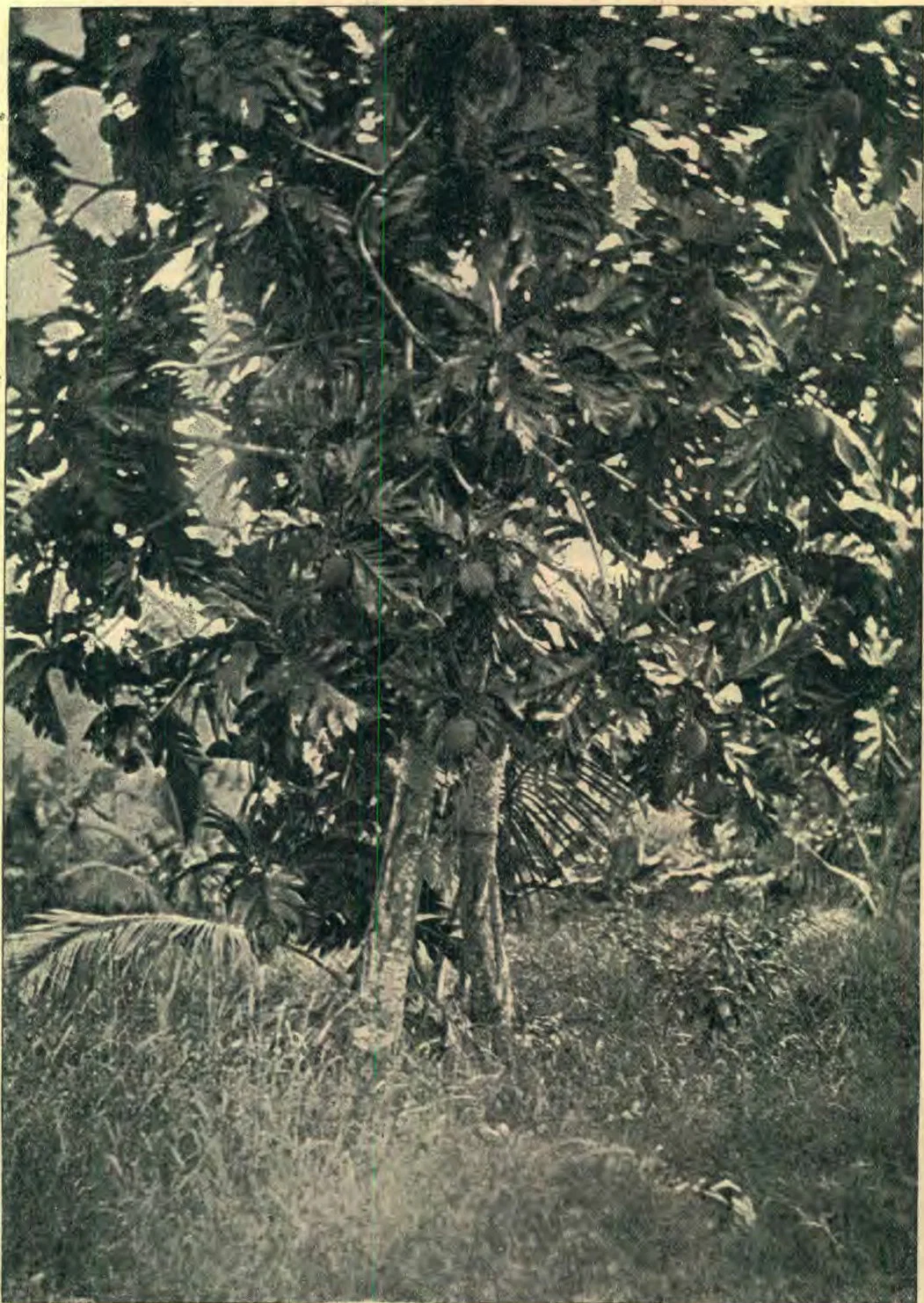
A BREADFRUIT TREE
A BREADFRUIT TREE

You have reached the end of this edition.

The Youth’s Instructor · Dec 7, 1915