Religious Schools Closed—Antagonism to Public Schools—The Religious Battle—Falsification of History—More Stringent Measures
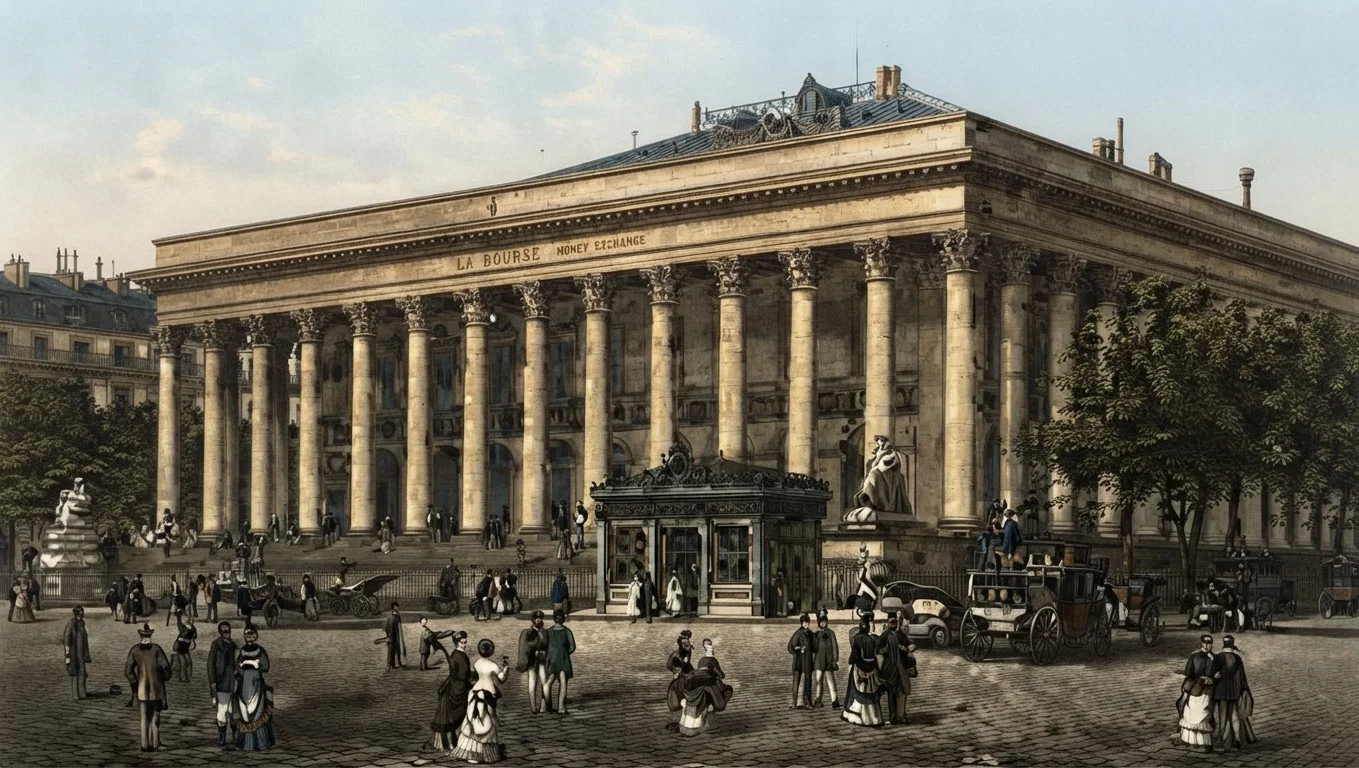
La Bourse—Money Exchange, Paris
THE separation between the church and the state in France which was accomplished a few years ago was but one battle in a long-continued conflict. One could hardly expect that it would be the last one. Recent events have proved that both adversaries were as far as ever from having reached a modus vivendi.
Religious Schools Closed
It will be remembered that seven or eight years ago, four years before the separation, the Waldeck-Rousseau government had abolished most of the teaching religious orders. This step on the part of the anti-clerical party was as important as the separation itself. Twenty thousand schools were shut down in France, and their scholars were added to the public schools' enrolment.
A few authorized congregations were still allowed to teach the children. These congregations themselves have since been forbidden to open schools, with the expectation, evidently, that the Catholic Church would send all her children to the public schools. This expectation was vain. Twenty-five thousand Catholic schools were opened by lay teachers who were simply unfrocked ecclesiastics, or even by regular priests not belonging to any order.
Antagonism to the Public Schools
At the same time, the public schools were jealously watched by associations of heads of families who had only too many reasons to fear that the teaching in the state schools was undermining the faith of their children. As a result, last September there came a letter from the Catholic bishops to the French Government accusing the public schools of outraging the faith of the Catholic scholars, calling these schools the principal cause of the demoralization of France, and singling out certain text-books which were a violation of religious neutrality.
This episcopal manifesto reopened public hostilities between the two foes. The answer of the government to this provocation on the part of the church was no less than the threat of establishing a state monopoly of schools. The battle, and a fierce battle, was waged in the Chamber of Deputies. On the one hand, the Catholic members accused the lay school of teaching atheism, and warned the government that they would fight the monopoly as they would for their lives. On the other hand, the government party endeavored to establish the fact that the Catholic schools were falsifying history, and teaching superstitions, and working contrary to true and loyal citizenship.
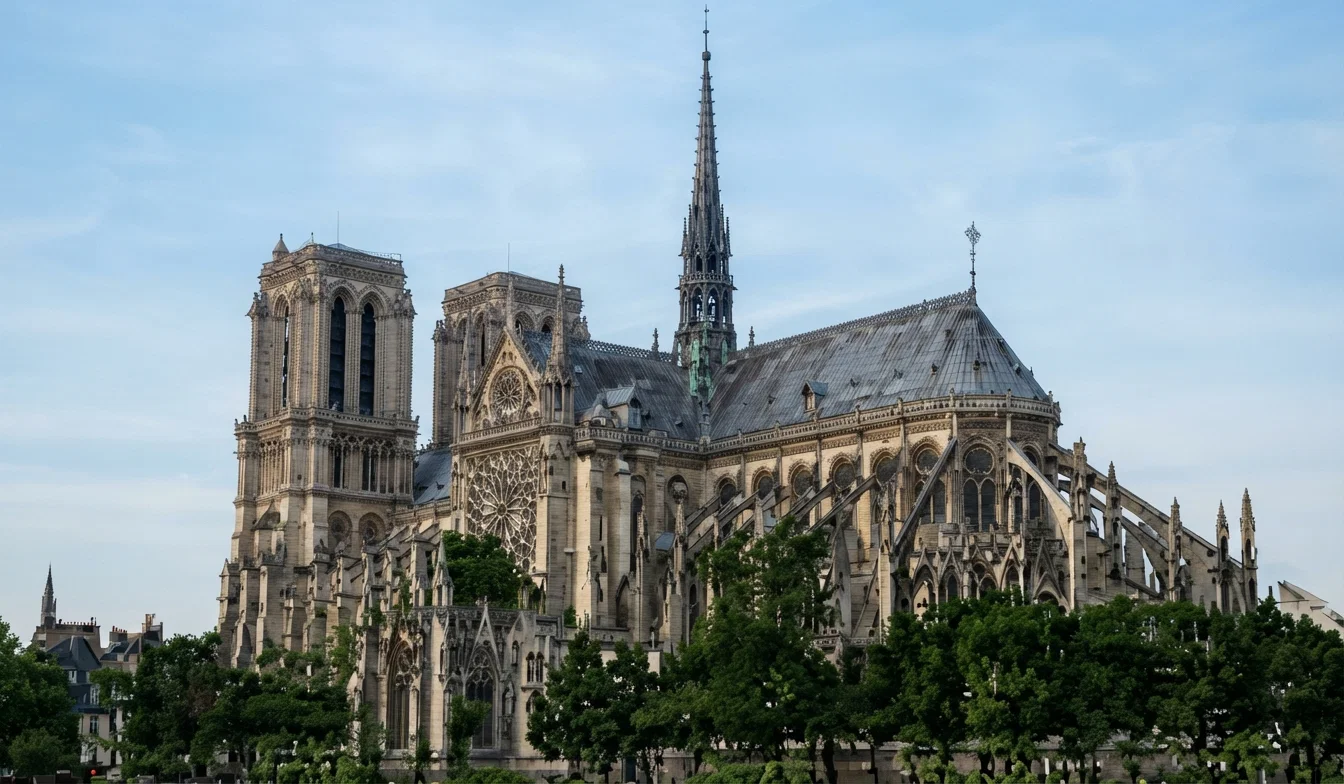
Cathedral of Notre Dame, Paris
It will be necessary in order to give a correct idea of this struggle, to quote from the speakers on both sides of the question.
A Religious Battle
One of the leading Catholic speakers, M. Groussau, referred back to the starting-point of the battle, to 1880 and 1882, when Jules Ferry and Paul Bert, the leading spirits of the time, brought about important changes in the public school system. The public schools, which until then were partially in the hands of the clergy, were thoroly "laycised;" primary school was made compulsory; fifteen thousand free schools were closed. At that time, however, there seemed to be no desire to do anything contrary to religious freedom. "There is not the least idea on the part of the government," said Jules Ferry, "of persecuting the Catholic Church; the republic would be foolish in entertaining even a thought of antagonizing Catholicism while making school attendance compulsory. If a public teacher should forget himself to the point of outraging the religious belief of any one, he would be as severely and as promptly punished as if he had brutalized said student. . . . Nothing will be done in the public schools which could in the least hurt the conscience of the parents or of the children."
The duty of the public school teacher with respect to religious and moral teaching was clearly defined in a book published by the state. Morality was to be taught, but without in any way contradicting the teachings of either Catholics or Jews. The name of God was not to be lightly spoken, and the laws of God were to be venerated as being in agreement with both conscience and reason.
M. Groussau then quoted from text-books now in use in the public schools. He asserted without contradiction that the word "God" had disappeared from such books. Eminent Catholics, such as Bossuet, Fénelon, Saint Bernard, were erased from the list of great men. Classical quotations referring to God's power and providence were changed for trivial remarks or commonplace proverbs. One of La Fontaine's fables has been mutilated in order to do away with the name of God. Adam and Eve have made room for some unknown Robert and Julia; and the phrase, "the commandments of God," has been changed into "the laws of nature."
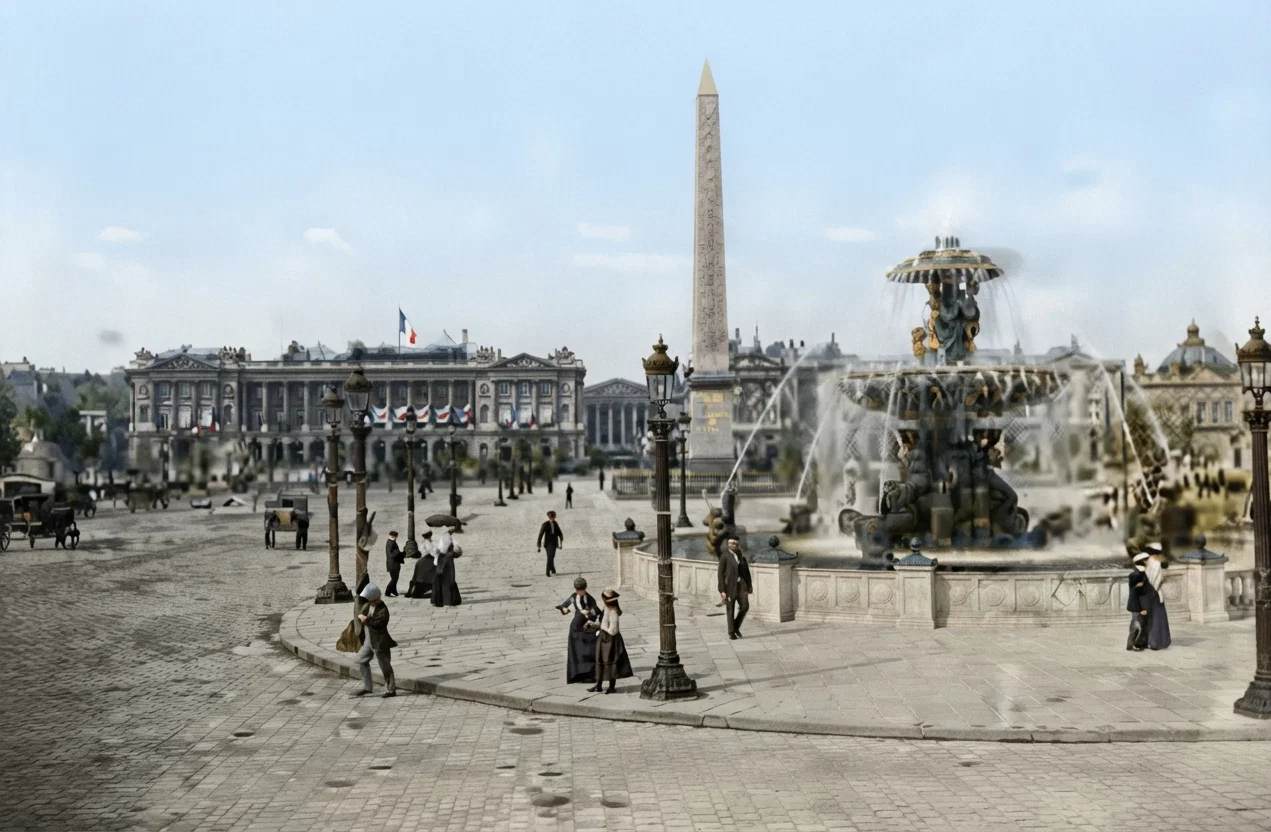
The Place of Concord, Paris
The "Primary School Review" was also quoted as teaching the non-existence of a future life and the blessings of free thought or unbelief. This same "Review," read by forty thousand teachers, plainly confesses its hope that atheism will triumph as a result of the present trend in the public schools. A school-book called "Moral Teaching at School," declares that "thinking people admit of no belief in God, in the origin of the world and man, or in the future destiny of man."
So Much for the Irreligious Character of the public schools. None of their advocates at the Chamber of Deputies disproved this sad arraignment. In fact, all their speeches were only a confirmation of the above statements. It is a well-known fact that the members of the French Government, aside possibly from a few Protestant rationalists, take no stock whatever in religion. And it is easy to understand the alarm of conscientious Catholics at the thought of seeing the faith of their children undermined and destroyed. The only pity is the fact that their own schools are not free from blame, and that their religious teaching is such as to disgust many a sound thinking unbeliever.
Falsification of History
This fact was also brought out by the discussion. The speakers on the government side proved from Catholic text-books a falsification of history, or at least a minimizing of everything disagreeable to the Catholic Church. The massacre of the Albigenses by Simon de Montfort and his men is left out as contrary to religious neutrality. The egotism, pride, and wanton prodigality of Louis XIV are condoned. So is the Saint Bartholomew massacre. From another Catholic text-book, the care of the body was shown to be prejudicial to the soul; the marriage relation is made inferior to celibacy, called "Christian virginity;" the duty of the state, among other things, is "to lend its help and strength to religious authorities," and so forth.
Add to this the fact that hundreds of Catholic schools are illegally reopening all over France, that these schools are generally full while many government schools have but a11scanty number of students, and you can understand the astonishment, impatience, and choler of the Free Mason party.
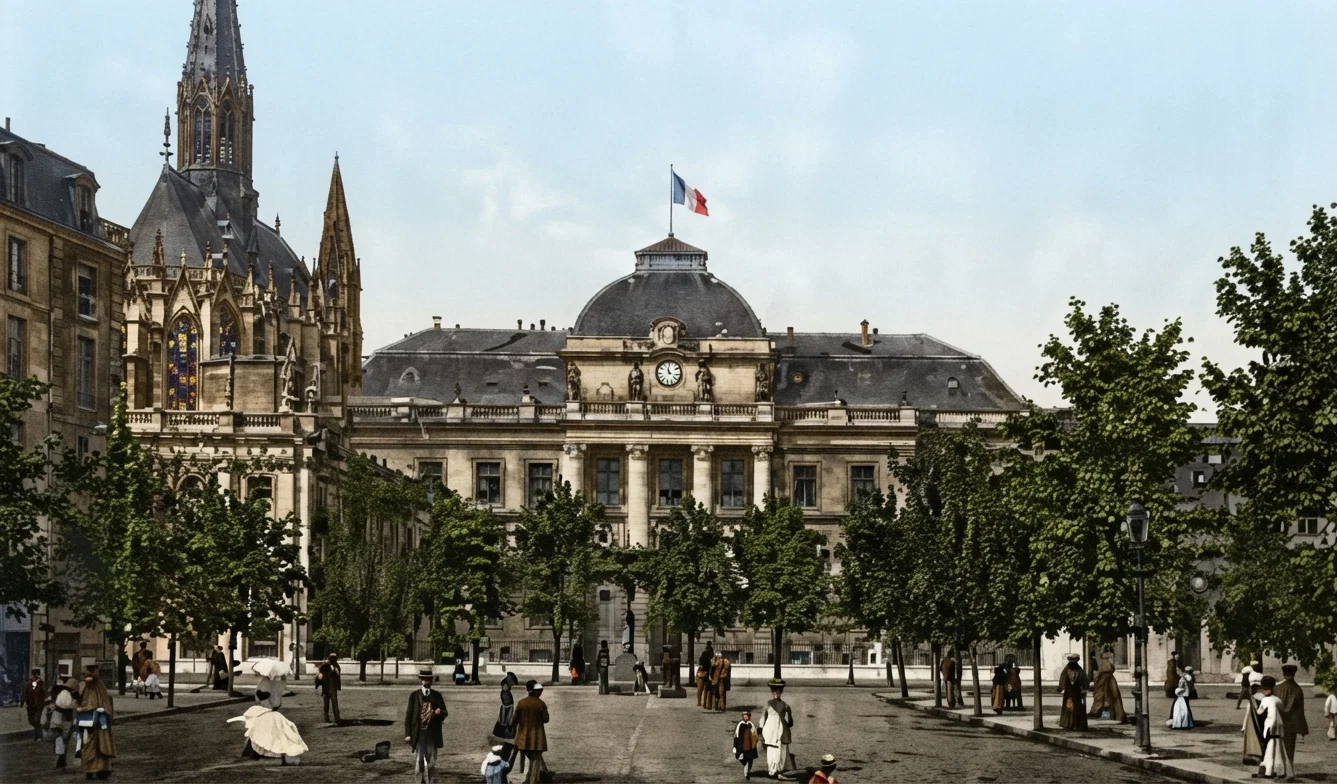
Church of St. Chapelle and Palace of Justice
More Stringent Measures
This parliamentary debate, which lasted several days, only forestalled the real battle. This will be waged when the minister of public instruction, M. Doumergue, shall introduce a new school bill which will compel, it is said, Catholic schools to submit their books for revision; or, according to others, which will inaugurate the absolute school monopoly, in other words the abolishment of all private schools. A more general uproar than in 1903-1904 may then be expected. M. Briand, it is reported, feels rather reluctant to follow his party blindly on to a new Waterloo; Napoleon without a sword, he would rather try his skill at a new concordat. This at least was the advice publicly given him by a speaker of the center. A strange repetition of history it would be, indeed! And how quickly and unexpectedly would France find herself again at the feet of the hoary queen on the Tiber!
Thus we are again facing a lamentable conflict between two parties, each of which represents one half of the truth: the government seeking to shield the country from the influence and by and by the supremacy of the Catholic Church, an influence which has been decidedly detrimental to France in the course of a long history; on the other hand, the Catholics of France, intent upon maintaining their faith, such as it is, with its errors and traditions. Alas! that such a great and beautiful country, such a charming and intelligent people, should be involved in such a hopeless conflict, the result of which, however the matter may turn, would be equally disastrous! In one case, we should witness a land of atheism and immorality; in the other, we should see a country crushed under Romish despotism.
Which Will It Be?
Will the Catholics yield in the long run, tired of fighting for their faith, or will the Free Mason party give up the battle as a bad job? Whichever may be the result finally, we may be sure that some fierce battles are ahead of us. Our only comfort, as we witness the scene, is the hope that the true Gospel — a Gospel which knows no antagonism between religion and civil government, between religious freedom and religious worship, between faith and reason — may soon be preached extensively over the fair land of France, claiming all the honest souls of either party, and bringing joy and peace into many homes in exchange for endless strife, sinfulness, and despair.
J. VUILLEUMIER.
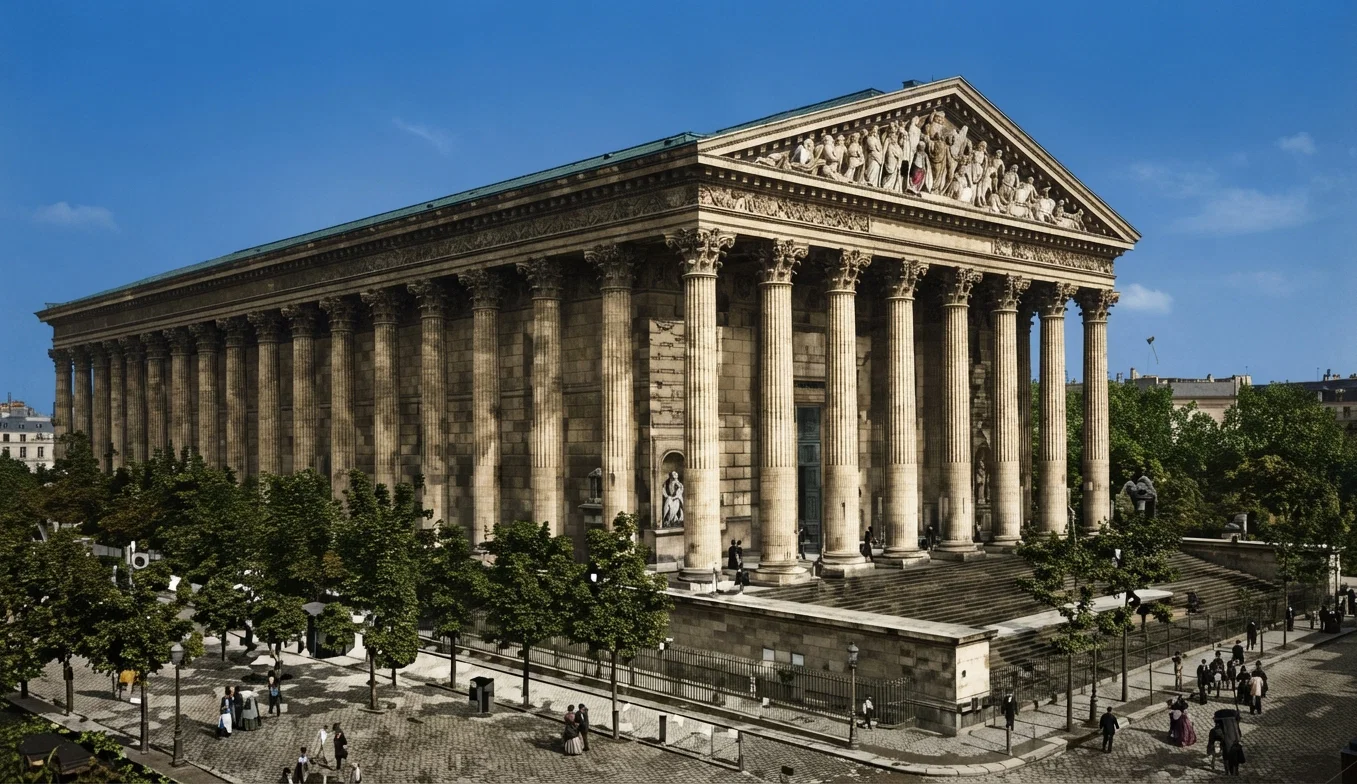
The Church of La Madeleine, Paris
THE OUTLOOK
By Editor
"Watchman, what of the night?"
Uneasiness in Germany
GERMANY has a military uneasiness not alone over England, but over her ancient rival Austria-Hungary. As one correspondent has expressed it, Germany and Austria-Hungary are partners, and Emperor William naturally wants Germany's partner to be an efficient one, but at the same time he wishes it distinctly understood that Germany is the head of the firm; but Austria-Hungary's progress has been so astonishing of late that he is becoming afraid that she will become the dominant factor. Of the aged emperor Franz Joseph he has no fear; but he will not live much longer, and his nephew and successor, the archduke Franz Ferdinand, is another matter altogether.
When he comes to the throne, Austria-Hungary will have as ambitious a ruler as ever Germany had, whose ambitions for the Teutonic race will be confined not to his own realm but to the whole German people. That he has a will of his own was shown in his marriage beneath his rank. He is said to be a Jesuit of the Jesuits. He has remarkable gifts as an organizer, statesman, soldier, and diplomat.
He now has as an object the securing of the Turkish port of Salonica as Austria-Hungary's outlet to the Mediterranean, and the seizing of Bosnia and Herzegovina was a step in this direction. He accomplished it with the assistance, but against the wish, of Germany; and as the correspondent puts it, "If things go on like this while the archduke is only heir to the throne, William is asking his ministers what he will do as kaiser."
For one thing he means to make Vienna the most important capital in Europe. He means to restore, we are told, the ancient glories of the empire over which his ancestors have ruled for seven centuries; he means to be the foremost monarch in the Old World, the arbiter and dictator of European politics. The correspondent further says that the archduke means that his reign shall mark the Turk's final expulsion from Europe. Until he has planted the Austrian flag on the banks of the Bosporus, and created an Eastern Empire of imposing magnitude and power, he will not consider his life's work accomplished. Certainly the European outlook is not by any means settled. Its surest horoscope is found in the prophetic Word.
News and Comment
By Editor
There is a proposal to erect a statue to the Honorable Samuel J. Tilden. Of him the New York World says, "Tilden never held a federal office; he was never a representative, or a senator, or a cabinet minister, yet it may be doubted if any other man since Lincoln exerted so great an influence upon national affairs." He will always be remembered because of his sucessful fight against the Tweed ring.
The feeling of California toward Japanese labor has taken several interesting little turns recently. Two years ago it was necessary for the Federal Government to restrain the anti-Japanese trend of the California legislature. Now the commissioner of labor, Mr. McKenzie, of the same state, in a final report on the Japanese labor problem, which involved two years' work and a careful census of all the farms employing Japanese, tells us that Japanese labor is essential not alone in developing our farming interests, but also in maintaining our present plane in the agricultural world. The report, 200,000 words long, cuts directly at many of the anti-oriental party of California, yet most of the Eastern papers are pleased with the report. The Independent calls it "the repentance of California."
According to a newspaper report, the greatest celebration that has ever occurred in Lincoln County, Arkansas, followed the lynching of a Negro which had been attended by "every man, woman, child, and dog in the county." Prize-fights are not the only brutalizing factors in the country. Frequently lynchings take a full share in mixing the elements of ugly, brutal passions into American life. Few things are worse than the taking of life by a mob, and fewer still are as bad as making such occasions pleasure celebrations.
The Roman Catholic Church is arousing itself to greater missionary activity. Whereas the Protestants of America gave more than $11,000,000 to missions, the whole Catholic body raised only $1,342,000 last year. This contrast is used by Catholic journals to urge the development of Catholic missions. There are about 54,000 Catholic missionaries at present. Of these, 10,000 are priests.
While other nations are spending more in naval lines, France is spending a great deal of money in air-ships. A despatch from Paris, May 7, says that France will spend four million dollars on her air-ship fleet. Germany just now is ahead; but the French are determined in this line, as they have led in the development of the navigation of the air.
How Little Mortals Know!—We use electricity, we explain and record its phenomena, and cause their repetition, but we guess as to what it is. Wireless telegraphy seems almost uncanny; it is partially understood, but not wholly. For instance, messages can be sent by night better than by day, but no one knows why.
At a late meeting of the Woman's Total Abstinence Union of England, a speaker declared that about 300,000 London children are alcoholists; that is, forty per cent of the young drink intoxicants regularly. It was also stated that fifty-eight per cent of New York children belong to the same class.
A car accident occurred the other day in New York City in which a car jumped a track and then turned over; yet nobody was injured, because an official immediately called out, "Hold on tight." The passengers held on tight and saved their bones. That is pretty good advice in most emergencies.
Spain is at last attempting to withdraw the disabilities that have lain on non-Catholic citizens for many centuries. It is a pleasure to record so happy an action. It will open the way to more Christian activity among Protestants.
The French navy department has decided that the day of the torpedo-boat is over. No more vessels of this type are to be constructed, but destroyers and submarines will gradually take their place.
Cottonseed flour is arousing attention in the South. It is said that a number of good things can be made of it, and, as well, that it is much cheaper than wheat flour.
The new German cruiser Von der Tann, of 19,000 tons, developed on her trial trip a speed of twenty-eight knots an hour.
The World’s Leading Navies
The rank of America among the navies of the world in the total displacement of completed warships is second to Great Britain. Great Britain is ahead in the number of tons. Five other countries are ahead in the number of vessels. Great Britain, the United States, and Germany are the leading naval powers. Great Britain has four super-Dreadnoughts, aggregating 73,700 tons; the United States four with 72,000 tons; Germany three with 55,500 tons, which includes an 18,500 ton battleship. Japan has just completed one having 19,200 tonnage. In the Dreadnought list Great Britain has seventeen, displacement 353,700 tons; United States, including two battle-ships recently provided for, ten, displacement 221,650 tons; Germany thirteen, displacement 175,000; Japan six, displacement 118,410; Russia four, displacement 92,000; Italy four, displacement 80,000; France, none given.
Great Britain, when her present ships are completed, will have 498 completed warships of more than 2,000,000 tons displacement. The United States will have 179 with 839,945 tons displacement; Japan 191 with 493,704 tons displacement.
The London Times, however, places Germany second to England, the United States third; but the Times basis is the present craft afloat rather than those now given, in all probability.
Among the Latest
Among the Latest.—The Scientific American of May 28 has an article on the latest Dreadnought development. It speaks of the modification since the first was introduced in 1905. The American modification is distinguished by the center-line arrangement of the gun turrets; the German, by the powerful secondary armament and the reported introduction of the triple turret; but "it has remained for Italy—the home of constructive genius and the real birthplace of the Dreadnought itself—to combine in one ship the twin turret, the triple turret, and the center-line arrangement." There are four such ships under construction now. The first will carry ten 12-inch guns; the other three will carry thirteen 12-inch guns,—a larger number of single caliber guns than has ever been mounted in a modern ship, altho the Japanese Satsuma and Aki each carry four 12-inch and ten 10-inch, to say nothing of the twelve 6-inch. The Italian ship will be able to give a full broadside of thirteen 12-inch guns, with a fore and aft fire of five; the displacement will be thirty-four thousand tons, and the speed 22 knots.
Shiloh: the Man of Sorrows
By Mrs. L. D. Avery-Stuttle
Chapter XIX.—In the Wilderness
N the meantime, strange and almost tragic are the scenes which are transpiring amid the gloomy and desolate wastes of the wilderness of Judea.
No human eye might witness that struggle upon which even the angels gazed with awe,—that mysterious struggle between the Prince of Light and the prince of darkness; between the Hope of Israel, the Shiloh of Jacob, the Saviour of a doomed and hopeless race, and the accuser of the brethren—Lucifer—once, in the ages gone by, called “Son of the Morning.”
Forty days and as many nights have dragged their cruel hours along, since the mighty Lion of the tribe of Judah left the habitations of those whom He came to save, and, relying only upon the strength of the Eternal, entered this first, fearful battle-ground, to wrestle alone with His mysterious and awful foe.
And what a battle-ground!
Silence profound and unbroken, save for the rush of the dark pinions of the birds of prey, or the shrill scream or angry snarl of the wild beasts. Desolation supreme; a narrow strip of barren country bordering the western shores of the Dead Sea,—that silent cemetery of the buried cities of the plain,—dreary and waste as the arid plains of Luna.
This is the battle-field.
The white limestone hills which rise lonely and bleak here and there, are thickly pierced with dark and unexplored caverns, whose dim entrances are half curtained and draped by the unfriendly and inhospitable fingers of the cactus.
It is night; and the cold face of the moon is partly covered by the changing curtain of dim clouds which scurry through the sky. The dark bodies of rocks and occasional trees cast deep shadows across the entrances of the cave-pierced mountains and hills, from which, ever and anon, cautiously peer the shaggy head and gleaming eyes of the mountain-lion or the sullen bear. Everywhere lie the skeleton bones of the gentle cony; and everywhere upon the craggy rocks, the dark aeries of the eagles are outlined against the dim sky.
Afar toward the northeast, the swollen waters of the turbulent Jordan hurry to rest upon the quiet bosom of the Dead Sea, whose heavy waters lie like a mighty basin of melted brimstone above the heaven-daring and heaven-buried cities of the plain. To the far west toss the blue waters of the Mediterranean.
Close beside yonder rock kneels a Man. The pallid face, haggard and emaciated, is upturned toward heaven. The sympathizing moon looks lovingly upon Him, and caresses the broad brow with her fingers of dim light.
The fearful fast of forty days has told upon the noble form, and the wonderful eyes are deep and sunken.
Suddenly a flash of light sweeps before Him, and the rush of dark pinions hidden by their mask of light is faintly heard.
“Hail, Thou Anointed One! Thy fast is ended!” announces the glib voice of the intruder. “Verily, I would have brought Thee bread from heaven, but so said not the Eternal, from whom I am sent. But surely if Thou be the Son of God, Thou canst cause that this stone be made bread.” Then the dark form, veiled with its false covering of light, stoops, and raises from its bed a grey rock from among its fellows which strew the side of the mountain, and holds it aloft tantalizingly near the pallid face of the Man, who, for the moment, replies not, while the tempter continues:
“Surely Thou art an hungered. These forty days have I watched Thee in this accursed desert, and behold, Thou hast eaten nothing. Now of a truth am I come to tell Thee that this Thy fast is at an end. Heard I not the Voice by the Jordan? and saw I not the Light? Behold, now the Father knoweth that Thou art obedient. He doth but test Thee, like as He tested Abraham,—and now Thy fast is done. Command that this stone be made bread; so shalt Thou eat thereof and be strengthened. For verily I am he who stayed the hand of Abraham in days of old; and I be sent with this commission from Thy Father. So, if Thou be the Son of God, fulfil my words.” And again the stone is held aloft in the mighty hand.
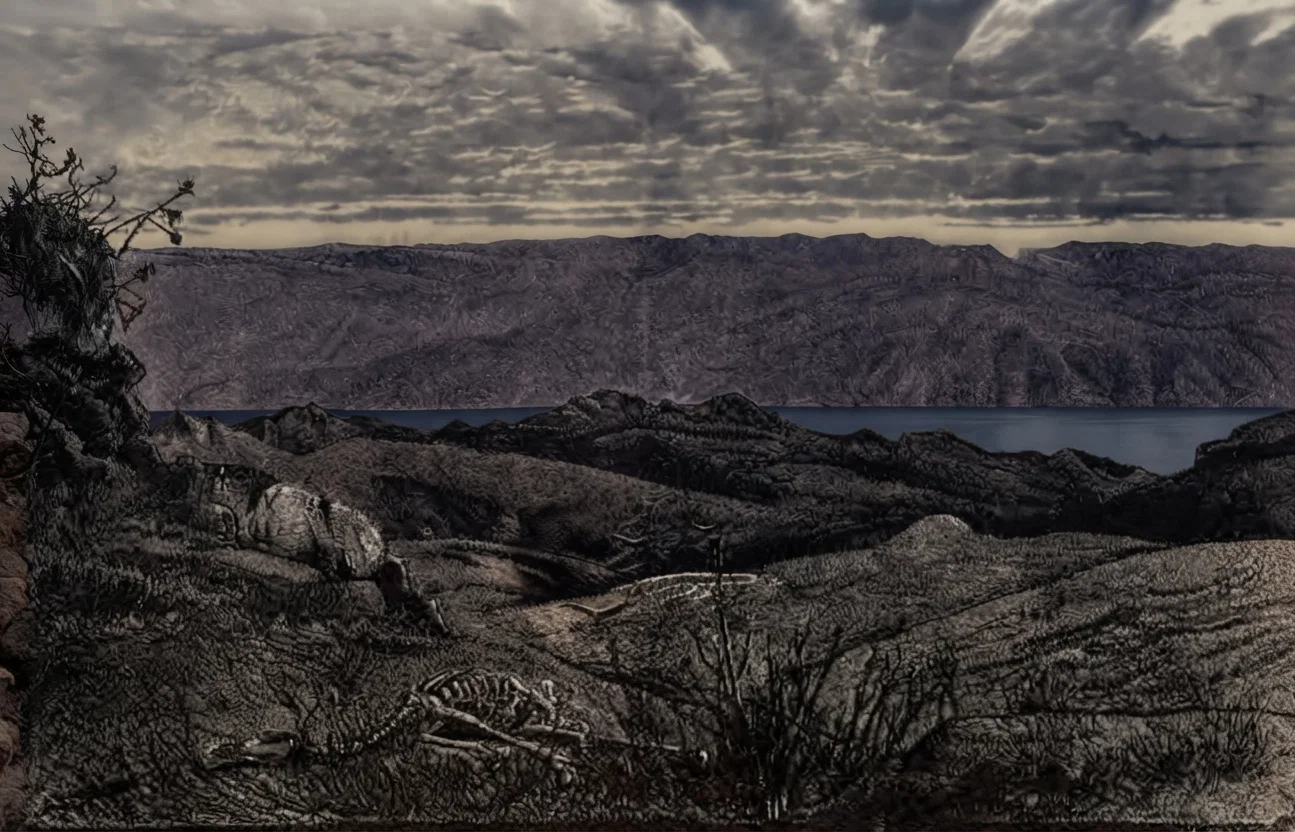
In the Wilderness Where Our Lord Was Tempted. See last page
For an instant the divine One fixes His eyes upon it, while the pale lips move as if in prayer. Then a voice is heard, soft and serene, but firm and unyielding as the rock upon which He kneels:
“Behold, it is written, Man shall not live by bread alone, but by every word that proceedeth out of the mouth of God.”
A spasm of astonishment and baffled rage crosses the face of the archfiend. But he has laid his plans well.
“Of a truth then, I perceive that Thou art not the Son of the living God! Him know I well. But Thou—who art Thou? Verily were the Eternal Thy Father, He would not leave Thee thus alone and in sore need; I know Him,—very pitiful and of tender mercy. His name is Love. Behold, Thou art a weakling, and Thy pale countenance betrayeth Thee. What! art Thou He by whose almighty power the worlds were made? Thou the commandant of the hosts of heaven? Ha! verily Thou art as weak as man.”
In an instant the scene changes. Quicker than a flash of light the fiend has borne Him to Jerusalem. The city is already awake, and the busy hum of life is everywhere. Yonder rises the smoke of the morning sacrifice; and companies of white-robed priests with sanctimonious faces and broad phylacteries are entering the sacred temple, while the droning hypocrite chants his morning prayers in the streets.
High up on one of the shining battlements of the temple, stand two forms: the Man of Galilee, upon whose overthrow the powers of hell are bent, and the cunning fiend.
“What! art Thou He who should bruise the serpent’s head?” questions the tempter. “Even from Thy birth the people Thou didst come to save have hated Thee and sought to do Thee harm. But see! by my might have I brought Thee hither. Behold, Thou shalt cast Thyself down from hence, and in so doing prove Thy power; and by this miracle Thou shalt force obedience from Thy people. See, the scribes and Pharisees and rulers are even now gathering about the temple. Quick, while they gaze! Cast Thyself down! For lo, He shall give His angels charge over Thee, to keep Thee in all Thy ways. They shall bear Thee up in their hands, lest at any time Thou dash Thy foot against a stone. Thus saith the Scriptures. And I doubt not that Thou couldst float in air, even as I. What! dost Thou hesitate? Then dost Thou doubt the watchful love and power of the Eternal. Ha! I know Thee now. Long time ago a mighty angel was cast out of heaven,—a rebel angel,—and surely Thou art he! If not, then haste! cast Thyself down; for thereby shalt Thou show Thy Father’s care and Thine own power.”
The archfiend paused. He saw his kingdom hanging in the balance. He saw his power begin to fade, and felt the throne of darkness tremble, as with a majesty and power which was not of earth, the Conqueror made answer:
“It is written, again, Thou shalt not tempt the Lord thy God.”
Then, toward a towering mountain peak He is borne by the hoary fiend. In a moment of time, there are spread out before them in vast panorama the kingdoms of earth. Instead of a barren desert, appear fields of living green, cities and palaces and goodly mansions adorned with all the beauties which wealth and earthly power can give.
Then with a wave of his mighty arm, the fiend exclaims:
“Seest Thou my power? All this is mine. But, behold, I will give it Thee, if Thou wilt grant me one small favor: But bend Thy knee to me and worship—small act indeed, and costs Thee naught. And, lo, why shouldst Thou suffer thus for man,—ungrateful worm! Behold, they seek Thy life already. Seest Thou, O Man of Nazareth, Thy puny form compared with mine? I ask Thy worship,—verily it is my due,—Thou canst not grant me less.”
But the voice of the Man sounds forth His divinity, and His eye blazes with celestial fire:
“Get thee behind Me, Satan, for it is written, Thou shalt worship the Lord thy God, and Him only shalt thou serve.”
Slowly the thin mantle of light faded from the wings of the fiend. A scowl of rage and fury darkened his hateful countenance, and he was gone.
The Conqueror stood alone. The battle was ended.
(To be continued)
IN THREE DAYS
SAN FRANCISCO
Overland Limited
TAKES YOU
To Chicago
ACROSS GREAT SALT LAKE
AND
HIGH SIERRA BY DAYLIGHT
Luxurious High-class Equipment
Electric Lighted Throughout
Pullman Drawing-room
Stateroom
Vestibuled Sleeping-cars
Careful and Attentive Dining
Service
Parlor Observation-car with
Library and Cafe
Ladies' Reading-room
Gentlemen's Smoking-room
Daily News Bulletins
Latest Papers and Magazines
Southern Pacific
Life and Health
By Editor
A PRACTICAL health journal, published with a view of meeting hygienic needs in every home; teaching how to care for the health and how to preserve life; prescribing simple home treatments to assist nature in throwing off diseases rather than adding more poison by using drugs or unnatural stimulants as remedies: teaching how to avoid disease as far as possible, how to manage in the home when sickness does come, and how to combat the disease by simple remedies which nature provides.
Send for sample copy and special rates to agents. Price 10 cents per copy or $1.00 per year.