To relieve pain nothing equals ordinary applications of heat and moisture by means of fomentations to the painful area. The articles required for a fomentation are very few and simple. Any old flannel cloth, wrung out of hot water, and folded in a dry flannel or towel, will do, if nothing else is at hand.
But every home should be supplied with a set of fomentation cloths. Get two single blankets, one all wool, and the other half wool. Each blanket will make four fomentation cloths. The half-wool absorbs water readily, while the all-wool does not; so the half-wool blanket should be used to make the cloths to be wet, and the all-wool one for those that are to be used dry, in which the wet ones are to be folded.
The cloths should be folded to suit the part to be treated. For the spine, fold to six or eight inches in width; for the chest or for the stomach and bowels, fold once in each direction; for the stomach and liver, fold to three thicknesses in one direction, and one in the other.
The most convenient method of heating the fomentation in the home is by wringing the cloth out of either hot or cold water, and laying it on a hot cook stove, or in a steamer over a kettle of boiling water, until it is heated through. The fomentations can be prepared more quickly in this way than by any other method. The hot cloth should be folded in the dry one in such a manner that there will be one thickness of dry cloth between it and the patient's body when applied.
The fomentation should be replaced by one newly heated at intervals of three12to five minutes for a stimulating effect. The application should be very hot, frequently renewed, and continued not more than ten or fifteen minutes. Each application may be alternated with a short cold compress, or a piece of ice quickly rubbed over the surface, always ending with the cold. For a sedative effect, or the relief of pain, the application may be continued half an hour or more with benefit.—Australasian Good Health.
How to Treat the Sick in Their Homes
By H. E. Brighouse
H. E. BRIGHOUSE, M. D.
One who is sick is out of harmony with nature. Some or all of the functions of the body are working abnormally. The nervous system is itself out of order, and as a consequence small causes produce large effects. Slight digressions or irregularities which have no effect or are not noticed in good health, cause much trouble in sickness. In health we may eat some unwholesome article of diet, and not feel any direct result. The functions working normally, a great deal of ill usage is borne without our becoming conscious of any derangement, but in sickness a different state exists. Every slight digression is answered by protest from nearly every function of the body. Many a relapse has been caused by just a little digression in diet.
It is for this reason that when one has fever, it takes so little to cause the fever to rise. The slightest digression in diet, a little excitement, a little fatigue, and the fever which seemed under control runs away up. It is because of these things that one who is sick must be so carefully guarded from bad influences, whether in the matter of eating, exercise, or excitement. People not accustomed to the sick-room can not realize the importance of keeping the sick person quiet, and especially is this so in the care of children. Conversation carried on in the sick-room, with or without an effort to interest or amuse the sick person, may be very fatiguing. It is not seen at the time that the patient is becoming fatigued. Later, possibly in the night, serious symptoms develop as a result.
Therefore, in the care of the sick, avoid loud noises, loud talking, slamming of doors in the sick-room, and every element of excitement. Do not discuss before the patient things which would in any way tend to arouse anxiety or fear. Permit no disagreeable conversation in the room, and avoid all talking and laughing in the close vicinity of the patient. Strong, bright lights are an annoyance and an injury to the patient, where they shine in the face. Let the bed be comfortable. See that the air is pure. A little impure air is much more harmful to a sick person than to one who is well. In health the poison of impure air can be borne with less ill result than in sickness. In sickness the purest air is needed, as the person is throwing off from his body so much poison.
The diet of a sick person should consist of simple foods. The digestive functions are acting abnormally, possibly scarcely acting at all, so a diet which requires much digestive energy would produce very serious symptoms, perhaps be the means of making the case take an unfavorable turn. For a sick person a liquid diet is always best. It is more easily digested than solid food. Milk is very nourishing, and being a natural food and a liquid, is, in general, excellent for the sick. However, being a good medium for the growth of germs, it can not be a good diet when the stomach and intestines are not in condition to destroy germs, which is always the case in stomach and intestinal diseases. Therefore, in inflammation or catarrh of the stomach or bowels, in typhoid fever, and in diarrheas of all kinds, milk is not the best diet. In stomach and bowel trouble and diarrheas of children and infants, milk must be interdicted for a time, the time to be regulated by some one who thoroughly understands the disease and the child. It may be from a few hours to days. Milk, in digesting, forms hard curds in the stomach, and because of this can not be used when the digestive function of the stomach is very feeble, as in very high fever.
Gruels are good, when rightly made, and are preferable to milk when the foregoing conditions exist. Fruit juices can not be too highly recommended. There is in the acid of fruit a natural cleansing and antiseptic property, and being easy of digestion, in fact not needing any digestion, there is no tax to the system.
Benefits Derived From Foot Baths
The shallow foot bath is a variety of the cold foot bath in which the amount of water employed is small, barely sufficient to cover the toes. After being held in the bath for one minute, one foot is taken out and rubbed for half a minute, and returned to the water, the other being then treated in like manner. The treatment is continued until each foot has been thoroughly rubbed three or four times.
The shallow foot bath produces powerful reactive effects in the feet, and is thus of great service in chronic cases of cold feet and sweating of the feet.
The hot foot bath produces, in a diminutive way, the same effect as the general hot bath.
As a curative measure, this bath is more commonly used, perhaps, than any other. At a temperature of from one hundred and three degrees to one hundred and six degrees the foot bath is an exceedingly useful means of aiding the regulation of the systematic circulation, the blood-vessels of the lower extremities relieving the congestion of the brain and other organs in the upper half of the body.
The hot foot bath is also of very great service as a means of relieving or preventing a cold resulting from exposure of the feet to dampness.
The very hot foot bath is exceedingly useful in cases of sprain of the ankle joint. The bath is begun at a temperature of about one hundred and four degrees, and then gradually raised by the addition of hot water until it is as hot as the patient can bear—one hundred and twenty degrees to one hundred and thirty degrees. Neuralgia of the feet is likewise relieved by the very hot foot bath. The process should be repeated two or three times a day, and continued for twenty or thirty minutes each time.—Australasian Good Health.
Cheerfulness as a Health Factor
“A MAN’S house,” says Beecher, “should be on the hilltop of cheerfulness and serenity, so high that no shadows rest upon it, and where the morning comes so early, and the evening tarries so late, that the day has twice as many golden hours as those of other men. He is to be pitied whose house is in some valley of grief between the hills, with the longest nights and shortest days.”
It is not an easy matter to build this mental mansion on the “hilltop of cheerfulness and serenity,” but how much more comfortable it is to live in than the house in the “valley of grief between the hills”! It is not easy to be bright and cheerful when our best-laid plans “gang aglee;” when the balance sheets will not balance; when the typewriter or sewing-machine will not move swiftly and rapidly, in spite of the fact that the machinery is apparently in good order; when it rains steadily and persistently on the very day when you wished the sun to appear the brightest; when you must wear for another season the shabby gown or jacket which you had hoped to replace with a new one. It is hard to give a sunny smile to the world when, for you, “the times are out of joint.” Make the effort, though, and see how you will be repaid, and what a golden reflection that little smile will throw back on your world within.
“No man e’er gained a happy life by chance, Or yawned it into being with a wish.” — Selected.
Definitions of Home
A PRIZE was offered recently by the London Tit-Bits for the best answer to the question, “What is home?” Here are a few of the answers which were received:—
“A world of strife shut out, a world of love shut in.”
“Home is the blossom, of which heaven is the fruit.”
“The golden setting, in which the brightest jewel is ‘mother.’”
“The father’s kingdom, the children’s paradise, the mother’s world.”
“The center of our affections, around which our hearts’ best wishes twine.”
“The jewel-casket, containing the most precious of all jewels—domestic happiness.”
“A little hollow scooped out of the windy hill of the world, where we can be shielded from its cares and annoyances.”
An Indian Funeral, or Elon, in South Chile
By H. F. Ketring
H. F. KETRING
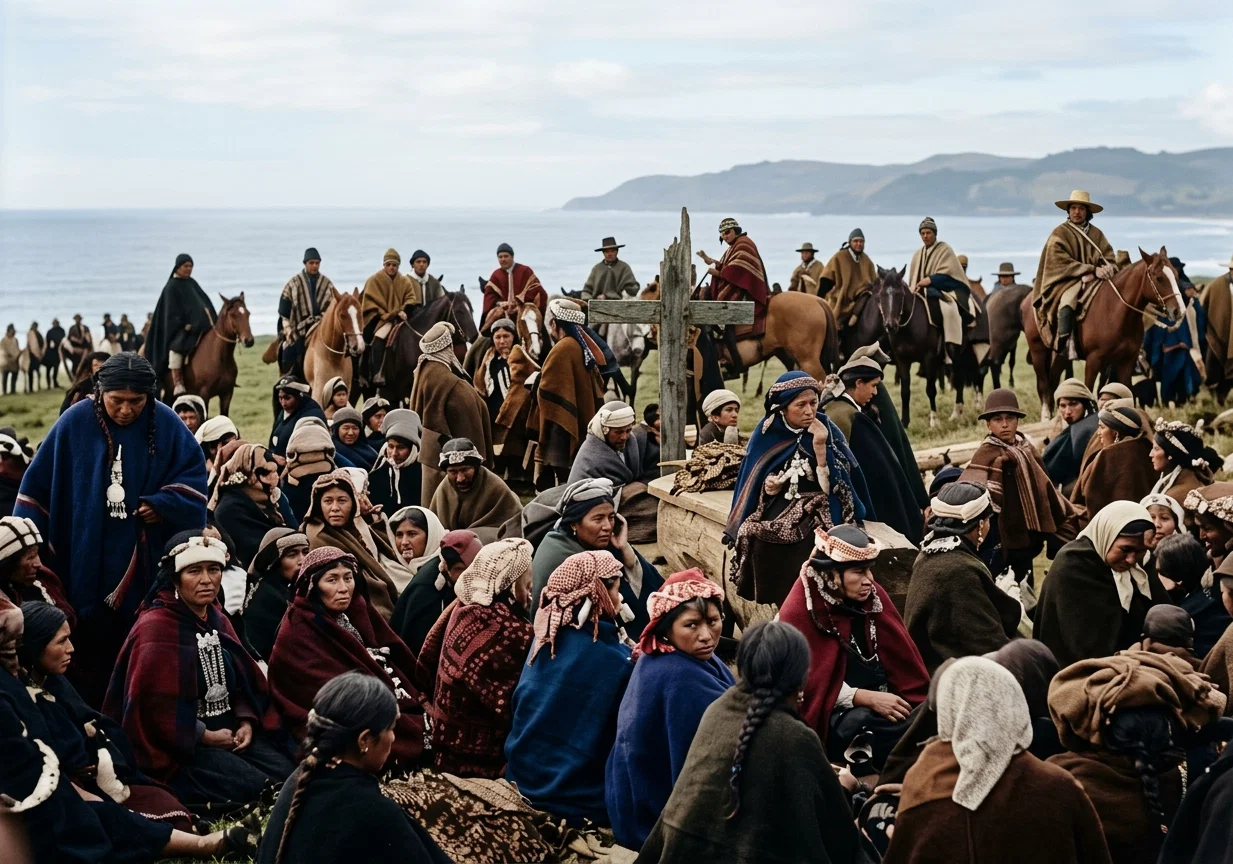
After an hour’s ride along the seashore south from Bajo Imperial, on Sunday morning, November 1, we arrived at Pillaf, an Indian village, where, according to the announcement, an Indian chief named Ignacio Puelpau was to be buried. Already there had assembled four or five hundred Indians from various directions, to pay their last tribute of respect to the remains of the well-known chief.
AT THE FUNERAL
At sundown the evening before, the coffin containing the body was dragged by two yoke of oxen to the top of a little knoll overlooking the expanse of the broad Pacific. This was to be the site of the ceremony. The coffin, as may be seen in the accompanying picture, was made by hollowing out a log in the form of a canoe. A three-inch plank hewn from a log formed the covering. A rude cross was planted at the head. Around this the wives of the chief, the relatives, and the most intimate friends gathered to pass the night weeping and mourning by the body of the deceased.
They were provided with a large quantity of all kinds of flesh meats, the rarest of which was horse flesh, a delicacy indulged in only on great occasions. They were also well supplied with wine, and the native mudai, which is a drink made from corn.
The process of making this last-named drink is very novel. I will tell it just as it was told to me, and confirmed by one of the chiefs. When a person of rank dies, they at once begin preparations for the funeral, which is to take place ten days later. A number of women surround an iron kettle on the floor. A quantity of corn is given them, which they are to chew, but not to swallow. When it is thoroughly masticated, they spit it into the kettle, and with a fresh supply repeat the process until all the corn is thus ground. Water is then added to the mass, and it is placed over the fire to boil, after which it is poured into a keg, and set aside to ferment until the day of the funeral, or elon. This is considered the most delicious of all drinks.
Supplied with meat and mudai, the friends of the dead chief passed the night around the coffin. Sunday morning other Indians began to arrive from all directions, and by noon their numbers had increased to more than a thousand. Soon after our arrival the trilla began. About thirty or forty horsemen galloped around in a circle, inside of which was the coffin and the mourners, as seen in the illustration. All shouted and yelled and made the most hideous noises, for the purpose of frightening away the “evil spirit.” This continued for about fifteen minutes, when all retired to one side. The ceremonies then ceased, while the multitude was generously served to meat and mudai. Fortunately for my companion and myself, we had our lunch with us. About two o’clock in the afternoon they had the great trilla in which more than two hundred horsemen participated. The hundreds of hoofs soon filled the air with such a cloud of dust that we could see only those nearest to us. After this the most intimate friends of the deceased gathered around on either side of the coffin to bid the chief good-by. They believed that he was just starting on a long journey to the “happy hunting grounds,” and amid their sobs they bade him farewell. They related to him everything of interest that had occurred during the last ten days since he had died, bidding him to tell it to their friends who had gone on before.
One’s heart would needs be of stone not to be touched by a scene so pathetic, the saddest part of it all being that they die with no hope in the Saviour in whom we believe. Here in the south of Chile are hundreds of thousands of these poor, ignorant, superstitious creatures who live and die without any hope in Christ.
After two more trillas, they attached two yoke of oxen to the coffin, and dragged it to the panteon, or cemetery, where the burial took place, not without preparations being first made for his long journey. His favorite horse was killed, and the skin, with the hoofs and head attached, was placed in the coffin with him. This was given to him to ride to the “happy hunting grounds.” A knife, some meat, some flour, a spoon, and a kettle for cooking were placed in the coffin beside him, also a mantle and a good supply of wine and mudai. They also provided him with a bundle of sticks to kindle the fire to do his cooking on the way. Gallons of mudai were poured over the coffin after it had been put into the grave, after which the grave was filled up. Thus in this twentieth century are these people still groping in midnight darkness with not a ray of light.
While at the funeral I met again the old Indian chief of whom I wrote some time ago, who wanted a school on his land. He was anxious to know how soon we could have a school for his children and for the children of his people. He said: “We Mapoches are very ignorant, and don’t know anything. The Chileans take advantage of our ignorance, and rob us of all that we have. We need some one to teach us.” I told him: “Yes, I know that the Mapoches are ignorant. When I came here to-day and saw all these poor, ignorant people, it made me want to weep for them, and want to teach them about our God.” It touched him when I told him that I felt sorry for them, and he said that he wanted a school so much, and that he had more confidence in us than in anybody else.
He is the most honorable of all the Indians in all that part, and has more Indians under his control than any other chief. It seems to me, dear brethren, that it is our time to make a beginning among this people. Here we can start work among them with very little cost, and he will give the land and the lumber for a house. These hundreds of thousands must hear the message in their own tongue.
One of our best workers has a strong desire to spend his life in labor for these people, but he can not be spared until we have some one to take his place. He and the writer are the only workers in the field among all these ten millions of people. We are still straining our eyes toward the homeland, hoping to see some one coming to our help. And shall we look in vain? We are praying that God will send us some one, and we believe that he will answer our prayers.
Iquique, Chile.
A Matabele Woman’s Grief
ROBERT MOFFAT, in one of his missionary addresses on his return home after twenty-three years of constant toil in South Africa, relates the following, showing the value set by a native14woman upon a single Gospel in the native tongue: “She was a Matabele captive,” said Moffat. “Once, while visiting the sick, as I entered her premises, I found her sitting, weeping, with a portion of the Word of God in her hand. I said, ‘My child, what is the cause of your sorrow? Is the baby still ill?’ ‘No,’ she replied, ‘my baby is well.’ ‘Your mother-in-law?’ I inquired. ‘No, no,’ she said, ‘it is my own dear mother.’ Here she again gave vent to her grief, and holding out the Gospel of Luke, in a hand wet with tears, she said, ‘My mother will never see this word; she will never hear this good news! O! my mother and my friends! they live in heathen darkness, and will die without seeing the light which has shone on me, and without tasting that love which I have tasted!’ Raising her eyes to heaven, she sighed a prayer, and I heard the former words again, ‘My mother, my mother.’” — Christian and Missionary Alliance.
The Balkan Meeting
By Guy Dail
GUY DAIL
TUESDAY afternoon, October 20, Elders Conradi and Huenergardt and I left our pleasant surroundings in the Caucasus, for the Balkans. A journey of sixty-four hours via Rostov and Taganrog, past thriving towns and villages and developing mines of iron and coal, through the renowned “black earth” region of South Russia, brought us to Odessa, the second port of Russia, which is a very nice city, with four hundred and five thousand inhabitants. We hastily registered at a hotel. On making inquiry concerning the best route to Rumania, we learned that in the evening a ship would leave for Galatz, so we secured the necessary vise to our passports, and left the harbor about sunset. Fourteen hours on the Black Sea enabled us to reach Sulina, Sabbath morning. The greater part of our route from Sulina to Tulcea lay through the international canal, which was formed at great expense by confining and deepening the middle outlet of the Danube; thereafter, until nine o’clock in the evening, we were on the bosom of the broad, meandering stream. We stayed all night in Galatz, and had a good sleep. Sunday morning we took the train for Faurei, Feteschi, and Constanta, on the Black Sea. We crossed the Danube, on the famous Cernavoda bridge, one of the great bridges of Europe, and certainly a credit to the Rumanian government.
We arrived at Constanta, the place of our Balkan meeting, about nine o’clock Sunday night. This is Rumania’s only seaport, and is provided with a fine harbor. It is the national bathing resort, and is one of the reputed birthplaces of Ovid, the Latin poet, in whose memory there stands a nice monument in one of the public squares. It is the eastern terminus of Trajan’s celebrated wall, erected near the Roman frontier to protect the empire against the inroads of the barbarians. The city contains about eleven thousand inhabitants,—Rumanians, Turks, Greeks, Jews, Bulgarians, Armenians, Servians, Russians, Hungarians Germans, and Gipsies, so that the streets of the town present a veritable, living kaleidoscope, revealing the quaint dress and the typical costumes of many nations. Here, as in other parts of the broad and fertile valley of the Danube, we saw a number of artificial hillocks, erected as watch-towers and ramparts for the Moslems during their supremacy. It must be remembered that for centuries the Balkan Peninsula has been one of the great storm-centers of the world, and that it is to-day the home of political unrest, discontent, and eagerness for revolution, the dwelling-place of insecurity and perpetual uneasiness, the battle-field where must be fought out the great Eastern question.
AN ARMENIAN LADY
In the territory of the Balkan Mission are Rumania, Bulgaria, Servia, and Montenegro. These states have been formed from the dwindling European dominions of Turkey, since 1861, by the aid of Russia or Austria, and with the consent of the powers.
The country of Rumania was separated from Turkey in 1861, and formed into a kingdom in 1881. It is about the size of New York and Rhode Island, and has 6,100,000 inhabitants. At nearly every station we saw immense piles of wheat, sacked and ready for shipping. Annually, forty million dollars’ worth of cereals is exported. Of the constitutional principality of Bulgaria, one could form the States of Connecticut and South Carolina, so far as area is concerned, while its people, whose chief occupations are agriculture and the raising of flocks and herds, number 3,800,-000. Servia, a constitutional kingdom, is as large as the three States of New Hampshire, Massachusetts, and Rhode Island; and the majority of its 2,550,000 inhabitants are engaged in herding swine, which feed in almost countless numbers on the acorns that grow in the immense oak forests. Montenegro is an absolute principality. It fought against the Turks for two hundred years before it secured its independence, in 1878. It is really an impregnable mountain fortress. It is not thickly populated; there are only 227,840 people there. It is as large as Rhode Island and Delaware together; its area is 3,630 square miles.
Thus far most of our work has been done among the Germans that live in Rumania; some effort has been put forth in Bulgaria. As to literature in the leading languages found in the Balkan Mission, we have “Steps to Christ,” “Matthew Twenty-four,” a selection of “Bible Readings,” “Full Assurance of Faith,” “Seven Reasons for Sunday-keeping Examined,” “Blessed Hope,” “Which Day Do You Keep, and Why?” and “Sabbath and Sunday,” in Rumanian; “Steps to Christ,” “Bible Readings,” “Blessed Hope,” “Is the End Near?” and “Which Day Do You Keep, and Why?” in Bulgarian; and “Full Assurance of Faith,” “Blessed Hope,” “Seven Reasons for Sunday-keeping Examined,” and “Sabbath and Sunday,” in Servian.
The meeting had been announced for a later date, so things were not quite so well prepared as they might otherwise have been; but there was yet time to call together a goodly number of the eighty-seven believers in this field, which was represented by between forty and fifty brethren, October 28-31. We were glad to see such an earnest spirit manifested by the believers who were present. There was deep humiliation and confession of sin. Educational, evangelical, publishing, and health-reform branches of the cause were all given due consideration. Quite a number of our people are planning to leave Rumania, as our German brethren find it so difficult to purchase land; they will, in the main, move to the eastern part of Germany, where large estates formerly owned by Bohemian noblemen are sold to returning German emigrants, on very easy terms. This weakening of our Balkan membership makes it very imperative that we begin a more earnest campaign among the native peoples of the peninsula.
There was in Constanta one Armenian family, the father and mother of which could not understand German, and they knew very little Rumanian (the evening discourse was translated into Rumanian from the German), and yet they were generally present. I could but think how true we ought to be in attending the services of the Lord’s house, when they are conducted in our native tongue.
During the first three quarters of 1903.15twelve were added to the Balkan membership; the tithe amounted to $412.22; offerings, $22.45. Two ordained ministers and one Bible worker received permission to continue their labors in this field, but the missionary licentiate had to flee from the country soon after the meeting in Constanta.
The circumstances leading up to this brother’s exile may be interesting and instructive. All have doubtless heard of the Macedonian troubles. Naturally enough, political feeling runs high. The Bulgarians sympathize with the Macedonians; the Rumanian government favors the Turks. There are many Macedonians in Rumania. Our Bible worker is a Macedonian, and therefore a Turkish subject. He was working with one of our ordained ministers, a Russian. They were laboring in Bucharest, the capital city, which contains two hundred and eighty thousand inhabitants. They decided to speak of the final fate of the Turkish government, as revealed in Daniel 11. When these lectures were given, detectives were present, and heard everything that was said. They misinterpreted the nature of our meetings, declared them to be political in their nature, and, consequently, forbidden. One can readily see that it is a very unwise thing for a Turkish subject to say anything that can be twisted and distorted into opposition to that government, in a land that especially sympathizes with the Ottomans. As might be expected, the brother had to flee, to save himself from being handed over to the Moslem authorities as a seditionist and revolutionist.
En route to Arad, Elder Conradi expected to speak to our little company of believers in Bucharest. Unknown to him, it had been advertised in the city papers that he would lecture on the Eastern question. When we went to the hall, we found that the police had been there and blown out the lights. Our brethren entered the place, and it was soon relighted. From one hundred to one hundred and twenty intelligent, well-dressed, wide-awake people came in; but just before time for the service to begin, the detectives came and inquired for Mr. Conradi. They took him before the mayor. The mayor said that he had but one question to ask: “Mr. Conradi, do you intend to speak to-night, or not? If not, you are free to go.” Owing to the manner in which the meeting had been advertised, we could not deny the political coloring it seemed to bear, and Elder Conradi saw that it would be folly to raise the cry for religious liberty, when the authorities had such good grounds for suspecting that the meeting was of a political nature. He quietly agreed not to speak, and had to leave the city without addressing our brethren. We believe this instance teaches, and that the general experience of our people will show, that we have no need whatever of resorting to sensational, politico-religious methods in our attempts to spread the everlasting gospel. What we need is the power of God, and not the power of sensationalism. Our business is to preach Christ and him crucified, and not to be continually finding fault with the government and with everything that it or its representatives may do. There is no call for our berating those who rule over us: we are commanded to pray for them, and as far as in us lies, to live peaceably with all. In many of these European fields the unwise actions of one man may do almost infinite harm to the cause which he professes to represent. We should be as wise as serpents, as harmless as doves.
In behalf of our work and workers in the great Balkan Peninsula, we would ask the prayers and sympathy of God’s children everywhere. Difficulties there are, and enough of them, but God will give those who trust him the final victory. And there are no more hardships to be borne here by his children than we may soon expect to encounter in the most favored lands of earth.
Hamburg, Germany.
What Has Been Done
By William Penniman
WILLIAM PENNIMAN
“A CENTURY ago China was almost an unknown land, and nothing had been done for it by the Protestant church. Reviewing the labors of the past years, two questions naturally come to the lips of those interested in mission work in that country: What has already been accomplished? and, What still remains to be done? Let us briefly answer these two inquiries.”
“China, not long ago a closed land, has been opened from end to end. The Bible has been given to her in her own languages, and mission stations opened in each province. The progress, though slow at first, has been increasingly rapid. After thirty-five years of work, starting from 1807, when Dr. Morrison landed in Canton, there were only six converts. After a second period of thirty-five years, the six had grown to 13,035. Within the next thirteen years that number could almost be multiplied by three, for the converts were then 37,287, and in 1900 the number of communicants had risen to 112,808, which means that during the ten years from 1890 to 1900, the number of converts had again been trebled. Though the persecutions of 1900 have reduced these numbers in large measure, that reduction is not a cause for discouragement, for many have been laid away to await the coming of the Life-giver.”
“According to the latest statistics obtainable, there are sixty-eight societies at work in China, twenty-two of which began their work since 1900.”
“In connection with these sixty-eight societies, there is an army of 2,785 missionaries, of whom 772 are wives and 825 single women. These are augmented by 6,388 native helpers. There are 241 medical missionaries, of whom seventy-nine are women, and during one year as many as 691,732 patients were treated.”
“Beyond these figures, we should remember the more than ten million portions of Scripture circulated by the British and Foreign Bible Society, and the similar work of other Bible societies, such as the Scottish and American; also the many millions of tracts scattered throughout the empire, which have results far beyond what can be tabulated.”
“Statistics tell only of the harvest already reaped, but there are other fields not yet fully ripe which must be included in ‘What has been done.’ There is much seed sown which will yet bear fruit, there is the blade already appearing, and much unripened grain which will yet be gathered in as the result of labors past.”
“Much has been done, but only in the way of beginnings. The foundations have been laid, and foundations being mostly below the surface, do not show. To-day there is opportunity as never before for building.”
The preceding, from China’s Millions, shows what has been done in preparing the way for the last message, and shows how quickly the work of evangelizing China, and also the whole world, can be done, when all of God’s people work with this end in view, trusting in him who has promised to cut the work short in righteousness. Rom. 9:28. As the work of evangelizing China is advancing with giant strides, so should this work advance in all other parts of the world. The time is not only hastening when the saints of the Most High are to possess the kingdom, but the people of God can, if they will, hasten the time when they will come into the possession of the kingdom. With this truly our watchword, “The evangelization of the world in this generation,” God’s truth will be carried quickly to the ends of the earth.
Mission Notes
“PRAYING and giving go hand in hand, and a neglect of the one obligation leads to a disregard of the other. Let us pray more, care more, think more, do more, during 1904.”
It was a wonderful thing when Stanley crossed the continent of Africa in nine hundred and ninety-nine days. But it is a more wonderful thing that a quarter of a century later sees a chain of missions established across that same road, the last now to be opened.
THE report of the condition of the missions of the American Board gives strong evidence that work in the foreign fields yields good returns. They have 535 native churches, under the care of native pastors and assistants. The additions to these churches last year numbered 5,902, an average of more than 110 to each church.
A FEW months ago the Presbyterian Church South placed a missionary steamer upon the Upper Congo, for the use of the Leubō mission, at a great cost. The report has just been received that the vessel has capsized, and the captain and twenty-three of the crew were drowned. Only two who were on board were saved. The details of the accident have not yet arrived.
British Guiana
By D. C. Barcock
GEORGETOWN.—Since my last report nine have been baptized, and two more are ready. I can scarcely find time for other work outside of laboring for the people. They come to my home, and I am busy giving Bible studies. One minister is coming daily to study the Bible, and in the evening he tells his people—a congregation of about four hundred—what he has learned. It is raising quite a stir among them. He is a man of moral worth, and I believe the Lord is using him.
Brother Giddings is spending a few days at New Amsterdam. With other duties, we are trying to finish the Kitty church.
Victory over sin is our watchword. A new power is taking possession of our dear people. The week of prayer closed with us one week later than it did in America. It was a glorious time. The Bootooba church has been greatly revived. Many who had been living in sin made open confession, and asked forgiveness. The power of God is manifest.
D. C. BARCOCK.
South Africa
By M. C. Sturdevant
BULUWAYO.—Our work here has been heavy, and there are perplexities; but the Lord has been our helper, and I am still pressing onward. Our health never was better. For this we praise our Heavenly Father.
I praise God with you for the pillar of cloud that has gone with us to Washington. I still claim a shelter under that cloud, and am cheered to know that it is he that leads us. I am sure this move is of God, and rejoice with you. My daily cry is, Shall I be able to stand? I do desire to stay low at the feet of Jesus. My only thought of life is to bless my fellow men.
Every week I give the boys a Bible study, which we take in four companies to the homes of the people every Sabbath afternoon. I go from one company to another, teaching the boys how to hold studies. About sixteen young men receive this instruction every Sabbath, and the people seem to enjoy it. I believe the time has fully come when we should do more missionary work among the people. So we are trying this plan, and so far it has been a success. I hope in this way to reach some of the older ones. Besides having the charge of the farm work, I teach English in the day school two hours each day, and have the care of the church.
We are being blessed also in the farm work. Our rainy season has hardly begun yet, but I have taken advantage of every shower to plow and plant, so that now our crops are all in, and most of them are coming up. I have planted thirty-five acres of corn, all up nicely, twenty-one acres of peanuts, doing well, five acres of Kaffir corn, ten acres of nyanti, and ten acres of sweet potatoes. Eighty or more acres are under cultivation this year. We are ahead of any one in these parts, and I am trusting the Giver of all for the harvest. A little drought just now is causing the bugs to eat very much. The grasshoppers have come in clouds three times; but no serious harm has resulted. All our small garden stuff has been eaten by bugs by night. They come in swarms, and take everything as soon as the blade peeps through the ground. But I expect to raise a crop yet; for I shall still plant, knowing not “whether shall prosper, either this or that.” So I am pressing the farm work, expecting the returns.
We know that God led us here, so we have not had the first thought of turning back. We can truly say we are glad we are here. We greatly desire the prayers of all, and are praying ourselves that we may be kept humble, that the Master may use us in his service.